On 29 October 2026, the Committee on Payments and Market Infrastructures (CPMI) of the Bank for International Settlements (BIS) published a 59-page research report titled The roles of central banks and central bank money in the evolving payment system[1]. The report was drafted by the CPMI's Future of Payments working group (FoP), with institutional baseline data from member central banks current as of September 2026.
In the foreword, CPMI Chair and Governor of the Bank of Italy Fabio Panetta framed the report's central concern around two questions: in a rapidly evolving payment ecosystem, what is changing, and what must be preserved?
The changes span three dimensions: demand, market participants, and technology. User and enterprise demand for faster, 24/7, digital-native, and cross-border payments continues to grow; non-bank payment service providers (PSPs), electronic money institutions (EMIs), and stablecoin issuers now perform payment processing functions previously handled by commercial banks; and distributed ledger technology (DLT) alongside asset tokenisation has reshaped how monetary claims are issued, recorded, and transferred. What must be preserved, however, are the long-standing institutional foundations of modern monetary and payment systems: the singleness of money, par value exchange, and settlement finality, along with the liquidity provision and risk containment arrangements required to maintain operational stability. Panetta's conclusion in the foreword is clear: central bank money does not need to appear in every single transaction or platform, but it must remain at the core of the overall system.
This conclusion raises a series of fundamental institutional and technical questions:
- Compared with its foundational predecessor—the 2003 report The role of central bank money in payment systems[2] published by the Committee on Payment and Settlement Systems (CPSS, the predecessor to CPMI)—how has the analytical framework evolved?
- In an environment where fast payments, closed-loop accounts, tokenised deposits, and stablecoins coexist, how do eight primary settlement asset configurations connect to central bank money at the top?
- What specific risks do tokenisation and functional unbundling reduce, and where do they shift new liquidity and operational risks?
- What policy instruments do central banks possess across their four roles as issuer, operator, overseer, and catalyst?
- What consensus and divergence emerge from the report's survey of global central bank account access and service boundaries?
In previous discussions within this column, Why Is One Yuan from Any Bank Still One Yuan, but a Stablecoin May Not Be? Understanding the BIS Idea of the Singleness of Money and Gold, Bitcoin and Stablecoins: Why None of Them Is "Money" Yet — Reading the BIS Paper Money and the Architecture of Trust examined the economic logic that enables liabilities from different issuers to exchange seamlessly at par, explaining why par exchange holds. The CPMI 2026 report builds directly on that foundation: from the practical perspective of central bank institutional design, financial market infrastructure engineering, and account service boundaries, it systematically sets out the concrete arrangements central banks employ to safeguard the singleness of money and settlement finality.
I. From 2003 to 2026: What the Report Addresses and What Remains Constant
Lineage and Institutional Role
To assess the significance of the 2026 report, it must be situated within the broader trajectory of BIS payment infrastructure research over the past two decades.
In 2003, the CPSS published The role of central bank money in payment systems. At that time, large-value payment systems globally were undergoing a comprehensive migration toward Real-Time Gross Settlement (RTGS), and securities settlement systems were widely implementing Delivery versus Payment (DvP) mechanisms. The 2003 report established the classic "hierarchical payment system" framework: central bank money sits at the apex as a settlement asset free of credit and liquidity risk; commercial banks maintain accounts at the central bank, settling interbank obligations in central bank money; while households and non-financial corporations hold commercial bank deposits, conducting everyday transactions across the lower tier.
Entering the 2020s, distributed ledgers, smart contracts, and programmable settlement began to reshape traditional payment architectures. In October 2024, the BIS and CPMI submitted a special report to the G20 on asset tokenisation and programmable payments, assessing the potential impacts of tokenisation on wholesale clearing. In mid-2026, the BIS Annual Economic Report dedicated Chapter III to Anchoring trust in money: innovation beyond stablecoins, analyzing the complementary coexistence of public money (central bank money) and private money in a tokenised environment[3].
The October 2026 report represents a comprehensive update to the 2003 hierarchical framework against the backdrop of tokenisation, non-bank expansion, and continuous 24/7 settlement. It should be noted that this publication is an analytical research paper rather than a binding regulatory standard (such as the Principles for Financial Market Infrastructures (PFMI) issued by CPMI-IOSCO in 2012[4]), but it reflects the latest operational consensus among CPMI member central banks.
BIS/CPMI Payment and Settlement Research Lineage
- CPSS (2003) Report The role of central bank money in payment systems: Established the classic hierarchical framework, placing central bank money at the apex as the foundation for interbank settlement;
- BIS-CPMI (2024) Report (to the G20): Assessed the implications of tokenisation, DLT, and smart contracts for wholesale clearing;
- BIS (2026a) Annual Economic Report Chapter III Anchoring trust in money: innovation beyond stablecoins: Explored the coexistence of central bank money and private money in the tokenised era;
- CPMI (2026) Report The roles of central banks and central bank money in the evolving payment system: Covered eight settlement asset configurations, five systemic impacts, four central bank roles, and an account access matrix.
Analytical Perspective and Core Concepts
At the outset, the CPMI draws precise distinctions across analytical dimensions and foundational terminology:
- The Overall Payment System versus an Individual Payment System:
The report distinguishes between "the payment system" and "a payment system". The former refers to the entirety of monetary forms, payment instruments, infrastructures, participating institutions, regulatory rules, and clearing and settlement arrangements within an economy. The latter refers to a specific financial market infrastructure (FMI) dedicated to clearing, settling, and recording monetary obligations—such as China's High-Value Payment System (HVPS), the US Federal Reserve's Fedwire Funds Service, or the Eurosystem's TARGET Services. As explored in What Exactly Is a Payment System? From the BIS Definition to the Global Financial Market Infrastructure Landscape, analyzing payment dynamics requires separating the micro-level messaging and clearing rails from the macro-level monetary circulation structure.
- Payment Instruments versus Settlement Assets:
A "payment instrument" or transfer mechanism is a claim or channel used by a payer to transmit payment instructions to a payee (e.g. debit cards, cheques, credit transfer messages, e-wallet balances). It does not in itself constitute unconditional, final debt discharge. By contrast, a "settlement asset" is the actual asset transferred between system participants to extinguish mutual claims and obligations.
- Ultimate Settlement versus Conventional Settlement:
In standard payment systems, settlement means that a transfer of funds or securities is irrevocable and unconditional under applicable law and operating rules, thereby achieving "settlement finality" (see Can a "Successful Payment" Be Reversed? What Risks Does Settlement Finality Solve?). However, footnote 8 of the report emphasizes that "ultimate settlement" carries a stricter standard: it requires not only legal finality of the transfer process, but also that the settlement asset itself carries no credit risk or liquidity risk. Within a sovereign currency regime, only the central bank's own liabilities—central bank reserves and physical banknotes—satisfy the definition of being free from both credit and liquidity risks.
Three Structural Shifts Over Two Decades
The report identifies three structural evolutions in the payment landscape relative to 2003:
- Demand-Side Upgrades:
In retail payments, consumer and merchant demand for instant, 24/7, fully digital payment services has become the baseline expectation. In cross-border payments, high costs, slow processing, and limited transparency stemming from correspondent banking chains prompted the G20 to make cross-border payment enhancement a global priority. In wholesale finance, the post-2008 mandatory clearing reforms for OTC derivatives significantly increased liquidity and collateral demands on central counterparties (CCPs), while tokenised securities and digital assets introduced requirements for continuous, instant atomic settlement on the cash leg.
- Diversification of Market Participants:
At the front end, non-bank PSPs, EMIs, major technology platforms, and stablecoin issuers have expanded rapidly, serving hundreds of millions of retail and corporate users. They handle customer acquisition, interface management, and payment initiation functions once dominated by commercial banks. Yet at the core tier of interbank clearing and wholesale liquidity, institutions holding direct central bank accounts remain concentrated among licensed credit institutions.
- Deconstruction and Rebundling of Underlying Technologies:
Distributed ledgers and tokenisation have altered the traditional model where a single centralized institution simultaneously records, custodies, and transfers assets. Asset issuance, registry maintenance, transaction validation, and settlement can now be separated across modular layers operated by different legal entities. Concurrently, smart contracts enable the bundling of execution, conditional settlement, collateral pledging, and funds transfer into automated sequences on a single programmable platform.
The Report's Assessment of Stablecoins
Section 3.2 evaluates the practical role of stablecoins. The report observes that despite rapid growth in market capitalization and on-chain transaction volumes, stablecoin use cases remain overwhelmingly concentrated within the crypto-asset ecosystem, primarily serving as units of account and collateral for virtual currency trading.
Beyond the crypto sector, real-world commercial payments and inter-institutional financial settlement via stablecoins remain limited, largely confined to niche cross-border remittances and trade prepayments. The report underscores that whether stablecoins can scale into general-purpose payment instruments or wholesale settlement assets depends on the strength of regulatory frameworks and their capacity to maintain reliable 1:1 par redemption backstopped by sovereign money—consistent with the regulatory trajectory discussed in Understanding Stablecoins in One Article: How Do They Actually Stay "Stable"?.
Three Invariant Economic Features of the Payment System
Despite technological changes, the CPMI emphasizes that three foundational economic characteristics of payment systems remain constant:
- Pronounced Network Effects and Coordination Challenges:
The value of a payment network scales non-linearly with participant adoption. These network externalities generate three primary collective action hurdles:
- Cybersecurity Externalities: Operational vulnerabilities or disruptions at a single node can transmit risks across interconnected interfaces;
- Liquidity Deadlocks: Without efficient queue scheduling and netting mechanisms, banks may delay outgoing payments while awaiting incoming funds, stalling system-wide settlement flows (see Not Enough Funds, So Payments Just Wait? How RTGS Queuing and Liquidity-Saving Mechanisms Work);
- Inertia in Standard Adoption: Migration to rich standards such as ISO 20022 involves substantial upfront costs for individual institutions while benefits depend on network-wide adoption, requiring central bank coordination to ensure orderly transition.
- Coexistence of Centralization and Fragmentation:
Clearing and settlement infrastructures feature substantial fixed development and operating costs. These economies of scale naturally concentrate wholesale settlement within a few core systems. Conversely, commercial entities compete by building proprietary interfaces and enclosed customer journeys, resulting in fragmented closed-loop systems that impede interoperability and partition market liquidity.
- Trust and the Singleness of Money:
Economic stability requires universal confidence in the monetary unit of account—ensuring that one dollar of commercial bank deposits, one dollar of cash, and one dollar of electronic money exchange interchangeably at par. The singleness of money relies not only on institutional credibility, but on enforceable par redemption arrangements.
Division of Labour: The Classical Hierarchical Structure
Under monetary economics and central bank balance sheet principles, commercial banks and non-bank entities operate under distinct balance sheet dynamics (see Understanding What a Central Bank Does Through Its Balance Sheet and M0, M1, and M2 Are Not Three Kinds of Money: Understanding the Real Logic of Monetary Hierarchy):
- Commercial banks create deposits through lending, simultaneously expanding assets (customer loans) and liabilities (customer deposits), which supply the broad money (M1/M2) used across the economy;
- Non-bank payment service providers do not engage in credit creation through unbacked lending. They issue payment balances only against pre-funded statutory funds or high-quality liquid assets, providing claims redeemable 1:1 against legal tender;
- Central banks anchor the top of the hierarchy across four complementary roles:
- Issuer: Providing reserve accounts and central bank reserves to eligible financial institutions, alongside physical banknotes to the public;
- Operator: Developing and operating core RTGS systems while supplying collateralized intraday credit to support interbank liquidity;
- Overseer: Applying regulatory and oversight standards (such as the PFMI) to systemically important payment systems and FMIs;
- Catalyst: Fostering technical harmonization and addressing market collective action barriers.
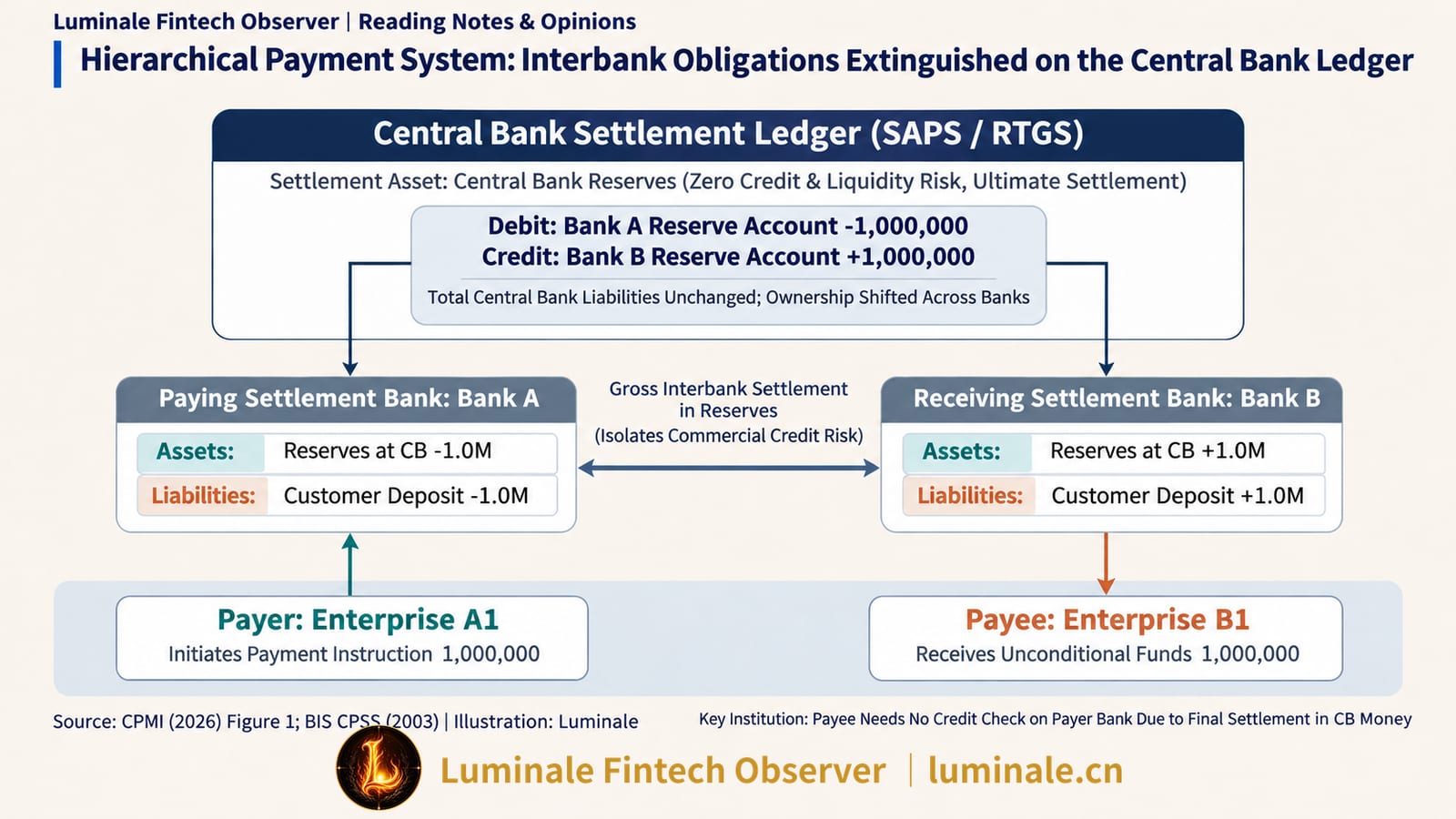
To illustrate how this hierarchical structure eliminates interbank credit risk, consider a standard interbank transfer of 1,000,000 RMB from a customer at Bank A to a customer at Bank B:
| Institutional Entity | Debit (Asset Change) | Credit (Liability Change) | Accounting Substance |
|---|---|---|---|
| Payer's Bank (Bank A) | Reserve Deposit: | Customer Deposit: | Customer claim against Bank A is extinguished; Bank A's reserve asset at the central bank decreases |
| Central Bank General Ledger | Bank A Reserve Account: | Bank B Reserve Account: | Total central bank liabilities remain unchanged; reserves are transferred across bank accounts |
| Payee's Bank (Bank B) | Reserve Deposit: | Customer Deposit: | Bank B's reserve asset at the central bank increases, balancing its new customer deposit liability |
The payee does not need to assess the solvency or creditworthiness of Bank A. The interbank transfer does not create an uncollateralized bilateral commercial exposure between the two commercial banks; instead, it settles immediately through central bank reserve accounts, achieving legally binding ultimate settlement.
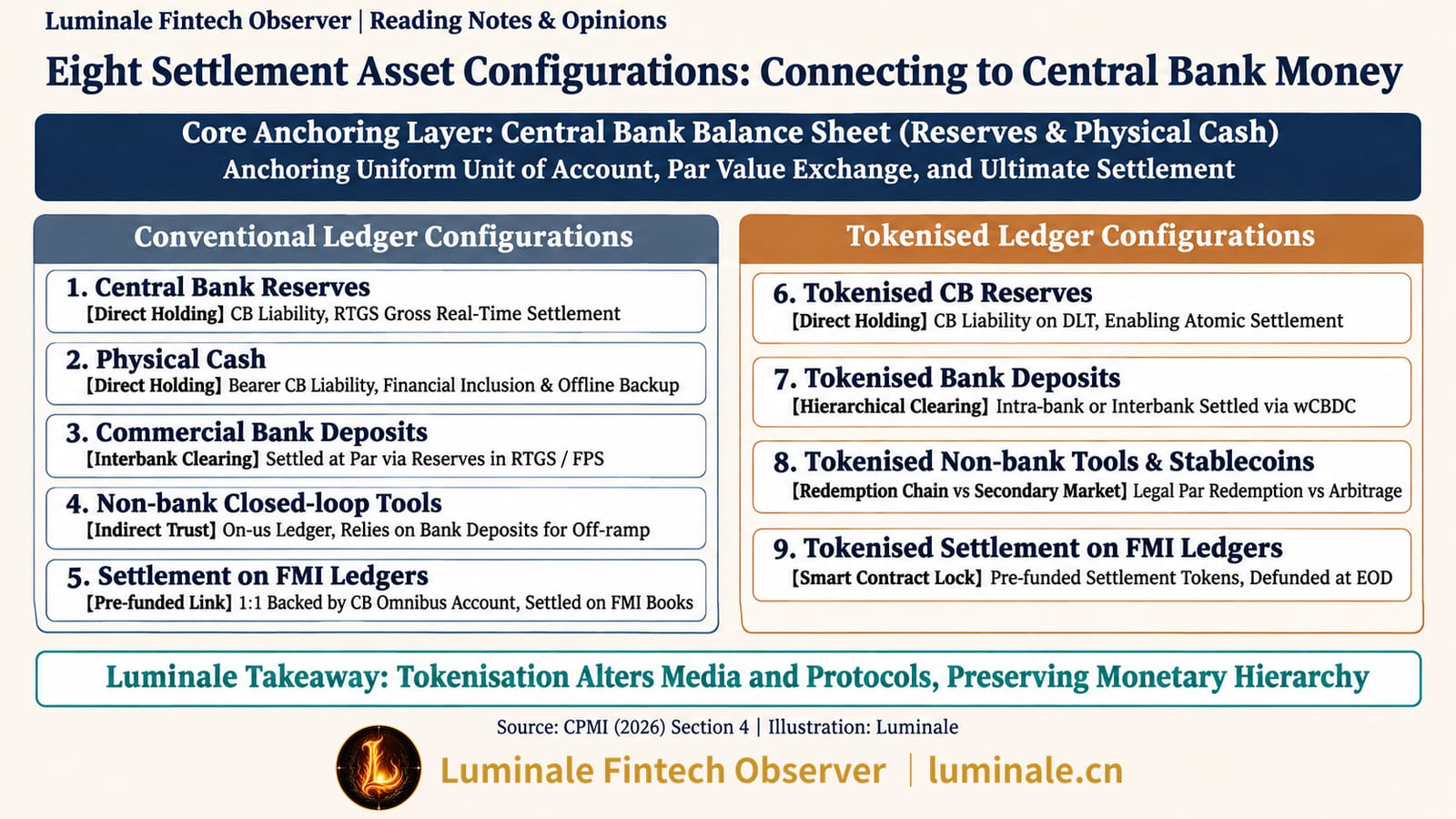
II. Eight Settlement Asset Configurations: Connecting to Central Bank Money
Section 4 defines a "payment system configuration" as the combination of three components: the settlement asset used, the regulatory status of the issuer, and the underlying infrastructure for asset recording and transfer.
Under the analytical framework developed by Luminale from the report, modern settlement asset configurations fall into two groups: conventional configurations based on centralized ledgers (encompassing four foundational forms plus FMI ledger settlement), and tokenised configurations based on distributed ledgers (encompassing four emerging forms).
Conventional Configurations: Core Pillars of Traditional Infrastructure
- Central Bank Reserves:
Balances held by commercial banks in clearing accounts at the central bank represent the primary wholesale settlement asset across financial markets (see From the Money Multiplier to Payment and Settlement: Central Bank Reserves Explained). Over the past twenty years, their role has expanded:
- FMI Settlement in Central Bank Money: Securities settlement systems (SSS) widely adopted DvP models settling cash legs in central bank money to eliminate principal risk in secondary market transactions (see Securities and Money Must Move "Delivery Versus Payment": What Risk Does DvP Actually Prevent?); central counterparties (CCPs) established margin accounts at central banks, removing commercial credit exposures from bank-held clearing funds (see What Does a CCP Actually Solve? Starting with Counterparty Risk).
- Fast Payment Settlement: Most fast payment systems (FPS) settle multilateral net positions or gross transfers directly using central bank reserves (see What Powers 24/7 Instant Payments? Understanding Fast Payment Systems (FPS) and How Does Big Money Move Between Banks? Understanding Large-Value Payment Systems).
- Extended Settlement Windows: Because retail FPS operates around the clock while traditional RTGS systems close overnight and over weekends, deferred clearing models accumulated interbank credit risks, and pre-funded models restricted liquidity replenishment. Consequently, central banks including the Bank of England and the US Federal Reserve have moved to extend RTGS operating hours toward near-continuous settlement.
- Physical Cash:
Banknotes and coins are issued directly by the central bank to the public. Although electronic payments have reduced cash transaction volumes, Box 3 notes that cash remains the only central bank liability directly accessible to all citizens, serving critical public policy functions: acting as an emergency fallback during power or telecommunications outages, and protecting financial inclusion for unbanked populations. The report emphasizes: the legal right of the public to convert bank deposits into cash at will imposes a structural discipline on commercial banks and digital payment issuers to maintain par redemption.
- Commercial Bank Deposits:
Deposits are the primary payment asset for households and non-financial corporations. The spread of FPS enabled real-time, 24/7 availability for retail deposits; meanwhile, automated clearing houses (ACH / bulk payments) handle scheduled, high-volume, low-urgency payments through periodic netting (see Why Aren't Salaries and Utility Bills Real-Time? Understanding Bulk Payment Systems). Across cross-border correspondent banking and central securities depositories (CSDs), commercial bank money also serves as an intermediary foreign currency settlement asset (see What Really Happens in a Cross-Border Payment? From Correspondent Banking and SWIFT to the G20 Roadmap).
- Non-bank Payment Instruments and Closed-Loop Systems:
Balances issued by non-bank payment service providers (e-wallets, mobile platforms) operate on the issuer's internal centralized ledger, forming closed-loop systems. Transfers between two users within the same platform represent internal book-entry shifts that leave the issuer's aggregate liabilities unchanged. When users withdraw funds to bank cards or make external transfers, the platform settles across institutions via custodial commercial banks or dedicated clearing channels using commercial bank deposits and central bank reserves (see Is Money in Alipay the Same as Money in a Bank Account? A Clear Explanation of "Customer Reserve Funds"). Non-bank payment tools maintain par value by indirectly inheriting convertibility from commercial bank and central bank money.
- Settlement on FMI Ledgers:
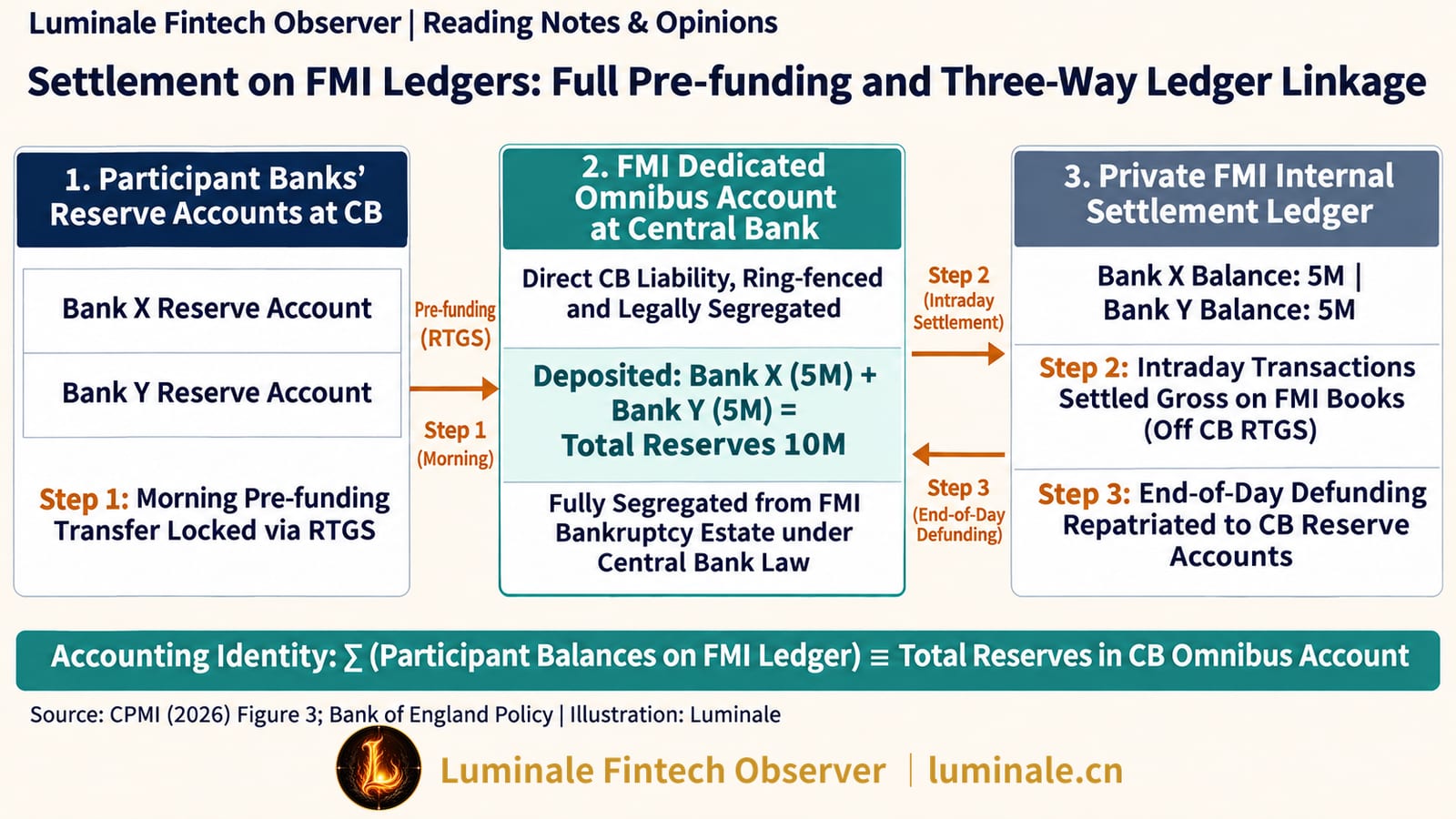
In specialized wholesale contexts, private FMIs maintain proprietary ledgers where participants settle obligations using FMI liabilities. To ensure these liabilities remain credit-risk-free, FMIs frequently utilize full pre-funding in central bank money:
- Participants transfer central bank reserves via RTGS into a dedicated omnibus account or joint account held by the FMI at the central bank before daily operations begin;
- Once pre-funded, the FMI credits equivalent settlement balances to participants on its internal ledger, enabling continuous transaction clearing without utilizing real-time central bank processing resources;
- At the end of the day or during designated settlement cycles, participants withdraw funds, converting internal net balances back 1:1 into reserves in their individual central bank accounts.
- Accounting Identity Constraint: At all times, the aggregate participant balances on the FMI's private ledger must equal the total reserve balance held in the central bank omnibus account ().
Examples include:
- The Clearing House Interbank Payments System (CHIPS) in the United States, which operates a joint account at the Federal Reserve Bank of New York, utilizing pre-funded reserves to drive an intraday liquidity-efficient continuous netting algorithm;
- The Bank of England's Omnibus Account Policy, which allows designated private payment systems to back internal tokenised or continuous settlement using central bank reserves;
- The Eurosystem's TARGET Ancillary System Model, which provides dedicated settlement accounts for clearing houses and retail systems;
- The Swiss National Bank (SNB) Third-Party Access Model, under which private FMIs do not hold central bank accounts but are authorized to submit settlement debits and credits directly into participant banks'reserve accounts within the Swiss RTGS system (SIC).
Tokenised Configurations: Four Emerging Asset Classes on Distributed Ledgers
Tokenisation introduces new recording media and transfer protocols without altering the core economic principles of the hierarchical payment system (see How Does Digital Money Keep the Books?: From Accounts and Tokens to CBDC Ledger Design):
- Tokenised Central Bank Reserves (wCBDC):
Digital liability tokens issued by central banks on distributed ledgers or unified ledger platforms, restricted to commercial banks and eligible financial institutions. They facilitate atomic settlement (DvP / PvP) for tokenised bonds, foreign exchange, and central bank liquidity operations, eliminating cross-system timing frictions. The report underscores: tokenisation modifies the technical interface and recording medium, while the legal status of central bank reserves as the safest and most liquid settlement asset remains unchanged.
- Tokenised Commercial Bank Deposits:
Commercial bank deposits represented as programmable tokens on shared ledgers (see Tokenized Deposits: How Commercial Bank Money Enters the On-Chain World). The report identifies two deployment models:
- Intra-bank Mode (Report Figure 5): Issued by multinational banks (e.g. JPM Coin) on private or permissioned networks to enable round-the-clock liquidity management across global corporate subsidiaries, operating as internal ledgers on DLT;
- Inter-bank Mode with Hierarchy (Report Figure 6): Preserves the classical layered architecture. Payers and payees hold tokenised deposits issued by their respective banks on a shared programmable platform. Interbank token transfers trigger simultaneous settlement across the banks'reserve accounts on a wholesale central bank token layer.
- Tokenised Non-bank Instruments and Regulated Stablecoins:
Fiat-referenced tokens issued by non-bank entities or regulated digital asset firms (e.g. Electronic Money Tokens under MiCA, fiat-backed stablecoins). Maintaining 1:1 par value depends fundamentally on the legal existence of a direct redemption right:
- If legislation mandates unconditional, par-value redemption directly against the issuer in fiat money, holders benefit from an institutional redemption path: Stablecoin Bank Deposit Central Bank Money;
- If redemption is restricted to authorized participants or market makers, retail holders rely on secondary exchange liquidity, where prices fluctuate based on order-book depth and arbitrage efficiency, creating discount risks during market stress (see Tokens Move Around the Clock, Redemptions Still Wait for Markets to Open: Reading the FSB Note on Cross-border Risks of Global Stablecoins).
- Tokenised Settlement on FMI Ledgers:
Networks where private FMIs issue settlement tokens via smart contracts. Participants pledge central bank reserves or traditional eligible collateral to obtain token allocations, settling tokenised asset transactions within a dedicated blockchain network, and converting tokens back into fiat reserves at day-end.
To evaluate these arrangements, Luminale summarizes the eight configurations below:
| Configuration Category | Typical Issuing Entity | Ledger Governance & Verification | Link to Central Bank Money | Par Preservation Mechanism | Typical Practical Examples |
|---|---|---|---|---|---|
| 1. Central Bank Reserves | Central bank | Central bank | Direct holding (central bank sovereign liability) | Sovereign unit of account (zero credit and liquidity risk) | RTGS systems (Fedwire, TARGET, HVPS) |
| 2. Physical Cash | Central bank | Central bank (physical anti-counterfeiting) | Direct holding (bearer central bank liability) | Legal tender status, direct central bank acceptance | Sovereign banknotes and circulating coins |
| 3. Commercial Bank Deposits | Commercial banks | Commercial bank core ledger | Interbank clearing via RTGS reserve transfers | Deposit insurance, prudential supervision, discount window | Bank demand deposits, FPS linked accounts |
| 4. Non-bank Payment Tools | Payment institutions / EMIs | Proprietary centralized servers | Indirect exchange via commercial bank custodial deposits | 100% reserve segregation, bankruptcy-remote trust funds | Digital wallets, Latin American and European EMIs |
| 5. Settlement on FMI Ledgers | Private FMIs | FMI clearing and settlement engines | Full pre-funding in central bank omnibus accounts | 1:1 balance backing identity, daily withdrawal rights | US CHIPS joint account, UK Omnibus accounts |
| 6. Tokenised CB Reserves | Central bank | DLT consensus governed by central bank nodes | Direct holding (sovereign liability on DLT) | Sovereign unit of account, programmable mint/burn control | Swiss Project Helvetia, Project Agorá wholesale leg |
| 7. Tokenised Bank Deposits | Commercial banks | Consortium shared programmable ledger | Interbank layer settled simultaneously via tokenised reserves | Prudential regulation, reserve clearing, deposit insurance | Commercial bank token consortia, Project Agorá |
| 8. Tokenised Non-bank Tools | Stablecoin issuers / digital platforms | Permissioned or public blockchain consensus | Direct redemption via banks or secondary trading | Segregated liquid reserve assets, statutory redemption | MiCA EMTs, regulated fiat-backed stablecoins |
| 9. Tokenised FMI Ledgers | Tokenised exchanges / CSDs | Private FMI DLT network | Smart contract lock-up of reserves or token conversion | Automated smart contract collateral lock-in | Tokenised CSD settlement under EU DLT Pilot Regime |
Box 1: Three Innovation Models in Cross-Border Payments
Box 1 analyzes three cross-border innovation models, aligning with analyses in From Bilateral Linkages to Multilateral Network: How Nexus Rearchitects Instant Cross-Border Payments and From PayNow–PromptPay to Payment Connect: How Fast Payment Systems Turn into Cross-Border Networks:
- Multilateral FPS Interlinking Platform (Project Nexus):
Led by the BIS Innovation Hub, Nexus connects domestic fast payment systems across jurisdictions using standardized messaging protocols and competitive FX provider (FXP) quotes, preserving local RTGS reserve settlement arrangements within each participating country.
- Shared Programmable Platform for Cross-Border Integration (Project Agorá):
Conducted by the BIS alongside seven central banks and international commercial banks, Agorá integrates tokenised commercial bank deposits with tokenised wholesale central bank money on a common programmable ledger to settle multi-currency transactions directly.
- The "Stablecoin Sandwich" Architecture:
Certain fintech arrangements bypass correspondent banking by having payers initiate domestic transfers in local fiat, which an intermediary converts into stablecoins for public blockchain cross-border transfer, whereupon a destination intermediary converts the tokens into local commercial bank deposits for the payee. While stablecoins act as the cross-border bridge, both ends remain tied to domestic banking rails (see What Really Happens in a Cross-Border Payment? From Correspondent Banking and SWIFT to the G20 Roadmap).
III. Five Systemic Impacts: Risk Has Shifted Rather Than Disappeared
New technologies do not eliminate financial risks; rather, they reallocate risks across institutions, technological layers, and regulatory perimeters. Section 5 details six interrelated dimensions of this shift.
1. Shifts in Settlement Asset Composition and Public Interest Trade-Offs
Under Principle 9 of the CPMI-IOSCO Principles for Financial Market Infrastructures (PFMI), an FMI should conduct its money settlements in central bank money where practical and available. When central bank money is not available (e.g. offshore foreign exchange settlement, or participants lacking central bank account eligibility), commercial bank money or internal FMI settlement assets may be used, provided strict credit and liquidity protections are in place.
In retail payments, declining cash usage reduces public contact with central bank money, raising three systemic considerations:
- Operational Continuity Dependency: Increased reliance on power grids, telecommunication networks, and centralized cloud service providers creates vulnerability to single-point technical failures;
- Data Privacy and Governance: Extensive commercial harvesting and monetization of retail transaction data prompt consumer protection concerns;
- Financial Inclusion Barriers: Elderly populations and unbanked groups face marginalization as cash acceptance narrows.
2. Functional Unbundling: Lower Entry Barriers and Blurred Accountability
Traditional banking bundles account opening, customer due diligence (KYC), asset custody, book-entry settlement, liquidity provision, and compliance within a single corporate entity. Tokenisation and open banking break this value chain apart through functional unbundling:
- Layer De-coupling: Tokenised ecosystems separate into four distinct tiers: infrastructure (blockchain nodes and consensus mechanisms), asset issuance (smart contract code and collateral management), applications (wallets and aggregator gateways), and front-end access (merchant terminals and user interfaces), often operated by separate entities;
- Accountability Ambiguity: When fraud, sanctions screening failures, smart contract exploits, or network congestion cause losses, the absence of a designated primary obligor can lead to regulatory gaps;
- Liquidity Fragmentation Across Platforms: Issuing tokenised claims across multiple public or permissioned chains fragments an institution's liquidity across isolated technical environments;
- Information Loss in Payment Flows: When transactions migrate to on-chain tokens or closed-loop wallets, commercial banks lose visibility over transaction flows, weakening their capacity to extend data-driven credit lines to small enterprises.
3. Functional Bundling: Operational Synergies and Concentrated Interconnections
Conversely, on shared programmable platforms (such as unified ledgers or consortium chains), multiple assets and operations can undergo functional bundling via smart contracts.
The primary benefit is that asset transfers, conditional settlement, collateral substitution, and reconciliation execute atomically via pre-defined code, eliminating timing frictions and accelerating collateral velocity (see Smart Contracts, Programmability, and On-Chain Settlement: Foundations of Financial Transaction Automation).
However, systemic risks also concentrate: embedding heterogeneous assets within a single technical substrate means that consensus interruptions or code vulnerabilities can propagate operational disruption across markets, generating liquidity gridlocks.
4. Liquidity Reshaping and Box 2's "Netting Efficiency Cost"
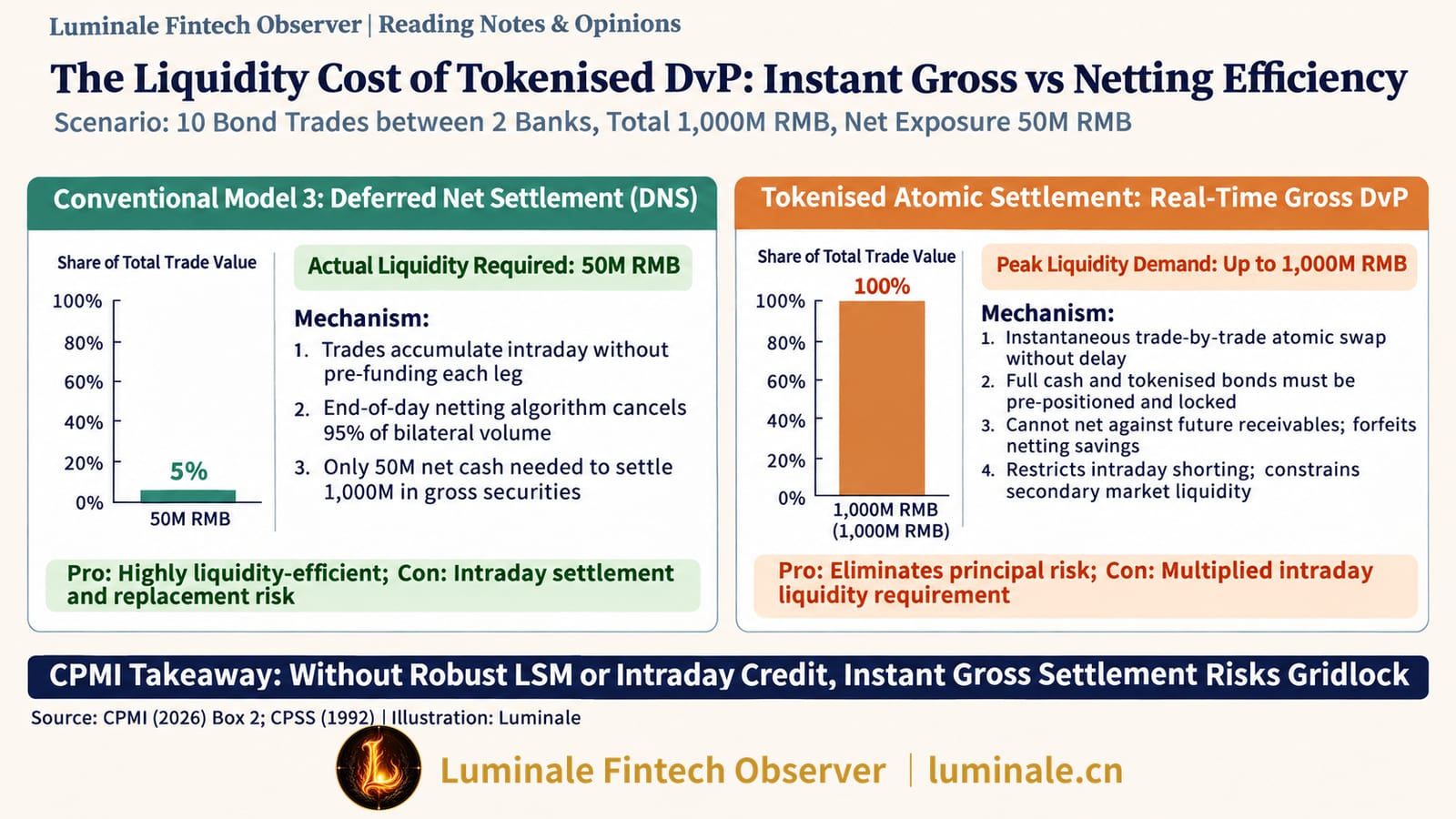
Wholesale financial markets rely on Deferred Net Settlement (DNS) to process large daily transaction volumes with modest central bank reserve balances. Box 2 highlights an essential trade-off: while instantaneous gross DvP/PvP settlement eliminates counterparty principal risk, it forfeits the liquidity-saving benefits of multilateral netting.
A simple quantitative scenario illustrates this difference (see Why Don't Payment Systems Settle Every Payment Immediately? Understanding RTGS and DNS):
Scenario: Over a single business day, Bank A and Bank B execute 10 secondary market bond trades against each other. Gross bilateral trade volume reaches 1,000,000,000 RMB, but offsetting bilateral cash flows leave Bank A with an end-of-day net payment obligation of only 50,000,000 RMB to Bank B.
| Settlement Model | Settlement Mechanism | Required Liquidity & Collateral | Trade-offs & Efficiency Analysis |
|---|---|---|---|
| Conventional Model: Deferred Net Settlement (DNS) | Transactions accumulate intraday; multilateral or bilateral netting occurs at scheduled cut-offs | Funds Required: 50,000,000 RMB Securities: Only net bond balances delivered | Extremely liquidity-efficient (95% netting efficiency); however, intraday counterparty credit exposure remains until settlement. |
| Tokenised Model: Atomic Gross DvP | Immediate, trade-by-trade atomic exchange of cash and securities tokens upon execution | Funds Required: Full pre-funding per trade Peak Intraday Liquidity: Up to 1,000,000,000 RMB depending on trade order | Eliminates principal and replacement risk; however, liquidity demand escalates significantly, requiring pre-positioned cash and securities. |
Furthermore, mandatory instant settlement constrains secondary market liquidity: traders cannot short securities intraday for end-of-day borrowing coverage or buy assets relying on afternoon receivables. Without robust Liquidity Saving Mechanisms (LSM) or collateralized intraday credit, immediate gross settlement risks transaction gridlock or forces institutions to maintain large precautionary reserves (see When Banks Run Short in RTGS, Where Does the Money Come From? Sources of Intraday Liquidity and IMF GFSR Reading: Does Tokenisation Make Financial Trading Faster While Making Risks Arrive Faster Too?).
5. Market Competition, Access Barriers, and Neutrality Conflicts
Direct access to central bank settlement accounts and intraday credit facilities remains largely limited to licensed commercial banks and select FMIs. Non-bank PSPs and fintech firms must connect to payment systems indirectly as indirect participants sponsored by clearing banks.
This structure creates an inherent conflict of interest: clearing banks act as upstream service providers to non-bank entities while competing directly against them for retail customer deposits and merchant relationships. Indirect access exposes non-bank entities to clearing markups and account de-risking actions, muting front-end competition.
6. Convertibility Mechanisms and Secondary Market De-Pegging Risks
Private payment liabilities preserve par value through two mechanisms:
- Direct Statutory Redemption Channels: Holders possess an enforceable right to redeem claims for sovereign currency against the issuer, backed by prudential reserves and deposit insurance;
- Interbank Clearing Intermediation: Bank deposits convert 1:1 via wholesale reserve transfers across the RTGS network.
Certain stablecoins lack direct retail redemption obligations and access to central bank settlement facilities, relying on secondary market arbitrage to sustain par. The March 2023 Silicon Valley Bank (SVB) resolution demonstrates this vulnerability: USDC issuer Circle held 3.3 billion USD in uninsured cash reserves at SVB. Amid market panic, USDC broke par on secondary exchanges, falling to approximately 0.87 USD. This episode illustrates that even if an issuer maintains balance sheet solvency, operational interruptions between its reserve assets and the commercial banking system can destabilize secondary market parity.
IV. The Central Bank's Four Roles and Policy Toolkit: Account Access, Infrastructure, Oversight, and Catalysis
Section 6 outlines the policy instruments available to central banks across four institutional roles.
1. Issuer Role: Account Access and Differentiated Service Boundaries
Determining eligibility for central bank accounts and the scope of available settlement and credit services is a decisive policy lever (see Who Can Hold an Account at the Central Bank? Decoding the Account Hierarchy and Settlement Infrastructure).
Central banks manage three policy trade-offs (Report Figure 7):
- Central Bank Money Adoption versus Private Closed-Loop Expansion: Restricting account access may drive non-bank entities to build private closed-loop ledgers, narrowing the reach of central bank money as a universal settlement anchor;
- Promoting Competition versus Preventing Regulatory Arbitrage: Granting full account access to non-bank entities without subjecting them to Basel capital, Liquidity Coverage Ratio (LCR), and macroprudential standards creates competitive distortions;
- Mitigating Intermediation Concentration versus Introducing Operational Contagion: Broadening access reduces dependency on major tier-one clearing banks, but varied cybersecurity controls among non-bank entrants could introduce operational vulnerabilities into core settlement systems.
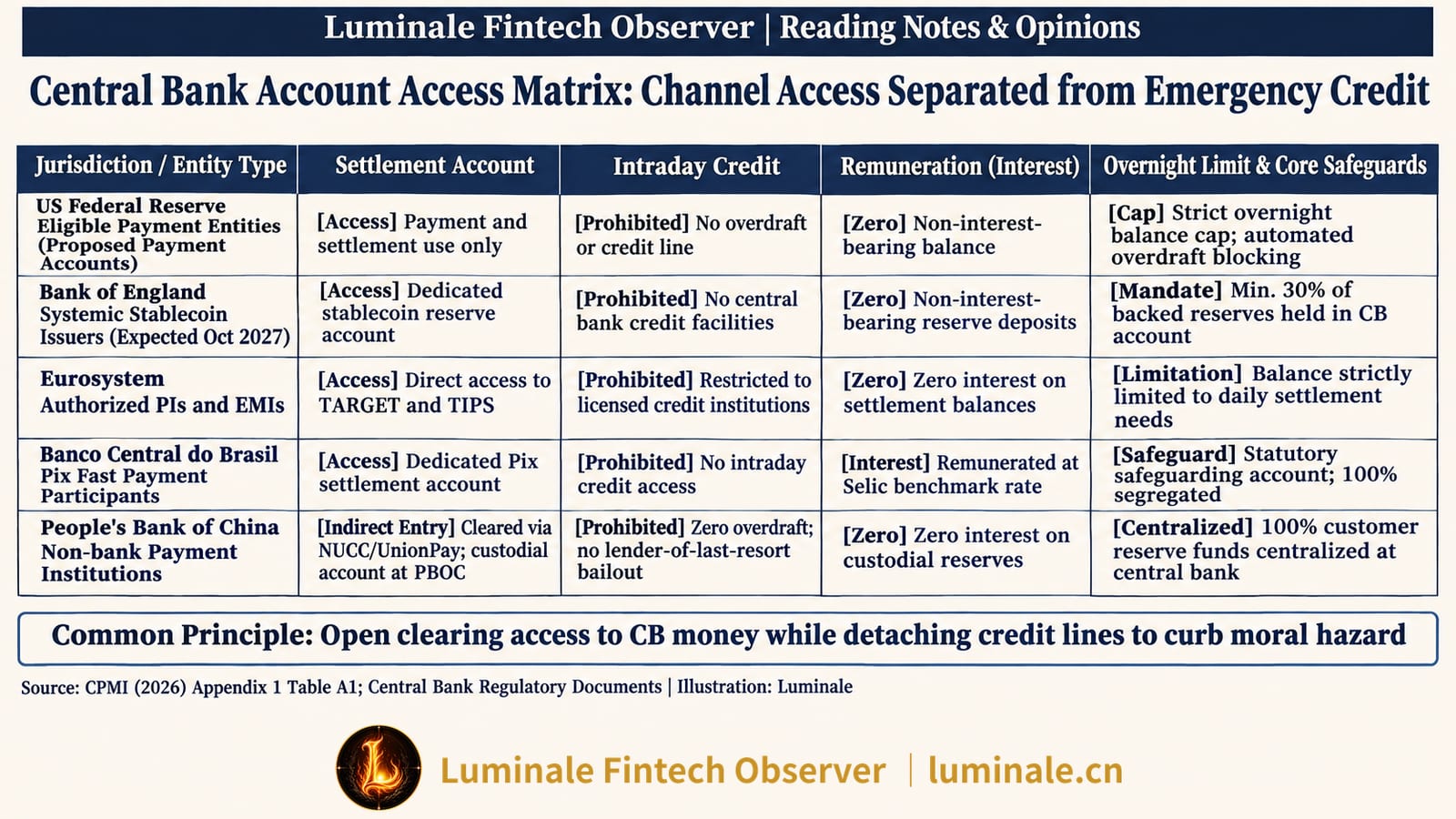
In response, central banks are implementing tiered account structures. The underlying model provides transactional settlement account access to non-bank payment firms and stablecoin issuers, while excluding them from intraday credit, discount window liquidity, and interest-bearing reserve balances. Central banks can also offer dedicated safeguarding accounts to hold customer funds off commercial bank balance sheets, while monitoring aggregate impacts on banking system liquidity (see Balance Sheet Logic of Monetary Policy Tools: Reserves Quantity, Price, and Constraints).
According to Appendix Table A1 (data as of September 2026), access frameworks across major jurisdictions reflect distinct tiered models:
| Jurisdiction / Authority | Eligible Access Entities | Account Functional Scope | Intraday Credit Availability | Interest on Balances | Overnight Caps & Key Safeguards | Regulatory Progress & Legal Basis |
|---|---|---|---|---|---|---|
| United States (Federal Reserve) | Proposed "Payment Account" holders | Limited to payment and settlement instruction clearing | Strictly prohibited (zero overdraft; automated blocking) | Non-interest bearing | Strict overnight balance caps; mandatory automated overdraft prevention | Public consultation on proposed guidelines; strictly limits expansion beyond statutory entity types |
| United Kingdom (Bank of England) | Regulated systemic stablecoin issuers | Dedicated stablecoin reserve settlement account | Strictly prohibited | Non-interest bearing | Mandatory requirement to hold at least 30% of backing reserves in the central bank account | Consultation paper issued June 2026; Table A1 indicates implementation target of October 2027 |
| Eurosystem (European Central Bank) | Licensed Payment Institutions (PIs) and Electronic Money Institutions (EMIs) | Direct access to TARGET and TIPS services | Strictly prohibited (restricted to credit institutions) | Non-interest bearing | Balances strictly capped at daily settlement needs; overnight saving balances prohibited | Formally enacted under ECB Decision (EU) 2025/222, permitting qualifying EMT issuers to hold accounts |
| Brazil (Banco Central do Brasil) | Licensed payment institutions and e-money issuers | Dedicated accounts connecting to Pix fast payment system | Strictly prohibited | Interest bearing (remunerated at the Selic policy rate) | Statutory Safeguarding Accounts; customer funds fully segregated in central bank custody | Fully operational; established statutory ring-fencing for customer balances at the central bank |
| China (People's Bank of China - PBOC) | Non-bank payment institutions (online payment, acquiring) | Indirect RTGS access via clearing houses; custodial reserve accounts | Strictly prohibited | Non-interest bearing | 100% of customer funds deposited centrally at the central bank, eliminating misappropriation risk | 100% centralized deposit implemented January 2019, creating a strict statutory safeguarding model |
Other notable survey findings from Appendix Table A1 include:
- China: Stablecoin issuer access is marked Entity Not Applicable (Entity NA), reflecting statutory prohibitions against unauthorized digital token issuance, while the digital renminbi (e-CNY) is categorized under official central bank arrangements;
- Hong Kong SAR: E-money issuers are eligible for central bank accounts (Y), whereas stablecoin issuers remain currently ineligible (N);
- United States: Stablecoin issuers are currently ineligible (N); private payment operators and FMIs may access accounts only if formally designated as systemically important by the Financial Stability Oversight Council (FSOC);
- Cross-Border Innovation: Under Project mBridge, participating central banks permit commercial banks from other participating jurisdictions to maintain digital wallets on the platform, holding wholesale tokenised central bank liabilities issued by foreign central banks.
2. Operator Role: Incremental System Modernization and Dedicated New Platforms
Central banks face two infrastructure modernization paths (Report Figure 8):
- Upgrading Legacy Infrastructure: Extending RTGS operating schedules (the Bank of England is planning for CHAPS to move toward 22×5, 22×6, and continuous settlement); adopting the ISO 20022 messaging standard (see What Is ISO 20022? Understanding the Common Language of Next-Generation Payment Infrastructure); introducing standardized APIs; and establishing bilateral liquidity bridges (such as the intraday euro liquidity arrangement between the Bank of England and De Nederlandsche Bank).
- Building Dedicated New Infrastructures: Over the past decade, approximately one-third of retail fast payment systems globally were developed and operated directly by central banks; currently, central banks are exploring wholesale CBDC platforms and shared unified ledgers.
| Design Dimension | Technical Options | Mechanisms and Practical Implementations |
|---|---|---|
| Dimension 1: Technical Form | Option A: Existing reserve balance API integration Option B: Tokenised reserve certificates Option C: Native digital tokens on DLT | Option A uses external APIs to synchronize ledgers (e.g. Eurosystem Pontes); Option B maps conventional reserves; Option C issues native tokens on dedicated DLT. |
| Dimension 2: Interaction Model | Option A: Independent interoperability bridges Option B: Shared programmable ledger | Option A connects distinct networks via cross-chain bridges; Option B co-hosts central bank reserves and commercial tokenised assets on a single ledger (e.g. Project Agorá). |
| Dimension 3: Platform Topology | Option A: Single centralized shared ledger Option B: Multiple interoperable ledgers | Option A consolidates liquidity and simplifies oversight but creates single-point risk; Option B enhances autonomy and resilience but increases fragmentation and standardization costs. |
| Dimension 4: Ownership & Governance | Option A: Fully owned and operated by central bank Option B: Developed and operated by private sector Option C: Public-private partnership (PPP) | Spans the governance spectrum from public infrastructure to commercial consortia and joint public-private governance models. |
Box 4 outlines these four architectural dimensions. Eurosystem experiments highlight these choices: through Project Appia and the Pontes pilot, the Eurosystem tested linking external capital market DLT platforms with TARGET RTGS settlement engines (see From Pontes to Appia: How Europe Is Rebuilding the "Cash Leg" for Tokenised Securities); in Switzerland, Project Helvetia tested connecting the traditional SIC system with private digital exchanges alongside issuing tokenised wholesale Swiss francs on shared DLT.
Regarding retail CBDC (rCBDC), Box 3 maintains an analytical stance: certain jurisdictions are pursuing pilots and legislation to preserve public access to sovereign money and support financial inclusion (e.g. the digital euro, see The Digital Euro Landscape: Why It Is Built, How It Works, and Current Progress and What Is a Central Bank Digital Currency (CBDC)? From "Digital Cash" to Financial Infrastructure); other jurisdictions, having evaluated mature private retail payment markets (e.g. Sweden, Australia), have deprioritized retail CBDC to focus on wholesale tokenisation infrastructure.
3. Overseer Role: Functional Oversight and Penetrating Third-Party Concentration
As new entities enter the payment ecosystem, central bank oversight frameworks are expanding:
- The "Same Business, Same Risk, Same Rules" Principle: Regardless of underlying technology labels, entities performing clearing and value transfer functions must be assessed for systemic importance based on transaction volume, funding scale, and interconnectedness, and subjected to proportional oversight (see Reading the PFMI: The Lines Financial Market Infrastructures Must Hold Behind the 24 Principles);
- Oversight of Critical Third-Party Service Providers: With financial institutions increasingly dependent on public cloud providers, messaging gateways, and DLT validation services, CPMI-IOSCO published guidance in 2026 addressing FMI reliance on critical third-party providers[5], requiring clear contractual allocations of liability and operational exit plans;
- Embedded Supervision: Utilizing open ledger structures and smart contracts, supervisory authorities can deploy read-only verification nodes to retrieve real-time compliance and risk data directly from on-chain transactions, reducing retrospective reporting burdens.
4. Catalyst Role: Overcoming Collective Action Barriers
When market competition leads to network fragmentation or liquidity deadlocks, the central bank can act as an impartial catalyst to establish shared market conventions.
Continuous Linked Settlement (CLS) represents a classic historical example of central bank catalytic action. Prior to the 1990s, cross-border foreign exchange transactions carried substantial Herstatt risk—the inability to synchronize payments across differing time zones. Following the G10 report on foreign exchange settlement risk in 1996, the Federal Reserve and fellow central banks did not establish a publicly operated FX clearing house directly; instead, they convened major commercial banks to form a private consortium, while granting multi-currency central bank settlement account access to CLS Bank. Commencing operations in 2002, CLS eliminated FX principal risk via Payment versus Payment (PvP) settlement across central bank accounts (see What Is the Most Dangerous Moment in FX? Why PvP Is the Market's "Payment-versus-Payment").
Today, initiatives such as Project Agorá, the Eurosystem Appia framework, and the CPMI-PMPG joint ISO 20022 harmonization requirements illustrate how central banks continue to serve as catalysts for next-generation digital financial infrastructure.
V. Assessment: What the Report Confirms and What It Leaves Unanswered
Synthesizing the CPMI report yields five key takeaways:
Takeaway 1: A Seven-Dimension Systemic Evaluation Checklist
The seven analytical dimensions outlined in the report's conclusions, combined with the configuration questions in Section 2, provide an evaluation checklist for analyzing tokenised deposits, stablecoins, or cross-border platforms:
Systemic Evaluation Checklist for Emerging Payment and Settlement Arrangements
- Asset and Ledger Layer: Who is the issuing entity? On whose balance sheet or ledger is the liability recorded? What is the legal classification (sovereign currency, commercial bank deposit, or non-bank liability)?
- Connection to Central Bank Money: Through what mechanism does the arrangement connect to central bank money (direct reserve holding, omnibus account pre-funding, commercial bank agency clearing, or secondary market arbitrage)?
- Par Value Exchange Safeguards: What legal entity is obligated to redeem at par? Is par backed by deposit insurance, central bank liquidity facilities, or statutory ring-fenced reserve assets?
- Safety and Operational Efficiency: Does transaction execution carry legal finality? Under instant gross settlement, how are liquidity consumption and the loss of netting efficiency addressed?
- Interoperability and Liquidity: Can the settlement asset transfer across platforms at par? Do divergent operating windows create liquidity fragmentation across systems?
- Competition and System Neutrality: Do non-bank participants encounter intermediary access barriers from commercial banks? Are regulatory standards applied proportionally without arbitrage?
- Allocation of Liability and Risk: Following functional unbundling, which legal entity bears primary liability for KYC, AML, operational resilience, and settlement failures?
Applying this framework to Project EnsembleTX by the Hong Kong Monetary Authority (HKMA) illustrates its utility (see What Money Settles Tokenised Assets? A Reading of the HKMA's EnsembleTX and From Retail CBDC to Tokenised Settlement: What Did the Two Phases of Project e-HKD Reveal?):
- Asset Property: Tokenised deposits issued by commercial banks, with liabilities recorded on their distributed ledgers;
- Central Bank Link: Interbank clearing operates through the HKMA EnsembleTX sandbox platform, settling wholesale transfers using tokenised central bank reserves (wCBDC);
- Par Protection: Preserves the tiered banking structure; tokenised deposits legally constitute demand deposits eligible for Hong Kong Deposit Protection Scheme coverage;
- Efficiency Mechanism: Real-time atomic wCBDC transfer on the settlement layer matches the tokenised deposit movement, supporting smart-contract-driven DvP delivery for green bonds and tokenised real-world assets (RWA).
Takeaway 2: Central Bank Money at the Core Implemented via Tiered Access
The central institutional insight of the report is moving past the binary debate over whether central bank account access should be entirely open or entirely closed.
The Federal Reserve's proposed Payment Accounts, the Bank of England's dedicated systemic stablecoin accounts, and the Eurosystem's TARGET access for EMIs converge on a consistent design: opening transactional settlement rails to eligible non-bank issuers to link their liabilities directly to central bank money, while strictly withholding intraday credit facilities, interest payments, and unconstrained overnight balances.
This tiered regulatory approach allows central bank money to serve as the ultimate settlement anchor without extending lender-of-last-resort guarantees to entities that do not face full banking capital and prudential oversight. Moving forward, the key benchmark for evaluating any national stablecoin or fintech framework is not whether an entity obtains a sandbox license, but what category of account it maintains on the central bank balance sheet and the specific scope of settlement services it is granted.
Takeaway 3: The Stablecoin Convertibility Chain Involves Intermediary Credit Risk
Commercial bank deposits maintain 1:1 parity because interbank transfers settle through direct transfers of central bank reserves. Even when a stablecoin carries a statutory right of redemption, its operational cash-out path involves multiple intermediaries:
Throughout this sequence, stablecoin holders face not only the issuer's operational performance risk, but also the credit and liquidity condition of the commercial banks holding the reserve assets. The Bank of England's requirement that systemic stablecoin issuers deposit at least 30% of reserves directly into non-interest-bearing central bank accounts is designed to bypass this commercial bank intermediary layer, anchoring stablecoins directly against central bank liabilities. For offshore stablecoins that lack statutory redemption rights and rely on secondary market arbitrage, there is no direct institutional link to central bank money, making price discounts during market stress an expected economic outcome.
Takeaway 4: China's Payment and Clearing System in the CPMI Framework
Benchmarking the People's Bank of China and domestic payment infrastructures against the CPMI framework demonstrates that China's arrangements align with several advanced policy structures:
- 100% Centralized Custody of Customer Reserve Funds: Since 14 January 2019, the PBOC has required non-bank payment institutions to deposit 100% of customer reserve funds in dedicated non-interest-bearing accounts at the central bank. This fulfills the CPMI's definition of a risk-free Safeguarding Account, establishing bankruptcy-remote ring-fencing seven years ahead of the Bank of England's proposed 30% deposit rule for systemic stablecoins;
- Severing Direct Bank-PSP Connections via NUCC: China mandated the establishment of the National Unified Clearing Corporation (NUCC), routing all inter-institutional payment transactions through regulated clearing networks, with final settlement executed across the PBOC's Settlement Account Processing System (SAPS) using central bank reserves. This aligns with the CPMI principle of replacing unmonitored private multilateral netting with central bank settlement intermediation (see What Do NUCC and UnionPay Actually "Clear"? The Middle Layer of Payment Clearing, Explained);
- Tiered Architecture of the Digital Renminbi: Box 3 cites the digital renminbi (e-CNY), which operates a two-tier framework of central bank issuance and commercial bank distribution. Commercial banks maintain dedicated digital wallets at the central bank backed 1:1 by reserves, distributing official digital cash without disintermediating the commercial banking system;
- Multilateral Cross-Border Infrastructure Development: Alongside the China Foreign Exchange Trade System (CFETS) and the Cross-Border Interbank Payment System (CIPS), China has participated in Project mBridge, exploring multi-currency trade settlement settled directly via tokenised central bank liabilities (see RMB Internationalization is More than "Settling in RMB": A Cross-Border Financial Infrastructure is Taking Shape and From Bank Cards to NUCC, UnionPay & HVPS: A Comprehensive Map of China's Payment System).
Takeaway 5: Practical Limitations and Unresolved Dilemmas
While the report provides a structured framework, the consensus nature of international policy documents leaves three notable questions unaddressed:
- Descriptive Options Without Prioritization: The report frequently notes that central banks "may consider" various trade-offs without offering sequenced implementation roadmaps. Given divergence across legal systems and financial development among the 28 member central banks, concrete operational guidance remains limited;
- Deliberate Separation from Monetary Policy and Financial Stability: The analysis explicitly abstracts from how changing reserve demands affect monetary policy transmission and how non-bank deposit substitution might impact bank credit intermediation—factors that represent central considerations when central banks evaluate account access;
- Unaddressed Spillover from Dominant International Stablecoins: The report assumes an analytical framework based on an individual domestic payment system. Across emerging market economies, foreign-currency-denominated stablecoins (primarily USD-backed) are increasingly used for local transactions and store of value. This digital currency substitution poses tangible challenges to monetary sovereignty and the singleness of domestic money, an area the report does not comprehensively examine.
Conclusion: Settlement Ultimately Rests on Sovereign Trust
Looking across the evolution from paper instruments and magnetic stripe cards to mobile QR codes, tokenised assets, and smart contracts, the outward forms of payment instruments have modernized considerably, but the underlying mechanisms for settling debt and transferring institutional trust remain intact.
The CPMI 2026 report reaffirms a fundamental financial principle: payments can be decentralized, 24/7, and executed via code, but clearing and ultimate settlement cannot detach from legal frameworks and sovereign monetary backing. Private enterprise drives front-end innovation and interface efficiency; however, when transactions scale into systemically important volumes, inter-institutional obligations must settle across the central bank balance sheet as the ultimate anchor of financial stability.
When evaluating claims that an emerging payment instrument will reshape the monetary system, the analytical framework of the CPMI report offers three grounded criteria:
What is the underlying settlement asset? How many layers of commercial credit intermediation separate it from central bank reserves? Is par exchange guaranteed through an unconditional statutory redemption right, or does it depend on secondary market speculative liquidity?
Addressing these questions clarifies the realistic scope and systemic role of payment innovations. Further analysis of the Federal Reserve's payment account proposal and the Bank of England's systemic stablecoin policy will be explored in subsequent articles (recommended reading: Which Rail Should a Payment Take? Classifying Payment Systems: Wholesale, Retail and Cross-Border).
References
[1]: Committee on Payments and Market Infrastructures (CPMI). (2026). The roles of central banks and central bank money in the evolving payment system. Bank for International Settlements. https://www.bis.org/publications/roles-central-banks-and-central-bank-money-evolving-payment-system ↩
[2]: Committee on Payment and Settlement Systems (CPSS). (2003). The role of central bank money in payment systems. Bank for International Settlements. https://www.bis.org/cpmi/publ/d55.pdf ↩
[3]: Bank for International Settlements (BIS). (2026). Anchoring trust in money: innovation beyond stablecoins. Annual Economic Report 2026, Chapter III. https://www.bis.org/publ/arpdf/ar2026e3.htm ↩
[4]: Committee on Payments and Market Infrastructures and International Organization of Securities Commissions (CPMI-IOSCO). (2012). Principles for Financial Market Infrastructures. Bank for International Settlements and IOSCO. https://www.bis.org/cpmi/publ/d101a.pdf ↩
[5]: Committee on Payments and Market Infrastructures and International Organization of Securities Commissions (CPMI-IOSCO). (2026). Financial market infrastructures'reliance on critical third-party service providers. Bank for International Settlements. https://www.bis.org/cpmi/publ/d226.pdf ↩
[6]: Board of Governors of the Federal Reserve System. (2026). Proposed Guidelines for Evaluating Account and Service Requests by Eligible Entities. Federal Register. https://www.federalreserve.gov/newsevents/pressreleases/bcreg20260815a.htm ↩
[7]: Bank of England. (2026). The Bank of England's approach to regulating systemic payment systems and stablecoins: Draft Code of Practice and Consultation Paper. https://www.bankofengland.co.uk/paper/2026/the-bank-of-englands-approach-to-regulating-systemic-payment-systems-and-stablecoins ↩
[8]: European Central Bank (ECB). (2025). Decision (EU) 2025/222 of the European Central Bank on access to TARGET by non-bank payment service providers and electronic money institutions. Official Journal of the European Union. https://eur-lex.europa.eu/legal-content/EN/TXT/?uri=CELEX:32025D0222 ↩
[9]: People's Bank of China. (2018). Notice of the General Office of the People's Bank of China on Matters Concerning the Full Centralized Deposit of Customer Reserve Funds of Payment Institutions (Yinbanfa [2018] No. 114). http://www.pbc.gov.cn/goutongjiaoliu/113456/113469/3570994/index.html ↩
[10]: Hong Kong Monetary Authority (HKMA). (2024). Project Ensemble: Advancing the tokenisation market in Hong Kong through architecture and sandbox innovation. https://www.hkma.gov.hk/eng/key-functions/international-financial-centre/fintech/project-ensemble/ ↩
Originally published by Luminale Fintech Observer: https://luminale.cn/articles/cpmi-roles-of-central-bank-money-evolving-payment-system-en