
The previous article, Not Enough Funds, So Payments Just Wait? How RTGS Queuing and Liquidity-Saving Mechanisms Work, showed how a Real-Time Gross Settlement (RTGS) system can use queuing, priorities and offsetting to settle more payments with the same amount of money. It also ended on an open point: a Liquidity Saving Mechanism (LSM) makes existing funds go further, but it cannot replace central bank intraday credit. If no offsetting payment can be found and the paying bank's account does not hold enough money, the payment still has to wait.
So when a bank in RTGS really is short of money, where does the money come from?
I. Queuing Reduces Liquidity Needs but Cannot Fill a Funding Gap
1. One Bank's Day
Suppose Bank A is a direct participant in a country's RTGS system and holds a settlement account at the central bank. On a given business day, the flows through its settlement account look like this.
RTGS does not allow a settlement account to go negative without a credit facility. The negative figures in the table would never actually appear on the account. They show that, without outside funds, these payments could only be queued or delayed.
| Time | Item | Amount | Settlement account balance |
|---|---|---|---|
| 09:00 | Opening balance | CNY 3 billion | |
| 09:30 | Cash leg of securities settlement | −CNY 4 billion | −CNY 1 billion |
| 10:00 | Large customer outflow | −CNY 2.5 billion | −CNY 3.5 billion |
| 10:30 | Margin paid to a central counterparty | −CNY 1.5 billion | −CNY 5 billion |
| 14:00 | Payments received from other banks | +CNY 4.5 billion | −CNY 0.5 billion |
| 15:30 | Payments received from other banks | +CNY 2.5 billion | +CNY 2 billion |
| End of day | +CNY 2 billion |
Over the day, Bank A receives CNY 7 billion and pays out CNY 8 billion, ending with CNY 2 billion. Taken as a whole, the day is not short of money. The problem is timing: large payments go out in the morning, while incoming funds arrive only in the afternoon. Between 10:30 and 14:00, Bank A is short by as much as CNY 5 billion.

That CNY 5 billion is Bank A's intraday liquidity gap for the day. The Basel Committee on Banking Supervision (BCBS) defines intraday liquidity as funds that can be accessed during the business day, usually to enable banks to make payments in real time[8]. For a direct participant in RTGS, it consists mainly of two parts: the balance on its central bank settlement account, plus any central bank intraday credit it can draw on at any time.
Intraday liquidity and the Liquidity Coverage Ratio (LCR) often discussed in banking regulation work on two different time scales. The LCR asks whether a bank can survive a 30-day stress period; intraday liquidity asks whether the margin payment due at 10:30 this morning can go out on time. A bank that meets its LCR can still be unable to make a large payment on a given morning.
2. Where the Gap Comes From
In Why Don't Payment Systems Settle Every Payment Immediately? Understanding RTGS and DNS, we compared RTGS with Deferred Net Settlement (DNS). DNS nets a day's payments first and settles only the net amounts; RTGS settles each payment gross, one by one, so every payment needs funds at the moment it settles. RTGS lowers settlement risk, and the price is that banks need more liquidity during the day.
Gaps usually come from a few kinds of situation:
- Timing mismatches between inflows and outflows. Money goes out early and comes in late, as with Bank A in the table above.
- Large, concentrated payments. The cash leg of securities settlement, the domestic- or foreign-currency legs of FX trades, and margin calls from central counterparties involve large single amounts bunched together in time. For how securities and cash are exchanged simultaneously, see Cash and Securities Must Change Hands Together: What Risk Does DvP Prevent?; for how the two currency legs of an FX trade relate, see What Is the Riskiest Moment in a Currency Exchange? Why PvP Matters in FX Markets.
- Payments with deadlines. Margin payments and pay-ins to other financial market infrastructures trigger default procedures or penalties if they miss their deadline, so they cannot wait.
- Customer behaviour. Large payments made by corporate customers at month-end or quarter-end are often not timed by the bank itself.
3. The Money Can Only Come From Three Places
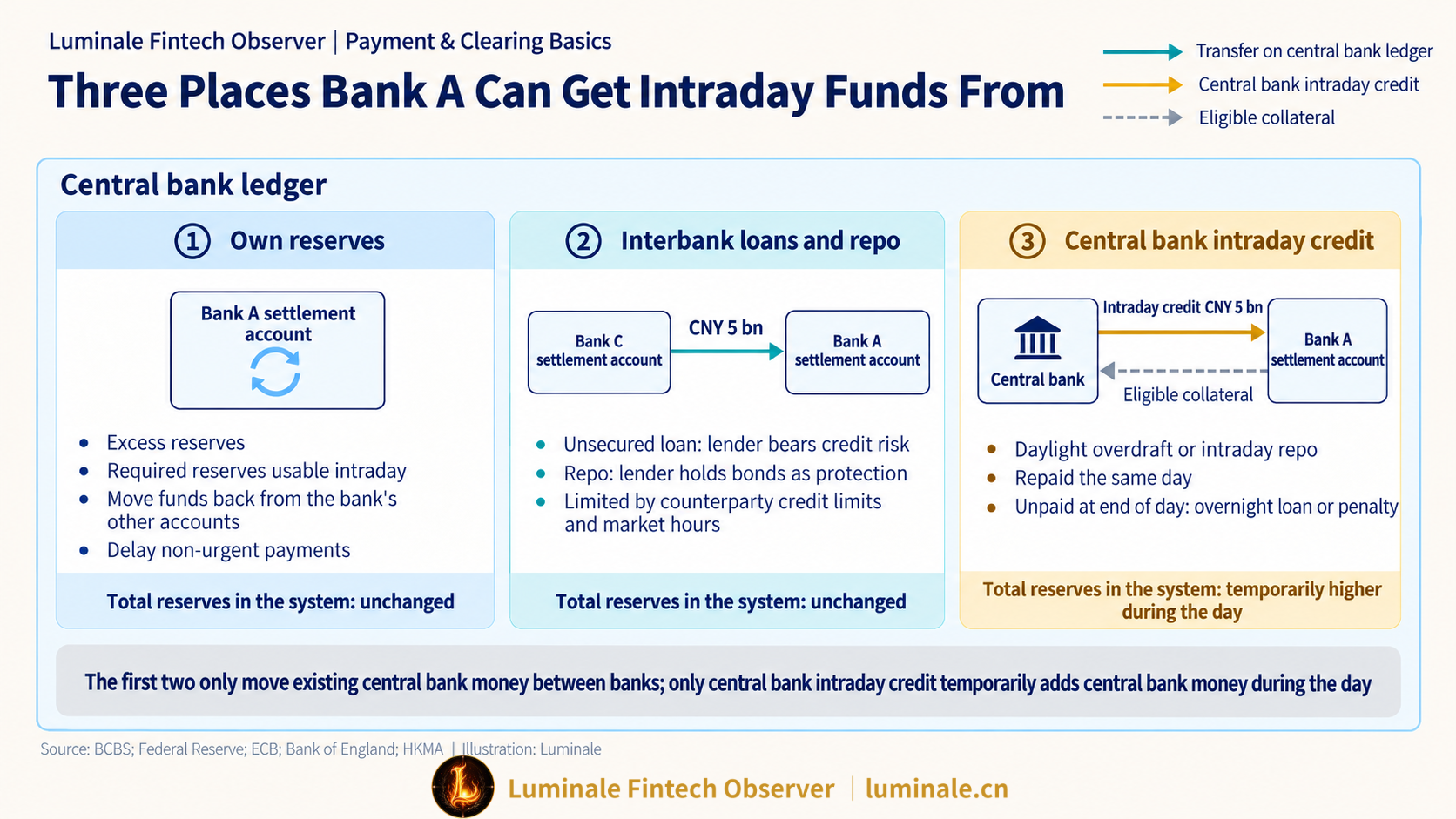
A settlement account can hold only central bank money. As we explained in From the Money Multiplier to Payment Settlement: Central Bank Reserves Explained, final settlement between commercial banks means reserves moving from one bank's name to another's on the central bank's books. So to fill that CNY 5 billion, Bank A can get money from only three places:
- its own reserves, including the portion of reserves it can use during the day;
- other banks'reserves, borrowed through interbank loans or repo;
- new intraday credit from the central bank.
The first two only move central bank money that already exists in the system; the third temporarily increases the amount of central bank money in the whole system during the day.
II. Own Reserves, the Interbank Market and Central Bank Intraday Credit: How Each Source Is Recorded
1. Source One: Own Reserves
The most direct option is to use the bank's own money. Excess reserves held in the bank's central bank settlement account can be used for payments at any time.
Whether required reserves can be used during the day depends on how each central bank assesses them. If required reserves are assessed on end-of-day balances or on an average over a period, a bank can use that money for payments during the day as long as it tops up by the assessment time or within the assessment period. From 15 September 2015, the People's Bank of China (PBOC) switched its assessment of required reserves from a point-in-time method to an averaging method: over the maintenance period, the arithmetic average of end-of-day balances divided by the assessment base must not fall below the required reserve ratio, while the ratio at the end of any single day may fall below the required reserve ratio by no more than 1 percentage point[5]. This gives banks a certain buffer.
Besides drawing down balances, banks can also rearrange funds internally: moving money back to the RTGS settlement account from their own accounts in securities settlement systems, in other currencies or in other systems, and delaying non-urgent payments so that payments with deadlines go first. The liquidity reservations, limits and priorities covered in the previous article all belong to this kind of self-management.
What these options have in common is that they do not change the total amount of reserves in the system. They only change how and when Bank A uses its own money.
2. Source Two: Interbank Loans and Repo
If Bank A's own money is not enough, it can borrow from a bank with surplus funds. There are two common forms:
- Interbank lending, also called unsecured lending: the borrower provides no collateral, and the lender bears credit risk on the borrower;
- Repurchase agreements (repo): the borrower sells bonds to the lender and agrees to buy them back later, so the lender holds bonds as protection.
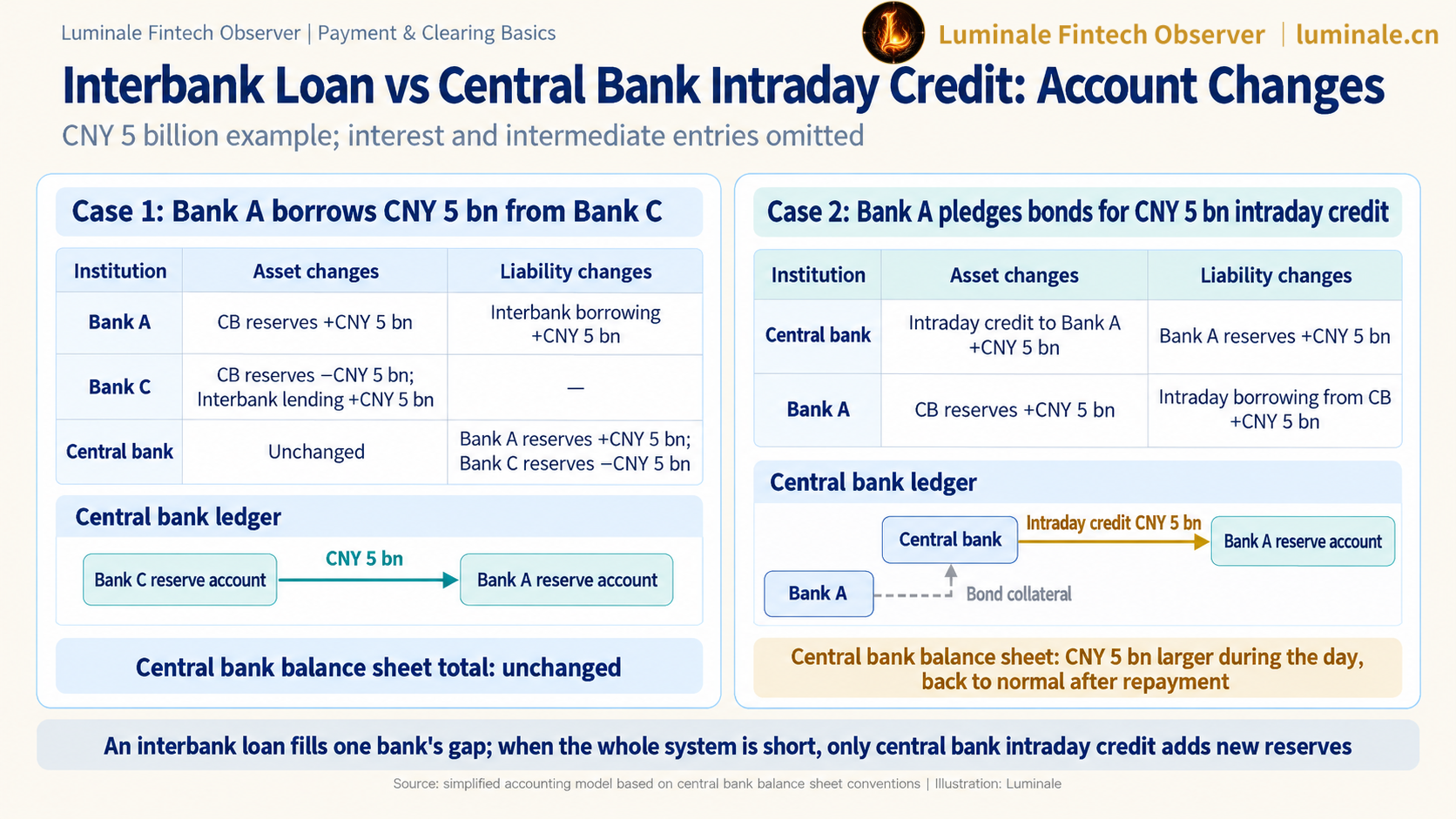
Suppose Bank C has surplus funds that day, and in the morning Bank A borrows CNY 5 billion of overnight funds from Bank C. Once the loan is agreed, Bank C pays the CNY 5 billion to Bank A through RTGS, and the three balance sheets change as follows:
Bank A
| Assets | Liabilities |
|---|---|
| Central bank reserves +CNY 5 billion | Interbank borrowing +CNY 5 billion |
Bank C
| Assets | Liabilities |
|---|---|
| Central bank reserves −CNY 5 billion | |
| Interbank lending +CNY 5 billion |
Central bank
| Assets | Liabilities |
|---|---|
| (Unchanged) | Bank A reserves +CNY 5 billion |
| Bank C reserves −CNY 5 billion |
This also explains the limits of the interbank market. If every bank is paying out in the morning and receiving in the afternoon, every bank in the system wants to borrow, and few will be willing to lend. An interbank loan also requires finding a counterparty, agreeing a price, staying within the counterparty's credit limit and completing the trade during market hours. A credit limit here means the borrowing ceiling a counterparty sets for Bank A. It determines how much Bank A can borrow in the interbank market, and it is a different thing from the intraday overdraft limit set by the central bank.
Most interbank loans are overnight or longer, but some systems provide dedicated arrangements for intraday lending between participants. Hong Kong's Clearing House Automated Transfer System (CHATS) for Hong Kong dollars, for example, has an Interbank Intraday Liquidity Facility that lets participants obtain intraday loans more efficiently from other participants registered as liquidity providers[6].
Interbank transfers also pass through the separate steps of payment instruction, account posting and funds transfer; see After "Transfer Successful": Payment Instructions, Account Posting and Funds Transfer Are Three Different Things.
3. Source Three: Central Bank Intraday Credit
If the whole system is short of money, only the central bank can add new central bank money. Short-term credit that a central bank extends to settlement account holders during the day is called intraday credit. There are two common forms:
- Daylight overdraft: the settlement account is allowed to go negative within an approved limit, so the bank pays first during the day and makes up the balance before the end of the day;
- Intraday repo: the bank sells eligible securities to the central bank and buys them back the same day, in exchange for a balance on its settlement account.
The two forms differ in their legal arrangements but have similar economic effects: the central bank gives the bank money during the day that must be repaid that day, and the bank pledges securities or other assets as protection.
Suppose Bank A pledges CNY 5 billion of bonds and obtains CNY 5 billion of intraday credit from the central bank.
When the intraday credit is drawn: Central bank
| Assets | Liabilities |
|---|---|
| Intraday credit to Bank A +CNY 5 billion | Bank A reserves +CNY 5 billion |
When the intraday credit is drawn: Bank A
| Assets | Liabilities |
|---|---|
| Central bank reserves +CNY 5 billion | Intraday borrowing from the central bank +CNY 5 billion |
In the afternoon, after receiving payments from other banks, Bank A repays the intraday credit. Both sides fall by CNY 5 billion and return to where they started.
If the intraday repo form is used, the central bank's asset side records the securities held under the repo or the corresponding repo claim, and Bank A's securities are transferred to the central bank for the duration of the repo. The accounting entries differ from the overdraft form, but the effect on reserves is the same. For the basics of writing a balance sheet, see Bank Accounting Quick Start and What a Central Bank Does, Seen Through Its Balance Sheet.
Only institutions that hold a settlement account at the central bank and meet the relevant conditions can use central bank intraday credit. For which institutions can open an account at the central bank, see Who Can Hold an Account at the Central Bank? Account Hierarchy Explained. The bonds used as collateral are mostly held at a Central Securities Depository (CSD); see Where Are Bonds Held? Why CSDs and SSSs Are the Real Back-Office Ledgers of the Securities Market.
4. What Happens if It Is Not Repaid by the End of the Day
Intraday credit lasts only one business day. Most RTGS systems do not allow a settlement account to stay negative overnight, and any amount not repaid at the end of the day is usually handled in one of two ways. The first is automatic conversion into overnight financing at a penalty rate; this overnight facility goes by different names in different jurisdictions, such as the Eurosystem's Marginal Lending Facility and the Hong Kong Monetary Authority's Discount Window. The second is a penalty charge on the unpaid amount, combined with management measures such as ex post counseling or restrictions.
Because overnight financing costs more than market rates, banks generally try to repay intraday credit before the end of the day, using the interbank market or their own incoming funds.
5. Five Things the Central Bank Has to Decide
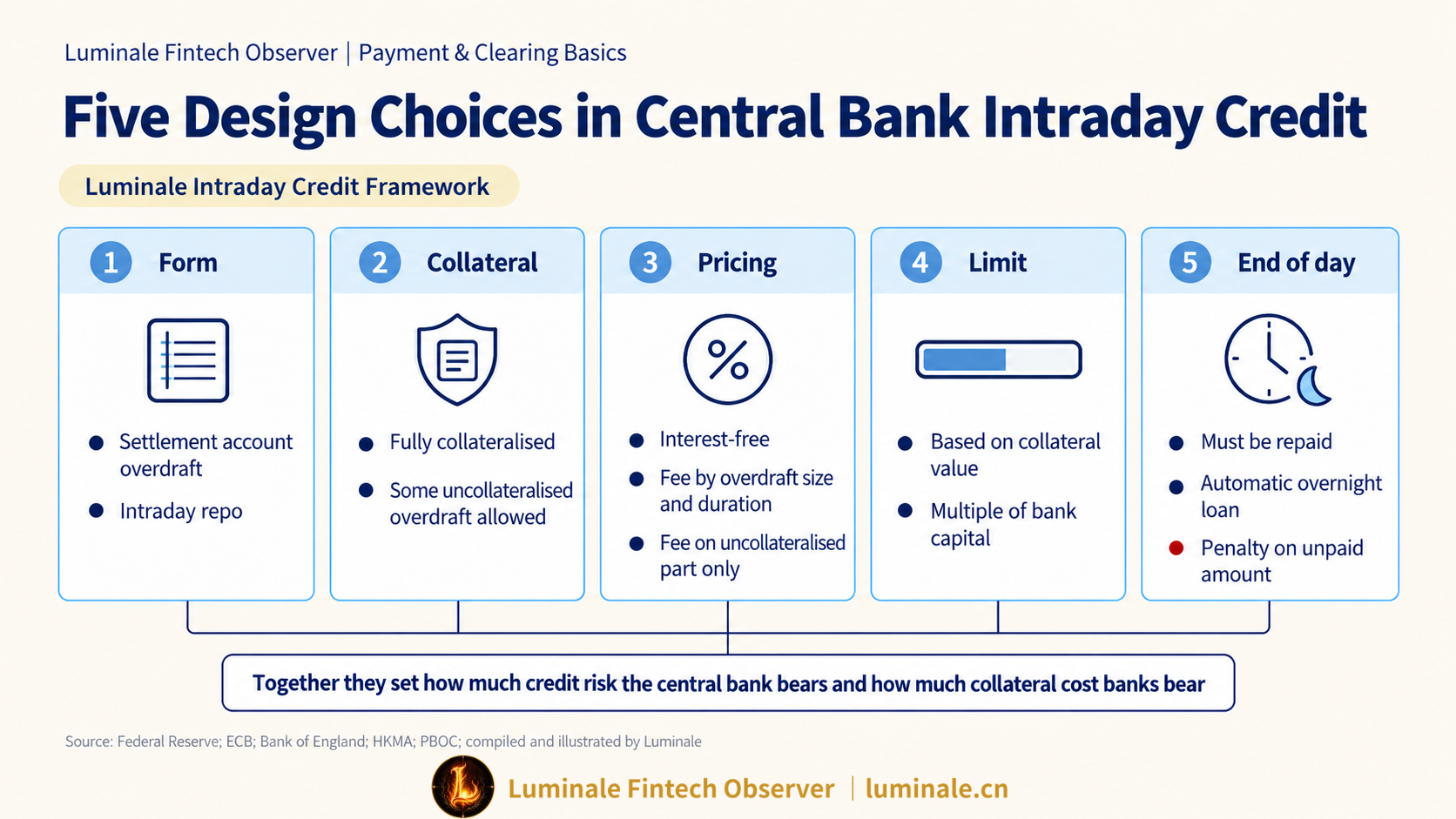
In Luminale's analytical framework, central bank intraday credit arrangements can be compared along five dimensions:
| Design dimension | Common approaches |
|---|---|
| Form | Settlement account overdraft; intraday repo |
| Collateral | Fully collateralised; some uncollateralised overdraft allowed |
| Pricing | Interest-free; fee based on overdraft size and duration; fee on the uncollateralised portion only |
| Limit | Based on collateral value; based on a multiple of bank capital |
| End-of-day treatment | Must be repaid; automatic conversion into overnight financing; penalty on the unpaid amount |
The three sources compare as follows:
| Source | Changes total system reserves? | Who bears the credit risk | Main cost |
|---|---|---|---|
| Own reserves | No | No new credit risk | Opportunity cost of holding reserves |
| Interbank loans, repo | No | Lending bank (repo is protected by bonds) | Interest on the loan or repo |
| Central bank intraday credit | Temporarily higher during the day | Central bank (controlled mainly through collateral) | Opportunity cost of collateral, plus any overdraft fees |
III. How Major RTGS Systems Provide Intraday Credit
Central banks answer the five questions above in different ways. The large-value payment systems of five major economies below show the range of approaches.
1. US Fedwire: Some Uncollateralised Overdraft Allowed, Managed Through Pricing
In the United States, the Federal Reserve Banks operate the Fedwire Funds Service, and daylight overdrafts are governed by the Federal Reserve Board's Federal Reserve Policy on Payment System Risk (PSR). The current version has been in effect since 20 July 2023[1].
The PSR allows healthy depository institutions to run uncollateralised overdrafts up to a limit, and uses pricing to encourage them to pledge collateral. The main arrangements are[1]:
- Net debit cap. Every institution that incurs uncollateralised daylight overdrafts must have a cap, equal to a capital measure multiplied by the multiple for its cap category. The categories are high (2.25), above average (1.875), average (1.125), de minimis (0.4), exempt-from-filing (USD 10 million or 0.20 of capital) and zero.
- Two-tier pricing. Collateralised daylight overdrafts carry a zero fee, while the uncollateralised portion is charged at an annual rate of 50 basis points.
- Additional capacity. Some institutions can pledge collateral to apply for daylight overdraft capacity above their net debit cap (max cap).
- Overnight overdrafts. The PSR expects institutions to avoid overnight overdrafts; an institution that has not extinguished its daylight overdraft by the end of the day pays a penalty fee and is subject to ex post counseling.
The PSR also states that the Reserve Banks supply intraday balances and credit to healthy depository institutions predominantly through explicitly collateralised daylight overdrafts, and that collateral eligibility and margins are the same as for the discount window[1].
2. Euro Area T2: Eligible Collateral, Interest-Free During the Day, Automatic Marginal Lending at the End of the Day
In the Eurosystem's T2 system, intraday credit is provided as a credit line on the participant's Main Cash Account (MCA), and the negative balance on the MCA may not go below that credit line[2].
The European Central Bank's guideline on TARGET sets out three basic rules[2]:
- Intraday credit must be based on eligible collateral, which consists of the same assets as are eligible for Eurosystem monetary policy operations and is subject to the same valuation and risk control rules;
- Intraday credit is provided free of interest;
- If a participant fails to repay intraday credit at the end of the day, this is automatically treated as a request for recourse to the marginal lending facility, so the credit becomes overnight financing charged at the marginal lending rate.
On the securities settlement side, the Eurosystem also offers auto-collateralisation: when a participant's dedicated cash account on TARGET2-Securities (T2S) is short of funds, it can automatically obtain central bank credit using eligible securities that it is buying or already holds. This credit is also free of interest and must be repaid by a set time[2]. For more on this, see How T2S Works: Euro DvP Settlement Across CSDs in Central Bank Money.
3. UK: Provided on Demand Against High-Quality Collateral
The Bank of England provides participants in RTGS-model payment systems with on-demand, supplementary central bank money during the day, which it calls intraday liquidity. It currently supports payments in the Clearing House Automated Payment System (CHAPS) and securities settlement in CREST[3].
In its policy document on settlement accounts, the Bank of England explains its reasoning: providing intraday liquidity exposes the Bank to the credit risk that a borrower may not repay, so intraday liquidity is generally provided as an advance secured against a defined set of high-quality, highly liquid collateral, transferred to the Bank by way of full title transfer[3].
The Bank of England also requires reserves account holders that are direct settlement participants of CHAPS and CREST to have the technical and legal arrangements in place to obtain intraday liquidity on demand. The criteria for accessing intraday liquidity are the same as those for participating in the Operational Standing Facilities (OSF). Electronic money institutions and payment institutions are excluded: even if they become settlement participants of CHAPS and CREST, they cannot use intraday liquidity[3].
4. Mainland China's High Value Payment System: Intraday Overdrafts, Automatic Pledge Financing and the Clearing Window
The High Value Payment System (HVPS), operated by the People's Bank of China, is part of China's modernised payment system. For its place in China's payment landscape, see From Bank Cards to NUCC, UnionPay and HVPS: A Map of China's Payment System.
The HVPS Operating Procedures (Trial) published on the PBOC website describe several liquidity arrangements[4]:
- Intraday overdraft limit. Once approved, the PBOC's accounting department sets an intraday overdraft limit on the clearing account; if the clearing account is placed under debit control, the intraday overdraft limit automatically ceases to apply.
- Automatic pledge financing. When a clearing bank that has enabled automatic pledge financing initiates a large-value payment and its clearing account position is insufficient, the system first queues the payment and then automatically triggers pledge financing. A final debit is attempted before the clearing window opens; if the debit still cannot be completed, the amount is handled as next-day financing through the China Central Depository's bond business system.
- Queuing. When the position is insufficient, payment instructions debiting the clearing account are queued by priority in this order: error corrections, extra-urgent large-value payments, intraday overdraft interest and fees, net amounts from local cheque clearing, urgent large-value payments, ordinary large-value payments and instant transfers.
- Clearing window. Before end of day, if any clearing account is overdrawn or payments are still queued, the system opens a clearing window so the banks concerned can raise funds; if funds are still insufficient when the window closes at the scheduled time, the queued large-value payments are returned.
On the market side, the main channels for domestic banks to top up their positions are the interbank lending market and the bond repo market.
5. Hong Kong CHATS: Interest-Free Intraday Repo, Automatically Rolled Into the Discount Window at Day-End
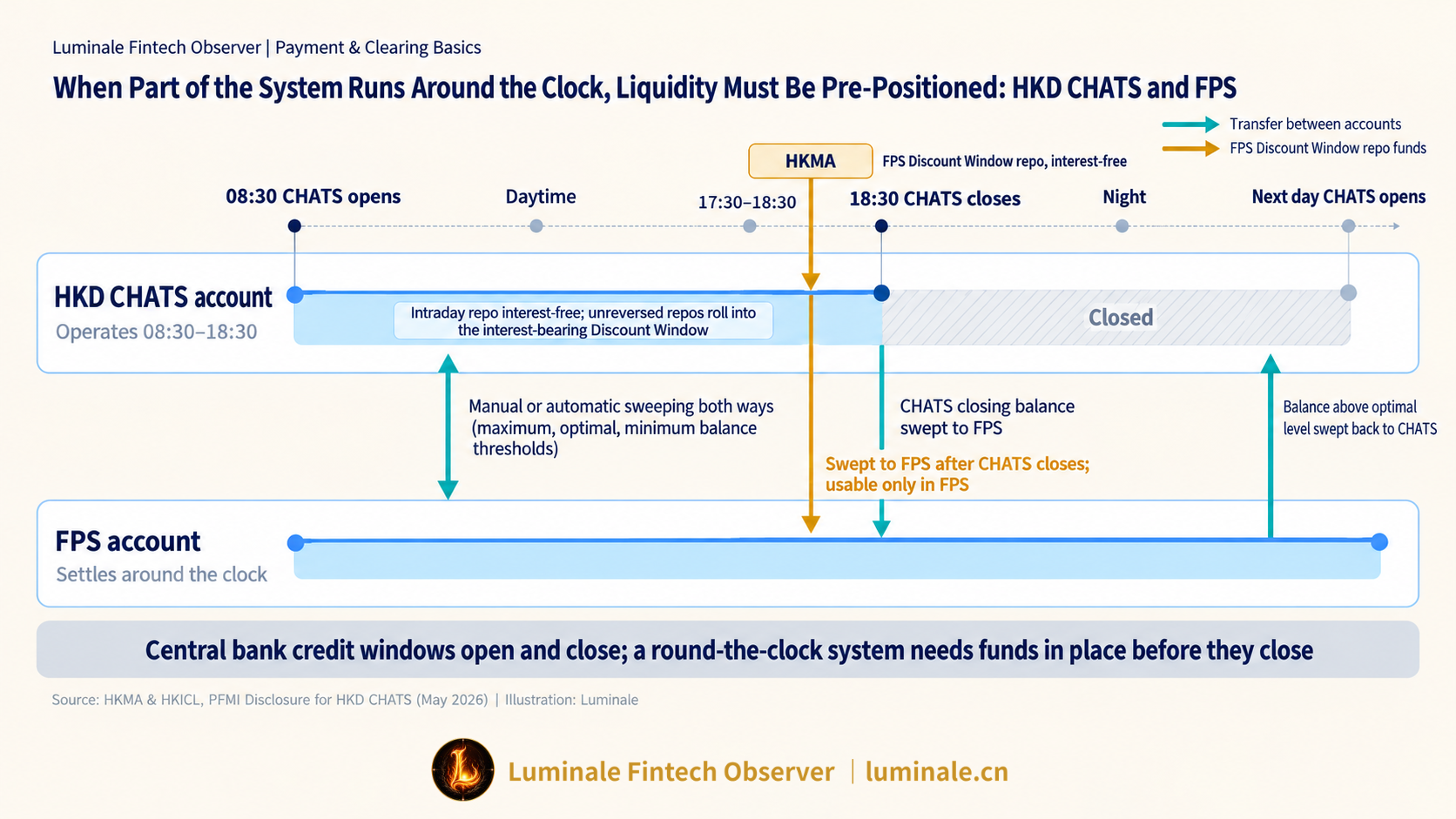
HKD CHATS has the Hong Kong Monetary Authority (HKMA) as settlement institution and Hong Kong Interbank Clearing Limited as system operator, and it runs from 08:30 to 18:30 on each business day[6].
According to the disclosure document the two institutions published under the PFMI framework in May 2026, HKD CHATS offers the following liquidity tools[6]:
- Settlement facilities. Participants can use Exchange Fund Bills and Notes as collateral to obtain intraday liquidity through the interest-free Intraday Repo and overnight liquidity through the interest-bearing Discount Window; intraday repos that cannot be repurchased before the system closes are automatically rolled into the Discount Window, on which the HKMA charges interest.
- The Interbank Intraday Liquidity Facility.
- A queuing mechanism with a re-sequencing function, plus real-time balance enquiry and advance notice of bulk settlement net amounts.
- Liquidity optimisers, which run on multilateral offsetting and have covered Payment versus Payment (PvP) payments since 18 November 2024.
- Throughput guidelines. Each bank must release and settle at least 35% of the value of its interbank RTGS payments for the day by 13:30, and at least 70% by 16:30.
The last item works much like the CHAPS rule on timely payment submission covered in the previous article: both use rules to push banks to spread their payments evenly over the day, so that fewer banks sit waiting for others to pay first.
6. Side by Side in One Table
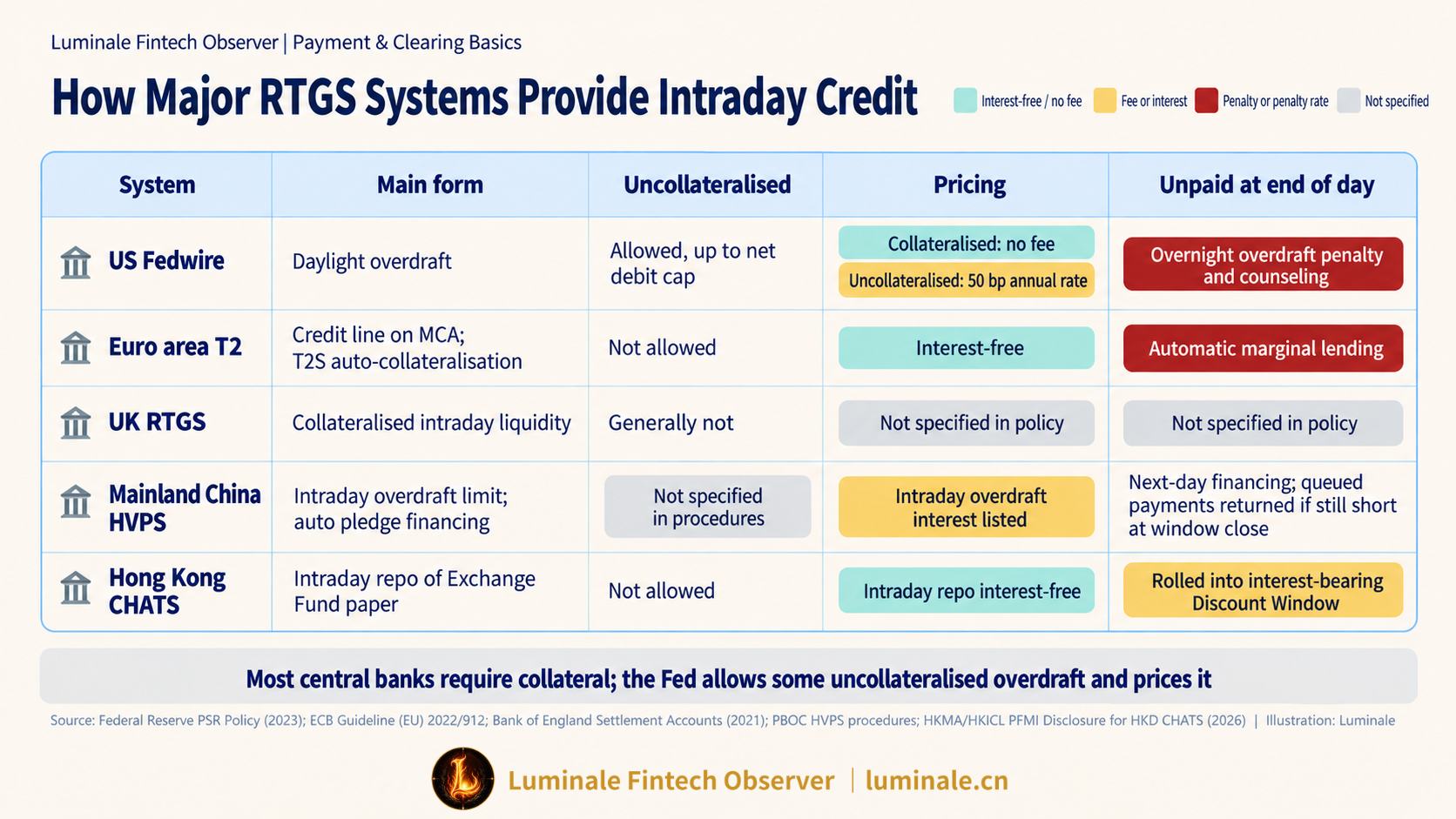
Sources for the table: the Federal Reserve's Policy on Payment System Risk[1], the ECB's TARGET guideline[2], the Bank of England's settlement accounts policy document[3], the PBOC's HVPS Operating Procedures (Trial)[4] and the PFMI disclosure document for HKD CHATS[6].
The table shows that most central banks make collateral a precondition for intraday credit. The United States is one of the few systems that allows some uncollateralised overdraft and then constrains it with fees. Behind these different choices lie different trade-offs over how much credit risk the central bank takes on and how much collateral cost banks bear. Interest-free intraday credit does not mean liquidity is free, either: banks need to hold enough eligible bonds, and bonds pledged as collateral cannot be used for other transactions at the same time.
IV. Back to the PFMI: Which Part the System and the Bank Each Cover
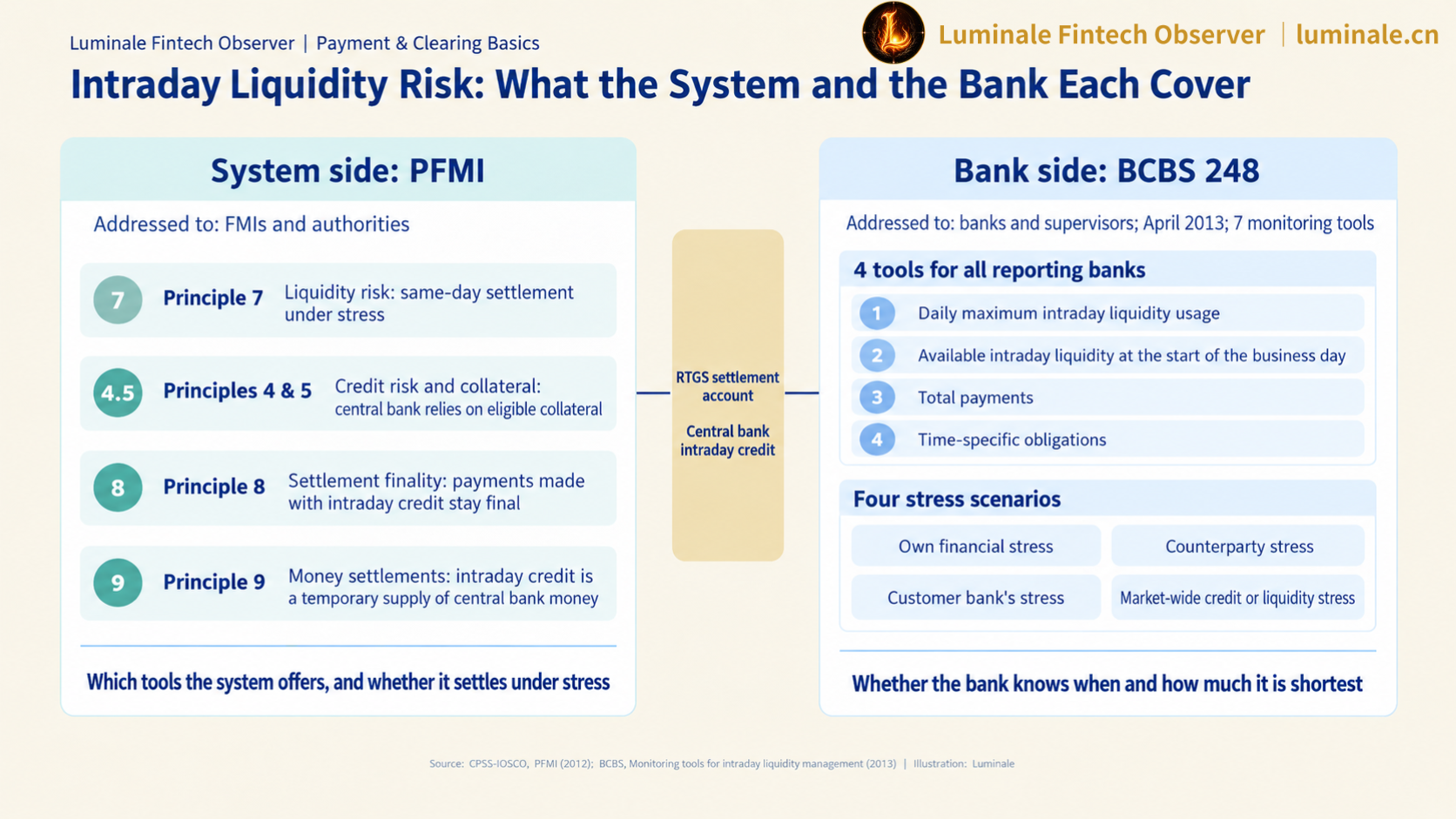
As we discussed in Reading the PFMI: 24 Principles and the Lines FMIs Must Hold, the Principles for Financial Market Infrastructures (PFMI) are addressed to Financial Market Infrastructures (FMIs) and authorities, and they do not bind commercial banks directly. Requirements for managing intraday liquidity are therefore split in two: the system side is governed by the PFMI, and the bank side is covered by the Basel Committee's monitoring tools.
1. The System Side: Relevant PFMI Principles
Principle 7 (liquidity risk) requires an FMI to effectively measure, monitor and manage its liquidity risk. For payment systems, the PFMI requires the system to complete same-day settlement with a high degree of confidence under a wide range of stress scenarios, which should include at a minimum the default of the participant and its affiliates that would generate the largest aggregate payment obligation in extreme but plausible market conditions[7]. The two-participant default (Cover 2) requirement mentioned in the PFMI article applies to Central Counterparties (CCPs) that are involved in activities with a more complex risk profile or are systemically important in multiple jurisdictions. For the liquidity needs of CCPs, see What Does a CCP Solve? Counterparty Risk, Clearing and Atomic Settlement.
Liquidity risk in RTGS takes a different shape from that in CCPs and DNS systems. Because RTGS settles payments one by one, a participant that cannot pay does not leave a whole batch of netted results unable to settle; the risk shows up instead as queued payments, delays and knock-on gridlock. For a central bank-operated RTGS, the resources for handling this kind of stress are mainly the balances on participants'settlement accounts and the intraday credit the central bank provides under its rules; queuing, liquidity-saving mechanisms and throughput requirements determine whether those resources can be used in time.
Several other principles also bear on intraday credit:
- Principle 4 (credit risk) and Principle 5 (collateral). A central bank providing intraday credit takes on credit risk itself, so it requires eligible collateral and sets haircuts and concentration limits. The Bank of England's settlement accounts policy explicitly names collateral as the way it controls this risk[3].
- Principle 8 (settlement finality). Payments completed with intraday credit are just as final; what the central bank holds is a claim on the borrowing bank, and it does not go back and unwind completed payments. For what settlement finality means, see Can a "Successful Payment" Be Reversed? What Risks Does Settlement Finality Solve?.
- Principle 9 (money settlements). RTGS settles in central bank money, and central bank intraday credit is a temporary supply of central bank money. Private settlement systems have no such capacity; it is support a central bank can offer when it operates RTGS.
Hong Kong also shows how the PFMI is put into practice: the HKMA and Hong Kong Interbank Clearing Limited publish how CHATS works under the PFMI disclosure framework, including the settlement facilities, queuing, optimisers and throughput guidelines mentioned above[6]. FMIs publishing their arrangements in a common framework is how the disclosure requirements discussed in the PFMI article show up in a specific system.
2. The Bank Side: The Basel Committee's Intraday Liquidity Monitoring Tools
In April 2013, the Basel Committee and the then Committee on Payment and Settlement Systems (CPSS) issued Monitoring tools for intraday liquidity management, commonly known as BCBS 248, to help banking supervisors monitor how banks manage intraday liquidity risk and their ability to meet payment and settlement obligations on a timely basis[8].
The framework comprises seven tools. Internationally active banks are required to apply them, and national supervisors decide how far they apply to other banks[8]. The four that apply to all reporting banks are:
- Daily maximum intraday liquidity usage, the highest cumulative net outflow reached during the day, which corresponds to the CNY 5 billion in Bank A's example;
- Available intraday liquidity at the start of the business day, including central bank account balances and central bank intraday credit that can be drawn;
- Total payments;
- Time-specific obligations.
The other three apply respectively to banks that provide correspondent banking services to other banks and to direct participants in payment systems, covering items such as intraday credit lines extended to customers and the pace of intraday payments. BCBS 248 also asks banks to assess intraday liquidity under four stress scenarios: own financial stress, counterparty stress, a customer bank's stress, and market-wide credit or liquidity stress[8].
Taken together, the PFMI focuses on what tools the system provides and whether it can complete settlement under stress; BCBS 248 focuses on whether a bank knows when during the day it is shortest of money and by how much, and whether it holds enough collateral to obtain central bank intraday credit.
V. Who Bears the Cost of Intraday Liquidity
Back to Bank A's CNY 5 billion gap. It can draw on its own reserves, borrow from Bank C, or take bonds to the central bank in exchange for intraday credit. Each option has a cost: holding reserves means giving up the return on other assets, interbank borrowing means paying interest, central bank intraday credit ties up eligible collateral, and in some jurisdictions there are overdraft fees as well.
These costs shape how banks pay. As the previous article explained, because intraday liquidity is costly, banks have a reason to delay payments until they have received funds from others. If every bank does this, the whole system becomes gridlocked. Central banks respond in several ways: LSMs lower the cost of paying first, rules such as Hong Kong CHATS's throughput guidelines and CHAPS's timely-submission requirement constrain bank behaviour, and central bank intraday credit on clear terms provides a backstop. The looser the terms of intraday credit, the more willing banks are to pay early, and the more risk the central bank takes on; the stricter the terms, the safer the central bank, and the heavier the burden on banks of holding collateral.
Several developments are now changing these costs.
1. How Plentiful Reserves Are
When reserves are plentiful, banks can make most payments from their own balances and rely less on intraday credit; Bank A's opening balance may already be enough to cover its morning payments. As central banks shrink their balance sheets and reserves fall, intraday liquidity becomes a constraint again. Changes in the size of central bank balance sheets feed directly into whether banks can make their payments on time each morning.
2. Longer Operating Hours
Hong Kong's Faster Payment System (FPS) offers a concrete example. FPS settles around the clock in RTGS mode, while HKD CHATS operates from 08:30 to 18:30. To make sure banks still have funds to settle FPS transactions after CHATS closes, the system provides account balance sweeping: during CHATS operating hours, banks can move funds manually or automatically between their CHATS and FPS accounts, and when CHATS closes, the closing balance of each bank's CHATS account is automatically transferred to its FPS account. The HKMA also offers interest-free FPS Discount Window repos between 17:30 and 18:30; the funds borrowed are swept into FPS automatically after CHATS closes and can be used only in FPS[6].
This arrangement shows that when part of a system runs around the clock while the central bank's intraday credit window opens and closes, liquidity has to be put in place in advance. As more payment systems extend their operating hours, the line between business day and end of day will blur, and where intraday credit's "day" begins and ends will need to be redesigned.
3. Shorter Settlement Cycles and Tokenised Settlement
As securities settlement cycles shorten, cash-leg payments come earlier and are more concentrated, and time-specific payments increase. In tokenised settlement, atomic settlement requires securities and cash to be in place at the same moment, so cash often has to be pre-positioned on the settlement platform. Such arrangements reduce principal risk, yet make the need for intraday liquidity more immediate. For discussion of tokenised deposits and the cash leg of tokenised securities, see Tokenised Deposits: How Commercial Bank Money Enters the On-Chain World and From Pontes to Appia: Rebuilding the Cash Leg for Tokenised Securities.
Conclusion
Draw Bank A's balance over that day as a curve, and the hours when the curve dips below zero are the hours when the bank needs outside liquidity. Own reserves set how high the curve starts, the interbank market sets how much can be borrowed from other banks, and central bank intraday credit sets how low the curve can go before payments come to a halt.
Of the three sources, the first two only move central bank money between banks. Only the central bank can temporarily increase central bank money during the day, and it asks banks to pledge collateral and repay before the end of the day. The different arrangements countries make on collateral, pricing and end-of-day treatment all allocate the same set of risks: how much credit risk the central bank bears, and how much collateral and funding cost banks bear.
RTGS settles payments one by one, in real time and with finality, and that requires someone to supply liquidity during the day. Seen this way, how smoothly an RTGS system runs depends not only on its technical design but to a large extent on the terms on which the central bank is willing to provide intraday credit.
References
[1]: Board of Governors of the Federal Reserve System, Federal Reserve Policy on Payment System Risk, as amended effective July 20, 2023, Part II (Sections B–E) and Part III. https://www.federalreserve.gov/paymentsystems/files/psr_policy.pdf ↩
[2]: European Central Bank, Guideline (EU) 2022/912 of the European Central Bank of 24 February 2022 on a new-generation Trans-European Automated Real-time Gross settlement Express Transfer system (TARGET) (ECB/2022/8), Annex I (provisions on the main cash account and intraday credit, including Part II, Articles 11 and 12) and provisions on T2S auto-collateralisation. https://eur-lex.europa.eu/eli/guideline/2022/912/oj ↩
[3]: Bank of England, Bank of England Settlement Accounts, July 2021, paragraphs 10–15, 40–43. https://www.bankofengland.co.uk/-/media/boe/files/payments/boesettlementaccounts ↩
[4]: People's Bank of China, HVPS Operating Procedures (Trial) (《大额支付系统业务处理手续(试行)》), PBOC website. https://www.pbc.gov.cn/zhifujiesuansi/128525/128535/128626/2892618/index.html ↩
[5]: People's Bank of China, announcement on reforming the assessment of required reserves from 15 September 2015, 11 September 2015. ↩
[6]: Hong Kong Monetary Authority and Hong Kong Interbank Clearing Limited, Principles for Financial Market Infrastructures: Disclosure for HKD CHATS, 15 May 2026, paragraphs 24, 30–31. https://www.hkma.gov.hk/media/eng/doc/key-functions/financial-infrastructure/infrastructure/HKD_CHATS_DF.pdf ↩
[7]: CPSS-IOSCO, Principles for financial market infrastructures, April 2012, Principles 4, 5, 7, 8 and 9. https://www.bis.org/cpmi/publ/d101a.pdf ↩
[8]: Basel Committee on Banking Supervision, Monitoring tools for intraday liquidity management, April 2013. https://www.bis.org/publ/bcbs248.htm ↩
Originally published by Luminale Fintech Observer: https://luminale.cn/articles/rtgs-intraday-liquidity-sources-en