Why Don't Payment Systems Settle Every Transaction Immediately?—Understanding RTGS and DNS
When you transfer money through mobile banking, the recipient's balance changes within seconds.
But in that same second, the paying bank may not have transferred the equivalent reserves to the receiving bank on a transaction-by-transaction basis.
Whether the customer's account has been credited, how banks calculate amounts receivable and payable between themselves, and when the settlement asset is actually transferred are three related but not identical matters. By separating these three things, the difference between real-time gross settlement and deferred net settlement becomes clear.
So why don't payment systems settle every transaction immediately? The answer is not technological. Technically, it is entirely feasible. The difficulty lies in the fact that payment systems must always strike a balance between two things:
RTGS and DNS are precisely the two fundamental institutional arrangements formed under this trade-off.
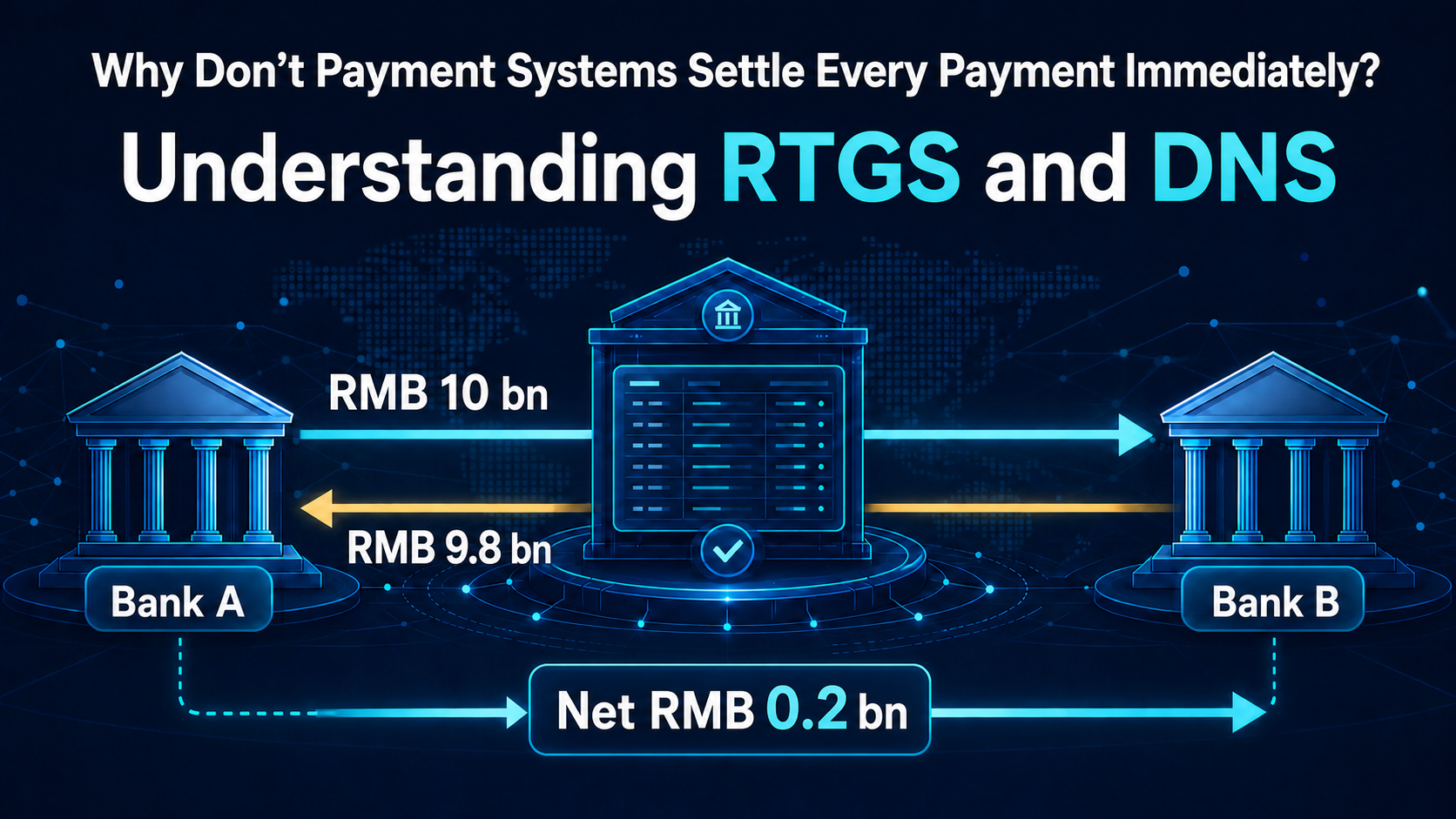
1. Bank A Oves 10 Billion Yuan, Bank B Owes 9.8 Billion Yuan—Why Not Necessarily Transfer 19.8 Billion Yuan?
Suppose that within one day, Bank A's customers need to pay 10 billion yuan to Bank B's customers; at the same time, Bank B's customers also need to pay 9.8 billion yuan to Bank A's customers.
Payment systems have at least two approaches.
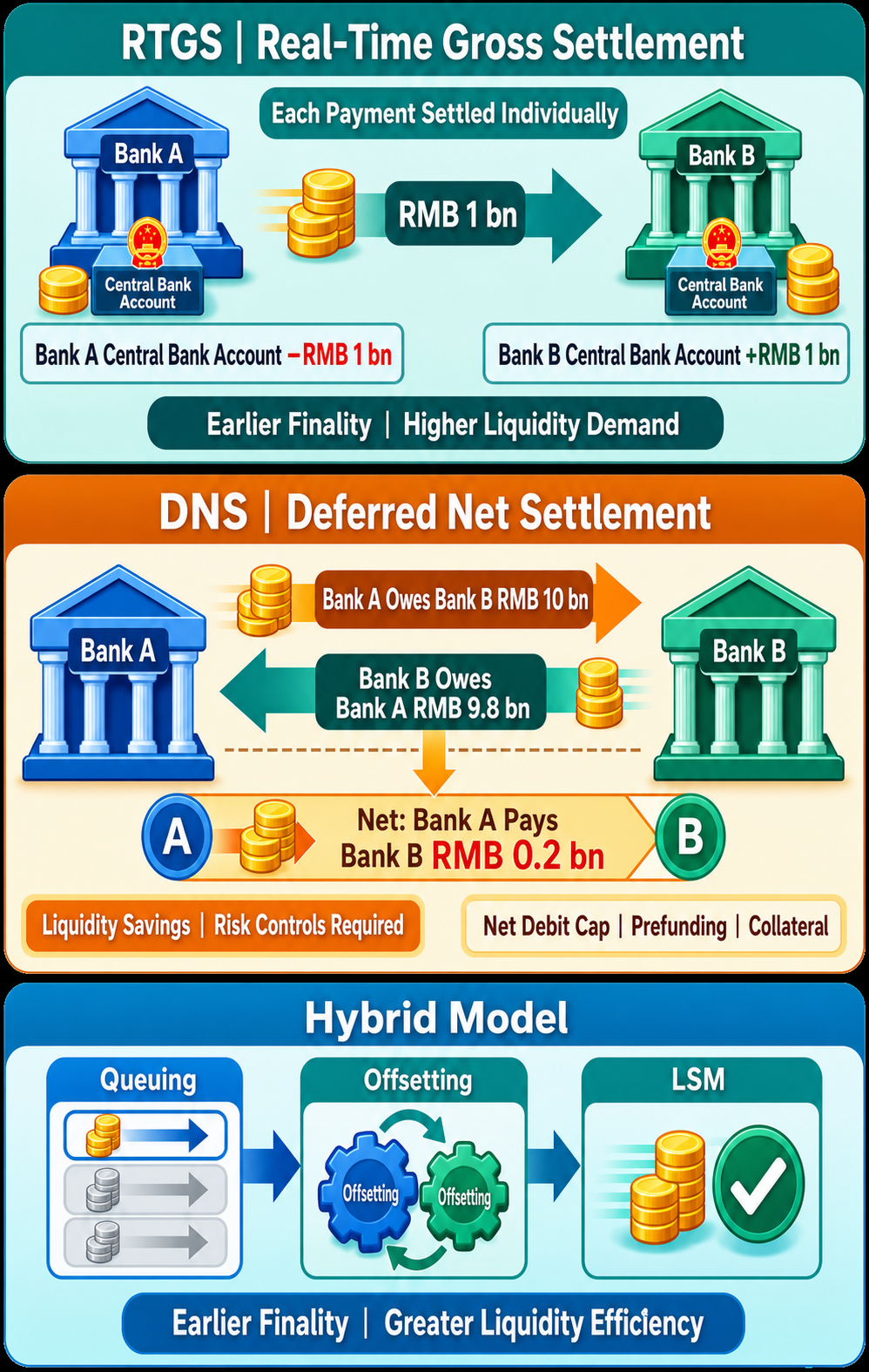
The first approach is to complete final settlement individually and immediately upon each payment instruction. Every payment from Bank A to Bank B is transferred individually in the settlement account; every payment from Bank B to Bank A is handled the same way. This is the most intuitive way to understand RTGS.
The second approach is to process customer payments first, continuously record the amounts receivable and payable between the two banks, and then calculate the net position at a designated settlement time:
| Payment Direction | Cumulative Amount |
|---|---|
| Bank A payable to Bank B | 10 billion yuan |
| Bank B payable to Bank A | 9.8 billion yuan |
| Netting result | Bank A pays 200 million yuan net to Bank B |
The payments that originally occurred between customers do not disappear. The transaction records of 10 billion yuan and 9.8 billion yuan still exist, and the accounts of the payers and payees must still be processed according to business rules. What changes is the settlement asset that ultimately needs to be transferred between participating institutions: from a total payment volume of 19.8 billion yuan in both directions to a net transfer of 200 million yuan from Bank A to Bank B.
This is the core logic of DNS (Deferred Net Settlement).
A common misunderstanding should also be avoided here: one cannot simply assert that RTGS necessarily requires at least 19.8 billion yuan to be available in both banks'settlement accounts. Because transactions between banks occur continuously, funds received in RTGS from a previous transaction can continue to be used for the next payment; the same intraday liquidity can circulate repeatedly. Moreover, payment systems may offer queuing, collateralized financing, and liquidity-saving mechanisms to help banks reduce the liquidity they need.
Therefore, what we focus on is not "which is smaller, 19.8 billion yuan or 200 million yuan," but the more practical question below:
2. Payment, Clearing, and Settlement Are Not the Same Action
In everyday language, "payment," "clearing," and "settlement" are often used interchangeably. When entering the realm of payment infrastructure, they must be distinguished.
| Stage | Main Problem Addressed |
|---|---|
| Payment | How the payer issues a fund transfer instruction to the payee |
| Clearing | How instructions are transmitted, verified, and how receivables and payables between participating institutions are calculated |
| Settlement | How the settlement asset is transferred to ultimately discharge obligations between participating institutions |
When a customer sees "funds received" in the App, it reflects the result at the customer account layer; when the clearing system calculates that "Bank A owes Bank B 200 million yuan net," it refers to inter-institutional obligations; when funds are actually transferred in central bank accounts or other designated settlement accounts, only then does final settlement occur.
To explain interbank payments clearly, we can first look at a highly simplified bank balance sheet:
| Assets | Liabilities Side |
|---|---|
| Reserves held at the central bank | Customer deposits |
| Loans and other assets | Other liabilities and owner's equity |
Assume that Bank A's customer pays 10 billion yuan to Bank B's customer through RTGS. The relevant accounting entries can be simplified as:
| Institution | Asset Change | Liability Change |
|---|---|---|
| Bank A | Central bank reserves −10 billion yuan | Paying customer deposits −10 billion yuan |
| Bank B | Central bank reserves +10 billion yuan | Receiving customer deposits +10 billion yuan |
Customer deposits of Bank A and Bank B are commercial banks'liabilities to their customers. If the transfer of assets and liabilities occurs between customers, then the banks to which those customers belong must complete final settlement through the settlement asset in the central bank account system.
In a DNS arrangement, customer account changes and inter-institutional final settlement may not occur at the same point in time. To ensure that the receiving bank credits its customer without delay, mechanisms such as payment system processing rules, risk controls, and participation agreements must be in place to protect banks from losses due to early crediting.
3. Why Is RTGS Safe?
RTGS stands for Real-Time Gross Settlement.
"Gross" indicates that payments are not netted at end-of-day but settled individually; "Real-Time" emphasizes that eligible instructions are processed in real time during system operation and achieve settlement finality.
Using the example of Bank A paying 10 billion yuan to Bank B:
- Bank A submits the payment instruction;
- The system checks whether Bank A has sufficient available settlement funds or is authorized to use intraday credit;
- Bank A's central bank account decreases by 10 billion yuan;
- Bank B's central bank account increases by 10 billion yuan;
- The settlement achieves finality.
The Federal Reserve's Fedwire is a typical RTGS. The Federal Reserve explicitly states that Fedwire debits the paying institution's account and credits the receiving institution's account on an individual basis, and once processed, the funds transfer is immediate, final, and irrevocable. Federal Reserve
The most important value of RTGS is that settlement finality arrives earlier. The receiving bank does not have to wait for the paying bank to perform at a later time, nor does it accumulate unsettled credit exposure to the paying bank over a long settlement cycle.
The cost is: the paying bank must have available liquidity at the moment the payment occurs.
Funds that can support RTGS must be the most liquid funds held in central bank accounts. Even if a bank has 10 billion yuan in assets on its books, that does not mean it can immediately use them for RTGS settlement, because loans, bonds, and other assets cannot be directly used to complete payments without processing. Therefore, in an RTGS system, banks need to manage a series of matters:
- Monitor in real time the available balance in the central bank account;
- Estimate in advance the payments expected to be received during the day;
- Require customers to report large outgoing payments in advance;
- Manage eligible collateral that can be mobilized;
- Ensure access to intraday financing from the central bank or the market;
- Process promptly any queued payments that have entered the system but are not yet settled.
Therefore, RTGS settlement does not mean "payments never queue." If the paying institution temporarily lacks available liquidity, payment instructions may enter a queue, waiting for fund inflows, financing, or the system's liquidity optimization procedures.
RTGS is also not "without risk." What it can reduce is the inter-institutional credit risk arising from incomplete final settlement, but liquidity risk, operational risk, network failures, and the risk management issues of participants themselves still exist.
4. Why Does DNS Save Liquidity?
DNS allows payments to be processed first, accumulates receivables and payables over one or more settlement cycles, and ultimately settles only the net amount.
The benefit is straightforward: if there is a large volume of two-way payments between Bank A and Bank B, only transferring the final net amount can significantly reduce settlement fund requirements.
The problem is equally straightforward.
Suppose from the first payment in the morning, Bank A continuously makes outgoing payments, building an increasingly large net debit position in the system. The receiving banks may have already made funds available to their customers, but the final settlement between banks has not yet occurred. If Bank A suddenly fails to perform before settlement, who fills the gap?
Therefore, a mature DNS does not allow participants to accumulate unlimited net debit positions. Common control measures include:
| Risk Control Tool | Main Function |
|---|---|
| Net debit cap | Limits how much net debit a participant can accumulate before final payment |
| Prefunding | Requires participants to hold funds in advance in dedicated accounts to cover the maximum net debit position |
| Ring-fenced funds | Locks a portion of available funds to prevent reuse |
| Collateral | Provides support for financing or default resolution under specific arrangements |
| Guarantee or loss-sharing arrangements | Pre-agrees on the source of funds and loss-bearing method in the event of participant default |
| Increased settlement frequency | Shortens the risk window between payment processing and final settlement |
A net debit cap does not necessarily mean participants must deposit an equivalent amount of cash in advance. It is a risk control limit; whether it is supported by cash, collateral, guarantee arrangements, or other resources depends on the specific system rules.
The People's Bank of China's publicly issued "Measures for the Operation of the Small-Value Payment System" (《小额支付系统业务处理办法》) clearly explains this logic: transactions passing the net debit cap check can be included in real-time netting; those failing the check may be queued, while real-time transactions may be rejected. The system also submits netted amounts for funds clearing at designated sessions and conducts multilateral matching among queued payments of multiple participants. People's Bank of China, Measures for the Operation of the Small-Value Payment System
In other words, DNS is not "owing first, dealing with it later." It has boundaries:
The UK's practice provides another intuitive example. The Bank of England's RTGS not only handles the individual real-time settlement of CHAPS but also undertakes net settlement for retail systems such as Bacs and Faster Payments. Bacs typically settles once daily, while Faster Payments conducts three net settlement cycles per business day. The prefunded system requires participants to hold funds matching their limits in dedicated RTGS accounts to cover the maximum potential net debit position. Bank of England
5. The Practice of Settlement Models in China's Payment Systems
To place RTGS and DNS within China's payment infrastructure, one often needs to start with a retail payment.
A retail payment may go through the following chain:
These steps may appear seamless, but they are often processed separately across multiple systems.
1. High-Value Payment System (HVPS)
HVPS primarily adopts the RTGS settlement model. It mainly serves large-value, urgent, and interbank fund transfers, processing and clearing funds in real time on a transaction-by-transaction basis. It is one of the core infrastructures for interbank fund settlement in China.
2. Bulk Electronic Payment System (BEPS)
BEPS serves batch and retail payment businesses. Eligible transactions pass the net debit cap check and are included in netting, with netsubmitted for funds clearing at designated sessions.
Therefore, it cannot be simply said that "BEPS only transmits messages and does not settle." Rather:
BEPS completes payment processing, limit checks, and netting under its own rules, and the inter-institutional net amounts ultimately complete fund settlement in the central bank clearing account system.
3. Internet Banking Payment System (IBPS)
IBPS is commonly referred to as "Super Internet Bank." It supports interbank fund transfers and real-time feedback, but a customer receiving a real-time processing result does not mean that every interbank reserve transfer is settled individually in the same moment.
The PBoC Clearing Center mentioned that IBPS adjusted its business processing model in 2016 from "real-time forwarding, real-time netting" to "real-time forwarding, scheduled netting" to alleviate the hot-account issue that high-volume participants might encounter. Yinqing Technology IBPS Introduction
This adjustment also illustrates from another angle: "real-time at the front end" and "real-time final settlement per transaction at the back end" cannot be equated.
4. UnionPay and NetsUnion Clearing
UnionPay and NetsUnion Clearing undertake transaction switching, clearing, and other functions, but they are not responsible for final settlement between participants.
As can be seen from the PBoC's amendments to the high-value payment system rules, the net amounts of interbank card payments and payment institution online payment transactions are settled through real-time transfer transactions initiated by direct participants. This provides a clear institutional basis for understanding the relationship between clearing institutions, the high-value payment system, and the final settlement layer in central bank accounts. PBoC Announcement on Relevant Institutional Amendments
For the online payment business of non-bank payment institutions, one must also understand the difference between customer reserved funds and bank reserves.
Customer reserved funds (备付金) are funds actually received by payment institutions for processing payment services on behalf of customers—funds collected in advance and pending payment. They are not ordinary margin deposited by a payment institution for its own performance. Current regulatory requirements stipulate that payment institutions process cross-institution payment business through designated clearing institutions and establish mechanisms for verifying, supervising, and risk-monitoring information related to customer reserved funds. Regulations on the Supervision and Administration of Non-Bank Payment Institutions (《非银行支付机构监督管理条例》)
Compressing these relationships into a "three-layer ledger" makes them easier to understand:
| Layer | Core Content Recorded |
|---|---|
| Customer account layer | Balances that individuals or enterprises see at banks or payment institutions |
| Clearing layer | Who owes what to whom among participating institutions and the net amount |
| Final settlement layer | The ultimate transfer of central bank money or settlement assets designated by the system |
Therefore, the fact that customers can receive funds instantly while interbank settlement has not yet occurred indicates that customer experience and inter-institutional final settlement can be jointly supported by different layers, different time schedules, and different risk controls.
6. Payment Systems Worldwide Are Solving the Same Problem: How to Be Both Fast and Liquidity-Efficient?
RTGS and DNS are not uniquely Chinese choices. Payment infrastructures across economies all manage the relationship among settlement finality, liquidity costs, and risk control.
| Economy | System | Primary Positioning | Mechanisms Worth Observing |
|---|---|---|---|
| China | HVPS | Large-value and interbank payments | Real-time gross settlement |
| China | BEPS | Retail batch payments | Limit checks, netting, and net amount funds clearing |
| China | IBPS | Real-time interbank retail payments | Real-time forwarding, scheduled netting |
| United States | Fedwire Funds | Large-value, time-critical dollar payments | Transaction-by-transaction RTGS, final and irrevocable after processing |
| United States | CHIPS | Large-value dollar payments | Continuous intraday final settlement with liquidity-saving mechanisms |
| Euro area | T2 | Large-value euro payments | RTGS in central bank money |
| Euro area | TIPS | Instant retail payments | 24×7 settlement in central bank money |
| United Kingdom | CHAPS | Large-value pound payments | Transaction-by-transaction settlement via Bank of England RTGS |
| United Kingdom | Bacs, Faster Payments | Retail payments | Deferred net settlement and prefunding |
| Hong Kong | HKD CHATS | HKD interbank payments | RTGS, queuing, and liquidity optimizer |
| Hong Kong | FPS | Instant retail payments | Immediate RTGS settlement when balances are sufficient |
The Federal Reserve defines Fedwire as a real-time gross settlement system; the Eurosystem's T2 performs RTGS, while TIPS can settle instant payments in central bank money 24×7. This shows that retail payments are not naturally equivalent to DNS. Federal Reserve, European Central Bank
On the other hand, CHIPS in the United States continuously matches and offsets payment obligations between participants, providing intraday final settlement while reducing fund requirements. It achieves a balance between RTGS-like finality and liquidity savings through its unique algorithm. The Clearing House
Hong Kong's HKD CHATS also adopts RTGS but incorporates queuing, intraday repurchase, and a liquidity optimizer. The optimizer periodically searches for combinations of queued payments that can be multilaterally offset and settled simultaneously, reducing participants'intraday funding pressure. Hong Kong's FPS settles transactions immediately in RTGS mode when the paying participant has sufficient balance. Hong Kong Monetary Authority
Four common trends can be observed across these systems:
- For payments of high systemic importance and stringent time requirements, markets place greater value on achieving finality as early as possible;
- DNS continuously shortens the duration of risk exposure by increasing settlement frequency;
- Risk controls are increasingly applied upfront—limits, prefunding, and collateral arrangements begin to function before payments are released;
- RTGS is also enhancing the volume of payments supported by a unit of liquidity through queuing, bilateral or multilateral offsetting, and LSM.
Therefore, the development direction of modern payment systems is not "DNS will eventually all become RTGS," but rather that both types of mechanisms are absorbing each other's strengths.
7. RTGS and DNS Represent Two Different Institutional Answers
Finally, let us return to Bank A and Bank B.
If Bank A needs to pay 10 billion yuan to Bank B, and Bank B needs to pay 9.8 billion yuan to Bank A, purely from the perspective of reducing settlement fund occupation, settling only 200 million yuan in the end is naturally more economical.
But after choosing DNS, the system must answer:
- What is the maximum net debit Bank A can accumulate?
- What happens if Bank A cannot perform before settlement?
- Why can the receiving bank dare to credit its customer in advance?
- What funds or collateral cover the maximum net debit position?
- How often is the net amount settled?
- Who bears the loss in the event of default?
Conversely, if all payments are settled individually through RTGS, the system must answer:
- How do banks obtain sufficient intraday liquidity?
- How are payments lacking adequate funds temporarily queued?
- How can received funds be recycled more quickly?
- Which payments should receive settlement priority?
- How to prevent participants from waiting on each other, forming a liquidity "deadlock"?
Therefore, RTGS and DNS are not a distinction between "advanced" and "backward," but rather two different institutional choices:
Modern payment systems are forming a third answer:
While maintaining earlier final settlement, reduce liquidity requirements through queuing, offsetting, prefunding, limits, and liquidity-saving mechanisms.
Once this is understood, the next question naturally emerges:
Since RTGS is real-time settlement, why do banks'payments still queue?
Originally published by Luminale Fintech Observer: https://luminale.cn/articles/rtgs-dns-settlement-tradeoff-en