At the start of the month, a garment exporter in Jiangsu receives USD 1 million from a US customer. The company's finance director has three things to deal with. Wages and fabric suppliers are paid in renminbi at the end of the month, so the dollars need to be converted first. Another USD 1 million payment is due in three months, and the director worries that the dollar may weaken by then and wants to lock in a price now. And the company also has some spare dollars sitting in its account, while renminbi will be tight for a stretch of next quarter.
Each of these three needs has a matching trade in the FX market: spot, forward and FX swap, which are also the three most common types. In the bank's app or at the counter, the finance director sees just one quote and taps once to confirm. After that tap, the bank still has to go to the interbank market to close out its own FX position, the trade has to be confirmed and cleared, and the dollars and renminbi have to settle separately in the US and Chinese payment systems.
This article follows the company's needs into the back office. It first looks at where FX is traded and what kinds of trades exist, then at where exchange rates come from, then at how the money moves after a trade and who supervises it, and finally at how companies and individuals handle FX business.
I. The FX Market Has No Trading Floor: A Tiered Structure from the Bank Counter to the Interbank Market
1. An OTC Market Centred on Banks
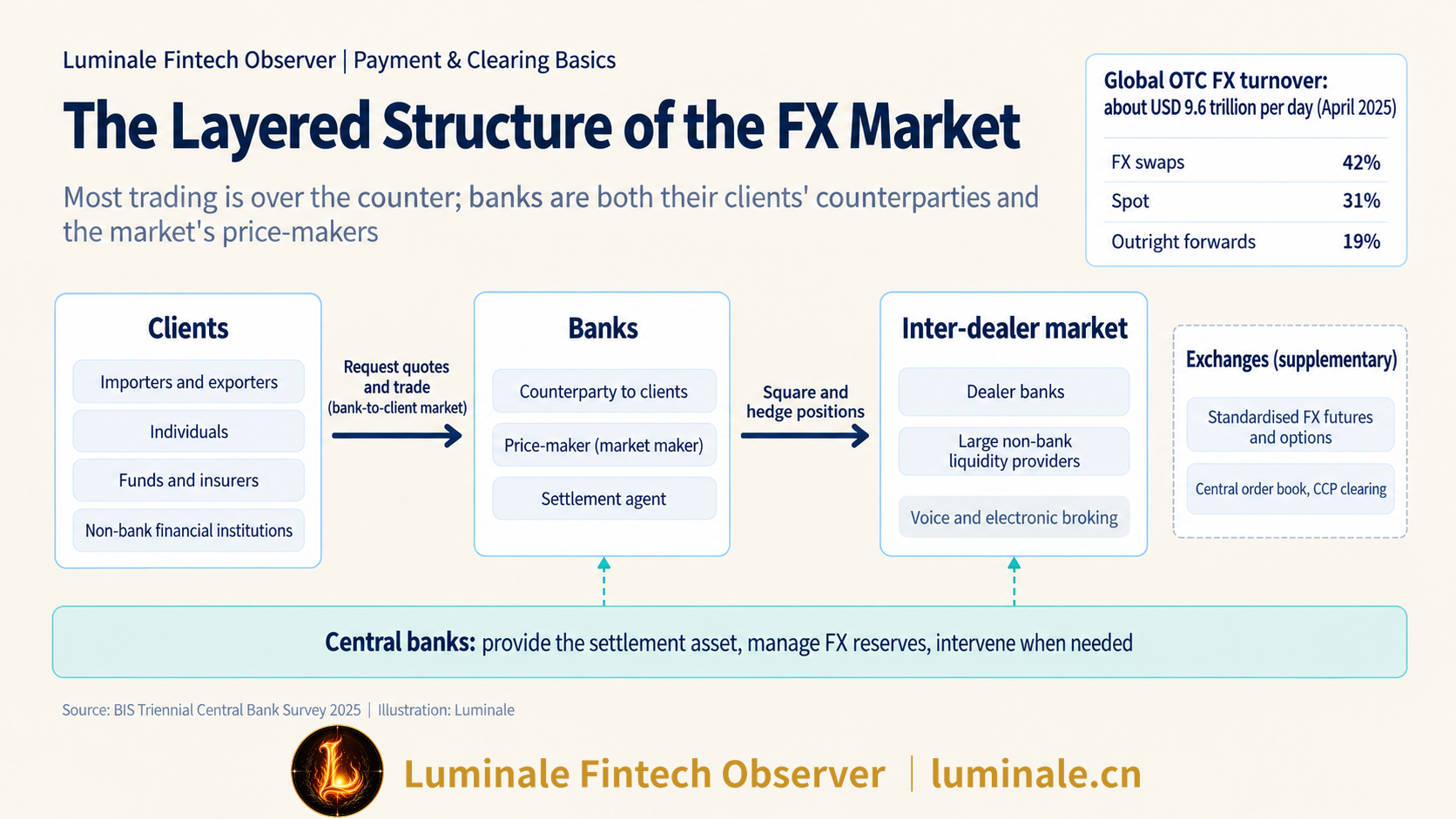
The FX market is one of the largest financial markets in the world by turnover. The Bank for International Settlements (BIS) runs a global survey of FX and OTC derivatives markets every three years. The April 2025 survey found that average daily turnover in global OTC FX markets was about USD 9.6 trillion, up 28% from USD 7.5 trillion in 2022[1].
No centralised matching venue like a stock exchange handles turnover of that size. The vast majority of FX trades are done over the counter (OTC): the two sides negotiate the price and trade directly, and each bears the other's credit risk. FX trading is OTC because of how the trades themselves are structured.
When a USD/CNY trade is delivered, the dollars have to be transferred within the dollar system and the renminbi within the renminbi system. The two legs sit in two countries'account systems, and there is no global account anywhere that can record both currencies at once. Large commercial banks hold accounts in both systems and can pay and receive both currencies for their clients. Companies also need different amounts, tenors and delivery dates, which are hard to fit into standard contracts. Over time, the FX market grew into a bank-centred structure. Banks are their clients'counterparties, the market's price-makers, and their clients'settlement agents.
2. The Tiers of Market Participants
By participant, the FX market roughly divides into three tiers.
| Tier | Main participants | How they trade |
|---|---|---|
| Customer tier | Importers and exporters, individuals, funds, insurers, non-bank financial institutions | Request quotes from banks and trade in the bank-to-customer market |
| Dealer tier | Market maker banks, large non-bank liquidity providers | Quote to each other and trade in the inter-dealer market to hedge positions |
| Central banks | Central banks and monetary authorities | Provide the domestic settlement asset, manage FX reserves, and intervene in the market when needed |
Customers rarely trade directly with each other. A company that needs to convert currency goes to its own bank. When the bank takes on the client's order, its own FX position changes, so it goes to the inter-dealer market to offset that position with other banks. The inter-dealer market used to run mainly on telephone quotes; most of it now trades on electronic brokerage platforms. Bank-to-customer trades are also increasingly done on multi-bank platforms or on single banks'electronic channels. In recent years, some large non-bank firms quoting with algorithms have also joined the ranks of market makers.
3. Exchange Trading Is a Supplement
FX is also traded on exchanges. FX futures and options at the Chicago Mercantile Exchange (CME), USD/CNH futures at Hong Kong Exchanges and Clearing, and USD/CNH futures at the Singapore Exchange are all standardised exchange-listed contracts.
Exchange-traded contracts have standardised amounts and expiry dates. They are matched centrally on the exchange and cleared by a central counterparty (CCP), with gains and losses marked to market and margin collected and paid every day. The two sides therefore do not bear each other's credit risk directly, which makes hedging in standard sizes convenient. But a company that wants to lock in the rate for a specific amount on a specific day will struggle to match that with a standard contract. That is why exchange trading is far smaller than OTC trading in the FX market.
Mainland China does not yet have FX futures. In October 2026, the China Financial Futures Exchange said it was preparing a pilot for renminbi FX futures in line with the overall plan of the China Securities Regulatory Commission[2].
4. Onshore and Offshore
The renminbi has two market prices. Onshore renminbi (CNY) is traded in the domestic interbank FX market and is subject to Chinese FX administration rules. Offshore renminbi (CNH) is traded in markets outside the mainland such as Hong Kong, Singapore and London, and its price is set by offshore supply and demand. They are the same currency with different trading venues and regulatory arrangements. Their prices are usually very close, but the spread can widen when markets are volatile.
For currencies whose capital accounts are not fully open, there is also an offshore non-deliverable forward (NDF) market. At maturity, the two sides do not exchange principal in the two currencies. They only settle the difference between the agreed rate and the reference rate at maturity, in a freely convertible currency such as US dollars.
5. A Market That Runs as a Relay Around the Clock
Over one trading day, the FX market passes from time zone to time zone, starting in Wellington and Sydney, moving through Tokyo, Singapore and Hong Kong, and on to London and New York. The BIS 2025 survey found that the United Kingdom is the largest FX trading centre, with about 38% of global turnover; trading desks in the UK, the US, Singapore and Hong Kong together account for about 75%[1].
Since 3 January 2023, China's interbank renminbi FX market has traded from 9:30 to 3:00 the next day Beijing time, with all products (spot, forwards, swaps, cross-currency swaps and options) trading continuously. This covers the whole London day and the New York morning[3].
For the overall division of labour among financial market infrastructures, see this column's What Does Financial Infrastructure Include? Understanding the Systems Behind Payment, Clearing, and Settlement. For more background on the offshore renminbi market and cross-border use of the renminbi, see RMB Internationalization is More than "Settling in RMB": A Cross-Border Financial Infrastructure is Taking Shape.
II. Spot, Forwards, Swaps, Cross-Currency Swaps and Options: What Each of the Five Trade Types Solves
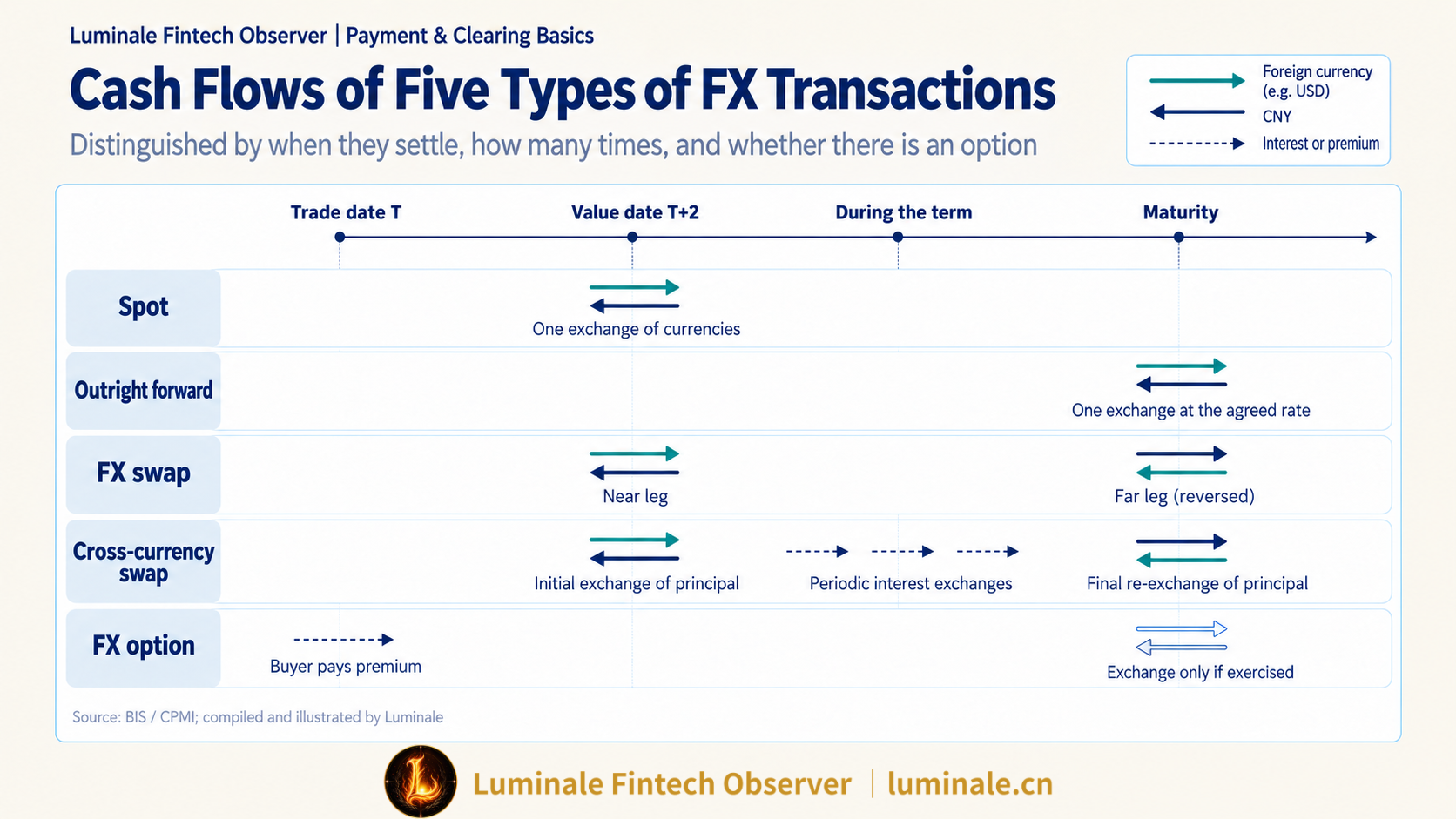
FX trades can be classified by asking three questions: when is the trade delivered, how many times is it delivered, and does the buyer have a choice? Based on those three questions, the common trades fall into five types. The examples below continue with the same exporter. For ease of calculation, assume a USD/CNY spot rate of 7.1000, a three-month US dollar interest rate of 4.0% a year and a renminbi rate of 1.5% a year.
1. Spot: The Money Is Needed Now
A spot trade is delivered shortly after it is agreed. The international convention is delivery on the second business day after the trade date, written as T+2, and the delivery day is called the value date. A few currency pairs, such as USD/CAD, settle on T+1. The value date has to be a business day in both currencies'home markets; if it falls on a US public holiday, the dollar leg cannot settle and the value date is pushed back.
T+2 is a legacy of earlier times, when confirming trades across time zones and arranging funds took time. When a company converts or buys currency at a bank counter, the bank usually credits the account the same day; that is a service arrangement between bank and customer. Spot trades between banks still settle according to value date rules.
A spot trade goes through roughly four steps. First a quote is requested, then the trade is done, then it is confirmed, with both sides checking the amount, rate, value date and receiving accounts through messages from the Society for Worldwide Interbank Financial Telecommunication (SWIFT) or a trading platform. On the value date, each side pays out one currency.
The USD 1 million the company received at the start of the month is converted at 7.1000 into CNY 7.1 million. Importers buying dollars to pay for goods and families buying currency to pay overseas tuition fees also use spot trades.
2. Forwards: Fix the Price Now, Exchange the Money Later
An outright forward fixes a future date and an exchange rate when the trade is agreed, and is delivered at that rate on that date. The company that will receive USD 1 million in three months can sign a three-month forward with its bank now, fixing the rate at which it will sell those dollars.
How is the forward rate set? It is determined by the spot rate and the interest rate differential between the two currencies, a relationship known as covered interest rate parity. Once the bank has signed the forward with the company, it will receive dollars and pay out renminbi in three months. The bank can borrow dollars today, sell them spot for renminbi, deposit the renminbi for three months, and repay the dollar loan with the dollars the company delivers at maturity. Through this round trip, the forward price equals the spot price adjusted for the difference between the interest paid on the dollars borrowed and the interest earned on the renminbi deposited over three months.
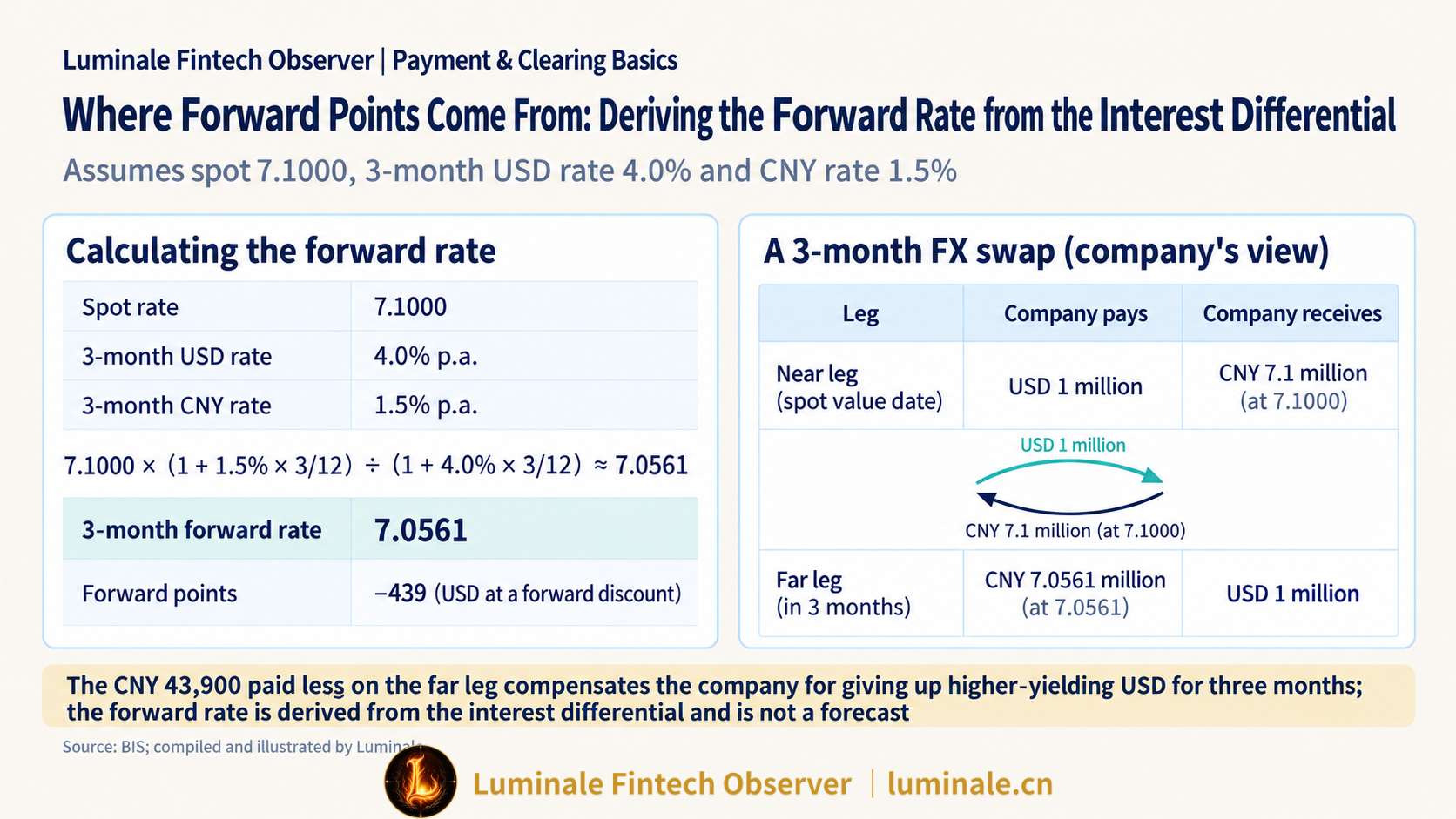
Under the assumptions above, the forward rate is calculated as follows.
Forward rate = 7.1000 × (1 + 1.5% × 3/12) ÷ (1 + 4.0% × 3/12) ≈ 7.0561
The forward rate is 0.0439 below the spot rate, which the market describes as forward points of −439. The higher-yielding dollar trades at a forward discount, and the lower-yielding renminbi at a forward premium.
At maturity, the company hands the USD 1 million to the bank and receives CNY 7,056,100 at 7.0561, whatever the spot rate is at that time. In China, banks require companies to have a genuine trade or investment background before doing forward FX sales or purchases with them.
3. FX Swaps: Exchange Now, Exchange Back at Maturity
An FX swap consists of two trades in opposite directions. The near leg exchanges currencies at the spot rate or a rate for a near date, and the far leg exchanges them back at the forward rate. The two legs usually have the same principal, and the difference between the near and far rates is the swap points.
The company, which has USD 1 million it does not need for now and will be short of renminbi next quarter, can do a three-month swap. The payments on the two legs are shown below.
| Leg | Date | Company pays | Company receives |
|---|---|---|---|
| Near leg | Spot value date | USD 1 million | CNY 7.1 million (at 7.1000) |
| Far leg | Three months later | CNY 7,056,100 (at 7.0561) | USD 1 million |
The trade is equivalent to the company borrowing renminbi for three months against USD 1 million of collateral, then repaying the renminbi and taking back its dollars at maturity. The company receives CNY 7.1 million on the near leg and only has to pay CNY 7,056,100 on the far leg, a difference of CNY 43,900. The company gives up dollars earning 4.0% in exchange for renminbi earning 1.5%, and the CNY 43,900 compensates it for the interest it forgoes by handing over its dollars for three months. The swap points reflect precisely the interest rate differential between the two currencies.
FX swaps make up the largest share of global FX turnover, about 42% in 2025[1]. They have three main uses.
- Banks managing positions and maturities in each currency. Over the day, banks carry out a large volume of currency conversion for clients, leaving them long in one currency and short in another. They can use swaps to rebalance funding without changing their exchange rate exposure.
- Cross-currency funding. An institution that holds domestic currency but needs dollars can borrow dollars through a swap. A December 2022 BIS study estimated that non-US non-banks had about USD 25 trillion of dollar payment obligations through FX swaps, forwards and currency swaps, and non-US banks over USD 35 trillion. Under derivatives accounting rules, these obligations are not recorded on balance sheets and do not show up in standard debt statistics[4].
- Companies rolling forward contracts. If a forward matures before the payment from the customer has arrived, the company can use a swap to push back the delivery date.
4. Cross-Currency Swaps: Longer Tenors, with Interest Payments Exchanged Too
A cross-currency swap has a similar name to an FX swap but a different structure. In a cross-currency swap, the principal is exchanged at the start; during the life of the swap, the two sides periodically exchange interest in the two currencies at agreed rates (fixed or floating); and at the end, the principal is exchanged back at the initial exchange rate. Tenors are usually more than one year.
A typical example is a Chinese company that has issued a five-year US dollar bond overseas while all its revenue is in renminbi. It can do a five-year cross-currency swap that turns the dollar interest it pays each period and the dollar principal it repays at maturity into cash flows that accrue interest and are repaid in renminbi. The debt effectively becomes a renminbi debt.
Bilateral local currency swap arrangements between central banks are a different thing from the cross-currency swaps described here. A bilateral swap line is a liquidity arrangement between two central banks, used when needed to provide the other country's currency to domestic financial institutions. It is different in nature from the cross-currency swaps that companies and banks trade.
5. Options: Pay a Premium, Buy the Right to Choose
The buyer of an FX option pays a premium in exchange for the right to buy or sell a currency at an agreed rate (the strike) on the expiry date. If the exchange rate has moved against the buyer at expiry, the buyer exercises; if it has moved in the buyer's favour, the buyer lets the option lapse. An exporter that buys a US dollar put option is effectively setting a floor on its conversion rate in three months; if the dollar strengthens, it can still convert at the better market rate.
Option pricing requires volatility, which this article does not cover. The April 2025 survey showed that global FX options turnover had more than doubled over three years[1]. When companies lose money on options, it is mostly through complex option structures. In the past, some companies bought so-called zero-cost structured products with embedded options that the company had sold to the bank; when exchange rates swung sharply, the losses far exceeded the value of the trade payments themselves. Companies are on much safer ground when they keep option amounts and tenors within their genuine FX receipts and payments.
6. Side by Side in One Table
| Trade type | Number of deliveries | Interest exchanged? | Common tenor | Main problem solved | Typical users |
|---|---|---|---|---|---|
| Spot | 1 | No | T+2 (a few pairs T+1) | Need the other currency now | Company receipts and payments, individual conversions, bank position closing |
| Forward | 1 | No | A few days to more than a year | Lock in a future conversion price in advance | Importers and exporters, investment institutions |
| FX swap | 2, in opposite directions | No; the rate differential is in the swap points | Overnight to one year | Position management, cross-currency funding, rolling forwards | Banks, institutional investors, companies |
| Cross-currency swap | 1 at the start and 1 at the end, with interest in between | Yes | Usually more than one year | Turn long-term debt or assets in one currency into another currency | Bond-issuing companies, banks |
| Option | 1 on exercise | No | A few weeks to one year | Lock in a worst-case price while keeping upside from favourable moves | Importers and exporters, institutional investors |
Trade confirmations currently rely mainly on SWIFT FX confirmation messages such as MT300. For the related message standards and migration, see What Is ISO 20022? Understanding the Common Language of Next-Generation Payment Infrastructure. All five types of trade run into the same problem at delivery. The two currencies have to be paid out separately in two systems, so who pays first? That question is taken up in Section IV.
III. Where Exchange Rates Come From: What Drives Them Over Time and Who Quotes Them Minute by Minute
1. Influences on Different Time Scales
Economics has many theories of exchange rates, and they are easier to follow when laid out by time horizon.
- In the long run, relative prices matter. The same basket of goods should cost roughly the same in two countries, which is called purchasing power parity (PPP). It can give a rough long-term direction for exchange rates, but rates often deviate from it for years at a time.
- In the medium term, interest rate differentials and capital flows matter. When one country's interest rates rise relative to others, money flows in and pushes up demand for its currency. The covered interest rate parity discussed in Section II only governs the price relationship between spot and forward; how capital moves between currencies also depends on risk, controls and expectations.
- The balance of payments. Exporters selling FX, importers buying FX, and foreign capital flowing in and out all end up as supply and demand in the FX market.
- In the short run, expectations and risk sentiment matter. Changing views on policy, economic data and geopolitical events can move exchange rates sharply within minutes or days.
These factors work at the same time and their weights keep changing, so no formula can predict exchange rates. For how the balance of payments is split into the current account and capital account, and how these turn into FX supply and demand, see From Current Account to Capital Account: How Cross-Border Capital Is Classified.
2. Prices Are Formed in Trading
Minute by minute, exchange rates are quoted by market makers and formed through trades. A market maker quotes a bid price and an offer price at the same time, and the gap between them is the spread. The size of the spread depends on the liquidity of the currency pair, how volatile the market is at the time, and the risk the market maker takes on. As client buy and sell orders keep coming in, the market maker's position changes, so it adjusts its quotes and hedges in the inter-dealer market. Thousands of such quotes and trades layered on top of one another make up the continuously moving exchange rate in the market.
The market also has benchmark rates used for valuation, settling derivatives and calculating indices. A widely used one is the WM/Reuters fix at 4 pm London time.
3. The Renminbi Central Parity and the Trading Band
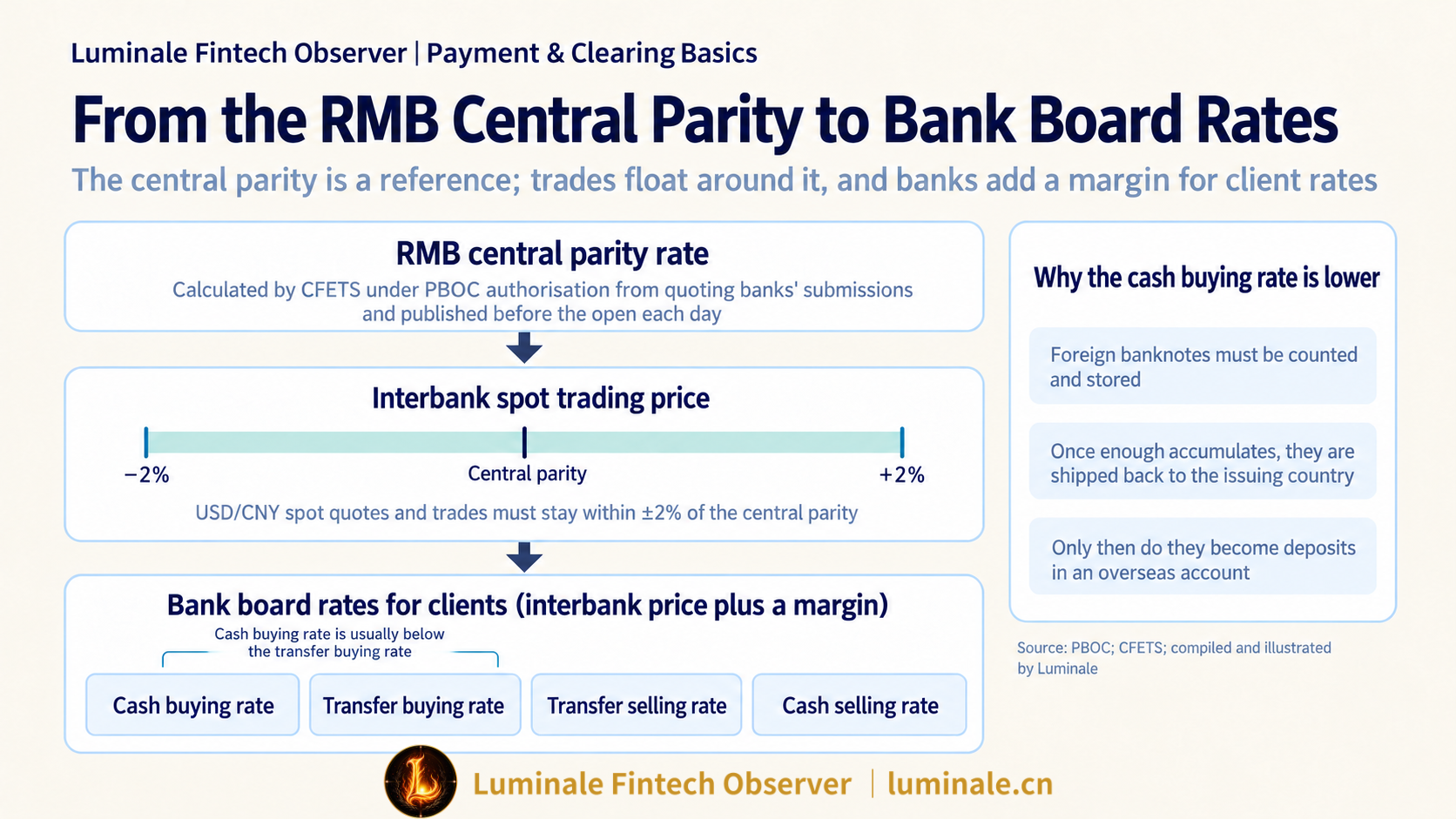
China operates a managed floating exchange rate regime based on market supply and demand and adjusted with reference to a basket of currencies. Before the market opens each trading day, the China Foreign Exchange Trade System (CFETS) calculates and publishes the central parity rates of the renminbi against the US dollar and other currencies, based on quotes from central parity quoting banks. The Regulations on the Administration of the Interbank Foreign Exchange Market, in force from February 2026, state that CFETS, as authorised by the People's Bank of China, calculates, forms and publishes the renminbi central parity based on quotes from qualifying financial institutions, and that participating institutions may not share their central parity quotes with others[5].
The central parity quoting mechanism has been adjusted several times. From 11 August 2015, quoting banks based their quotes on the previous day's interbank closing rate. From 2016, a quoting mechanism of "closing rate plus changes in a basket of currencies" took shape. In May 2017, a counter-cyclical factor was introduced into the quoting model to offset pro-cyclical swings in market sentiment[6]. From October 2020, quoting banks gradually phased out the counter-cyclical factor[7].
The central parity is a reference benchmark, and actual interbank trades move up and down around it. The Regulations on the Administration of the Interbank Foreign Exchange Market provide that interbank spot prices are subject to a maximum daily fluctuation band: quotes and trades may not go beyond a certain range above or below the central parity, with the range set and published by the People's Bank of China[5]. Under the rules in force since 2014, the band for the renminbi against the US dollar is 2% above or below the central parity[8].
4. From Interbank Prices to Bank Board Rates
The rates that companies and individuals see posted at banks are formed by adding a margin to interbank market prices. The People's Bank of China allows banks to set their own posted rates for the renminbi against other currencies based on market demand and their pricing capacity[8]. A bank's rate board usually shows four prices.
| Board rate | Meaning | Example |
|---|---|---|
| Transfer buying rate | The bank buys foreign currency deposits in the client's account or incoming remittances from abroad | Converting a US dollar remittance received from abroad |
| Cash buying rate | The bank buys foreign banknotes from the client | Taking US dollar notes to the counter to change into renminbi |
| Transfer selling rate | The bank sells foreign currency to the client, credited to the client's FX account or remitted directly | Buying currency and wiring tuition fees |
| Cash selling rate | The bank sells foreign banknotes to the client | Withdrawing US dollar cash at the counter before travelling abroad |
The cash buying rate is usually lower than the transfer buying rate. When a bank takes in foreign banknotes, it has to count and store them, and once enough have built up, ship them back to the issuing country before they can become deposits in a bank account abroad. All these costs are built into the price. Transfer funds are already deposits in the bank's overseas accounts, so the handling cost is much lower.
5. The Role of the Central Bank
A central bank can buy and sell FX directly in the market. When it does, its FX reserves and its domestic currency liabilities change at the same time. For the accounting behind this, see Understanding What a Central Bank Does Through Its Balance Sheet and Balance Sheet Logic of Monetary Policy Tools: Reserves Quantity, Price, and Constraints.
Central banks also have macroprudential tools that influence FX supply and demand by changing the cost of certain kinds of trades. The FX risk reserve on forward FX sales is one example. With a reserve ratio of 20%, a bank had to hold USD 20 interest-free at the central bank for every USD 100 of forward FX it sold, and that cost was passed on in the forward rate companies paid to buy dollars. In September 2022, the People's Bank of China raised this ratio to 20%; on 27 February 2026 it announced a cut to 0 effective 2 March[9]. The required reserve ratio on FX deposits and the macroprudential adjustment parameter for cross-border financing are also tools of this kind. They change the cost of trading, while exchange rates are still formed through market trading.
IV. After the Trade: Confirmation, Clearing, Settlement and the Division of Regulatory Roles
1. Four Post-Trade Steps
Once an FX trade is done, it still has to go through several steps before it is complete.
| Step | What happens | Who does it |
|---|---|---|
| Execution | The two sides agree on the amount, rate and value date | Trading platform or the two sides'traders |
| Confirmation | The two sides check the trade details and the paying and receiving accounts | Trading platform, SWIFT messages or confirmation matching services |
| Clearing | Calculating what each side owes and is owed on the value date, either trade by trade bilaterally or centrally through a CCP or netting service | The two counterparties, or a clearing house |
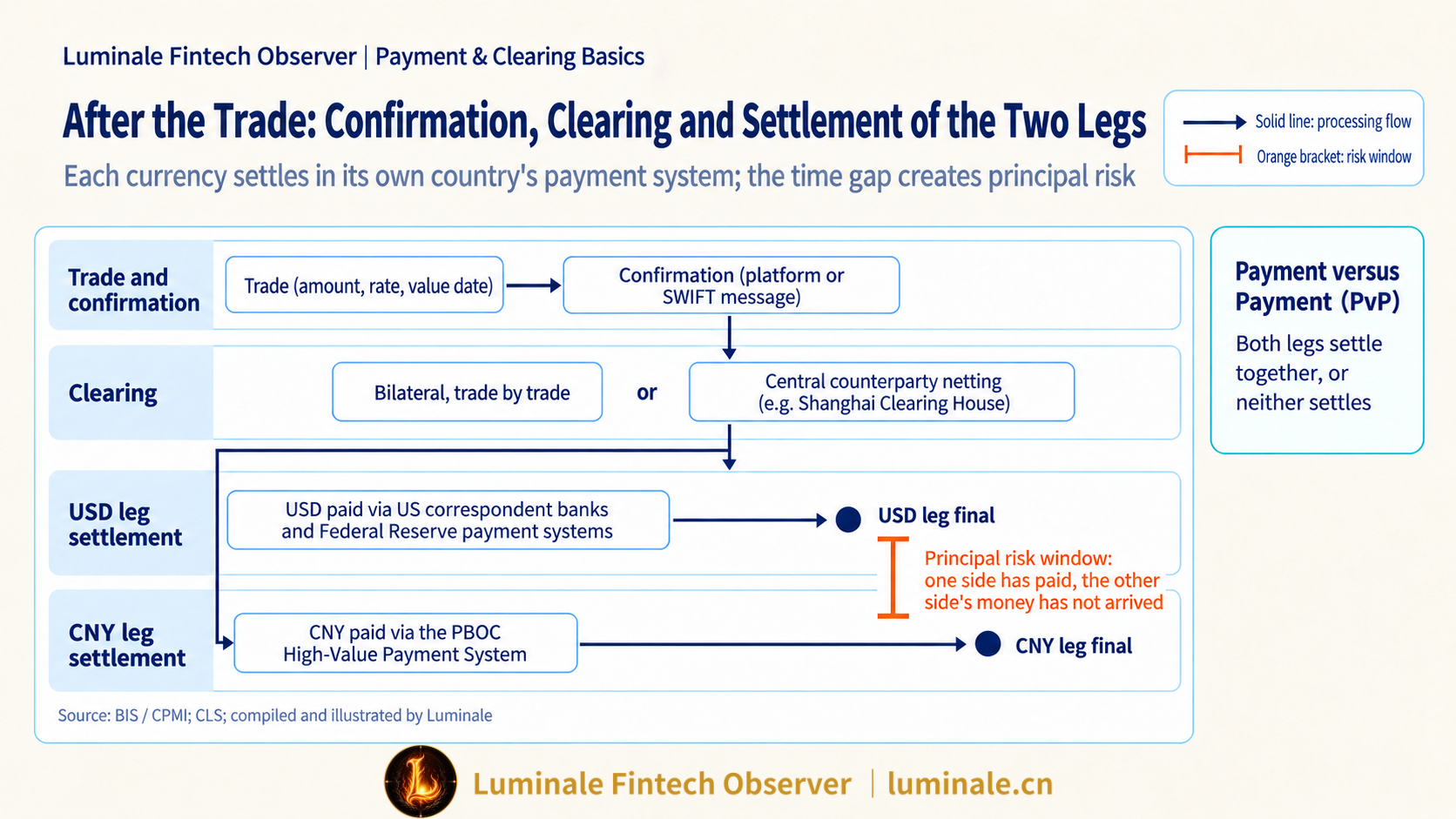
| Settlement | The two currencies are finally transferred in their own payment systems | Each country's payment system and correspondent banks |
Settlement happens in two places. The dollar leg ends up on US bank accounts, with large-value dollar payments settling between banks through the Federal Reserve's payment systems. The renminbi leg ends up on Chinese bank accounts, with interbank settlement through the People's Bank of China's High Value Payment System (HVPS). When each leg becomes irrevocable is determined by the rules of its own payment system; for the related concepts, see Can a "Successful Payment" Be Reversed? What Risks Does Settlement Finality Solve?.
The two legs are completed separately in two time zones and two systems, possibly hours apart. If one side has already paid out its currency and the other side's currency has not yet arrived, and the counterparty fails at that moment, the principal already paid may be lost entirely. This is principal risk in FX settlement. After the collapse of Germany's Bankhaus Herstatt in 1974, it also became known as Herstatt risk.
The solution is payment versus payment (PvP): the two legs are completed together only when both can be completed, and if one cannot, the other does not move either. The world's largest FX PvP settlement institution is CLS Bank International. How principal risk arises, how PvP works and how CLS operates are covered in detail in What Is the Most Dangerous Moment in FX? Why PvP Is the Market's "Payment-versus-Payment", so they are not repeated here. CLS currently settles 18 currencies, and the renminbi is not one of them[10]. According to media reports, CLS is planning to launch a USD/CNH settlement session in Hong Kong, with timing subject to regulatory approval[11]. A large volume of FX trades outside CLS are still settled separately by the two counterparties through correspondent bank accounts, with principal risk managed through credit limits and settlement arrangements between them.
CLS requires participants to pay in funds at set times, which concentrates banks'intraday liquidity needs at those points. For more on this, see When Banks Run Short in RTGS, Where Does the Money Come From? Sources of Intraday Liquidity.
2. International Regulation and Self-Regulation
The FX market spans every major currency and financial centre, yet there is no single global regulator. Current arrangements fall roughly into three layers.
The first layer is supervision by jurisdiction. Each country's central bank and financial regulators supervise the banks, trading platforms and trading conduct in their own jurisdiction. Some important FX infrastructures are overseen cooperatively by several central banks. CLS, for example, is overseen by a group led by the US Federal Reserve together with the central banks of the currencies it settles, and is assessed against the Principles for Financial Market Infrastructures (PFMI). For the content of the PFMI, see Reading the PFMI: The Lines Financial Market Infrastructures Must Hold Behind the 24 Principles.
The second layer is codes of conduct. Central banks and market participants jointly set up the Global Foreign Exchange Committee (GFXC), which published the FX Global Code in 2017, covering ethics, governance, execution, information sharing, risk management and settlement. The December 2024 revision updated 5 of the 55 principles, with one focus on FX settlement risk and another on transparency in how electronic trading platforms use client data[12]. The Code has no legal force; it relies on market participants voluntarily signing statements of commitment, and supervisors refer to it in their examinations.
The third layer is the OTC derivatives reforms that followed the 2008 financial crisis. FX derivatives trades have to be reported to trade repositories (TR). Physically settled FX swaps and forwards have not been brought under mandatory central clearing in some jurisdictions. In 2012, the US Treasury decided to exclude these two types of trade from the definition of swaps under the Commodity Exchange Act; they still have to be reported and are subject to business conduct rules[13].
3. Trading, Clearing and Settlement in China's Interbank FX Market
The domestic interbank FX market has a clear legal framework. The Regulations on the Administration of the Interbank Foreign Exchange Market (PBOC Order No. 13 [2025]), in force from 1 February 2026, replaced the 1996 interim provisions. The main arrangements are as follows[5].
- Trading venue. The interbank FX market is the market for trading renminbi against foreign currencies through CFETS. Renminbi FX trades between domestic financial institutions licensed for currency conversion business must be conducted through CFETS. Products include spot, forwards, FX swaps, cross-currency swaps and options, and trading methods include bilateral quotation, auction and order matching.
- Clearing. Domestic financial institutions may choose bilateral clearing or central clearing through Interbank Market Clearing House Co., Ltd. (Shanghai Clearing House). CFETS and Shanghai Clearing House organise trading and clearing respectively, and manage institutions'trading and clearing eligibility respectively.
- Market maker system. The interbank FX market operates a market maker or quoting bank system, and market makers must provide continuous bid and offer quotes. Domestic financial institutions can close out positions arising from currency conversion business in the interbank market.
- Post-trade processing. Financial institutions should complete trade confirmation as soon as possible after a trade is done, and may decide for themselves whether to use risk mitigation services such as trade compression and payment versus payment.
- Internal management. Financial institutions must separate front, middle and back offices, and must sign a derivatives master agreement with counterparties before trading renminbi FX derivatives.
When an institution chooses central clearing at Shanghai Clearing House, Shanghai Clearing House steps in between the two counterparties as CCP, nets each institution's receivables and payables, collects margin according to risk, and manages a clearing fund. For the role of a CCP, see What Does a CCP Actually Solve? Starting with Counterparty Risk. Interbank renminbi transfers go through the People's Bank of China's HVPS. For where HVPS sits in China's payment system, see From Bank Cards to NUCC, UnionPay & HVPS: A Comprehensive Map of China's Payment System; for why it settles each payment individually and in full, see Why Don't Payment Systems Settle Every Payment Immediately? Understanding RTGS and DNS. Foreign currency funds go through the domestic foreign currency payment system or through banks'correspondent accounts abroad.
4. China's Division of Regulatory Roles
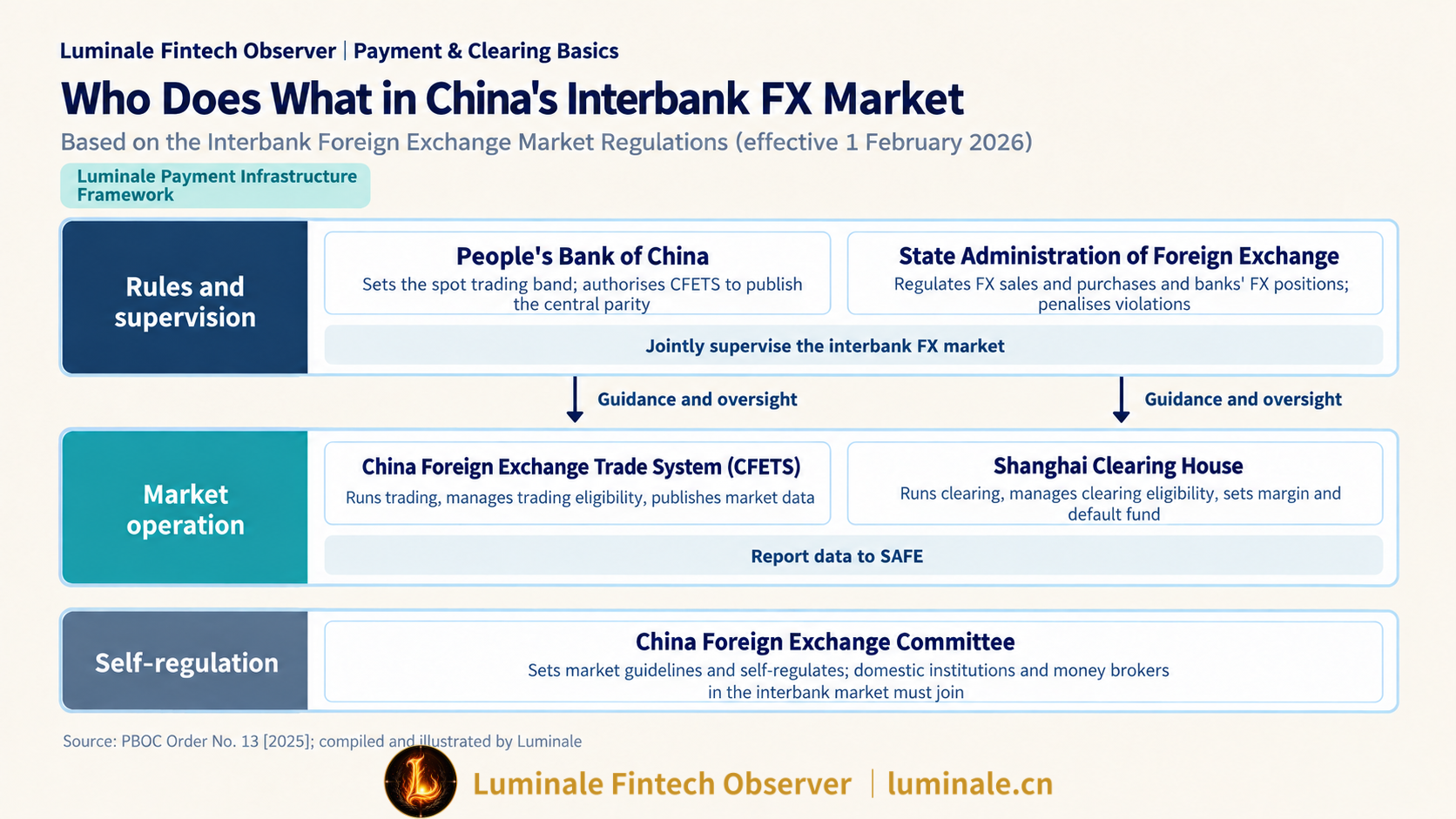
In Luminale's payment infrastructure analysis framework, the governance of the domestic FX market can be viewed in three layers: rule-making, market operation and industry self-regulation.
| Layer | Institutions | Main responsibilities |
|---|---|---|
| Rule-making and supervision | People's Bank of China, State Administration of Foreign Exchange | Jointly supervise the interbank FX market; the PBOC sets the spot trading band and authorises CFETS to publish the central parity; SAFE manages currency conversion business and banks'conversion positions, and penalises violations |
| Market operation | CFETS, Shanghai Clearing House | Organise trading and clearing respectively, set business rules, manage trading and clearing eligibility, publish market and clearing information, and report data to SAFE |
| Industry self-regulation | China Foreign Exchange Market Self-Regulatory Framework | Drafts FX market codes and carries out self-regulation; domestic financial institutions and money brokers participating in the interbank FX market should all join |
5. How a Currency Conversion Moves Through a Bank's Books
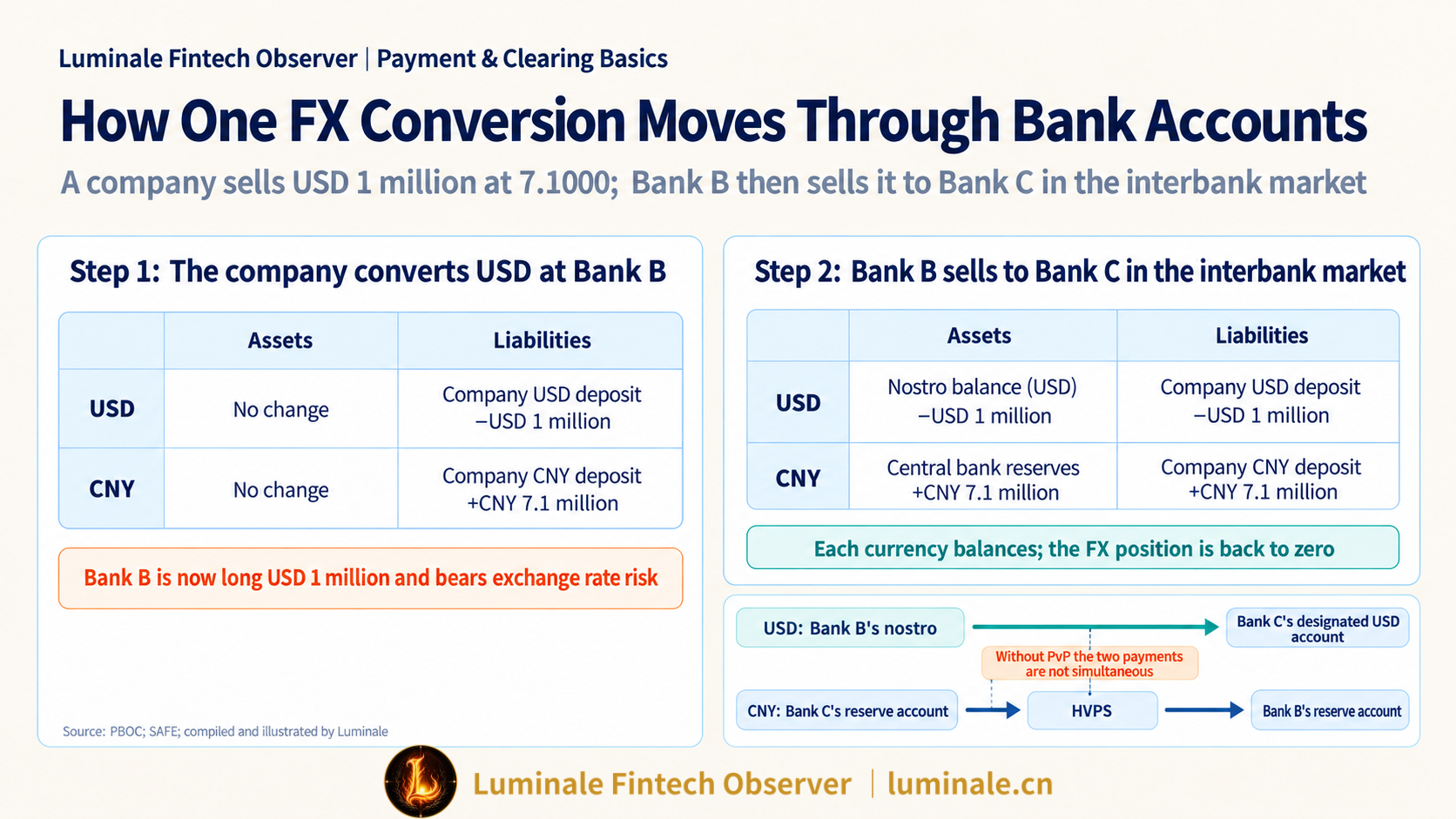
Back to the exporter. It holds a US dollar account and a renminbi account at Bank B, and at the start of the month converted USD 1 million at 7.1000. Bank B takes on the trade and then sells USD 1 million to Bank C in the interbank market to close out its own position. For how to read T-accounts, see Bank accounting quick start.
Step 1: the company converts its dollars at Bank B.
| Bank B | Assets | Liabilities |
|---|---|---|
| US dollars | Unchanged | Company USD deposit −USD 1 million |
| Renminbi | Unchanged | Company CNY deposit +CNY 7.1 million |
Step 2: Bank B sells USD 1 million to Bank C in the interbank market, and on the value date the two legs settle separately.
| Bank B | Assets | Liabilities |
|---|---|---|
| US dollars | Due from overseas banks (USD) −USD 1 million | Company USD deposit −USD 1 million (Step 1) |
| Renminbi | Central bank reserves +CNY 7.1 million | Company CNY deposit +CNY 7.1 million (Step 1) |
V. How Companies and Individuals Convert Currency: Currency Conversion Business and the Link Between FX Trading and Cross-Border Payments
1. FX Business for Companies
Companies and individuals cannot access the interbank FX market. To convert currency they go to a bank and trade in the bank-to-customer market; this business is called currency conversion, covering both the sale of foreign currency to banks and its purchase from them. Banks take on client demand in the middle and then close out in the interbank market.
To handle FX receipts and payments under trade, a company must first register in SAFE's list of enterprises for trade-related FX receipts and payments. When payment arrives from abroad, it goes into the company's FX account first; the company can keep the foreign currency as needed or convert it at any time. When paying for imports, the company submits materials that show the trade is genuine, such as contracts, invoices and customs declarations, and the bank reviews them before buying and remitting the currency. Banks follow the "know your customer, know your business, conduct due diligence" principle in their reviews; specific document requirements and facilitation measures follow SAFE's current rules.
For derivatives such as forwards, swaps and options, banks apply the actual-need principle to companies. A company must have a genuine trade or investment background, and the amount and tenor of its hedges must match its genuine FX receipts and payments. This requirement is meant to make companies use derivatives to manage exchange rate risk they already have, not to bet on the direction of exchange rates. Regulators have been promoting the idea of exchange rate risk neutrality for years, and in 2025 companies'FX hedge ratio rose to 30%, the highest since records began[14].
Banks take on several kinds of risk in client business. The FX position risk created by client conversions is passed on by closing out in the interbank market. If a client fails to perform a forward contract at maturity, that is credit risk, which banks usually manage by drawing on credit lines or collecting margin. Compliance and anti-money laundering risks are managed through authenticity reviews and transaction monitoring.
2. FX Business for Individuals
Individuals'currency sales and domestic individuals'currency purchases are subject to an annual facilitation quota: each person can sell and buy up to the equivalent of USD 50,000 a year each. Within the quota, an individual can go to a bank with valid personal ID; above the quota, proof of a genuine transaction is required. When buying foreign currency, an individual must fill in a Personal Foreign Exchange Purchase Application and truthfully declare the purpose. The money may not be used for capital account items that are not yet open, such as buying property abroad, investing in securities, or buying life insurance and investment-type insurance with returns or dividends, and individuals may not lend their quota to help others buy currency[15]. For more detail on the quota and balance of payments reporting, see From Current Account to Capital Account: How Cross-Border Capital Is Classified.
The facilitation quota only caps the amount of currency sold and bought; USD 50,000 is not an annual limit on how much an individual can send abroad. Remitting foreign currency already held in one's own account, or buying currency above the quota with genuine tuition or medical bills, are covered by separate rules.
Take a family paying tuition for a child studying in the US. There are roughly two steps. First, the parents buy dollars in the bank's app at the transfer selling rate, and the dollars are credited to their FX account. Then they wire the money from that FX account to the school's US account. The first step is an FX trade; the second step is a cross-border payment. If the parents want to take some US dollar cash before travelling, they have to pay the cash selling rate, which is somewhat more expensive than the transfer rate.
3. Where FX Trading Sits in Cross-Border Payments
A cross-currency cross-border payment usually involves two things: currency conversion and the cross-border transfer. Take a domestic company paying USD 1 million to a US supplier.
- The company buys dollars at its bank: its renminbi deposits fall and its dollar deposits rise. This is the FX trade.
- The bank pays the USD 1 million from the company's account to the US supplier's bank through its correspondent network. This is the cross-border payment.
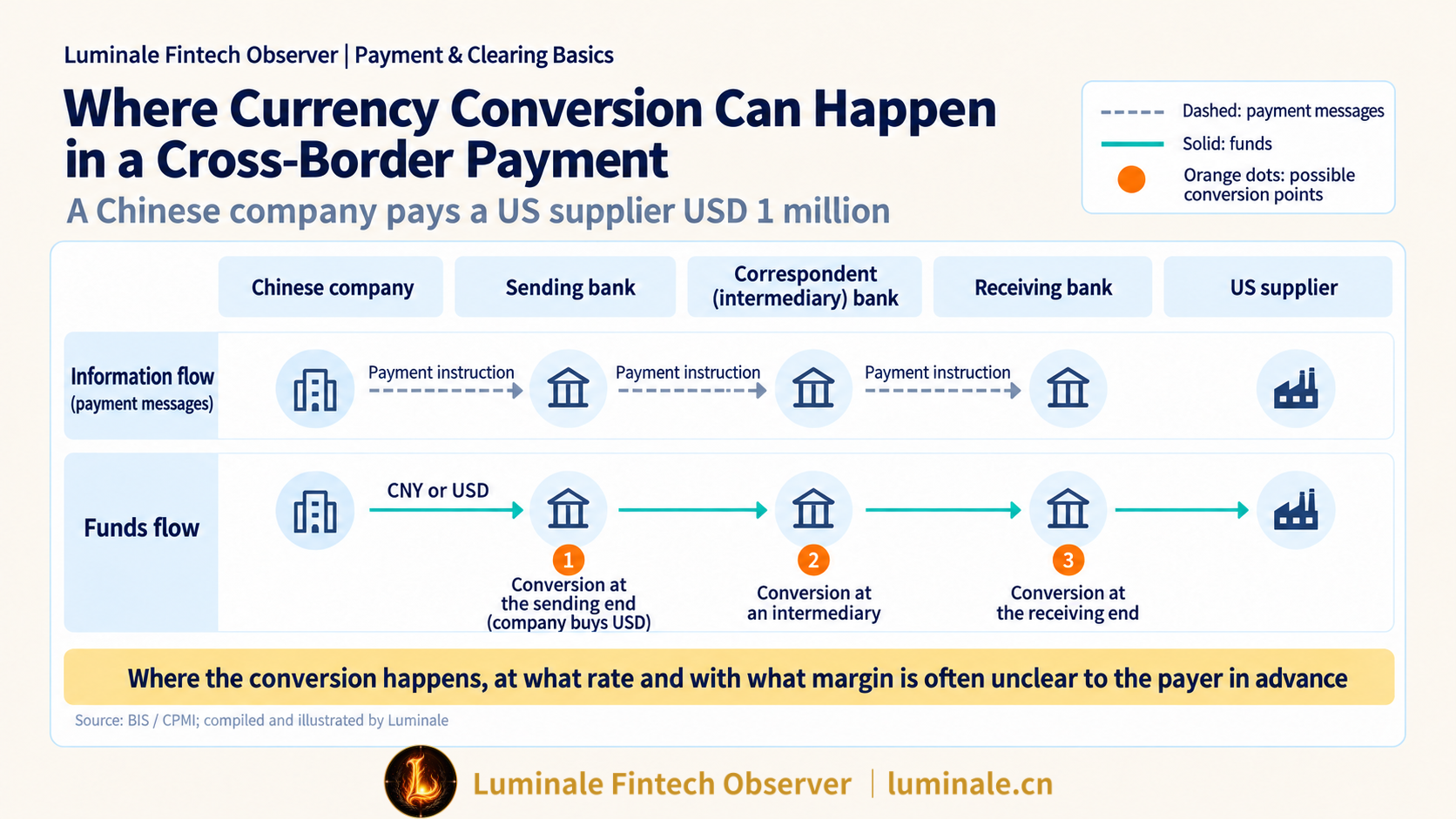
The conversion does not have to happen on the payer's side. The company could remit renminbi directly and let an intermediary or the receiving bank abroad convert it into dollars. As long as the currency the payee receives differs from the currency the payer pays, the conversion can happen at any bank along the chain. At which end the conversion happens, at what rate and with what margin are often unclear to the payer in advance. This is one reason cross-border payments are seen as expensive, slow and opaque, and the G20 roadmap for enhancing cross-border payments lists both FX conversion and PvP settlement as areas for improvement. For how correspondent banking networks work and the main routes of cross-border payments reform, see What Really Happens in a Cross-Border Payment? Correspondent Banking, SWIFT, and Global Payments Reform. For what happens after the money reaches the receiving country, see Money Has Reached the Destination Country, Why Does It Still Take Hours? The Real Cross-Border Payment Bottleneck Is Shifting to the "Last Mile". If the payment also uses a letter of credit, see this column's What Is a Letter of Credit? From Issuance, Presentation, and Examination to Final Payment for how documents and payment relate.
Cross-border renminbi settlement and local currency settlement arrangements remove the conversion that passes through the US dollar. For example, when two countries quote renminbi directly against each other's currency under a local currency trading framework, a company no longer needs to convert renminbi into dollars and then dollars into the other currency. An FX trade still has to be done, just without an intermediate currency. For background, see the section on local currency trading frameworks in RMB Internationalization is More than "Settling in RMB".
4. How Risk Moves Between the Layers
Connecting this chain from end to end shows how risk is passed outward step by step. A company faces exchange rate risk; it can bear it itself or pass it to a bank through forwards or options. A bank that takes on client orders takes on position risk and counterparty risk, and then hedges them in the interbank market. Settlement risk between dealers is reduced by arrangements such as CLS, PvP and CCP clearing. In 2025, total turnover in China's FX market reached USD 42.6 trillion[14]. Turnover on that scale builds up from layer upon layer of trades that pass on risk and hedge it.
Many of the experiments that the BIS and central banks have run with new technologies in recent years target particular steps in this chain.
Settlement has seen the most experiments. The Federal Reserve Bank of New York's Project Cedar, and Cedar×Ubin+ run with the Monetary Authority of Singapore, tested atomic settlement of FX trades on distributed ledgers, where a trade completes only when both legs can be completed[16]. Project Meridian FX, run by the BIS with the Bank of England and the Eurosystem, tested synchronised settlement between existing real-time gross settlement systems and several distributed ledger solutions[17]. Project Agorá, led by the BIS with seven central banks, used tokenised central bank reserves and commercial bank deposits to achieve atomic settlement of multi-currency cross-border payments[18].
Others are experimenting with pricing and conversion. The BIS's Project Mariana tested using an automated market maker (AMM) to price spot FX trades between wholesale central bank digital currencies[19]. Icebreaker and Nexus let several FX providers compete to quote for each cross-border payment[20]. Rialto connects an automated currency conversion module to interlinked fast payment systems, settling in central bank money.
At the end that faces individuals and companies, the Reserve Bank of India launched the FX-Retail platform in 2019, where retail clients can buy and sell US dollars against rupees directly on an electronic platform and see interbank spot prices[21]. Cross-boundary Payment Connect, launched in June 2025 by the People's Bank of China and the Hong Kong Monetary Authority, lets residents of the two places remit and convert currency in a single step[22].
Conclusion
Back to the exporter at the start of the month. The spot, forward and swap trades it did at its bank address three different needs: using money now, locking in an exchange rate, and managing liquidity. Behind that single quote on the screen sit market makers'prices, the central parity mechanism and the bank's spread. Once a trade is done, every one of them ends up as offsetting entries on bank accounts in two countries.
The FX market runs over the counter around banks because of how account systems work. Each currency can only be finally settled within its own account system, and the ones able to connect to both systems at once are mainly large banks holding multi-currency accounts and a few specialised settlement institutions. Trading can be electronic and algorithmic, and quotes can become more transparent, but as long as currencies and account systems are divided along national lines, FX trading cannot do without correspondent relationships, settlement arrangements across time zones, and regulatory coordination across jurisdictions. PvP, multilateral platforms, local currency settlement and tokenised settlement are all efforts to shorten the time gap between the two legs and shrink the credit exposure in between. As long as there is economic activity, the need to exchange one currency for another will remain.
References
[1]: BIS, Triennial Central Bank Survey of foreign exchange and over-the-counter (OTC) derivatives markets in 2025, press release, 30 September 2025. https://www.bis.org/press/p250930.htm ↩
[2]: East Money, "CFFEX: Steadily Advancing Preparations for a Renminbi FX Futures Pilot" (《中金所:正扎实推进人民币外汇期货试点准备工作》), 15 October 2026. https://finance.eastmoney.com/a/202610153896587612.html ↩
[3]: China Foreign Exchange Trade System, Notice on Extending the Trading Hours of the Interbank Foreign Exchange Market (《外汇交易中心关于延长银行间外汇市场交易时间有关事项的通知》), 30 December 2022. https://www.chinamoney.com.cn/chinese/rdgz/20221230/2526857.html ↩
[4]: Claudio Borio, Robert McCauley and Patrick McGuire, "Dollar debt in FX swaps and forwards: huge, missing and growing", BIS Quarterly Review, December 2022. https://www.bis.org/publ/qtrpdf/r_qt2212h.htm ↩
[5]: People's Bank of China, Regulations on the Administration of the Interbank Foreign Exchange Market (《银行间外汇市场管理规定》, PBOC Order No. 13 [2025]), published 16 December 2025, in force from 1 February 2026. https://nanjing.pbc.gov.cn/zhengwugongkai/attachDir/2025/12/2025122910541412031.pdf ↩
[6]: ChinaMoney, explanation of the introduction of a counter-cyclical factor into the RMB/USD central parity quoting model, 26 May 2017. https://www.chinamoney.com.cn/chinese/rdgz/20170526/1004571.html ↩
[7]: China Securities Journal, report on RMB/USD central parity quoting banks phasing out the counter-cyclical factor, 29 October 2020. https://cs.com.cn/lc/202010/t20201029_6106250.html ↩
[8]: People's Bank of China, Notice on Matters Relating to the Management of Interbank FX Market Trading Prices and Bank Posted Rates (《中国人民银行关于银行间外汇市场交易汇价和银行挂牌汇价管理有关事项的通知》), reposted on ChinaMoney. https://www.chinamoney.com.cn/chinese/zgrmyh/20140702/1002496.html ↩
[9]: Xinhua, "PBOC Cuts FX Risk Reserve Ratio on Forward FX Sales to 0 to Help Companies Manage Exchange Rate Risk" (《央行下调远期售汇业务外汇风险准备金率至0 支持企业管理好汇率风险》), 28 February 2026. https://www.news.cn/money/20260228/74fadefbcb9142ebbd61b3cbdd056224/c.html ↩
[10]: CLS Group, CLSSettlement: Currencies. https://cls-group.com/products/settlement/clssettlement/currencies ↩
[11]: The Full FX, "CLS Proposes USD/CNH Settlement Session in HK", July 2026. https://thefullfx.com/cls-proposes-usd-cnh-settlement-session-in-hk/ ↩
[12]: Global Foreign Exchange Committee, "GFXC updates FX Global Code and enhances Disclosure Cover Sheets for Liquidity Providers and Platforms", press release, 24 January 2025. https://www.globalfxc.org/press-p250124/ ↩
[13]: U.S. Department of the Treasury, "Fact Sheet: Final Determination on Foreign Exchange Swaps and Forwards", November 2012. https://home.treasury.gov/news/press-releases/tg1773 ↩
[14]: Xinhua, "Xinhua Fresh Report: Multiple Record Highs as the FX Market Stays Resilient and Active in 2025" (《新华鲜报丨多个新高!2025年外汇市场保持韧性与活力》), 15 January 2026. https://www.news.cn/fortune/20260115/20a09855812b467ea377c1286f15546a/c.html ↩
[15]: State Administration of Foreign Exchange Xiamen Branch, explanatory material on personal FX business, October 2021. https://www.safe.gov.cn/xiamen/file/file/20211022/f4794075e84e40dd9394be523a52731b.pdf ↩
[16]: Federal Reserve Bank of New York and Monetary Authority of Singapore, "Project Cedar Phase II x Ubin+: Improving wholesale cross-border multi-currency payments and settlements", May 2023. https://www.newyorkfed.org/medialibrary/media/nyic/project-cedar-phase-two-ubin-report.pdf ↩
[17]: BIS Innovation Hub, Bank of England, Banque de France, Deutsche Bundesbank, Banca d'Italia and ECB, "Project Meridian FX: exploring synchronised settlement in FX", April 2025. https://www.bis.org/publ/othp94.htm ↩
[18]: BIS, "Project Agorá shows how tokenisation can improve wholesale cross-border payments", press release, 27 May 2026. https://www.bis.org/press/p260527.htm ↩
[19]: BIS Innovation Hub, Banque de France, Monetary Authority of Singapore and Swiss National Bank, "Project Mariana: cross-border exchange of wholesale CBDCs using automated market-makers", final report, September 2023. https://www.bis.org/publ/othp75.pdf ↩
[20]: BIS Innovation Hub, Bank of Israel, Norges Bank and Sveriges Riksbank, "Project Icebreaker: breaking new paths in cross-border retail CBDC payments", March 2023. https://www.bis.org/publ/othp61.htm ↩
[21]: Reserve Bank of India, "Rollout of the Foreign Exchange Trading Platform for Retail Participants (FX-Retail)", 2019. https://www.rbi.org.in/Scripts/NotificationUser.aspx?Id=11597 ↩
[22]: Hong Kong Monetary Authority, press release on the launch of the link between the fast payment systems of the Mainland and Hong Kong (Cross-boundary Payment Connect), 20 June 2025. https://www.hkma.gov.hk/eng/news-and-media/press-releases/2025/06/20250620-4/ ↩
Originally published by Luminale Fintech Observer: https://luminale.cn/articles/fx-market-spot-forward-swap-infrastructure-en