
When corporates settle trade payables, ordinary bank transfers are the most direct route. A payer initiates payment instructions via corporate online banking; the paying bank debits the enterprise's demand deposit and transfers central bank reserves; the receiving bank credits central bank reserves and increases the payee's bank deposit. The entire cycle completes within seconds or on the same business day. As we analyzed in Behind "Transfer Succeeded": Payment Instructions, Account Posting, and Funds Settlement Are Three Separate Things, this process divides into distinct layers: transmission of payment instructions, customer ledger posting, and interbank settlement.
Receiving a commercial draft follows an entirely different economic logic. Upon receipt, a corporate payee does not see its demand deposits increase by a single cent. Instead, it acquires an actionable statutory claim on a negotiable instrument—an unconditional promise by an acceptor to discharge payment at a specific future maturity date. During its tenor, the holder may endorse and transfer the draft to suppliers to settle procurement payables, or apply to a commercial bank for discounting to obtain immediate liquidity. Once entered into the financial system, drafts can be mobilized across financial institutions via rediscounting, pledged repos, and outright repos, or presented by banks to the central bank for rediscounting facilities[1].
Accepting a commercial draft means agreeing to postpone the realization of cash. Yet, throughout this deferral window, the instrument retains high liquidity through endorsement and credit financing. Across its circulation, one must analyze two parallel dimensions: the transfer of draft rights and the actual debit and credit of funds.
This article traces the full lifecycle of a commercial draft from issuance and circulation to final redemption, deconstructing the dual mechanisms of the draft rights chain and the funds settlement chain: who holds the entitlement, and when, where, and through which financial market infrastructures funds actually move.
1. Distinctions Among Bills of Exchange, Promissory Notes, and Cheques
Under the Negotiable Instruments Law of the People's Republic of China, statutory negotiable instruments comprise three distinct classes: bills of exchange (drafts), promissory notes, and cheques[2]. All can serve payment functions, but their settlement modalities and use cases differ fundamentally.
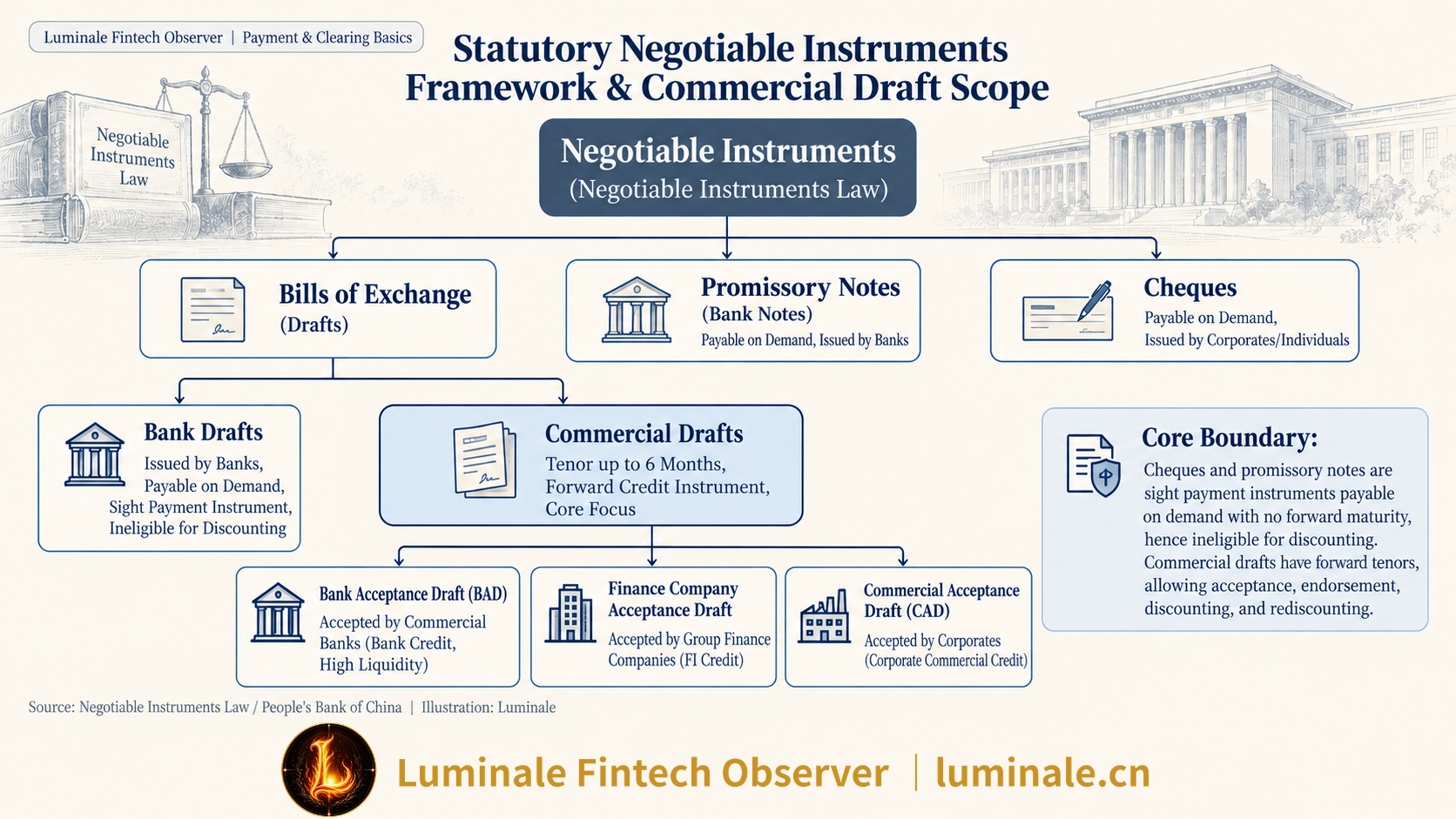
Two foundational distinctions must be clarified first:
- Bank Drafts vs. Bank Acceptance Drafts: A bank draft is issued directly by a bank after the applicant delivers equivalent funds upfront; the issuing bank acts as the drawer and primary payer, functioning as a sight payment instrument payable on demand. A bank acceptance draft (BAD), by contrast, is typically drawn by an enterprise with an underlying commercial trade background; the bank signs and confirms acceptance on the instrument, committing to unconditional payment on a designated forward maturity date[3].
- Promissory Notes and Cheques: Within mainland China's statutory framework, promissory notes are restricted to bank promissory notes issued by banks and payable on demand. Cheques are drawn by corporates or individuals directing their depository bank to pay an unconditional sum on sight. Because both are sight payment instruments payable on demand with no forward tenors, they cannot be discounted prior to maturity like forward commercial drafts[4].
As established in From Bank Cards to NUCC, China UnionPay, and CNAPS: An Architectural Map of China's Payment System, commercial drafts belong to the "payment instrument" layer, while acceptance and discounting constitute "payment and credit businesses" conducted by commercial banks. Whenever monetary funds are transferred, the transaction relies on core financial market infrastructures such as the High Value Payment System (HVPS).
In modern commerce, physical paper drafts have been almost entirely phased out. Under the Administrative Measures for the Acceptance, Discounting, and Rediscounting of Commercial Drafts and the operating rules of the China Commercial Paper Exchange System (CPES) operated by the Shanghai Commercial Paper Exchange (SHCPE), all stages—issuance, acceptance, endorsement, guarantees, discounting, pledging, presentment, and recourse—must be electronically registered within central-bank-supervised infrastructures[1][5].
The lifecycle analyzed below standardizes on electronic commercial drafts.
2. Inception: Issuance, Acceptance, and Endorsement Transfer
Consider a baseline scenario: Company A (buyer) purchases RMB 1 million worth of industrial raw materials from Company B (supplier). Settling via bank transfer requires Company A to hold RMB 1 million in immediately available demand deposits. If the parties agree to settle via commercial drafts, Company A can deliver a commercial draft with a face value of RMB 1 million and a 6-month tenor.
Regulatory rules strictly mandate that the tenor of a commercial draft, from issuance to maturity, shall not exceed 6 months, and both issuance and acceptance must be underpinned by genuine commercial trade relationships and authentic debt-creditor relations[1].
1. Commercial Drafts vs. Ordinary Trade Receivables
Prior to drawing a commercial draft, Company B holds nothing more than an ordinary trade receivable against Company A under the purchase contract.
Ordinary trade receivables are relative contractual claims (in personam). Transferring a receivable requires formal debtor notification; if a dispute arises, the buyer can invoke contractual defenses—such as product defects or missed inspection milestones—to refuse payment. Enforcing claims against a defaulting buyer often entails lengthy litigation.
Converting this transaction into a commercial draft grants Company B a non-causative statutory draft entitlement (abstraktes Wertpapier) under the Negotiable Instruments Law. Provided the draft is formally complete and the endorsement chain is uninterrupted, the holder's assertion of draft rights is legally severed from underlying contract disputes. Should the acceptor dishonor the draft at maturity, the holder benefits from expedited judicial summary proceedings and can directly exercise joint and several recourse against all prior endorsers. This statutory standard and defense-severing quality provide the institutional bedrock for continuous supply chain circulation.
2. Payment Liabilities in Issuance and Acceptance
Company A draws the instrument in the electronic commercial paper system—an act legally defined as issuance (drawing). The electronic draft record explicitly specifies the drawer (Company A), the payee (Company B), the face value (RMB 1 million), and the maturity date.
However, mere drawing does not constitute an enforceable payment promise until a designated entity formally commits to honor the draft at maturity. This legal confirmation is called acceptance. The credit standing of the acceptor governs the instrument's market classification, secondary liquidity, and discount pricing:
- Commercial Acceptance Draft (CAD): Accepted by the drawer itself or a commercial affiliate. Where Company A accepts the draft, Company B assumes Company A's commercial counterparty credit risk. If Company A suffers an operational liquidity crunch at maturity, the draft faces dishonor and default risk.
- Bank Acceptance Draft (BAD): Accepted by Company A's commercial bank. Once the bank confirms electronic acceptance, it becomes the primary obligor (Hauptschuldner), assuming the first-order, unconditional liability to pay at maturity. Company B's credit exposure shifts from a single commercial enterprise to a regulated commercial bank, completing a critical credit transformation.
Banks do not accept drafts unconditionally. When an enterprise applies for a BAD, the transaction passes through the bank's internal commercial credit underwriting process. Depending on the applicant's creditworthiness, the bank requires an acceptance cash margin ranging from 0% to 100%, with the remaining balance deducted from the corporate's overall credit facility, alongside an acceptance fee[1].
| Draft Classification | Primary Obligor (Acceptor) | Core Credit Underpinning | Secondary Market Liquidity & Discounting Cost |
|---|---|---|---|
| Commercial Acceptance Draft (CAD) | Corporate Legal Entity | Corporate Commercial Credit | Lower liquidity; discount rates diverge sharply based on corporate credit standing |
| Bank Acceptance Draft (BAD) | Commercial Bank | Regulated Commercial Bank Credit | High liquidity; tight discount spreads; universally accepted across interbank markets |
| Finance Company Acceptance Draft | Enterprise Group Finance Company | Quasi-Bank Institutional Credit | Mid-tier liquidity; circulates primarily within group member affiliates and supply chain ecosystems |
Upon completing issuance and acceptance, Company B holds a standardized, legally transferable payment claim. While trade payables have been legally discharged, Company B's bank deposit balance remains unchanged.
3. Endorsement Transfer to Upstream Suppliers
Suppose Company B holds this 6-month, RMB 1 million BAD. One month later, Company B must pay RMB 1 million for procurement from its own upstream supplier, Company C.
Instead of waiting five months for the bank to honor the draft before initiating a bank transfer, Company B can endorse and transfer the electronic draft to Company C through the CPES platform.
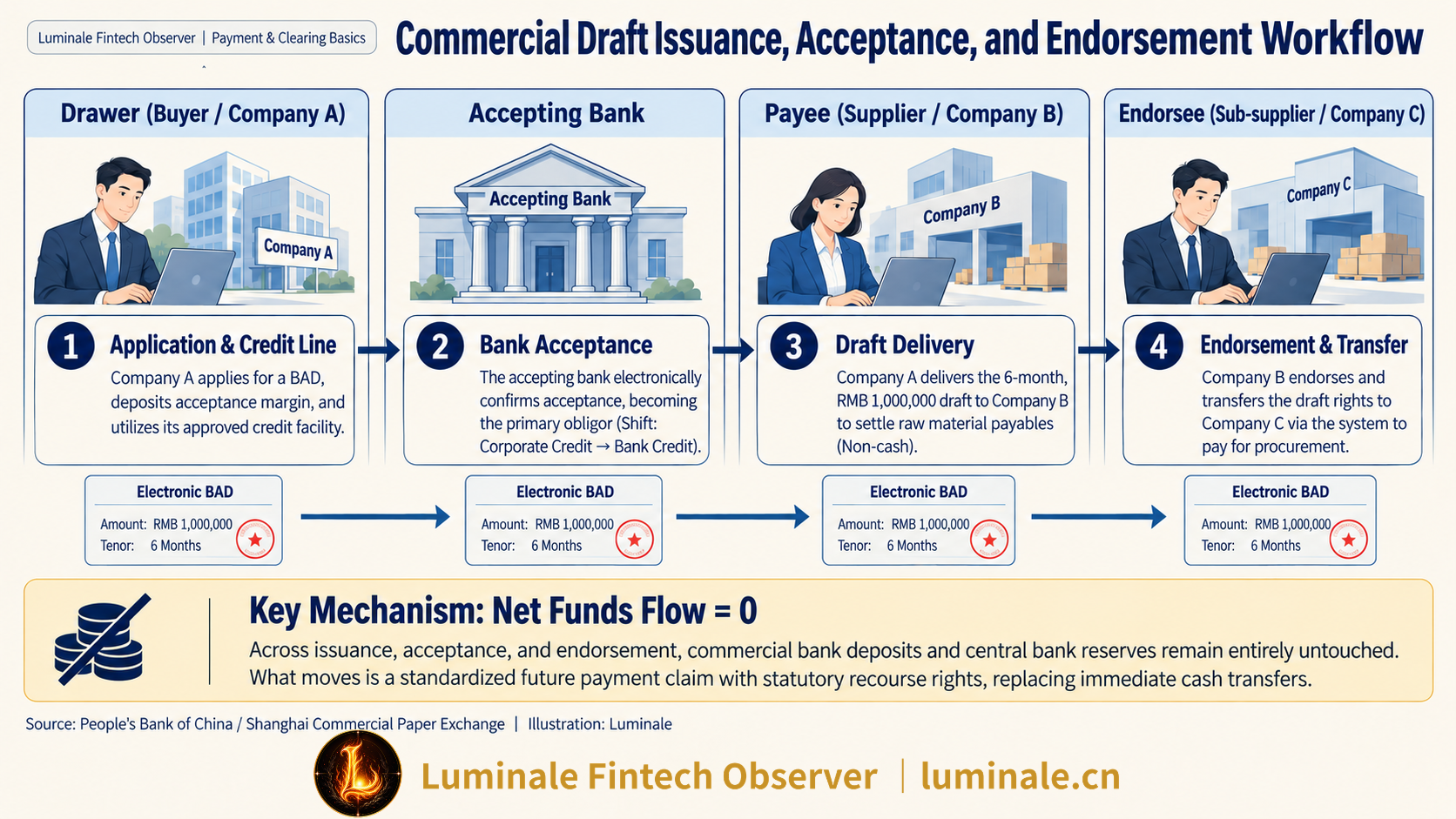
Once Company B signs the electronic endorsement and Company C confirms receipt, Company C becomes the lawful holder of the draft rights.
Crucially, zero physical or central bank funds move during this endorsement. Demand deposits across Company A, Company B, and Company C remain entirely unchanged.
By accepting the forward payment entitlement, Company C satisfies its receivable, allowing Company B to discharge trade debts without depleting its cash balances. This illustrates how commercial drafts function as an effective private payment medium across corporate supply chains.
3. Liquidity Mobilization: Discounting, Rediscounting, Repos, and Central Bank Facilities
Now suppose Company C holds this RMB 1 million draft with 120 days remaining until maturity, but requires urgent liquidity to pay wages or meet operational expenses. While the draft can discharge procurement obligations, it cannot be spent directly as bank deposits. Company C must convert the draft into cash through financial discounting.
To understand draft financing, one must observe where draft rights are transferred and from where liquidity is drawn.
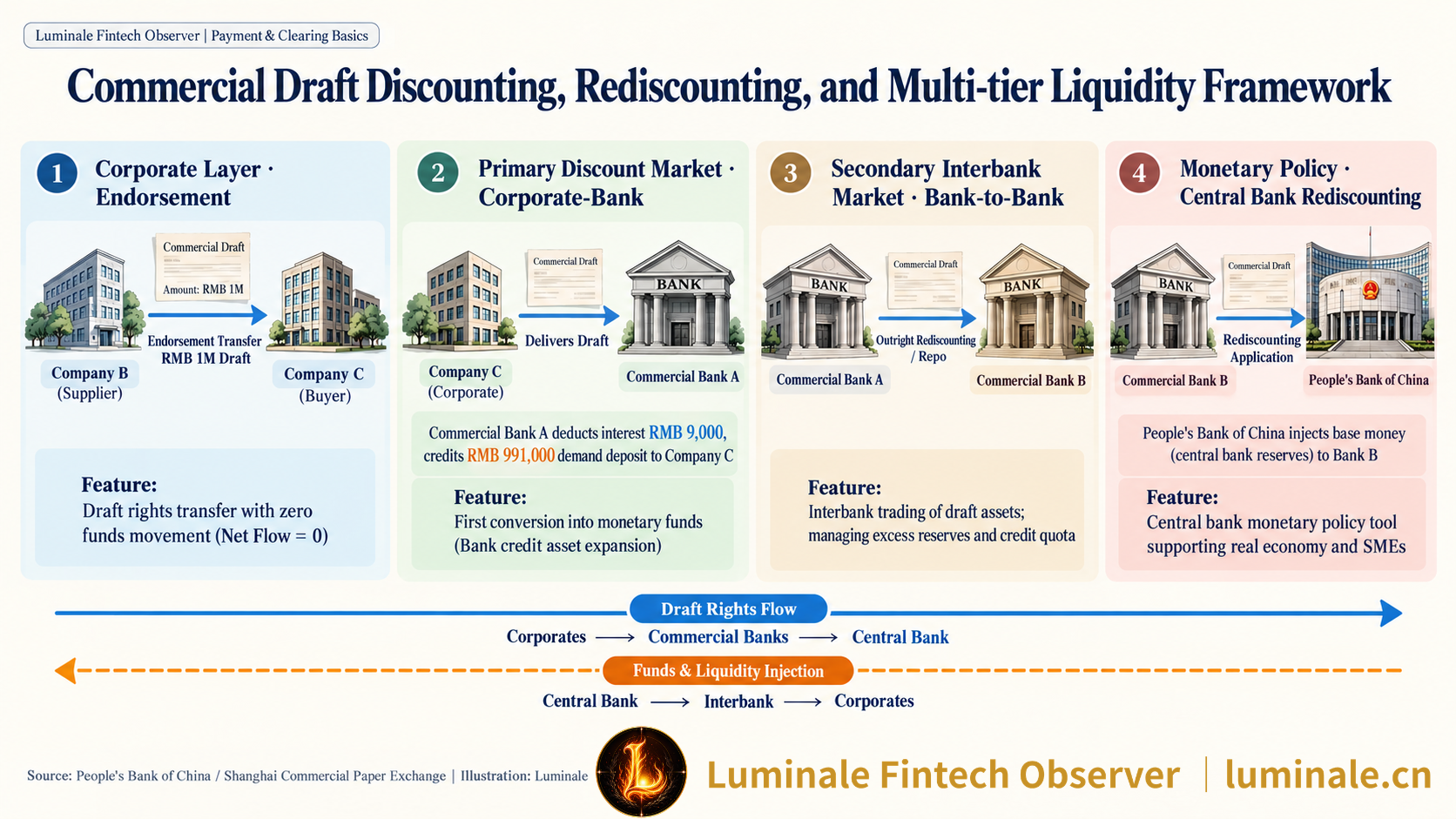
1. Primary Discounting: Converting Future Receivables into Bank Deposits
Discounting refers to the transaction where a draft holder transfers its unexpired commercial draft to a financial institution licensed for lending operations prior to maturity, receiving immediate funds net of prepaid discount interest[1].
Assuming an annualized market discount rate of 2.7%, Company C presents its RMB 1 million BAD (with 120 days remaining) to Commercial Bank A. Bank A deducts discount interest of approximately RMB 9,000 and credits RMB 991,000 directly into Company C's demand deposit account.
From an accounting standpoint, discounting represents the very first moment actual monetary liquidity is disbursed across the draft's entire lifecycle. In A Quick Guide to Bank Accounting, we demonstrated the asset-liability matching principles of commercial banking. This discounting transaction expands Commercial Bank A's balance sheet as follows:
| Commercial Bank A: Assets | Commercial Bank A: Liabilities |
|---|---|
| Discounted Assets (Loans & Advances): +RMB 1,000,000 | Demand Deposits (Company C Account): +RMB 991,000 |
| Deferred Income (Unearned Discount Interest): -RMB 9,000 |
Following discounting, Company C exits the draft chain with newly created bank money, while Commercial Bank A becomes the lawful holder. The commercial draft officially transitions from an enterprise balance sheet to a commercial bank balance sheet, classified as a standard credit asset.
2. Interbank Rediscounting and Repos
Commercial Bank A is not required to hold the discounted draft to maturity. To optimize excess reserve holdings, adjust credit asset quotas, or manage short-term liquidity, Bank A can sell the unexpired draft to Commercial Bank B in the interbank market. This interbank transaction is termed rediscounting (interbank discounting).
Interbank draft operations divide into outright and repurchase structures:
- Outright Rediscounting: The selling bank permanently transfers ownership of the unexpired draft to the purchasing bank against cash consideration; the purchasing bank assumes subsequent maturity collection risk and retains all proceeds.
- Repurchase Agreements (Repos): Financial institutions mobilize short-term funding against draft collateral, encompassing pledged repos and outright repos. In a pledged repo, the reverse repo party provides funds while holding the pledged draft; upon repayment of principal and interest at maturity, the pledge is dissolved without legal ownership ever transferring.
3. Central Bank Rediscounting Facilities
When commercial banks hold portfolios of high-grade commercial drafts (particularly those supporting agriculture, green development, and small-and-medium enterprises), they can access liquidity facilities by applying for central bank rediscounting with the People's Bank of China (PBOC)[1].
Central bank rediscounting is a structural monetary policy tool whereby the central bank purchases unexpired discounted drafts from financial institutions to inject monetary base. In Understanding What the Central Bank Does Through a Balance Sheet, we examined central bank asset-liability dynamics: draft assets transfer to the central bank's asset side under "Claims on Other Depository Corporations," while the central bank simultaneously credits the commercial bank's reserve deposit account on the liability side, expanding the central bank monetary base.
4. Forfaiting vs. Commercial Draft Discounting
In trade finance, practitioners occasionally confuse forfaiting with domestic draft discounting.
Forfaiting is a broader international and domestic trade finance structure wherein a bank or specialized forfaiting house purchases without recourse medium-to-long-term trade receivables guaranteed or accepted by an eligible financial institution. The underlying assets can encompass usance drafts, promissory notes, or book receivables arising under domestic or international letters of credit[7].
Domestic draft discounting is a standardized instrument transaction governed by statutory negotiable instruments law. Forfaiting, however, is a structured debt-purchase financing arrangement where negotiable instruments represent merely one eligible asset class. Forfaiting should not be considered a mandatory stage in standard commercial draft lifecycles.
| Transaction Type | Financing Applicant | Funding Provider | Underlying Asset Type | Recourse Structure |
|---|---|---|---|---|
| Discounting | Non-financial Corporate | Commercial Bank / Finance Co. | Unexpired Commercial Draft | Statutory Recourse Retained |
| Rediscounting (Interbank) | Financial Institution | Financial Institution | Discounted Unexpired Draft | Governed by Interbank Master Agreements |
| Central Bank Rediscounting | Commercial Bank | People's Bank of China | Eligible Discounted Drafts | Central Bank Policy Facility |
| Forfaiting | Trading Corporate | Forfaiter / Financing Bank | Drafts, Letters of Credit, Receivables | Strictly Without Recourse |
4. Title Transfer and Funds Settlement: Dual-Leg DvP Architecture
In Luminale's payment infrastructure analysis framework, any financial market transaction decomposes into two operational vectors: the asset leg recording title ownership changes, and the funds leg executing the corresponding monetary settlement. In draft markets, the asset leg is referred to as the draft leg.
Consider an interbank rediscounting trade: Commercial Bank A sells an unexpired draft with a face value of RMB 10 million to Commercial Bank B. How is title transferred, and through which rails do interbank funds settle?
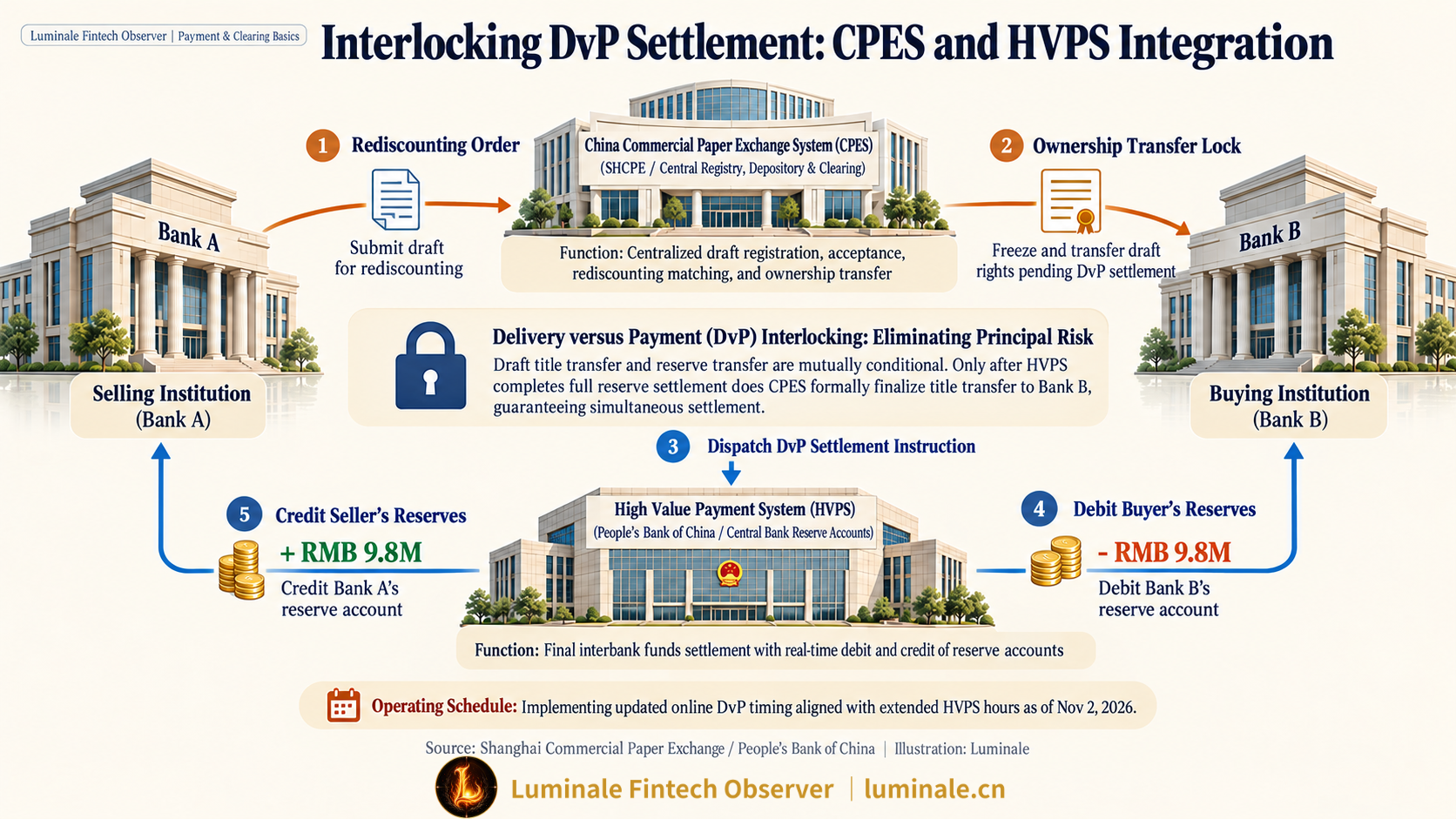
1. Centralized Registration of Draft Rights
Under physical paper regimes, draft delivery necessitated physical transfer of paper certificates and manual verification.
In contemporary electronic architectures, commercial drafts exist exclusively as book-entry entitlements maintained on central infrastructure ledgers; title cannot be transferred by emailing files between local servers. In Where Are Bonds Actually Held? CSD and SSS as the True Back-Office Ledgers of Securities Markets, we demonstrated the mechanics of central securities depositories and book-entry transfers, principles that apply directly to electronic draft markets.
In 2022, the Shanghai Commercial Paper Exchange launched its Next-Generation Commercial Paper System, unifying the legacy Electronic Commercial Draft System (ECDS) and the China Commercial Paper Trading System. The unified CPES platform centrally processes draft issuance, registration, acceptance, endorsement, discounting, trading, pledging, guarantees, clearing, settlement, and legal recourse[8].
When an outright rediscounting trade executes, CPES updates its electronic title registry, changing the beneficial custodian from Commercial Bank A to Commercial Bank B. This title update constitutes the draft leg.
2. Delivery versus Payment (DvP) and Settlement Mechanics
Commercial Bank B's disbursement of consideration funds to Commercial Bank A constitutes the funds leg.
Interbank draft markets standardly mandate Delivery versus Payment (DvP) to eliminate counterparty credit risk and prevent situations where one party transfers title while the other defaults on funds. As analyzed in Why Securities Settlement Demands DvP: From Herstatt Risk to Principal Risk Elimination, DvP interlocks the asset leg and the funds leg so that neither can settle in isolation:
- Draft ownership transfers if and only if funds are verified and settled;
- Funds release to the seller if and only if draft title is successfully transferred;
- Failure by either counterparty due to liquidity shortfalls or defective title triggers automatic transaction rollback.
3. Final Settlement over the High Value Payment System (HVPS)
While the Shanghai Commercial Paper Exchange matches transactions and coordinates DvP settlement instructions, final interbank funds settlement occurs entirely within the central bank system. As established in What Is a Payment System: From BIS Definitions to Global Financial Market Infrastructures and From Money Multipliers to Payment Settlement: A Comprehensive Guide to Central Bank Reserves, finality across interbank markets requires transfers across central bank statutory reserve accounts.
Under the Administrative Measures for Commercial Paper Transactions, financial institutions settling DvP trades across CPES must achieve final settlement over their central bank reserve settlement accounts integrated via the High Value Payment System (HVPS)[6]:
- Direct Settlement Model: Commercial banks holding direct clearing accounts in the PBOC's HVPS system receive DvP settlement instructions directly; HVPS executes real-time gross debit of the purchasing bank's reserve account and real-time credit to the selling bank's reserve account.
- Indirect / Agency Settlement Model: Rural financial institutions or non-bank market participants lacking direct HVPS access settle through designated settlement agency banks or infrastructure proxy accounts. The ultimate liquidity transfer continues to settle across the sponsor bank's central bank reserve account. Account hierarchies and participation tiers are detailed in Who Can Open an Account at the Central Bank? Understanding the Central Bank Account Hierarchy.
Assuming an agreed trade price of RMB 9.8 million, central bank reserve ledgers record the following entries:
- Commercial Bank A (Seller) Reserve Account at PBOC: +RMB 9.8 million
- Commercial Bank B (Buyer) Reserve Account at PBOC: -RMB 9.8 million
4. Operating Windows for Draft Settlement
Although draft markets operate under specialized trading rules and interfaces, all liquidity settlement remains strictly bound by the operational window of the underlying central bank payment system.
In September 2026, the Shanghai Commercial Paper Exchange issued an official notice adjusting the online DvP operating hours of CPES to synchronize with extended HVPS clearing hours established by the People's Bank of China, with the updated schedule taking effect on November 2, 2026[9].
This underscores that regardless of frontend draft system optimizations, any transaction involving liquidity movements—including discounting, interbank rediscounting, and electronic redemption—must synchronize its operating schedules, settlement batches, and reserve liquidity buffers with the central bank's RTGS core.
5. Maturity: Presentment, Discharge, and Joint Recourse
Regardless of how many times a draft circulates among supply chain enterprises or passes through interbank repos, it ultimately reaches its operational endpoint: presentment for payment at maturity.
1. Presentment and Discharge
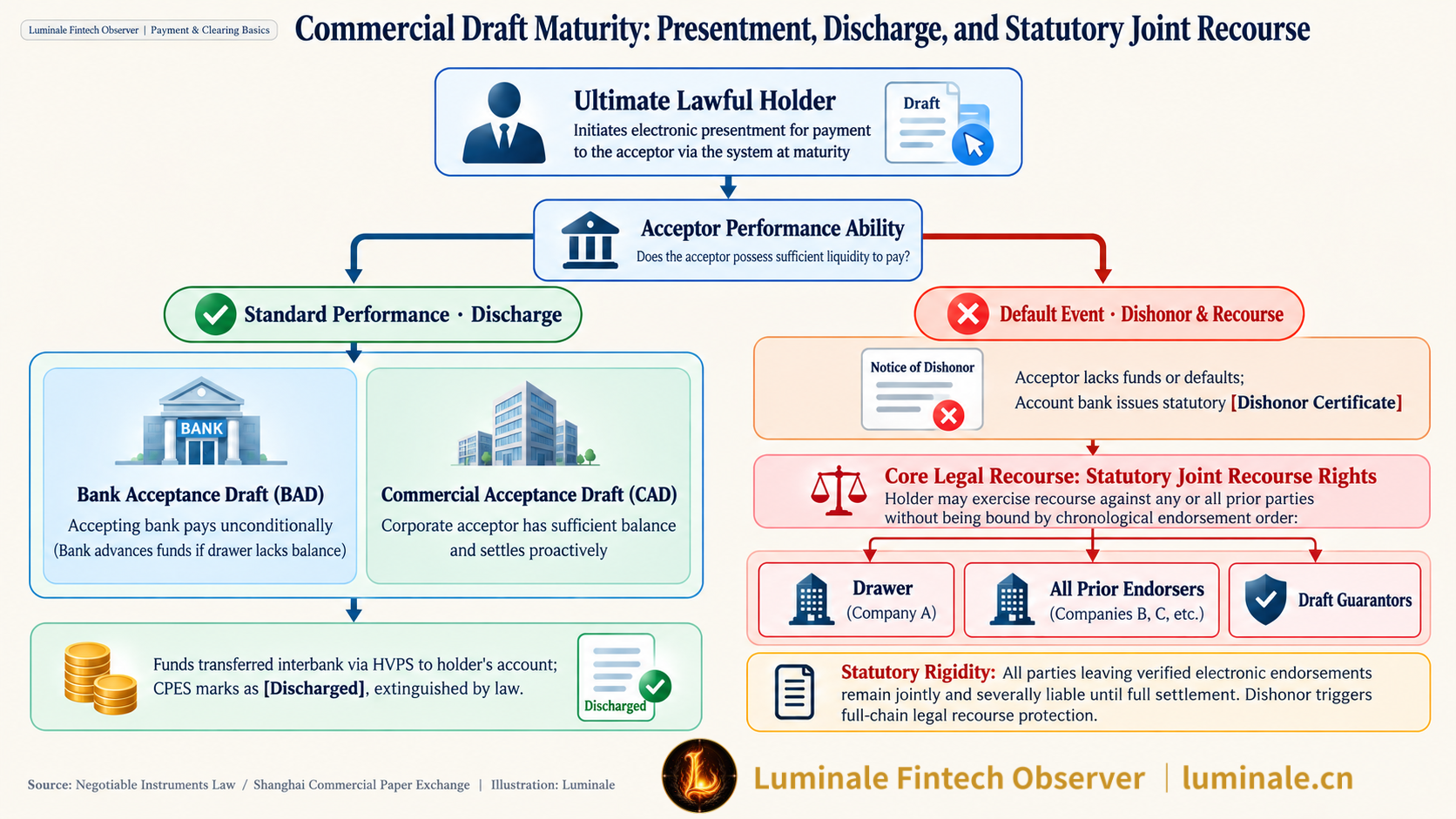
Upon maturity, the lawful holder (whether a corporate supplier or an interbank purchasing bank) initiates an electronic presentment for payment against the acceptor through the system within statutory deadlines.
- Bank Acceptance Draft Discharge: The accepting bank bears unconditional liability. Even if the drawer (Company A) maintains zero balances, the accepting bank must advance the full face value to the presenting holder. The bank subsequently reclassifies the advance as an overdue credit exposure and pursues recovery. The holder's claim relies on regulated bank creditworthiness, remaining insulated from corporate liquidity issues.
- Commercial Acceptance Draft Discharge: The acceptor is a commercial corporation. Upon receiving presentment, the acceptor authorizes its depository bank to execute the transfer, provided sufficient funds exist. Once interbank funds clear through HVPS into the holder's account, CPES marks the draft status as "Discharged," extinguishing all underlying draft entitlements.
2. Dishonor and Statutory Joint Recourse
If a CAD acceptor lacks liquidity or defaults, the acceptor's depository bank issues a formal electronic "Dishonor Certificate" through the platform.
Dishonor immediately activates the statutory protective cornerstone of negotiable instruments law: joint and several recourse.
Under the Negotiable Instruments Law of the People's Republic of China, when a holder exercises recourse upon dishonor, the drawer, all prior endorsers, and any guarantors bear joint and several liability toward the holder[2].
Suppose Company A accepts a CAD that is endorsed to Company B, then to Company C, and ultimately held by Company D. If Company A defaults at maturity, Company D can exercise recourse flexibility:
- Initiate legal proceedings against drawer and acceptor Company A;
- Demand immediate payment of the RMB 1 million face value plus statutory penalty interest from immediate endorser Company C;
- Bypass Company C entirely and initiate recourse directly against upstream endorser Company B.
Any commercial entity affixing a verified electronic endorsement to a commercial draft remains bound by potential joint and several payment liabilities until the draft is fully discharged. Enterprises evaluating commercial paper must rigorously evaluate both the primary acceptor and upstream endorsers, recognizing that endorsing a draft does not sever statutory credit exposure until final settlement.
3. Four Core Dimensions of Draft Risk
Across issuance, transfer, financing, and maturity, market participants must manage four interrelated risks:
- Credit Risk: Counterparty default probability and financial solvency of the primary acceptor, predominantly concentrated in commercial acceptance drafts.
- Liquidity Risk: The ability of a holder to discount or rediscount unexpired paper at competitive spreads, guarding against working capital disruptions.
- Operational Risk: Exposure arising from system authorization failures, digital signature misconfigurations, incorrect endorsement entries, or missed presentment deadlines.
- Legal and Compliance Risk: Ensuring drafts possess genuine commercial trade backgrounds, maintaining continuous endorsement chains, and avoiding regulatory violations regarding illegitimate credit arbitrage.
6. Synthesis: Dual Mapping of Rights and Funds Settlement
Ordinary bank transfers directly shift deposits: payment instructions execute across banks, and the recipient immediately acquires usable funds.
Commercial drafts solve a fundamentally different economic problem: decoupling trade entitlement from final monetary settlement across time. They allow enterprises to finalize trade obligations and legally settle commercial debts today, while deferring actual central bank reserve movements to future maturity or credit discounting.
Synthesizing this complete operational trajectory reveals the continuous structural evolution across both operational tracks:
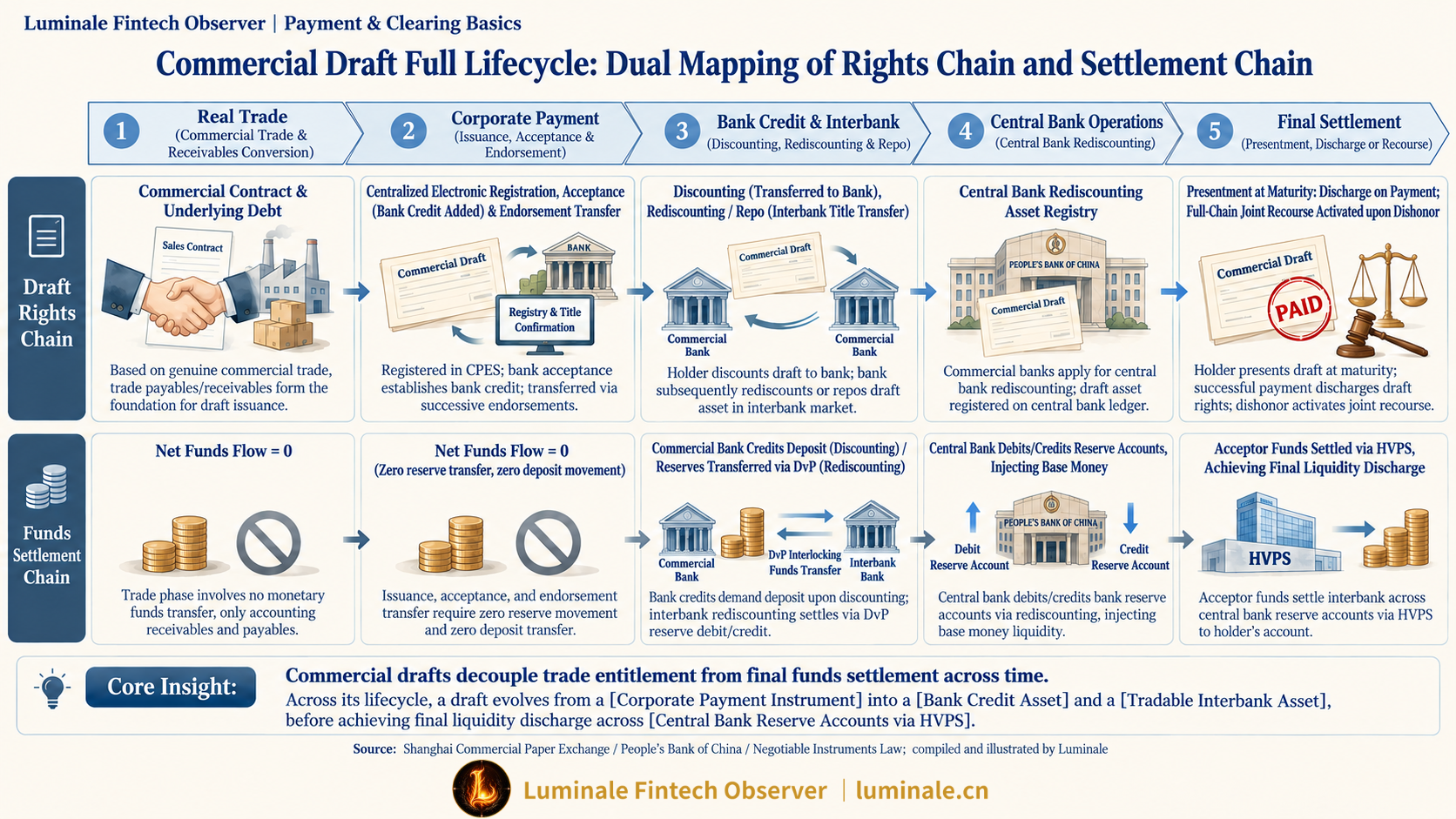
Commercial drafts originate within commercial supply chains, acquire enhanced credit through bank acceptance, circulate as private payment media via endorsement, and mobilize immediate liquidity through discounting. In interbank secondary markets, the Shanghai Commercial Paper Exchange manages electronic title transfers while the central bank's High Value Payment System executes reserve DvP settlement.
Tracing the draft rights chain alongside the underlying funds settlement chain clarifies the vital role commercial drafts occupy across China's payment, clearing, and macroeconomic financial infrastructure.
References
[1]: People's Bank of China, China Banking and Insurance Regulatory Commission. Administrative Measures for the Acceptance, Discounting, and Rediscounting of Commercial Drafts (Order of the PBOC and the CBIRC [2022] No. 4) [EB/OL]. (2022-11-18). http://www.pbc.gov.cn/zhengwugongkai/4051386/4051390/4051400/4051402/4719602/index.html ↩
[2]: Standing Committee of the National People's Congress of the People's Republic of China. Negotiable Instruments Law of the People's Republic of China (Presidential Decree No. 22) [EB/OL]. (Amended 2004-08-28). https://www.gov.cn/banshi/2005-07/11/content_13699.htm ↩
[3]: People's Bank of China. Measures for Payment and Settlement (Yinfa [1997] No. 393) [EB/OL]. (1997-09-19). http://www.pbc.gov.cn/tiaofasi/144941/144959/2804245/index.html ↩
[4]: Financial Market Trading Center, People's Bank of China. Business Q&A: Ineligibility of Cheques for Commercial Draft Discounting Facilities [EB/OL]. 2026. ↩
[5]: Shanghai Commercial Paper Exchange. Operating Guidelines and Business Specifications of the Next-Generation Commercial Paper System [EB/OL]. https://www.shcpe.com.cn/ ↩
[6]: People's Bank of China. Administrative Measures for Commercial Paper Transactions (Order of the PBOC [2016] No. 29) [EB/OL]. (2016-12-06). https://www.gov.cn/gongbao/content/2017/content_5213210.htm ↩
[7]: China Banking Association. Guidelines for Factoring and Forfaiting Practice and Risk Management in Banking [M]. Beijing: China Financial Publishing House, 2023. ↩
[8]: Shanghai Commercial Paper Exchange. Announcement on the Commissioning and Launch of the Next-Generation Commercial Paper System [EB/OL]. (2022-06-07). https://www.shcpe.com.cn/ ↩
[9]: Shanghai Commercial Paper Exchange. Notice on Adjusting the Online Business Operating Hours of the Commercial Paper System (SHCPE [2026] No. 67) [EB/OL]. (2026-09-04). ↩
Originally published by Luminale Fintech Observer: https://luminale.cn/articles/commercial-draft-acceptance-endorsement-discounting-settlement-en