
A Chinese manufacturing enterprise plans to purchase a batch of industrial machinery from a German supplier under a contract valued at $1 million. As this is their first commercial collaboration, the buyer is unwilling to pay the purchase price in full prior to dispatch, while the seller is reluctant to ship high-value equipment across continents only to await payment from an unfamiliar customer.
Under the friction of geographical distance, transit delays, and differing legal jurisdictions, it is virtually impossible for buyers and sellers to execute delivery and payment simultaneously. The equipment may spend weeks in maritime transit, after which the buyer must handle customs clearance, installation, and commissioning. Meanwhile, the seller must fund raw materials, manufacturing costs, and freight charges upfront, unable to carry payment risk indefinitely.
A letter of credit (Letter of Credit, L/C) resolves this mutual counterparty trust dilemma by introducing commercial banks into the transaction. The buyer applies to open an L/C, and the issuing bank issues an independent commitment to the seller: once the seller presents documents that strictly comply with the terms of the credit, the bank will honour the payment as agreed.
However, the bank's commitment is strictly conditional. Whether the seller ultimately receives payment depends on whether the presented documents comply with the credit and whether the relevant banks perform on their commitments. The buyer, in turn, secures documentary proof of shipment, marine insurance, and technical inspection through pre-agreed document stipulations.
Only by understanding this operational architecture can one make sense of the distinct banking roles, examination standards, financing facilities, and the ultimate interbank fund settlements that must occur once documents are accepted. This article focuses primarily on documentary credits used in commercial trade in goods and services.
1. The Credit Dilemma Resolved by Letters of Credit: Who Assumes Payment Liability and Under What Conditions
1. How Buyers and Sellers Allocate the Risks of Prepayment vs. Deferred Settlement
Commercial transactions typically employ one of several fundamental payment arrangements:
| Payment Arrangement | Operational Mechanism | Primary Risks Borne by the Seller | Primary Risks Borne by the Buyer |
|---|---|---|---|
| Cash in Advance | The buyer pays upfront; the seller ships thereafter | Post-settlement contractual delivery performance | Non-shipment after payment, or goods failing to conform to contract |
| Open Account | The seller ships upfront; the buyer pays upon agreed credit terms | Buyer delay, default, insolvency, or refusal to pay | Payment liabilities post-delivery and commercial goods quality risks |
| Documentary Collection (D/C) | Banks forward shipping documents against collection instructions and collect funds | The buyer may refuse payment or acceptance; banks assume no independent payment undertaking | Goods risks remain after paying or accepting bills to obtain documents |
| Letter of Credit | The bank undertakes to honour complying presentations under the terms of the credit | Discrepancies, bank credit risk, and other uncovered non-compliance risks | Issuance fees, reimbursement obligations to the bank, and the risk that documents cannot prove full underlying physical compliance |
Both documentary collections and letters of credit involve commercial banks and trade documents, but their underlying payment liabilities differ fundamentally. Under a collection, the remitting and collecting banks merely act as administrative agents to facilitate document delivery and funds transmission; they assume no independent payment obligations. Under a letter of credit, the issuing bank assumes an independent primary undertaking to pay. For a comprehensive operational comparison of payment arrangements, see the Trade Finance Guide published by the U.S. International Trade Administration[2].
Letters of credit also incur substantial transaction costs. The buyer may have its bank credit line tied up or be required to deposit cash collateral, while the seller must prepare and review complex documentation. Issuance, advising, confirmation, and trade financing services each carry separate banking fees. For smaller transactions between long-term commercial partners with established mutual trust, enterprises often prefer open account terms, collections, or other streamlined instruments. Whether a letter of credit is optimal must always be evaluated against the concrete commercial realities of the trade.
2. How Banks Undertake Payment Commitments
The Uniform Customs and Practice for Documentary Credits (UCP 600), codified by the International Chamber of Commerce (ICC), anchors the letter of credit upon an irrevocable bank undertaking and the principle of complying presentation. A complying presentation requires strict adherence to the terms and conditions of the credit, applicable rules, and international standard banking practice[1].
In our industrial machinery scenario, the issuing bank issues an undertaking to the German seller: upon receiving a conforming commercial invoice, transport documents, and other specified certificates within the agreed validity window, the bank will execute payment in accordance with the credit's settlement terms.
The seller thereby obtains an independent bank commitment. However, the creditworthiness and sovereign risk of the issuing bank itself must still be independently assessed; a seller cannot assume absolute payment security merely because it receives a document titled "Letter of Credit" forwarded by the buyer.
The issuing bank is irrevocably bound by its undertaking from the moment the credit is issued. Irrevocability means that the applicant cannot unilaterally cancel or amend the credit post-issuance; any documentary credit amendment requires the mutual consent of the relevant parties in accordance with applicable rules[1].
3. What the Underlying Commercial Contract and the Letter of Credit Respectively Govern
Although both legal instruments serve the same commercial transaction, they govern two distinct, legally segregated relationships.
The commercial contract for the machinery defines technical specifications, performance parameters, quality standards, warranty terms, installation support, and breach of contract liabilities. The letter of credit, by contrast, dictates which documents the bank will accept, by what deadline, and under which payment modality the bank will honour its commitment.
The Independence Principle dictates that the bank's obligations under the letter of credit are entirely separate from and unaffected by disputes arising from the underlying commercial contract. Concurrently, the Documentary Principle dictates that banks deal exclusively with documents, not with the physical goods, services, or contractual performance to which those documents may relate. Articles 4 and 5 of UCP 600 formally enshrine these two foundational doctrines[1].
For instance, if the Chinese buyer inspects the machinery after delivery and finds that operating noise exceeds contract tolerances, the buyer must pursue breach of contract claims against the seller under the underlying sales contract. When examining the presentation under the credit, the bank is presented with an ostensibly conforming set of commercial invoices, clean bills of lading, and third-party inspection certificates. Commercial banks are neither equipped nor legally mandated to inspect factory floors to verify whether the machinery meets engineering benchmarks.
Consequently, the buyer must meticulously structure the documentary requirements at the outset. If the buyer insists on verifying equipment performance prior to payment, it must explicitly stipulate in the sales contract and L/C application that a performance inspection certificate issued by a designated independent inspection agency must form an indispensable part of the presentation.
Nevertheless, the autonomy of the credit has statutory boundaries. Where genuine fraud is established at the inception or execution of the documentary transaction, the fraud exception applies under governing law, permitting courts to enjoin the issuing bank from making payment[3].
2. Banking Roles in a Letter of Credit: Issuing, Advising, Nominating, Confirming, and Negotiating
1. Four Fundamental Parties to a Letter of Credit
A letter of credit encompasses four core participating parties:
| Party | Role in the Machinery Transaction | Primary Responsibilities |
|---|---|---|
| Applicant | Chinese Buyer A | Applies for L/C issuance, posts cash collateral or utilizes credit lines, and reimburses the issuing bank |
| Issuing Bank | Bank X | Issues the letter of credit and undertakes the primary payment obligation under the credit |
| Advising Bank | German Bank Y | Authenticates the apparent authenticity of the credit received and accurately advises the seller |
| Beneficiary | German Seller B | Reviews the credit terms, performs commercial delivery, and presents conforming documents |
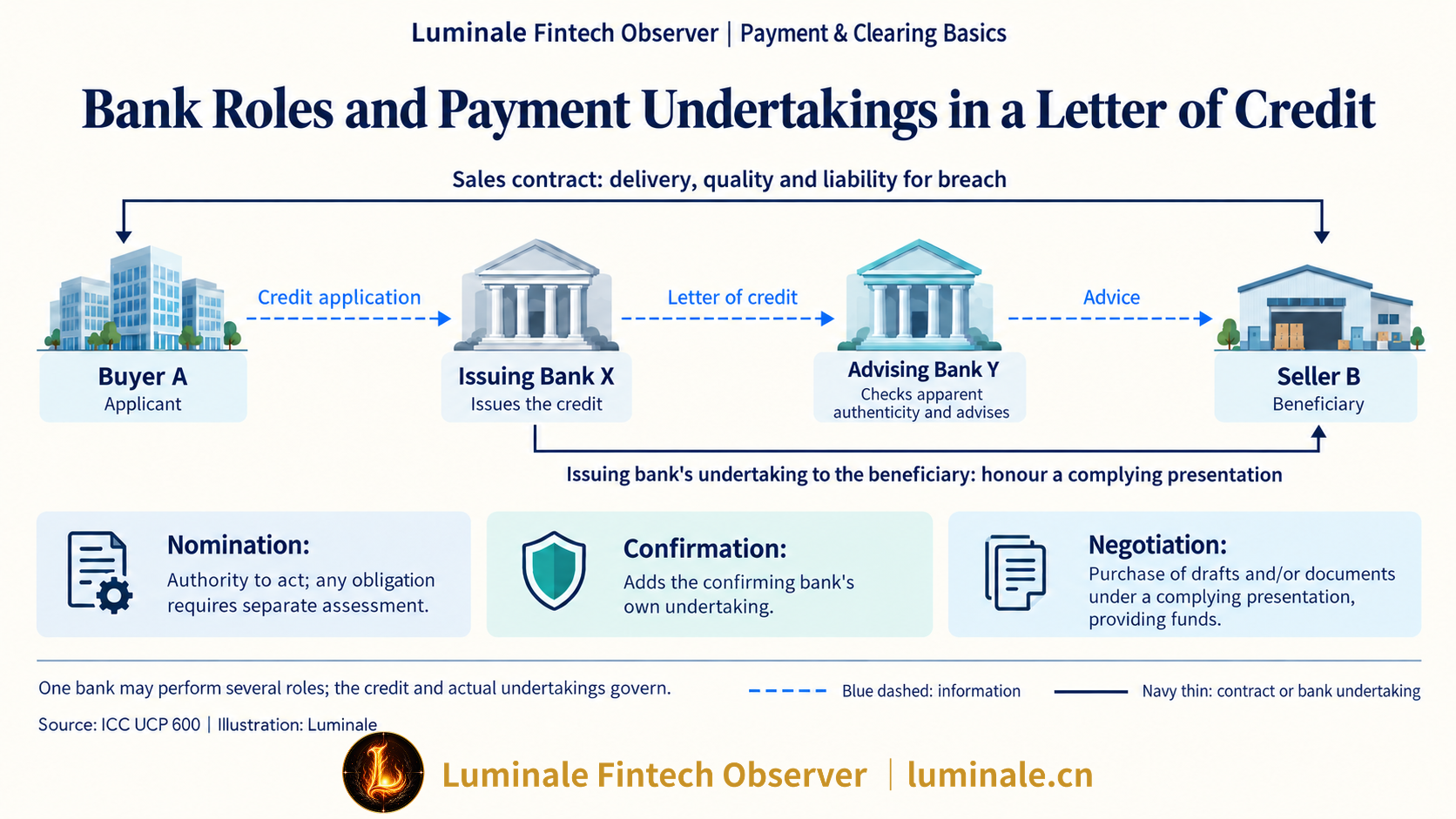
The issuing bank assumes the direct payment undertaking, while the advising bank enables the beneficiary to receive authenticated credit terms transmitted through formal banking communication channels. Advising, confirming, and nominating represent distinct banking functions; a single financial institution may serve multiple roles concurrently. See the ICC Guidance on Advising Credits[4].
Having five or six distinct role designations does not imply that every transaction requires five or six separate financial institutions.
2. The Advising Bank
When advising a letter of credit, the advising bank is required to verify the apparent authenticity of the credit or amendment received, ensuring that the notification accurately reflects the exact terms delivered by the issuing bank.
Upon receiving the notification from Bank Y, the German seller can verify the identity of the issuing bank, the credit amount, governing regulatory rules, and whether any terms are commercially unworkable.
Merely advising a credit does not constitute an undertaking by Bank Y to honour or negotiate the credit. Whether the seller can demand payment directly from Bank Y depends on whether Bank Y has added its confirmation, accepted independent payment commitments, or executed authorized financing operations[4].
3. The Nominated Bank
A Nominated Bank is the financial institution with which the letter of credit is available; if the credit allows availability with "any bank," any bank eligible under the credit falls within the scope of a nominated bank.
Here, Availability refers to where and through which operational modality the beneficiary can utilize the credit to obtain honour or negotiation. When analyzing an L/C, the bank designation must always be examined in tandem with its availability mechanism:
| Availability Modality | Operational Action Executed by the Bank | Is a Financial Draft Mandatory? |
|---|---|---|
| Sight Payment | Pays funds against a complying presentation | Not necessarily |
| Deferred Payment | Incurs an undertaking to pay at maturity and pays at maturity | Does not require a bill of exchange as a prerequisite |
| Acceptance | Accepts a time draft drawn by the beneficiary and pays at maturity | Requires a corresponding time draft |
| Negotiation | Purchases drafts and/or documents under a complying presentation by advancing or agreeing to advance funds | Not necessarily, depending on credit structure |
Under UCP 600, Honour comprises three distinct settlement modalities: sight payment, incurring a deferred payment undertaking, and acceptance[5].
In banking practice, the term Paying Bank is also frequently used to describe a bank that undertakes or executes payment. Assessing its legal liabilities requires evaluating its status as an issuing, nominated, or confirming bank alongside its explicit undertakings.
A nominated bank is not automatically bound to pay. Except in cases such as a confirming bank, nomination by the issuing bank merely confers operational authorization to act; whether the nominated bank assumes payment liability depends on whether it explicitly agrees and communicates that undertaking to the beneficiary. Merely receiving, examining, and forwarding documents does not automatically create an obligation to honour or negotiate[5].
In our machinery transaction, if the credit nominates Bank Y for deferred payment, the seller must confirm with Bank Y whether it actually accepts this role. Seeing Bank Y named on the credit does not entitle the seller to assume that Bank Y has committed to pay 90 days hence.
4. Confirmation
Confirmation represents a definite undertaking by another bank, authorized or requested by the issuing bank, in addition to that of the issuing bank, to honour or negotiate a complying presentation. A bank assuming this role is designated the Confirming Bank[1].
Assuming the German seller is comfortable with the Chinese buyer's purchase order but unwilling to shoulder the standalone credit and cross-border risk of a foreign issuing bank, the seller may insist on adding confirmation by a trusted prime bank.
Once Bank Y agrees to add its confirmation, the seller, upon satisfying the confirmation scope and presentation terms, can demand honour or negotiation directly against Bank Y's independent undertaking. This facility incurs an additional confirmation fee.
Key parameters governing confirmation include the applicable amount, validity period, presentation counter, and whether subsequent amendments are accepted by the confirming bank. Amendments increasing the credit value or extending payment tenors typically require reconfirmation by the confirming bank[6].
5. Negotiation
When a Negotiating Bank negotiates, it advances funds to the beneficiary, or agrees to advance funds under governing rules, prior to reimbursement. Merely examining documents, charging an examination fee, and dispatching documents to the issuing bank does not constitute negotiation[7].
Under the UCP 600 definition of negotiation, the draft purchased must be drawn on a bank other than the nominated bank itself. Negotiation can take place under sight letters of credit—for example, where a bank advances funds to the seller upfront and subsequently seeks reimbursement from the issuing bank. Under usance (term) credits, trade financing may take the form of discounting accepted bills of exchange, prepaying or purchasing deferred payment undertakings, or forfaiting facilities.
While each of these facilities delivers liquidity to the seller ahead of maturity, their statutory frameworks, legal title status, primary obligors, and recourse arrangements differ substantially. When reviewing financing agreements, enterprises must look beyond nominal amounts and interest rates to verify which claim the bank is purchasing or financing, who the obligor is at maturity, and whether the bank retains recourse against the seller if the issuing bank defaults.
3. The Full Lifecycle of a Letter of Credit
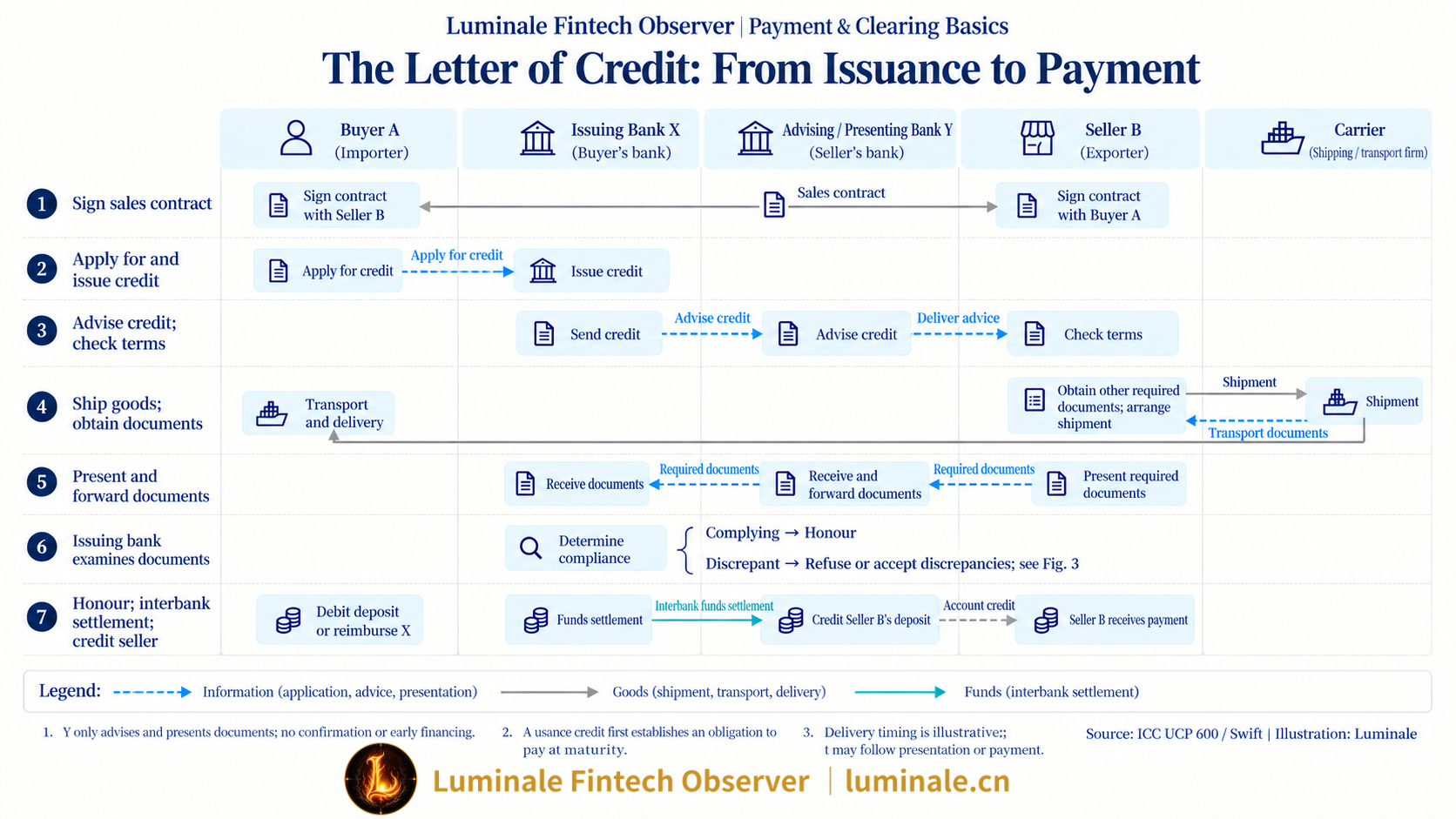
1. Agreeing on Payment Terms and Applying for Letter of Credit Issuance
The machinery sales contract may stipulate payment via an irrevocable sight letter of credit, or specify payment at 90 days after the bill of lading date. The commercial parties must also define the issuance deadline, acceptable issuing banks, fee allocations, and whether confirmation is required.
The trigger event for calculating maturity dictates corporate cash management. Ninety days after the bill of lading date, ninety days after sight, or a fixed future calendar date represent fundamentally different calculation bases. The credit text must articulate the baseline event with absolute precision.
Buyer A submits an L/C application, underlying trade contracts, and regulatory authorizations to Bank X. The bank evaluates customer creditworthiness, underlying transaction authenticity, credit lines, and collateral arrangements.
If the bank requires 100% cash collateral, Buyer A must lock up corresponding liquid funds in a dedicated margin deposit account. If the bank grants credit-line issuance, Buyer A can obtain the credit without depositing full cash collateral upfront. Collateral ratios, guarantee modalities, and credit line utilization depend on specific corporate banking underwriting terms. The Bank of China Credit Line L/C Issuance Overview illustrates this structural liquidity arrangement[8].
2. Letter of Credit Transmission and Beneficiary Verification
Cross-border letters of credit are transmitted between financial institutions via interbank telecommunication messages over the Society for Worldwide Interbank Financial Telecommunication (Swift). Swift Category 7 messages govern documentary credits, guarantees, and standby letters of credit, with MT 700 serving as the universal standard for issuing a documentary credit[9].
The transmission and receipt of a message confirm only that the credit terms have been formally delivered; whether monetary funds have moved depends on subsequent honour, interbank reimbursement, and correspondent account settlements.
Upon receiving the advice, Seller B must conduct a systematic clause-by-clause audit:
- Confirm whether the issuing bank, amount, currency, and governing rules match the commercial contract;
- Verify where the credit is available, under which modality, and whether confirmation has been confirmed;
- Assess whether the latest shipment date, presentation period, expiry date, and presentation counter are commercially feasible;
- Verify whether all stipulated transport, insurance, inspection, and commercial documents can be obtained from designated third-party issuers;
- Check whether document copy counts, original requirements, goods descriptions, and banking fee splits are explicitly stated.
If the machinery requires 45 days to manufacture but the credit imposes a latest shipment date within 30 days, the seller faces immediate breach. If the buyer verbally promises an extension but fails to issue a formal credit amendment, bank document examiners must judge the presentation strictly against the active credit terms.
3. Shipment and Document Procurement
The seller manufactures, insures, and ships the goods in strict accordance with the sales contract and credit stipulations, collecting the required trade documents.
| Common Document | Typical Information Recorded | Distinctions Relative to Other Documents |
|---|---|---|
| Commercial Invoice | Transaction parties, goods description, quantities, unit prices, total value | Records commercial trade terms; cannot independently prove that goods were laden on board |
| Packing List | Packaging specifications, package counts, gross/net weights, cargo distribution | Facilitates packing verification and stevedoring; cannot substitute for transport documents |
| Marine Bill of Lading (B/L) | Receipt or loading on board, carrier, vessel name, voyage details | Specific types possess negotiable document-of-title functions enabling delivery against presentation |
| Air Waybill (AWB) | Air transport and cargo receipt details | Generally non-negotiable; does not carry the full negotiable functions of an ocean bill of lading |
| Insurance Document | Insured value, covered risks, policy effective dates | Provides evidence of insurance coverage; cannot prove that goods arrived undamaged |
| Certificate of Origin | Country/region of manufacture | Serves trade policy origin compliance; distinct from quality or quantity inspection certificates |
| Inspection Certificate | Findings of designated inspection agencies on specified testing items | Scope of proof is strictly limited to inspected parameters, testing methods, and inspection time |
Certain ocean bills of lading are negotiable documents of title, whereas railway, road, and air waybills are typically non-negotiable consignment notes. Consequently, transport documents confer vastly different rights regarding control over physical delivery. See the UNCITRAL Explanatory Notes on Transport Documents[10].
Not every document in the table is required for every credit. Which documents must be presented depends entirely on the commercial terms of the credit. While customs declarations and carrier tracking data may be reviewed during internal bank compliance checks, they do not constitute mandatory presentation documents unless explicitly stipulated in the credit.
4. Presentation: Aligning Shipment Date, Presentation Period, and Expiry Date
The seller presents documents to the nominated bank or directly to the issuing bank as stipulated in the credit. The presentation counter and transmission path must strictly comply with the credit and governing rules.
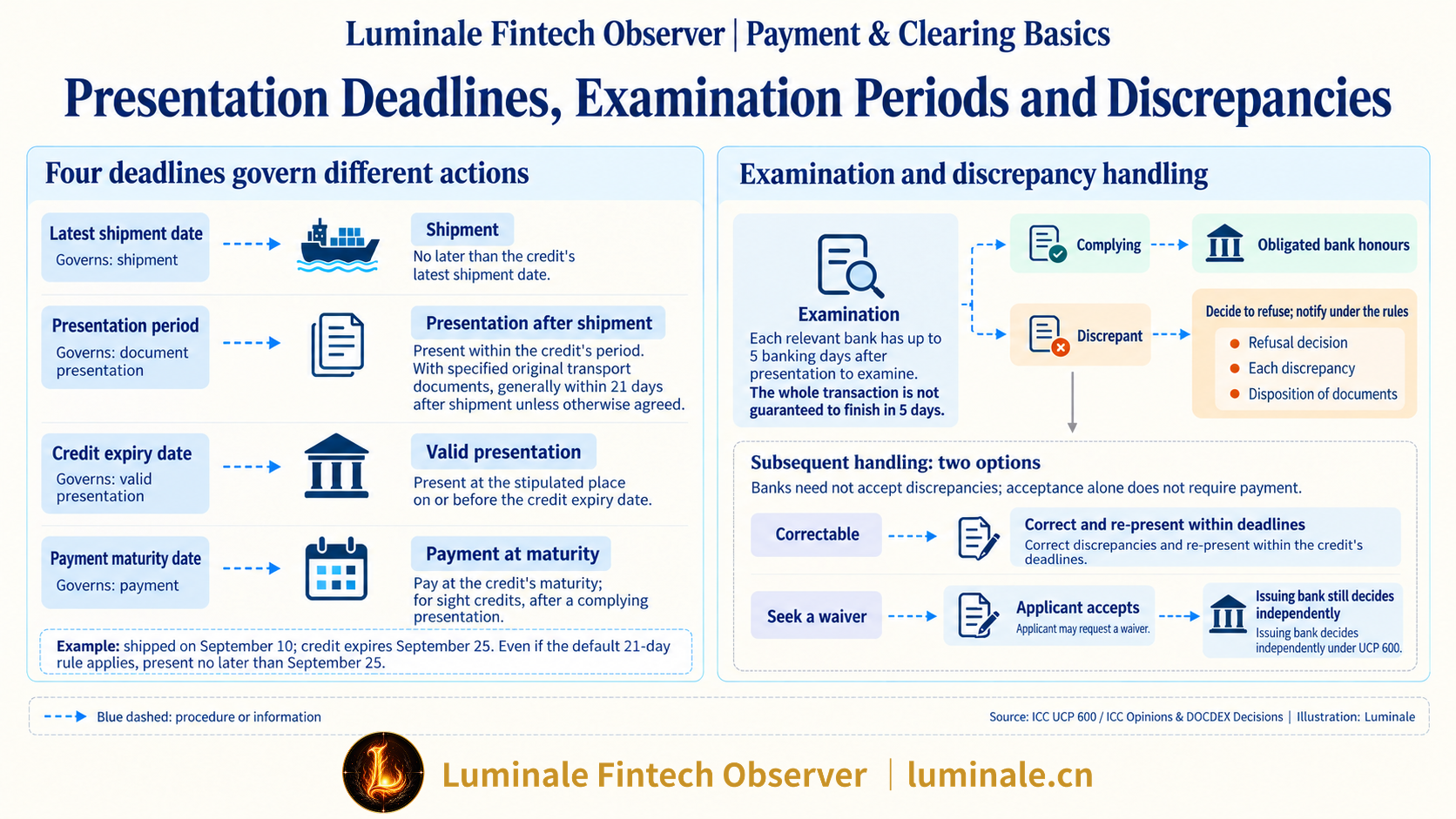
A letter of credit enforces several critical timeframes:
| Time Requirement | Governed Operational Action |
|---|---|
| Latest Shipment Date | Deadline by which goods must be loaded on board or dispatched |
| Presentation Period | Maximum window following shipment within which stipulated documents must be presented |
| L/C Expiry Date | Absolute final deadline for tendering a valid presentation |
| Payment Maturity Date | Tenor date on which monetary settlement must be discharged under deferred arrangements |
Under the default provisions of UCP 600, a presentation including one or more original transport documents subject to Articles 19–25 must be made within 21 calendar days after the date of shipment, but in any event no later than the expiry date of the credit; individual credit terms may explicitly modify this default window[1].
5. Document Examination and Determining Compliance
The bank examines the presentation against the credit terms and applicable rules, scrutinizing document types, issuers, signatures, amounts, dates, transport data, and internal consistency.
The International Standard Banking Practice for the Examination of Documents under UCP 600 (ISBP) provides detailed operational guidance for document examiners; the ICC released ISBP 821 in 2023. It assists banks in interpreting practical examination standards alongside UCP 600[7].
Document examination is not a mechanical, word-for-word string comparison across every sheet. UCP 600 permits data across documents not to be identical, provided that it does not conflict when read in context[11].
For example, if the commercial invoice recites the comprehensive machinery model number while the transport document uses a non-conflicting generic description of goods, this does not per se constitute a discrepancy. Whether minor typographical variations, address differences, or numerical expressions are acceptable must be judged against the specific credit terms, the function of the document, and international banking practice.
UCP 600 grants the nominated bank, confirming bank, and issuing bank each a maximum of five banking days following the day of presentation to determine whether a presentation is complying. This five-day window applies to each bank individually; it must not be misconstrued as a guarantee that the entire cross-border transaction will conclude within five days. Banking days may also vary across differing national and regional calendars[12].
6. Handling Discrepancies
A discrepancy is a specific instance where the presented documents fail to comply with the terms of the credit or governing regulatory rules.
In machinery transactions, typical discrepancies include: the bill of lading showing a shipment date later than the latest shipment date; omission of a required inspection certificate; insurance coverage falling below the mandatory percentage; presenting an incomplete set of original bills of lading; or inconsistent machinery quantities between invoices and packing lists.
When a bank decides to refuse honour or negotiation, it must issue a formal Notice of Refusal in strict compliance with governing rules. The notice must state that the bank is refusing honour or negotiation, enumerate each individual discrepancy relied upon, and state the disposition of the documents within the prescribed time limit. Failure to issue the notice in accordance with these rules precludes the issuing or confirming bank from asserting that the documents are non-complying[13].
Upon receiving a notice of discrepancy, the seller can correct rectifiable documents and tender a re-presentation within the remaining validity window; alternatively, the seller can request the applicant to waive discrepancies. However, an applicant's waiver does not bind the bank. The issuing bank retains the ultimate discretion to decide whether to accept the non-complying presentation. Judicial interpretations in mainland China likewise strictly distinguish between an applicant's waiver and the issuing bank's independent commercial determination[3].
7. Honour upon Compliance: Sight Payment or Incurring Deferred Payment Undertakings
Under sight arrangements, the bank pays funds against a complying presentation. Under deferred payment arrangements, the bank incurs an undertaking to pay on a designated future date; under acceptance arrangements, the bank accepts a forward bill of exchange[5].
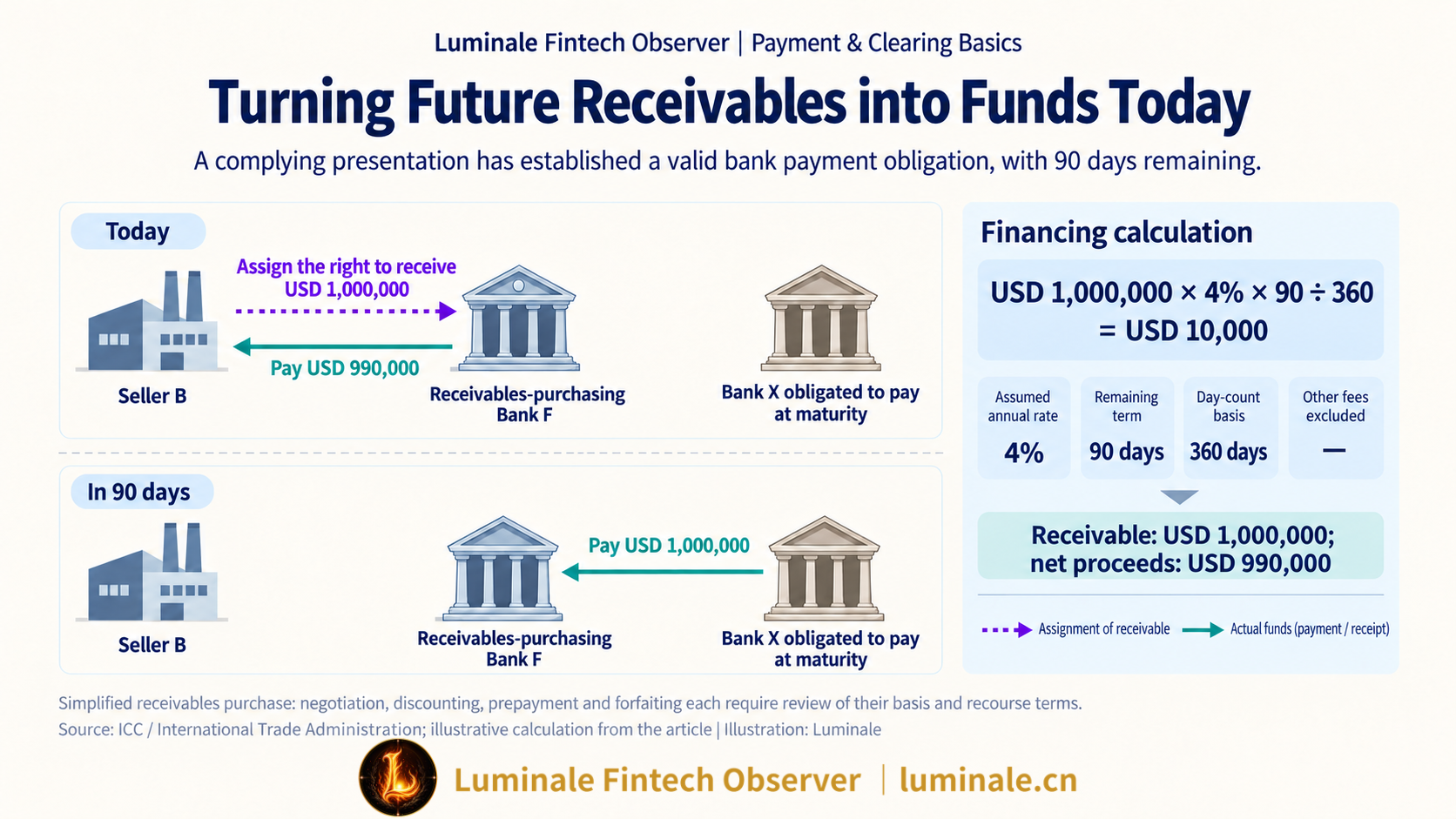
Continuing our machinery example, assume the credit provides for payment 90 days after the bill of lading date. Once the seller ships the equipment and tenders a complying presentation, and the relevant bank incurs its deferred payment undertaking, the seller holds a legally enforceable claim to future payment.
If the seller requires immediate working capital to fund payroll and purchase raw materials for subsequent orders, it can negotiate trade financing facilities with its bank.
Forfaiting typically involves the purchase of trade receivables on a non-recourse basis, enabling the seller to secure immediate liquidity while the forfaiter assumes the debtor's payment credit risk[14].
Pre-maturity financing under a letter of credit shares economic commonalities with commercial draft discounting. For detailed analysis on acceptance, claim transfers, and early cash realization, see Bills of Exchange Are Not Just Another Bank Transfer: Understanding Acceptance, Endorsement, Discounting, and Funds Settlement. Letters of credit can utilize deferred payment arrangements directly without mandating the physical issuance of a bill of exchange.
8. How Funds Reach the Beneficiary Account Following Settlement Discharge
A letter of credit transaction simultaneously involves three parallel operational flows, synthesized below based on governing rules and banking workflows:
| Flow | Primary Transmission Path | Substantive Content Transmitted |
|---|---|---|
| Goods Flow | The seller transports machinery to the buyer via commercial carriers | Physical transit and handover of the commercial machinery |
| Document & Information Flow | Interbank transmission of credits; submission, forwarding, and notification of trade documents | Payment undertakings, performance documents, examination findings, and reimbursement claims |
| Funds Flow | Paying/financing banks disburse funds to relevant banks and the seller; the buyer reimburses the issuing bank | Balance sheet adjustments in customer deposits and interbank settlement accounts |
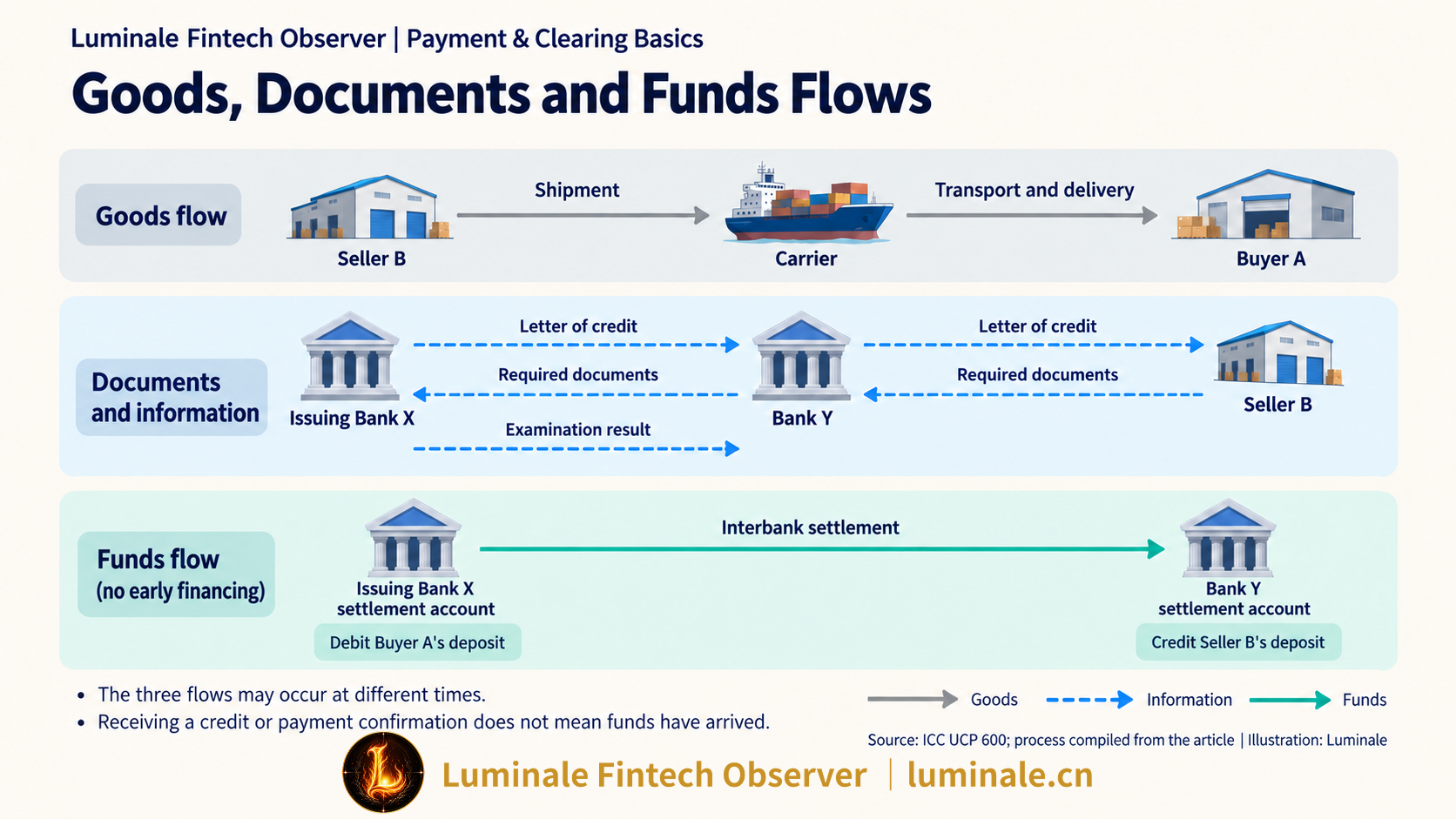
The chronological sequence of these three flows is not static. Cargo may arrive at the port of destination while documents remain under bank examination; conversely, a financing bank may advance funds to the seller well before the issuing bank provides reimbursement.
While the letter of credit defines payment liabilities and conditions, bank accounting ledgers execute the actual monetary debit and credit postings. Interbank reimbursement may also be divorced from the beneficiary's cash receipt: a nominated bank may pay the seller first and claim reimbursement from the issuing bank subsequently.
This ledger mechanic can be illustrated through a domestic RMB settlement model. Assume Buyer A holds an account with Bank X, Seller B holds an account with Bank Y, and the settlement value is RMB 1,000,000. Both institutions are direct participants in the national clearing system, settling directly over their respective reserve accounts at the central bank, setting aside intermediary fees and credit financing lines.
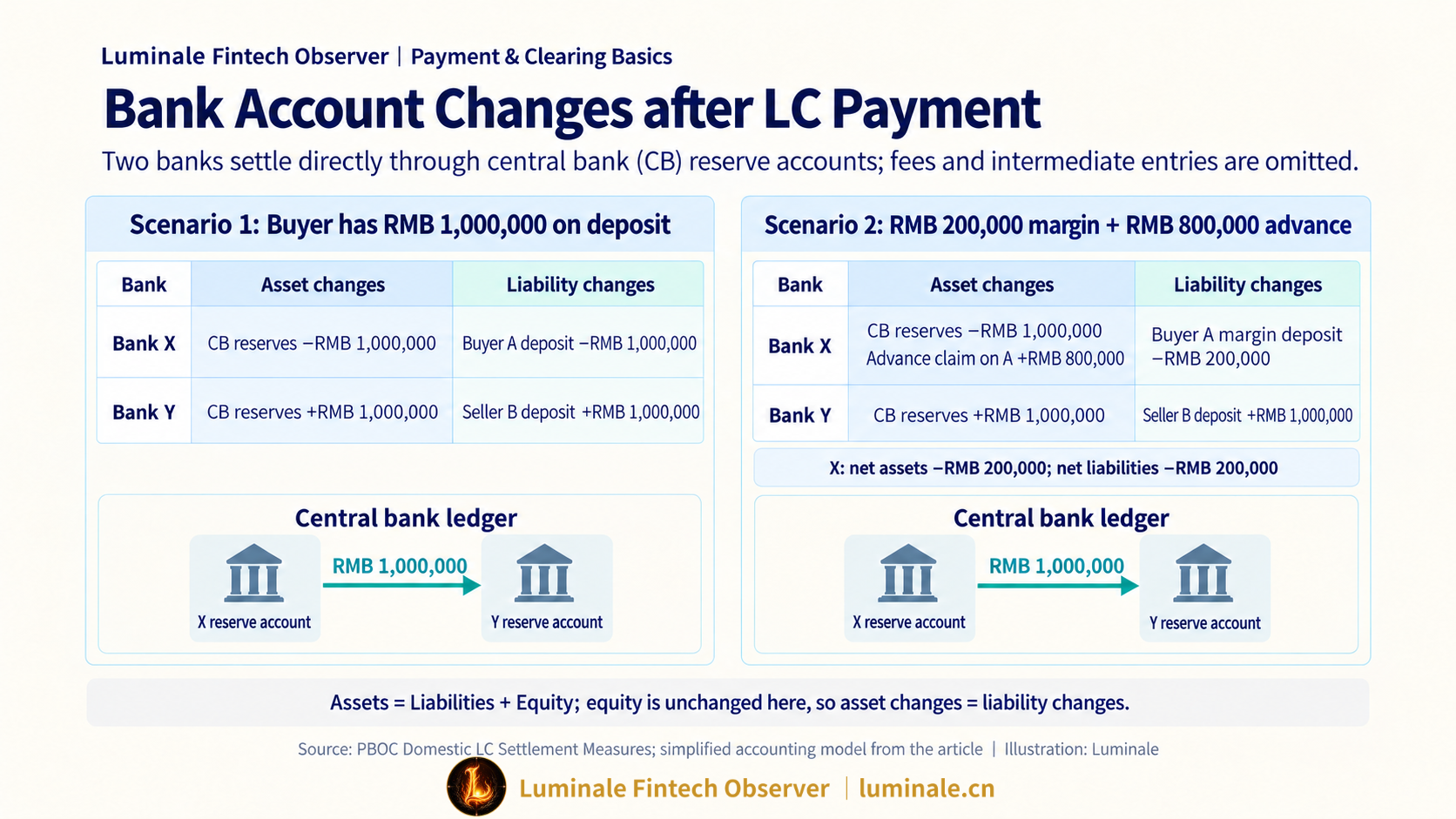
For the underlying architectural mechanics of interbank clearing and reserve transfers, see Behind "Transfer Succeeded": Payment Instructions, Account Posting, and Funds Settlement Are Three Separate Things. Governing rules for domestic letters of credit explicitly affirm that under a complying presentation or once the issuing bank has incurred a payment commitment, insufficient applicant margin deposits or bank balances do not relieve the issuing bank of its independent payment liability[15].
Cross-border fund settlement is considerably more intricate, typically routing through correspondent banking accounts and clearing systems such as Fedwire/CHIPS for U.S. dollar settlements. For a detailed breakdown, see What Actually Happens During a Cross-Border Wire Transfer? From Correspondent Banking and SWIFT to Global Payment Reforms.
4. Distinctions Between Domestic and International Letters of Credit
1. Domestic Letters of Credit in Mainland Chinese Trade in Goods and Services
Promulgated jointly in 2016 by the People's Bank of China (PBOC) and the former China Banking Regulatory Commission (CBRC), the Administrative Measures for Domestic Letter of Credit Settlement define a domestic L/C as an RMB-denominated, irrevocable documentary credit issued by commercial banks to service domestic trade in goods and services between enterprises; both issuance and transfer must be backed by genuine underlying commercial trade[15].
Consequently, domestic letters of credit are widely used in domestic equipment procurement, bulk commodity sales, and service contracts. They likewise require bank undertakings, document presentation, and formal examination, accompanied by optional confirmation, negotiation, and usance financing.
International letters of credit typically incorporate UCP 600 by contractual reference. Article 1 of UCP 600 mandates that the credit must explicitly state that it is subject to these rules; the cross-border nature of a transaction does not automatically trigger the application of UCP 600[1].
UCP 600 constitutes a set of international private banking customs codified by the ICC. Concrete transactions remain governed by mandatory domestic statutes, judicial jurisdictions, and regulatory compliance rules; Chinese statutory law and UCP 600 must not be treated as mutually exclusive legal regimes.
2. How Regulatory and Operational Divergences Impact Transactions
| Comparative Dimension | Domestic Letters of Credit (China) | International Letters of Credit |
|---|---|---|
| Regulatory Framework | Administrative Measures for Domestic Letter of Credit Settlement, statutory laws, and CBA industry guidelines | Contractually incorporated rules (typically UCP 600), subject to governing national law |
| Trade Context | Domestic trade in goods and services between mainland Chinese legal entities | Typically cross-border international trade in goods and services |
| Currency | Exclusively denominated in Renminbi (RMB) | Denominated as agreed (e.g., USD, EUR, RMB, etc.) |
| Banking Roles | Includes advising, confirming, negotiating, and transferring arrangements | Encompasses issuing, advising, nominated, confirming, and negotiating banks |
| Institutional Environment | Operates within domestic statutory laws, commercial banks, and RMB clearing systems | Involves multijurisdictional laws, foreign exchange, sanctions, sovereign risks, and correspondent networks |
While domestic and international documentary credits share broad operational similarities, practitioners must adhere strictly to their respective governing rules.
For example, Article 44 of the Administrative Measures for Domestic Letter of Credit Settlement requires banks to execute sight payment or confirm maturity payment undertakings within five business days starting from the day following document receipt. By contrast, UCP 600's five banking days define the maximum window for respective banks to determine whether a presentation is complying. Despite the identical numerical threshold of five days, the underlying legal obligations and procedural triggers differ[15][12].
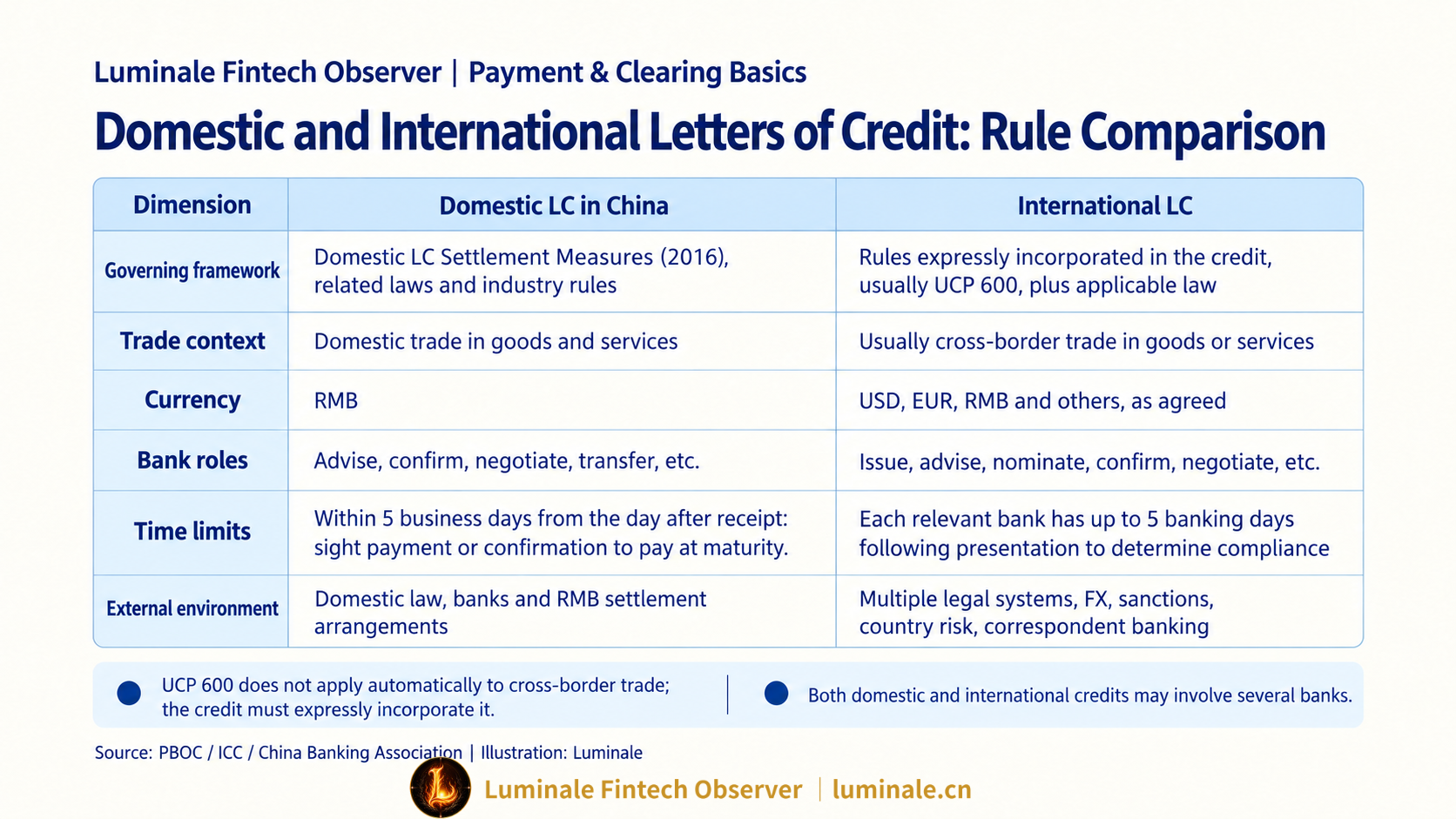
3. Interbank Transmission of Domestic L/Cs and Presentation Documents
The China Banking Association (CBA) promulgated the Product Guidelines for Interbank Domestic Letters of Credit (2020), standardizing interbank workflows for issuance, advising, presentation, confirmation, negotiation, and settlement via postal transit and recognized electronic channels[16].
Teletransmitted credits are dispatched by the issuing bank over mutually recognized electronic communication channels, whereas mail-issued credits utilize physical delivery verified by tested authentication wires. Presentation documents may subsequently be dispatched physically or transmitted electronically.
The guidelines provide standardized message formats for domestic L/C tested authentications (such as Swift MT 799) and maturity payment confirmations, as well as electronic messages transmitted over the PBOC High Value Payment System (HVPS)[16].
These telecommunication messages serve interbank administrative messaging. An incoming maturity payment confirmation indicates that a bank has incurred an undertaking; whether final monetary settlement has executed still requires auditing corresponding clearing and reserve postings.
Domestic letters of credit also support secondary asset mobilization and interbank claims trading. The CBA guidelines explicitly govern domestic L/C forfaiting, encompassing the non-recourse purchase of undue receivables confirmed for payment by the issuing or confirming bank, as well as secondary syndication.
Physical machinery does not need to be redelivered when underlying trade receivables are traded across the interbank market. What changes is which financial institution collects from the paying bank at maturity and who bears the underlying bank credit risk. Claim assignments require strict compliance with statutory notice, title perfection, and settlement instruction protocols.
5. Trade Finance Digitization: Connecting Documents with Physical Trade Realities
1. Trade Data Fragmentation Across Supply Chain Stakeholders
When industrial machinery is exported, commercial trade data is naturally fragmented across disparate entities: the seller holds commercial contracts, purchase orders, and invoices; shipping lines control ocean bills of lading and vessel tracking data; terminal operators maintain port entry/exit logs and stevedoring statuses; customs authorities retain regulatory declarations; and marine underwriters manage insurance policies and claim records.
Commercial banks typically receive a static physical document dossier at a single transaction milestone. The paperwork delivered may not reflect real-time maritime logistics shifts, nor can the bank instantly authenticate every data point against primary sources.
| Data Custodian | Potential Information Maintained | What Banks Can Assist in Evaluating |
|---|---|---|
| Commercial Enterprises | Contracts, purchase orders, invoices, payment arrangements | Counterparty identities, transaction values, and commercial relationships |
| Carriers & Logistics Firms | Dispatch notices, transport documents, consignment statuses | Verifiable records of physical cargo movements and transport documentation |
| Ports & Terminal Operators | Gate in/out logs, stevedoring timestamps, operational statuses | Verification of physical logistical milestones |
| Customs & Regulatory Agencies | Import/export declarations, tariff codes, regulatory records | Cross-checking declaration data against commercial documentation |
| Insurance Underwriters | Policies, risk coverage terms, claims histories | Insurance documentation validity and scope of risk mitigation |
| Financial Institutions | Letters of credit, financing records, claim assignments, payment histories | Payment liabilities, liquidity demands, and existing debt pledges |
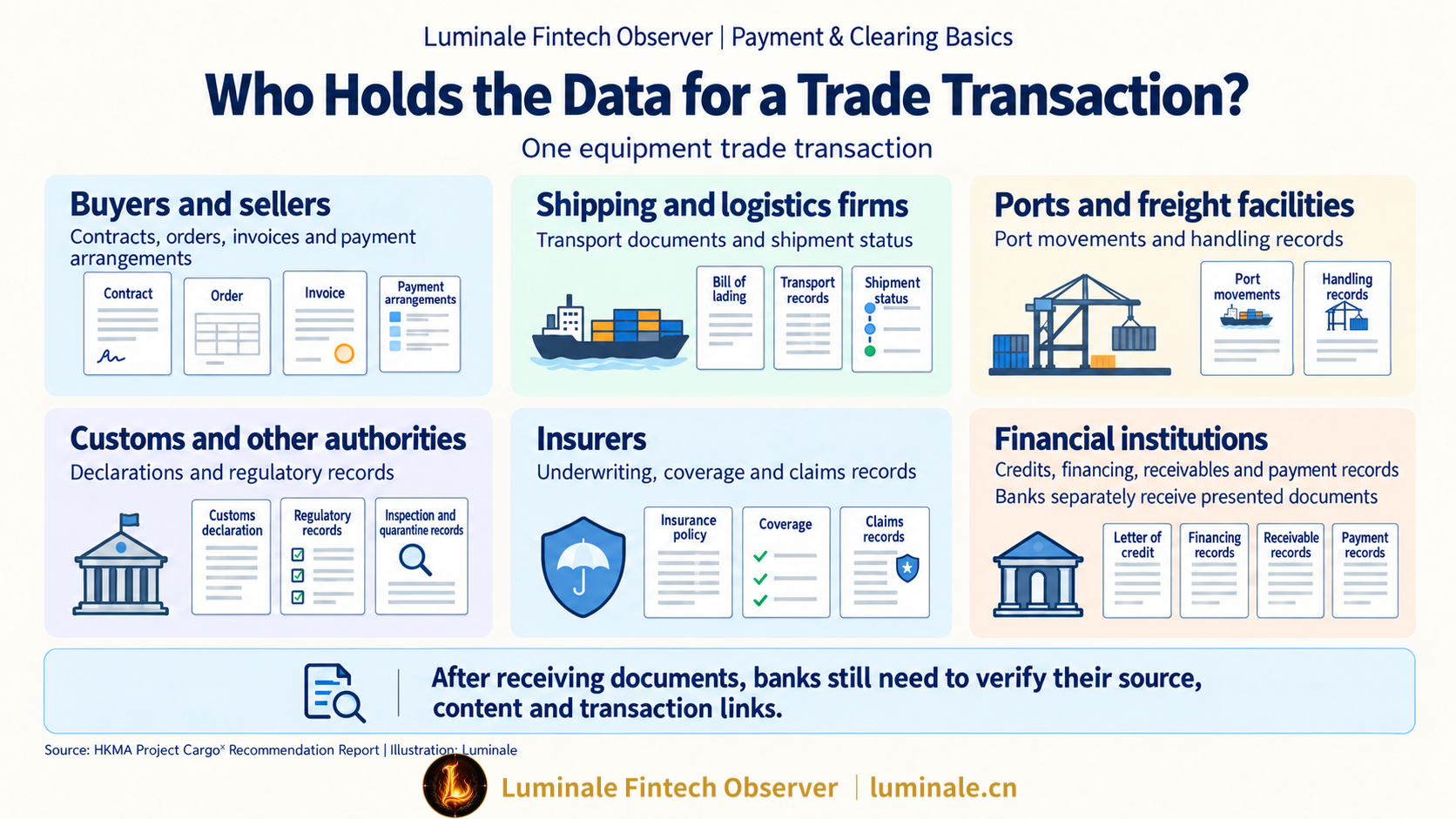
The table above categorizes general operational relationships; actual data accessibility depends on organizational willingness, customer consent, legal frameworks, and technical infrastructure. The Project Cargoᵡ Recommendation Report released by the Hong Kong Monetary Authority (HKMA) addresses the systemic challenges of data fragmentation, reuse, and connectivity across shipping and trade finance[17].
Even when trade data is integrated into banking workflows, lenders must critically evaluate what that data actually proves. A terminal container gate-in record confirms a logistics event; it does not prove that the cargo inside the container satisfies contract engineering tolerances, nor can it independently verify whether the underlying receivable has been fraudulently pledged to another commercial bank.
2. Electronic Documents, Verifiable Data, and the Transfer of Rights
Scanning paper invoices into PDF attachments and transmitting them via email eliminates courier delays, but receiving banks still resort to manual re-keying, document reading, and reconciliation. Furthermore, unstructured PDF data cannot be ingested directly into automated banking engines.
Negotiable documents present a much steeper legal hurdle regarding the transfer of proprietary rights. A physical negotiable bill of lading confers constructive possession of cargo through physical possession and endorsement of the paper document. By contrast, digital files can be cloned infinitely; presenting an electronic file alone cannot prove that the holder holds legitimate, exclusive proprietary entitlement.
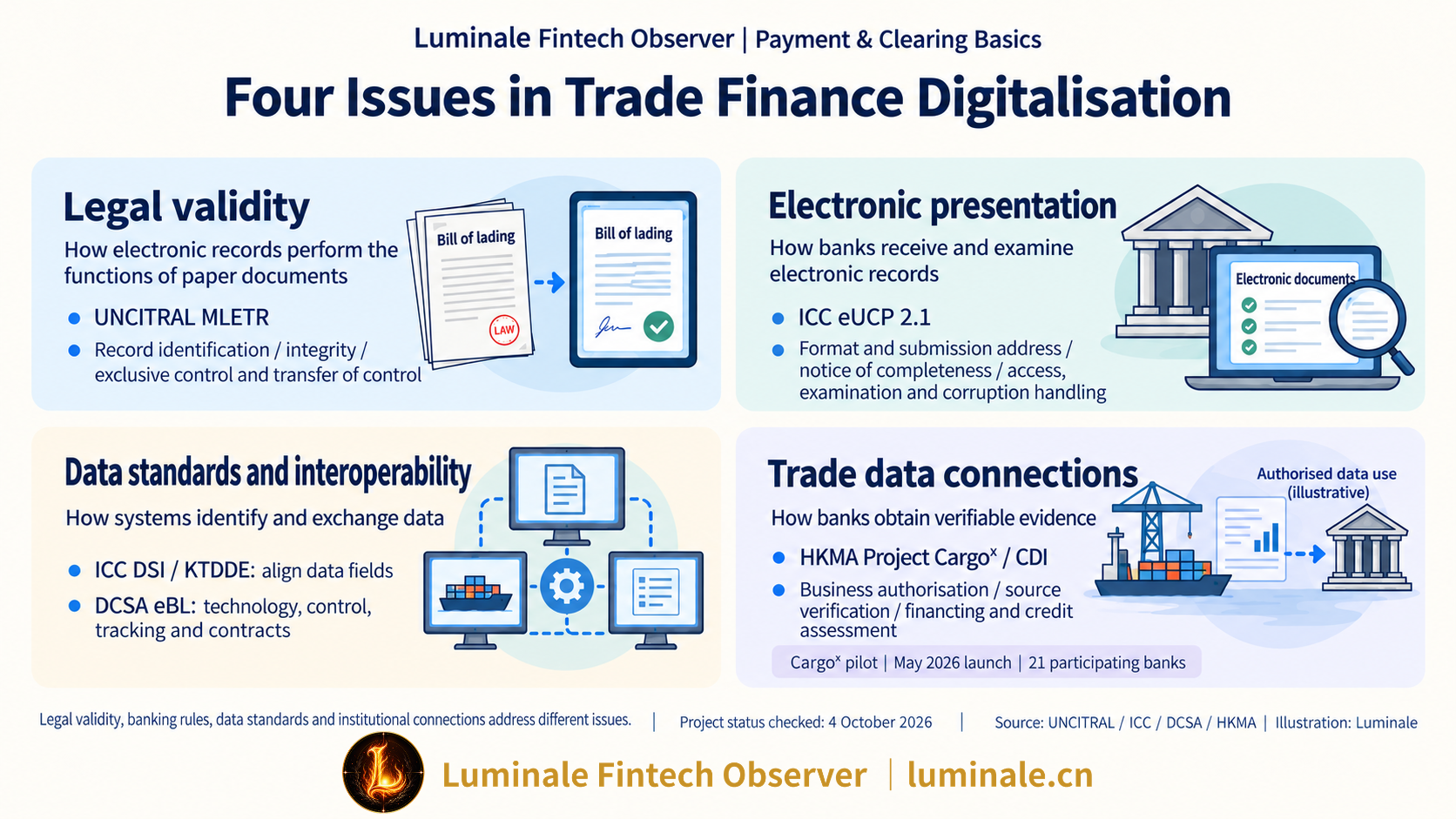
Consequently, trade finance digitization must resolve several interrelated challenges simultaneously: who issued the record, whether it was altered post-issuance, who holds the exclusive right to control and transfer it, whether counterparty systems recognize it, and whether governing law accords statutory validity to the digital arrangement.
These challenges span substantive legal regimes, banking operational rules, technical data standards, and inter-organizational system connectivity.
3. How Electronic Transferable Records Substitute for Paper Documents
The United Nations Commission on International Trade Law (UNCITRAL) adopted the Model Law on Electronic Transferable Records (MLETR) in 2017, establishing a legislative blueprint for the statutory recognition of electronic bills of lading, bills of exchange, and warehouse receipts[18].
Under MLETR, the legal concept of Control serves as the functional equivalent of physical possession of a paper document. Reliable methods must be employed to identify the electronic transferable record, preserve its integrity, and ensure that a designated person can exercise exclusive control and be verified as the person in control[18].
For instance, when an Electronic Bill of Lading (eBL) is transferred, the underlying platform must verify that the transferee acquires exclusive control and that the transferor is stripped of its ability to execute further transfers. These legal and architectural criteria far exceed merely archiving scanned documents.
MLETR adopts a principle of technological neutrality, accommodating diverse implementations such as distributed ledgers and centralized registries. Because MLETR is a model law, its legal force depends on enactment by sovereign jurisdictions into domestic law.
4. How Electronic Presentation Is Received and Examined
The ICC codified the Uniform Customs and Practice for Documentary Credits for Electronic Presentation (eUCP Version 2.1) to supplement UCP 600 for electronic presentations, supporting both standalone electronic records and mixed presentations combining electronic and paper documents[19].
Transacting parties must explicitly structure electronic presentations in compliance with eUCP rules and credit stipulations; a bank receiving an unprompted email attachment cannot be deemed to have received a valid presentation.
eUCP governs critical operational mechanics: permissible data formats, electronic presentation addresses, notices of presentation completion, the precise moment banks obtain access to examine records, and data corruption contingency protocols. Timelines for physical document delivery and electronic accessibility must be separately articulated.
While eUCP governs the presentation and examination of electronic records within letter of credit operations, whether an eBL effectively transfers title and what legal claims the person in control holds continue to be governed by substantive maritime law and platform contractual frameworks.
5. Aligning Data Semantics Across Disparate Platforms
A single machinery purchase order may carry conflicting naming conventions, serial numbers, and unit measurements across invoices, bills of lading, customs declarations, and trade financing portals. Even when documents are entirely digital, systems cannot cross-reference data automatically without semantic alignment.
The ICC Digital Standards Initiative (DSI) established the Key Trade Documents and Data Elements (KTDDE) working group, releasing a comprehensive data mapping framework in 2024 covering 36 foundational trade documents to align data schemas across supply chain participants[20].
In our machinery scenario, if the purchase order number, carrier name, shipment date, goods description, and unit quantities are mapped to standardized data attributes with immutable provenance, banks can automatically reconcile them against trade records and detect discrepancies.
Furthermore, technical interoperability requires diverse commercial platforms to exchange records and ownership states seamlessly. In June 2026, the Digital Container Shipping Association (DCSA) announced that five leading eBL solution providers adopted its DCSA Interoperability Standards Annex v.2 with International Group of P&I Clubs approval, combining technical protocols, control state tracking, and legal rulebooks[21].
Interoperability ensures that enterprises are not locked into isolated platform silos. However, whether a given cross-platform eBL transaction can be executed still requires verifying local legal enforceability and institutional platform participation.
6. Bridging Physical Trade Data and Banking Systems: HKMA's Project Cargoᵡ
The Hong Kong Monetary Authority (HKMA) launched Project Cargoᵡ to explore integrating freight and logistics data into trade finance underwriting and monitoring.
In January 2026, the HKMA released its comprehensive Recommendation Report, putting forward 20 recommendations structured across data, infrastructure, and connectivity. On May 7, 2026, the HKMA officially inaugurated the Cargoᵡ Pilot Programme in partnership with 21 commercial banks, leveraging the Commercial Data Interchange (CDI) infrastructure to connect logistics data with trade finance applications[22].
For documentary credit operations, these data connections deliver independent corroborating evidence beyond traditional paper dossiers, enabling commercial banks to evaluate continuous supply chain flows and enhance credit underwriting. Obtaining and processing corporate trade data nevertheless requires formal enterprise authorization, source verification, access governance, and rigorous legal data-sharing agreements.
Returning to the cross-border machinery procurement introduced at the outset: the essence of a letter of credit is to bridge the counterparty trust chasm between distant buyers and sellers through an irrevocable bank payment undertaking coupled with a pre-agreed set of trade documents.
Today, electronic presentations are superseding physical paper, electronic bills of lading establish legal control in digital environments, semantic standards enable automated data mapping, and inter-institutional data rails provide banks with verifiable logistics insights. Yet regardless of how technological media evolve, trade finance remains anchored to the same foundational questions: what obligation did the bank undertake, what facts do the documents verify, who holds legal title, and across which banking ledgers are monetary reserves settled?
References
[1]: International Chamber of Commerce (ICC), Uniform Customs and Practice for Documentary Credits (UCP 600), 2007 Revision, see especially Articles 1–5, 7, 8, 10, and 14. ↩
[2]: U.S. International Trade Administration, Trade Finance Guide, on cash in advance, open account, documentary collections, and letters of credit. ↩
[3]: Supreme People's Court of the People's Republic of China, Provisions on Several Issues Concerning the Trial of Letter of Credit Dispute Cases, adopted in 2005, amended in 2020, see especially Articles 5–10. ↩
[4]: International Chamber of Commerce (ICC), Users'Handbook for Documentary Credits under UCP 600, Chapter VIII: Advising the Credit, on advising, apparent authenticity, and bank obligations; advising per se creates no honour or negotiation liability, see UCP 600 Article 9. ↩
[5]: International Chamber of Commerce (ICC), Users'Handbook for Documentary Credits under UCP 600, Chapter IX: The Nominated Bank, on nominated banks, availability modalities, and undertakings. ↩
[6]: International Chamber of Commerce (ICC), Consolidated ICC Guidance on the Use of Sanctions Clauses in Trade Finance-related Instruments, 2024 Edition. ↩
[7]: ICC Academy, Documentary credits: Rules, guidelines & terminology, on negotiation, honour, ISBP 821, and related rules. ↩
[8]: Bank of China, Issuance of Domestic Letter of Credit under Credit Line Facility. This article cites only the credit-line issuance mechanism, without adopting historical fee schedules or application checklists as unified industry requirements. ↩
[9]: Swift, Category 7 — Documentary Credits and Guarantees/Standby Letters of Credit, Message Reference Guide, 2023 Edition, see MT 700 specification. ↩
[10]: United Nations Commission on International Trade Law (UNCITRAL), Working Group VI: Negotiable Cargo Documents, on functional distinctions between negotiable bills of lading and other transport documents. ↩
[11]: International Chamber of Commerce (ICC), DOCDEX Decision No. 310, on data across documents not needing to be identical, but not conflicting. ↩
[12]: ICC Banking Commission, Opinion TA901rev, on examination timeframes for respective banks under UCP 600. ↩
[13]: International Chamber of Commerce (ICC), DOCDEX Decision No. 296, on contents of notice of refusal, specific discrepancies, and document handling. ↩
[14]: U.S. International Trade Administration, Forfaiting, general overview of non-recourse trade receivables financing. ↩
[15]: People's Bank of China and former China Banking Regulatory Commission, Administrative Measures for Domestic Letter of Credit Settlement, Announcement [2016] No. 10, issued April 27, 2016, effective October 8, 2016, see especially Articles 2, 3, 5, 44, and 45. ↩
[16]: China Banking Association, Product Guidelines for Interbank Domestic Letters of Credit (2020), issued June 30, 2020, on interbank transmission channels, business workflows, forfaiting, and risk assessment. ↩
[17]: Hong Kong Monetary Authority (HKMA), Project Cargoᵡ Recommendation Report, published January 2026. ↩
[18]: United Nations Commission on International Trade Law (UNCITRAL), Model Law on Electronic Transferable Records (MLETR) with Explanatory Note, adopted July 13, 2017, focusing on functional equivalence, control, integrity, and technological neutrality. ↩
[19]: International Chamber of Commerce (ICC), eUCP Version 2.1, published June 2023. ↩
[20]: International Chamber of Commerce (ICC), ICC Digital Standards Initiative launches complete framework for supply chain digitalisation, April 24, 2024. ↩
[21]: Digital Container Shipping Association (DCSA), Five eBL platforms adopt DCSA Standard Annex v.2 with IGP&I approval, enabling global, cross-platform eBL exchange, June 4, 2026. ↩
[22]: Hong Kong Monetary Authority (HKMA), HKMA publishes Project CargoX Recommendation Report, January 19, 2026; HKMA launches CargoX Pilot Programme, May 7, 2026. Verification date of project status: October 4, 2026. ↩
Originally published by Luminale Fintech Observer: https://luminale.cn/articles/letter-of-credit-from-issuance-to-final-payment-en