
In October 2026, Iñaki Aldasoro, an economist in the Monetary and Economic Department of the Bank for International Settlements (BIS), published a paper titled Money and the architecture of trust[1].
The paper takes up a very old question: what is money? It does not begin with "money buys things". Its starting point is the obligation to pay when a debt falls due. Working outwards from a single payment, the author builds an account of how money works, and then uses that account to test three things that are often compared with money: gold, bitcoin and stablecoins.
Many news reports have summed up the paper as "the BIS says gold, bitcoin and stablecoins are not money". What the paper actually says is that gold and bitcoin choose to stand outside the monetary system, while stablecoins want to come in but do not yet meet the conditions. Where exactly each of the three falls short is what the rest of this article will work through with you.
I. Starting from a payment: money settles debts
Every day, every economic unit faces the same requirement: payments must be made when they fall due. A company has to pay its suppliers, a household has to make its mortgage payment, and a commercial bank has to settle its positions with other banks in its account at the central bank. The economist Hyman Minsky called this requirement the "survival constraint"[1].
One party's inflow is another party's outflow, so at any moment some units are in surplus and others are short. No single unit has any reason to expect that its inflows will be exactly enough at the moment a payment is due. When it is short, there are only three options: borrow, which pushes settlement into the future; sell assets, which turns future money into money now; or default, which turns its own failure to pay into someone else's unexpected shortfall[1].
Take an example. A company is solidly profitable on paper, but most of its receivables will not come in until the end of the month, and today is payday. The income statement tells you whether the company is making money; the survival constraint only asks whether it can pay wages today. The company will either draw on a bank credit line or redeem some of its wealth management products. The paper stresses that when the survival constraint tightens, what is being tested is liquidity, and solvency is a separate matter: a company whose assets exceed its liabilities can still fail to pay because it cannot turn those assets into cash in time[1].
This leads to the most basic distinction in the paper. Money settles debts: once it is delivered at maturity, the debt is extinguished. Credit is a promise to pay money in the future, and it pushes settlement back. In the author's words, "money settles, credit promises"[1].
Because of this starting point, the paper is not organised around the three textbook functions of money: medium of exchange, unit of account and store of value. The author argues that exchange is only one of the settings in which settlement happens, and that storing value is not unique to money, since any asset can store value. What really deserves attention is settlement and the unit of account[1]. This does not deny the medium-of-exchange function; it simply changes the vantage point.
The paper also notes a detail. In practice, the vast majority of debts are extinguished not by actually delivering money but by netting: receivables and payables are offset against each other, and only the remaining balance is settled. This has been true from medieval fairs and village ledgers to today's clearing houses. The author's reading is that the very effort people put into netting shows that the means of settlement is scarce and that holding it is costly[1]. This is the same trade-off between Real-Time Gross Settlement (RTGS) and Deferred Net Settlement (DNS) that Luminale has covered before; see Why Don't Payment Systems Settle Every Payment Immediately? and Not Enough Money, So the Payment Has to Wait?.
At the outset, the paper also distinguishes two kinds of trust. One is trust in specific promises: whether this bank or that issuer will pay when due. This kind of trust is broken often, and the failure of an individual institution is not unusual. The other is trust in the monetary system itself: whether there will still be a means of settlement that everyone accepts, and whether its value will hold. This kind of trust rarely fails, but when it does the result is hyperinflation or monetary collapse[1]. The whole set of institutional arrangements the paper goes on to describe exists to stop failures of the first kind from turning into failures of the second.
II. The hierarchy of money and par: what keeps one yuan worth one yuan
Settlement assets form a hierarchy
What a payee wants is something it can use to settle its own debts. In other words, whatever the payer delivers must also be acceptable to the payee's creditors. Follow that chain upwards and payment promises naturally arrange themselves into a hierarchy: the most widely accepted means of settlement sits at the top, and the further down you go, the more contingent things become[1].
Borrowing a term from the economist Perry Mehrling, the paper calls this the hierarchy of money. In a modern economy, the top layer is central bank liabilities, namely reserves and cash. The next layer is bank deposits, which are money to the public but only credit to the banking system, because banks ultimately settle with one another in reserves. Below that are securities, which are promises to pay deposits after a period of time. Further down are promises with more and more conditions attached[1].
| Layer | Representative instruments | Role for the layer below | What it settles in |
|---|---|---|---|
| Layer 1 | Central bank liabilities (reserves, cash) | Ultimate settlement asset of the banking system | No higher layer to settle in |
| Layer 2 | Bank deposits | Means of payment for the public | Settled between banks in reserves |
| Layer 3 | Securities | Promises to pay deposits in the future | Settled in deposits |
| Lower layers | Other, more contingent promises | Depends on the specific arrangement | Settled in liabilities of the layer above |
Liabilities at each layer are settled in the liabilities of the layer above. Whether a given instrument counts as money or as credit depends on which layer you view it from: a bank deposit is money to the depositor, but for settlement between banks it is just credit that has to be redeemed in reserves.
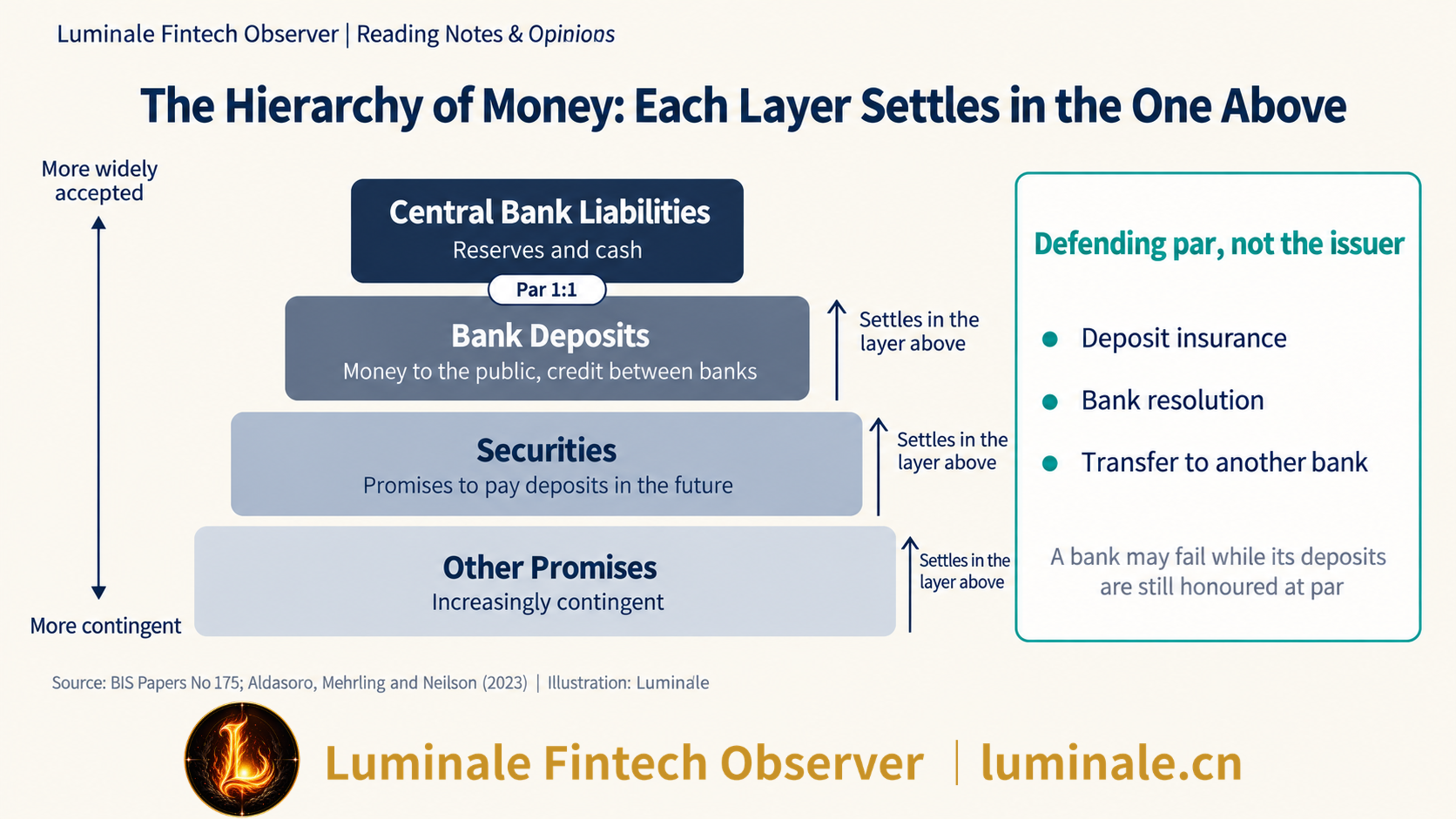
This table is easy to confuse with the statistical aggregates M0, M1 and M2. The statistical aggregates are divided by liquidity and use; the paper's hierarchy is divided by who settles in whose liabilities. They answer different questions. For the logic of the statistical aggregates, see M0, M1 and M2 Are Not Three Kinds of Money; for why reserves sit at the top, see From the Money Multiplier to Payment and Settlement: Central Bank Reserves Explained.
One more conclusion follows: the payment system is itself a credit system. This has two meanings. First, when payers are short, the most common remedy is to borrow; without a steady supply of credit, the payment system would quickly seize up. Second, the payment instrument being transferred is itself a credit claim: the deposit a customer sends out is a liability of the bank. Banks are therefore not neutral pipes. The payment function and the credit function are carried out by the same institutions, on the same balance sheet[1].
Par is the price that links the layers
For the hierarchy to work, there must be a reliable exchange price between any two adjacent layers. The paper cites Mehrling's four prices of money: par, the interest rate, the exchange rate and the price level. Mainstream monetary theory focuses mostly on the price level, but the author argues that the most fundamental of the four is par[1].
Par is the price at which bank deposits exchange for central bank money, and by definition it equals one. Because of par, a restaurant cashier who accepts a card payment does not need to ask about the asset quality of the issuing bank, and an exporter shipping goods does not need to worry whether the importer's bank will still be around when payment is due. Par turns trust in an individual bank into trust shared across the whole system, so that no transaction requires bilateral due diligence[1].
Par normally does not move at all, so few people ever think about it. The author puts it this way: "Par has no neighbourhood". When a bank cannot pay at par, it does not post a quote of "0.99 per unit of deposit"; it simply fails. The reason is straightforward. A depositor who sees a 99-cent quote learns two things at once: the bank cannot pay in full, and waiting will not make things better. The rational move is to withdraw everything immediately, so as soon as a discount appears it triggers a run, and the run widens the discount[1].
History supplies a ready example. In the US free banking era, banks issued their own notes, and the further a note travelled from its place of issue, the larger its discount. In normal times the discounts were small and seemed harmless. Once confidence was shaken, the discounts widened rapidly, merchants refused unfamiliar notes, and commerce stalled[1].
Par is maintained by a set of institutional arrangements: prudential supervision, deposit insurance, banks'access to wholesale money markets, and the central bank's willingness to lend against eligible collateral in times of stress[1]. The paper makes a point of saying that defending par is not the same as rescuing banks. A bank can fail, and in a well-functioning system some banks should be allowed to fail. As long as its monetary liabilities are honoured through deposit insurance, resolution or transfer to another bank, par holds. What the public sector commits to defending is this price, not any particular issuer[1].
How this relates to the singleness of money
The first article in this column, Why Is One Yuan at Every Bank Worth One Yuan, While a Stablecoin May Not Be?, discussed the singleness of money from the BIS Annual Economic Report, as well as the idea that money is accepted with "no questions asked"[2]. That article also used T-accounts to show how reserves move in an interbank transfer, so we will not repeat it here.
In Box A, this paper reinterprets both concepts. The author argues that singleness and "no questions asked" both describe outcomes that appear when the system is working well. The payee does not ask because the hierarchy, par and the backstops give it confidence that the claim can be settled at par in central bank money. Take away deposit insurance, suspend the lender of last resort, let par break, and people will very quickly start asking questions[1]. In the author's words, singleness is par: singleness is the symptom, and the architecture behind it is the mechanism.
III. Elasticity, discipline and backstops: trust needs an architecture
Loans create deposits, interest rates discipline expansion
The hierarchy can expand, and it can also contract.
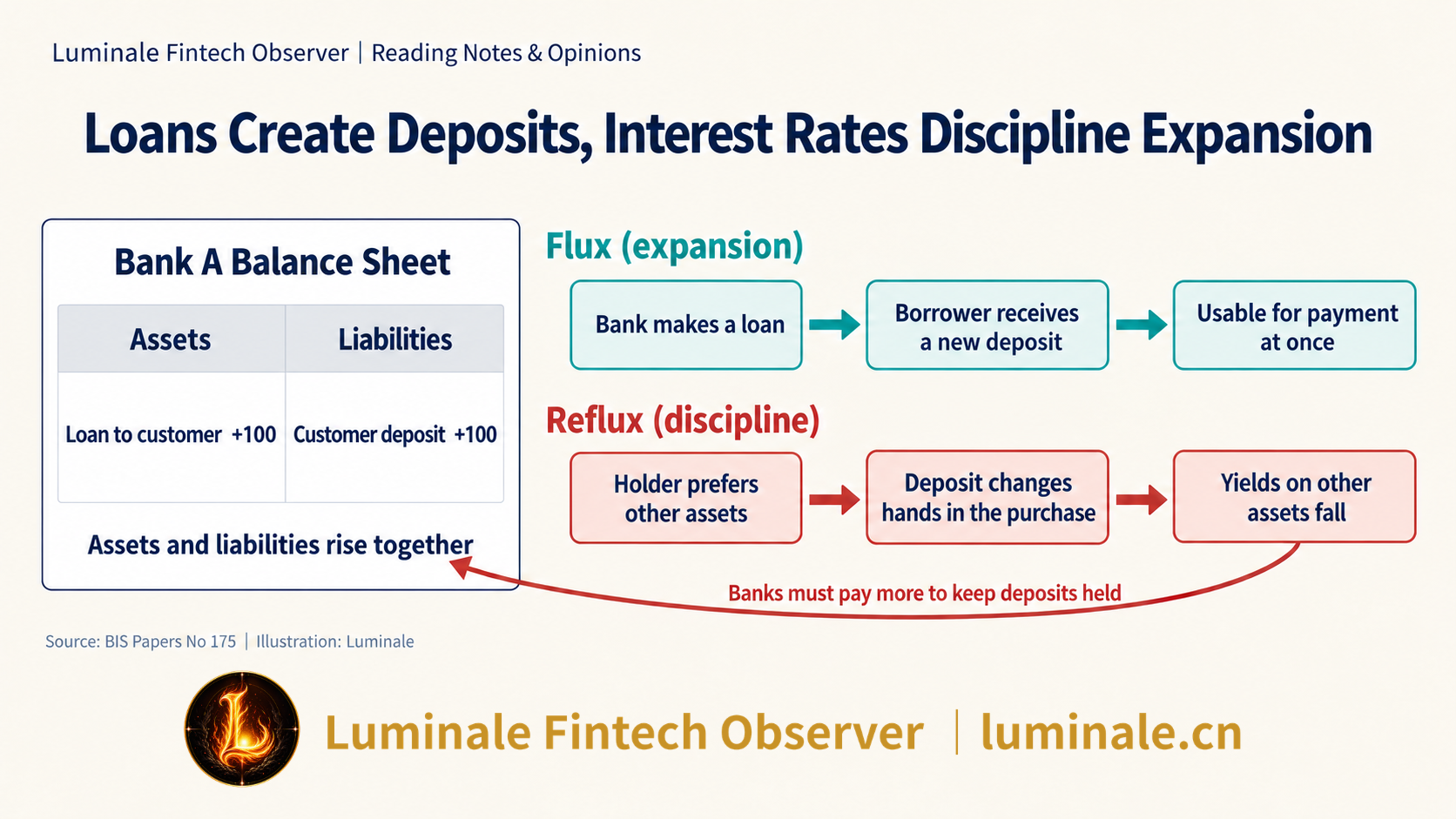
Expansion happens when banks lend. When a bank makes a loan of 100, it does not lend out 100 that someone else deposited. It records a loan on the asset side and, at the same time, a deposit for the borrower on the liability side[1].
| Bank A assets | Change | Bank A liabilities | Change |
|---|---|---|---|
| Loan to customer | +100 | Customer deposit | +100 |
The paper calls this process flux: money and credit expand together. It gives the system elasticity, because borrowers can obtain purchasing power without first saving and without anyone else giving up their savings[1]. For the basics of bank balance sheet accounting, see A Quick Start to Bank Accounting.
Expansion also has limits. The new deposit ends up with some holder, and if that holder would rather hold bonds or other assets, it will use the deposit to buy them. The purchase itself does not destroy the deposit, which simply changes hands, but this shift in asset preferences pushes up the prices of other assets and pushes down their yields, forcing the banking system to raise the return on its own liabilities so that deposits continue to be held. The paper calls this return flow reflux, and the discipline works through a price: the interest rate[1]. For how the quantity and price of reserves constrain banks, see The Balance Sheet Logic of Monetary Policy Tools in this column.
The expansion and contraction of credit also form a cycle. In a boom, the hierarchy flattens: weaker promises are accepted as near-money, and more and more promises rest on less and less cash. When the boom ends, the hierarchy steepens: people want money, not promises, the difference between money and credit becomes obvious again, units that cannot pay are forced to default, and one unit's default becomes another's unexpected shortfall[1].
Backstops come from the layer above
What stops this chain of defaults? The paper's answer is that the layer above steps in. Each layer has a capability the layer below lacks: it can create the means of settlement for the layer below. Commercial banks can create deposits but not reserves; the central bank can create reserves. When a bank cannot borrow reserves in the market and the central bank lends to it, the central bank is using its position at the top of the hierarchy to relax a survival constraint that the private sector cannot relax on its own[1].
This is the lender of last resort function, first set out systematically by Walter Bagehot in the 19th century. After the 2008 global financial crisis and the market turmoil of March 2020, it was extended to buying assets outright in dysfunctional markets, a role described as "dealer of last resort" or "market maker of last resort"[1].
The paper stresses that backstops are not only useful in a crisis. Because everyone knows that someone will provide liquidity when stress arrives, people do not rush to hoard money in normal times, and money can circulate without being scrutinised. The author's phrase is that backstops socialise trust. The author also points out that what allows the central bank balance sheet to serve as a backstop is the fiscal support of the government behind it: when a central bank takes on credit risk at scale, the government ultimately has to provide arrangements to make it whole[1].
Private initiative, crisis and public validation
The paper describes a recurring historical pattern in three stages[1]:
| Stage | What happens | Historical examples |
|---|---|---|
| Private initiative | Private institutions issue liabilities that the market is willing to use as money | Bills of exchange in medieval Europe, notes issued by goldsmiths in 17th-century England, post-war eurodollars, money market funds in the US in the 1970s |
| Crisis | The promise is tested and the issuer cannot pay the money it promised | Discounts on banknotes, money market funds "breaking the buck", freezes in the eurodollar market |
| Public validation | The public sector at the top of the hierarchy decides whether to extend backstops to the new money, attaching regulatory conditions | Deposit insurance validated bank deposits; support for money market funds in 2008 and 2020; dollar liquidity swap lines validated the eurodollar system |
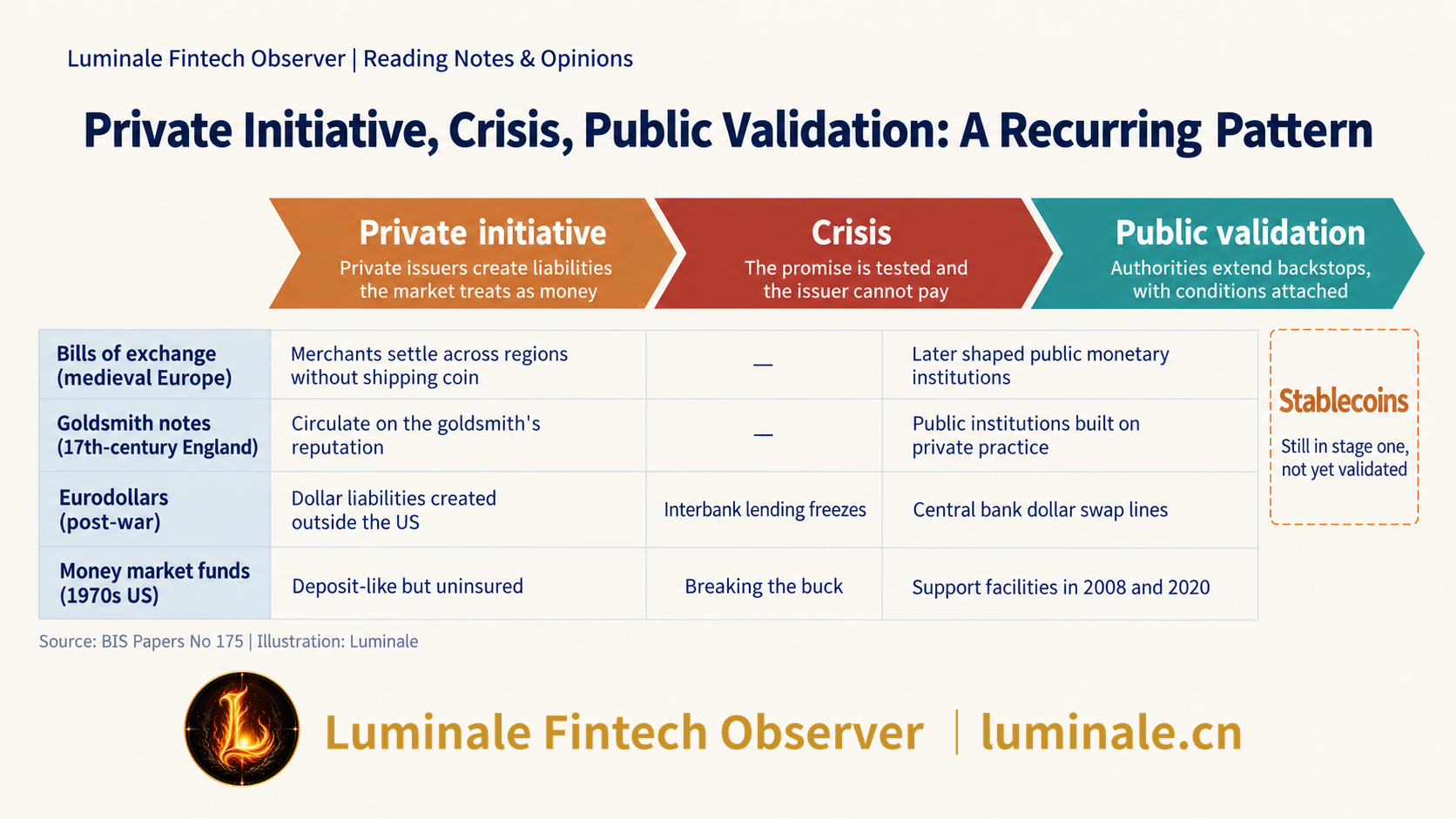
Minsky observed that anyone can create money; the problem is getting it accepted[1]. Public validation turns a fragile private arrangement into part of the institutional infrastructure, and the price is regulation, supervision, reporting and capital requirements.
Validation cannot be taken for granted either. The author points out that if every promise were automatically guaranteed, discipline would disappear. So central banks maintain a constructive ambiguity: assurance for the system as a whole, uncertainty for individual participants. Validation without discipline amounts to a subsidy[1].
The paper also discusses the state's place in money. The author argues that the state's most important monetary act is to define the unit of account, that is, the unit in which debts are written, enforced and taxed. Who issues claims in that unit is, to a large extent, a private matter. Private initiative always comes first, and legal and institutional recognition often arrives only after a crisis[1].
The same hierarchy exists at the global level
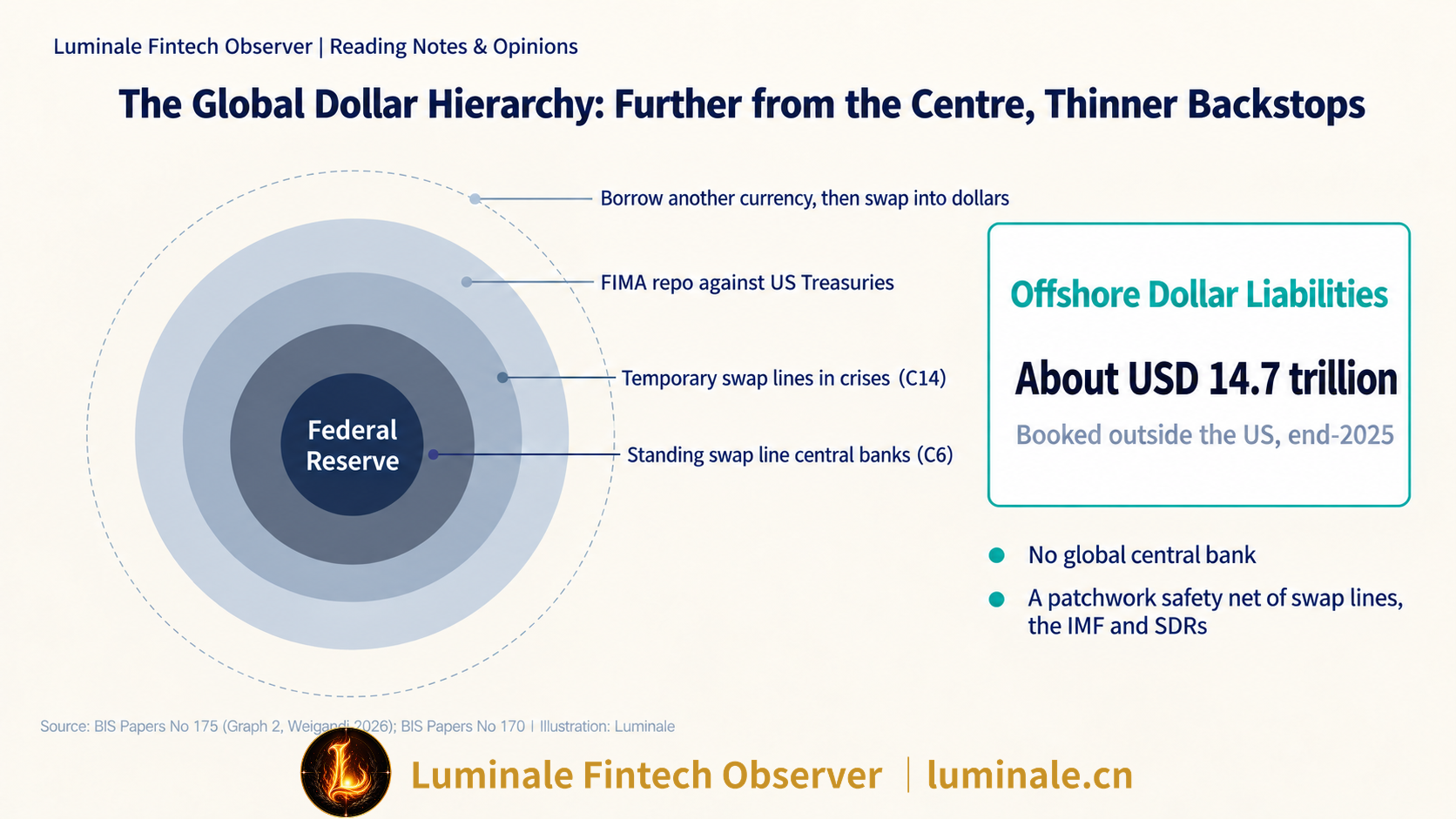
The same logic applies to the international monetary system, only with weaker institutions. The dollar sits at the top of the international monetary system. According to the data cited in the paper, dollar-denominated liabilities booked outside the United States totalled about USD 14.7 trillion at the end of 2025, and none of their issuers has direct access to the Federal Reserve[1][3].
The terms on which institutions outside the US can obtain dollar liquidity depend on where they sit in the hierarchy. Central banks with standing swap lines with the Fed are in the inner circle. Central banks that receive temporary swap lines in a crisis are in the next ring. Further out, central banks can only exchange their holdings of US Treasuries for dollars through the Foreign and International Monetary Authorities repo facility (FIMA). Central banks in the outer rings first have to borrow another currency and then swap it into dollars in the foreign exchange market[1]. There is no global central bank, so this safety net is stitched together from swap lines, the International Monetary Fund (IMF), Special Drawing Rights (SDR) and similar arrangements, and it is more fragile than domestic backstops[1]. For the infrastructure questions at the cross-border level, see RMB Internationalisation Is More Than "Settling in Renminbi" in this column.
IV. Gold and bitcoin: nobody's liability, so they cannot carry payments
Gold expresses distrust
The first three sections set out a measuring stick: which layer money sits in, what keeps it at par, and who provides liquidity under stress. Section 6 of the paper applies this stick to three things.
On gold, the author writes that today nothing is priced in gold and nothing is paid in gold; gold is valued precisely because it is nobody's liability[1]. It does not depend on the credit of any issuer, the solvency of any bank or the fiscal capacity of any sovereign. It sits outside the web of payment promises.
Wanting an asset that is nobody's liability means wanting to exit the social contract that money represents. The paper argues that, under the right conditions, a rising gold price can be read as a barometer of declining confidence in this system. In that sense gold is a monetary protest, not a substitute for money[1].
These judgements apply to gold today. Under the 19th-century gold standard, gold was money in the strict sense, but its main role was to discipline credit expansion. Most day-to-day settlement was done with bills of exchange, banknotes and deposits, and gold was used for settlement only at the margin[1]. The author also mentions an accounting detail: in the national accounts, monetary gold and Special Drawing Rights are the only two financial assets with no corresponding liability[1].
The problem with gold is that it cannot expand. In a system built on an asset that is nobody's liability, supply is determined by geology and the means of settlement cannot expand as the economy needs. In its pure form, such a system cannot support an economy of modern scale[1].
Bitcoin gets elasticity and discipline backwards
Bitcoin inherits the same characteristics as gold. The bitcoin white paper states its goal clearly: an electronic payment system "based on cryptographic proof instead of trust"[4]. Its design aims to remove every trusted intermediary: no central bank, no commercial banks and no hierarchy.
The author points out that what bitcoin removes is trust in an issuer, not trust itself: holders still depend on others continuing to accept it[1]. For how cryptoassets are classified and how they work, see What Is a Cryptoasset?.
The paper also observes that the crypto ecosystem has not escaped hierarchy; it has regrown one in a cruder form. Bitcoin sits at the top, other tokens rank below it by reliability, exchanges act as de facto banks that take deposits and match buyers with sellers, and stablecoins have become the settlement money of the ecosystem. Between these layers there are none of the backstops left by centuries of institutional evolution[1].
The more fundamental problem is that crypto gets the elasticity and discipline described in Section III backwards. When elasticity is needed, it has none: the total supply of bitcoin and its issuance schedule are fixed in code, there is no lender of last resort, and the means of settlement cannot expand when settlement demand surges. When restraint is needed, it has none either: new coins and tokens can be issued almost without limit. According to the paper's count, as of August 2026 CoinMarketCap ranked about 8,000 actively traded assets, and CoinGecko tracked about 18,600[1].
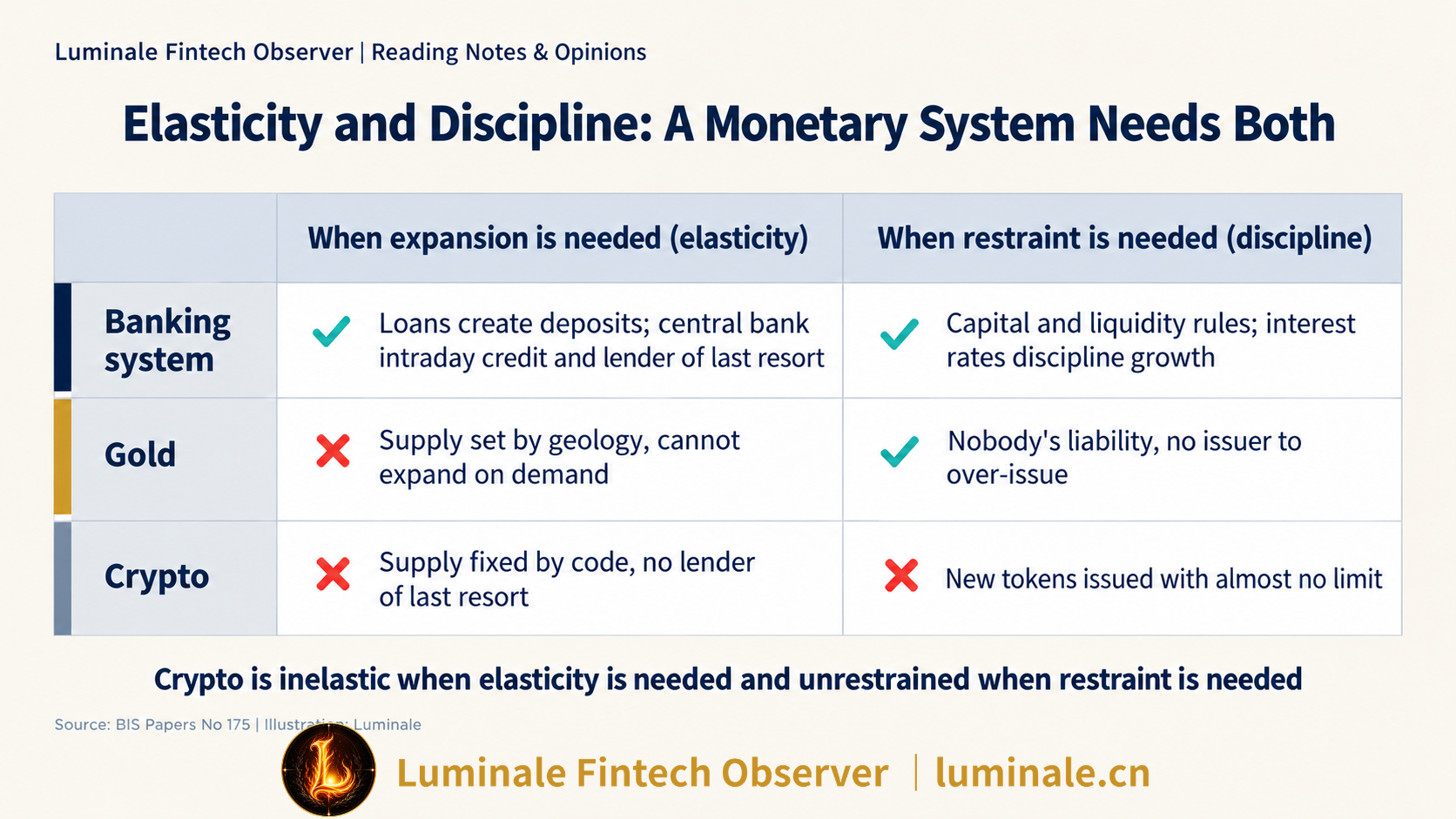
The author also cautions that, although bitcoin and gold are often mentioned together, they differ considerably. Gold has a monetary history and industrial and decorative uses. Bitcoin has twice been made legal tender (in El Salvador and the Central African Republic), and both decisions were later reversed without it ever coming into general use. What the two have in common is only that they both carry the desire for an asset that is "nobody's promise"[1].
Research by the economist Eric Budish, cited in the paper, offers another angle: the cost of blockchain-style trust grows linearly with the value it protects, whereas traditional institutional trust has economies of scale, since society pays a broadly fixed cost for laws and institutions and can then cover a vast amount of economic activity[5].
The liquidity cost of atomic settlement
The paper does not stop at bitcoin. It extends the same critique to two ideas that have become popular in recent years.
The first is atomic settlement: an exchange of two assets either completes in full or does not happen at all, and there is no settlement lag. The author looks at these two properties separately. All-or-nothing conditional settlement is not new. Delivery versus Payment (DvP) and Payment versus Payment (PvP) have been used in securities and foreign exchange settlement for decades, precisely to remove the principal risk that one side delivers but never receives the counter-value, and this property is cheap[1]. For the mechanics, see Securities and Cash Must Change Hands Together and What Is the Most Dangerous Moment in an FX Trade?. In the euro area, T2S runs DvP trade by trade in central bank money, and when cash is short participants can obtain intraday credit from the central bank through auto-collateralisation; see More Than Twenty CSDs Sharing One Settlement Engine. This is a ready-made example of conditional settlement paired with central bank credit.
What atomic settlement adds is the absence of a lag: every trade has to settle gross and immediately. The cost is the loss of the time window for netting and saving liquidity. Participants either hold large precautionary balances at all times, or borrow at the right moment on the right terms. The first makes the system lose its elasticity; the second lets credit back in through the back door, merely turning overdrafts into committed credit lines[1].
The author's example is RTGS, which Luminale has covered. In the 1980s and 1990s, large-value payment systems around the world moved from DNS to RTGS, accepting higher intraday liquidity needs in return for finality and lower settlement risk. That shift became affordable only because central banks deliberately provided intraday credit on a large scale. Atomic settlement seeks to repeat the same exchange without the credit that made it affordable, which, the author argues, does not hold up even on its own terms[1].
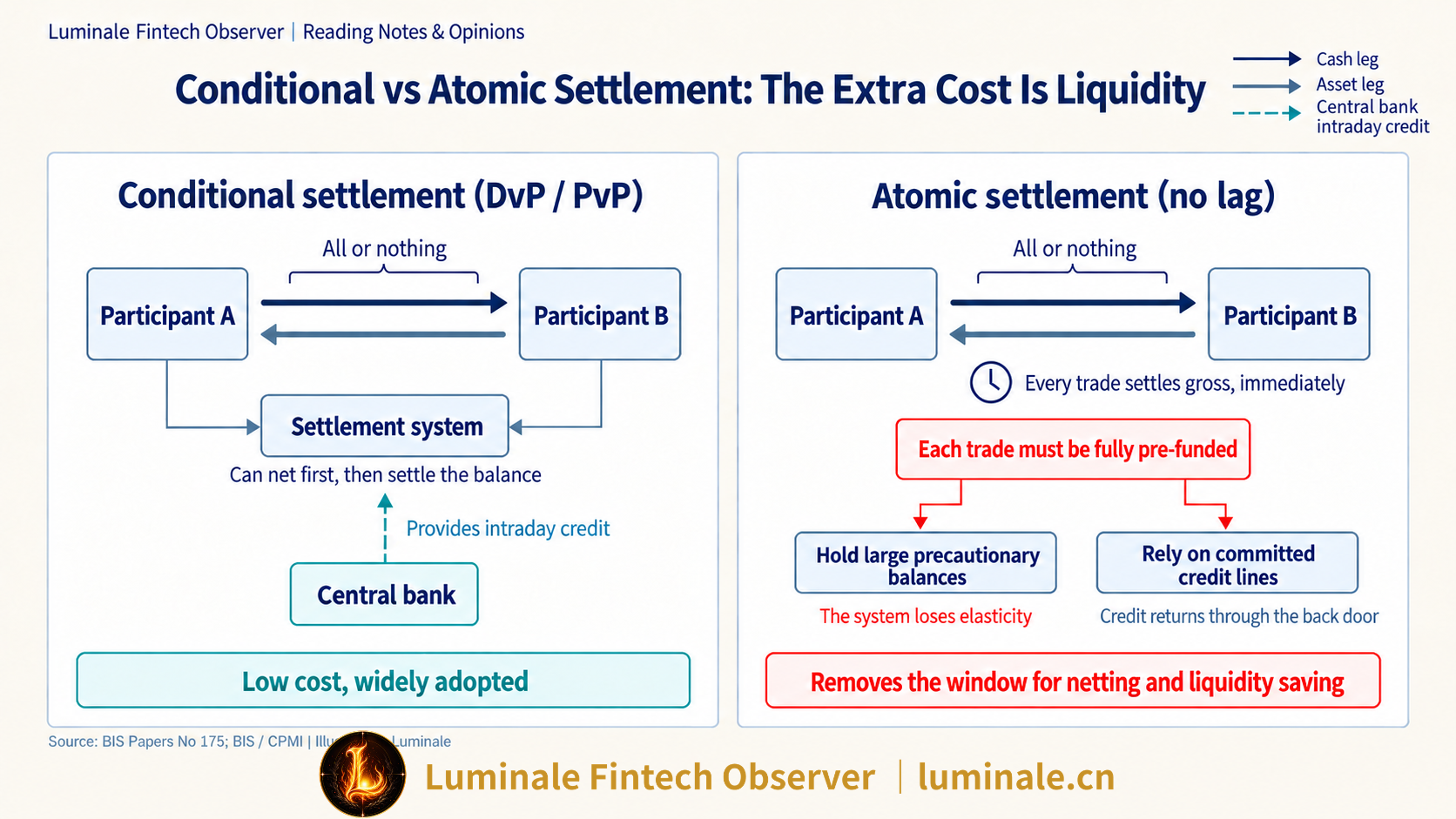
This is close to the conclusion of the IMF tokenisation report read in this column: tokenisation makes transactions faster, but it also squeezes the room for netting, so liquidity needs move earlier; see IMF Report Close Reading: Tokenisation Makes Financial Transactions Faster, but Will Risk Arrive Faster Too?. For how atomic settlement is implemented technically through smart contracts, see Smart Contracts, Programmability and On-Chain Settlement. The paper's critique targets the design of "immediate gross settlement without matching credit"; conditional settlement itself is endorsed.
Unbundling payments from money just adds another layer of liabilities
The second idea is to unbundle money and payments, treating payments as a technical service independent of money issuance. The author argues that if money is defined as the means of payment, then separating payments from money leaves something that is no longer money[1].
What advocates of unbundling actually describe is, for the most part, new intermediaries entering the payment chain. The problem is that these intermediaries all end up issuing their own liabilities: a stablecoin is the issuer's promise to pay one dollar, and a balance on a fintech platform is the platform's promise to its user. The hierarchy does not disappear; it gains another layer at the bottom, and the payment function is tied to a weaker promise. The author calls this rebundling[1].
Readers in China will find this structure familiar. The balance in a payment account is a liability of the payment institution to the user, and under current rules customer reserve funds must be deposited in full, centrally, with the People's Bank of China; see Is Money in Alipay the Same as Money in Your Bank Card?. From the paper's perspective, this trades full reserving for safety: the payment institution's liabilities are backed by funds in a central bank account, but it cannot lend those funds, so it provides no elasticity for credit expansion. The two are comparable only in balance sheet structure. Their regulation, custody and redemption arrangements are very different, and payment institutions should not be equated with stablecoin issuers.
Narrow banking and "assets only, no liabilities"
Narrow banking belongs to the same line of thinking as unbundling. These proposals require deposit-taking institutions to back their monetary liabilities in full with safe assets, separating the deposit business from credit creation. Similar ideas have been put forward by economists from Irving Fisher to Milton Friedman[1].
The author considers narrow banking more coherent than unbundling: it accepts that money is the means of payment and only seeks to take credit creation away from the institutions that issue money. It can also be seen as the balance sheet version of atomic settlement, guaranteeing settlement through full prefunding. The design behind it is the same as that of gold and bitcoin: an attempt to squeeze credit, and therefore trust, out of the monetary system. The paper paraphrases Mehrling: credit is a feature of the monetary system, not a bug[1].
On page 26, the paper reproduces a meme that circulated on social media, titled "Money (that's what I want)". Luca Pacioli was the first to publish a systematic account of double-entry bookkeeping, in the 15th century, and the meme's caption reads "If I were Luca Pacioli I would have only invented assets, no liabilities". In the three panels below, a dog first says "Only money", says "No IOUs" when someone hands it something, and finally shouts "Only money!!".
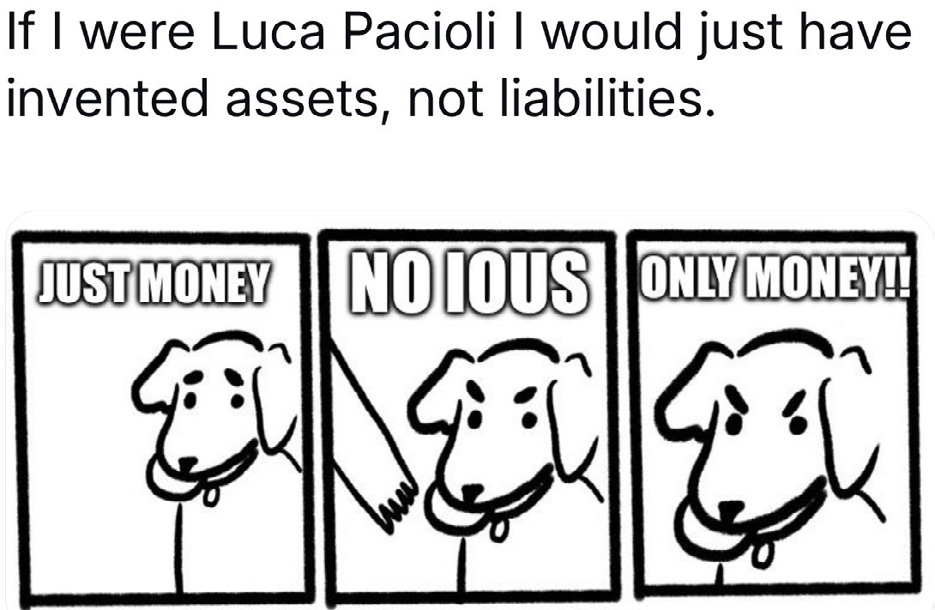
The author's comment is that in the modern world all money is an IOU, a liability of some issuer, sustained by trust that the issuer will honour its promise. The dog wants an asset that is nobody's liability because it does not trust; what it wants is gold, or bitcoin. But without trust there is no money, and money without trust is a contradiction in terms[1].
V. Stablecoins: they want to join the monetary system, but still lack par, elasticity and backstops
Bitcoin wants out, stablecoins want in
Stablecoins and bitcoin share a common origin but want opposite things. Bitcoin wants to replace the monetary system; stablecoins want to join it. In terms of the historical pattern in Section III, stablecoins are the latest round of private initiative seeking public validation[1].
In its most basic form, a stablecoin is a digital token whose issuer promises to redeem it at par, for one dollar, at any time. It is a liability of the issuer and circulates among those who accept it; the paper calls it a private near-money[1]. For the basics of how stablecoins work, see Stablecoins Explained in One Article. In Luminale's framework for analysing payment infrastructure, assessing a new payment instrument usually comes down to three questions: whose liability is it, which layer does it sit in and what asset does it settle in, and who provides liquidity under stress. The three shortcomings the paper lists for stablecoins correspond to these three questions.
Shortcoming one: par is not supported by the hierarchy
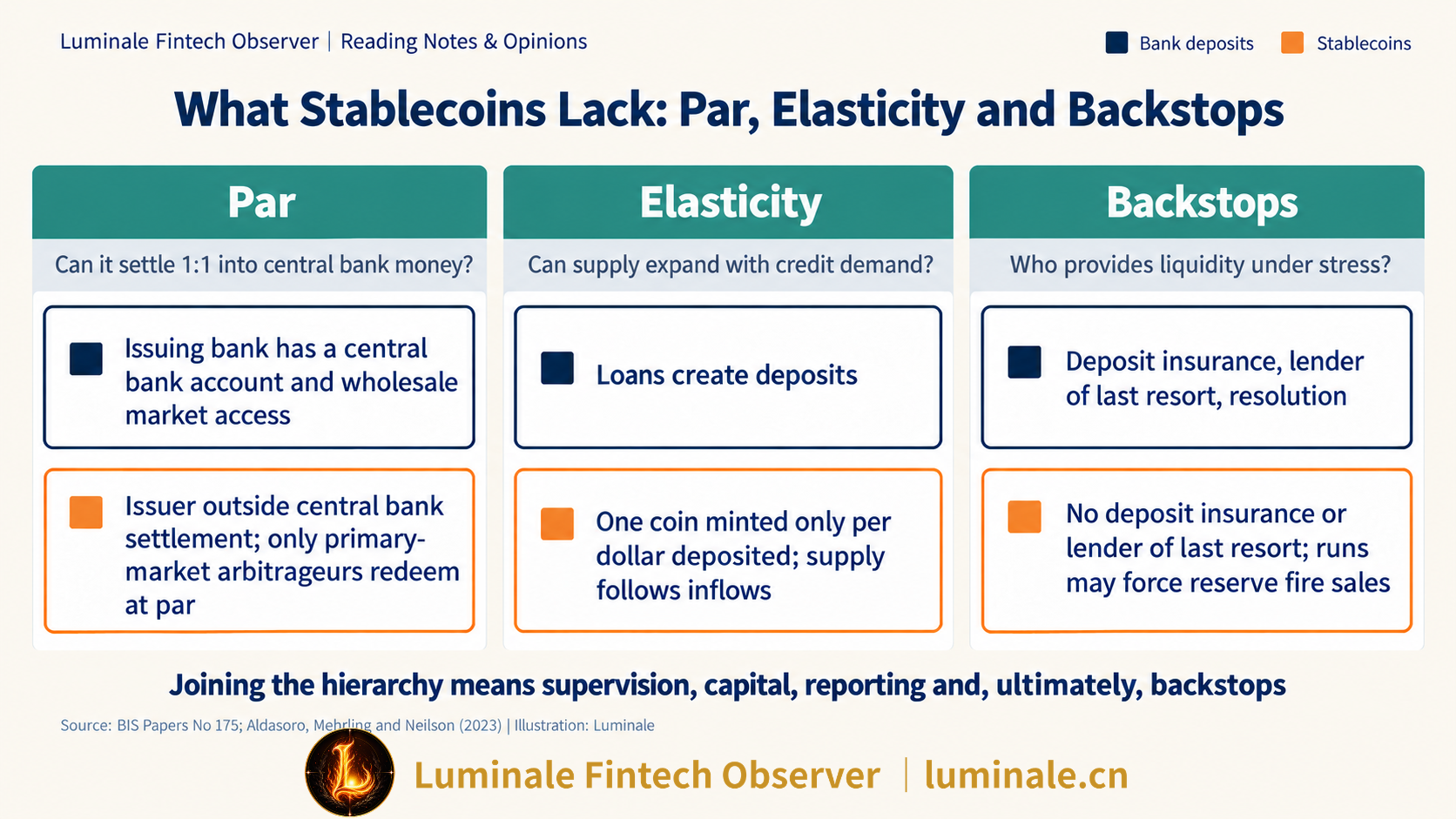
Bank deposits can be exchanged for central bank money at par because the issuing bank has an account at the central bank, has access to wholesale money markets and can obtain lender of last resort support in an emergency. Other banks are willing to accept that bank's deposits at par, and this acceptance is exactly what depositors experience when they make a transfer[1].
Stablecoin issuers currently sit outside the central bank's settlement perimeter. They have no central bank accounts and no standing lender of last resort facilities. For which institutions can hold accounts at the central bank, see Who Can Open an Account at the Central Bank?. The promise of redemption at par is effective only for arbitrageurs with direct redemption rights in the primary market; ordinary users rely on a secondary market price held up by those arbitrageurs. The promise is supported by the issuer's portfolio of reserve assets, usually US Treasuries and bank deposits. How reliable the promise is depends on the liquidity of those assets and on the issuer's operational ability to handle redemptions under stress. The author describes stablecoins as a money market instrument without a backstop[1][6].
This is the other side of the problem examined in the Financial Stability Board (FSB) report that Luminale has covered. That report focused on mismatches in the redemption chain across time zones, jurisdictions and information: tokens can move on-chain around the clock, but redemption has to wait for the markets and banks holding the reserve assets to open; see Tokens Move Around the Clock, but Redemption Still Waits for Markets to Open. This paper explains at the institutional level why that happens: the issuer is not connected to the hierarchy, so par can only be maintained through its asset portfolio and secondary market arbitrage.
By contrast, tokenised deposits are still liabilities of commercial banks, and the issuing bank has an account at the central bank, so they stay inside the hierarchy; see Tokenised Deposits: How Does Commercial Bank Money Enter the On-Chain World?.
Shortcoming two: supply follows inflows of funds
What makes banks special is that their liabilities are widely accepted as means of payment, so a bank can buy assets by issuing new liabilities; this is how loans create deposits. It is the source of the elasticity of bank payments[1].
Under current arrangements, stablecoin issuers cannot do this. A stablecoin can be minted only when someone hands one dollar to the issuer. The supply of stablecoins follows inflows of funds and has nothing to do with the economy's demand for credit. As the author puts it, the coin itself is an IOU, but the payment system built on it creates no credit[1]. Given this structure, today's stablecoin issuers are essentially narrow banks: they take in deposits, hold reserves and earn a spread, but do not create money[1].
Current regulation is also locking stablecoins into this form. The US Guiding and Establishing National Innovation for U.S. Stablecoins Act (GENIUS Act), signed in July 2025, and the EU's Markets in Crypto-Assets Regulation (MiCA) both require issuers to back outstanding stablecoins in full with highly liquid assets, and both prohibit paying interest to holders[7][8].
The paper cautions that this is not set in stone. The author cites a 2026 analysis by Claudio Borio and co-authors: if a stablecoin became widely accepted as a means of payment, its issuer might no longer buy assets only with the bank deposits it receives when issuing coins, but could issue new stablecoins directly to buy assets, thereby gaining the exorbitant privilege of money creation that has so far belonged only to banks and central banks. At that point, the issuer would be closer to a real bank and would need to be subject to bank-style regulation[1][9]. Elasticity depends on acceptance, and acceptance depends on use cases, market practice and regulatory choices.
Shortcoming three: no backstop
When bank promises come under stress, deposit insurance reassures small depositors, the central bank lends against eligible collateral, and resolution regimes ensure that a bank's monetary liabilities are honoured even if the bank fails. Stablecoins have none of these arrangements[1].
In May 2022, the algorithmic stablecoin TerraUSD lost its peg to the dollar within a few days, and tens of billions of dollars in value were wiped out, with no lender of last resort, no deposit insurance and no resolution regime involved at any point[1]. Even a stablecoin backed by traditional reserve assets could, if redemptions came fast enough and in large enough volume, force its issuer to dump reserve assets, push its price below par and trigger exactly the kind of run that the banking system's institutional arrangements are designed to prevent[1][10].
One example mentioned in the paper occurred in March 2023. When Silicon Valley Bank failed, Circle, the issuer of the stablecoin USDC, disclosed that about USD 3.3 billion of its reserves were held at the bank, and the market price of USDC immediately moved well away from one dollar. On 12 March, the US Treasury, the Federal Reserve and the Federal Deposit Insurance Corporation (FDIC) announced that all Silicon Valley Bank depositors would be fully protected, and USDC then returned to near par[11]. On this basis, the author points out that the backstop extended to Silicon Valley Bank in effect also backstopped part of the stablecoin ecosystem[1]. In a crisis nobody wants credit and everyone wants money; promises to pay money will always be tested, and when they are, the institutions called on to backstop them are still the ones at the top of the hierarchy.
Two paths to inclusion
The paper does not conclude that stablecoins can never become money. The author writes that maintaining par with the dollar is ultimately a policy choice, and it is conceivable that regulation, supervision and the central banking system could in future support the exchange of stablecoins at par. The conditions are supervision, capital requirements, reporting obligations and, ultimately, access to a backstop that socialises the risk of issuer failure. This is the same bargain struck by every private money that has been validated before. The author adds that social validation should be conditional on social usefulness[1].
Two developments in 2026 can be compared within this framework.
The first is in the United States. On 20 May 2026, the Federal Reserve Board requested public comment on a "payment account", widely referred to in the industry as a "skinny master account". Under the proposal, eligible institutions could use the account to clear and settle on the Fed's payment services, but balances would earn no interest, end-of-day balances would be capped, only services with automated overdraft controls could be used, and there would be no access to intraday credit or the discount window[12]. Measured against the paper's three shortcomings, such an account would let the holder settle directly in central bank money, partly easing the par problem, while elasticity and backstops would still be missing. It looks more like a form of limited validation. Note also that the proposal itself does not change who is legally eligible to hold an account at the Fed: whether a stablecoin issuer could use such an account depends on whether it first obtains the corresponding institutional eligibility.
The second is in China. The People's Bank of China issued the Action Plan on Further Strengthening the Digital Renminbi Management and Service System and Related Financial Infrastructure, under which the measurement framework, management system, operating mechanism and ecosystem of the new-generation digital renminbi took effect on 1 January 2026. According to Lu Lei, Deputy Governor of the People's Bank of China, digital renminbi held in customers'wallets at commercial banks is an account-based liability of the commercial bank, banks pay interest on balances in real-name wallets, and deposit insurance provides the same protection by law as for deposits[13]. Through the paper's lens, this puts digital money back into the bank liability layer, giving it direct access to the elasticity of the banking system and its existing protections. For background on the digital renminbi, see What Is a Central Bank Digital Currency (CBDC)? and How Is Digital Currency Actually Recorded?.
| Comparison | Stablecoins today | Stablecoin issuer with a Fed payment account (as proposed) | Digital renminbi from 2026 |
|---|---|---|---|
| Whose liability | Stablecoin issuer | Still the issuer, with an added central bank settlement channel | Commercial bank |
| Direct settlement in central bank money | No | Yes, but balances are capped | Yes, via the bank's reserve account |
| Elasticity of credit expansion | None; supply follows inflows of funds | No change | Yes, as bank deposits |
| Backstop under stress | No deposit insurance, no lender of last resort | No intraday credit, no discount window | Deposit insurance and existing banking system arrangements |
Sources for the table: BIS Papers No 175, the Federal Reserve press release of 20 May 2026, and Xinhua's report on the People's Bank of China action plan[1][12][13].
The two paths point in different directions, but they answer the same set of questions: whose liability is this money, which layer does it settle in and in what asset, and who backstops it under stress.
Conclusion: money is not a technology
In its conclusion, the paper offers a test for new money. A new form of money may bring programmability, speed or broader reach, but if it is not denominated in the unit of account (merely being priced in the unit of account is not enough), cannot guarantee par through final settlement in central bank money, and cannot provide or obtain elastic liquidity backstopped by the public sector, it risks bringing back problems that the modern monetary system solved long ago[1].
My own view of the paper comes down to two points.
First, in discussions of stablecoins, tokenisation and atomic settlement, technical questions are often put first: blockchain throughput, whether contracts can execute automatically, how chains interoperate. What usually determines the outcome is a plainer set of three questions: whose liability is it, which layer does it settle in and in what asset, and who provides liquidity under stress. The first kind of question has engineering answers; the second can only be answered by institutions.
Second, "removing credit" looks safer, but the cost is a system that loses its elasticity. Gold, bitcoin, narrow banking and atomic settlement without matching credit all take this path. Rather than designing a money that needs no trust, it is better to connect new technology to trust structures that have already been proven. The Eurosystem designing a central bank money cash leg for tokenised securities (see From Pontes to Appia), the Hong Kong Monetary Authority first routing interbank settlement of tokenised deposits through HKD RTGS before upgrading to tokenised central bank money (see What Money Settles On-Chain Assets?), and the digital renminbi returning to the commercial bank liability layer are all different attempts in this direction.
At the end of the paper, the author writes that money is not a technology but an institutional achievement, and that the privilege of creating money must always come with corresponding responsibility[1]. The BIS took the same position in its 2026 Annual Economic Report, arguing for bringing tokenisation into a two-tier monetary system with the central bank at its core[2]. Seen this way, the answer to whether stablecoins can become money lies not on-chain but in the shared institutional choices of regulators, central banks and users.
References
[1]: Iñaki Aldasoro, "Money and the architecture of trust", BIS Papers No 175, October 2026. ↩
[2]: BIS, "Anchoring trust in money: innovation beyond stablecoins", Annual Economic Report 2026, Chapter III, June 2026. ↩
[4]: Satoshi Nakamoto, "Bitcoin: A Peer-to-Peer Electronic Cash System", 2008. ↩
[3]: Iñaki Aldasoro, Jon Frost and Hiro Ito, "The impact of stablecoins on the international monetary and financial system", BIS Papers No 170, 2026. ↩
[5]: Eric Budish, "Trust at scale: the economic limits of cryptocurrencies and blockchains", Quarterly Journal of Economics, Vol 140, No 1, 2025. ↩
[6]: Iñaki Aldasoro, Perry Mehrling and Daniel Neilson, "On par: a money view of stablecoins", BIS Working Papers No 1146, 2023. ↩
[7]: United States, Guiding and Establishing National Innovation for U.S. Stablecoins Act (GENIUS Act), signed on 18 July 2025. ↩
[8]: European Union, "Regulation (EU) 2023/1114 on markets in crypto-assets" (MiCA), 31 May 2023, Article 50. ↩
[9]: Claudio Borio, Piti Disyatat and Nikola Tarashev, "Stablecoins and the exorbitant privilege of money creation", VoxEU/CEPR column, 1 February 2026. ↩
[10]: Rashad Ahmed, Iñaki Aldasoro and Chanelle Duley, "Public information and stablecoin runs", BIS Working Papers No 1164, 2024. ↩
[11]: US Treasury, Federal Reserve and FDIC, "Joint Statement by Treasury, Federal Reserve, and FDIC", 12 March 2023. ↩
[12]: Board of Governors of the Federal Reserve System, "Federal Reserve Board requests public comment on a proposal to establish a "payment account," which legally eligible financial institutions could use for the specific purpose of clearing and settling their payments", 20 May 2026. ↩
[13]: Xinhua News Agency, "Major Adjustments to the Digital Renminbi" (in Chinese), 29 December 2025. ↩
Originally published by Luminale Fintech Observer: https://luminale.cn/articles/bis-money-and-architecture-of-trust-en