Open your mobile banking app, and the screen shows a balance of 100 yuan; open a payment app, and you can also complete payments digitally. From a user-experience perspective, the modern monetary system has long been highly digitalized.
If that is the case, why are central banks around the world still researching central bank digital currencies, or CBDCs?
This question cannot be answered simply by asking "is it blockchain or not." To understand CBDC, what matters is what the numbers on the screen actually represent in terms of whose liability they are, who can hold them, and what asset is ultimately used to settle a transaction.
The 100 yuan in a bank account is a commercial bank's liability to its customer; the banknote in your wallet is typically a central bank's liability; CBDC is a new form of central bank liability in the digital environment. Its potential impact extends beyond the payment interface, touching the monetary relationships among the public, commercial banks, and the central bank, as well as the settlement infrastructure of future digital financial markets.
I. Our Money Has Already Been Digitalized for a Long Time — Why Do We Still Need CBDC?
The Bank for International Settlements'classic definition of CBDC is:
"A digital payment instrument, denominated in the national unit of account, that is a direct liability of the central bank."
In other words, CBDC is a digital payment instrument denominated in the national unit of account and constituting a direct liability of the central bank. Bank for International Settlements
In this definition, "digital" is not the key point. The key points are three: denominated in the national unit of account, a direct liability, and the liable entity is the central bank.
Both may display as "100," but the underlying financial relationships can be completely different.
| Money or Asset | Issuer or Direct Liable Entity | Is It Central Bank Money | Credit Basis | Settlement Basis for Payment or Redemption |
|---|---|---|---|---|
| Cash | Central bank | Yes | Central bank and the national monetary system | Cash itself completes payment |
| CBDC | Central bank | Yes | Central bank and its balance sheet | CBDC itself is a central bank settlement asset |
| Commercial bank deposits | Commercial banks | No | Bank assets, regulation, deposit insurance, and central bank liquidity support | Interbank payments are typically settled through central bank reserves |
| E-money or payment account balances | Depends on local law and the specific product | Usually not | Pre-funded funds, bank deposits, regulation, and redemption arrangements | Usually still depend on the banking system and central bank money |
| Stablecoins | Private issuers or specific legal structures | No | Reserve assets, redemption mechanisms, custody arrangements, and issuer creditworthiness | Depend on on-chain rules and their exchange arrangements with the banking system |
| Issuerless crypto assets such as Bitcoin | No issuer in the traditional sense | No | Network consensus, scarcity, and market acceptance | Transferred within their own networks; do not constitute a claim on a central bank or a bank |
Therefore, although the 100 yuan in a bank card is also a digital record, it is not CBDC. It represents a customer's claim against a commercial bank. A commercial bank can complete payments using such deposits because, behind the banking system, there are institutional arrangements including deposit insurance, prudential regulation, central bank liquidity support, and reserve settlement.
CBDC is different. It is a central bank liability held directly by the public or by specific financial institutions. Within the domestic currency system, it does not carry the credit risk of a commercial bank issuer.
So there is no need to think of CBDC as a "central bank version of Bitcoin." It may not use blockchain at all and does not need to rely on decentralized consensus to establish value. Its source of credit is the central bank and the national monetary system, not any particular technology.
Why Is "Wholesale CBDC" Beginning to Become a Contested Term?
When discussing retail CBDC, the distinction is relatively clear: in the past, the central bank money that the public could directly hold consisted mainly of cash, while retail CBDC could allow the public to directly hold central bank liabilities in the digital environment.
The wholesale domain, however, is different. Commercial banks have long held digital reserve accounts at central banks and used those accounts to settle interbank payments. In that sense, digital central bank money used by financial institutions has existed for decades.
For this reason, in a 2025 joint report, the BIS and several central banks noted that "wholesale CBDC" could be ambiguous. The report instead uses the term "wholesale central bank money tokens," referring specifically to central bank money represented in tokenized form on a programmable platform and used to settle commercial bank money or other tokenized assets. Bank for International Settlements
This conceptual shift reminds us that, in the wholesale domain, a more worthwhile question than "is it CBDC or not" is what additional capabilities it provides relative to existing reserves. Does what changes concern the legal form of central bank liabilities, or the technological way in which central bank money is recorded and transferred? Can it connect with tokenized securities? Can it support automated delivery-versus-payment? Could it cause liquidity fragmentation across settlement platforms?
These questions matter more than the name itself.
II. Why Are Central Banks Studying CBDC? The Answer Is Not Just "Fighting Bitcoin"
Different countries began studying CBDC from different starting points, and there is no single globally unified development path. Over the past decade, the drivers of research have broadly shifted through three layers.
First-Generation Question: What If Cash Continues to Decline?
As shopping, bill payments, and person-to-person transfers move online, the use of cash in some economies has continued to decline. If almost all money used by the public on a daily basis becomes private-sector liabilities, does the digital economy still need a form of central bank money that the public can use directly?
In this sense, retail CBDC is first and foremost a question of "how the public can continue to access central bank money." It is usually positioned as a complement to cash, not a replacement for it.
Second-Generation Question: What If Private Digital Payments Become Increasingly Concentrated?
Central banks also pay attention to payment efficiency, financial inclusion, offline payments, cash management costs, and system resilience.
For regions with underbanked populations or limited network coverage, offline CBDC could offer new payment options. For economies where retail payments rely heavily on a few large platforms or foreign card networks, CBDC may also be viewed as a public infrastructure that enhances competition, unifies payment standards, and safeguards payment sovereignty.
Around 2019, as discussions of global stablecoins heated up, the question of the monetary anchor was added. If privately issued digital currencies — especially stablecoins denominated in foreign currencies — entered domestic payment scenarios on a large scale, could the domestic central bank currency continue to serve as the common unit of account and settlement base?
Stablecoins were not the only reason central banks studied CBDC, but they did prompt central banks to think more seriously about the boundary between public money and private money.
Third-Generation Question: After Asset Tokenization, What Money Should Be Used for Settlement?
In recent years, attention has shifted further toward financial market infrastructure.
When bonds, funds, deposits, and other assets move onto tokenization platforms, transactions can be recorded on-chain, but fund settlement still requires a reliable settlement asset. If assets are traded on new platforms but central bank money cannot enter those platforms, financial institutions may be forced to rely on private settlement assets, or to build complex funding bridges between old and new systems.
Against this backdrop, CBDC research is expanding from "how to bring central bank money into digital payments" to "how to ensure central bank money continues to serve as the settlement anchor of the digital financial system."
A BIS survey published in 2025 shows that 85 of the 93 central banks surveyed — that is, 91% — are still studying retail CBDC, wholesale CBDC, or both. Overall, wholesale CBDC research is now more advanced than retail CBDC research. More than one-third of surveyed jurisdictions also indicated that developments in stablecoins and other crypto assets had prompted them to accelerate their CBDC work. Bank for International Settlements
This data does not mean that 91% of central banks are preparing to issue a retail CBDC. What it indicates is that countries are still studying how central bank money can adapt to changes brought about by the decline of cash, the development of private digital currencies, and asset tokenization.
III. How Exactly Is CBDC Issued?
The design of CBDC involves at least four independent dimensions. Conflating them easily leads to misunderstandings such as "retail CBDC must be account-based" or "token-based CBDC must use blockchain."
| Design Question | Common Options | What It Actually Answers |
|---|---|---|
| Who can hold it | Retail, wholesale | Who are the intended users |
| Who provides customer-facing services | Direct, hybrid, intermediated, or two-tier models | How the central bank and private institutions divide responsibilities |
| How value is identified and transferred | Account-based, token-based, or hybrid designs | How the system verifies identity, balances, or control rights |
| What technology is used | Centralized database, DLT, or hybrid architecture | How the underlying system records and processes transactions |
Retail vs. Wholesale: The Difference Is Not Just Transaction Size
Retail CBDC mainly targets residents and businesses, and can be used for person-to-person transfers, merchant payments, online and offline payments, and government transfer payments.
Wholesale central bank money targets qualified financial institutions such as banks, mainly serving interbank payments, securities settlement, foreign exchange settlement, and tokenized asset markets. It is called "wholesale" mainly because of the participants and the purpose of the infrastructure, not simply because of transaction amount thresholds.
In securities transactions, the system can require "delivery of securities" and "payment of funds" to occur simultaneously — this is called delivery-versus-payment, or DvP. In foreign exchange transactions, two currencies can be delivered synchronously — this is called payment-versus-payment, or PvP. The purpose in both cases is to reduce principal risk arising when one party has delivered while the other has not yet performed.
The Central Bank Issues It, but That Does Not Mean the Central Bank Serves Every Customer Directly
In theory, the central bank could open accounts for the public directly, maintain balances, and handle customer service. But this would require the central bank to take on large-scale account opening, identity verification, anti-money laundering, wallet operations, fraud handling, and customer support.
Many real-world proposals favor a two-tier or intermediated model: the central bank handles money issuance and core settlement, while commercial banks, payment institutions, and others handle wallets, account opening, customer identification, merchant services, and product innovation. CBDC remains a central bank liability, but the customer-facing services can be provided by private institutions.
This arrangement continues the public-private division of labor in the modern monetary system and does not mean the central bank will replace commercial banks in retail banking operations.
Account-Based, Token-Based, and Blockchain Are Three Different Things
Account-based designs typically place more emphasis on verifying "who you are" and how much balance is recorded in an account; token-based designs place more emphasis on verifying "who has the right to control and transfer this value."
But "token-based" does not equal "blockchain-based." Tokens can run on centralized systems, and account systems can also be combined with distributed technologies.
The digital euro is a very direct example. The European Central Bank is currently designing a centralized settlement platform, in which the Eurosystem processes and verifies settlement and holding records, and has explicitly stated that the digital euro will not be built on DLT. European Central Bank
So, CBDC is first and foremost a monetary and institutional arrangement; blockchain is just one of the possible technological tools that may be adopted.
How Does a 100-Yuan Deposit Become CBDC?
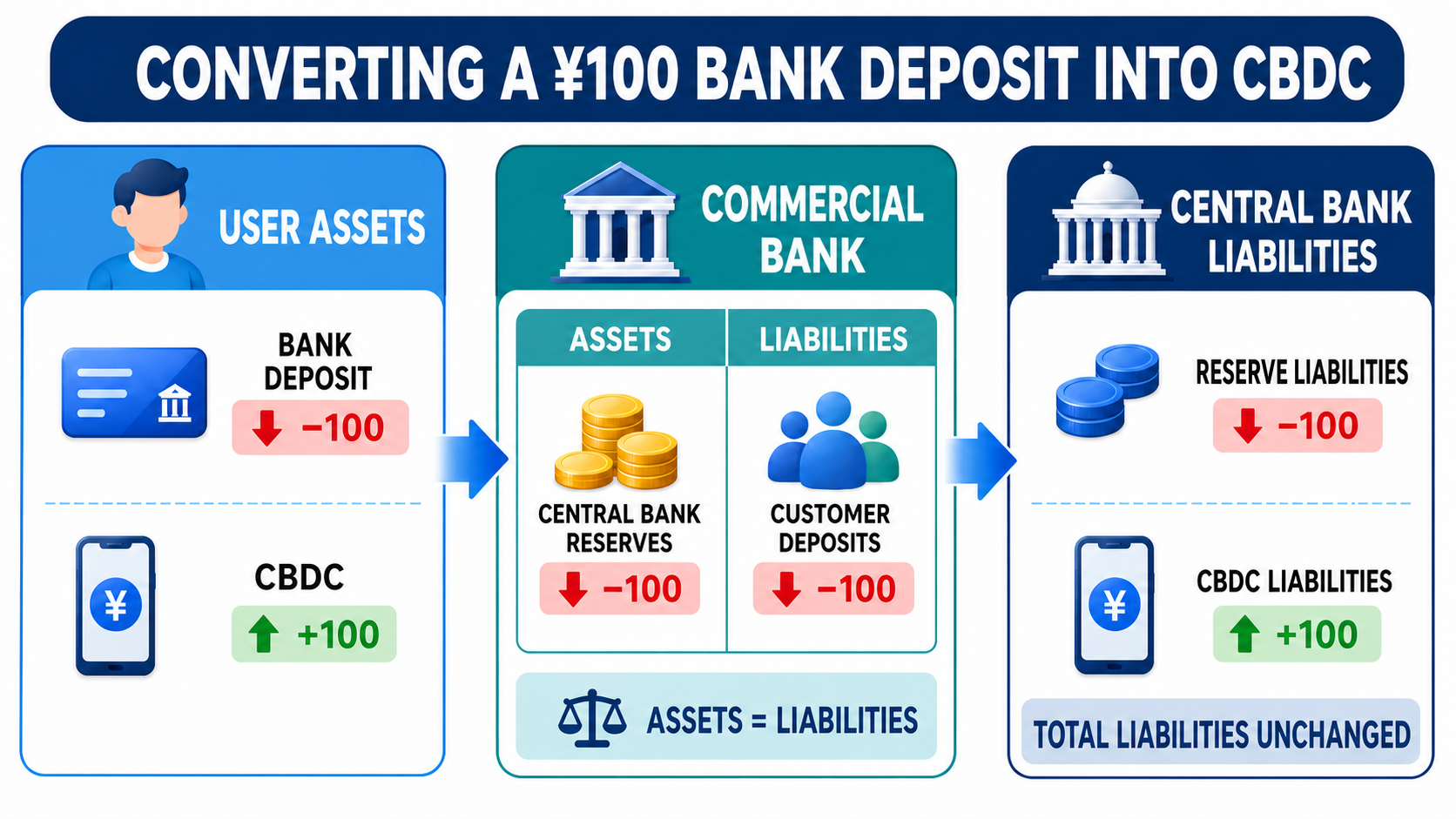
Suppose a customer exchanges 100 yuan from their commercial bank account into 100 yuan of CBDC, ignoring fees and other operational details for the moment.
For the customer, only the composition of assets changes:
| Customer Assets | Change |
|---|---|
| Commercial bank deposits | −100 |
| CBDC | +100 |
| Total assets | Unchanged |
For the commercial bank, customer deposits are the bank's liabilities; the reserves the bank holds at the central bank are the bank's assets. After the exchange is completed:
| Commercial Bank Assets | Change | Commercial Bank Liabilities | Change |
|---|---|---|---|
| Central bank reserves | −100 | Customer deposits | −100 |
For the central bank, this transaction is a change in the structure of liabilities:
| Central Bank Liabilities | Change |
|---|---|
| Commercial bank reserves | −100 |
| CBDC | +100 |
| Total liabilities | Unchanged |
This example highlights an important difference between CBDC and ordinary payment instruments: the customer is not moving the same bank deposit between two interfaces, but rather exchanging a claim on a commercial bank for a claim on the central bank.
It also explains why retail CBDC may affect bank funding. If large numbers of customers permanently convert deposits into CBDC, both the deposit liabilities and the reserves of commercial banks will decline. Banks may then need to replace funding sources with higher-rate deposits, wholesale funding, or central bank borrowing.
Programmable Payment Is Not the Same as Programmable Money
"Programmability" is another concept often conflated in CBDC discussions.
Programmable payment means payments are automatically initiated or completed when specified conditions are met — for example, payment is released only after goods are confirmed received. Programmable money means the money itself is restricted to be used only at specific times, places, or for specific purposes.
The two are not the same. The technical ability to execute conditional payments does not mean the central bank will necessarily restrict how the public uses money. The European Central Bank explicitly distinguishes between the two: its proposal does not design the digital euro as programmable money with restricted uses, but it can support conditional payments. European Central Bank
IV. By 2026, Major Economies and Financial Centers Have Moved in Different Directions
The following international updates use August 22, 2026, as the information cutoff date.
There is no inevitable "research–pilot–issuance" route for CBDC. Different regions have different cash usage, banking systems, private payment markets, legal frameworks, and policy objectives, and their final choices have clearly diverged.
Moreover, observing CBDC today can no longer focus only on "whether to issue a retail wallet to the public." The developments in Hong Kong, Singapore, and Japan show that retail CBDC and wholesale settlement infrastructure are forming two distinct policy tracks.
| Economy or Financial Center | Status as of August 22, 2026 | Misreadings to Avoid |
|---|---|---|
| Euro area | Advancing technical preparations and preparing real-scenario pilots | An official issuance decision has not yet been made |
| United Kingdom | Design phase nearing completion, awaiting comprehensive assessment and next-stage decision | Experiments do not mean entering the build or issuance phase |
| United States | Current executive policy explicitly prohibits federal agencies from establishing, issuing, or promoting CBDC | This is not simply "slower research" |
| Japan | Continuing retail CBDC experiments while exploring tokenized central bank reserves and wholesale settlement | Technical experiments do not mean an issuance decision has been made |
| India | Expanding retail and wholesale CBDC pilots and testing offline, interoperability, and programmability scenarios | Large-scale pilots still do not mean full official issuance |
| Hong Kong | Completed Phase 2 of the e-HKD pilot, prioritizing wholesale scenarios; Ensembleᵀˣ has moved to real-value transactions | Completion of retail pilots does not mean a decision to issue to the public |
| Singapore | Completed live interbank settlement trials of wholesale CBDC on the SGD Testnet | Wholesale CBDC trials do not mean issuing a retail digital Singapore dollar |
Euro Area: Technical Preparations for a Potential Issuance
The digital euro preparation phase from 2023 to 2025 has concluded. In October 2025, the ECB Governing Council decided to move to the next phase, continuing to raise technical readiness, deepen market engagement, and support legislative work.
In July 2026, the European Central Bank selected 36 payment service providers to participate in the digital euro pilot. The pilot is planned to launch in the second half of 2027 and last 12 months, testing real scenarios including merchant payments, person-to-person transfers, and online and offline payments. European Central Bank
If the relevant EU legislation is adopted in 2026, the Eurosystem hopes to have the technical capacity for a first issuance of the digital euro by 2029. But this is not a formal issuance decision. The European Central Bank has made clear that whether and when to issue will be decided only after the relevant legislation is completed.
The current design also includes distribution by banks and other payment service providers, support for both online and offline payments, no interest remuneration, and a holding limit. The holding limit and the non-interest-bearing feature are not ordinary product details — they are designed to prevent the digital euro from becoming a large-scale savings instrument rather than a day-to-day payment tool, thereby reducing the risk of bank deposit outflows and financial stability concerns.
United Kingdom: Decide Whether to Enter the Build Phase After Design Is Complete
The design phase of the digital pound, conducted by the Bank of England and HM Treasury, will end in 2026. The work includes policy evaluation, system blueprint, technical experiments, and the Digital Pound Lab.
As of the information cutoff, the United Kingdom has still not decided whether to introduce a digital pound. The official plan is to publish the blueprint, a comprehensive assessment, and the next-step decision in 2026. Bank of England
The UK's path illustrates that an economy can invest substantial resources in researching and experimenting with CBDC, yet may still choose, after evaluation, not to enter the build phase — or may allocate more resources to upgrading existing payment infrastructure.
United States: A Fundamental Shift in Policy Direction
On January 23, 2025, the President of the United States signed an executive order prohibiting federal agencies from taking action to establish, issue, or promote CBDC within or outside the United States, and requiring the termination of any existing federal plans related to the creation of a CBDC. The White House
Therefore, the current situation in the United States cannot be summarized as "CBDC research is progressing slowly." It should be understood as a change in policy direction. Its digital monetary policy places greater emphasis on private digital assets, dollar stablecoins, and existing payment infrastructure.
This shows that CBDC is a policy choice, not a product that inevitably emerges once economic digitalization reaches a certain stage.
Japan: Observing Both Retail CBDC and Wholesale Infrastructure
The Bank of Japan continues its retail CBDC pilot launched in 2023, focusing on experiments related to stable ledger operation, transaction processing, security, and collaboration with private institutions.
At the same time, the Bank of Japan has expanded its research scope to tokenized central bank current deposits and wholesale payments. Official materials from 2026 show that the Bank of Japan is using a DLT sandbox to study how central bank money can be used for interbank settlement and for delivery-versus-payment of tokenized assets. Bank of Japan
Japan's path is highly representative: the research focus has moved beyond "whether to give the public a CBDC wallet" to how to upgrade retail payments, wholesale payments, and digital asset settlement infrastructure simultaneously.
India: Expanding Real-World Pilots, but Not Yet Full Official Issuance
India is one of the cases among major economies with a relatively large retail CBDC pilot.
According to publicly released answers in the Indian Parliament, as of March 16, 2026, 19 banks had participated in the retail CBDC pilot, with approximately 10 million users included; the wholesale CBDC pilot involved 16 banks and non-bank institutions. The Reserve Bank of India continues to emphasize a phased approach, evaluating further before making a final issuance decision, and testing offline payments, programmability, interoperability with UPI, and cross-border scenarios. Indian Parliament
In February 2026, the Indian government also launched a programmable CBDC pilot in a local food subsidy program, disbursing subsidies in CBDC form to designated beneficiaries'wallets. Press Information Bureau, Government of India
India demonstrates the potential use of CBDC in government transfer payments and restricted scenarios. However, the inclusion of pilot users in the system does not mean that all users are continuously and actively transacting, let alone that the digital rupee has been fully and officially issued.
Hong Kong: After Retail Pilots, Prioritizing Wholesale Settlement
The Hong Kong Monetary Authority has been studying e-HKD since 2021 and has examined personal and corporate use cases through two phases of pilots.
Phase 2 was completed in October 2025, with 11 groups of enterprises testing tokenized asset settlement, programmability, and offline payments. The pilot findings showed that e-HKD can improve certain payment and settlement processes, but tokenized bank deposits can also provide similar functions in some scenarios, and commercial banks showed a certain preference for tokenized deposits.
Accordingly, Hong Kong did not directly announce public issuance of e-HKD after the retail pilots concluded. The HKMA proposed that, at the current stage, priority will be given to developing wholesale e-HKD for use by financial institutions, while preparing the policy, legal, and technical groundwork for possible future extension to retail scenarios. Whether to proceed further will depend on market demand, international developments, and technological changes. Hong Kong Monetary Authority
Another main track in Hong Kong is Project Ensemble, which studies how tokenized deposits and digital assets can complete interbank settlement. In November 2025, the HKMA launched Ensembleᵀˣ, allowing participating banks and institutions to conduct real-value transactions in tokenized Hong Kong dollar deposits and digital assets within a controlled environment. Hong Kong Monetary Authority
It is important to note that the main payment assets in Ensembleᵀˣ include tokenized deposits issued by commercial banks, which do not automatically become CBDC simply because they use DLT or move to a new platform. The core question Hong Kong is studying is how to make tokenized bank money, e-HKD, and other digital assets settle safely within new market infrastructure.
Hong Kong's experience shows that CBDC research does not necessarily lead to a standalone retail wallet. It may also drive the formation of a new wholesale settlement system in which central bank money, tokenized deposits, and digital assets all participate.
Singapore: Wholesale CBDC Moving from Technical Trials to Real Bank Ledgers
Singapore's most clearly defined CBDC progress currently lies in the wholesale domain.
The Monetary Authority of Singapore has established the Singapore Dollar Test Network, or SGD Testnet, allowing qualified financial institutions to test the settlement of tokenized financial assets using a Singapore dollar wholesale CBDC. The platform provides three core functions: issuance, transfer, and redemption of wholesale CBDC; programmable settlement based on transaction conditions; and multi-asset atomic delivery of funds and securities.
In November 2025, the Monetary Authority of Singapore completed a live settlement trial of interbank overnight lending on the SGD Testnet. DBS, OCBC, and UOB participated in the trial. This was not merely a proof of concept, but the first time a Singapore dollar wholesale CBDC was used in real transactions and recorded in the participating banks'official ledgers and regulatory reporting. Monetary Authority of Singapore
Singapore also plans to issue tokenized MAS Bills in subsequent trials and settle them using wholesale CBDC. This trajectory connects with asset tokenization work such as Project Guardian: once assets move onto programmable platforms, a settlement asset that is commonly accepted by all transacting parties and carries low credit risk is needed.
This does not mean Singapore has decided to issue a retail digital Singapore dollar to the public. It reflects another CBDC path: first answering the question "what money will be used for final settlement in the tokenized financial market," rather than first adding a consumer wallet.
International Divergence Cannot Be Reduced to a Single "Issuance Progress Bar"
With Hong Kong and Singapore added, global CBDC developments are better observed along two dimensions.
The first is retail CBDC policy:
The United States is explicitly opposed; the United Kingdom, Japan, Hong Kong, and Singapore have not yet entered formal public issuance; the euro area is making technical preparations for a potential issuance; India continues to expand real-world application pilots.
The second is wholesale settlement infrastructure:
Hong Kong, Singapore, and Japan are all actively studying how to bring central bank money, tokenized deposits, and digital assets into new settlement platforms.
The first track answers "whether the public needs a digital central bank wallet"; the second track answers "what money will ultimately settle transactions in the tokenized financial market." By 2026, the importance of the latter question is clearly increasing.
V. What Will CBDC Actually Change?
The most visible aspect of CBDC is the payment experience, but its deeper impact occurs in bank liabilities, the central bank's balance sheet, and the way financial markets settle.
1. Where Do Residents Keep Their Money?
When the public can conveniently convert commercial bank deposits into central bank liabilities that carry no commercial bank credit risk, some funds may shift from bank deposits to CBDC.
In normal times, such a shift may be slow. Banks may respond by raising deposit rates, increasing wholesale funding, or borrowing from the central bank to fill the funding gap.
In times of financial stress, the issue becomes more sensitive. Digital channels enable very rapid fund transfers, and CBDC provides a direct channel into central bank liabilities, which may accelerate outflows from individual banks. A 2025 BIS study distinguishes between slow disintermediation and fast disintermediation: the former affects banks'long-term funding structure, while the latter may reinforce digital bank runs. Bank for International Settlements
This is precisely why some retail CBDC proposals discuss holding limits, non-remuneration, and automatic pass-through mechanisms. The design goal is to make CBDC suitable for payments while reducing its attractiveness as a large-scale substitute for savings.
2. Will Banks and Payment Institutions Be Displaced?
CBDC does not mean private payment institutions will disappear.
What is more likely to emerge is a new public-private division of labor: the central bank handles money issuance and core settlement, while banks and payment institutions handle wallets, customer identification, anti-money laundering, merchant services, fraud prevention, and value-added functions.
The central bank provides the public settlement foundation, and private institutions compete around user needs. The key question is how responsibilities, data, risks, and commercial incentives are divided between the public and private sectors.
3. What New Responsibilities Will the Central Bank Itself Take On?
If the public can directly use central bank digital liabilities, the central bank must confront more retail infrastructure issues, including 24/7 operations, cybersecurity, privacy protection, fraud handling, offline payments, device loss, customer data governance, and operational resilience.
Even if the front-end services are delegated to banks and payment institutions, the central bank still needs to set unified standards and ensure the reliable operation of the core system.
The expansion of CBDC would also change the composition of cash, reserves, and CBDC on the central bank's liability side, and affect commercial banks'demand for reserves and central bank liquidity. If CBDC pays interest, monetary policy transmission, market interest rates, and competition for bank deposits all become more complex.
4. What Money Will Financial Institutions Ultimately Use to Settle?
The potential of wholesale CBDC or tokenized central bank money lies more in financial market infrastructure than in everyday consumer spending.
Consider a tokenized bond transaction on a new platform. If the securities have already been digitalized but the funds must first be transferred off-platform, settled through the traditional banking system, and then the result sent back, the transaction still suffers from process fragmentation, reconciliation costs, and settlement time lags.
If central bank money can enter the same platform, or be reliably synchronized with the new platform, securities and funds could settle simultaneously through DvP. Similar mechanisms could also apply to PvP in foreign exchange and multi-asset conditional settlement.
Hong Kong's Ensembleᵀˣ and Singapore's SGD Testnet represent two different routes. Hong Kong approaches primarily from interbank settlement of tokenized bank deposits and digital assets, while Singapore directly tests wholesale CBDC as a common settlement asset. Both face the same question: once financial assets move to new platforms, how can the funding side obtain a credible, unified settlement foundation with finality?
But "atomic settlement" does not automatically eliminate all risks. Transaction-by-transaction simultaneous delivery may reduce principal and counterparty risks, but it may also increase immediate liquidity requirements; the coexistence of multiple old and new platforms can also cause liquidity fragmentation. Technology changes the structure of risk; it does not make risk disappear.
5. Can CBDC Automatically Solve Cross-Border Payments?
No.
The issuance of CBDC by a single country will not automatically solve the problems of foreign exchange conversion, system interoperability, applicable law, identity verification, anti-money laundering, capital flow management, and cross-border data flows inherent in cross-border payments.
Even if different CBDC systems all use DLT, that does not mean they can naturally interconnect; even if the technology can connect, jurisdictions still need to decide who can access the system, which law applies in the event of disputes, how liquidity is managed, and how the two currencies achieve synchronized delivery.
Turning money into tokens is not the hardest part — the difficulty lies in institutional coordination between jurisdictions.
Conclusion: The Key to CBDC Is Not "Digital," but "Central Bank Money"
The significance of CBDC is not that money has suddenly become digital. Our bank deposits, securities accounts, and most payment activities have long been digitalized.
What is worth examining is whether central bank liabilities can enter digital payments and digital financial markets in a new way.
For the general public, the question is: as cash usage declines, does the digital economy still need a form of central bank money that can be used directly?
For financial institutions, the question is: as securities, deposits, and other assets are gradually tokenized, what asset should assume the role of the ultimate settlement asset?
The future may not be that every country launches a retail CBDC wallet. The different paths of the United States, the United Kingdom, Japan, India, the euro area, Hong Kong, and Singapore have already shown that there is no single globally unified answer to CBDC.
What deserves longer-term observation is this: in a monetary system where cash, commercial bank deposits, e-money, stablecoins, tokenized deposits, and on-chain assets coexist, in what form will central bank money continue to maintain the equivalent exchange among different forms of money and serve as the ultimate settlement anchor of the entire financial system?
summary:
This article explains the classification, issuance mechanisms, and global policy divergence of CBDC from the perspectives of issuers, liability relationships, and settlement assets, and analyzes its impact on banks and financial infrastructure.
Originally published by Luminale Fintech Observer: https://luminale.cn/articles/what-is-central-bank-digital-currency-en