When people talk about Bitcoin, Ether, or "virtual currencies," they often group them together as a new form of money. From the perspective of financial infrastructure, however, that description is not quite right.
What Bitcoin and Ether introduced was not simply another currency. They offered a different way of organizing assets from the traditional financial system: the rules for how assets are created, how ownership is recorded, who verifies transfers, and when a state becomes final are embedded to a much greater extent in cryptographic rules, distributed ledgers, and consensus mechanisms.
That does not mean they replace the traditional financial system.
To understand cryptoassets, two points must be held together. Protocols do embed part of the rules for asset registration and transfer in a network. But such assets typically lack the issuer credit, legal claims, or stable value anchor on which traditional financial assets rely, so their risk structure is fundamentally different as well.
I. Start with the Concepts: Cryptoassets Are Not the Same as "Virtual Currency"
In its prudential framework for cryptoassets, the Basel Committee defines a cryptoasset as a private-sector digital asset that depends primarily on cryptography, distributed ledger technology, or similar technology. A digital asset, meanwhile, is described as a digital representation of value that can be used for payment, investment, or access to goods and services. The focus of these definitions is the technology and form of the asset—not whether it has become money. (BIS Basel Framework, SCO60)
Several terms that are often used interchangeably should therefore be kept separate:
| Type | Basis of Value | Principal Issuer or Liable Party | Redemption or Legal Claim? |
|---|---|---|---|
| CBDC | Central bank credit | Central bank | A monetary claim on the central bank |
| Stablecoin | Reserve assets or a stabilisation mechanism | Private issuer or arrangement | Depends on the design and legal arrangements; usually purports to offer redemption |
| Tokenized traditional asset | An off-chain or pre-existing financial asset | Original issuer, custodian, or registry arrangement | Depends on the underlying asset and legal structure |
| Bitcoin, Ether, and similar assets | Protocol rules, network utility, and market supply and demand | No issuer in the traditional sense | Usually no redemption claim against a specified party |
For prudential classification purposes, the Basel framework distinguishes among qualifying tokenized traditional assets, cryptoassets with an effective stabilisation mechanism, and other cryptoassets that do not meet the relevant conditions. This taxonomy is designed first and foremost for bank risk measurement; it is not a once-and-for-all economic characterization of every token. (BIS Basel Framework, SCO60)
This article focuses on native on-chain assets such as Bitcoin and Ether. A more precise label is "unbacked cryptoassets": their value is not supported by a pool of redeemable reserve assets, nor do they inherently represent claims associated with pre-existing assets such as bonds, equity, or deposits.
Calling them all "virtual currencies" obscures this distinction. Money normally needs to serve, with reasonable stability, as a unit of account, medium of exchange, and store of value. For BTC and ETH, the more prominent attributes at present are those of native network assets, protocol-incentive instruments, and tradable market assets. They can be used for payment in some settings, but that is different from being money in the macroeconomic sense.
II. What Does "Unbacked" Actually Mean?
"Unbacked" does not mean "useless," nor does it mean "without market value." It means that an asset's value is not supported by external assets, issuer commitments, or legally enforceable redemption obligations in the traditional financial sense.
A bank deposit is a bank's liability to its customer. A properly structured stablecoin will usually be organized around reserves, redemption, and issuer accountability. A tokenized bond still points to the bond issuer and pre-existing legal rights. Bitcoin is different: a holder cannot present BTC to an issuing entity and demand payment from a basket of assets.
Bitcoin's value is shaped more by its scarcity rules, network security, demand for use, liquidity, and market supply and demand. Ether adds a layer of network functionality: on Ethereum, ETH is used to pay the fees required to execute transactions, and it is also used for validator staking and protocol incentives. That functionality does not make its value stable or give it the characteristics of a debt claim, but it helps explain why ETH should not be reduced to a digital symbol with no economic use whatsoever.
This is where stablecoins diverge from BTC and ETH. The intended stablecoin chain is "token—reserves or stabilisation mechanism—redemption value." The BTC chain is closer to "protocol rules—network participation—market pricing." The two types of assets may circulate on the same exchange or blockchain, but their credit foundations and sources of risk are not the same.
III. How Are They Created? PoW, PoS, and Protocol Issuance
Traditional financial assets are often issued by companies, banks, or governments. Native on-chain assets, by contrast, can have issuance rules set in advance by an open protocol and enter circulation through mechanisms that support network operation.
Bitcoin: Maintaining the Ledger Through Proof of Work
Bitcoin uses Proof of Work (PoW). Miners compete to perform computational work for the opportunity to package valid transactions into a new block. The successful miner receives the protocol-defined block reward and usually the transaction fees included in that block.
This mechanism answers two questions at once: who maintains the ledger, and how new assets are created. Participants contribute computing power, equipment, and energy; the network uses rewards and fees to incentivize compliance with the consensus rules.
Its costs are equally clear. Energy use, hardware requirements, concentration of computing power, and network throughput can all become sources of systemic risk and governance controversy. "Decentralization" in PoW does not mean that there are no organizations or concentration risks. It means that the trust structure shifts from a centralized ledger operator to a combination of open participation, rule-based constraints, and economic incentives.
Ethereum: Coordinating Validators Through Proof of Stake
Ethereum uses Proof of Stake (PoS). Validators stake ETH to participate in proposing and validating blocks and earn rewards under the protocol rules. Staked assets may also be penalized when specified rules are violated.
| Dimension | PoW | PoS |
|---|---|---|
| Typical example | Bitcoin | Ethereum |
| Main participants | Miners | Validators |
| Scarce resource | Computing power and energy | Staked native tokens |
| Primary incentives | Block rewards and transaction fees | Validation rewards and transaction-related revenue |
| Key risk focus | Energy use, concentration of computing power, hardware barriers | Concentration of staking, governance, and protocol complexity |
In a PoS system, ETH simultaneously functions as a market asset, collateral for network security, and a medium for paying transaction fees. These multiple roles make it more like a native resource of an open network than a single-purpose "digital currency."
There are also other models for token creation and allocation, including Delegated Proof of Stake (DPoS), Proof of Authority (PoA), liquidity incentives, governance distributions, and algorithmic inflation. To assess a cryptoasset, do not look only at its name or price. Ask instead: Who maintains the network? What resources do participants contribute? Where do rewards come from? What function does the token serve in the system?
IV. How Are Assets Held and Transferred? Wallets, Private Keys, and Trading Platforms
In traditional finance, investors usually hold assets through accounts at banks, brokers, or custodians. Cryptoassets introduce another control structure: on-chain addresses record state, while a private key—or equivalent signing capability—determines who can initiate a transfer that complies with the rules.
So a "wallet" is not an electronic container holding BTC or ETH. It is a tool that helps a user manage addresses, create transactions, and sign them; the asset state itself is recorded on the blockchain ledger.
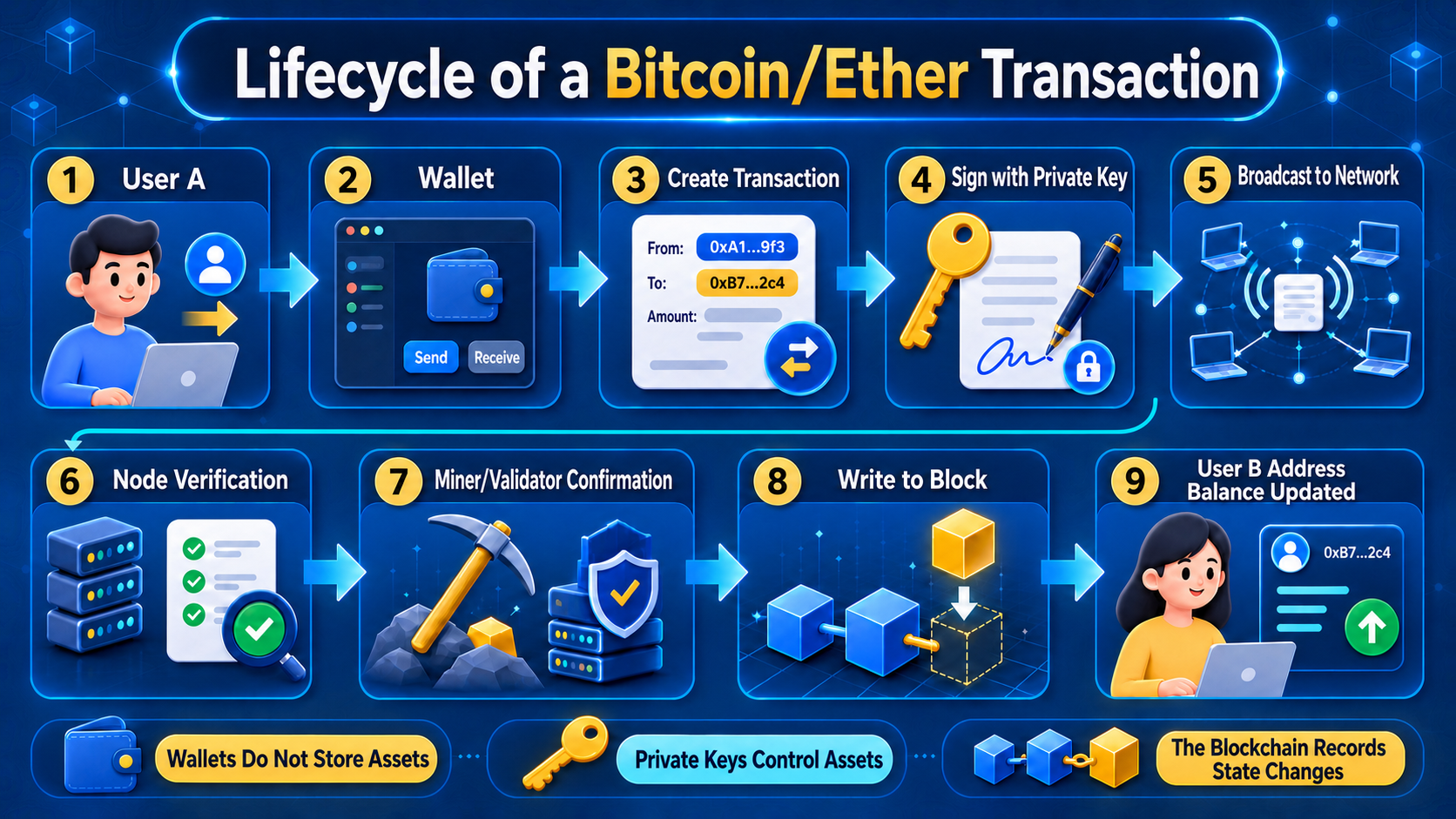
A typical on-chain transfer can be summarized as follows:
- User A creates a transaction in a wallet to transfer assets to User B's address;
- the wallet uses the private key to create a digital signature;
- the transaction is broadcast to the network;
- nodes verify the signature, balance, and transaction format under the protocol rules;
- miners or validators include the transaction in a block;
- subsequent blocks or validation processes provide stronger confirmation; and
- the on-chain state is updated, changing the spendable balance associated with User B's address.
This model gives users more direct control over their assets, but also more direct responsibility. Lost private keys or seed phrases, phishing attacks, malicious approvals, and mistaken transfers can all result in asset loss, often without the cancellation, recovery, or customer-service remedies commonly available for traditional bank accounts.
| Holding method | Controller of private keys | Main advantage | Main risks |
|---|---|---|---|
| Self-custody, such as a hardware wallet | User | Private keys can be kept offline; control is direct | Lost seed phrases, operational mistakes, and physical safekeeping risks |
| Software wallet | User or the user's device | Convenient to use and can connect directly to on-chain applications | Malware, phishing, and deceptive authorization requests |
| Exchange or custodial account | Platform or custodian | Convenient trading and conversion between fiat and cryptoassets | Platform operations, asset segregation, cybersecurity, and run risk |
It would be wrong to assume that decentralized trading eliminates intermediaries. Although users can interact directly with wallets and smart contracts, a large share of BTC and ETH trading in real markets is still matched and held through centralized exchanges. Intermediaries have not disappeared. Rather, some functions formerly carried out by banks, brokers, and central securities depositories are now performed by a new mix of exchanges, custodians, wallet providers, node operators, oracles, and smart-contract developers.
Stablecoins play an important intermediary role in this environment. Many cryptoasset trades are not settled directly in fiat currency; stablecoins are first used to form trading pairs and on-chain liquidity. Stablecoins are therefore not an "external supporting actor" in cryptoasset markets, but important infrastructure connecting the fiat system, trading platforms, and on-chain settlement activity. Their reserve, redemption, and issuer risks, however, require separate assessment.
V. What Are Global Regulators Concerned About?
Specific rules differ across jurisdictions, but regulatory attention is gradually shifting from "whether these assets exist" to "how activities, risks, and accountable parties should be brought within the regulatory perimeter."
The Financial Stability Board's global framework emphasizes "same activity, same risk, same regulation," and calls on regulators to focus on governance, risk management, disclosure, cross-border cooperation, and conflicts of interest and risk transmission arising from multi-function intermediaries. (FSB, High-level Recommendations for the Regulation, Supervision and Oversight of Crypto-asset Activities and Markets)
| Jurisdiction | Regulatory logic and focus |
|---|---|
| Mainland China | Maintains a strict risk-prevention stance toward virtual currencies and related business activities. A 2026 notice states explicitly that virtual currencies do not have the same legal status as legal tender and places related illegal financial activities and acts that facilitate them within a risk-disposal framework. (CSRC notice) |
| United States | Places greater emphasis on the specific facts and legal characteristics of an asset or activity. The SEC focuses on the issuance, registration, and disclosure of cryptoassets that may constitute securities, while the CFTC treats virtual currencies such as Bitcoin as commodities under the Commodity Exchange Act and continues to warn of risks in spot and derivatives trading. (SEC statement, CFTC risk advisory) |
| European Union | MiCA establishes a unified framework for cryptoasset issuance, market access, and service providers, but not every digital asset automatically falls into the same regulatory category. (Official MiCA text) |
| Hong Kong | Applies licensing and supervisory arrangements to centralized virtual-asset trading platforms that operate in or actively market to Hong Kong, while addressing the applicable boundary for both security tokens and non-security tokens. (SFC VATP page) |
| Singapore | Approaches the issue through payment services and risk management, with a focus on digital payment token services, anti-money laundering, technology risk, and consumer protection. (MAS PSN05) |
Regulatory divergence does not make risk disappear. The IMF notes that, as cryptoasset markets become more interconnected with established financial institutions, capital flows, and payment systems, macro-financial stability, financial integrity, and consumer protection require ongoing monitoring. (IMF, Digital Payments and Finance)
VI. From a Financial-Infrastructure Perspective: What Changes Is the Logic of Asset Transfer
In traditional finance, an asset's lifecycle is usually distributed across multiple institutions and systems for issuance, registration, custody, trading, clearing, and settlement. Native on-chain assets seek to combine some of those rules within a verifiable protocol environment: assets are created according to rules, addresses record state, signatures authorize transfers, and consensus mechanisms confirm updates to the ledger.
This is not simply a matter of "faster payments." The deeper change is that asset records, trade execution, and settlement confirmation can be tightly coupled within the same programmable ledger. In its work on the next-generation monetary and financial system, the BIS describes tokenization's potential as integrating messaging, reconciliation, and asset transfer, while stressing that trusted money, legal foundations, and reliable settlement assets remain essential to the financial system. (BIS, Annual Economic Report 2025)
Cryptoassets have not simply "eliminated intermediaries"; they have changed their boundaries:
- In the traditional system, banks, brokers, central securities depositories, central counterparties, and central banks perform distinct functions in account management, custody, registration, clearing, or final settlement;
- In on-chain systems, exchanges, wallet providers, custodians, node operators, validators, smart contracts, and oracles recombine these functions; and
- Existing credit, liquidity, operational, and legal risks are correspondingly transformed into private-key risk, protocol risk, smart-contract risk, governance risk, custody risk, and cross-chain risk.
Bitcoin and Ether are better understood as an experiment in how asset infrastructure can be organized. They demonstrate that asset creation, ownership records, transfer verification, and state confirmation can operate differently on open networks. But they also remind us that financial infrastructure is never only a technical matter. Sources of credit, legal certainty, allocation of responsibility, risk segregation, and regulatory reach still determine whether an asset arrangement can genuinely support financial activity at scale.
The question worth watching in the future is not the short-term price of any particular token, but which assets will be tokenized, which post-trade processes will be redesigned, and how traditional financial infrastructure will connect with on-chain systems.
Originally published by Luminale Fintech Observer: https://luminale.cn/articles/what-is-cryptoasset-en