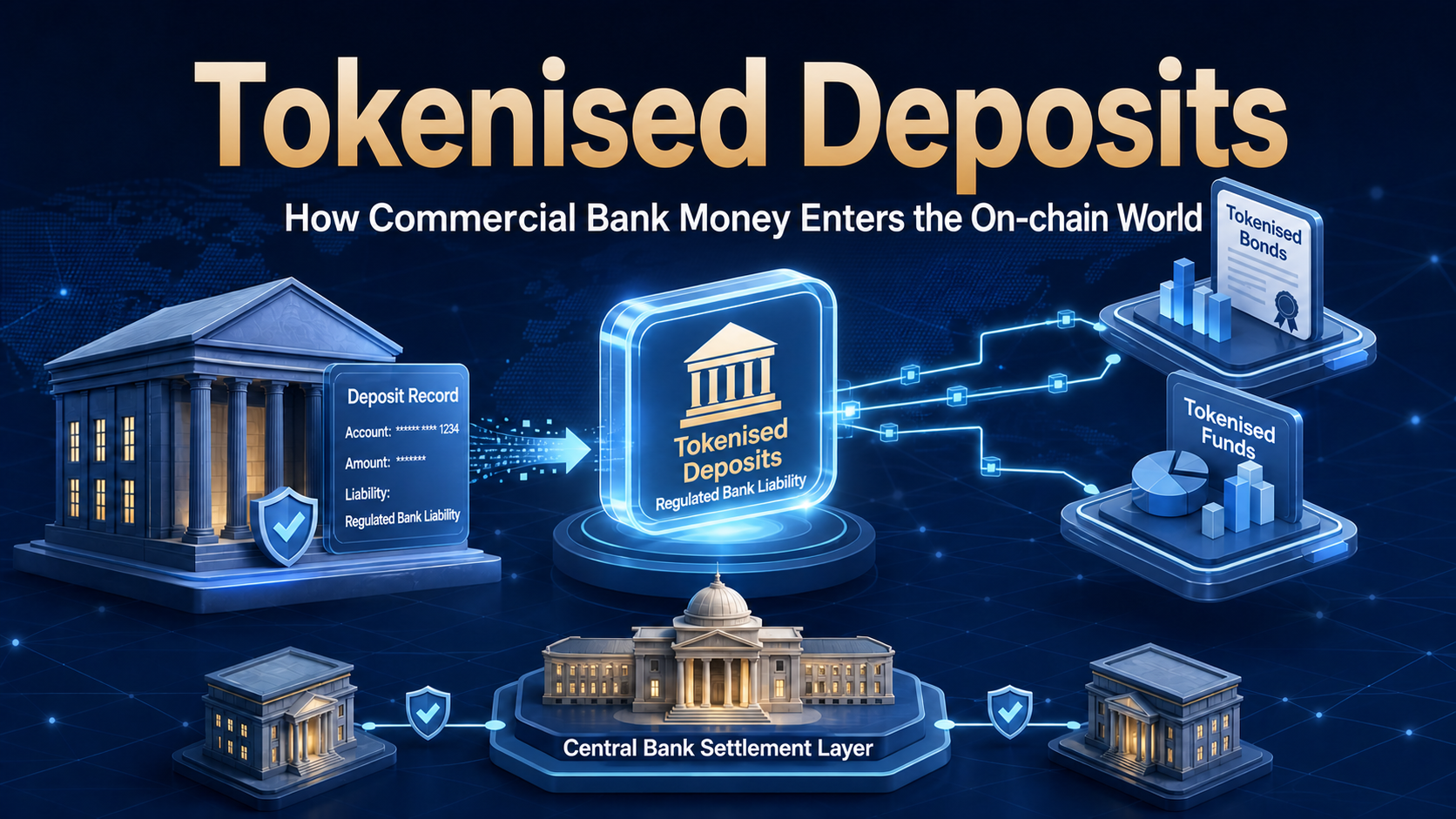
As bonds, funds, foreign exchange, and real-world assets gradually move onto programmable ledgers, a seemingly simple but crucial question arises:
Once assets are on-chain, what money will settle them?
Stablecoins offer one answer: private institutions issue tokens that can circulate on blockchains and maintain par value with reserve assets.
Central bank digital currencies (CBDCs) offer another: central banks bring their own liabilities into digital, programmable infrastructure.
Tokenized deposits take a third path. Rather than creating a new form of money outside the existing banking system, they give commercial bank deposits—the form of money we use most often today—the ability to be programmed, composed with other services, and settled synchronously with tokenized assets.
Putting bank deposits on a blockchain is not simply a matter of adding a technical wrapper. The real question is this:
If more assets and transactions run on programmable ledgers in the future, how can commercial bank deposits, which make up the bulk of today's monetary system, continue to serve as a means of payment and settlement?
That is why tokenized deposits have become another focus of digital-currency discussions, alongside stablecoins and CBDCs.
I. From Blockchain to Tokenization: What Exactly Are We Moving On-Chain?
"Blockchain," "token," and "tokenization" are often used interchangeably, but they belong to three different layers.
Blockchain or distributed ledger technology is the infrastructure used to record and update information.
A token is a digital vehicle for a particular legal or economic relationship recorded on that ledger.
Tokenization is the expression, management, and transfer of a right, asset, or liability in token form.
So when we see a token, the first question is not which chain it runs on, or whether it can be transferred between wallets. It is:
What right does this token represent, and between whom?
When a fund is tokenized, the token may represent a fund share. When a bond is tokenized, it may represent an investor's claim on the issuer. When an income right in real estate is tokenized, the token may represent a contractual right to future cash flows.
Likewise, when a bank deposit is tokenized, the token still represents the customer's claim on a commercial bank.
| Digitized object | Principal right or relationship represented by the token | Typical issuer or responsible party |
|---|---|---|
| On-chain native assets such as Bitcoin and ETH | Control over a protocol-native asset | Usually no single issuer in the traditional sense |
| Stablecoin | A claim on the issuer or a specified legal structure | Stablecoin issuer |
| CBDC or tokenized central bank money | A claim on the central bank | Central bank |
| Tokenized deposit | A deposit claim on a commercial bank | Commercial bank |
| Tokenized bonds, funds, and RWAs | A right to securities, fund shares, or income from real-world assets | Issuer, fund, or special-purpose vehicle |
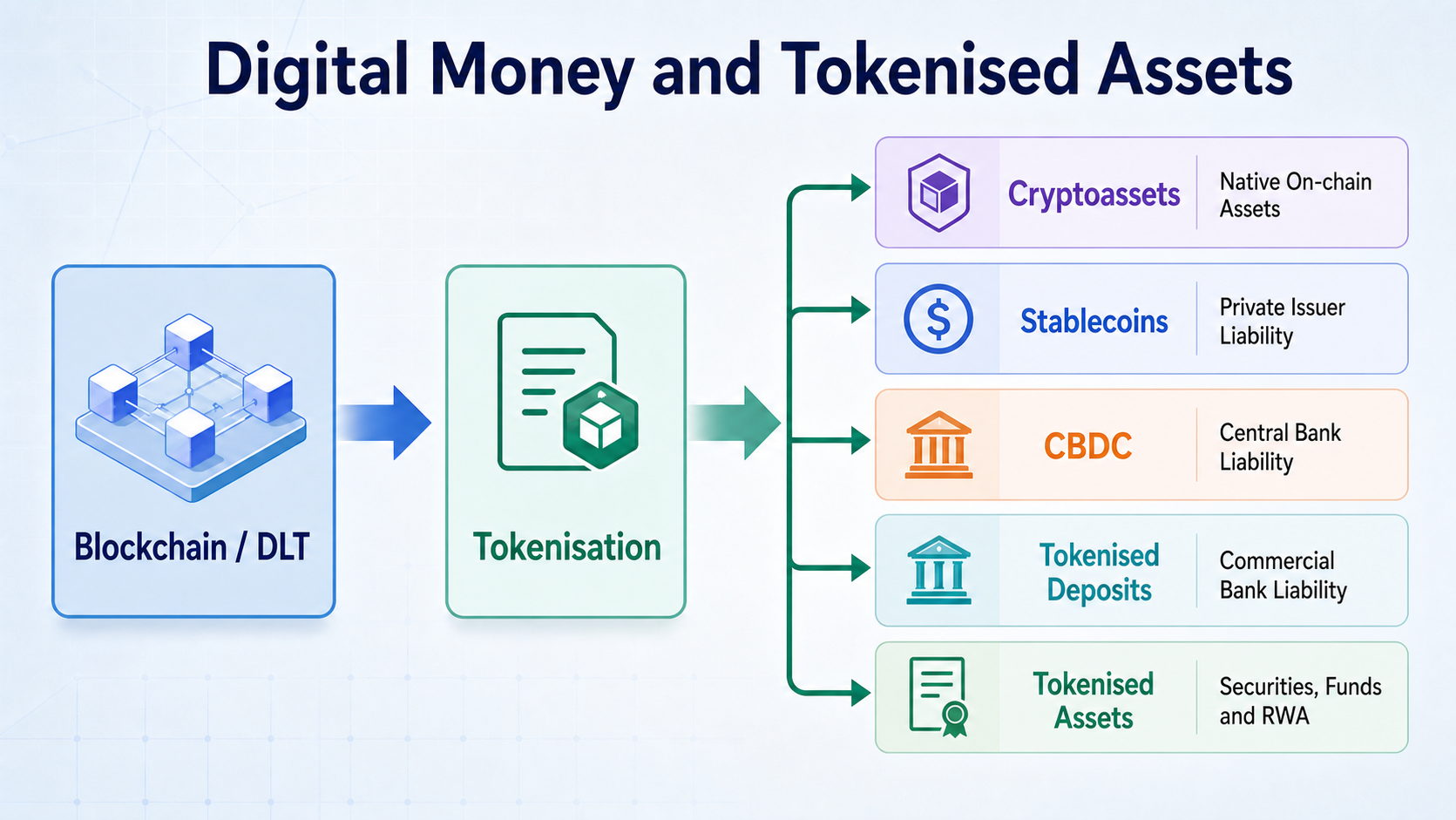
Therefore, "tokenization" does not mean "turning something into cryptocurrency."
Tokens can run on permissionless public chains or on permissioned ledgers accessible only to approved institutions. They can be transferred directly between wallets, or merely serve as a new way for a bank's back office to record an account. Their legal effect, eligible holders, and redemption terms all depend on the specific product design and legal rules.
Turning paper share certificates into electronic securities does not automatically change shareholders'legal rights. Similarly, converting deposit records in a bank database into tokens on a programmable ledger does not mean that an entirely new currency has come into existence.
What changes first is how rights are recorded and transferred, not the rights themselves.
II. Bank Deposits Have Long Been Digital—Why Tokenize Them?
Bank deposits are not antiquated, nor do they become "digital currency" only after turning into tokens.
Payroll deposits, mobile transfers, card payments, and corporate online banking already involve electronic entries in bank-account systems. For most people, money has long ceased to be banknotes; it is the deposit balance recorded on commercial banks'balance sheets.
So tokenized deposits are not about "turning paper deposits into electronic deposits." They address a different question:
When assets enter programmable ledgers, how can money held in traditional accounts join the same transaction workflow?
Suppose shares in a fund have already been tokenized. After an investor submits a purchase order, a smart contract can check transaction conditions, verify identity, and transfer the fund token. But if payment must still leave that ledger and be completed through the traditional banking system, the transaction must still pass messages, confirm states, and reconcile across multiple systems.
This creates a series of frictions:
- Asset transfer and payment cannot naturally occur in sync;
- On-chain and off-chain states must be repeatedly reconciled;
- If a payment fails, asset operations that have already executed may need to be reversed;
- Different systems operate on different schedules;
- Both parties remain exposed to counterparty risk until settlement is complete;
- To prevent settlement failure, participants may need to pre-position additional liquidity or collateral.
Traditional securities markets already have a "securities leg" and a "cash leg." If the securities leg enters a new DLT channel while the cash leg remains in the old channel, the two legs cannot coordinate naturally within the same program logic.
This is the immediate backdrop for tokenized deposits.
In its unified-ledger concept, the BIS proposes placing central bank money, tokenized commercial bank deposits, and tokenized assets within a common or interoperable programmable environment, so that messages, asset transfers, and cash settlement are no longer fully scattered across disconnected systems. BIS Annual Economic Report 2023
Why Not Use Stablecoins for Everything?
Stablecoins have provided important payment and liquidity tools for open blockchains, but they essentially add a new form of private money alongside bank deposits.
When using a stablecoin, questions still need answers:
- Who is the issuer?
- What are the reserve assets?
- Can holders always redeem at par?
- Can reserves be liquidated quickly when redemption requests surge?
- What legal rights do holders have?
- Is the product a protected deposit?
- Can stablecoins from different issuers always exchange one-for-one?
Tokenized deposits instead seek to carry forward the existing credit, account, compliance, and liquidity arrangements of commercial bank deposits.
This also involves "monetary singleness."
Today, one yuan in Bank A and one yuan in Bank B normally do not trade at different prices in everyday payments simply because the issuing banks differ. They can be converted into each other at par, in large part because interbank payments can ultimately settle on the central bank's balance sheet in central bank money.
If tokenized deposits retain this mechanism, it becomes easier to preserve the idea that "money from different banks is still the same money." The BIS therefore views central bank money as the institutional anchor for monetary singleness and settlement finality. BIS research on stablecoins and tokenized deposits
Why Not Use CBDC for Everything?
CBDC is a central-bank liability and can directly provide the highest-quality settlement asset. But central banks may neither be suited nor willing to take on account management, customer service, credit allocation, anti-money-laundering reviews, and payment-product innovation for every business and individual.
Modern monetary systems generally use a two-tier structure:
- Central banks provide base money, final settlement, and liquidity support;
- Commercial banks take deposits, create credit, serve customers, and manage risks.
The purpose of tokenized deposits is not to abolish this division of labor, but to bring it into a new technological environment.
This preserves the monetary system's established hierarchy:
Commercial bank deposits serve customers; tokenized central bank money or central bank reserves provide final interbank settlement.
One More Factor: Monetary Elasticity
Typical fully reserved stablecoins generally first receive funds, invest the corresponding assets in cash, government bonds, or other highly liquid reserves, and then issue stablecoins.
Commercial bank deposits work differently. Banks can create deposits when they make loans, with credit expansion constrained by capital, liquidity, reserves, and prudential regulation. They do not simply lock away one yuan in cash for every yuan of deposits.
This mechanism enables the banking system to provide credit and liquidity in line with the needs of the real economy—what is known as "monetary elasticity." The BIS describes tokenized commercial bank money, tokenized central bank reserves, and tokenized government bonds as an important combination in the next generation of the monetary and financial system. BIS Annual Economic Report 2025
So the difference between tokenized deposits and stablecoins is not merely who issues them; it also involves two different financial structures.
III. What Actually Happens When a ¥100 Deposit Becomes a Token?
The UK Prudential Regulation Authority has offered a concise working definition: a tokenized deposit is a deposit claim recorded on a programmable ledger that can support functions such as smart contracts and atomic settlement. Relevant UK PRA document
The key word is not "ledger," but "deposit claim."
Assume Customer A already has a ¥100 deposit at Bank A. Let us radically simplify Bank A's balance sheet:
| Bank A assets | Amount | Bank A liabilities | Amount |
|---|---|---|---|
| Reserves, loans, and other assets | 100 | Customer A's ordinary deposit | 100 |
| Total assets | 100 | Total liabilities | 100 |
After the customer asks to tokenize the ¥100 deposit, the change can be understood as follows:
| Bank A assets | Amount | Bank A liabilities | Amount |
|---|---|---|---|
| Reserves, loans, and other assets | 100 | Customer A's ordinary deposit | 0 |
| Customer A's tokenized deposit | 100 | ||
| Total assets | 100 | Total liabilities | 100 |
The bank has not somehow gained an additional ¥100 in assets by generating a token, nor has it created a second ¥100 liability. What has changed is the way the existing liability is recorded, controlled, and transferred.
In practice, banks need not handle a product by "destroying an ordinary deposit and minting a token." Some products may simply map an existing account balance to a new ledger; some may move funds into a dedicated blockchain deposit account; others may tokenize only in the bank's back office, so customers need neither wallets nor a direct view of a token.
Transfers Within the Same Bank
If Customer A and Customer B both bank with Bank A, and A pays B ¥100, the core change is simply that Bank A reallocates its own liabilities:
| Bank A account | Change |
|---|---|
| Customer A's tokenized deposit | −100 |
| Customer B's tokenized deposit | +100 |
| Bank A's total deposit liabilities | Usually unchanged |
| Interbank reserve settlement | Not required |
In substance, this is no different from the accounting for a traditional intrabank transfer. What is new is that, on a programmable ledger, the transfer can be combined with other business logic.
For example, in a trade setting, a smart contract can specify that funds move to the seller only after an electronic bill of lading, goods acceptance, and compliance checks have all passed. If the conditions are not met together, neither the funds nor the assets move.
Interbank Transfers
The truly challenging case is when Customer A banks with Bank A and Customer B with Bank B.
One approach is for B to receive a token issued directly by Bank A. The token changes holder, but B still holds a claim on Bank A.
This raises further questions: Is B willing to hold a deposit from Bank A? How do Banks A and B share customer-identification obligations? How are risk and responsibility allocated? Can the token be redeemed at par? Can it be transferred onward to customers of other institutions?
Another approach more closely resembles the architecture of today's banking system: after payment, Bank A's deposit is cancelled or reduced, Bank B increases B's deposit, and the two banks settle with central bank money:
| Participant | Change in deposit liabilities | Change in central bank reserves |
|---|---|---|
| Bank A | Customer A's tokenized deposit −100 | −100 |
| Bank B | Customer B's tokenized deposit +100 | +100 |
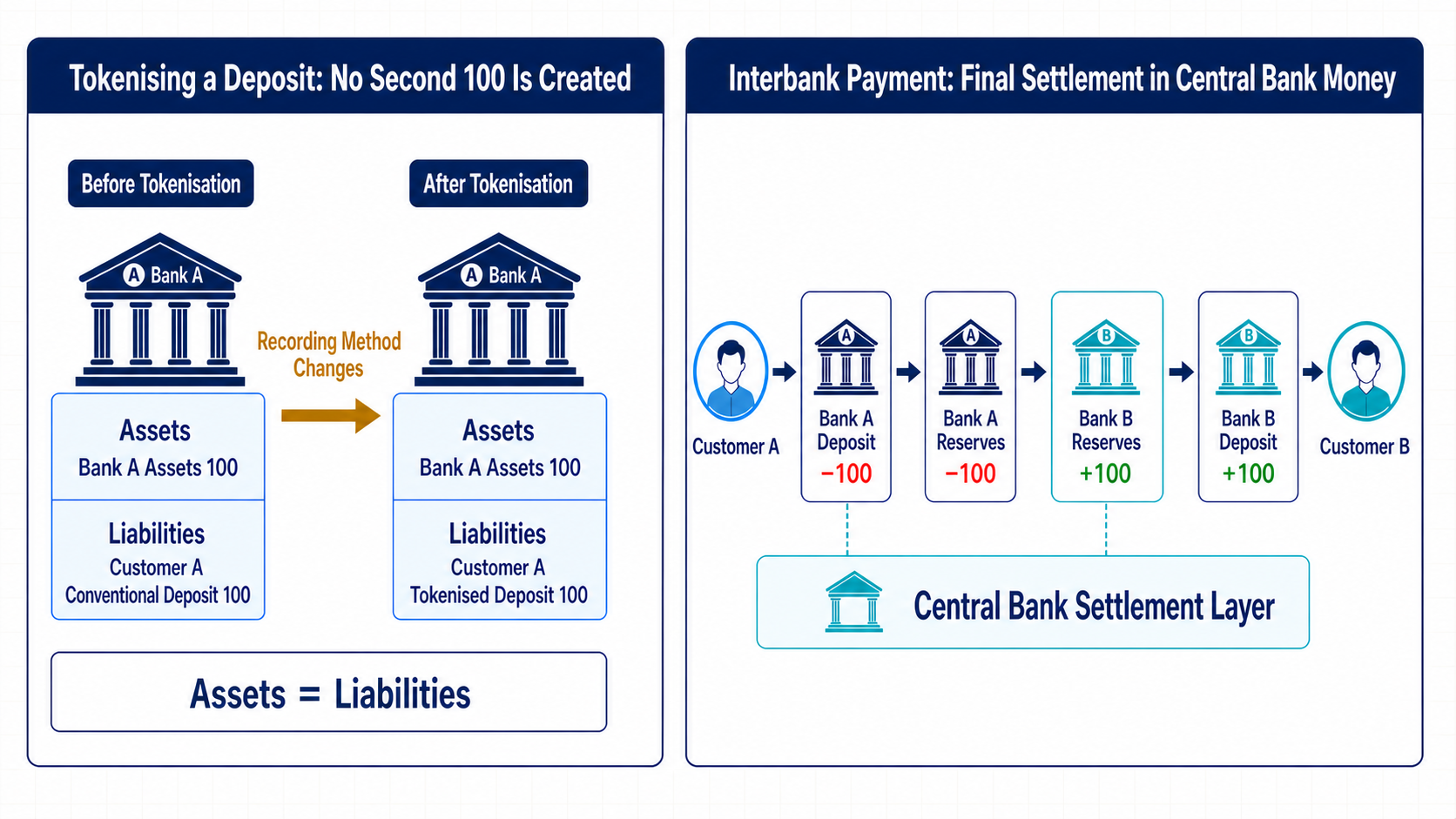
Its full logic is:
Customer A's Bank A deposit falls → Bank A transfers central bank reserves to Bank B → Customer B receives a Bank B deposit
At the front end, this looks like a token payment; in the back end, it still depends on commercial-bank liabilities and central-bank settlement assets.
Payment, Clearing, and Settlement Are Not the Same Thing
To understand this distinction, three concepts need to be separated:
- Payment: the entire process through which a payer discharges a monetary obligation to a payee;
- Clearing: confirming transactions, reconciling instructions, and calculating what each participant owes and is due;
- Settlement: the actual final transfer of assets or funds.
Tokenized deposits do not inherently eliminate clearing and settlement. Rather, they can compress processes that were previously spread across different systems and points in time into one programmable workflow.
If a securities transaction uses delivery versus payment (DvP), the securities and cash can be designed to "either both succeed or both fail." Payment versus payment (PvP) in foreign-exchange transactions follows a similar logic.
This is the meaning of "atomic settlement." It can reduce principal risk, where one party has paid but the other has not delivered the asset, but it cannot automatically solve questions of legal effect, identity, compliance, liquidity, and system governance.
Tokenized Deposits Do Not Have a Single Standard Architecture
Current market approaches can roughly be grouped into three types:
| Architecture | Key characteristics | Typical uses | Main challenges |
|---|---|---|---|
| Account-mapping or back-office service model | Customers continue using traditional accounts, online banking, or APIs while the bank tokenizes in the back office | Corporate cash transfers, liquidity management, conditional payments | Interoperability with external token networks |
| Single-bank token model | One bank issues transferable deposit tokens on a permissioned or public chain | Payments for the bank's institutional clients, on-chain collateral, and digital-asset settlement | Eligible holders, bank credit risk, and interbank conversion |
| Shared multi-bank ledger model | Multiple banks issue their own liabilities on a common platform connected to central-bank settlement assets | Interbank payments, DvP, cross-border, and multicurrency settlement | Governance, standards, legal finality, and access to central bank money |
Citi Token Services is closer to the first type: clients can continue to use existing accounts, CitiDirect, or APIs, and may not need to manage tokens or wallets themselves.
J.P. Morgan's JPM Coin US-dollar deposit token is closer to the second type. It is already available to institutional clients on Base, can move between permissioned EVM-compatible wallets, and seeks to combine with smart contracts, collateral, and on-chain asset settlement. J.P. Morgan product overview
Projects such as Agorá, the UK's GBTD, and Hong Kong's Ensemble explore third-type issues to varying degrees.
What Could Tokenized Deposits Deliver?
Their potential value mainly lies in:
- Around-the-clock movement of funds;
- Automatic payment once conditions are met;
- Synchronous delivery with securities, funds, or foreign exchange;
- Automated execution of some compliance and business rules;
- Less repeated reconciliation between on-chain and off-chain systems;
- More efficient corporate cash concentration and liquidity management;
- Less need in some cases to pre-position funds or collateral;
- Combining payment, asset delivery, and business information in a single workflow.
But none of these benefits comes automatically.
Risks Do Not Disappear Because a Blockchain Is Used
Tokenized deposits face at least the following issues:
- Can tokens issued by different banks exchange at par?
- How will different ledgers, wallets, and smart contracts interoperate?
- When does a token transfer achieve legal finality?
- Who bears liability when a smart contract fails?
- How should lost private keys, network outages, or oracle errors be handled?
- How can data privacy and regulatory visibility both be met?
- How can cross-border payments comply with different countries'anti-money-laundering, sanctions, and capital-control requirements?
- When there is a technical fork or a mismatch between ledger records and underlying facts, which record has legal force?
Deposit insurance cannot simply be described as "certainly applicable" or "certainly inapplicable."
If a product remains a protected bank deposit under local law, it may retain the relevant protection. But the result may differ if a token is issued by a different legal entity, changes the structure of the claim, or is held by someone outside the scope of protection. The exact treatment depends on the jurisdiction, issuer, customer type, and product contract.
24/7 Is Not All Upside
The ability for funds to move around the clock does not mean all bank infrastructure is already capable of operating around the clock.
If customers move tokenized deposits at scale on weekends or late at night, banks must continuously manage:
- Central bank reserves and intraday liquidity;
- Collateral movements;
- Foreign-exchange positions;
- Anti-money-laundering and sanctions screening;
- Technology operations and exception handling;
- Settlement arrangements while traditional RTGS systems are closed.
So 24/7 availability may improve the efficiency of funds use, but it may also turn risks once managed during business hours into a continuous operational responsibility.
IV. How Far Have Global Projects Advanced?
As of August 2026, the development of tokenized deposits has broadly progressed through three stages:
Stage 1: Proving that bank deposits can be represented using tokens or programmable ledgers;
Stage 2: Proving that they can be used for real payments, cash management, and digital-asset settlement;
Stage 3: Resolving questions involving multiple banks, currencies, ledgers, jurisdictions, and final settlement in central bank money.
The industry is moving toward the third stage, but project maturity varies greatly.
| Region or institution | Representative project | Commercial bank money arrangement | Central bank money arrangement | Nature of funds | Stage as of August 2026 |
|---|---|---|---|---|---|
| Global | Project Agorá | Tokenized commercial bank deposits from multiple banks | Tokenized central bank reserves | Controlled tests with real value completed | Prototype and validation stage; not yet a formal global payment infrastructure |
| United States | JPM Coin / JPMD | J.P. Morgan US-dollar deposit token | Relies on existing bank settlement arrangements | Commercialized institutional-client service | Available on Base to eligible institutional clients |
| United States and multiple financial centers | Citi Token Services | Bank back-office tokenized-deposit service | Connected to the bank's existing payment and clearing system | Commercially operational | Focuses on 24/7 corporate liquidity and cash management |
| Germany | CBMT | Multi-bank commercial bank money tokens | Connection method remains under study | Test money, not real funds | Sandbox and exploratory stage |
| Euro area | Pontes / Appia | Not itself a tokenized-deposit project | Pontes connects DLT with TARGET Services | Pontes is scheduled to launch in September 2026 | Central-bank settlement-layer development and longer-term ecosystem research |
| United Kingdom | RLN / GBTD | Tokenized pound deposits from multiple banks | Exploring synchronization with Bank of England settlement infrastructure | GBTD pilot uses real transactions | Seven banks and building societies are involved; the pilot is nearing completion |
| Hong Kong | EnsembleTX | Real Hong Kong-dollar tokenized deposits | Initially through HKD RTGS, with a later plan for 24/7 tokenized central bank money | Controlled transactions involving real value | Continuing pilot in 2026 |
| Singapore | Guardian / BLOOM | Research into tokenized bank liabilities and regulated stablecoins | Includes settlement assets such as tokenized central bank reserves | Multiple industry trials | Expanding from asset tokenization to interoperability among multiple settlement assets |
Agorá: Bringing the Correspondent-Banking System into a Programmable Architecture
Agorá is driven by the BIS and the Institute of International Finance and currently brings together eight central banks and more than 40 regulated financial institutions.
The project is not issuing a global stablecoin. Rather, it connects tokenized commercial bank deposits and tokenized central bank reserves from different jurisdictions in a shared architecture.
The prototype announced in May 2026 demonstrated the technical and legal-design feasibility of multicurrency, cross-jurisdiction atomic settlement. In July 2026, the project further completed controlled tests involving real value: 28 financial institutions and central banks participated in 17 transaction scenarios, with an aggregate value of about CHF 800,000 equivalent. Latest BIS Project Agorá developments
What makes it especially worth watching is that it does not attempt to bypass the existing two-tier banking system. Instead, it reorganizes that system into programmable, synchronized cross-border payment flows.
United States: Commercial Products Have Taken Different Forms
J.P. Morgan has chosen to let institutional clients use US-dollar deposit tokens on Base. The product shows that commercial bank deposits need not run only on a bank's internal permissioned chain; subject to identity, wallet, and transfer restrictions, they can also enter a public-blockchain environment.
Citi has taken a different route. Citi Token Services primarily places blockchain capabilities in the bank's back office, while clients can continue using familiar bank accounts and APIs.
Europe: Commercial-Bank Tokens and the Central-Bank Settlement Layer Advance Together
CBMT, led by the German banking industry, remains a sandbox research project. Current tests cover interbank B2B payments, multiple currencies, ERP integration, and cross-chain DvP, using test environments and test funds rather than real transactions. CBMT project overview
The European Central Bank's focus is different: when securities and bank money move onto DLT, how can central bank money continue to serve as the final settlement asset?
The ECB's Pontes project is intended to connect market DLT platforms with TARGET Services so DLT transactions can settle in central bank money. Under the ECB's current arrangements, Pontes is scheduled to launch in September 2026; Appia is studying the longer-term European tokenized wholesale-finance ecosystem and plans to produce a blueprint in 2028. ECB Appia roadmap
Pontes and Appia are not tokenized-deposit products in themselves, but they may become settlement layers on which future European commercial-bank tokenized deposits depend.
United Kingdom: From Shared-Ledger Research to a Real Tokenized Pound-Deposit Pilot
The UK's earlier Regulated Liability Network project studied the interoperability of different regulated monies and assets in a shared architecture.
Building on this work, the Great British Tokenised Deposits project involves Barclays, HSBC, Lloyds, Monzo, NatWest, Nationwide, and Santander, and tests scenarios including e-commerce retail payments, mortgage refinancing, and digital-asset settlement. UK Finance project overview
In early 2026, Lloyds also issued tokenized pound deposits on the Canton Network and used them to buy tokenized UK government bonds. This illustrates a practical use of tokenized deposits as the "cash leg" of digital securities. Lloyds transaction overview
Hong Kong: A New Ledger First Connects to the Existing RTGS
Hong Kong's Ensemble project has conducted transactions involving real Hong Kong-dollar tokenized deposits and tokenized assets in a controlled environment, with an initial focus on tokenized money-market funds and corporate liquidity management.
Interbank settlement has not immediately shifted to entirely new tokenized central bank money. It is first completed through the existing Hong Kong-dollar RTGS, before a gradual upgrade toward 24/7 tokenized central bank money settlement. Relevant Hong Kong Monetary Authority announcement
Its structure can be summarized as:
Tokenized assets
↕ DvP
Tokenized deposits
↓
Hong Kong-dollar RTGS
↓
Settlement in central bank money
"First connect the new ledger to the existing settlement system, then progressively upgrade the central-bank settlement layer as business and institutional conditions permit"—this may be closer to reality than "moving RTGS onto a blockchain overnight."
Singapore: Multiple Digital Settlement Assets Coexist
Singapore's Project Guardian focuses on institutional asset tokenization for bonds, funds, repos, and foreign exchange. As more asset-side experiments emerge, policy attention has shifted toward "what money will settle them?"
Launched in 2025, BLOOM simultaneously studies tokenized bank liabilities, well-regulated stablecoins, and settlement assets including tokenized central bank reserves, covering multiple currencies, cross-border payments, corporate cash management, and trade finance. Monetary Authority of Singapore BLOOM announcement
This approach suggests that the Monetary Authority of Singapore may allow multiple regulated digital settlement assets to coexist over the long term, while maintaining system stability through standards, convertibility, and the central-bank-money anchor.
V. What Tokenized Deposits Really Change Is Financial Infrastructure
If tokenized deposits become widespread, ordinary users may not notice much difference at the front end, and may not even realize they hold an asset called a "bank token."
The real changes are more likely to occur in the back end.
Today, the different stages of a financial transaction are often scattered across separate systems:
Trade agreed
→ Payment instruction sent
→ Compliance check
→ Clearing
→ Interbank cash settlement
→ Asset delivery
→ Reconciliation
In a tokenized environment, these steps may be recombined as:
Transaction conditions met
→ Smart contract triggered
→ Compliance rules verified
→ Cash and assets transferred synchronously
→ DvP or PvP completed
→ Some records updated automatically
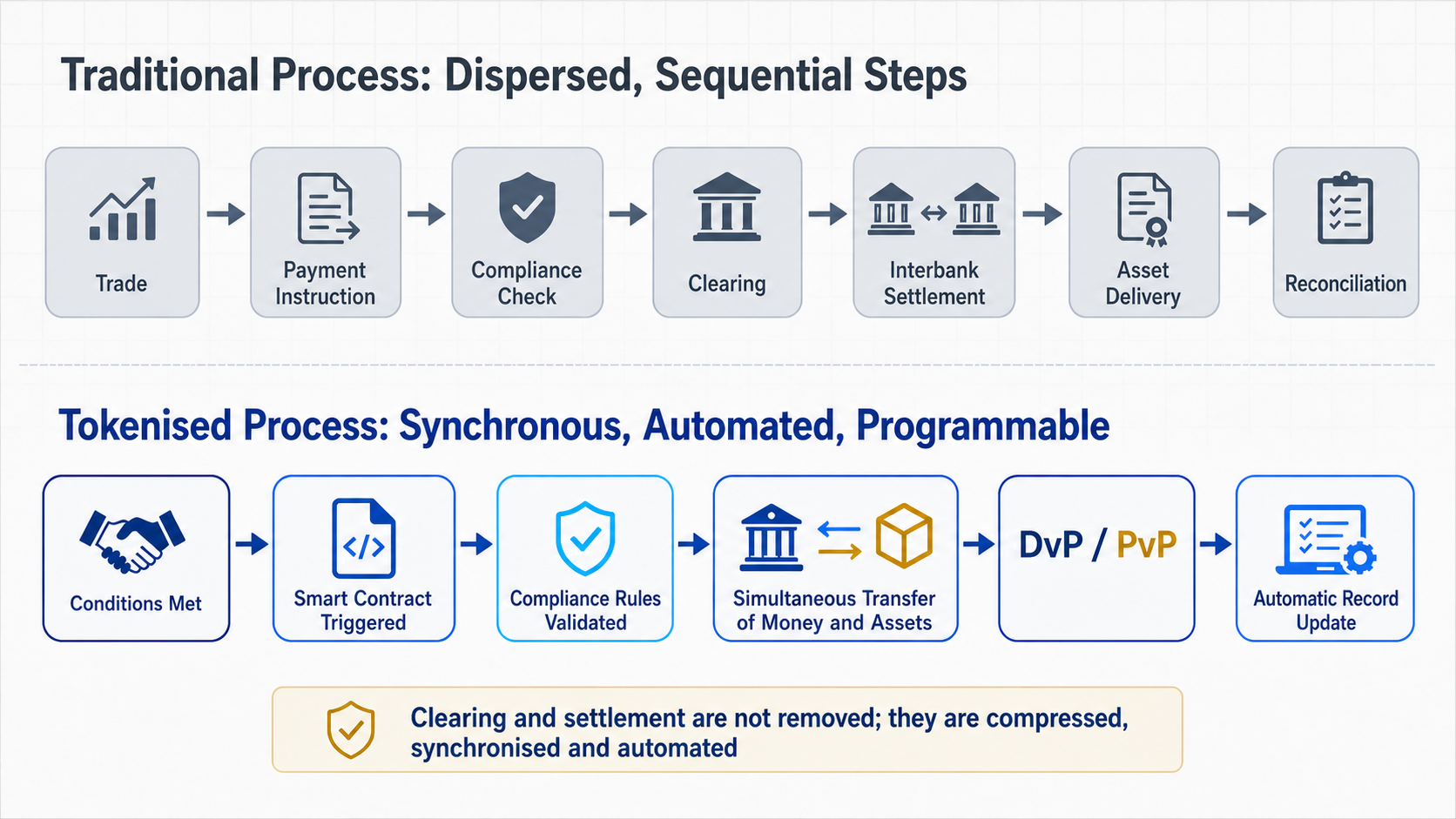
This does not mean clearing and settlement disappear. They may instead move from separate, message-driven serial steps to more synchronized, automated, programmable processes.
Banks'Role May Be Strengthened Rather Than Displaced by Blockchain
If tokenized financial-asset transactions make extensive use of commercial bank deposits, the traditional two-tier monetary system may continue into the new technological environment.
Banks would still:
- Take deposits;
- Make loans and create credit;
- Manage customer relationships;
- Carry out KYC, AML, and sanctions screening;
- Manage credit, liquidity, and operational risks;
- Provide payment products to businesses and individuals.
Blockchain changes how banks organize and execute certain activities; it does not automatically eliminate these responsibilities.
Central Bank Reserves May Become Even More Important
Tokens can run on many different networks, but interbank payments must ultimately answer:
Why is Bank A's money equal to Bank B's money?
If each bank issues its own token without common conversion, settlement, and liquidity arrangements, new digital-money silos may emerge.
Central bank money's role in achieving final interbank settlement at par remains the core mechanism for maintaining monetary singleness. The more likely future combination is:
Tokenized commercial bank deposits + tokenized central bank reserves
rather than a choice of one to the exclusion of the other.
Traditional RTGS Will Not Suddenly Disappear
The real-world transition is more likely to take three stages:
New ledgers connect to existing RTGS
→ RTGS supports more synchronous, around-the-clock settlement
→ Some central bank money becomes further tokenized or natively programmable
Hong Kong's Ensemble and Europe's Pontes both reflect this "connect first, then evolve" approach.
A blockchain is not necessarily superior to RTGS merely because it has a newer name. For some services, upgrading existing RTGS systems or adding APIs and synchronization mechanisms may already deliver sufficient benefits. For other cases requiring assets, funds, and complex conditions to execute together, a shared programmable ledger may offer more obvious value.
Infrastructure Competition Will Shift from "Who Has a Chain" to "Who Can Connect Different Ledgers"
The important question in the future may no longer be:
"How does Bank A connect to Bank B?"
Instead, it may be:
- How do banks'private ledgers connect to shared ledgers?
- How do shared ledgers connect to public blockchains?
- How do tokenized securities networks connect to central bank money?
- How do ledgers in different jurisdictions exchange compliance information?
- Once an asset crosses chains, how can duplicate issuance or duplicate settlement be prevented?
So the focus of competition may shift from simply building blockchains to identity, standards, interoperability, governance, and final settlement.
The Hardest Problem Is Not Issuance and Redemption, but Institutional Coordination
Technically, issuance, redemption, smart contracts, cross-chain communication, and atomic swaps can all already be implemented.
What is truly difficult is:
- Who may hold a given bank's token?
- How can different banks guarantee conversion at par?
- Who operates and governs a shared ledger?
- Who bears losses from smart-contract errors?
- At what point does irreversible legal finality arise?
- How can AML, data, and capital-management rules of different countries all be satisfied?
- When will central banks provide 24/7 settlement?
- How can banks continuously manage round-the-clock liquidity?
- How should services degrade and recover during network outages?
These questions cannot be resolved through technical iteration alone.
Stablecoins, CBDCs, and Tokenized Deposits Will Likely Coexist for a Long Time
The future is unlikely to see one form of digital money completely replace all others.
The more likely division of labor is:
- Stablecoins serve accessibility and on-chain liquidity in open networks;
- Tokenized deposits connect the banking system, corporate cash, and institutional finance;
- Wholesale CBDC or tokenized central bank reserves provide the anchor for final interbank settlement;
- Traditional account money and RTGS continue to meet many mature, stable payment needs.
What will truly determine the future landscape is not merely the technology any particular form of money adopts, but whether these different forms can convert into one another safely, at par, and with low friction.
Conclusion: Bringing Today's Money into Tomorrow's Infrastructure
Once tokenized deposits are understood, many debates about digital currency in recent years can be viewed anew.
Bitcoin asks:
Can value be transferred across a network without banks and central banks?
Stablecoins ask:
Can fiat value be brought onto open blockchains?
CBDCs ask:
How can central bank money adapt to the digital age?
Tokenized deposits pose another, more practical question:
If future assets, transactions, and business processes increasingly run on programmable ledgers, what happens to commercial bank deposits, which make up the bulk of today's monetary system?
Their answer is not to create an entirely new kind of money, but to bring today's money into tomorrow's infrastructure.
What is truly worth watching, therefore, is not merely whether more banks will issue their own tokens, but:
Can these bank tokens interoperate across banks, achieve final settlement through central bank money, and coordinate synchronously with securities, funds, foreign exchange, and cross-border payments?
If these questions are resolved, what changes will not merely be the form deposits take, but potentially the organization of the entire payment, clearing, and settlement system.
Originally published by Luminale Fintech Observer: https://luminale.cn/articles/what-is-tokenized-deposits-en