What Money Settles On-chain Assets? Reading the HKMA's EnsembleTX
On 13 November 2025, the Hong Kong Monetary Authority (HKMA) announced EnsembleTX, the point at which Project Ensemble moved from sandbox testing into a pilot phase. Participants began settling tokenised deposits and digital asset transactions with real money.[1] On the same day, HSBC said it had completed the first live cross-bank transaction on EnsembleTX. It moved HKD 3.8 million in tokenised deposits for its client Ant International to Ant International's wallet at another local bank.[2]
The amount is small, but one sentence in the HKMA's press release explains the current state of the arrangement. Interbank settlement of tokenised deposit transactions will initially run through the HKD Real Time Gross Settlement (RTGS) system.[1] In practice, tokenised deposits can move on-chain between customers, but the money between the two banks still has to be settled in the HKMA's RTGS system. RTGS operates during set hours, while assets on a blockchain can change hands at any time.
The HKMA's next step is to upgrade this pilot environment so that settlement runs 24/7 in tokenised central bank money. The 2026 Policy Address gave a more specific timeline. The government plans to implement central bank digital currency settlement and 24/7 operation under EnsembleTX by around the end of this year.[3] The first Five-Year Plan for Hong Kong, released on the same day, also includes Project Ensemble among its fintech priorities.[4]
This article follows that thread and answers three questions. Why did Hong Kong build a dedicated tokenised settlement platform? How does EnsembleTX settle today, and what replaces it next? And where do tokenised deposits, wholesale central bank digital currency, regulated stablecoins and tokenised Exchange Fund Bills each sit within Hong Kong's settlement system?
I. Tokenised assets are growing, but on-chain money still waits for RTGS
Hong Kong's asset side has been moving on-chain for several years. The government and the HKMA have issued tokenised green bonds more than once. The Policy Address notes that digital bonds issued in Hong Kong between 2025 and the first half of 2026 accounted for nearly 50% of the global market.[3] Asset managers are also launching tokenised money market funds (MMFs). Once assets are recorded on a distributed ledger (Distributed Ledger Technology, DLT), a new question arises: what money does the buyer pay with?
A securities trade has two legs. Securities move from seller to buyer, and funds move from buyer to seller. The industry often calls the funds side the cash leg. If tokenisation covers only the securities leg, the cash still moves through traditional bank transfers and RTGS. The two legs then run on separate systems, so at the moment the on-chain asset is delivered, the funds may not have arrived yet, and delivery versus payment (DvP) cannot happen simultaneously. DvP protects against principal risk, the risk that one party delivers and the other does not pay. The mechanics are explained in Securities and money must be exchanged "delivery against payment": what risk does DvP guard against?.
Three kinds of money could serve as the on-chain cash leg:
| Settlement asset | Whose liability | Credit profile |
|---|---|---|
| Tokenised deposits | The commercial bank that takes the deposit | Depends on the bank's balance sheet and deposit protection |
| Regulated stablecoins | A licensed non-bank issuer or bank | Depends on reserve assets, redemption arrangements and regulation |
| Wholesale central bank digital currency (wCBDC) | The central bank | No commercial credit risk |
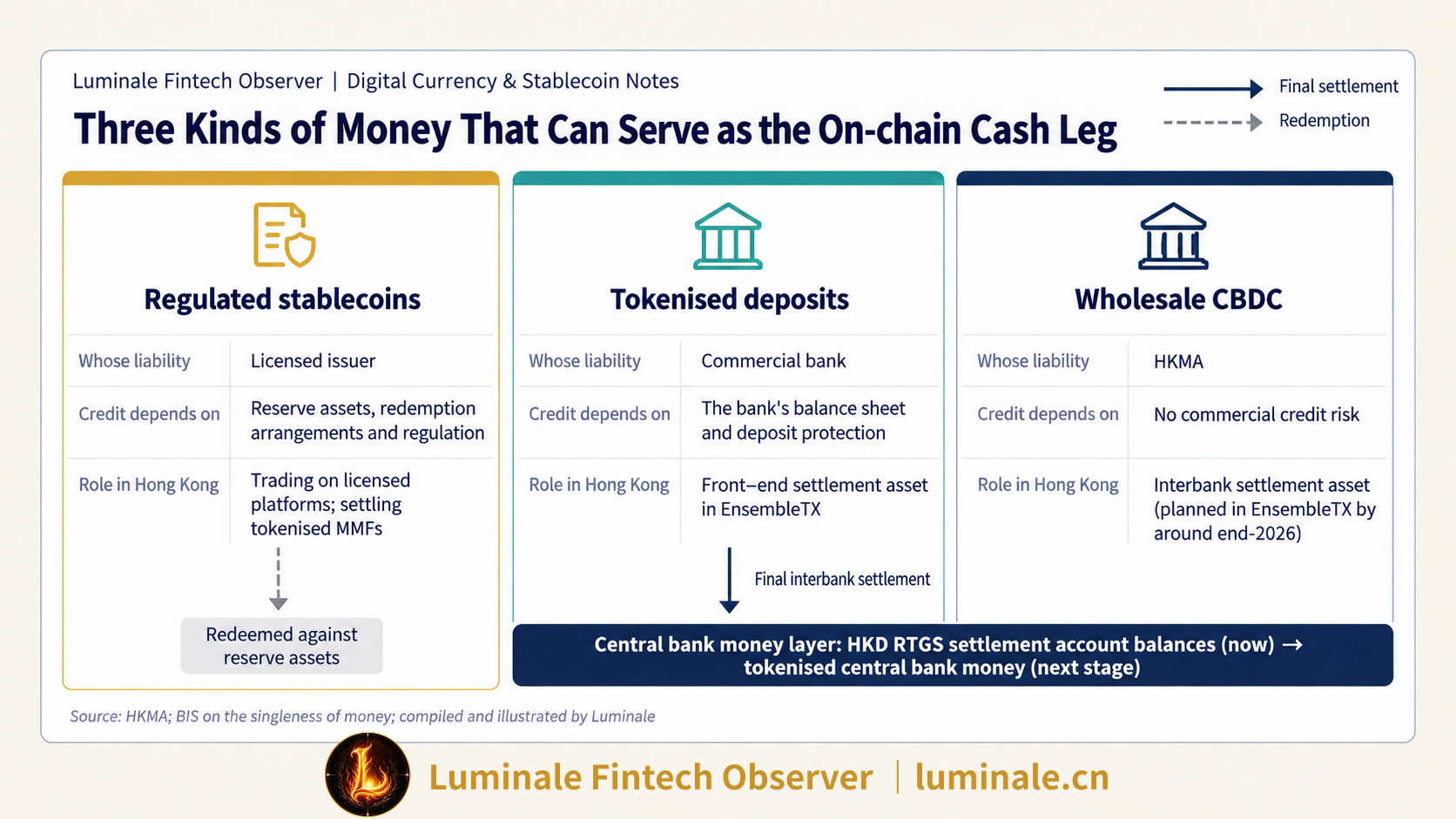
A tokenised deposit is a commercial bank's customer deposit recorded on a distributed ledger. It remains the bank's liability to the customer. The mechanics are explained in Tokenised deposits: how commercial bank money enters the on-chain world. The problem appears across banks. When a customer of Bank A pays a customer of Bank B with tokenised deposits, the two customers'accounts are updated, but Banks A and B now owe each other money that must be settled. If each bank's tokenised deposit platform is isolated and cannot connect to the others, customers cannot even make interbank transfers. Even when the platforms are connected, the banks'obligations to each other must still be settled in central bank money to achieve final settlement.
When the euro area rebuilt the cash leg for tokenised securities, it chose to extend central bank settlement services to DLT platforms. The approach is described in From Pontes to Appia: how Europe is rebuilding the cash leg for tokenised securities. Project Ensemble addresses the same problem in Hong Kong. It must do two things. It must make tokenised deposits from different banks interoperable, and it must ensure that settlement between banks ultimately lands in central bank money.
II. From sandbox to real money: the steps of Project Ensemble
On 7 March 2024, the HKMA announced Project Ensemble. It positioned the project as a wholesale central bank digital currency initiative aimed at building new financial market infrastructure for interbank settlement of tokenised money, starting with tokenised deposits.[5] The original plan was for the HKMA to launch a sandbox for testing settlement use cases for tokenised real-world assets and to set up an Architecture Community. Banks, digital asset firms, technology companies and CBDC experts would help develop industry standards there. Whether a wholesale CBDC would actually be issued would depend on industry response during the sandbox phase.[5]
Ensemble Sandbox launched on 28 August 2024. Participating banks connected their tokenised deposit platforms to the sandbox and ran payment-versus-payment (PvP) and delivery-versus-payment experiments between banks. The first round covered four themes: fixed income and investment funds, liquidity management, green and sustainable finance, and trade and supply chain finance.[6] In October of the same year, the HKMA said it had completed the first phase of six use cases across those four themes. It also announced cooperation with the Central Bank of Brazil and the Bank of Thailand to explore cross-border tokenisation use cases under Project Ensemble.[7]
A separate track concerns the digital Hong Kong dollar (e-HKD). In October 2025, the HKMA published the Phase 2 report of the e-HKD pilot. The research scope expanded to include new digital money such as tokenised deposits, and the HKMA put more effort into wholesale central bank money applications.[8] The conclusions of the two-phase pilot are summarised in From retail CBDC to tokenised settlement: what did the two-phase e-HKD pilot answer?. The difference between retail and wholesale central bank digital currency is covered in What is a central bank digital currency (CBDC)? From "digital cash" to financial infrastructure.
On 3 November 2025, at Hong Kong FinTech Week, the HKMA unveiled its Fintech 2030 strategy. It has four pillars (DART): data and payment infrastructure, artificial intelligence, resilience, and tokenisation of finance, with more than 40 initiatives. Under the tokenisation pillar, the HKMA said it would regularise the issuance of tokenised government bonds and explore tokenising Exchange Fund papers. It also said on-chain settlement would rely on new digital money, including the e-HKD, tokenised deposits and regulated stablecoins.[9] Ten days later, EnsembleTX launched.
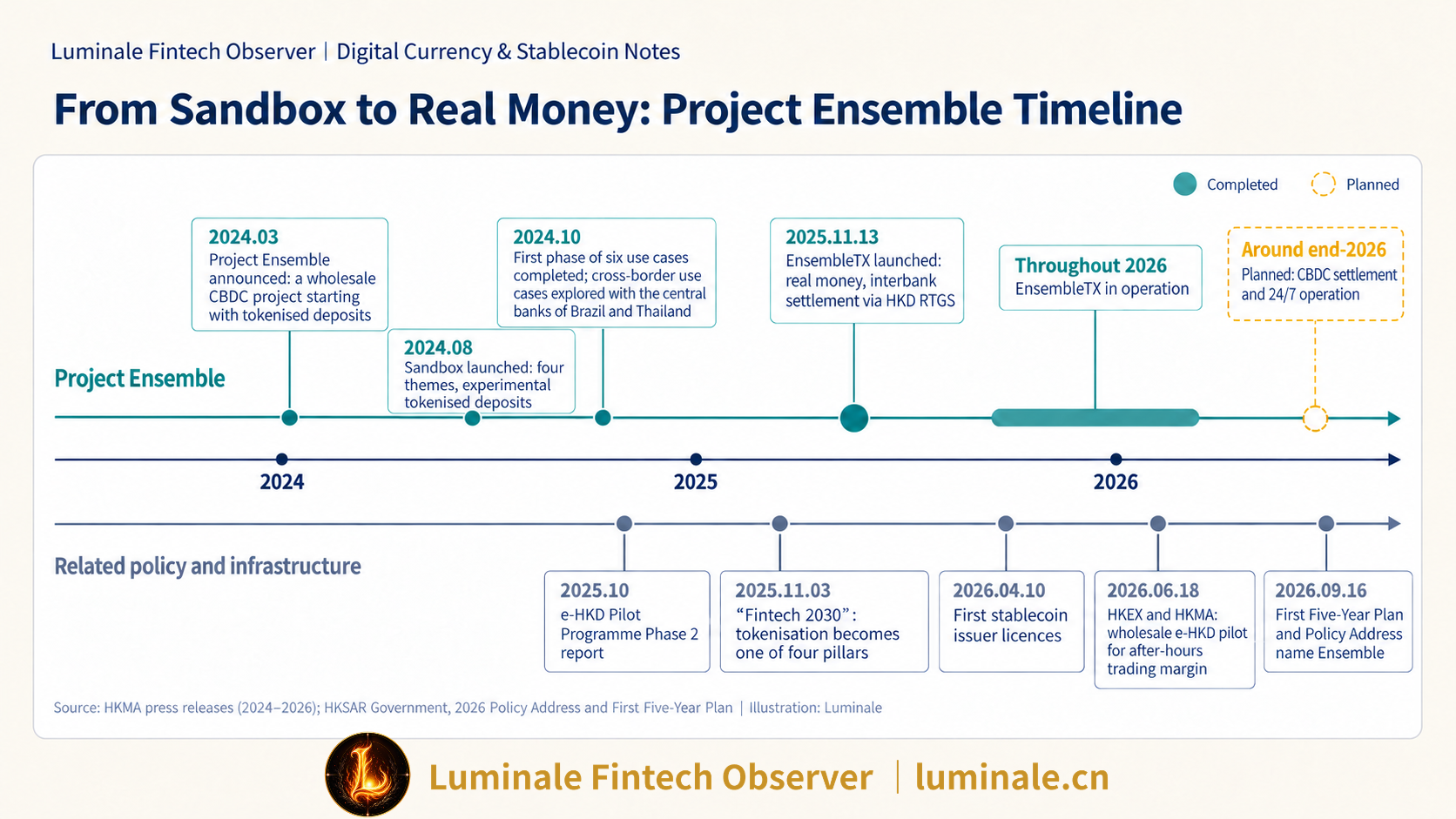
Compared with the sandbox phase, EnsembleTX brings three changes:
- From experimental money to real money. The sandbox used experimental tokenised deposits. EnsembleTX uses real deposits, so settlement creates real rights and obligations.
- From several themes to initial use cases. The first use case focuses on using tokenised deposits in tokenised MMF transactions, helping market participants manage liquidity and funding needs in real time.[1] MMF subscriptions and redemptions are frequent, the products are highly standardised, and corporate treasurers are sensitive to when funds arrive, which makes MMFs a sensible first use case.
- A clear list of participants. Annex A lists seven tokenised deposit banks: Bank of China (Hong Kong), China Construction Bank (Asia), Fubon Bank (Hong Kong), Fusion Bank, Standard Chartered Bank (Hong Kong), The Bank of East Asia and HSBC. Annex B lists 13 other industry pioneers, including Ant International, BlackRock, Franklin Templeton, BOC Hong Kong Asset Management, E Fund (Hong Kong), Hong Kong Exchanges and Clearing and Yintong (银通).[10] The HKMA defines a tokenised deposit bank as a commercial bank that offers tokenised deposit products and services to Hong Kong customers and settles tokenised deposit transactions between banks through EnsembleTX in a real-value environment.[10]
The Securities and Futures Commission (SFC) is a key partner and a member of the Ensemble Architecture Community. Tokenised investment products and trading platforms fall under the SFC's supervision, while banks and tokenised deposits fall under the HKMA's. EnsembleTX puts both regulatory lines into one project. At the EnsembleTX launch, SFC Chief Executive Julia Leung said that scaling tokenised investment products requires interoperability.[1]
So far, the only publicly disclosed EnsembleTX transaction is the one HSBC reported. Other banks'and institutions'transactions will have to be disclosed by the HKMA or the participants themselves.
III. How EnsembleTX settles: tokenised deposits in front, RTGS behind
Consider a hypothetical transaction to see how EnsembleTX settles. Company X holds tokenised deposits at Bank A and plans to subscribe HKD 10 million in a tokenised MMF. The fund's subscription account sits at Bank B and is also held as tokenised deposits.
The transaction takes four steps:
- Company X submits a subscription on the tokenised fund platform, and the fund units await delivery.
- Through EnsembleTX's interoperability layer, HKD 10 million of Company X's tokenised deposits at Bank A are transferred out, and the fund's tokenised deposits at Bank B rise by HKD 10 million.
- The fund units are delivered to Company X.
- An obligation of HKD 10 million arises between Banks A and B, and it is finally settled through HKD RTGS on the HKMA's books.
The first three steps take place on-chain and between the banks'tokenised deposit platforms. The fourth step takes place in RTGS. The Hong Kong dollar RTGS system, also known as the Clearing House Automated Transfer System (CHATS), is operated by Hong Kong Interbank Clearing Limited (HKICL). Interbank Hong Kong dollar payments are settled continuously, one by one, in full, on the HKMA's books.[11] The operating logic of RTGS is explained in Why don't payment systems settle every payment immediately? RTGS versus DNS.
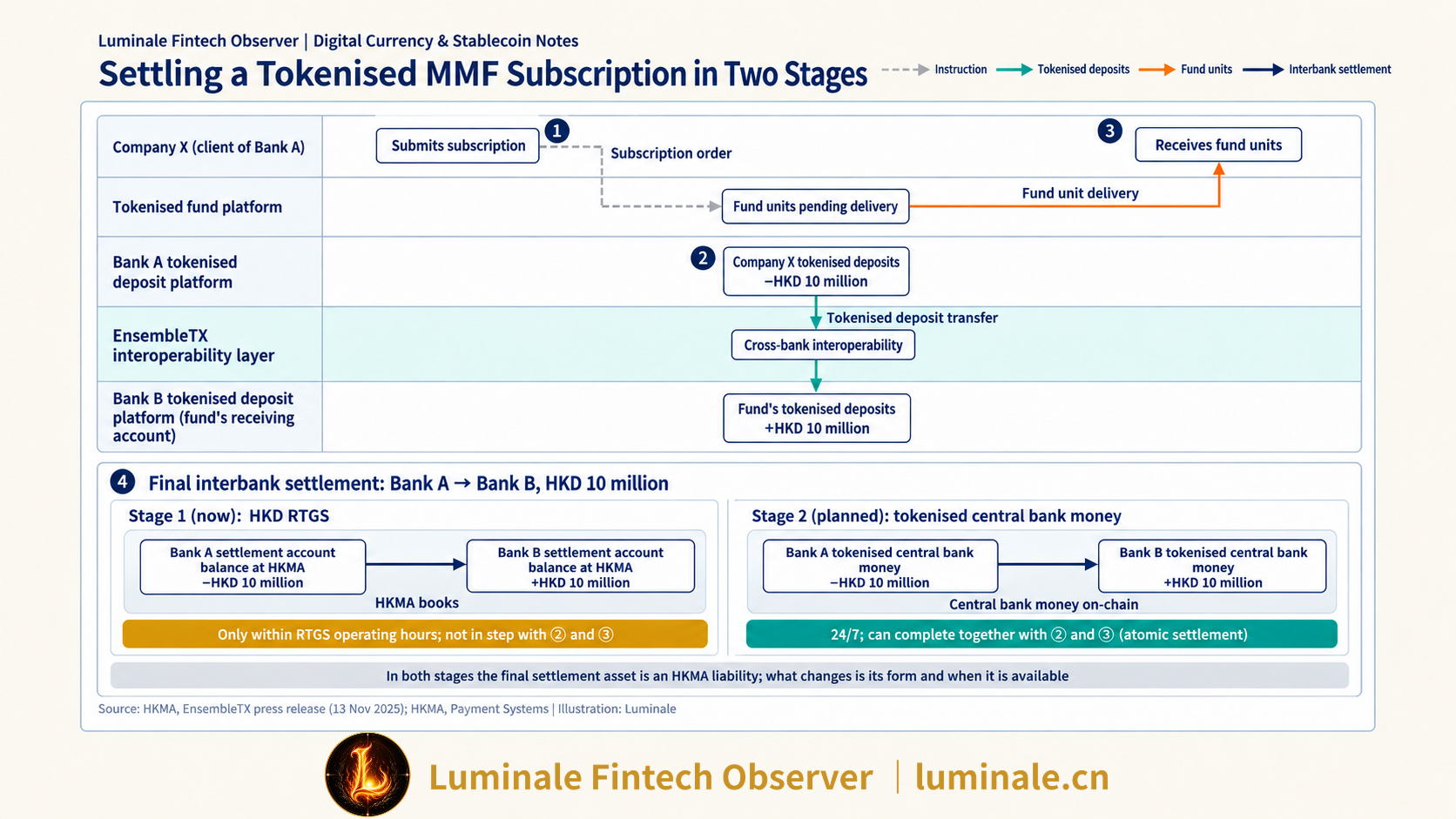
The HSBC transaction of HKD 3.8 million followed the second step. HSBC said it had connected its Tokenised Deposit Service (TDS) to EnsembleTX's interoperability layer, enabling real-time cross-bank transfers of tokenised deposits.[2] Each bank keeps its own tokenised deposit platform and connects through a shared layer. That is the role of EnsembleTX's interoperability layer.
1. Changes to the books in the two stages
After the fourth step, the positions change as follows. Stage 1 is the current arrangement, in which banks settle with each other using their settlement account balances at the HKMA. Stage 2 is the upgrade the HKMA plans, in which the settlement asset becomes tokenised central bank money (CeBM).
| Institution | Change in assets | Change in liabilities |
|---|---|---|
| Bank A | Stage 1: settlement account balance at the HKMA −HKD 10 million Stage 2: tokenised central bank money held −HKD 10 million | Company X tokenised deposits −HKD 10 million |
| Bank B | Stage 1: settlement account balance at the HKMA +HKD 10 million Stage 2: tokenised central bank money held +HKD 10 million | Fund tokenised deposits +HKD 10 million |
| HKMA | No change | Stage 1: Bank A's settlement account balance −HKD 10 million, Bank B's settlement account balance +HKD 10 million Stage 2: tokenised central bank money held by Bank A −HKD 10 million, held by Bank B +HKD 10 million |
The table also shows what does not change in Stage 2. Customers still hold commercial bank liabilities, and banks still settle with each other using central bank liabilities. The two-tier monetary structure stays in place. The singleness of money, a concept from the Bank for International Settlements (BIS), depends on this structure. Deposits at different banks can be exchanged at par because each one can ultimately be converted one-for-one into central bank money. See Why is HKD 1 at one bank the same as HKD 1 at another, while stablecoins may not be? Reading the BIS on the singleness of money.
The HKMA has not yet published the design of Stage 2 tokenised central bank money, including how it would be issued or how banks would convert settlement account balances into tokens. If it is created by converting settlement account balances one-for-one, the HKMA's total liabilities would not increase. Only part of the liabilities would change form. Who can hold tokenised central bank money directly also depends on who can hold a settlement account at the central bank. The tiers of central bank accounts are explained in Who can open an account at the central bank? A single chart explaining the central bank account hierarchy.
2. Stage 1's constraint is timing
In Stage 1 the settlement asset is already central bank money, so the constraint is timing. Tokenised MMF units can be transferred at any time, and tokenised deposits between customers can be recorded on-chain at any time. But the fourth step has to wait for RTGS to run. When RTGS is not running, participating banks face two choices. They can hold the whole transaction until RTGS reopens, or they can record the customer-level movements and leave the interbank amount to settle when RTGS reopens. The second option means that during the gap, the receiving bank has an unsettled claim on the paying bank, and the banks carry credit exposure to each other. Recording a transaction on-chain and completing final settlement are different things. The related discussion is in After a payment "succeeds," can it still be reversed? What settlement finality protects against.
Stage 2 puts central bank money on-chain too. The second and fourth steps can then complete in the same network at the same moment. A smart contract confirms that fund units have been delivered, the tokenised deposits move, and the tokenised central bank money between the two banks moves at the same time. Asset delivery, customer payment and final interbank settlement happen together, which is what atomic settlement means. How smart contracts trigger conditional settlements of this kind is explained in Smart contracts, programmability and on-chain settlement: the foundation of automated financial transactions.
3. Around-the-clock settlement also needs around-the-clock liquidity
The value of 24/7 settlement is not only speed. RTGS settles payments one by one in full, so banks need enough intraday liquidity to settle each payment during the day. The HKMA explains that Hong Kong banks can obtain interest-free intraday liquidity through intraday repurchase agreements with the HKMA, using Exchange Fund Bills and Notes (EFBN) as collateral.[11] When liquidity is short, payments queue. That issue is discussed in Short of cash, must payments simply wait? Queuing and liquidity-saving mechanisms in RTGS.
If settlement extends to 24 hours a day, banks'liquidity management must also run around the clock. Paragraph 35 of the Policy Address says the HKMA will test tokenised operation of Exchange Fund Bills by year-end. The aim is to let banks use more than HKD 1.3 trillion of Exchange Fund Bills more efficiently around the clock, to improve asset and liability management.[3] The Policy Address does not directly link this test to EnsembleTX's 24/7 settlement. From the settlement perspective, if around-the-clock central bank money settlement is to work smoothly, banks will need to mobilise liquidity at night and on holidays too. Tokenised Exchange Fund Bills could become a tool for that.
Derivatives markets offer another example. On 18 June 2026, HKEX and the HKMA announced a joint pilot to study using the e-HKD to pay advance margin during the after-hours trading session of the derivatives market. The HKMA's press release describes the e-HKD here as a wholesale central bank digital currency that operates 24/7.[12] Under current arrangements, clearing participants must submit advance margin deposit requests to HKFE Clearing Corporation Limited (HKCC) by 3:00 p.m. before the funds can be used for that evening's after-hours session.[12] After-hours trading is already running, but margin funding still follows bank business hours. A wholesale central bank digital currency that operates around the clock would fill that gap.
IV. Hong Kong's layered settlement toolkit
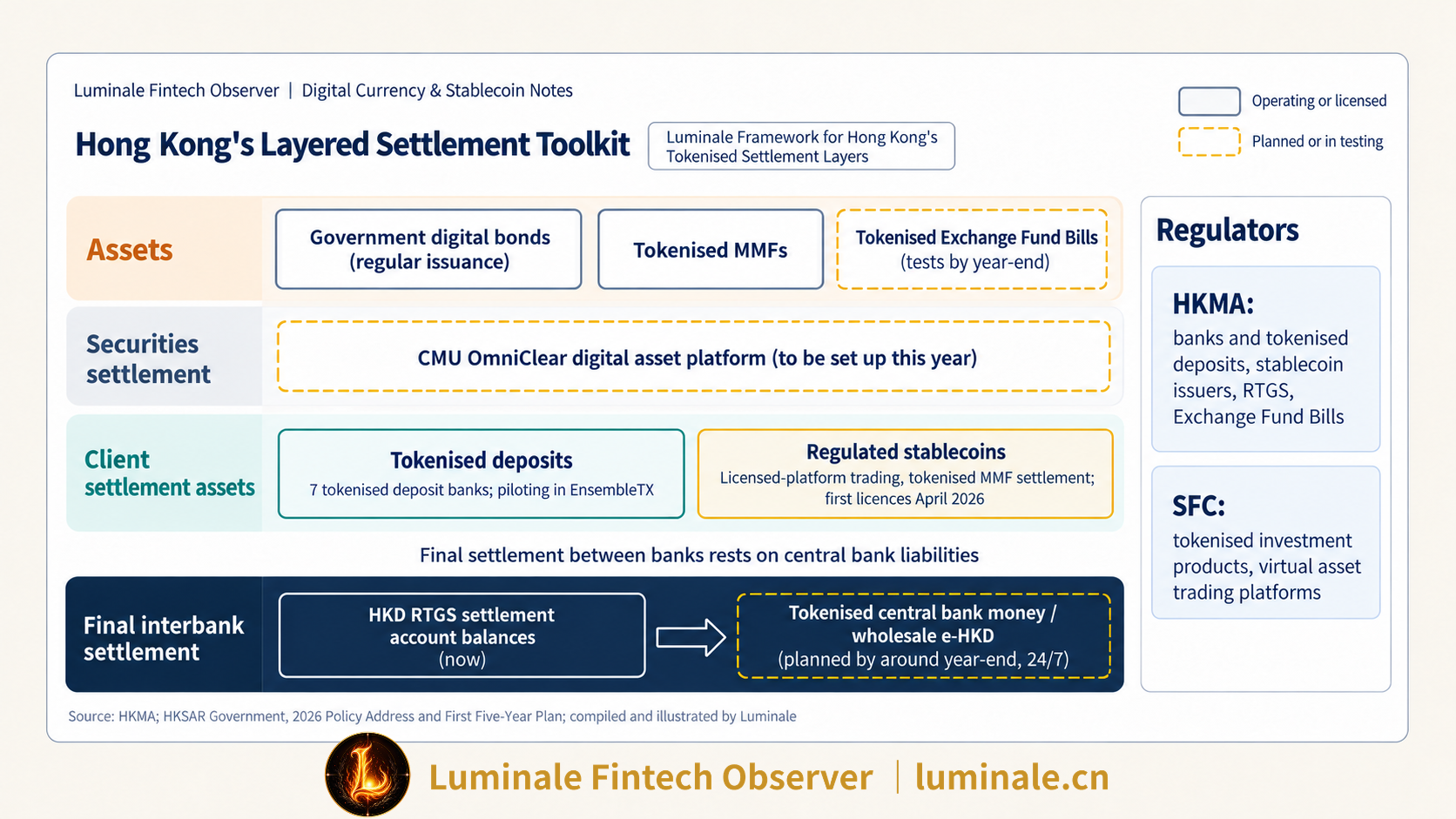
Viewed against Hong Kong's wider arrangements, the settlement instruments currently disclosed can be arranged by liability issuer and purpose, as follows:
| Settlement instrument | Issuer and nature of liability | Main users | Typical use | Current status |
|---|---|---|---|---|
| Tokenised central bank money / wholesale e-HKD | HKMA liability | Banks, financial market infrastructures | Final interbank settlement; after-hours derivatives margin | EnsembleTX plans to implement it by around year-end; the HKEX pilot was announced in June 2026 |
| Tokenised deposits | Commercial bank liability | Corporate and institutional clients | Tokenised MMF transactions; real-time liquidity and treasury management | Piloting in EnsembleTX; seven tokenised deposit banks |
| Regulated stablecoins | Licensed issuer liability | Users of licensed platforms, investors | Trading on licensed virtual asset platforms; tokenised MMF settlement | First issuer licences granted in April 2026; the Policy Address promotes related applications |
| Tokenised Exchange Fund Bills | Exchange Fund liability | Banks | Around-the-clock asset and liability management | The Policy Address proposes testing by year-end |
| Government digital bonds and the CMU OmniClear digital asset platform | Government debt; settlement infrastructure | Issuers, investors | Issuance and settlement of digital bonds | Regular issuance of digital bonds; the platform is to be set up this year |
In Luminale's digital currency analytical framework, this table can be read in two directions. Across a row, each entry answers the question of whose liability the money is. Hong Kong dollar money on-chain can be a central bank liability, a bank deposit or a stablecoin, each corresponding to a different issuer: the HKMA, a commercial bank or a licensed issuer. Each carries a different credit profile. Down a column, Hong Kong has not asked one kind of digital money to cover every use. Interbank final settlement is anchored in central bank money. Banks and clients use tokenised deposits. Stablecoins are confined to designated uses such as licensed platforms and tokenised fund settlement. Tokenised Exchange Fund Bills add liquidity, and digital bonds together with CMU OmniClear serve the asset and securities settlement sides.
The regulatory framework for stablecoins is already in place. The Stablecoins Ordinance (Cap. 656) took effect on 1 August 2025. On 10 April 2026, the HKMA granted the first stablecoin issuer licences to Anchorpoint Financial Limited and The Hongkong and Shanghai Banking Corporation Limited.[13] Paragraph 49 of the Policy Address proposes promoting the trading of regulated stablecoins on licensed virtual asset trading platforms and their use in settling tokenised money market funds.[3] Stablecoins can serve as a cash leg in some settings, but large-value settlement between institutions still needs assets with no credit risk. Stablecoins can trade away from par in secondary markets, and redemptions are constrained by the business hours of the markets where reserve assets are held. The analysis is in Stablecoins explained: how do they hold their peg? and Tokens move around the clock, but redemptions still wait for markets to open: reading the FSB's report on cross-border risks of global stablecoins. EnsembleTX plans to make interbank settlement around the clock, while a stablecoin's redemption chain still depends on off-chain markets opening. Looking at the two together helps explain why the HKMA wants central bank money itself to be usable around the clock.
Securities settlement on the asset side is also moving. The Central Moneymarkets Unit (CMU) is Hong Kong's central securities depository and settlement system for the debt market. The Policy Address says CMU OmniClear will set up a digital asset platform this year, offering one-stop services for issuing and settling digital bonds.[3] For how bond registration, custody and settlement work in traditional markets, see Where are bonds held? CSDs and SSSs as the back-end ledger of the securities market. For how bookkeeping differs between account-based and token-based models, see How does digital money keep its books? From accounts and tokens to CBDC ledger design.
Compared with other markets, Hong Kong's route has one distinctive feature. It uses the existing RTGS system to run real money first, and only then upgrades central bank money itself into tokens. Singapore's approach to asset tokenisation and wholesale settlement is covered in Where has Singapore's digital finance got to? From tokenisation to payment and settlement infrastructure. The euro area, for its part, has first connected central bank settlement services to DLT platforms. All three jurisdictions are working on the cash leg problem, but they start from different points.
V. The Five-Year Plan writes Ensemble in: what remains open to 2030
The first Five-Year Plan for the Hong Kong Special Administrative Region, 2026–2030, released on 16 September 2026, lists four priority areas for fintech in its Column 3: data and payment infrastructure, artificial intelligence, enhanced resilience and tokenisation of finance. These correspond to the four pillars of the HKMA's Fintech 2030 strategy.[4] The plan says tokenisation of finance will be advanced through the HKMA's Project Ensemble, to drive further practical application of tokenisation across more asset classes and use cases. On central bank digital currencies, stablecoins, tokenised deposits, tokenised bonds and tokenised securities products, the plan uses the phrase "prudent and steady promotion" (穩慎推動).[4] Paragraph 2.8 of the plan also calls for steadily regularising the issuance of government digital bonds and improving the related legal and market framework.[4]
Ensemble has thus moved from a pilot run by the HKMA to a project named in the government's five-year plan. The near-term milestones are all set out in the Policy Address. EnsembleTX is to implement central bank digital currency settlement and 24/7 operation around year-end, the Exchange Fund Bills tokenisation test is due by year-end, and CMU OmniClear is to set up its digital asset platform this year.[3]
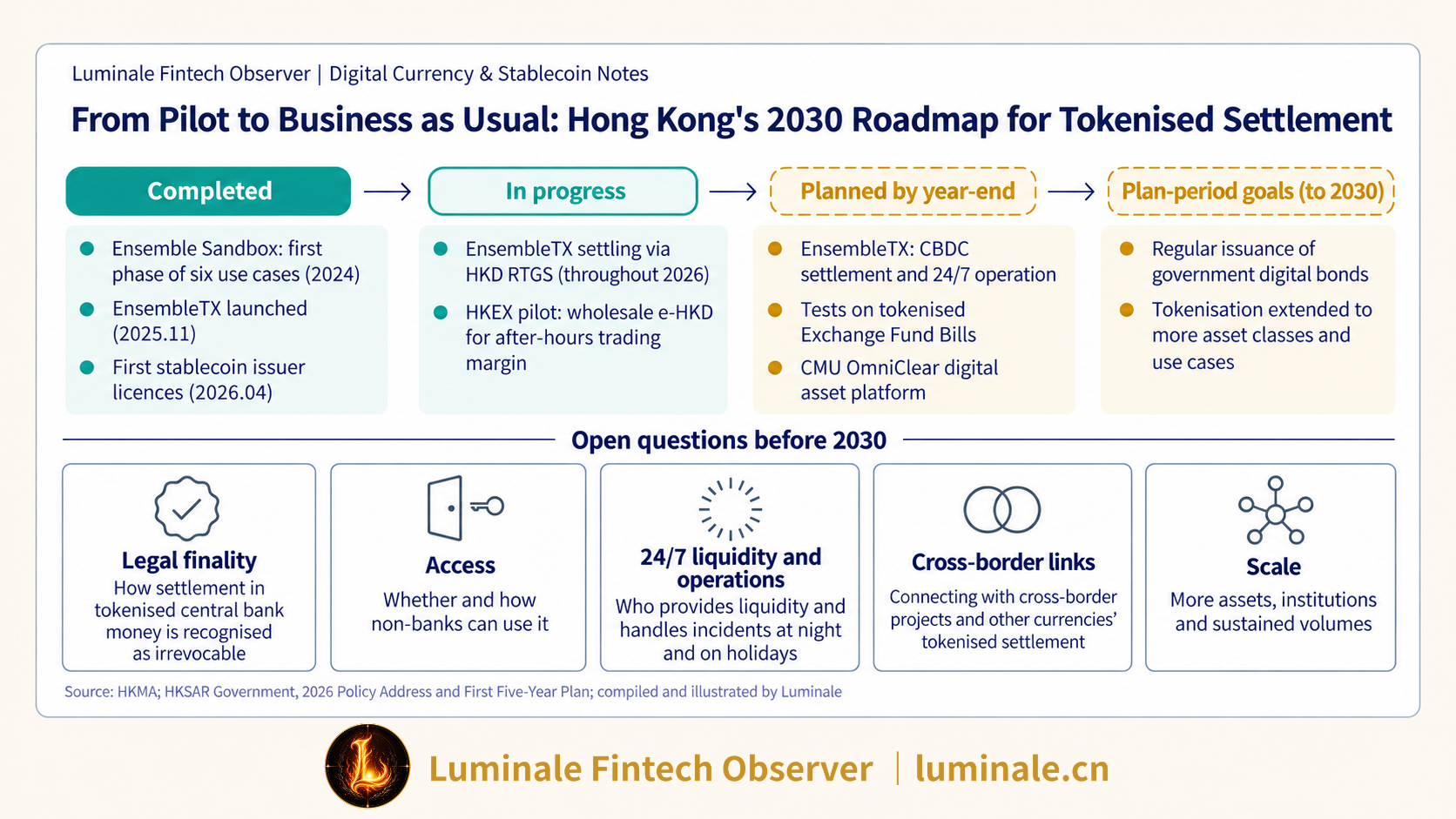
| Status | Items |
|---|---|
| Completed | Ensemble Sandbox first phase of six use cases (2024); EnsembleTX launched (November 2025); first stablecoin issuer licences (April 2026) |
| In progress | EnsembleTX settling tokenised deposits through RTGS (throughout 2026); HKEX pilot of wholesale e-HKD for after-hours trading (announced June 2026) |
| Planned by year-end | EnsembleTX implementing central bank digital currency settlement and 24/7 operation; tokenised Exchange Fund Bills test; CMU OmniClear digital asset platform |
| Plan-period goals | Regular issuance of government digital bonds; tokenisation extended to more asset classes and use cases |
The plan sets out a direction and a timetable. Several questions must still be answered before a pilot becomes business as usual. The following are Luminale's own summary from public material. The plan and the Policy Address do not list them.
First, legal settlement finality. A transfer completed in tokenised central bank money has to be recognised in law as final and irrevocable before it can replace RTGS. Hong Kong's current settlement finality protections rest on the designated-system arrangements of the Payment Systems and Stored Value Facilities Ordinance. The HKMA will need to explain how a new tokenised settlement platform fits into that framework.
Second, who can use tokenised central bank money directly. The HKEX pilot has already run into this. Many of the clearing participants in HKCC are not banks, so they cannot hold wholesale central bank digital currency directly and must participate through settlement banks. Whether and on what terms tokenised MMF managers, securities firms and payment institutions can connect will determine how far this toolkit reaches.
Third, liquidity and operational risk in 24/7 operation. When large payments fall due at night or on holidays, who provides liquidity, and against what collateral? When the system fails, who handles it, and how quickly must it recover? The Exchange Fund Bills tokenisation test may answer part of the liquidity question. Staffing, contingency arrangements and monitoring for operations will still need separate design. The Principles for Financial Market Infrastructures (PFMI), issued by the Committee on Payments and Market Infrastructures (CPMI) and the International Organization of Securities Commissions (IOSCO), set requirements for settlement finality, money settlement and operational risk. Tokenised platforms must meet the same standards. See PFMI explained: the principles of financial market infrastructures and the bottom lines they must hold. Faster settlement also speeds up risk transmission. The IMF's analysis of this point is discussed in IMF report explained: tokenisation makes trading faster, but does it also make risk move faster?.
Fourth, cross-border interoperability. In 2024 the HKMA had already explored cross-border tokenisation use cases under Project Ensemble with the Central Bank of Brazil and the Bank of Thailand.[7] The HKMA also participates in the multilateral central bank digital currency bridge project (mBridge). How Ensemble's local settlement platform will connect with these cross-border arrangements, and whether tokenised Hong Kong dollar assets can interoperate with tokenised settlement in other currencies, has no public answer yet. For how cross-border payments change at the messaging layer and the settlement layer, see From messaging to execution: which layer of cross-border payments does Swift's Shared Ledger change?.
Fifth, scale. Seven banks and more than a dozen other institutions are participating. That already covers several of Hong Kong's main note-issuing banks and asset managers. For a tokenised settlement platform to create network effects, it will need more asset classes, more institutions and sustained transaction volumes. Korea's Project Hangang also combines tokenised deposits with wholesale central bank money, and its pilot faces similar questions about use cases and scale. See Where has Korea's digital currency experiment got to? Reading Project Hangang.
Conclusion
EnsembleTX has so far settled very little in public view. Its real significance lies in its structure. Hong Kong lets tokenised deposits circulate at the front end and keeps central bank money in its place as the final settlement asset between banks. It uses the existing RTGS system to run real money first, and then plans to make central bank money itself usable as tokens around the clock. This route does not bypass the banking system, and it does not let private digital money replace central bank money. It places tokenisation inside the existing two-tier monetary structure.
The Five-Year Plan writes Ensemble into government planning and gives the work a longer timeline. Whether Hong Kong can take this arrangement from pilot to business as usual by 2030 depends on whether the rules for legal finality, access, around-the-clock liquidity and cross-border interoperability can keep pace. Making settlement run around the clock is not technically difficult. The harder question is, when it runs around the clock, who bears the risk and who sets the rules.
References
[1]: Hong Kong Monetary Authority, "HKMA announces new phase of Project Ensemble to support real-value transactions in tokenised deposits and digital assets," 13 November 2025. https://www.hkma.gov.hk/gb_chi/news-and-media/press-releases/2025/11/20251113-3/ ↩
[2]: HSBC Hong Kong, "HSBC completes first live cross-bank transaction in EnsembleTX," 13 November 2025. https://www.about.hsbc.com.hk/news-and-media/hsbc-completes-first-live-cross-bank-transaction-in-ensembletx ↩
[3]: HKSAR Government, "The 2026 Policy Address," paragraphs 35, 49 and 50, 16 September 2026. https://www.policyaddress.gov.hk/2026/public/pdf/policy/policy-full_en.pdf ↩
[4]: HKSAR Government, "The First Five-Year Plan for the Economic and Social Development of the Hong Kong Special Administrative Region (2026–2030)," full text (part 2), 16 September 2026. https://www.info.gov.hk/gia/general/202609/16/P2026091600140.htm ↩
[5]: Hong Kong Monetary Authority, "HKMA unveils Project Ensemble to support the development of the Hong Kong tokenisation market," 7 March 2024. https://www.hkma.gov.hk/gb_chi/news-and-media/press-releases/2024/03/20240307-5/ ↩
[6]: Hong Kong Monetary Authority, press release on the launch of the Project Ensemble Sandbox, 28 August 2024. https://www.hkma.gov.hk/media/eng/doc/key-information/press-release/2024/20240828e3a1.pdf ↩
[7]: Hong Kong Monetary Authority, "Hong Kong FinTech Week 2024" press release, 28 October 2024. https://www.hkma.gov.hk/eng/news-and-media/press-releases/2024/10/20241028-5/ ↩
[8]: Hong Kong Monetary Authority, "e-HKD Pilot Programme Phase 2 Report," October 2025. https://www.hkma.gov.hk/media/eng/doc/key-functions/financial-infrastructure/e-HKD_Pilot_Programme_Phase_2_Report.pdf ↩
[9]: Hong Kong Monetary Authority, "HKMA unveils Fintech 2030 at Hong Kong FinTech Week 2025," 3 November 2025. https://www.hkma.gov.hk/gb_chi/news-and-media/press-releases/2025/11/20251103-3/ ↩
[10]: Hong Kong Monetary Authority, annexes A and B to the EnsembleTX press release, 13 November 2025. https://www.hkma.gov.hk/media/gb_chi/doc/key-information/press-release/2025/20251113c3a1.pdf ↩
[11]: Hong Kong Monetary Authority, "Payment Systems" (Hong Kong dollar RTGS system and intraday liquidity arrangements). https://www.hkma.gov.hk/eng/key-functions/international-financial-centre/financial-market-infrastructure/payment-systems/ ↩
[12]: Hong Kong Monetary Authority, "HKEX and HKMA launch pilot project to enable digital payment solution for derivatives after-hours trading," 18 June 2026. https://www.hkma.gov.hk/gb_chi/news-and-media/press-releases/2026/06/20260618-8/ ↩
[13]: Hong Kong Monetary Authority, "Grant of stablecoin issuer licences," 10 April 2026. https://www.hkma.gov.hk/gb_chi/news-and-media/press-releases/2026/04/20260410-4/ ↩
Originally published by Luminale Fintech Observer: https://luminale.cn/articles/hkma-ensembletx-tokenised-settlement-en