In October 2025, the Hong Kong Monetary Authority (HKMA) released the report on Phase 2 of the e-HKD Pilot Programme, expanding the research scope to encompass tokenised deposits and other novel forms of digital money, officially renaming the initiative Project e-HKD+[1].
From the launch of Project e-HKD in 2021 to the completion of Phase 1 in October 2023 and Phase 2 in October 2025, the focus of this research underwent a distinct shift: from initially exploring retail payment tools for the general public to examining institutional settlement assets within a tokenised financial ecosystem.
The two-phase pilot addressed two progressive questions: Phase 1 tested whether the underlying technical capabilities were usable, while Phase 2 examined whether these capabilities specifically required central bank money. This exploration clarified the division of labour among different forms of digital money within the financial infrastructure and laid out the underlying logic for Hong Kong's subsequent tokenised financial architecture.
I. Background and Retail Payment Environment of Project e-HKD
In September 2022, the HKMA published the policy position paper titled e-HKD: A policy and design perspective, proposing a three-rail approach to advance the research and development of e-HKD[2]:
- Rail 1: Laying the legal and technical foundations, formulating legislative proposals to amend relevant laws to confer legal tender status on e-HKD, and developing wholesale infrastructure.
- Rail 2: Conducting industry pilots and application research, diving deep into use cases, application designs, and implementation issues through the pilot programme.
- Rail 3: Consolidating the outcomes of Rail 1 and Rail 2, and determining the timeline for the potential formal launch of e-HKD based on market evolution and technological readiness.
The pilot programme falls under the market application exploration of Rail 2. Unlike developing economies lacking digital payment infrastructure, Hong Kong's local retail payment ecosystem is already highly mature.
At the level of everyday consumer payments, Hong Kong operates a stable, real-time retail payment system—the Faster Payment System (FPS), which supports 24/7 instant interbank fund transfers in both Hong Kong dollars and renminbi. Concurrently, Stored Value Facilities (SVF) such as Octopus, AlipayHK, and WeChat Pay HK, alongside contactless credit and debit cards, are widely adopted. For individual users, small-value payments and daily consumer transactions already benefit from instant, low-cost settlement.
In such a market environment, researching a retail central bank digital currency (Retail Central Bank Digital Currency, rCBDC) designed for the general public faces a fundamental constraint: can it provide demonstrable incremental value beyond existing mature commercial payment networks?
The institutional distinction lies in the underlying liability structure of the money. Bank deposits transferred via FPS, or balances held within SVF wallets, represent the liabilities of commercial banks or payment institutions; in contrast, a retail central bank digital currency represents a direct legal liability of the central bank to the public. However, in routine retail spending, rigorous bank licensing oversight and deposit protection schemes mean that consumers rarely perceive the difference between these two liability types. If a new payment medium merely replicates the user experience of scanning a QR code or tapping a card, the substantial costs of system overhauls and merchant terminal upgrades would struggle to deliver positive commercial returns.
Consequently, Project e-HKD did not dwell solely on front-end payment convenience, but instead focused on exploring deeper capabilities across programmability, tokenisation, and asset settlement.
II. Phase 1 Functional Testing: Programmability, Tokenisation, and Atomic Settlement
Phase 1 of the pilot programme concluded in October 2023, involving 16 firms across 14 pilot trials covering six broad categories: full payments, programmable payments, offline payments, tokenised deposits, Web3 transaction settlement, and tokenised asset settlement[3].
Through diverse sandbox experiments, Phase 1 identified three core capabilities through which e-HKD could deliver potential unique value:
- Programmability: Binding payment logic to predefined conditional rules. For instance, in government subsidy distribution, merchant prepaid fund escrow, or targeted loyalty rewards, funds are automatically unlocked and disbursed only when specific criteria—such as eligible merchant categories, spending windows, or verified identity credentials—are satisfied.
- Tokenisation: Mapping conventional monetary rights or real-world assets onto distributed ledger technology (Distributed Ledger Technology, DLT), enabling them to circulate and interoperate directly across modern digital networks.
- Atomic Settlement: Executing asset transfers and fund transfers simultaneously within a single atomic transaction, enabling Delivery versus Payment (DvP) or Payment versus Payment (PvP), thereby completely eliminating principal settlement risk arising from unilateral default.
In traditional financial transactions, asset delivery and cash settlement typically occur in fragmented, disconnected systems. In large-value asset transactions, even after the buyer's asset ownership is updated in a central registry, the funds often require delayed transfers across interbank clearing rails. The time lag between these legs introduces counterparty credit risk. Atomic settlement leverages smart contracts (Smart Contract) to bind asset ownership transfer and settlement fund delivery into an indivisible operational unit—ensuring that both legs either succeed together or fail together, preventing unilateral settlement failures.
The Phase 1 report highlighted an important empirical observation: many points of operational friction and inefficiency in existing business workflows stem from legacy business models, compliance review procedures, and cross-institutional information silos. Introducing a new digital currency technology cannot automatically dismantle these institutional overheads; technology must be thoughtfully paired with practical business workflows to generate tangible economic value.
III. Phase 2 Testing of Commercial Viability
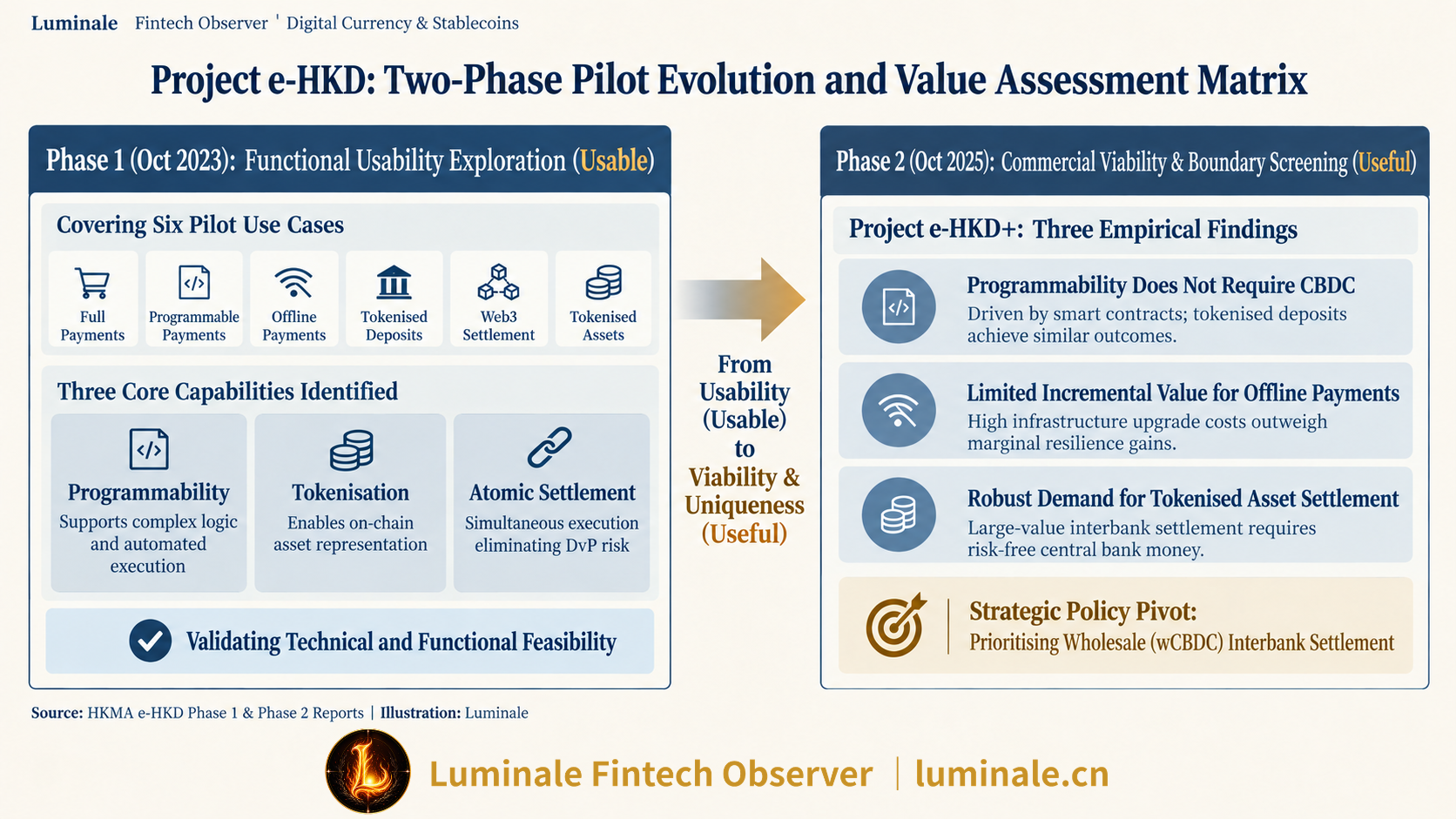
Phase 2 of the pilot programme, initiated in 2024 and concluded in October 2025, narrowed its research focus to three core themes: tokenised asset settlement, programmability, and offline payments. With 11 participating groups, the project was officially rebranded as Project e-HKD+, broadening its analytical lens to encompass tokenised deposits and broader novel digital currency arrangements[1].
The HKMA drew a clear distinction between the mandates of the two phases: Phase 1 tested whether features were usable, whereas Phase 2 tested whether they were genuinely useful, prioritising the evaluation of commercial viability and scalability. Phase 2 yielded three principal conclusions:
1. Programmability Derives Primarily from Smart Contracts Rather than the Settlement Asset Itself
Phase 2 trials demonstrated that the efficiency gains realized from conditional payments, targeted fund usage, and automated disbursements stem predominantly from the smart contracts encoding the business logic, rather than whether the underlying settlement token is directly issued by the central bank.
Commercial bank tokenised deposits, and even traditional bank accounts integrated via open application programming interfaces (Application Programming Interface, API), can equally execute automated escrow or supply-chain fund segregation logic. Programmability is a capability of the distributed technology stack, rather than an exclusive justification for issuing a retail central bank digital currency.
2. Incremental Value for Offline e-HKD Remains Limited in Hong Kong
Testing around offline payments demonstrated that establishing a dual-offline e-HKD ecosystem reliant on hardware secure elements (Secure Element) faces a steep cost-benefit imbalance in Hong Kong's dense urban environment.
Hong Kong enjoys world-class cellular network and public Wi-Fi coverage, alongside the ubiquitous adoption of contactless offline payment solutions like the Octopus card. Pilot survey data revealed that nearly half of respondents considered existing offline payment alternatives entirely adequate for emergency contingencies. Building an independent offline e-HKD terminal infrastructure would necessitate extensive point-of-sale (POS) terminal replacements and hardware wallet distribution, while requiring complex risk reserve mechanisms to mitigate double-spending (Double-spending) risks. The marginal systemic resilience gained does not justify the massive capital expenditure.
3. Tokenised Asset Settlement Demonstrates Robust Institutional Demand
In stark contrast to the modest response from retail consumer use cases, Phase 2 revealed robust, actionable demand in the settlement of tokenised asset transactions.
Across tokenised fund redemptions, green bond issuances, and structured financial product delivery, tokenised settlement assets enable real-time or near-real-time 24/7 delivery, substantially compressing the intraday liquidity tied up in traditional T+1 or T+2 settlement cycles and reducing reconciliation overhead between custodian intermediaries.
Nevertheless, this finding raised a deeper architectural question: within tokenised networks, commercial bank tokenised deposits can also execute on-chain cash transfers. Given that commercial bank money can circulate natively on-chain, what is the indispensable role of central bank money?
IV. Central Bank Money vs. Commercial Bank Money in Tokenised Systems
When payment and settlement requirements transition from everyday retail consumption to large-value interbank institutional transactions, the credit quality of the underlying settlement asset becomes the primary determinant of systemic stability.
In modern two-tier banking architectures, circulating money comprises two fundamental layers: central bank liabilities and commercial bank liabilities. In the tokenised era, this dual structure persists under new technological representations:
- Central Bank Digital Currency (CBDC): A direct liability of the central bank, carrying zero credit risk and zero liquidity risk, representing the ultimate settlement asset.
- Tokenised Deposits: Direct liabilities of deposit-taking commercial banks recorded on distributed ledgers, whose creditworthiness and redemption depend on the issuing bank's balance sheet and applicable deposit protection schemes.
- Stablecoins: Liabilities of private, non-bank entities, whose creditworthiness and convertibility depend on underlying reserve asset management, redemption mechanics, and regulatory compliance.
In retail purchases, when a consumer spends HKD 100 on groceries, there is no practical need to distinguish whether the funds represent the liabilities of HSBC, Bank of China (Hong Kong), or Standard Chartered. However, in wholesale interbank settlement, securities clearing, or cross-border payment flows involving hundreds of millions of dollars, financial institutions cannot sustainably accept each other's commercial bank liabilities as ultimate discharge of obligations; doing so would accumulate unacceptable counterparty credit exposures across the banking network.
Within the digital financial infrastructure framework articulated by Luminale, the choice of settlement asset directly defines the credit tier and systemic risk perimeter of the ecosystem.
To illustrate this settlement divergence, consider a tokenised asset trade between clients of two different banks. Suppose Client A (banking with Bank A) purchases HKD 10 million in tokenised bonds from Client B (banking with Bank B) via an on-chain smart contract, with both parties holding tokenised deposits issued by their respective commercial banks.
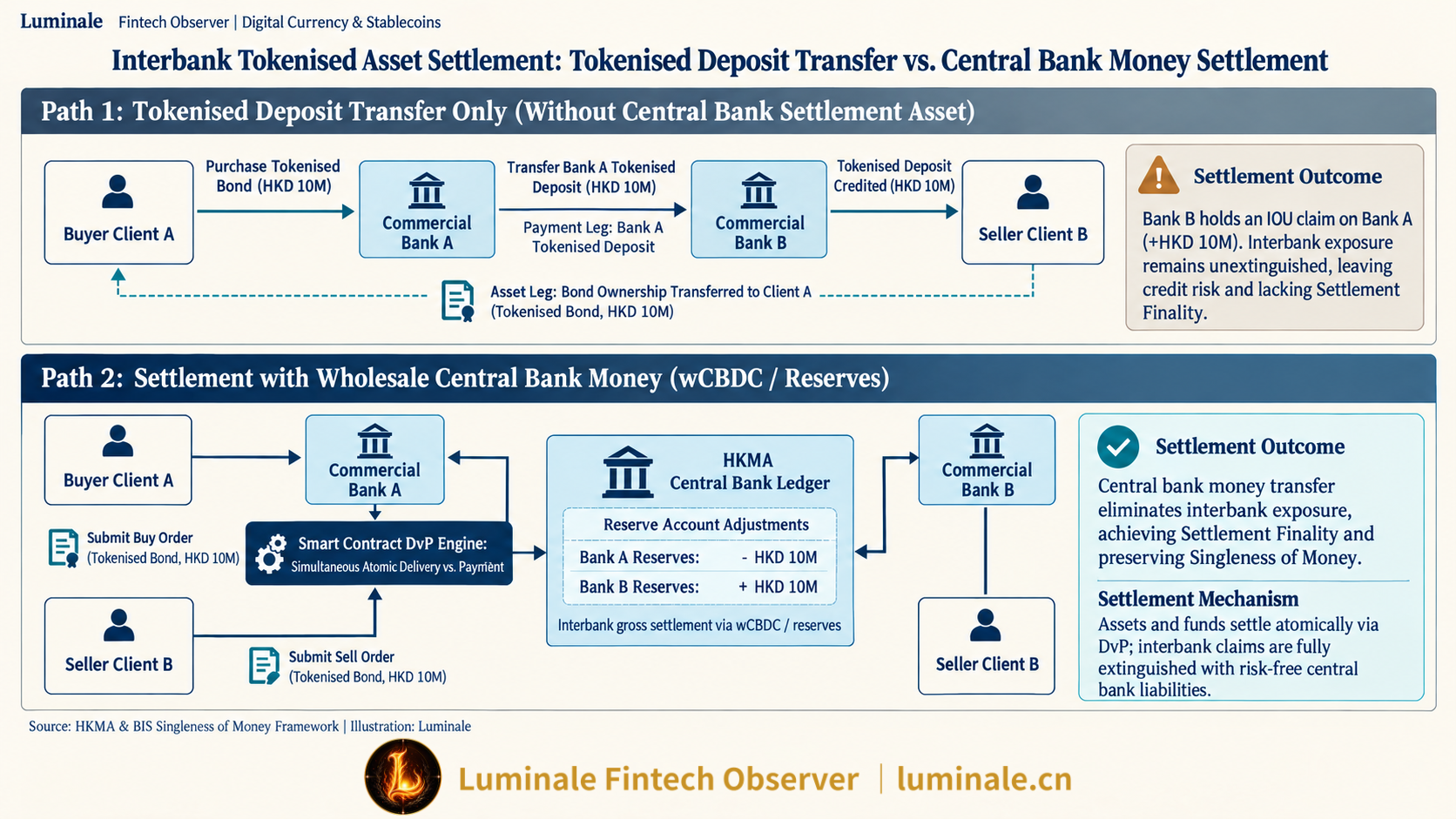
When the tokenised bonds are delivered to Client A, cash settlement can follow two fundamentally different underlying paths:
Path 1: Reliance Solely on Commercial Bank Tokenised Deposits
If interbank settlement is restricted strictly to the tokenised deposit layer, Bank B receives Bank A deposit tokens transferred from Client A, meaning Bank B now holds an uncollateralised credit claim against Bank A for HKD 10 million:
| Institution | Asset Change | Liability Change |
|---|---|---|
| Commercial Bank A | No change | Client A Tokenised Deposit: -HKD 10M IOU / Due to Bank B: +HKD 10M |
| Commercial Bank B | Claim / Due from Bank A: +HKD 10M | Client B Tokenised Deposit: +HKD 10M |
Path 2: Settlement via Central Bank Money
To eliminate interbank counterparty risk, both banks must extinguish their obligations using risk-free assets issued by the central bank (statutory reserves or wholesale tokenised central bank money):
| Institution | Asset Change | Liability Change |
|---|---|---|
| Commercial Bank A | Central Bank Reserves / wCBDC: -HKD 10M | Client A Tokenised Deposit: -HKD 10M |
| Commercial Bank B | Central Bank Reserves / wCBDC: +HKD 10M | Client B Tokenised Deposit: +HKD 10M |
| Hong Kong Monetary Authority | No change | Bank A Statutory Reserve Account: -HKD 10M Bank B Statutory Reserve Account: +HKD 10M |
This encapsulates the principle of Singleness of Money emphasized by the Bank for International Settlements (BIS): distinct forms of commercial bank money must exchange at 1:1 par value against central bank money, with the central bank liability serving as the ultimate monetary anchor that underpins the stability of the entire financial architecture.
This insight explains the strategic policy stance adopted in the HKMA's Phase 2 report: prioritising the wholesale deployment of e-HKD for financial institutions. Because central bank money carries zero institutional credit risk, its systemic value in large-value institutional tokenised settlement far outweighs its marginal utility in everyday retail payments.
V. Infrastructure Extensions: Project Ensemble and Project CargoX
The conclusion of Phase 2 of the pilot programme did not mark the end of Hong Kong's digital currency exploration; rather, it catalyzed a strategic realignment of Hong Kong's digital financial infrastructure: shifting the primary focus from individual retail wallets to cross-institutional clearing and settlement for tokenised finance.
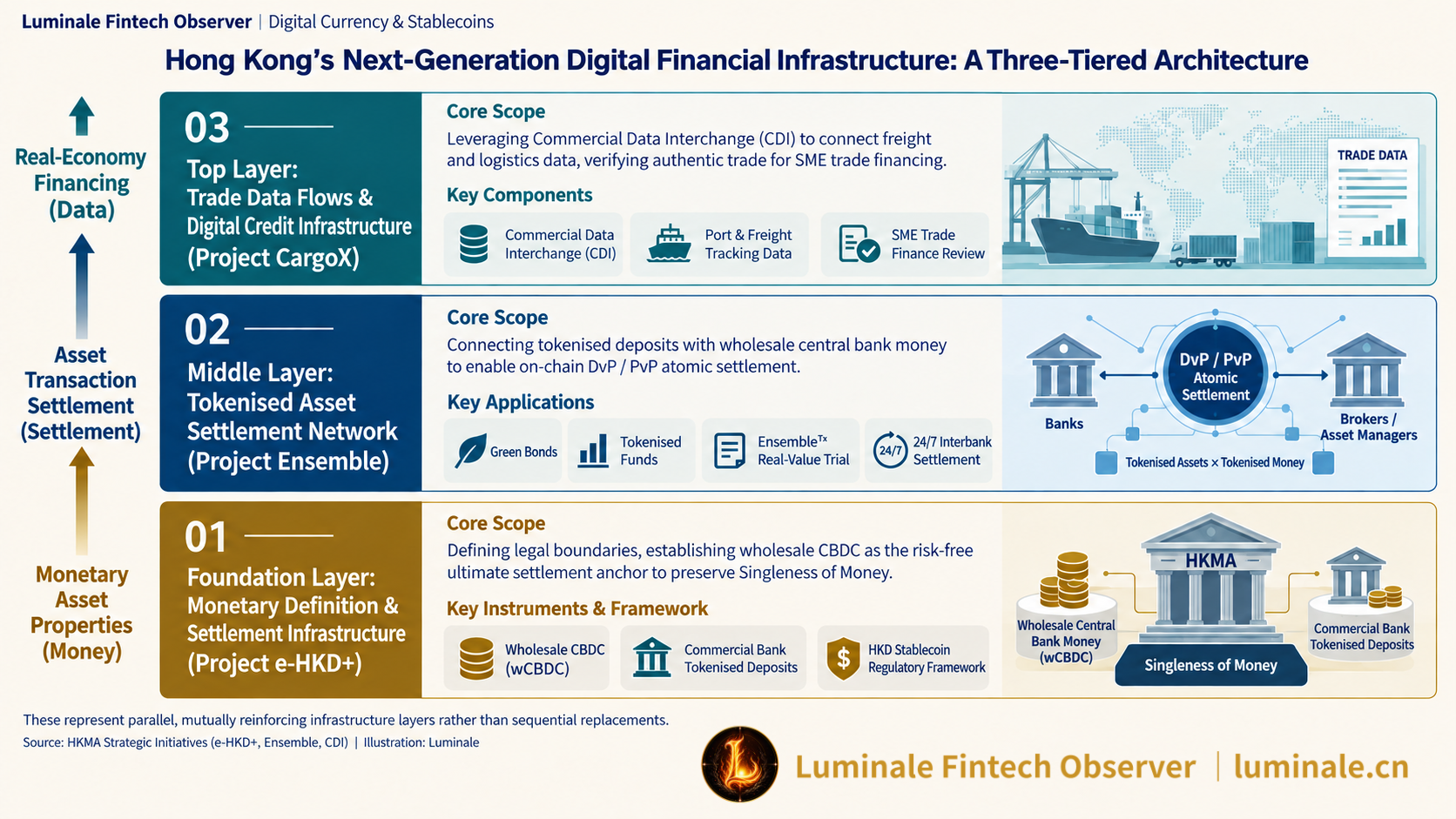
This progression connects directly with two subsequent pillars of Hong Kong's fintech infrastructure: Project Ensemble and Project CargoX.
| Infrastructure Layer | Corresponding Project | Primary Role & Positioning |
|---|---|---|
| Layer 1: Monetary Definition & Liability Tiers | Project e-HKD+ | Clarifying the legal claims, credit tiers, and regulatory boundaries of tokenised deposits, stablecoins, and CBDC |
| Layer 2: Financial Asset Settlement Infrastructure | Project Ensemble / Ensembleᵀˣ | Linking tokenised deposits with wholesale central bank money to enable on-chain DvP / PvP atomic settlement and interbank discharge |
| Layer 3: Real-Economy Trade Data Infrastructure | Project CargoX | Leveraging the Commercial Data Interchange (CDI) to connect authentic logistics and trade data with bank credit underwriting |
1. Project Ensemble and On-Chain Tokenised Asset Settlement
While e-HKD+ established the legal and credit attributes of tokenised money, Project Ensemble, launched in 2024, focuses specifically on solving how tokenised currencies issued by different commercial banks settle across heterogeneous networks alongside tokenised financial assets[4].
Project Ensemble established a sandbox architecture spanning wholesale central bank digital currency (Wholesale Central Bank Digital Currency, wCBDC), commercial bank tokenised deposits, and tokenised real-world assets. In November 2025, the project advanced into its Ensemble Transaction Trial (Ensembleᵀˣ) stage, where participating commercial banks began utilizing real-money balances to pilot interbank tokenised deposit settlement and atomic delivery of fixed-income assets. Under the HKMA's roadmap, 2026 will see extended capabilities supporting 24/7 interbank final settlement powered by tokenised central bank money[5].
Within this framework, commercial bank tokenised deposits serve corporate and institutional clients, while wholesale central bank money operates at the core clearing tier, functioning as the ultimate medium for interbank discharge.
2. Project CargoX: Connecting Trade Finance with Real-Economy Data Flows
Once the settlement foundations for digital money and tokenised assets are established, the next imperative is connecting real-world commercial activity directly into digital credit workflows. This is the precise mandate of Project CargoX.
Project CargoX is not a third phase of e-HKD or CBDC; rather, it is a data infrastructure pilot built upon the Commercial Data Interchange (CDI)[6].
In conventional trade finance, small and medium-sized enterprises (SMEs) routinely face arduous document verification, risks of fraudulent or duplicated bills of lading, and elevated bank underwriting costs. Project CargoX links freight logistics platforms, port authorities, and commercial banking systems. By accessing authorized, immutable cargo tracking milestones and shipping documents, banks can instantly authenticate underlying trade reality, thereby expediting trade finance approvals and liquidity disbursement.
The CargoX pilot launched in May 2026 has attracted 21 commercial banks. Alongside e-HKD and Ensemble, it completes the tripartite architecture of Hong Kong's digital financial ecosystem:
- e-HKD+: Defines the settlement asset forms and liability tiers for the digital asset era;
- Project Ensemble: Constructs the financial market infrastructure linking tokenised assets with digital money;
- Project CargoX: Establishes the data infrastructure connecting real-world trade data to commercial bank credit.
The overarching takeaway from the two-phase e-HKD pilot programme is that the industry has moved past a superficial fixation on consumer-facing retail payment interfaces, arriving at a clearer appreciation of central bank money as the indispensable, risk-free settlement anchor. As bonds, investment funds, and real-world assets increasingly migrate to programmable distributed ledgers, the financial system still fundamentally demands an ultimate settlement medium that all participants accept without hesitation. Hong Kong's strategic pivot toward wholesale infrastructure aligns squarely with the timeless mechanics of two-tier banking and settlement finality.
References
[1]: Hong Kong Monetary Authority, e-HKD Pilot Programme Phase 2 Report, October 2025. https://www.hkma.gov.hk/media/eng/doc/key-functions/financial-infrastructure/e-HKD_Pilot_Programme_Phase_2_Report.pdf ↩
[2]: Hong Kong Monetary Authority, e-HKD: A policy and design perspective, Policy Position Paper, September 2022. https://www.hkma.gov.hk/media/eng/doc/key-information/press-release/2022/20220920e3a1.pdf ↩
[3]: Hong Kong Monetary Authority, e-HKD Pilot Programme Phase 1 Report, October 2023. https://www.hkma.gov.hk/media/eng/doc/key-information/press-release/2023/20231030e3a1.pdf ↩
[4]: Hong Kong Monetary Authority, Project Ensemble: Architecture and Overview of the Wholesale Central Bank Digital Currency Sandbox, March 2024. https://www.hkma.gov.hk/eng/key-functions/international-financial-centre/fintech/project-ensemble/ ↩
[5]: Hong Kong Monetary Authority, Briefing on the Work of the Hong Kong Monetary Authority to the Legislative Council Panel on Financial Affairs, Legislative Council Issues, February 2026. https://www.hkma.gov.hk/media/eng/doc/about-the-hkma/legislative-council-issues/20260202e1.pdf ↩
[6]: Hong Kong Monetary Authority, Commercial Data Interchange (CDI) and Project CargoX Pilot Programme Overview, May 2026. https://cdi.hkma.gov.hk/project-cargox/ ↩
Originally published by Luminale Fintech Observer: https://luminale.cn/articles/e-hkd-pilot-phase-1-and-2-tokenised-settlement-en