When exploring the implementation pathways of Central Bank Digital Currency (CBDC) globally, observers often default to a familiar expectation: an initiative spearheaded by a central bank implies the issuance of a "digital legal cash" accessible directly to general public wallets to replace or supplement physical banknotes.
In the initial stages of its digital currency exploration, the Bank of Korea (BOK) also followed this approach for technical verification. However, as research progressed, the strategic focus of South Korean regulatory and monetary authorities underwent a fundamental pivot. In late 2023, the Bank of Korea, together with the Financial Services Commission (FSC) and the Financial Supervisory Service (FSS), officially launched the Digital Currency Usability Test, subsequently designated as Project Hangang[1].
Project Hangang is not a typical retail central bank digital currency (rCBDC) pilot. In this trial, end-users hold tokenised deposits issued by commercial banks rather than direct liabilities of the Bank of Korea; the institutional digital currency issued by the central bank resides at the underlying tier, dedicated to interbank clearing and settlement.
Following the completion of the Phase 1 live transaction trial from April to June 2025, the Financial Services Commission adjusted its innovative financial service (regulatory sandbox) designations in July 2026, formally initiating the expansion and preparatory phase for Phase 2[2].
The core proposition tested by Project Hangang is: how to map central bank money and commercial bank money onto distributed ledger technology (DLT) and programmable settlement networks without dismantling the modern two-tier banking monetary architecture.
I. Project Hangang Overview
Project Hangang takes its name from the Han River that traverses Seoul, symbolizing the foundational conduit linking the financial ecosystem to the real economy. Understanding this project requires examining its strategic evolution within the central bank's broader R&D trajectory.
The Bank of Korea initiated CBDC technical and legal feasibility studies around 2020, consecutively completing two phases of proof-of-concept (PoC) simulations. Early tests covered classic retail functionalities, including token issuance, distribution, redemption, offline payments, and cross-border remittances. However, test results gradually aligned with observations from the Monetary Authority of Singapore (MAS), the Swiss National Bank (SNB), and the Bank for International Settlements (BIS): in a highly developed economy with pervasive, friction-free instant retail payment rails, direct central bank issuance of peer-to-peer digital cash to the public yields marginal incremental utility while introducing systemic risks of commercial bank disintermediation.
Consequently, Project Hangang shifted South Korea's research orientation from "designing a brand-new sovereign currency medium" toward "constructing a novel digital currency infrastructure tailored to the tokenised economy."
This infrastructure remains anchored in the two-tier monetary system that has underpinned global finance for centuries:
- Tier 1 (Wholesale / Anchor Layer): The central bank issues credit-risk-free central bank money, functioning as the ultimate monetary anchor and final settlement asset for the financial system;
- Tier 2 (Retail / Circulation Layer): Regulated commercial banks issue commercial bank money to enterprises and households, performing credit intermediation, liquidity creation, and day-to-day payment functions.
The innovation of Project Hangang lies in migrating this two-tier monetary framework into a programmable ecosystem built on distributed ledger technology:
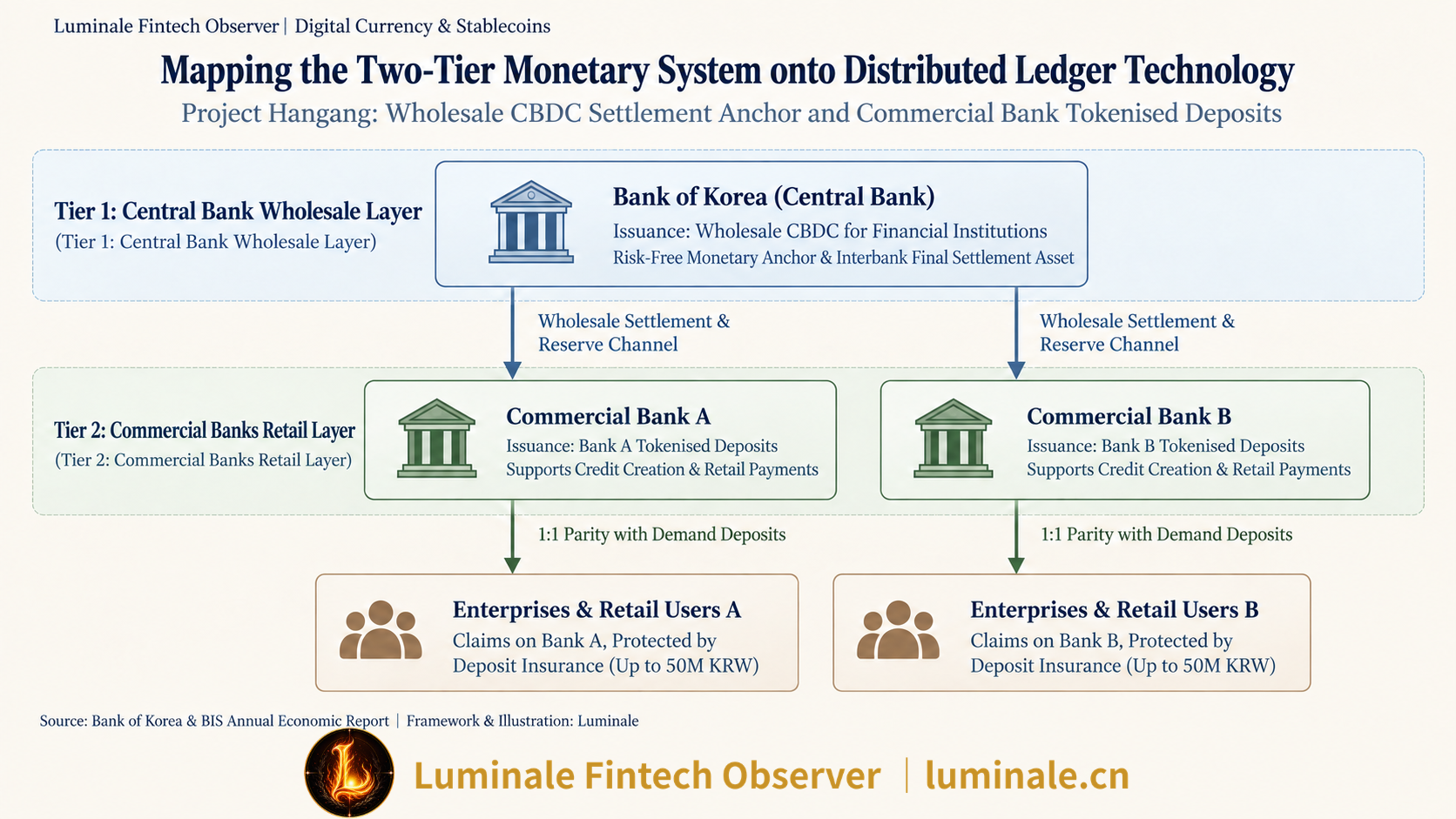
The digital wallets utilized by general consumers in Project Hangang do not hold direct liabilities of the central bank. Instead, they store tokenised deposits minted 1:1 against physical commercial bank deposits. Legally, users retain conventional deposit claims against specific commercial banks, protected by statutory deposit insurance (up to 50 million KRW per depositor per bank) and prudential banking supervision.
Therefore, the essence of Project Hangang is not issuing digital won, but conducting a controlled experiment in commercial bank deposit tokenisation within a sovereign credit framework.
II. System Architecture and Operational Mechanics
Prior to Project Hangang, private stablecoins in the crypto-asset market demonstrated the advantages of peer-to-peer circulation and automated smart contract execution. However, their private issuance, heterogeneous reserve asset quality, and run risks render them unsuitable as primary monetary anchors or core financial market infrastructures.
The solution formulated by the Bank of Korea in collaboration with the BIS integrates wholesale CBDC (wCBDC) and commercial bank tokenised deposits into a regulated unified ledger environment[3].
1. Core Digital Asset Components
The network primarily supports three categories of digital tokens:
- Wholesale CBDC: Settlement tokens issued by the Bank of Korea strictly to eligible participating financial institutions, serving as the ultimate interbank settlement asset when tokenised deposit obligations are discharged across banks; closed to the general public;
- Tokenised Deposits: Digital claims issued by commercial banks to retail customers backed by traditional demand deposits. Holders can convert these tokens 1:1 back and forth with conventional KRW demand deposits at any time;
- Digital Voucher Tokens: Purpose-bound programmable tokens embedded with conditional rules (such as time limits, merchant category restrictions, or designated public subsidy uses), established by government agencies or corporate entities via participating bank liquidity pools.
2. The Interbank "Burn-and-Issue" Settlement Mechanism
Conventional blockchain architectures often assume that a token is simply transferred directly from a payer's wallet to a payee's wallet. However, commercial bank money represents the private liability of an individual licensed banking institution. Bank A's deposit token cannot simply become Bank B's asset or liability. Permitting Bank A's tokens to circulate directly into Bank B customer wallets would force Bank B to accept uncollateralized credit exposure to Bank A. This would breach balance sheet separation across institutions, create price divergence among bank tokens, and ultimately compromise the singleness of money.
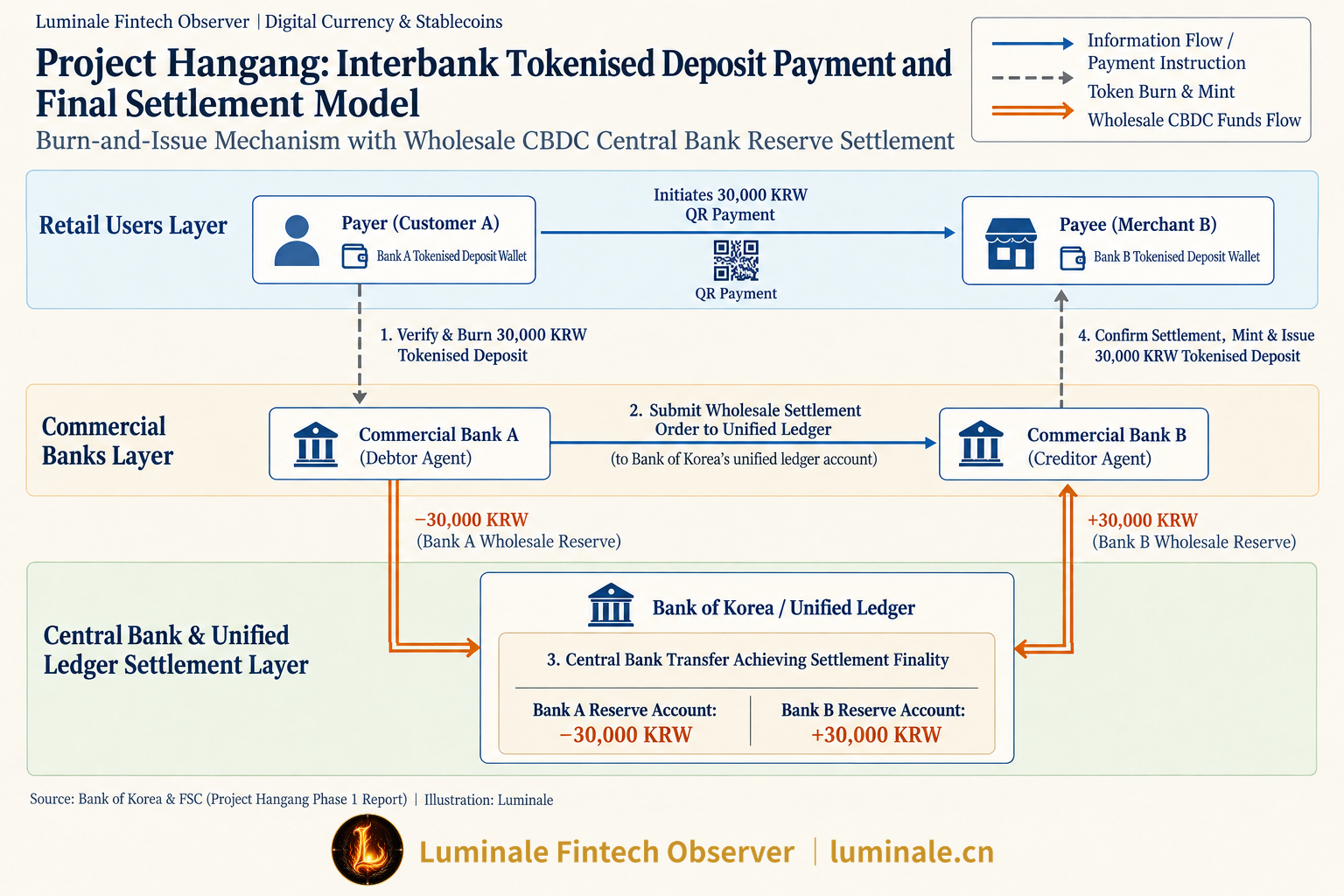
Within the analytical framework of financial infrastructure, Project Hangang maintains the division of labor found in modern clearing and settlement: it accomplishes interbank par-value transfer via a burn-and-issue mechanism synchronized with central bank reserve settlement.
Suppose Customer A (banking with Commercial Bank A) uses the Project Hangang wallet to pay 30,000 KRW to Merchant B (banking with Commercial Bank B) for goods. The corresponding balance sheet adjustments across the system proceed as follows:
| Institutional Entity | Asset Changes | Liability Changes | Description |
|---|---|---|---|
| Commercial Bank A | Central Bank Settlement Reserves −30,000 KRW | Customer A Tokenised Deposits −30,000 KRW (Burned on-chain) | Bank A liability to Customer A extinguished; equivalent central bank settlement assets transferred out |
| Commercial Bank B | Central Bank Settlement Reserves +30,000 KRW | Merchant B Tokenised Deposits +30,000 KRW (Minted on-chain) | Bank B receives central bank settlement assets; creates equivalent tokenised deposit liability to Merchant B |
| Bank of Korea | No net change (Total reserves unchanged) | Bank A Wholesale Account −30,000 KRW Bank B Wholesale Account +30,000 KRW | Central bank liabilities shifted between Bank A and Bank B, achieving interbank final settlement |
III. Phase 1 Live Transaction Verification
From April 1 to June 30, 2025, the Bank of Korea, the Financial Services Commission, and the Financial Supervisory Service conducted a three-month live transaction pilot for Project Hangang (Phase 1)[1]. This represented one of the earliest public live-environment trials by a major economy integrating wholesale CBDC with tokenised deposits.
1. Participating Institutions and Sandbox Perimeter
Seven commercial banks participated in the issuance and testing:
- KB Kookmin Bank
- Shinhan Bank
- Woori Bank
- Hana Bank
- Industrial Bank of Korea (IBK)
- NH NongHyup Bank
- BNK Busan Bank
Operating under a regulatory sandbox perimeter, the trial initially set an enrollment ceiling of 100,000 retail participants, who opened designated custodial wallets through their respective banking mobile apps.
2. Four Core Evaluation Dimensions
Phase 1 evaluated system performance across four key dimensions:
- On/Off-Ramping and Deposit Conversion: Verified real-time 1:1 bidirectional conversion between traditional demand deposits and tokenised deposits. When users top up wallets, banks hold the corresponding demand deposits and mint equivalent tokens; on redemption, tokens are burned and bank deposits released.
- Retail Merchant Acceptance: Deployed QR-code payment acceptance across convenience stores, coffee franchises, university bookstores, and selected e-commerce platforms to evaluate transaction throughput and ledger consistency under multi-bank concurrency.
- Interbank Parity and Interoperability: Confirmed that consumers holding tokenised deposits from different banks could pay any participating merchant seamlessly, triggering the underlying "burn-wholesale settlement-mint" workflow at an invariant 1:1 par value.
- Programmable Digital Vouchers: Integrated smart contracts into public expenditure disbursement. In programs such as the Seoul Youth Culture Pass, Daegu Childcare Grants, and Silla University student stipends, public entities disbursed programmable vouchers instead of unrestricted cash. Smart contracts enforced eligible merchant categories, verified vendor whitelists, and applied spending expiration dates.
3. Demonstrating the Value of Programmability
In conventional public grant programs, disbursements often encounter administrative overhead, delayed audits, and fund misallocation. Traditional workflows require "advance disbursement → dispersed spending → physical receipt submission → manual retrospective audits."
Project Hangang transformed retrospective audits into inline compliance verification: transactions attempted at non-eligible merchant categories are automatically rejected on-chain, while compliant transactions settle instantly without requiring merchants to submit paper claims to municipal authorities. This validated the operational utility of programmable money in targeted disbursement.
IV. Phase 1 Findings: Proven Feasibility, Unresolved Commercial Viability
The Phase 1 evaluation report published by the Bank of Korea and the FSC confirmed engineering and architectural viability while highlighting distinct user experience and commercial adoption headwinds[1].
1. Verified Structural Strengths
- Viability of the Two-Tier Model on DLT: The trial confirmed that the traditional division—central bank as settlement anchor, commercial banks as customer-facing intermediaries—can operate effectively on distributed ledgers without bypassing the banking system.
- Settlement Alongside Payment: Unlike retail clearing systems that rely on deferred net settlement, pairing retail tokenised deposits with wholesale CBDC enables instantaneous gross finality at the central bank tier, substantially mitigating intraday interbank credit exposures.
- Potential for Fee and Settlement Compression: By disintermediating multi-layered card scheme networks (issuers, acquirers, card schemes), tokenised deposits provide real-time funds availability to merchants, creating theoretical headroom to lower payment processing costs.
2. Operational Friction and Institutional Challenges
- Authentication Friction: Strict compliance with Know Your Customer (KYC) and Anti-Money Laundering (AML) standards introduced multi-step verification during wallet onboarding and transactions, resulting in a user experience less frictionless than established commercial wallets such as Kakao Pay or Naver Pay.
- Liquidity Inflexibility: In Phase 1, the token wallet functioned as a segregated pre-funded balance. When a transaction exceeded wallet funds, the system could not automatically debit the shortfall from the linked bank deposit account, leading to transaction declines and user drop-off.
- Voucher Utilization Constraints: Narrow merchant category restrictions and rigid voucher expiration windows, coupled with limited public familiarity, resulted in lower-than-projected voucher utilization rates.
- Unsettled Legal and Regulatory Classification: Operating under a sandbox designation deferred statutory conflicts. Prior to full-scale commercialization, policymakers must clarify under the Bank of Korea Act and the Banking Act whether tokenised deposits constitute conventional electronic demand deposits or a novel category of cryptographic payment instruments, alongside statutory reserve requirements and bankruptcy remoteness safeguards.
V. Phase 2: Advancing from Controlled Sandbox to Functional Maturity
To address the bottlenecks identified in Phase 1, the Financial Services Commission approved the regulatory sandbox modification for Project Hangang Phase 2 on July 15, 2026, defining the operational framework for the next testing stage[2].
1. Institutional Expansion and Scaled Enrollment
Building upon the initial 7 nationwide commercial banks, Phase 2 incorporates two regional financial institutions:
- BNK Kyongnam Bank
- iM Bank (formerly DGB Daegu Bank)
The enrollment ceiling has been expanded fivefold, from 100,000 to 500,000 participants, providing a larger sample size for stress testing and payment velocity analysis.
2. Feature Enhancements and User Experience Upgrades
According to regulatory filings, Phase 2 introduces four functional upgrades:
- Peer-to-Peer (P2P) Fund Transfers: Moving beyond the merchant-only purchase scope of Phase 1, Phase 2 activates direct account-to-account and wallet-to-wallet P2P transfers, bringing tokenised deposits closer to the full liquidity of ordinary bank money;
- Automated Account Sweep (Auto Top-up): Introducing auto-replenishment from linked demand deposit accounts. When transaction amounts exceed token balances, authorized sweeps automatically convert deposit balances into tokens to prevent payment failures;
- Elevated Transaction and Balance Limits: Increasing daily holding and transaction ceilings for corporate users, high-volume merchants, and frequent transactors to assess stability under higher liquidity velocity;
- Biometric and Streamlined Authentication: Integrating fingerprint and facial recognition modules to streamline payment authorization while satisfying security protocols.
3. Government Treasury and Public Fund Management
The Bank of Korea's 2026 operational agenda specifies extending Phase 2 into Government Treasury Fund disbursements and public project settlements[4].
By converting public procurement and fiscal allocations into programmable tokens with verifiable milestones, authorities aim to evaluate whether automated fund release can prevent fund diversion and delayed payments across multi-tiered public construction and research grant supply chains.
VI. Comparative Architecture: Retail CBDC, Tokenised Deposits, and Stablecoins
Across the global digital currency landscape, jurisdictions and market participants have pursued three divergent architectural pathways.
| Dimension | Retail CBDC | Tokenised Deposits (Project Hangang) | Fiat-backed Stablecoins |
|---|---|---|---|
| Ultimate Liability | Central Bank | Commercial Banks (Individual licensed banks) | Private Issuers (Non-bank entities like Tether, Circle) |
| Legal Nature | Sovereign digital currency, statutory legal tender | Digital claim on commercial bank demand deposits | Contractual liability / token redemption claim |
| Settlement Asset | Central bank liability, no inter-entity settlement required | Interbank settlement via Wholesale CBDC / Central Bank Reserves | On-chain token transfer; reserve backing held in commercial bank accounts |
| Deposit Insurance | Not applicable (zero sovereign default risk) | Covered by statutory deposit insurance (up to 50M KRW cap) | Not eligible for statutory deposit insurance; reliant on reserve audit transparency |
| Banking Impact | Risks deposit disintermediation and bank balance sheet contraction | Retains funds within banking balance sheets; preserves credit creation | Diverts bank demand deposits into private reserve pools |
| Programmability Scope | Governed by central bank mandate and statutory privacy rules | Banks can program tailored credit, escrow, and wealth management contracts | Highly programmable on open chains, but faces compliance and regulatory scrutiny |
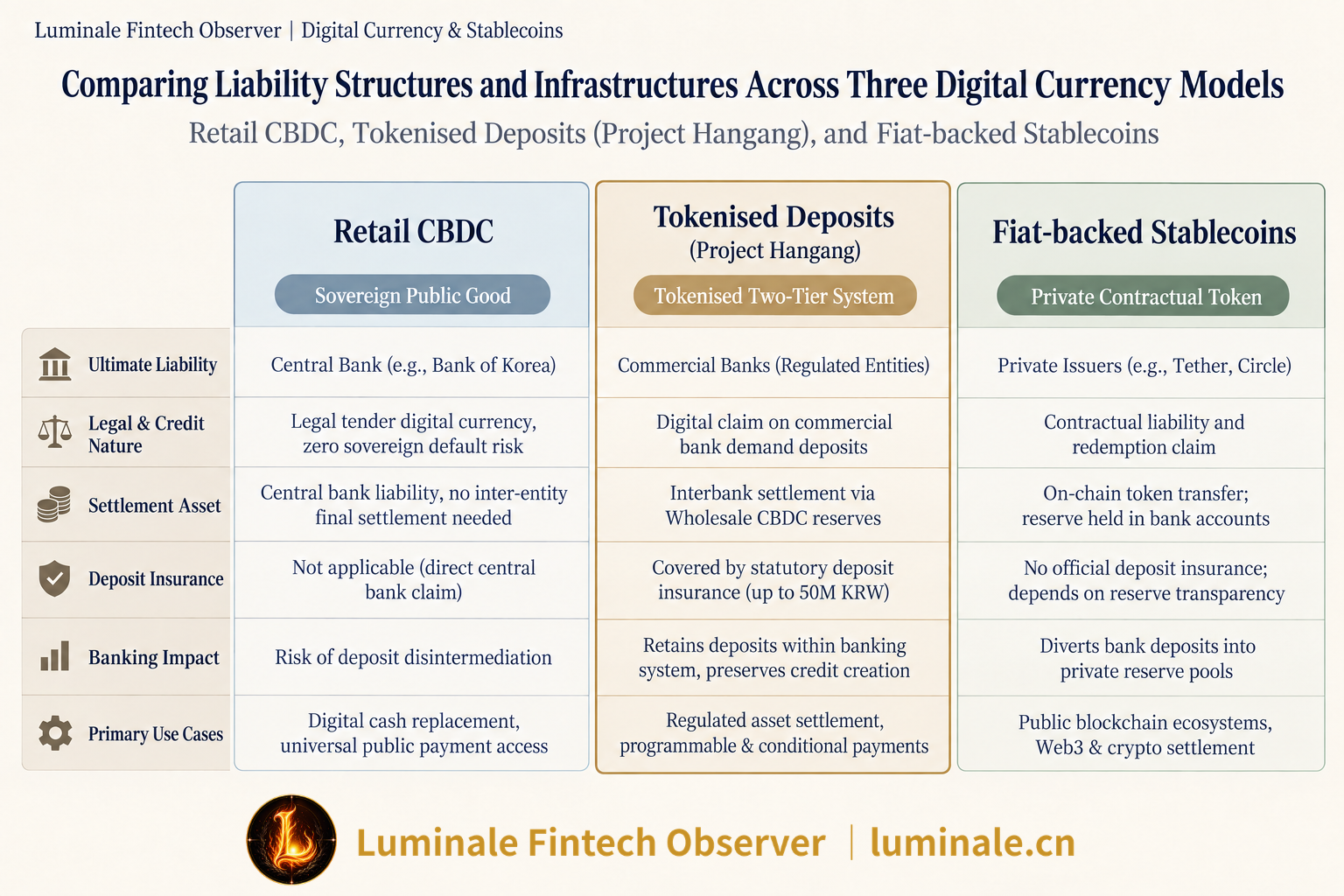
This comparison highlights the core institutional distinctions:
- Retail CBDC focuses on digitizing sovereign public money to ensure universal access to risk-free central bank money in a cashless economy. In mature financial systems, however, an unconstrained retail CBDC risks disintermediating the commercial banking sector.
- Stablecoins prioritize high-velocity liquidity across open networks and digital asset markets. While minimizing transactional friction, they operate outside central bank lender-of-last-resort frameworks and remain susceptible to procyclical run dynamics.
- The Tokenised Deposit Pathway (Project Hangang) represents an institutional evolution balancing stability with programmability. It preserves the fractional-reserve banking mechanism, maintains credit intermediation, and safeguards statutory deposit protection, while deploying wholesale CBDC as an interbank settlement anchor to connect with programmable distributed ledger ecosystems.
Conclusion
The enduring significance of Project Hangang lies not in whether the Bank of Korea will shortly debut a retail digital won, but in demonstrating how the traditional two-tier banking architecture can transition to distributed ledgers.
As real-world asset (RWA) tokenisation, supply-chain finance integration, and automated machine-to-machine payments expand, demand for instantaneous settlement and programmable conditions will intensify. If regulated commercial bank money cannot offer on-chain capabilities, private stablecoins will step in to capture this transactional liquidity.
The trajectory pursued by South Korea through Project Hangang maintains the central bank's role as the ultimate settlement anchor while retaining commercial banks as the primary credit and account intermediaries, organizing both within a unified ledger network.
From testing two-tier mechanics and conditional vouchers in Phase 1 to expanding P2P transfers, automated top-ups, and treasury management in Phase 2, this experiment provides an empirical reference for the technical feasibility and institutional boundaries of deposit tokenisation.
References
[1]: Bank of Korea (BOK), Financial Services Commission (FSC), Financial Supervisory Service (FSS): Project Hangang: Live Pilot of a Unified Ledger Integrating Wholesale CBDCs and Tokenized Deposits (Phase 1), October 2025. https://www.bok.or.kr/eng/bbs/E0000654/view.do?menuNo=400048&nttId=10095216 ↩
[2]: Financial Services Commission (FSC): Announcement on Innovative Financial Service Designation and Sandbox Revision for Project Hangang Phase II, July 15, 2026. https://www.fsc.go.kr/no010101/87338 ↩
[3]: Bank for International Settlements (BIS): Blueprint for the future monetary system: improving the old, enabling the new, BIS Annual Economic Report 2023, Chapter III, June 2023. https://www.bis.org/publ/arpdf/ar2023e3.htm ↩
[4]: Bank of Korea (BOK): Payment and Settlement Systems Report 2025, English Edition published in September 2026. https://www.bok.or.kr/portal/bbs/E0000866/view.do?menuNo=400223&nttId=11064840 ↩
Originally published by Luminale Fintech Observer: https://luminale.cn/articles/south-korea-cbdc-experiment-project-hangang-en