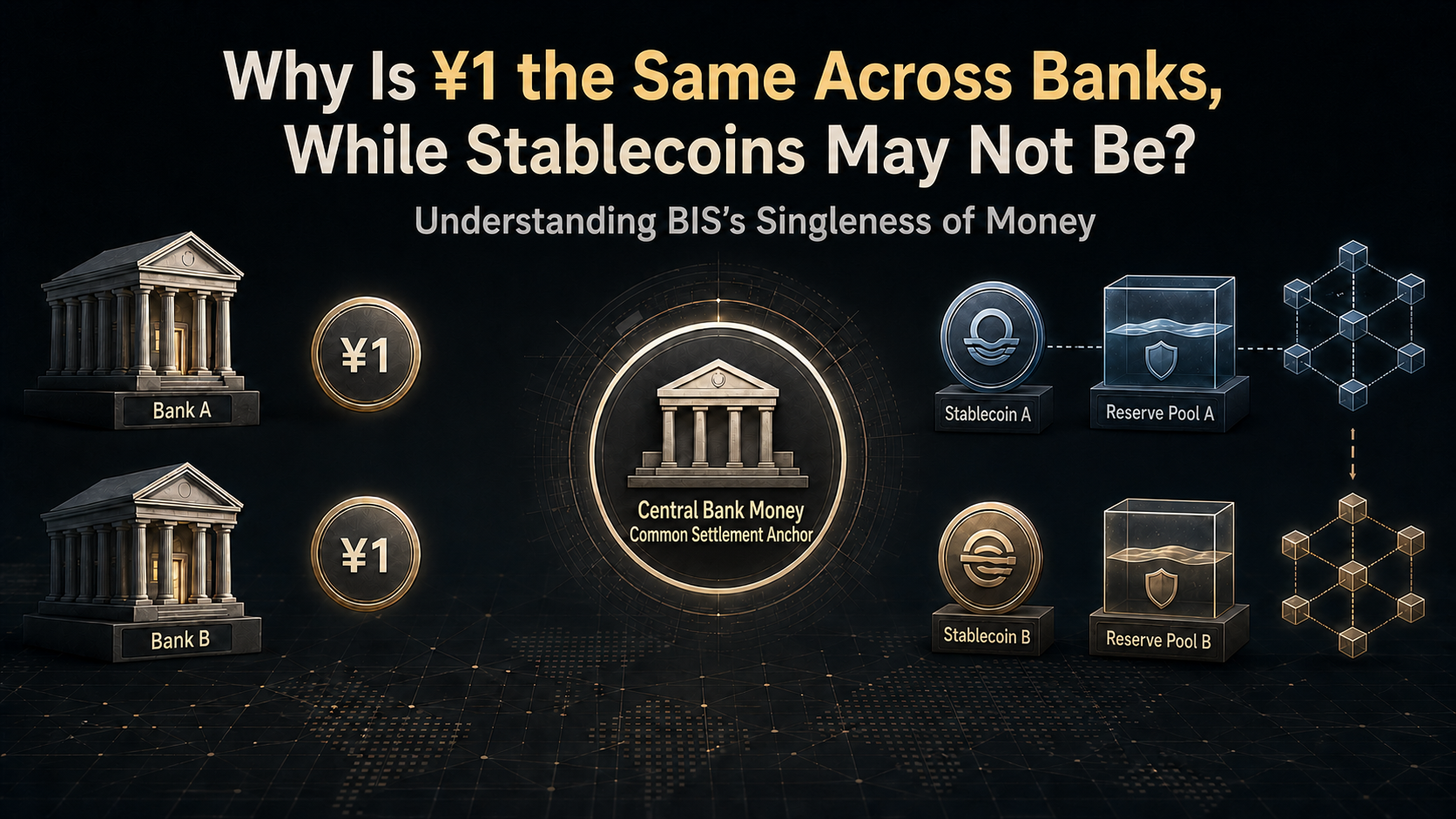
You have 100 yuan on deposit at ICBC and transfer 100 yuan to a friend who banks with China Merchants Bank. When your friend receives the money, they normally will not ask: is this renminbi issued by ICBC or by China Merchants Bank? Could 100 yuan at CMB be worth less than 100 yuan at ICBC?
In everyday payments, people assume that one yuan from any bank is fully equivalent. The assumption feels ordinary, yet an entire institutional framework stands behind it.
In legal terms and on the balance sheet, a deposit at ICBC and a deposit at China Merchants Bank are not the same liability. Each bank owes its own depositors, and banks differ in asset quality, liquidity, and operating risk. The modern monetary system still allows these deposits to circulate at face value under normal conditions, so ordinary users do not have to assess a bank's creditworthiness before every payment.
That is exactly the trust the Bank for International Settlements (BIS) examines in Chapter 3 of its 2026 Annual Economic Report, "Anchoring trust in money: innovation beyond stablecoins": how such trust forms, and how it can be maintained once money goes digital. The report first sets out the attributes a sound monetary system needs, then analyzes the design of today's stablecoins, the operating conditions of public permissionless blockchains, and the macro-financial implications if stablecoins were widely used. It closes with two policy directions: improve the regulation and redemption arrangements of stablecoins, and bring tokenization into a two-tier monetary system anchored in central bank money. BIS 2026 Annual Economic Report, Chapter 3
This article does not restate the report page by page, and it does not discuss how stablecoins are issued or how they hold their value. It focuses on one concept: the singleness of money. That concept explains why one yuan from different banks stays 1:1, and it gives us a sharper yardstick for comparing bank deposits, stablecoins, and tokenized deposits.
1. What is the singleness of money?
In its 2026 report, the BIS distills the foundation of an effective monetary system into two elements.
Economic agents use one shared unit of account to express prices, contracts, and balance sheets. Monetary claims denominated in that unit can be converted into central bank money at face value, with finality. The second element is the singleness of money. BIS on the attributes of money
Conversion at face value means that a 1-yuan deposit at Bank A, a 1-yuan deposit at Bank B, and 1 yuan of central bank money all settle as 1 yuan. No exchange rate is needed between different issuers.
The singleness of money and price stability answer different questions.
| Concept | Question it addresses | Example |
|---|---|---|
| Price stability | How the purchasing power of one unit of money changes over time | What 100 yuan buys this year versus next year |
| Fixed price or peg | Whether an asset's market price can stay close to a reference asset | Whether 1 stablecoin can hold near 1 US dollar |
| Singleness of money | Whether different forms of money settle at par, at the same moment, under the same unit of account | Can 100 yuan on deposit at Bank A transfer as 100 yuan at Bank B |
A currency can have low inflation while deposits across banks still fail to exchange at par. A stablecoin can hover near 1 USD most of the time yet have no arrangement for par settlement across issuers and networks.
The singleness of money also includes finality. Finality carries a legal and institutional meaning: once a settlement is completed under the applicable rules, the obligation is discharged and cannot be unwound just because some intermediate participant later fails.
A transaction being written into a block and receiving a number of confirmations only means the network state has reached some degree of technical certainty. It does not automatically answer whether the holder can obtain a bank deposit of the same face value, and it does not say what asset clears debts between different issuers.
The BIS attaches great importance to money being accepted no questions asked. The recipient does not need to investigate the credit quality of the payment instrument, or work out which sound bank the yuan came from, before deciding whether to take it at a discount.
This no questions asked concern covers only the credit assessment of the money instrument. Banks and payment institutions still verify customer identities and monitor suspicious transactions. The BIS files those requirements under financial integrity: the institutional capacity to fight money laundering, terrorist financing, and other illicit activity.
The 2025 Annual Economic Report compared stablecoins with the future monetary system using three criteria: singleness of money, elasticity, and financial integrity. The 2026 report adds a shared unit of account, interoperability, and finality, placing these attributes inside the institutional framework of trust in money. BIS 2025 Annual Economic Report, Chapter 3
2. How deposits at different banks achieve 1:1 convertibility
Bank deposits are each bank's own liability
A bank deposit is not a stack of cash the bank keeps in safe custody for one customer. The balance in a customer's account records how much the bank owes that customer, which is why it sits on the liability side of the bank's balance sheet.
A simplified bank balance sheet looks like this:
| Assets | Liabilities and equity |
|---|---|
| Central bank reserves | Customer deposits |
| Loans extended | Bank borrowings |
| Bonds and other holdings | Shareholders'equity |
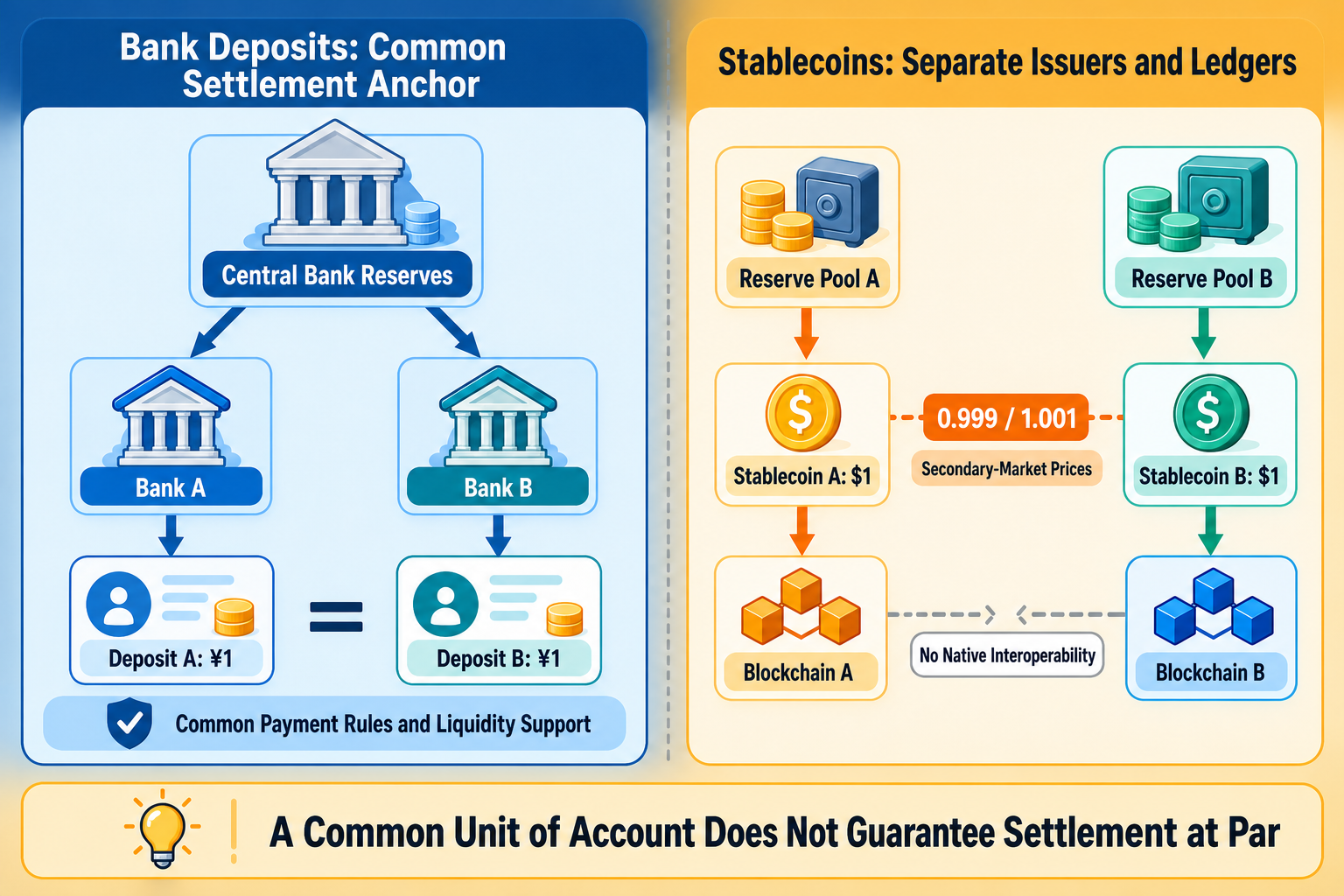
Suppose Zhang San has a 100-yuan deposit at Bank A: that 100 yuan is Bank A's liability to Zhang San. Li Si's 100-yuan balance at Bank B is Bank B's liability to Li Si. The two deposits use the same renminbi unit of account, but the issuers, and the balance sheets behind them, are not the same.
Banks do not park every customer deposit untouched in a reserve account either. There is no one-to-one mapping between individual deposits and specific assets. A bank holds reserves, loans, bonds, and other assets, and earns returns and liquidity through them.
The everyday claim that "banks lend out your deposits" is only a simplification. When a bank issues a loan, it typically creates a loan asset and a matching deposit liability for the borrower at the same time. Banks can therefore create deposits by lending, subject to capital, liquidity, risk-management, and monetary-policy constraints.
So a 100-yuan deposit at a given bank does not have 100 yuan of reserves sitting behind it, line by line, waiting to be redeemed. Even so, deposits at different banks still transfer at face value under normal conditions.
Interbank payments move central bank reserves
When Zhang San transfers 100 yuan from Bank A to Li Si at Bank B, the banking system changes as follows:
| Participant | Customer deposit liability | Central bank reserves |
|---|---|---|
| Bank A | −100 yuan | −100 yuan |
| Bank B | +100 yuan | +100 yuan |
Bank A reduces its deposit liability to Zhang San and transfers 100 yuan of reserves to Bank B. Bank B, having received the reserves, increases its deposit liability to Li Si. Assuming no fees or other ancillary transactions, the two banks'assets and liabilities change in step.
What the customer sees is 100 yuan moving from one account to another. What the back office processes are changes in the liabilities of two private institutions and a transfer of central bank reserves.
Deposits at different banks do not need a secondary market to discover their exchange rate against each other, because they attach to the same settlement layer. Eligible banks hold accounts at the central bank and settle with each other using reserves. Reserves sit on the central bank's balance sheet and are the settlement asset the banking system accepts in common.
Liquidity, regulation, and deposit protection sustain the 1:1 together
Access to a central bank account, by itself, is not enough to maintain the singleness of money.
Tax deadlines, month-ends, quarter-ends, or market stress can all leave banks suddenly needing more settlement balances. If the supply of reserves is too rigid, banks may delay payments simply because they temporarily lack settlement liquidity, and liquidity problems can spread to other institutions.
Within its policy and risk-management requirements, the central bank can provide intraday credit, standing facilities, or a liquidity backstop in stressed times. The BIS calls the system's ability to supply liquidity in line with payment needs elasticity.
Bank regulation also plays its part. Capital and liquidity requirements curb excessive risk-taking; deposit insurance protects depositors up to a limit; resolution regimes for failing banks limit how bankruptcies disrupt payments; and payment system rules define access, operations, and final settlement terms.
The 1:1 convertibility between deposits at different banks therefore rests on an institutional package:
- Banks settle with each other in central bank money;
- The central bank supplies elasticity to the system's liquidity under set institutional arrangements;
- Banks are bound by capital, liquidity, and risk-management requirements;
- Deposit insurance and resolution regimes soften the impact of credit events;
- Payment systems connect different banks under common rules.
These mechanisms largely screen out credit differences between banks. Consumers do not need to check the paying bank's capital adequacy ratio before accepting a payment, nor price deposits at different banks differently.
But the BIS also notes that although the singleness of money narrows credit differences in everyday payments, it does not mean every bank liability is free of risk under all circumstances.
3. Why one dollar of one stablecoin may not equal one dollar of another
Fiat-backed stablecoins also use sovereign currencies such as the US dollar or the euro as their unit of account. Issuers typically hold bank deposits, short-term Treasuries, repo assets, or other reserves, and promise redemption under defined conditions.
The analysis in Section 2 shows why that is not enough: although stablecoins all quote in dollars, they do not automatically produce the singleness of money. Compared with the banking system, stablecoin arrangements differ in how claims transfer, what settles between institutions, how holders redeem, where liquidity comes from, and how networks are structured.
Transferring a stablecoin transfers a claim on the same issuer
In an interbank transfer, the sender's deposit at their bank shrinks, the recipient gets a new deposit at their own bank, and the two banks settle with central bank reserves.
A stablecoin behaves more like a digitized bearer instrument. If User X sends Stablecoin A to User Y, Y receives a claim on the issuer of Stablecoin A. The issuer's liability simply moves from one holder to another; no central bank money settles in the background with each on-chain transfer.
In a 2023 BIS Bulletin, Garratt and Shin compared stablecoins with tokenized deposits. A stablecoin circulates as a transferable claim on its issuer; a tokenized deposit can follow the banking convention, with the paying bank extinguishing the customer liability, the receiving bank creating a new one, and tokenized central bank money moving at the same time. Stablecoins versus tokenised deposits
Even if Stablecoin A and Stablecoin B are both labeled 1 USD, their holders own claims on two different issuers. Once reserve quality, redemption terms, operational risk, or market liquidity differ, the two tokens can trade at different prices.
The 1:1 redemption promise comes with conditions
The issuer's promise to redeem at 1 USD is a key condition for a stablecoin to hold its price. Whether holders can actually exercise that right depends on the specifics:
- Who may redeem directly with the issuer;
- Whether there is a minimum redemption amount;
- How long redemption takes;
- Whether the holder needs a qualified bank account;
- Whether reserve assets can be liquidated in time;
- Whether redemption fees, caps, or suspensions kick in during stress;
- Whether the issuer has access to intraday liquidity or other backstops.
Ordinary users may only be able to sell their stablecoins on an exchange or another secondary market, where the price reflects redemption costs, issuer credit, reserve liquidity, and market sentiment. If confidence in an issuer shifts, Stablecoin A might trade at $0.999 while Stablecoin B trades at $1.001, and under liquidity stress the gap can widen further.
The deeper point is this: even if an issuer's reserves exactly match its stablecoin liabilities, stablecoins across issuers have no common clearing mechanism. Short-term Treasuries may be highly liquid, high-quality assets, but they do not serve as the settlement asset in trades between different stablecoin issuers. In stressed markets, selling reserves is itself subject to market depth, execution time, and price moves.
Fast issuance is not elasticity
A stablecoin issuer can mint new tokens quickly once the funds arrive. That speed is not what the BIS means by elasticity.
Most fiat-backed stablecoins follow a pay-first, issue-later model: creating 1 new dollar of stablecoin usually requires taking in 1 dollar of funding and deploying matching reserves first. When the market suddenly needs far more payment liquidity, issuers have no inherent right to intraday central bank credit or lender-of-last-resort support.
The banking system, by contrast, can create deposits through lending within regulatory limits, and the central bank can provide final settlement liquidity. What the BIS cares about is whether the system as a whole can supply enough funding, at a particular time and place and under stress, for payments to complete. Fully pre-funded reserves reduce some risks in the stablecoin model, but they also limit the system's ability to expand settlement balances on demand.
Multiple blockchains bring new fragmentation
Graph 3 of the 2026 report pushes the problem down to the network layer. The same stablecoin can exist on Ethereum, Tron, Solana, and other chains. The name and issuer may be identical, but the tokens are recorded on ledgers that cannot natively communicate with one another.
Moving from one chain to another requires a bridge, native multi-chain issuance, or an interoperability protocol. Each arrangement carries its own smart contracts, validation methods, and governance rules, and can introduce risks of delay, attacks, mis-issuance, locked assets, and distorted data feeds.
The BIS notes that a given stablecoin on Ethereum is not natively equivalent to the same-named stablecoin on Solana. Without a clearing and settlement system recognized across ledgers, this fragmentation weakens the singleness of money. BIS 2026 report on cross-chain fragmentation
On-chain stablecoin transfers may achieve a form of technical or legal finality, but that finality is confined to a state change of a specific token on a specific network. It does not make stablecoins of different issuers exchangeable at par automatically, and it does not provide a common central bank money settlement layer across multiple ledgers.
Putting the institutional differences side by side, the contrast between bank deposits and today's stablecoin systems becomes clear:
| Comparison | Commercial bank deposits | Today's fiat-backed stablecoins |
|---|---|---|
| Claim held by the user | Direct claim on the account-holding bank | Claim on a specific stablecoin issuer, or a redemption arrangement with them |
| Payment across institutions | Paying bank reduces its liability; receiving bank increases its liability | Tokens of the same issuer move between holders |
| Inter-institution settlement | Usually settled with central bank reserves | On-chain transfers generally do not settle on a central bank balance sheet |
| Face-value relationship | Maintained by a common settlement layer and supporting institutions | Relies on issuer reserves, redemption, and secondary-market liquidity |
| Source of liquidity | Bank credit creation plus central bank liquidity facilities | Constrained mainly by the pre-funding model and reserve-asset liquidity |
| Cross-platform connection | Linked by payment system rules and a common settlement asset | Fragmented across multiple chains, dependent on bridges and interoperability protocols |
| Financial integrity | Customers onboarded and continuously monitored by regulated intermediaries | Public permissionless networks and self-custody wallets raise the compliance difficulty across parties |
4. Does the report mean the BIS is against stablecoins?
Judging by the report's content, the answer is no.
The BIS acknowledges what stablecoins demonstrate about tokenization: programmable payments, round-the-clock operation, digital asset trading, and cross-border value transfer. The report does not say stablecoins can never become money. It asks where current designs fall short, and how different designs give stablecoins different monetary properties.
The 2026 report places stablecoins on a spectrum of designs. One end holds payment-type money stablecoins: they need to redeem at par across all market conditions, backed by low-risk reserves, intraday liquidity, and a credible backstop. The other end shades toward investment products, where price deviation, redemption restrictions, and liquidity-management tools are acceptable.
Where a given stablecoin sits on that spectrum depends on its reserve composition, redemption terms, access to a central bank account or backstop, and its regulatory regime. BIS on the stablecoin design spectrum
The near-term policy directions the BIS proposes include capital and liquidity requirements for issuers, protection of stablecoin holders, better disclosure and resolution regimes, and exploring, under strict conditions, whether stablecoin arrangements could access central bank liquidity. These recommendations show that the BIS leaves room for improved stablecoins.
Its policy preference is equally clear: tokenization can keep developing, but the future monetary system should still anchor common settlement in central bank money.
Central banks could provide tokenized reserves, or let programmable platforms connect synchronously to existing reserve accounts. Above that settlement layer, tokenized commercial bank deposits, appropriately designed and regulated private money, and tokenized assets could trade in the same environment.
The unified ledger the BIS describes is not one single blockchain. It is the capability to bring many tokenized monies and assets into the same venue, possibly composed of several fully interoperable ledgers, with unified settlement relationships, governance rules, and legal finality. BIS on the two-tier system and the unified ledger
Project Agorá offers an example. Its prototype involves eight central banks and more than forty regulated institutions, using a shared platform to connect tokenized commercial bank deposits with tokenized central bank reserves across different jurisdictions. Once validation completes and the required balances are locked, a transaction can settle cross-currency atomically, all-or-nothing, while each jurisdiction keeps control over its own reserves. BIS 2026 report and press release
In this framework, a tokenized deposit's standing does not depend on the issuer simply being a bank. It preserves the customer's direct claim on a bank, interbank payments still connect to central bank money settlement, and it sits inside bank regulation, liquidity support, and customer identification regimes. The technology changes how deposits are recorded and executed; it does not sever the institutional relationships that maintain the singleness of money.
So the report expresses an institutional judgment. The BIS accepts the new functions tokenization brings, and accepts that the private sector will keep issuing and operating money. What it requires is that these money forms answer a few old questions: how do you redeem at par, how do you achieve settlement finality, how do you replenish liquidity under stress, and how do you maintain financial integrity?
5. In closing
We use bank deposits every day and rarely feel the credit differences between banks. A shared unit of account, central bank money settlement, liquidity support, bank regulation, deposit protection, and payment system rules hold private monies issued by different institutions on the same scale of value.
Stablecoins make this usually invisible institutional scaffolding visible again. Where multiple issuers and multiple networks lack a common settlement asset, a source of liquidity, and interoperability rules, the market still has to judge what each stablecoin is worth and whether it can be smoothly exchanged back into banking money.
In my view, competition among future digital monetary systems will move increasingly deep into the settlement layer.
Blockchain performance, wallet experience, and user scale still matter: they determine whether a product is convenient to use. The settlement layer determines whether the product can carry monetary functions at scale. Who provides the final settlement asset, who supplies liquidity under stress, who maintains the face-value relationship between different private monies. These questions do not disappear just because payments move onto a blockchain.
The closer a stablecoin comes to being a broadly used payment currency, the more it needs high-quality reserves, direct redemption, intraday liquidity, backstop arrangements, consistent regulation, and a credible settlement design. What it gradually absorbs is precisely the institutional capability that two-tier monetary systems built up over the long run.
That also means that when judging a tokenized currency, we should keep asking:
Whose liability does the holder actually own?
Which balance sheets change when a payment completes?
What asset settles debts across institutions?
Who can provide support during a run or a liquidity squeeze?
How do same-named currencies across multiple networks stay equal in face value?
The monetary system of the future can accommodate many kinds of front ends. Bank deposits, stablecoins, tokenized deposits, and other regulated private monies may each serve different users and use cases. Central bank money can be tokenized, or it can enter programmable platforms through synchronous interfaces.
The technological form may change; the questions raised by the singleness of money remain.
Whether different private monies can keep exchanging at par determines whether they add up to one currency or become monetary islands that must price and convert against each other. The 1-yuan-equals-1-yuan we take for granted is the institutional outcome of payments, clearing, settlement, regulation, and central bank balance sheets working together.
Originally published by Luminale Fintech Observer: https://luminale.cn/articles/bis-singleness-of-money-en