The International Monetary Fund (IMF)'s October 2026 Global Financial Stability Report (GFSR) devotes Chapter 3 to tokenisation. The IMF published the chapter early on October 8, and the full report is scheduled for release on October 13. This article reads that chapter.
We have already covered the basic mechanics of tokenisation. A claim on an asset is recorded on a shared ledger and turned into a transferable token. We have also written about how commercial bank money enters the chain, in Tokenized Deposits: How Bank Money Moves On-Chain, and about how contracts execute automatically, in Smart Contracts, Programmability & On-Chain Settlement Explained. This article does not repeat those basics. It asks a more specific question: once tokenisation moves from pilots into real trading, do risks change along with the efficiency gains?
1. Where the Tokenised Market Stands
According to the IMF, the publicly traceable market for tokenised real-world assets (RWA) stood at roughly US$65.1 billion as of July 31, 2026. This figure excludes private markets, repo, and stablecoins. At least US$8 billion of the private tokenised market consists of tokenised bonds.
Repo tells a different story. The 30-day average daily trading volume of tokenised repo is roughly US$303 billion. This is a flow measure, not a stock of assets, so it cannot be added to or directly compared with the US$65.1 billion figure.
The tokenised equity market is about US$2.3 billion, and Ondo and Backed Finance together account for more than 70% of it, so the market is highly concentrated.
In short, tokenisation is growing quickly but unevenly. Bonds, repo, equities, and collateral management differ greatly in size and in who uses them. From an infrastructure perspective, tokenised repo and institutional cash management deserve more attention than retail-facing on-chain equities, because they directly support the daily operation of funding and collateral.
2. Efficiency Gains That Have Appeared, and Those Still Awaiting Proof
The IMF divides the benefits of tokenisation into several layers. Some have already appeared in the market, such as lower issuance costs, trading that runs around the clock, and greater transparency of trade information. Others are forming, such as fractional ownership, observable on-chain price signals, more flexible collateral mobility, and faster settlement. A third group is still unproven, including composability across assets and platforms and programmable real-time regulatory reporting.
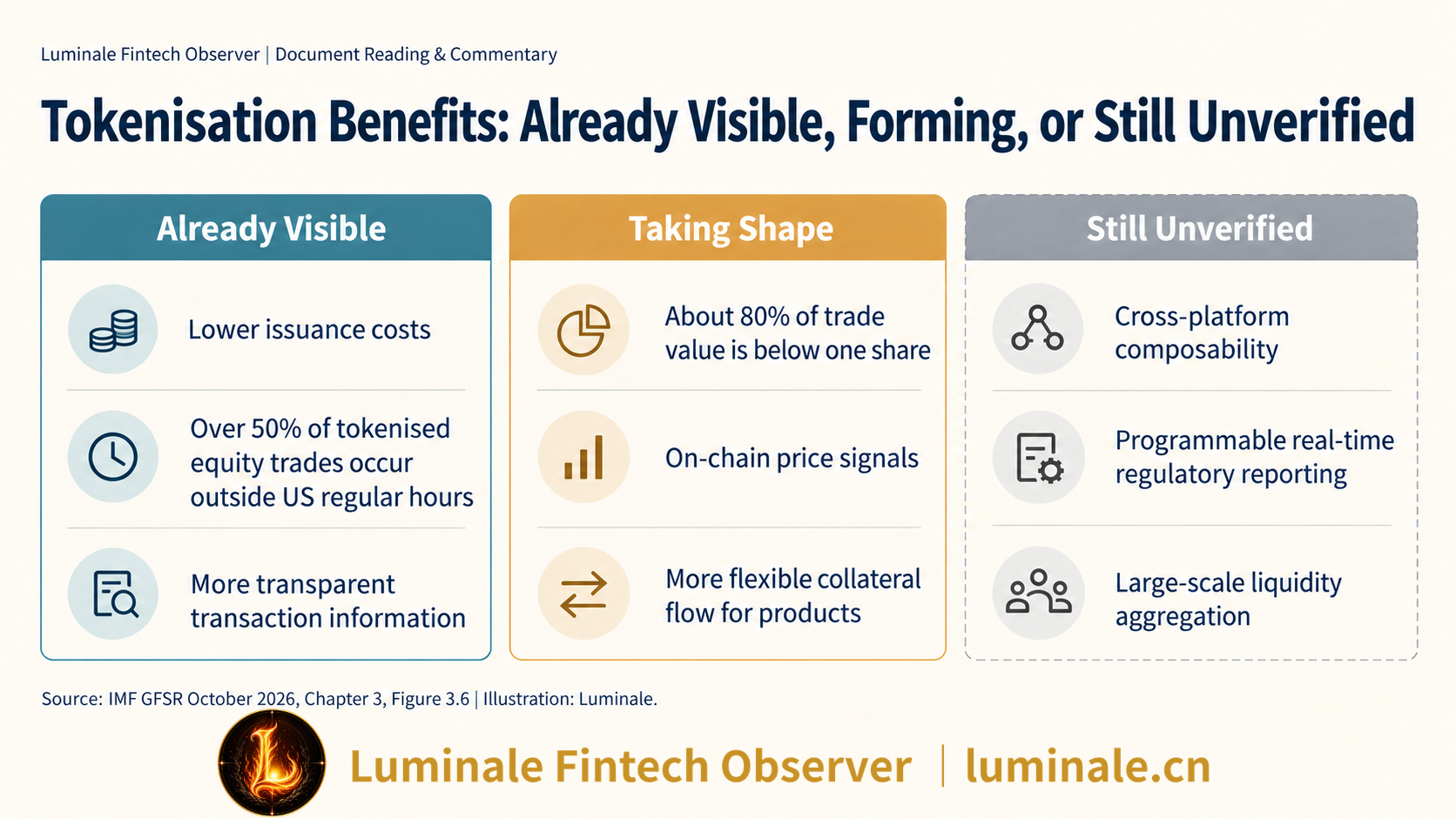
The equity sample offers some concrete evidence. More than 50% of tokenised equity trades took place outside US regular trading hours, which suggests real demand for 24-hour trading rather than a mere technical demonstration. About 80% of trades were for amounts less than one share, which suggests that small holdings did lower participation barriers for some investors. At the same time, the realised volatility of the tokenised equities in the sample was about 1.5 times that of traditional shares. This result comes from a limited sample, and on-chain trading hours differ from traditional market hours, so it cannot be used to conclude that tokenisation necessarily amplifies volatility.
The IMF also studied five tokenised US equities. The regression pass-through coefficient between overnight on-chain price changes and the returns in the first five minutes after traditional market open ranges from about 0.87 to 0.99. This suggests that on-chain prices may contain information from traditional markets. It does not mean that the on-chain market already dominates price discovery, and it cannot establish causality.
One point is easy to overlook. Many of the benefits, such as real-time processing, automated compliance, and shorter settlement cycles, are also being pursued by traditional markets. When discussing the benefits of tokenisation, it is necessary to separate them from the improvements that general digitalisation brings.
My own view is that the value of tokenisation should not be judged by how many assets have moved on-chain. More meaningful indicators include the total processing cost per transaction, settlement failure rates, the amount of cash and collateral tied up, market depth, and whether legal and operational risks actually decline. The report does not provide direct data for every one of these, but they say far more than a count of tokenised assets.
3. Why Risk Can Be Amplified as Efficiency Rises
The IMF's analysis centres on three tensions.
The first tension is that faster settlement does not necessarily reduce liquidity needs. Suppose A owes B 10 billion yuan, while B owes A 9.8 billion yuan at the same time. If the two sides settle on a net basis, they need to pay only the 200 million yuan difference. If every transaction must be settled gross, in full and immediately, both sides must prepare funds or securities in advance for the total amount in each direction.
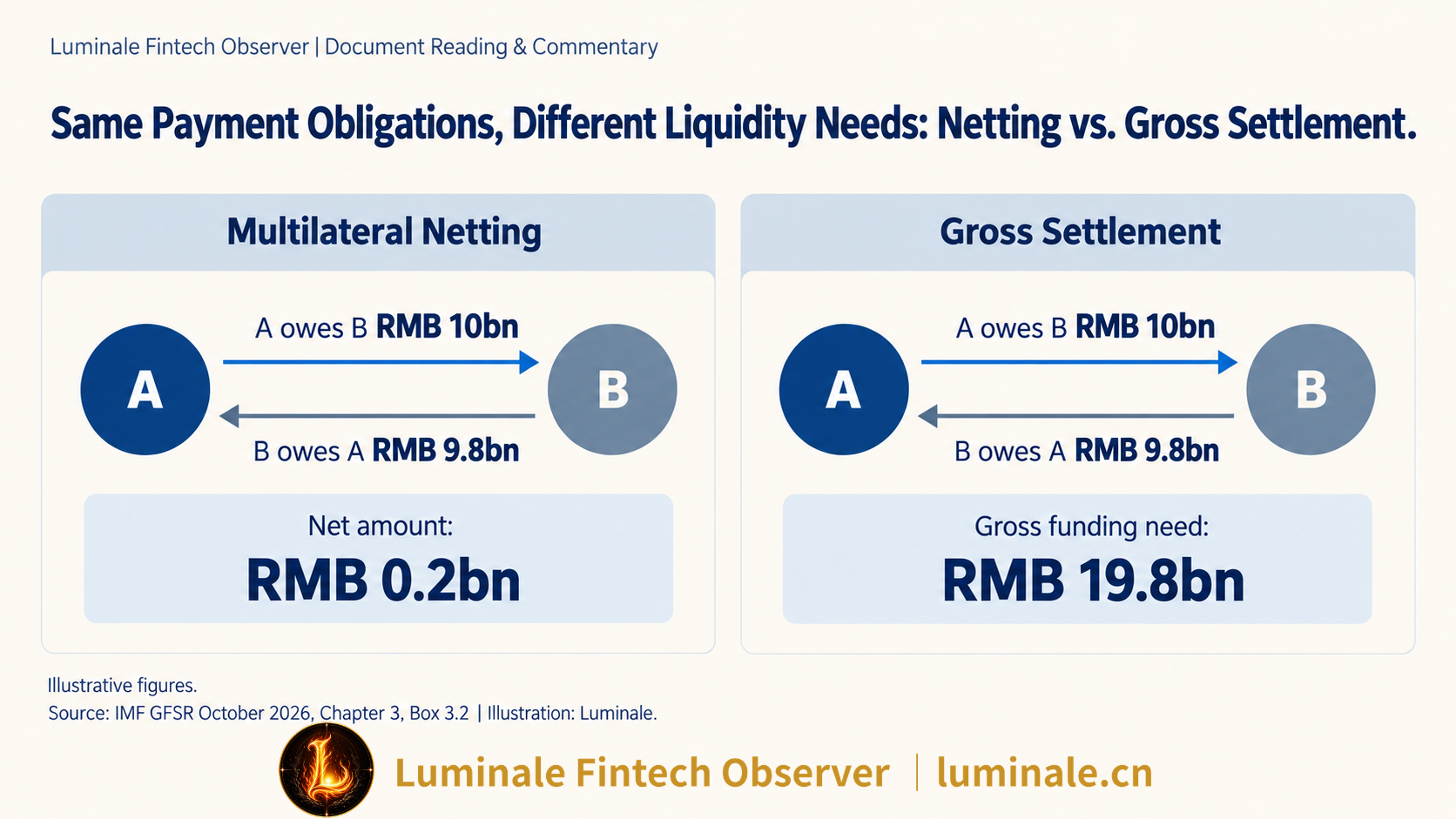
Box 3.2 of the IMF report discusses tokenised repo in particular. Tokenisation could allow repo to settle intraday or over the weekend, which would shorten the time positions occupy balance sheets. But much of the efficiency of traditional repo comes from netting rather than from speed of settlement. If more transactions settle outside a central counterparty (CCP), the benefits of multilateral netting shrink. The report's judgement is that the gain from faster settlement may come at the cost of lower netting efficiency. Batch settlement can recover some netting efficiency, but at the price of slower settlement.
This is the same trade-off we have discussed in payment systems. We have already written about the costs of real-time gross settlement versus netting, in RTGS and DNS: Payment Settlement, Liquidity, and Risk, and about how a CCP reduces exposure, in What Does a CCP Solve? Counterparty Risk, Clearing and Atomic Settlement.
The report also notes that in the US uncleared bilateral repo market, intraday repo accounts for only a small share, and Federal Reserve daylight overdrafts remain low. This suggests that not every market urgently needs faster intraday settlement, and that speed does not automatically bring benefits.
The second tension is that the more mobile collateral becomes, the faster leverage and risk contagion can spread. Tokenisation can make collateral easier to redeploy across different uses, which can release liquidity when markets are calm. The problem is that the same asset may be reused across several platforms and funding arrangements, lengthening collateral chains. When prices fall fast, automatic margin calls, higher haircuts, and programmed liquidations can push many participants to deleverage at the same time.
The following is an illustrative transmission path:
Collateral price falls → a smart contract automatically calls for additional margin → institutions are forced to sell assets or cut positions → prices fall further → a feedback loop forms.
The third tension is that automation does not eliminate risk. Smart contracts, oracles, cross-chain bridges, and shared ledgers may replace part of the manual reconciliation and coordination work, but they can also become critical infrastructure that financial markets depend on. In a separate box, the report notes that tokenisation may not eliminate intermediaries, and that shared platforms could instead concentrate risk. The more tightly connected the system, the faster local technical failures and liquidity shocks can spread across platforms.
My own view is that tokenisation does not create an entirely new set of financial risks. It recombines credit, liquidity, leverage, and operational risks, and changes the speed and paths along which they spread. This is more analytically useful than simply saying that "real-time settlement is more dangerous" or that "netting is better," because the size of the risk depends on specific market design, collateral rules, liquidity arrangements, and default management.
4. Scaling Tokenisation Means Passing Four Tests
The IMF argues that for tokenisation to enter mainstream financial markets, four interdependent conditions must be met.
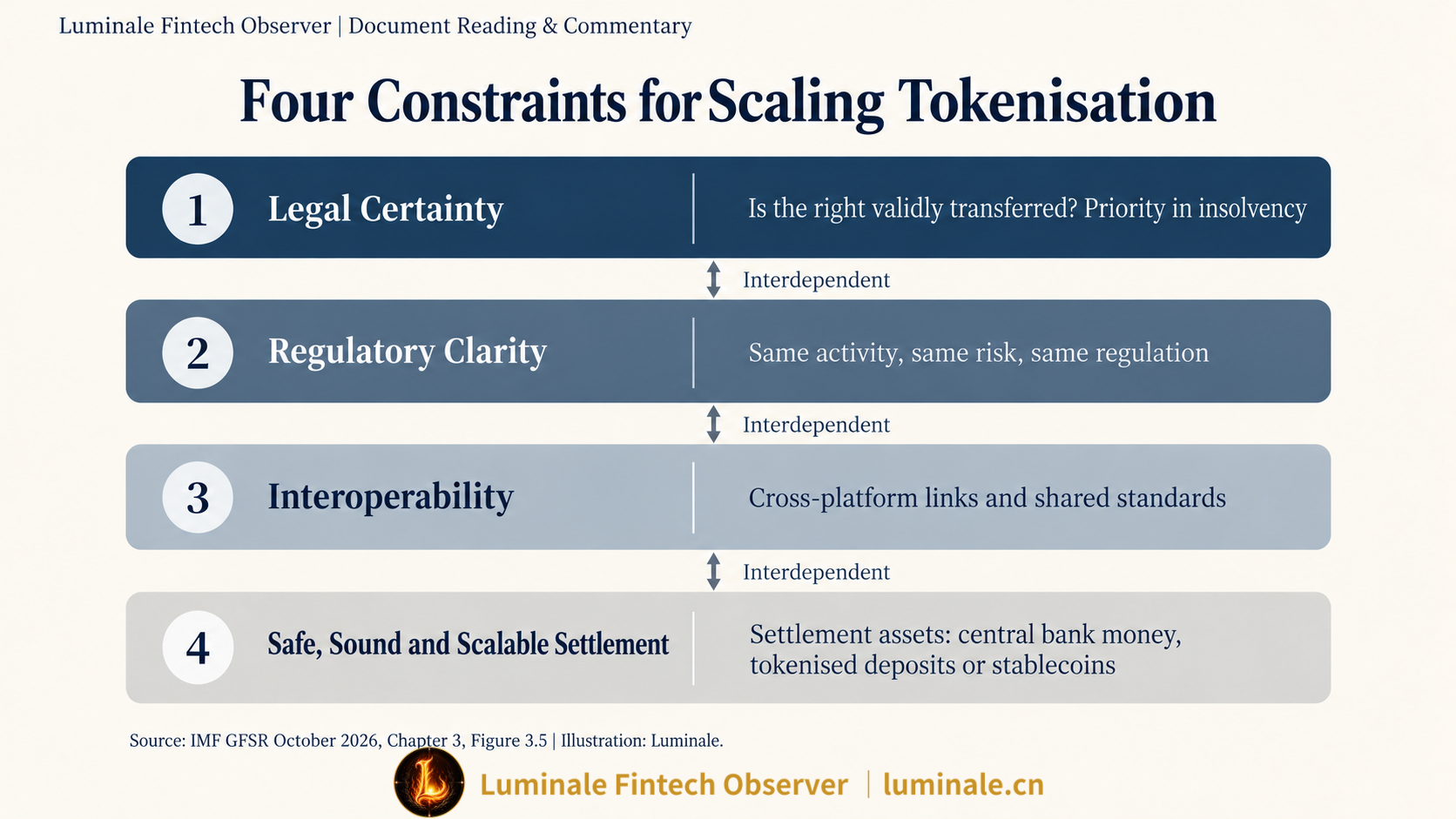
The first is legal certainty. Does a token represent ownership of a security, a claim on a custodian, or only price exposure to an underlying asset? Once a transfer is completed on-chain, has ownership legally changed hands? In insolvency, who has priority? Without clear answers to these questions, on-chain records are unlikely to replace traditional registration.
The second is regulatory clarity. Using distributed ledger technology (DLT) does not take securities, deposits, or payment activities outside existing regulatory principles. However, questions such as custody of private keys, the finality of on-chain settlement, and round-the-clock risk exposure may indeed require specific rules. The IMF stresses "same activity, same risk, same regulatory outcome": regulation should follow activities and risks rather than technology labels.
The third is interoperability. If different platforms can issue, trade, and settle assets only within their own ecosystems, new liquidity silos will form. Cross-chain bridges and shared standards can help connect markets, but they also introduce new technical dependencies.
The fourth is safe, robust, and scalable settlement. Assets can move on-chain, but what funds are used for payment? Central bank money, tokenised commercial bank deposits, or stablecoins? Each settlement asset carries different credit, liquidity, and legal arrangements. Where feasible and available, the IMF considers central bank money the preferred settlement asset.
Europe's Pontes and Appia projects are rebuilding the cash leg for tokenised securities, and they can be read alongside the report's conclusion on this point. We have already covered this in From Pontes to Appia: Rebuilding the Cash Leg for Tokenised Securities. Whether a stablecoin can serve as a settlement asset also depends on its redemption and reserve arrangements. We have written about stablecoins in Stablecoins: How They Stay Stable and Where They Differ.
Hong Kong's tokenised government bonds (Box 3.3) show how these constraints appear in practice. The first tokenised government bond issued by Hong Kong in 2023 mainly tested whether issuance and settlement could be completed legally and operationally. Investors had to join a dedicated digital asset platform, which created an "island" separated from mainstream market infrastructure. The second issuance in 2024 introduced a dual channel: investors could participate directly through the distributed ledger platform, or indirectly through the Central Moneymarkets Unit (CMU) operated by the Hong Kong Monetary Authority and its links with Euroclear and Clearstream. In 2025, the Hong Kong dollar and renminbi tranches further introduced tokenised central bank money settlement options, including e-HKD and e-CNY. Cumulative issuance in Hong Kong is about US$2.2 billion.
We have also written about the two-phase e-HKD pilot, in From Retail CBDC to Tokenised Settlement: Project e-HKD.
The IMF draws two conclusions from this case. First, if tokenisation is only a standalone technical layer, its market value is limited, so digital platforms need to connect with existing market infrastructure. Second, a deep and active secondary market requires more than tokenised issuance: it also needs sufficient issuance volume, broader investor participation, and trading conditions close to those of the traditional bond market.
5. Possible Paths Ahead
The IMF describes three scenarios in the report, and it stresses that these are scenario analyses rather than forecasts of future market share.
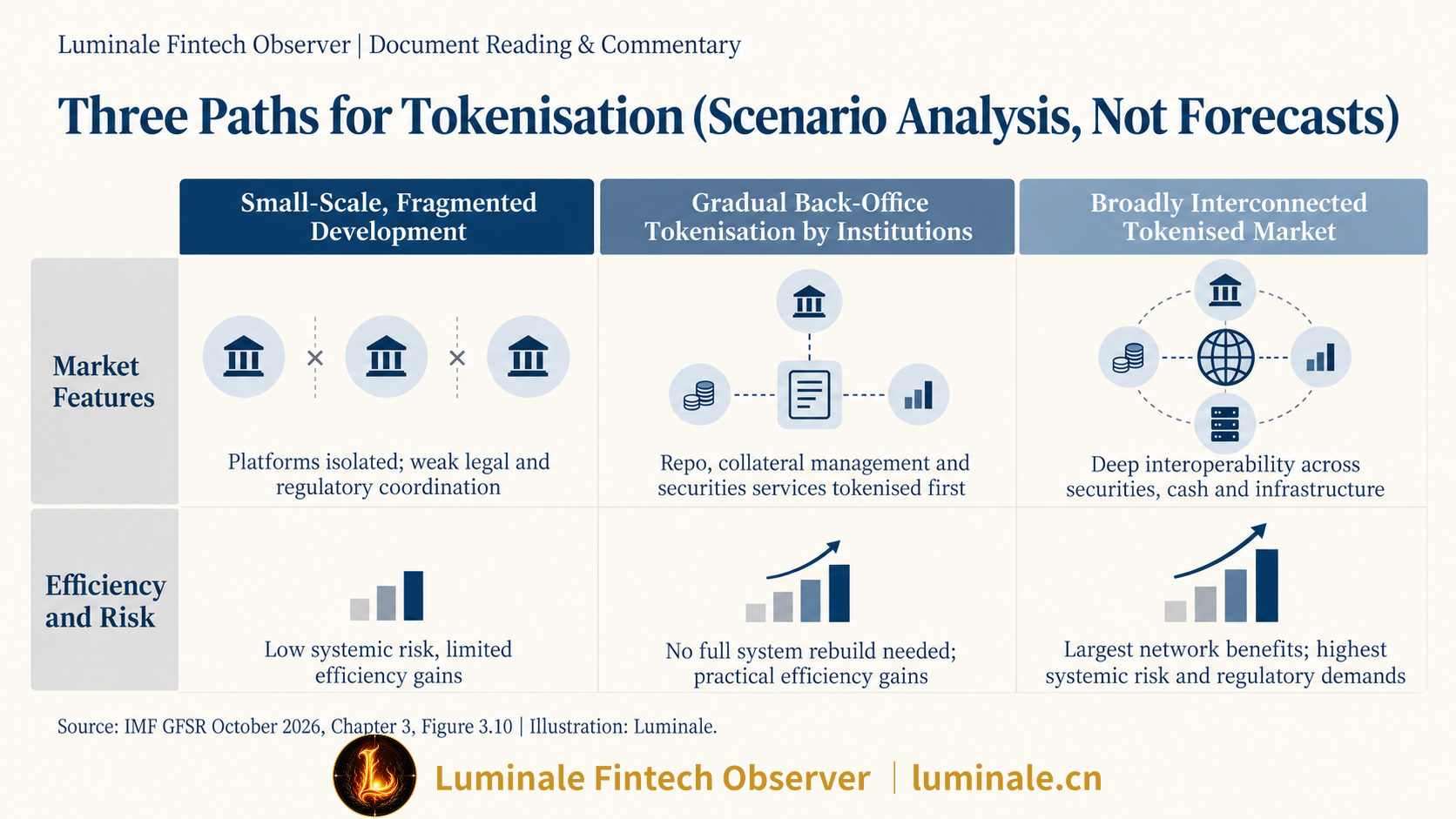
The first is fragmented, small-scale development. Platforms remain isolated, legal and regulatory coordination is weak, and settlement assets are restricted. Systemic risk is limited, but so are the efficiency gains.
The second is gradual tokenisation of institutional back offices. Repo, collateral management, securities services, and cash management adopt tokenisation first, for example through permissioned institutional repo and cash arrangements. This path does not require rebuilding the whole financial system and can still deliver real efficiency gains.
The third is a broad, interconnected tokenised market. Securities, funds, and financial infrastructure achieve much tighter interoperability. The network benefits are the largest, but so are systemic risk and regulatory demands.
At the policy level, the IMF recommends technology neutrality, regulation by activity and risk, regulatory sandboxes for innovation, central bank money settlement where feasible, and circuit breakers and liquidity backstops designed for 24-hour trading.
I have three views of my own here. They draw on the report's analysis but are not explicit conclusions of the IMF.
First, in the short to medium term, tokenisation may change the back offices of financial institutions before it changes the trading interfaces that ordinary investors use. The demand in repo, collateral mobilisation, and securities lifecycle management is clear, and it does not require all market participants to migrate at once.
Second, tokenisation will not automatically eliminate financial market infrastructure, but it may change how these institutions divide their work. Central securities depositories, central counterparties, custodian banks, and payment systems perform registration, risk management, final settlement, and legal responsibility functions, and these still need appropriate institutional and governance arrangements. What may need to be redesigned is the technology through which these institutions provide their services.
Third, market design should pursue settlement safety, liquidity efficiency, and operational resilience together, not speed alone. Future tokenised markets may need to combine atomic settlement, netting arrangements, intraday liquidity tools, and traditional or new central clearing arrangements, depending on asset class, transaction structure, and participating institutions.
Conclusion
Tokenisation shows the possibility of financial markets becoming more automated, more real-time, and more interconnected. From asset issuance to trade settlement, and from collateral mobilisation to liquidity management, financial activities that were once scattered across different institutions and ledgers are now being linked through new infrastructure.
But the financial system is not just a technical system for transmitting information and keeping records. It is also an institutional system of rights, credit, liquidity arrangements, risk segregation, and legal responsibility. Faster settlement does not necessarily mean less capital tied up. Fewer intermediaries do not necessarily mean fewer risk bearers. A more tightly connected system can also let local shocks spread faster.
So judging whether tokenisation truly succeeds cannot rest on how many assets go on-chain, whether trading runs around the clock, or how much settlement time is cut. The more important question is whether, once these technologies enter large-scale financial activity, the market can keep operating safely, robustly, and sustainably at a lower overall cost.
When some of the frictions in traditional finance are removed, which frictions may in fact be serving as risk buffers? This may be the most useful question to pursue further after reading this report.
Originally published by Luminale Fintech Observer: https://luminale.cn/articles/imf-tokenization-faster-trading-faster-risk-en