Bank A buys a basket of bonds worth CNY 10 billion, and Bank B sells it.
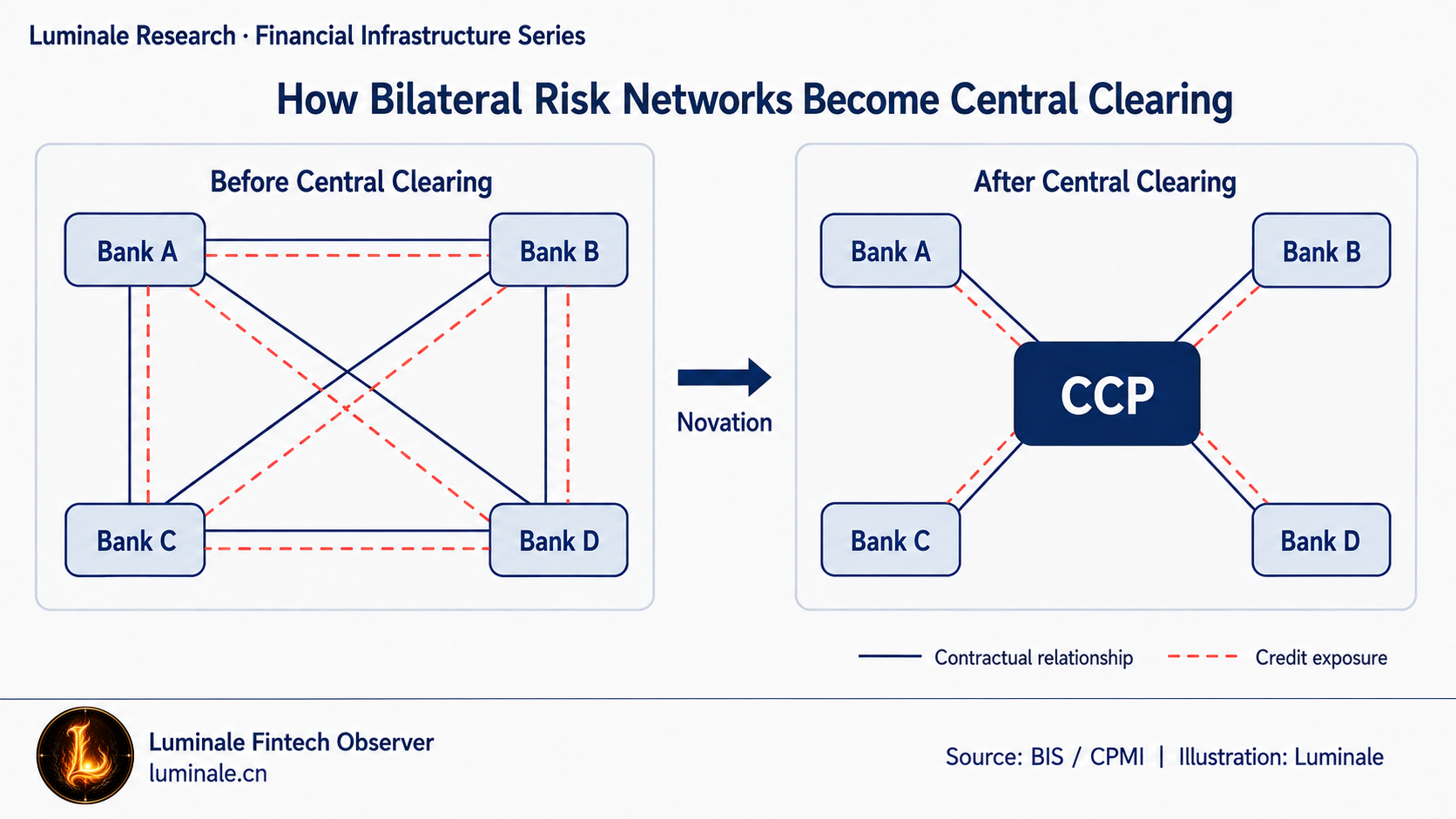
When the trade is agreed, neither the securities nor the cash have moved. Bank A promises to pay on the settlement date, while Bank B promises to deliver the securities. Until final settlement is complete, both face counterparty credit risk: the other party may fail to perform its contractual obligations on time or in full.
Suppose the bond price rises after the trade and buying the same basket again would cost CNY 10.2 billion. If Bank B defaults before settlement, Bank A may have to spend an additional CNY 200 million to restore its original market position, even though it has not yet paid. This is replacement cost risk. Conversely, if the price falls to CNY 9.8 billion and Bank A defaults, Bank B may incur a similar loss when it resells the securities.
As discussed earlier, a Delivery versus Payment (DvP) arrangement links the cash leg and the securities leg, preventing principal risk caused by one leg completing while the other fails 《Securities and Money Must Move "Delivery Versus Payment": What Risk Does DvP Actually Prevent?》. But DvP cannot stop a counterparty from defaulting before settlement, nor can it eliminate the price loss and the pressure to arrange replacement cash and securities. That is the layer of risk addressed by a Central Counterparty (CCP).[1][2]
I. From Two Banks to a Bilateral Risk Network
If the market contains only Bank A and Bank B, they can manage risk through credit limits, bilateral margin and collateral agreements.
As more participants enter, the relationships quickly become complex. In a market with N institutions where any pair may trade, the maximum number of bilateral relationships is N×(N−1)÷2. One hundred institutions create 4,950 potential pairings.
Each relationship may involve:
- credit limits and admission conditions;
- trade valuation and mark-to-market arrangements;
- margin calculation and collateral delivery;
- netting agreements and their legal enforceability;
- default determinations and early-termination provisions;
- close-out of positions and recovery of losses after default.
Counterparty credit risk is not the same as an institution having a liquidity problem. Even when both parties are financially sound, credit exposure exists objectively as long as the contract remains outstanding. The size of that exposure changes with market prices, position size and the time remaining until settlement.
After a trade is executed, a price move can leave one party with a positive mark-to-market value and the other with a negative value. If the party with the negative value defaults, the party with the positive value may face replacement cost. A counterparty default can also disrupt the planned cash and securities arrangements, turning a credit problem into liquidity pressure.
The settlement finality discussed previously 《Can a "Successful" Payment Be Reversed? What Risks Does Settlement Finality Solve?》 focuses on when a transfer of funds or securities acquires irrevocable and unconditional legal effect. A CCP focuses on the risk that contractual obligations will not be performed before final settlement. They address different stages of post-trade processing.
II. How a CCP Changes a Trade
The Bank for International Settlements'Principles for Financial Market Infrastructures (PFMI) classify a CCP as one type of Financial Market Infrastructure (FMI). Once a CCP intervenes, the original bilateral contractual relationship changes under the applicable law and clearing rules.[1]
Consider novation:
| Stage | Contractual relationship | Bank A's counterparty | Bank B's counterparty |
|---|---|---|---|
| Before CCP acceptance for clearing | Bank A ↔ Bank B | Bank B | Bank A |
| After CCP acceptance for clearing | Bank A ↔ CCP; CCP ↔ Bank B | CCP | CCP |
The original contract between Bank A and Bank B is discharged and replaced by two new contracts:
| Contract | Securities obligation | Cash obligation |
|---|---|---|
| Bank A and CCP | CCP must deliver securities to Bank A | Bank A must pay the CCP |
| CCP and Bank B | Bank B must deliver securities to the CCP | CCP must pay Bank B |
The CCP therefore becomes the buyer to every seller and the seller to every buyer. It assumes the contractual obligations between the original parties and takes on the corresponding credit exposures. But when the CCP accepts a trade, when the original bilateral relationship ends, and whether netting and default rules are enforceable all require a clear legal basis.[1]
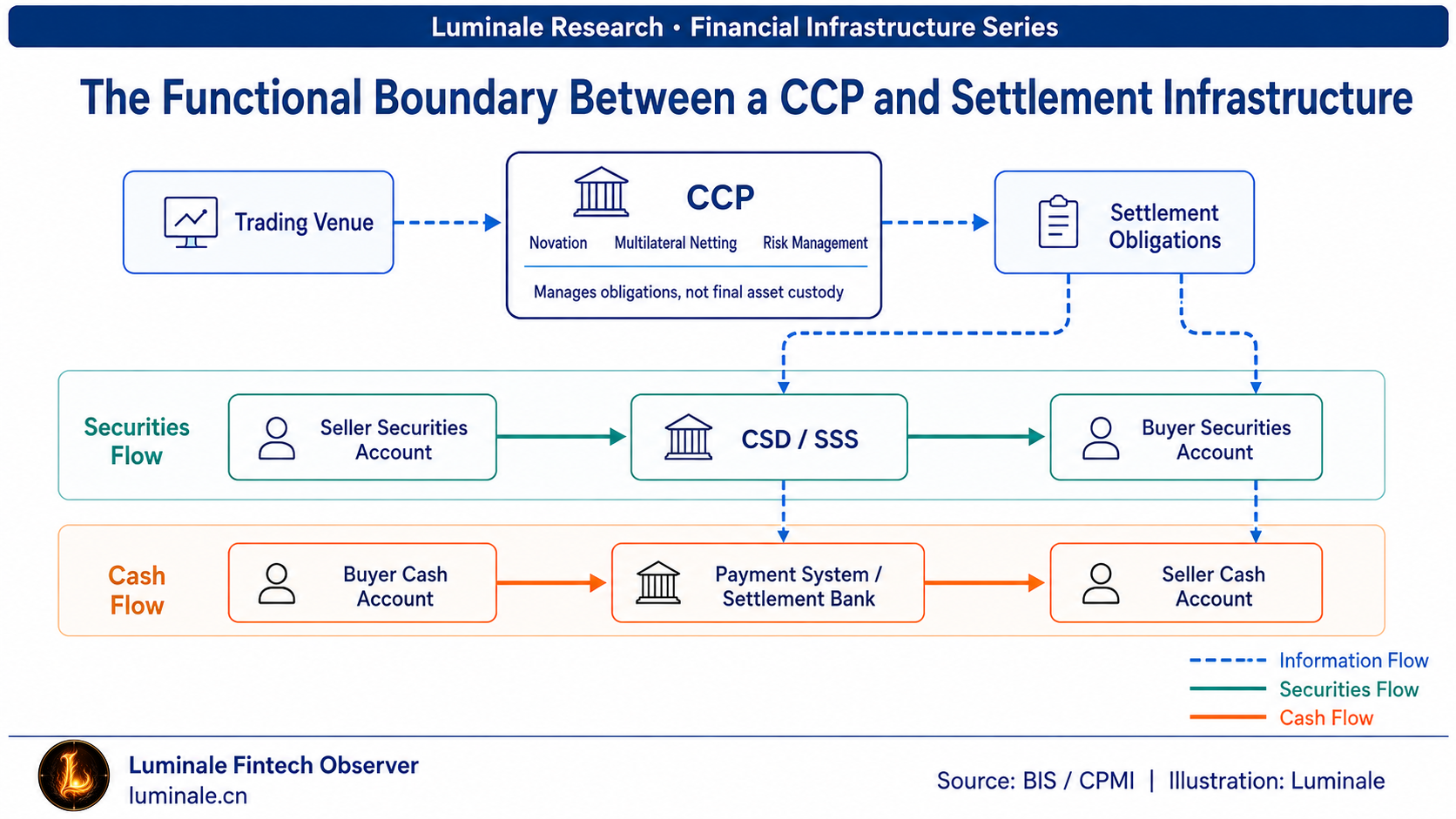
A CCP does not take custody of securities or operate every settlement account simply because it stands in the middle of the contract. Under Luminale's analytical framework for financial market infrastructures, a securities transaction can be divided into the following stages:
| Stage | Main institution or system | What it handles |
|---|---|---|
| Trading | Trading venue or trading platform | Buyers and sellers agree a trade |
| Central clearing | CCP | Accepts trades, changes contractual relationships, calculates positions and manages risk |
| Securities settlement | Securities Settlement System (SSS) | Transfers securities under settlement instructions |
| Securities registration and custody | Central Securities Depository (CSD) | Maintains records of securities issuance, holdings and transfers |
| Cash settlement | Payment system, settlement bank or central-bank account system | Completes the cash leg |
The same institution may operate more than one of these stages, but the functional boundaries still matter. A CCP creates and manages settlement obligations; a CSD and SSS handle securities accounts and securities transfers; a payment system or settlement bank handles the cash leg.
This distinction explains why a CCP mainly changes contractual and credit relationships at the clearing layer. Where securities are ultimately registered, which settlement asset is used for cash, and when settlement becomes final still depend on the subsequent securities and cash settlement arrangements.
III. Multilateral Netting in Practice
Once a large number of trades enter the same CCP, each clearing member faces the same contractual counterparty. Where the product, currency, account, settlement date and clearing rules permit, the CCP can use multilateral netting to calculate each member's net obligations to the CCP.
Assume that Bank A trades the same bond through the same CCP on the same day, using a simplified common valuation basis:
| Trade | Bank A's securities position | Bank A's cash position |
|---|---|---|
| Buys CNY 10 billion from Bank B | Receives CNY 10 billion in securities | Pays CNY 10 billion |
| Sells CNY 8 billion to Bank C | Delivers CNY 8 billion in securities | Receives CNY 8 billion |
| Buys CNY 3 billion from Bank D | Receives CNY 3 billion in securities | Pays CNY 3 billion |
If the three trades settle separately, Bank A must receive CNY 13 billion in securities, deliver CNY 8 billion in securities, pay CNY 13 billion and receive CNY 8 billion. Under multilateral netting, Bank A's position against the CCP can be simplified as follows:
| Item | Gross receivable | Gross payable | Net obligation |
|---|---|---|---|
| Securities | CNY 13 billion | CNY 8 billion | Net receipt of CNY 5 billion |
| Cash | CNY 8 billion | CNY 13 billion | Net payment of CNY 5 billion |
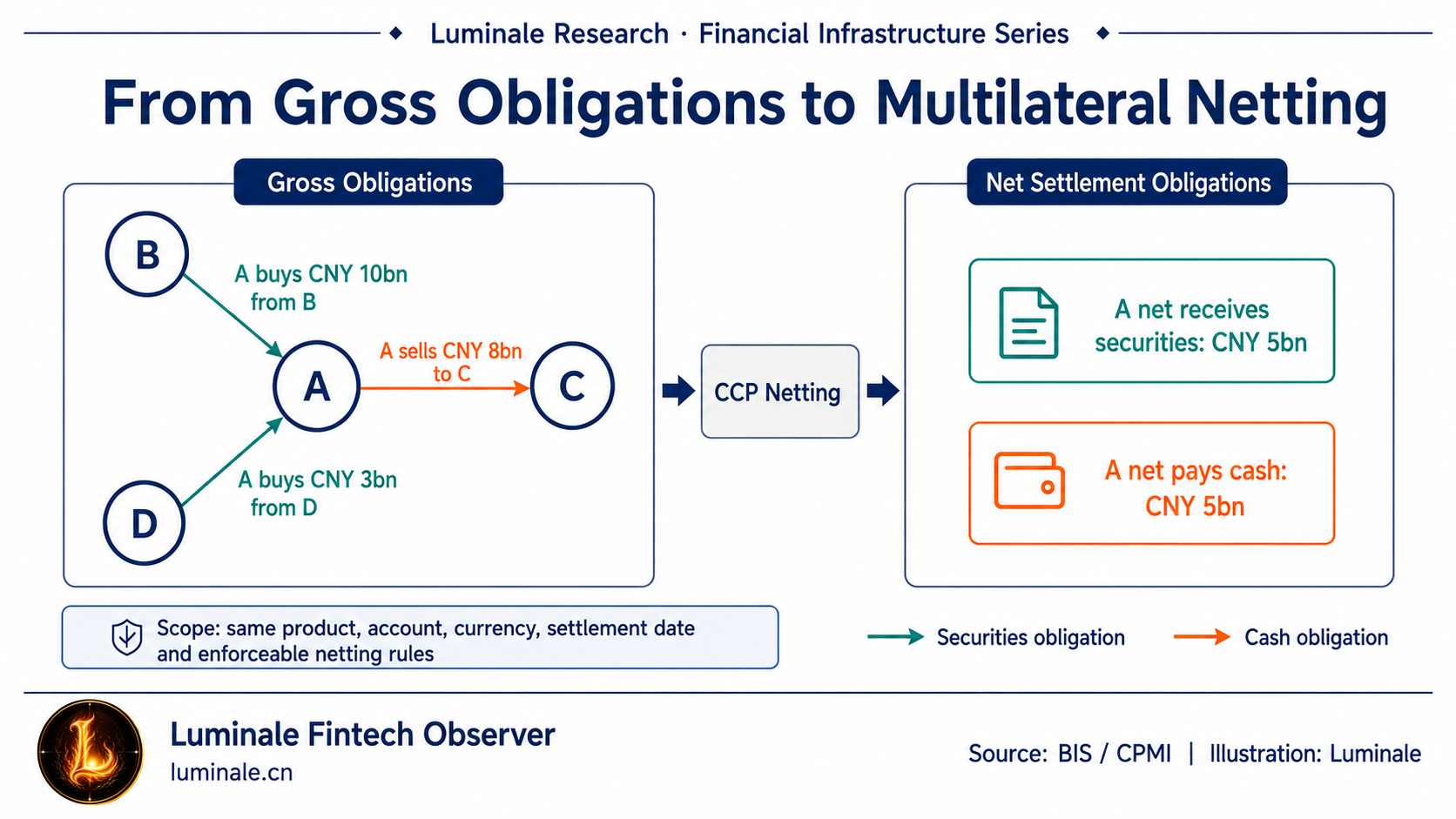
Netting reduces the securities and cash that must actually be delivered, lowering intraday liquidity, settlement operations and collateral needs.
Bilateral netting can offset obligations only between the same pair of counterparties. Multilateral netting places eligible obligations owed by multiple members to the CCP into one netting set, expanding the scope for offsetting. BIS research on central clearing notes that central clearing turns dispersed bilateral exposures into a concentrated network between members and the CCP, while multilateral netting reduces counterparty credit exposures and settlement obligations.[3]
Not every trade can be multilateral-netted. Whether netting is valid depends on law and rules, and PFMI requires the arrangement to have a sound, transparent and enforceable legal basis. Multilateral netting cannot be used when:
- different products cannot be placed in the same netting set;
- different currencies or settlement dates cannot be offset arbitrarily;
- client accounts and proprietary accounts may need to be segregated;
- positions at different CCPs generally cannot be combined directly;
- some markets settle securities gross and net only the cash leg;
- products with insufficient risk correlation cannot be offset merely to reduce margin.
CCP clearing and netting are therefore not the same thing. Central clearing restructures counterparty relationships and brings risk under common rules; multilateral netting is an additional effect that this structure may produce.
IV. How a CCP Controls Exposures After Risk Is Concentrated
Under normal conditions, the obligations a CCP collects from members broadly match the obligations it owes to other members. When a member defaults, that balance is disrupted. The CCP must still perform to non-defaulting members while managing the positions left by the defaulting member. Risk therefore moves from a dispersed bilateral network to the CCP. Market participants have less direct exposure to numerous counterparties, but they collectively depend on the CCP's models, operational capacity, collateral and financial resources. The CCP itself becomes a potential transmission point for market stress.
PFMI sets out several layers of requirements for this risk:[1]
| Risk-management component | Main purpose | Limitation |
|---|---|---|
| Variation Margin (VM) | Transfers current mark-to-market gains and losses, limiting the accumulation of current exposure | It is not a long-term pool for shared losses |
| Initial Margin (IM) | Covers potential future price losses between a member default and the hedging, close-out or transfer of its positions | It cannot cover every extreme tail loss |
| Collateral | Specifies which assets members may use to meet margin or other security requirements | Requires valuation, haircuts, concentration and liquidity management |
| Default Fund | Provides pre-funded resources for stress losses beyond the defaulting member's own margin | May include mutualised resources; the order of use is rule-based |
| Stress Testing | Tests whether the CCP's total financial resources are sufficient in extreme but plausible scenarios | It differs from backtesting the day-to-day coverage performance of a margin model |
| Liquidity Arrangements | Ensures that the CCP can make payments, deliver securities and pay variation margin when due | Accounting coverage of losses does not mean the required funds are available on time |
PFMI Principle 4 requires a CCP to measure, monitor and manage current and potential future exposures. Through margin and other pre-funded financial resources, it should cover credit exposures to each participant with a high degree of confidence. A CCP with more complex risk or systemic importance in multiple jurisdictions must also consider an extreme-but-plausible scenario involving the simultaneous default of the two participants and their affiliates that would generate the largest aggregate credit exposure. Other CCPs should at least cover the stress scenario involving the participant and affiliates that would generate the largest aggregate credit exposure.[1]
Principle 6 addresses margin specifically. An initial-margin model must cover potential future exposure between the last margin collection and the close-out of a defaulting position, with a one-tailed confidence level of at least 99%. A CCP should also mark positions to market and collect variation margin at least daily, while retaining the capacity to call additional intraday margin.[1]
The nominal amount of collateral cannot be treated as its available value. If a member posts assets that are volatile, illiquid or highly concentrated, the CCP may face a discount when selling them under stress. PFMI therefore requires financial market infrastructures to use prudent valuation and haircuts, control collateral concentration and consider stressed market conditions.
Credit risk and liquidity risk must also be managed separately. Credit risk asks how much may ultimately be lost; liquidity risk asks whether enough usable funds are available when payment falls due. Even if a receivable can eventually be recovered, a CCP that cannot access the money that day may be unable to pay non-defaulting members on time. PFMI Principle 7 requires a CCP to maintain sufficient liquidity resources in the relevant currencies to make securities-related payments, variation-margin payments and other obligations when due.[1]
In 2017, the Committee on Payments and Market Infrastructures (CPMI) and the International Organization of Securities Commissions (IOSCO) issued further guidance on CCP resilience. It addressed governance, credit and liquidity stress testing, resource coverage, margin, and the role of a CCP's own financial resources in absorbing losses. The guidance did not create a separate standard; it clarified how CCPs should implement PFMI.[4]
V. How a CCP Handles a Member Default
Assume that Bank A holds a large portfolio of open positions. After a sharp market move, Bank A fails to pay variation margin when due, and the CCP declares a default under its rules.
The CCP must handle several tasks at once:
- Confirm the scope of the default, identifying Bank A's proprietary positions, client positions, collateral and unsettled obligations.
- Continue managing payment and delivery obligations to non-defaulting members, assessing the liquidity needed that day and over the following days.
- Temporarily hedge the defaulting portfolio to limit exposure to further market moves.
- Depending on the product and market conditions, auction, close out or transfer the positions.
- Use financial resources in the order set by the rules to allocate losses that remain uncovered.
- Replenish resources already consumed so that the CCP can continue operating.
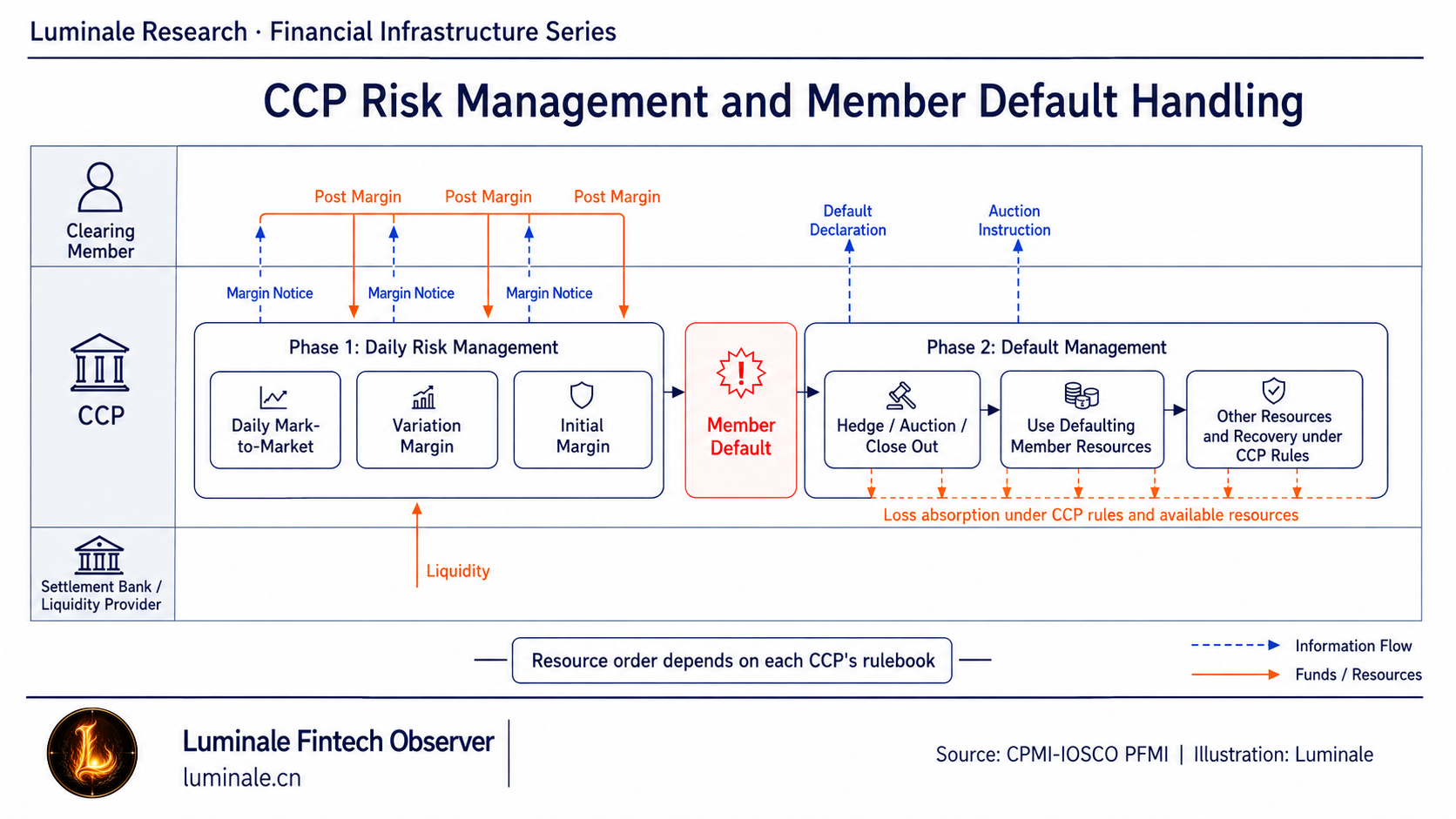
PFMI Principle 13 requires financial market infrastructures to maintain clear and effective participant-default rules so that they can control losses and liquidity pressure promptly while continuing to perform their obligations. The rules should specify the order in which resources are used, how positions are handled and what participants are responsible for; they should also be tested regularly with members and other relevant parties.[1]
After a member defaults, a CCP will generally use the defaulting member's margin or other available collateral first. The defaulting positions may be hedged, auctioned, transferred or closed out. If losses exceed the member's own resources, the CCP may then use other default-fund resources, its own financial resources and subsequent recovery tools under its rules.
In January 2025, the Basel Committee on Banking Supervision (BCBS), CPMI and IOSCO issued final policy proposals on the transparency and responsiveness of initial margin in centrally cleared markets. The ten proposals cover margin-simulation tools, model disclosures, measures of initial-margin responsiveness, model governance, and information that clearing members provide to clients and CCPs. The policy objective is to make margin requirements more transparent and predictable and to improve participants'liquidity preparation for margin calls.[5]
On 6 May 2026, CPMI and IOSCO issued a consultation paper on targeted revisions to the 2017 CCP resilience guidance and the 2015 Public Quantitative Disclosures (PQD) standards. The plan is to incorporate relevant parts of the 2025 proposals into the existing framework. The proposed content covers margin-simulation tools, measures of initial-margin responsiveness, model governance, overlays and public disclosure.[6]
This policy work shows why margin arrangements matter. Margin must reflect risk promptly or the CCP will accumulate uncovered exposure; but margin requirements that rise quickly in stressed markets can amplify members'short-term liquidity needs. More transparent models, usable simulation tools and disciplined overlays can help members estimate funding needs in advance and reduce liquidity pressure.
VI. Can Atomic Settlement Replace a CCP?
Tokenised finance represents securities, deposits, central-bank money and other assets as digital tokens on a programmable platform. If security tokens and cash tokens can move synchronously on the same platform, a smart contract can combine the two settlement legs into one indivisible operation:
| Verification result | Securities leg | Cash leg |
|---|---|---|
| All conditions satisfied | Securities and cash move simultaneously | Trade completes |
| Any condition not satisfied | Securities remain with the original holder | Cash remains with the original holder |
This arrangement is called Atomic Settlement. It aims for both legs to succeed together or for neither to occur. If the securities and cash sit on the same ledger, the system can complete Delivery versus Payment in one state update. BIS research on the future of securities settlement finds that such arrangements can shorten the time between trade and settlement and thereby reduce replacement cost risk.[7]
The European Central Bank's 2026 analysis of digital capital markets suggests that, in some spot markets for equities and bonds, immediate atomic settlement could eliminate exposure between trade and settlement, so a CCP would no longer need to charge margin for that risk window. Where specific conditions are met, the traditional central-clearing step could be compressed or even disappear.[9]
But this benefit does not apply to every trade. It generally requires:
- a spot trade that can settle immediately;
- securities and cash that are pre-funded and immediately available;
- both legs to settle synchronously on the same platform or through reliable interoperability;
- on-chain records with clear and enforceable legal effect;
- cash tokens with acceptable credit quality and redemption arrangements;
- market participants willing to give up some netting benefits and bear the liquidity cost of gross, trade-by-trade settlement.
If any one of these conditions fails, counterparty risk can reappear.
Atomic Settlement Handles Synchronisation; CCPs Manage Ongoing Obligations
Atomic settlement controls one settlement action: whether securities and cash can complete their final transfer at the same time.
A CCP performs a broader set of functions. It accepts trades and changes the contractual relationship, calculates multilateral net positions, marks positions to market, collects margin, manages collateral, and hedges, auctions or closes out positions after a member defaults. A single atomic state update cannot replace these functions.
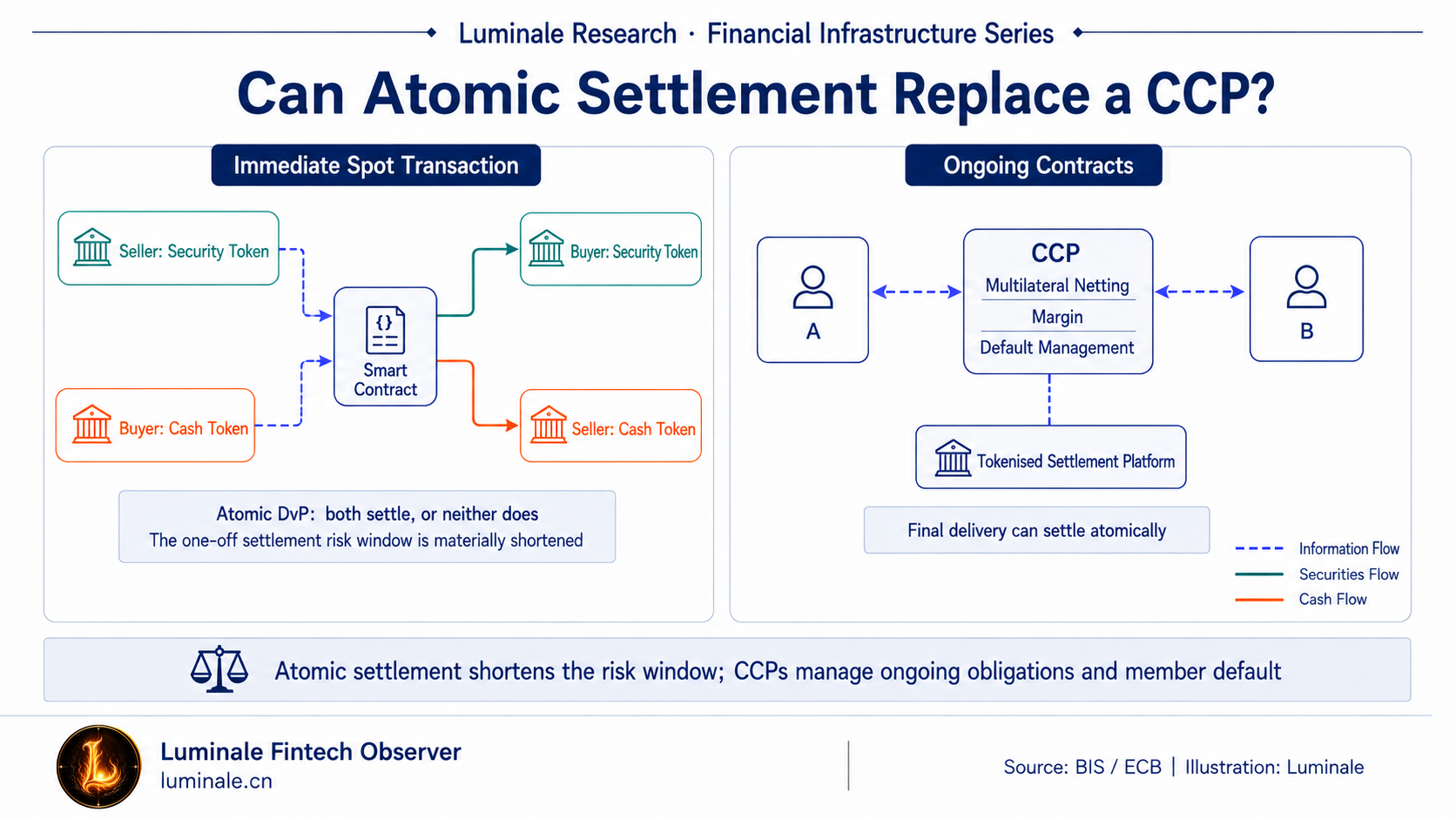
| Trade type or market arrangement | Possible effect of atomic settlement | Is a CCP function still needed? |
|---|---|---|
| Tokenised equity or bond spot trades with immediate delivery | Can shorten or eliminate the risk window between trade and settlement | Some trades may no longer need CCP involvement |
| Securities trades with delayed settlement | Can make final delivery synchronous, but price and default risk remain before settlement | Margin or other credit-risk management may still be needed |
| Derivatives | Contract value continues to change over months or years | Mark-to-market, margin, netting and default management remain necessary |
| Repurchase Agreement (Repo) trades | The opening and closing legs can each settle atomically | Ongoing credit and collateral risk remains between the two legs |
| Securities lending | Asset delivery can be automated | Valuation, collateral calls and default handling remain necessary during the loan |
| Anonymous or high-volume markets | Can increase settlement automation | The market may still need common admission, netting and default-management arrangements |
Derivatives and repos are particularly difficult to de-risk through one atomic transfer. The contract runs over time, while market prices, interest rates and collateral values continue to change. Even if every margin payment is automated on-chain, someone still has to set the margin model, haircut, netting set, default trigger and loss-allocation rules. A smart contract can execute rules, but it cannot create a risk regime that is accepted by the market and the law.
Atomic Settlement Can Consume More Liquidity
A CCP's multilateral netting allows participants to offset large numbers of purchases and sales. Immediate atomic settlement is usually closer to gross, trade-by-trade Delivery versus Payment. Each time a trade is executed, the buyer must have the cash ready and the seller must have the securities ready.
In the earlier example, Bank A needs to pay only CNY 5 billion and receive CNY 5 billion in securities after netting. If all three trades settle immediately and separately, Bank A must have CNY 13 billion of payment capacity at different times, along with the required securities. Even if the final net position for the day is unchanged, the intraday liquidity path is different.
Cash and securities may also need to be locked in advance. Pre-positioning can improve settlement success, but it limits the use of those assets for other trades or financing. If different tokenised platforms use their own cash tokens, participants may also have to hold liquidity across several platforms. BIS research therefore notes that shorter settlement cycles can reduce replacement cost risk, while gross settlement and pre-funding can increase liquidity needs.[7]
Atomic settlement involves a trade-off: the counterparty-risk window becomes shorter, but market participants must prepare cash and securities earlier. The liquidity saved by CCP netting and the safety benefit of shortening the risk window through immediate settlement must be weighed together.
On-Chain Synchronisation Is Not the Same as Legal Settlement Finality
A smart contract can show that execution succeeded, but it is still necessary to determine what rights the tokens represent.
Whether a security token gives its holder a direct right against the issuer, and whether a cash token represents central-bank money, a commercial-bank deposit or another private issuer's liability, affects credit risk after settlement. Atomic delivery using privately issued cash tokens can ensure that the buyer and seller exchange tokens synchronously, but it cannot remove the credit and redemption risks of the cash-token issuer.
The on-chain record must also be recognised under applicable law. Settlement finality, asset ownership, bankruptcy remoteness, erroneous trades and conflicts of jurisdiction cannot be determined solely by the result of code execution. A 2024 BIS and CPMI report on tokenisation notes that the credit, liquidity, operational and governance risks faced by traditional financial market infrastructures also apply to tokenised arrangements, although their form may change. Tokenised systems still require sound governance, risk management and regulatory arrangements to improve the safety and efficiency of the financial system.[8]
Cross-chain settlement adds another layer of difficulty. If the security token and cash token sit on different ledgers, the two systems need to be connected through a coordinator, an interoperability protocol or a time-locked smart contract. Timing gaps, failed validation or a system outage can break the synchronisation. BIS analysis of some cross-ledger mechanisms finds that poor design can allow principal risk to reappear.[7]
A CCP May Become Part of On-Chain Rules
Central clearing creates a more standardised, concentrated and supervisable risk-management structure. Atomic settlement offers a new way to deliver assets. Future markets may remove some intermediary steps, or embed CCP risk-management capabilities in a new platform architecture. Trade confirmation, netting, margin collection and settlement instructions can be written into smart contracts, while a CCP may connect directly to tokenised securities platforms and tokenised settlement assets.
In such a structure, some clearing operations can be automated, while the CCP continues to define and maintain the risk rules:
- determine which trades can enter a netting set;
- calculate portfolio-level initial margin;
- monitor member and client positions;
- manage collateral and liquidity resources;
- declare a member default and start the close-out process;
- organise the hedging, auction or transfer of defaulting positions;
- remain responsible under the applicable law and regulatory framework.
Atomic settlement can therefore replace part of a CCP's role under specific conditions. It can compress the time between trade and settlement, reduce replacement cost risk in spot trades and allow some immediate trades to proceed without central clearing.
But when the market needs multilateral netting, deferred performance, protection for anonymous trading, portfolio margin or member-default management, the CCP's institutional functions remain. Technology can change who performs these functions, which ledger they use and how quickly they run, but it does not make risk management disappear.
References
[1]: Committee on Payments and Market Infrastructures and International Organization of Securities Commissions, Principles for Financial Market Infrastructures, April 2012. See Principles 1, 4, 5, 6, 7 and 13, as well as the explanations of novation, open offer and netting arrangements. ↩
[2]: Committee on Payment and Settlement Systems and Technical Committee of the International Organization of Securities Commissions, Recommendations for Central Counterparties, November 2004. See the definitions of counterparty credit risk, replacement cost risk and principal risk. ↩
[3]: Dietrich Domanski, Leonardo Gambacorta and Cristina Picillo, Central clearing: trends and current issues, BIS Quarterly Review, December 2015. ↩
[4]: Committee on Payments and Market Infrastructures and International Organization of Securities Commissions, Resilience of central counterparties (CCPs): Further guidance on the PFMI, July 2017. ↩
[5]: Basel Committee on Banking Supervision, Committee on Payments and Market Infrastructures and International Organization of Securities Commissions, Transparency and responsiveness of initial margin in centrally cleared markets: review and policy proposals, final report, 15 January 2025. ↩
[6]: Committee on Payments and Market Infrastructures and International Organization of Securities Commissions, CPMI-IOSCO consultation on updated guidance and public disclosures to implement initial margin proposals, consultation paper, 6 May 2026. ↩
[7]: Morten Bech, Jenny Hancock and Amber Wadsworth, On the future of securities settlement, BIS Quarterly Review, March 2020. ↩
[8]: Bank for International Settlements and Committee on Payments and Market Infrastructures, Tokenisation in the context of money and other assets: concepts and implications for central banks, report to the G20, 21 October 2024. ↩
[9]: European Central Bank, Towards an efficient and integrated digital capital market in Europe: the role of tokenisation and the Eurosystem's policy response, Macroprudential Bulletin, April 2026. ↩
Originally published by Luminale Fintech Observer: https://luminale.cn/articles/ccp-counterparty-risk-central-clearing-en