1. Europe Never Merged Its CSDs, So How Can Cross-Border Settlement Work Like Domestic Settlement?
Suppose a French asset manager, through its custodian in Paris, buys German federal bonds with a nominal value of EUR 10 million. The seller is an Italian bank whose bonds are held in Milan. The issuer Central Securities Depository (CSD) for these bonds is Clearstream Banking Frankfurt (CBF). The buyer's custodian is a participant of Euroclear France in Paris, and the seller is a participant of Euronext Securities Milan. A single trade involves three countries and three CSDs, and the buyer's and seller's cash sits with the Banque de France and the Banca d'Italia respectively.
Ten-odd years ago, this trade would have been passed from one CSD to the next over bilateral links, and each CSD had its own settlement timetable, message formats and cash settlement arrangements. Cross-border settlement cost more than domestic settlement, took longer and failed more often. Today, the transfer of securities and the settlement of cash behind this trade are completed on a single platform, under a single set of rules, within the same settlement day. That platform is TARGET2-Securities (T2S), operated by the Eurosystem.
In Where Are Bonds Held? CSD & SSS Back-Office Ledgers Explained, we described how CSDs and Securities Settlement Systems (SSS) divide their work, and in Section 5 of What Does Bond Connect Actually Connect? we listed T2S as one of three typical arrangements for cross-border bond settlement. This article expands on that section. It looks at how securities accounts and central bank money accounts change at the same moment inside T2S, and how T2S relates to T2, the euro large-value payment system.
1. Fragmentation Before T2S
Europe unified its currency in 1999, but the securities back office stayed divided along national lines. In 2001, an expert group chaired by Alberto Giovannini submitted a report to the European Commission listing 15 barriers to cross-border clearing and settlement in the EU, falling into three categories: technical requirements and market practice, taxation procedures, and legal certainty[1]. Some of these barriers came from national settlement systems each going their own way: different IT and interfaces, different settlement days and cut-off times, and different arrangements for intraday settlement finality.
In July 2006, the ECB Governing Council decided to explore, together with CSDs, the creation of a single securities settlement service. On 17 July 2008, it decided to formally launch the T2S project, to be developed and operated by four central banks: those of Germany, Spain, France and Italy[2]. The platform went live on 22 June 2015 with five CSDs in the first wave; further migrations followed in waves, and the last regular wave was completed in September 2017[3]. In October 2018, Danmarks Nationalbank connected to the platform, making the Danish krone the first non-euro settlement currency in T2S[4]. Bulgaria's two depositories completed their migration in September 2023[5]. According to the European Central Bank (ECB) website, T2S currently connects 24 CSDs from 23 countries, settles in euro and Danish krone, and handles around 800,000 securities transactions a day[6].
2. Dispersed Institutions, One Shared Engine
These twenty-plus CSDs have not merged. They remain separate legal entities, each keeping its issuer services, the legal relationships behind its securities accounts, and its processing of income payments and corporate actions, and each applying its own rules to its clients. What they hand over to T2S is the settlement step alone: matching settlement instructions, checking that enough securities and cash are available, and booking the transfer on the accounts.
An analogy helps. Several shopping malls keep their own brands, loyalty schemes and after-sales service, but share one checkout and inventory system, so the customer's payment and the release of goods from the warehouse are completed on the same ticket. What T2S unifies is the settlement layer. Securities law, taxation and corporate actions remain national.
2. What T2S Is: Three Layers and Two Types of Account
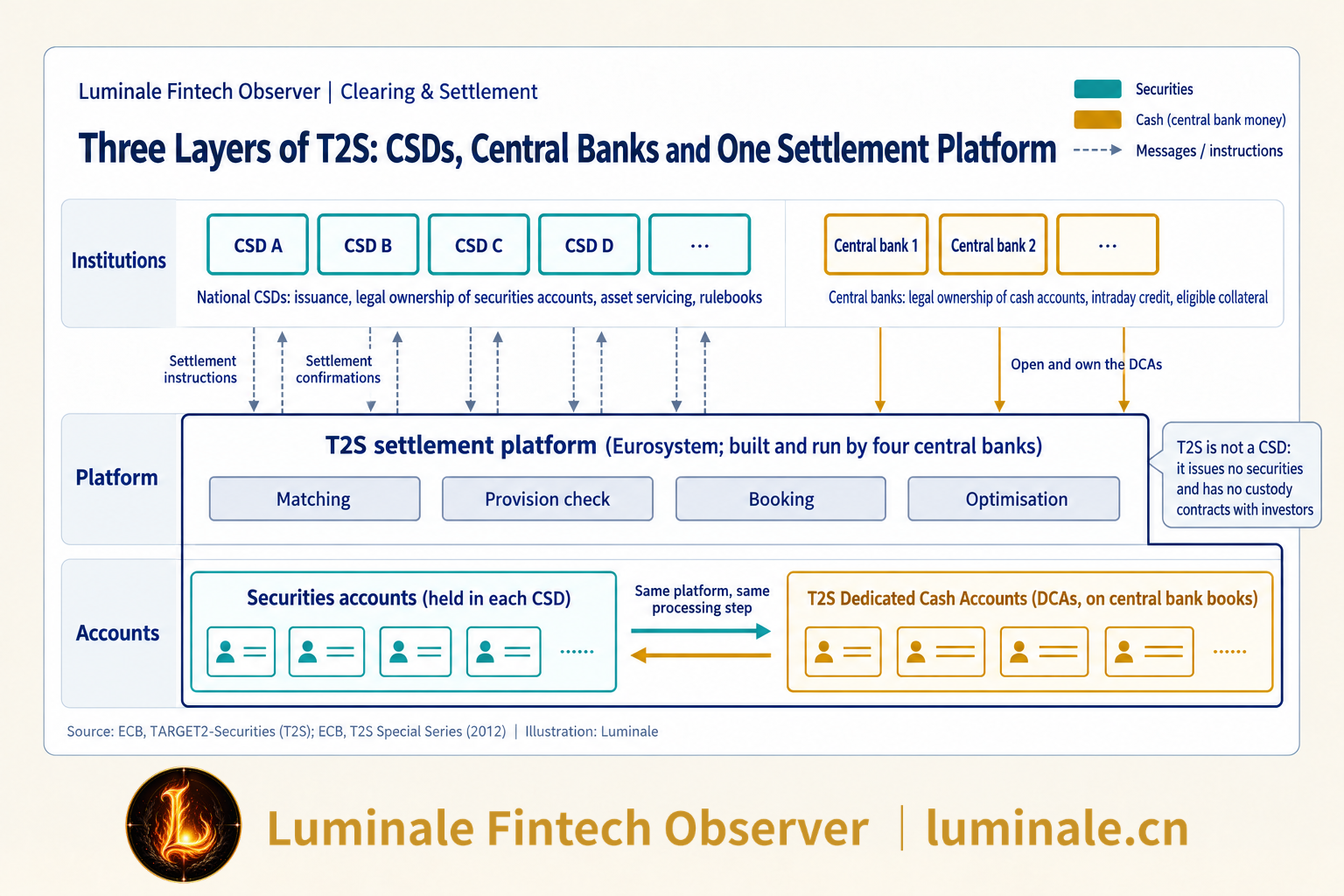
Within the financial market infrastructure analysis framework compiled by Luminale, T2S can be placed in three layers: who bears legal responsibility for the accounts, who runs the technical platform, and where the accounts themselves sit.
| Layer | Entity | Responsibilities |
|---|---|---|
| Institutions (securities) | National CSDs | Issuance and registration, legal ownership of securities accounts, asset servicing (income payments, corporate actions), rulebooks for participants |
| Institutions (cash) | Euro area national central banks, Danmarks Nationalbank | Legal ownership of cash accounts, intraday credit, management of eligible collateral |
| Platform | The Eurosystem (developed and operated by the central banks of Germany, Spain, France and Italy, known as the 4CB) | Matching, provision checks, booking, settlement optimisation, messaging |
| Accounts | Securities accounts and T2S Dedicated Cash Accounts | Both types of account sit on the same technical platform |
1. T2S Itself Is Not a CSD
T2S is a technical service the Eurosystem provides to CSDs and central banks[7]. It does not issue securities, it signs no custody contracts with investors, and legally it is not a depository. By signing the T2S Framework Agreement, a CSD outsources its settlement function to the platform. Securities accounts are opened and maintained on T2S, but which CSD an account belongs to, and what rights the account holder has in the securities, are still determined by the law of that CSD's country and by the CSD's own rules.
2. Dedicated Cash Accounts: Central Bank Accounts Held on T2S
The cash leg in T2S uses T2S Dedicated Cash Accounts (T2S DCAs). These accounts are opened by national central banks for eligible institutions and are kept on that central bank's books; the account balance is a liability of the central bank to the account holder[8]. The cash leg of DvP therefore uses central bank money. This is what makes T2S settlement safe: the cash leg carries no credit risk from a commercial bank failure.
DCA holders are usually banks, known in T2S terminology as payment banks. Many securities account holders do not open a DCA themselves. Instead, they link their securities accounts to a payment bank's DCA, and that bank pays and receives cash for their securities transactions[9]. One DCA can serve securities accounts in several CSDs at once, so a bank can use a single pool of euro liquidity to settle the cash side of its securities trades in Germany, France, Italy and other markets.
For the Eurosystem's account hierarchy and who can hold an account at the central bank, see Who Can Hold an Account at the Central Bank? Account Hierarchy Explained. For why central bank money is the safest settlement asset, see Central Bank Reserves: Money, Liquidity, and Settlement.
3. How T2S Relates to T2
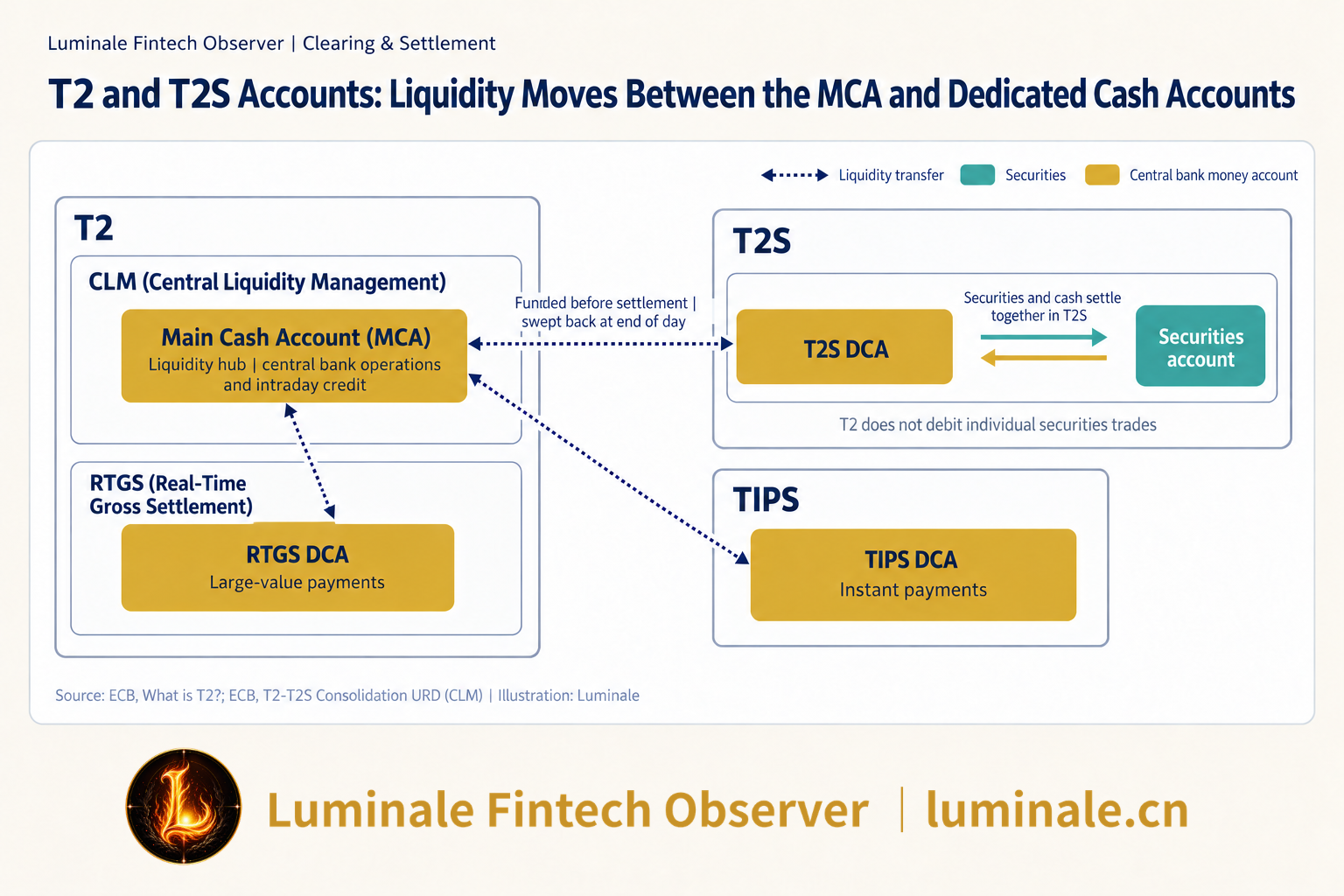
Discussions of T2S often include the claim that "T2S settles euro by calling on T2." This can give the impression that every securities trade sends a payment to T2 and waits for T2 to confirm the debit before T2S delivers the securities. In practice, the cash leg is completed directly between DCAs inside the T2S platform, and T2's job is to top up or withdraw liquidity from the DCAs before and after settlement.
On 20 March 2023, T2 replaced the former TARGET2[10]. The new T2 has two parts: Central Liquidity Management (CLM) and Real-Time Gross Settlement (RTGS). Banks hold a Main Cash Account (MCA) in CLM as their liquidity hub in the Eurosystem, and their central bank intraday credit line is attached to this account. The MCA is connected through liquidity transfers to RTGS dedicated cash accounts, T2S DCAs and the dedicated cash accounts of TARGET Instant Payment Settlement (TIPS)[11].
| Account | Service | Main use |
|---|---|---|
| Main Cash Account (MCA) | CLM in T2 | Liquidity hub; central bank operations and intraday credit |
| RTGS dedicated cash account | RTGS in T2 | Interbank and customer large-value payments |
| T2S Dedicated Cash Account (T2S DCA) | T2S | Cash leg of securities transactions |
| TIPS dedicated cash account | TIPS | Instant payments |
3. How a Euro DvP Settles in T2S
Delivery versus Payment (DvP) addresses principal risk: the seller delivers the securities but is not paid, or the buyer pays but does not receive the securities. In Delivery Versus Payment (DvP): How It Prevents Principal Risk, we covered the three DvP models set out in 1992 by the payment and settlement committee of the Bank for International Settlements (BIS)[12]. T2S uses DvP Model 1: securities and cash settle trade by trade, gross, and simultaneously.
To isolate DvP itself, this section simplifies the example from Section 1 to a trade within a single CSD: both buyer and seller are participants of CBF, and the settlement amount is EUR 10 million. Cases involving two or more CSDs are covered in Section 4.
1. Six Steps from Instruction to Finality
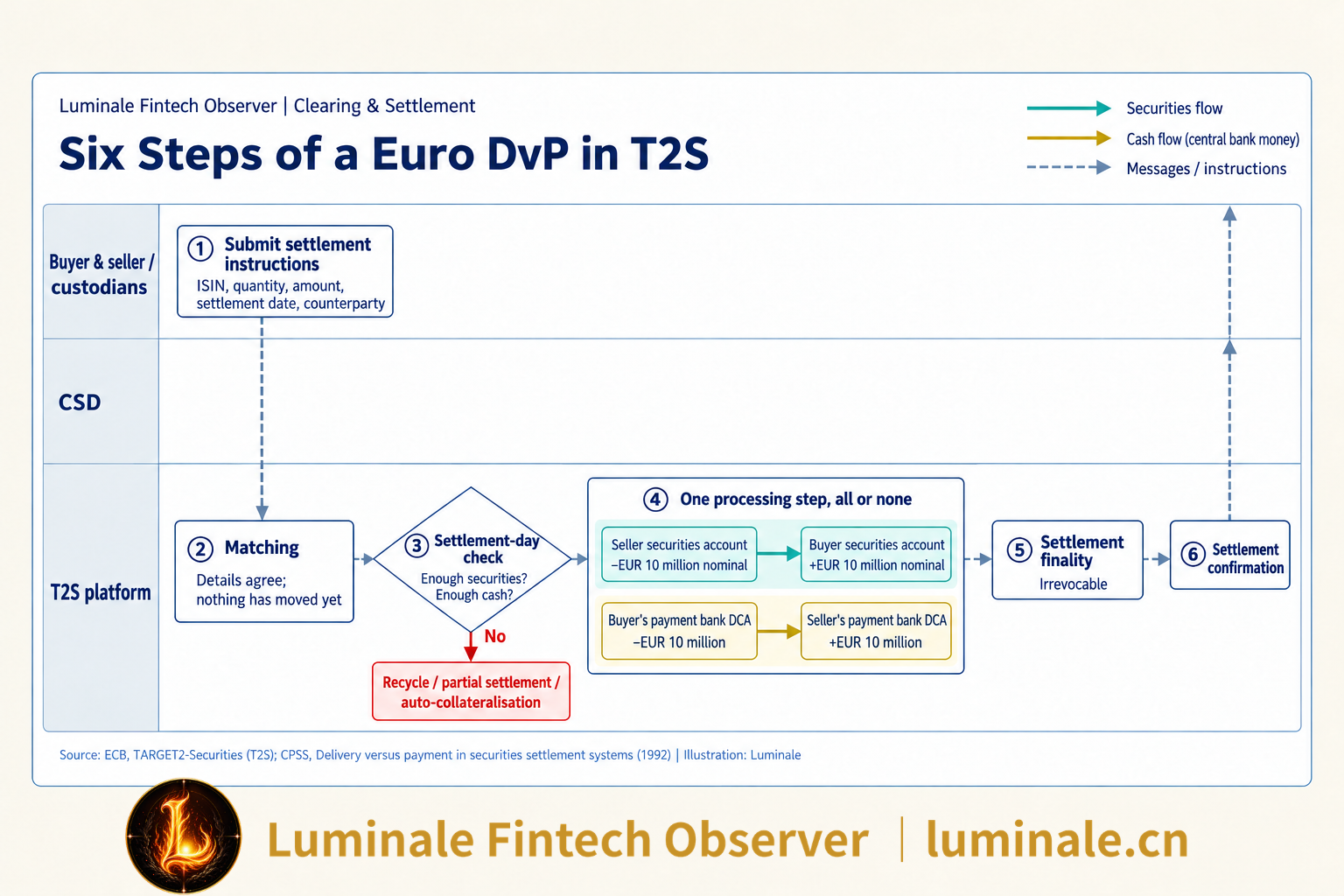
Step 1: Submit settlement instructions. Once the trade is agreed, the buyer and seller (or their custodians) each send a settlement instruction to their CSD, which passes it into T2S. The instruction contains the securities identifier (ISIN), quantity, settlement amount, intended settlement date, counterparty, and the securities and cash accounts on each side.
Step 2: Matching. T2S compares the mandatory fields of the two instructions and pairs those that agree, which then wait for settlement. Matching only shows that both sides agree on the terms; at this point neither securities nor cash have moved.
Step 3: Settlement-day check. On the intended settlement date, T2S checks whether the seller's securities account holds enough securities and whether the buyer's linked DCA holds enough cash. If cash is short, the system can trigger auto-collateralisation to obtain intraday credit from the central bank, which Section 5 covers in detail.
Step 4: Booking. Once the checks pass, the securities move from the seller's securities account to the buyer's, and the cash moves from the buyer's payment bank DCA to the seller's payment bank DCA. Both legs are completed in the same processing step: either both are booked or neither is.
Step 5: Finality. The moment booking is complete, settlement is final: it is irrevocable and unaffected by any later insolvency of a participant. The securities settlement systems of all participating CSDs are designated systems under the EU Settlement Finality Directive (SFD). T2S applies a common standard for determining the moments of entry into the system, irrevocability and final settlement, and each CSD's rules follow this standard. For the legal meaning of finality, see Can a "Successful Payment" Be Reversed? Settlement Finality.
Step 6: Confirmation. T2S sends a settlement confirmation to the CSD, the CSD notifies its participant, and the participant notifies the end client.
2. How the Accounts Change
When settlement is complete, the two types of account change at the same moment:
| Account | Location | Change |
|---|---|---|
| Seller's securities account | CBF (running on T2S) | German federal bonds −EUR 10 million nominal |
| Buyer's securities account | CBF (running on T2S) | German federal bonds +EUR 10 million nominal |
| Buyer's payment bank T2S DCA | Deutsche Bundesbank books (running on T2S) | −EUR 10 million |
| Seller's payment bank T2S DCA | Deutsche Bundesbank books (running on T2S) | +EUR 10 million |
On the Bundesbank's balance sheet, this settlement simply moves part of its liabilities from the buyer's payment bank to the seller's payment bank:
| Bundesbank: assets | Bundesbank: liabilities |
|---|---|
| (unchanged) | Buyer's payment bank T2S DCA −EUR 10 million |
| Seller's payment bank T2S DCA +EUR 10 million |
Total central bank liabilities are unchanged, and so are its assets. The cash leg is an internal transfer on the central bank's books, so the settlement asset is central bank money.
If the two payment banks'DCAs are held at different central banks, for example the buyer's payment bank DCA at the Banque de France and the seller's at the Banca d'Italia, the transfer also creates claims and liabilities between the two central banks. The Banque de France reduces its liability to the buyer's payment bank and at the same time incurs a liability to the Eurosystem; the Banca d'Italia increases its liability to the seller's payment bank and at the same time acquires a claim on the Eurosystem. Under the general mechanism of TARGET, these cross-central-bank positions are netted at the end of the day into a single bilateral position of each national central bank vis-à-vis the ECB, commonly known as TARGET balances[13].
3. Compared with Cross-System DvP in Bond Connect
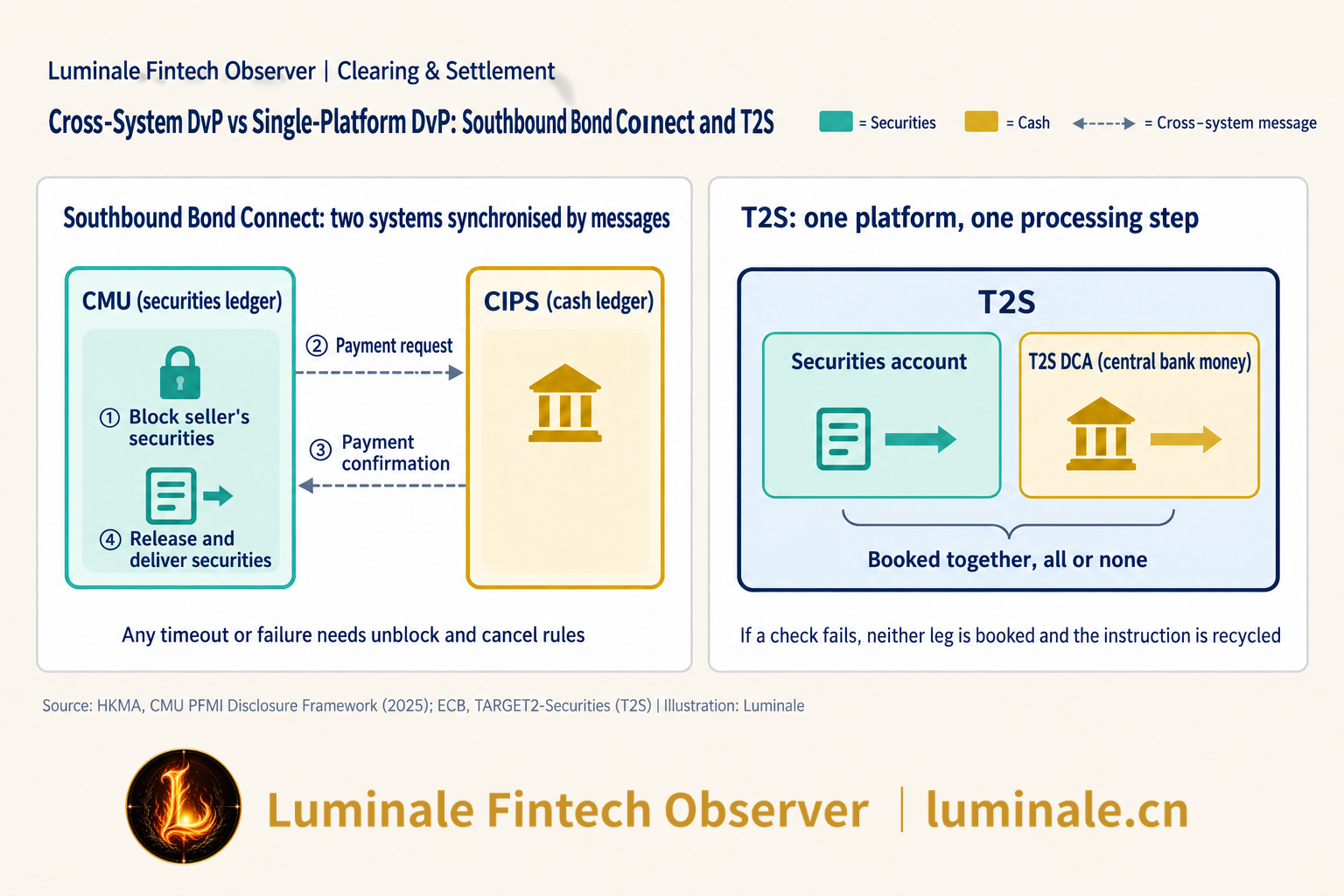
In Southbound Bond Connect, DvP spans two systems. The Central Moneymarkets Unit (CMU) first blocks the seller's securities, then sends a payment request to the Cross-border Interbank Payment System (CIPS); once CIPS completes the payment it returns a confirmation, and only on receiving it does the CMU release the securities. The two ledgers pass status to each other by message, and if any step times out or fails, there have to be corresponding rules to unblock and cancel.
T2S moves this message chain inside a single platform. Securities accounts and central bank money accounts are in the same system, and checking and booking happen in a single processing step, so two systems never need to ask each other "has your side been debited?" Cross-border DvP turns from a coordination problem between systems into a bookkeeping task within one platform.
| Item | Southbound Bond Connect (CMU and CIPS) | T2S |
|---|---|---|
| Securities ledger | CMU | Securities accounts of each CSD, running on T2S |
| Cash ledger | CIPS | T2S DCAs of each central bank, running on T2S |
| How the two legs are synchronised | Block securities, pay, return confirmation, release securities | Both booked together in the same processing step |
| On failure | Failed payment is reported to CMU, which unblocks and cancels | If a check fails, neither leg is booked and the instruction is recycled |
4. What Happens When Settlement Fails
Instructions that fail the check are not discarded. T2S keeps retrying them during the settlement day and processes them again when new securities or cash arrive. Participants can allow partial settlement, so that whatever can be delivered is delivered during the intraday partial settlement windows[14]. The platform also runs optimisation algorithms that look for groups of instructions that can settle together: if A is selling securities to B and B is selling the same securities to C, processing these instructions together reduces the securities and cash each party needs to have in place beforehand. The idea is similar to queuing and offsetting in RTGS, with the difference that T2S has to handle both the securities leg and the cash leg.
4. Cross-CSD Settlement: Issuer CSDs, Investor CSDs and Synchronised Realignment
The real value of T2S only becomes visible when the buyer and seller are not in the same CSD. Back to the example from Section 1: the seller is in Euronext Securities Milan, the buyer's custodian is in Euroclear France, and the issuer CSD for these German federal bonds is CBF.
1. Issuer CSDs and Investor CSDs
The issuer CSD is the CSD in which the securities were originally issued and registered. For another CSD to let its participants hold these securities, it has to become an investor CSD: it opens an omnibus account at the issuer CSD, holding the total for all its participants in its own name, records each participant's holdings on its own books, and uses a mirror account to reflect its omnibus position at the issuer CSD.
Assuming both Euronext Securities Milan and Euroclear France have links with CBF, the holding structure looks like this:
| Books | Account | What it records |
|---|---|---|
| CBF (issuer CSD) | Euronext Securities Milan omnibus account | Total holding of this bond by all Milan participants |
| CBF (issuer CSD) | Euroclear France omnibus account | Total holding of this bond by all Paris participants |
| Euronext Securities Milan (investor CSD) | Italian bank (seller) securities account | The seller's holding |
| Euroclear France (investor CSD) | French custodian (buyer) securities account | The buyer's holding |
2. Before T2S: Booking in Stages, Reconciling Afterwards
Before T2S, this trade would first reduce the seller's holding in Milan, then notify CBF over a bilateral link to move EUR 10 million nominal from the Milan omnibus account to the Paris omnibus account, and finally credit the buyer in Paris. Each stage was completed in a different system with time gaps in between, and if any stage was not finished, the books at different tiers would not agree. The cash also took a separate route and settled at a different time.
3. In T2S: The Realignment Chain Settles in One Go
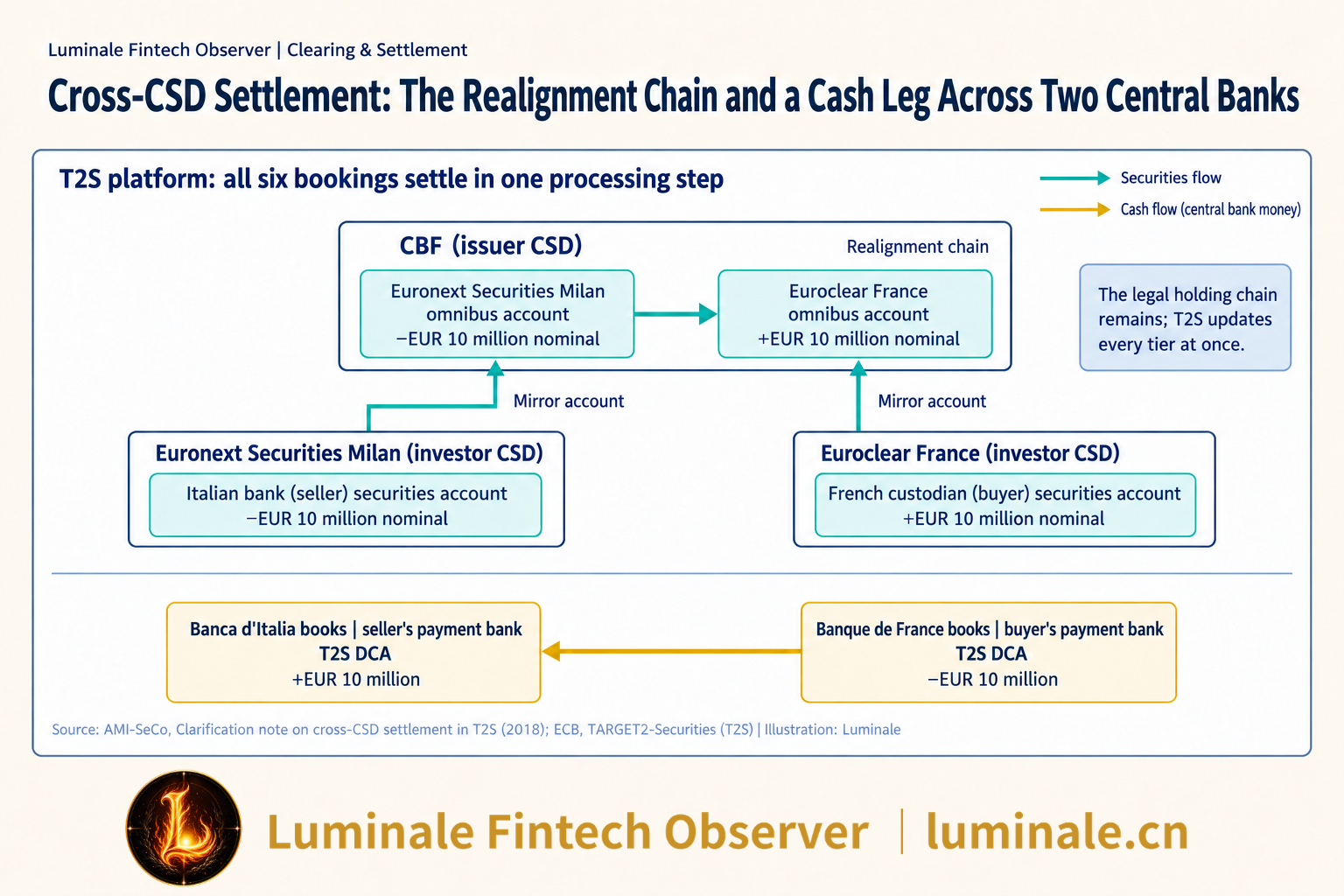
In T2S, the securities accounts of all three CSDs are on the same platform. Once the buyer's and seller's instructions are matched, T2S uses the structure of the accounts involved to derive automatically the adjustments needed to the omnibus accounts between CSDs, known as the realignment chain. It then settles the client-level bookings and these adjustments together as one set of instructions, on an all-or-none basis[15].
| Books | Account | Change |
|---|---|---|
| Euronext Securities Milan | Italian bank (seller) securities account | −EUR 10 million nominal |
| CBF | Euronext Securities Milan omnibus account | −EUR 10 million nominal |
| CBF | Euroclear France omnibus account | +EUR 10 million nominal |
| Euroclear France | French custodian (buyer) securities account | +EUR 10 million nominal |
| Banca d'Italia books | Seller's payment bank T2S DCA | +EUR 10 million |
| Banque de France books | Buyer's payment bank T2S DCA | −EUR 10 million |
All six entries are completed in the same processing step. The mirror accounts on the investor CSDs'books are adjusted at the same time, so the books at every tier stay consistent and no reconciliation is needed afterwards.
Another analogy: when a parcel moves between regions, the inventory records of the central warehouse and the regional warehouses used to be updated separately and reconciled periodically. T2S is like all the warehouses sharing one inventory system, so when the customer signs for the parcel, the records at every warehouse update together.
4. CSDs Outside T2S
When the CSD of one party is not on T2S, this is called external CSD settlement. T2S cannot book entries for an external system, so it relies on mechanisms such as Conditional Securities Delivery (CoSD): T2S first blocks the relevant securities and makes the final booking in T2S only once the conditions for settlement in the external system are met[15].
5. The Legal Holding Chain Still Exists
T2S has not removed multi-tier holding. Legally, the seller and the buyer are still participants of the Milan and Paris CSDs respectively, and those two CSDs still hold the CBF-issued securities through omnibus accounts. What T2S changes is the way these books are updated, so that the records at each tier change at the same moment. Under Northbound Bond Connect, the Hong Kong CMU opens accounts at the mainland CSDs as nominee holder, which is the same kind of tiered holding; compare Section 2 of What Does Bond Connect Actually Connect?.
This arrangement brings two changes. Cross-CSD settlement now comes close to domestic settlement in processing time and failure rates. Investors can also choose one CSD as their entry point and hold securities from several markets through it, which has created competition among CSDs on services.
6. Where the Two International CSDs Stand
The two International Central Securities Depositories (ICSDs), Euroclear Bank and Clearstream Banking Luxembourg, do not settle on T2S. Their internal settlement mainly uses cash on the ICSDs'own books, that is, commercial bank money, which coexists with the central bank money model of T2S. The local CSDs of the Euroclear and Clearstream groups (such as Euroclear France and CBF), by contrast, are participating CSDs in T2S.
5. Where the Liquidity Comes From: DCAs, T2 and Auto-Collateralisation
If DCAs are central bank accounts, where does the money in them come from, and where does it go at the end of the day?
1. Cash Flows Over a Settlement Day
A bank's euro liquidity normally sits in its MCA in T2. To pay for securities settlement, the bank first transfers part of those funds from the MCA to its T2S DCA. The transfer can be made manually or set up in advance as a rule: a fixed amount at a set time each day, or an automatic top-up when the DCA balance falls below a certain level and an automatic transfer back when it rises above one[11]. DvP during the day is settled against the DCA balance. At the end of the day, any funds left in the DCA are automatically swept back to the MCA[16].
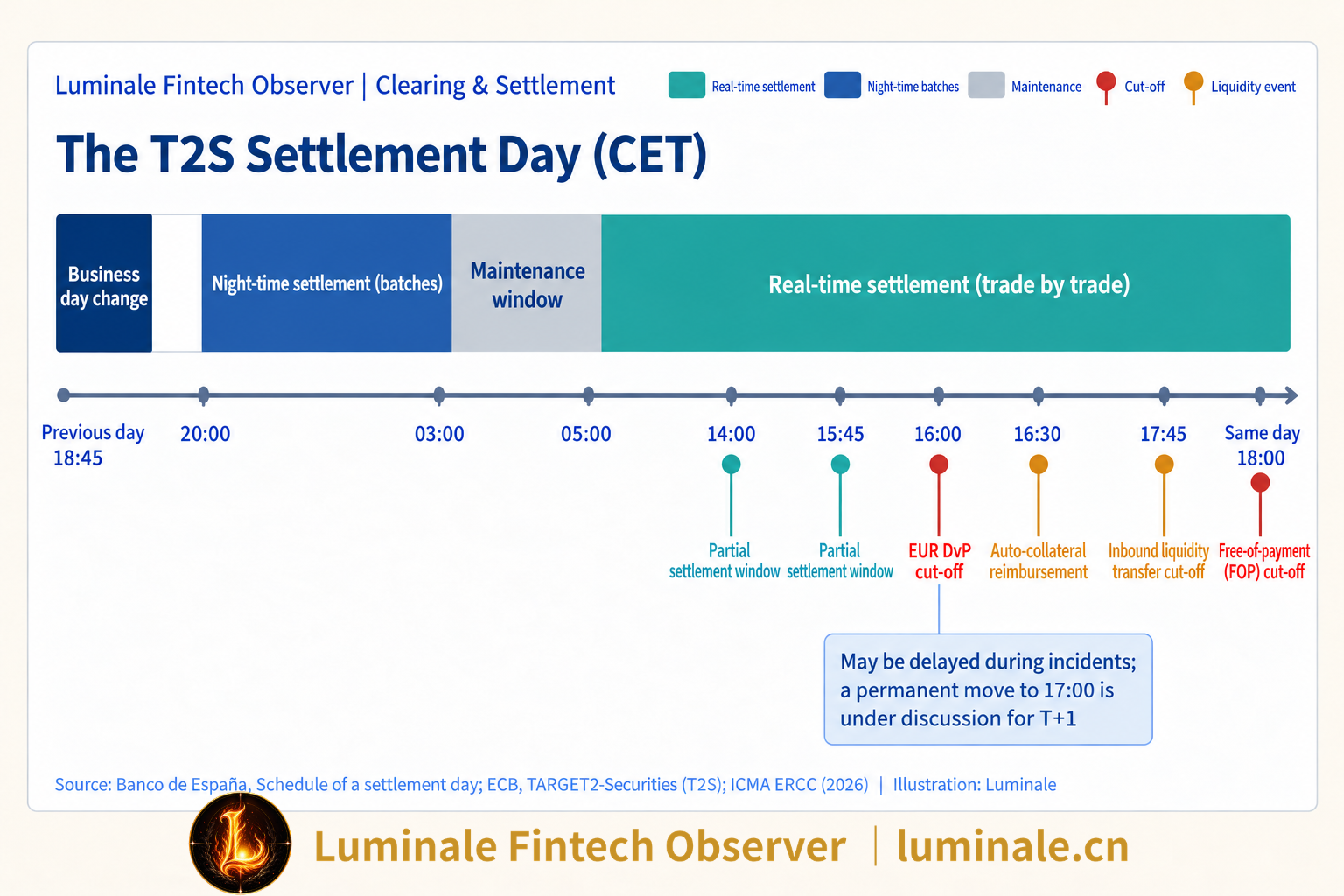
The T2S settlement day runs roughly as follows (Central European Time)[14]:
| Phase | Time | Main activity |
|---|---|---|
| Start of day and night-time settlement | Business day changes at 18:45; 20:00 to 03:00 the next day | Settles previously submitted instructions in batches |
| Maintenance window | 03:00 to 05:00 | System maintenance |
| Real-time settlement | 05:00 to 18:00 | Real-time, trade-by-trade settlement; partial settlement windows at 14:00 and 15:45 |
| EUR DvP cut-off | 16:00 | No further euro DvP instructions are settled |
| Auto-collateral reimbursement | 16:30 | Intraday auto-collateralisation is repaid; cash may optionally be swept out |
| Inbound liquidity transfer cut-off | 17:45 | No further transfers from T2 into DCAs are accepted |
| FOP cut-off | 18:00 | Cut-off for Free of Payment (FOP) instructions |
During night-time batch settlement, T2S checks a whole batch of instructions together for sufficient securities and cash, and inflows within the same batch can be used to cover outflows. Each instruction is still booked gross, which differs from Deferred Net Settlement (DNS), where only the net difference is settled. For the difference between the two, see RTGS and DNS: Payment Settlement, Liquidity, and Risk.
The 16:00 euro DvP cut-off is not fixed. When the system has an incident, the cut-off can be postponed temporarily. On 5 May 2025, for example, access channels to T2S failed, and that day's euro and Danish krone DvP cut-off was moved from 16:00 to 17:00[17]. In preparation for the EU shortening the securities settlement cycle to one business day (T+1) on 11 October 2027[18], the market is also discussing a permanent move of the euro DvP cut-off to 17:00[19].
2. Auto-Collateralisation: Turning Securities into Intraday Liquidity
If at some point the buyer's DCA does not hold enough money to pay for a securities trade, T2S can trigger auto-collateralisation: the system automatically uses eligible securities as collateral to obtain intraday credit from the central bank, and the arrival of funds, the delivery of securities and the registration of the pledge are completed in the same processing step[20].
The securities used as collateral come from two sources. The first is the security being bought, known as collateralisation on flow: the buyer uses the bonds it is about to receive to finance the payment for those same bonds. The second is other eligible securities already held in the buyer's account, known as collateralisation on stock.
Auto-collateralisation comes in two types, depending on who provides the credit[21]:
| Type | Credit provider | Borrower | Who bears the credit risk |
|---|---|---|---|
| Central bank auto-collateralisation | The payment bank's central bank | Payment bank | The central bank, controlled through eligible collateral and haircuts |
| Client auto-collateralisation | Payment bank | The payment bank's client (securities account holder) | The payment bank, controlled through the limits it sets for clients |
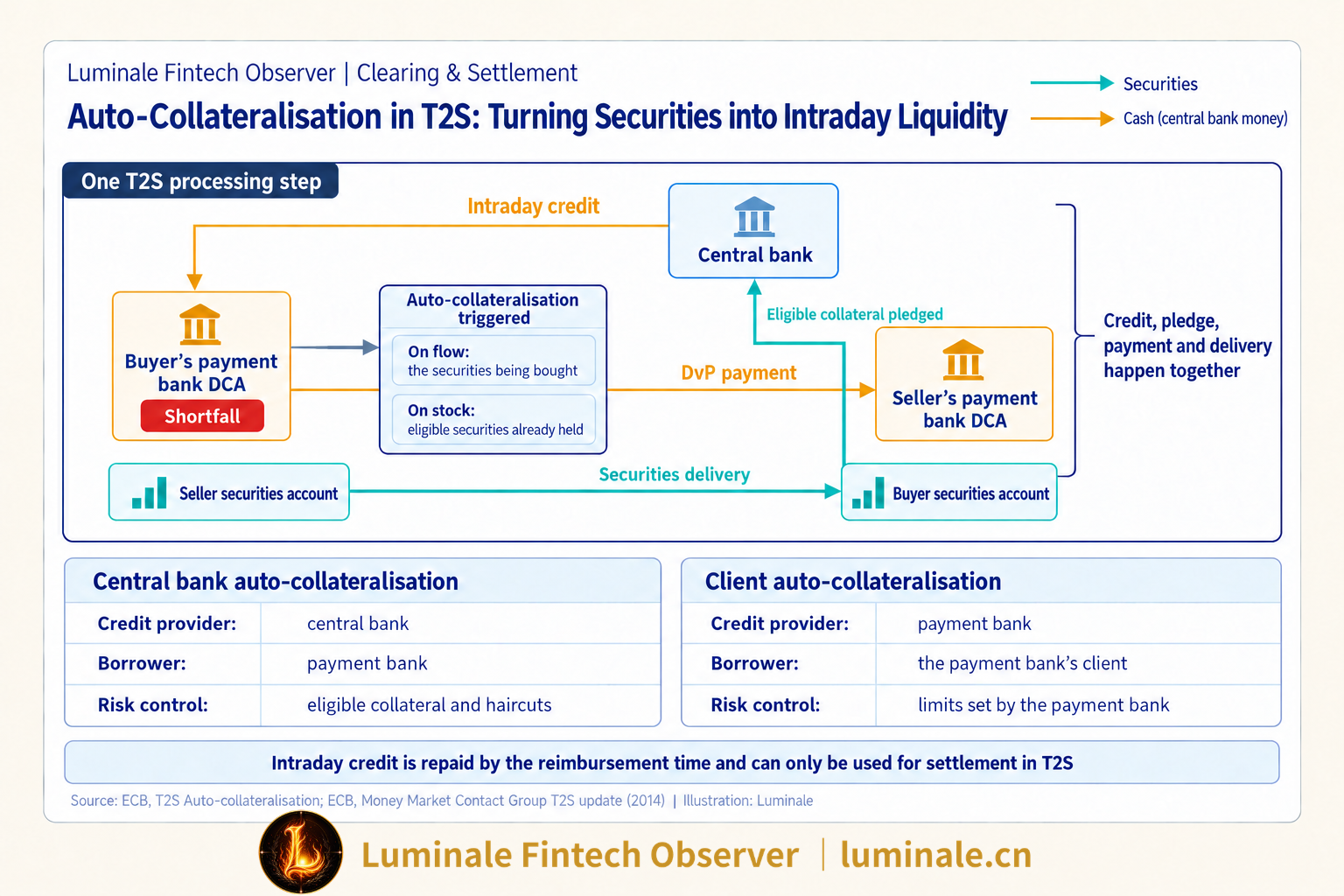
Auto-collateralisation creates intraday credit, which has to be repaid by that day's reimbursement time. It also has limits: only collateral the central bank accepts as eligible can be used, the amount that can be borrowed is calculated after haircuts, and it is capped by the limit the central bank sets for the payment bank. Liquidity obtained through auto-collateralisation can only be used for securities settlement within T2S; it cannot be moved to T2 to make other payments.
On 16 June 2025, the Eurosystem Collateral Management System (ECMS) went live, replacing the separate collateral management systems of the national central banks[22]. Which securities are eligible and what haircuts apply fall under the central bank's collateral management; T2S is responsible for booking the pledge on the securities accounts.
This mechanism addresses the same kind of problem as liquidity-saving mechanisms in RTGS: completing more settlement with limited liquidity. For queuing, offsetting and priorities in RTGS, see RTGS Payment Queuing and Liquidity-Saving Mechanisms Explained. For how central bank intraday credit appears on the balance sheet, see Central Bank Balance Sheets: Money, Reserves, and Settlement.
6. Conclusion: The Value, the Limits and the Next Step for a Shared Platform
Back to the trade at the start. A French buyer, an Italian seller, a German issuer CSD and two central banks in different countries end up completing, in one go on a single platform, the transfer of securities, the adjustment of omnibus accounts between CSDs, and the transfer of central bank money. T2S did not merge any CSD. What it did was put securities accounts and central bank money cash accounts on the same machine and use one set of rules to check and book them at the same time.
1. The Value Lies in Keeping Both Types of Account in One Place
The value of T2S comes mainly from having securities accounts and central bank money accounts on the same platform, so cross-CSD and cross-border DvP no longer requires two systems to pass messages back and forth. One pool of DCA liquidity can serve several markets, auto-collateralisation turns securities themselves into a source of liquidity, and as a result the cost and failure rate of cross-border settlement have come close to domestic levels. The ECB's published DvP fee is EUR 0.195 per instruction, plus a temporary surcharge of EUR 0.04[6].
2. The Limits Lie in the Legal and Asset-Servicing Layers
T2S has not harmonised securities law, tax procedures, corporate action processing or issuer services. These remain national and are the main source of the other barriers identified in the Giovannini reports. Fragmentation has been pushed out of the settlement layer, but it has not disappeared. Concentration also brings concentrated operational risk: when the platform fails, twenty-plus markets are affected, as the temporary postponements of cut-off times during several incidents in 2025 showed. This is why the Principles for Financial Market Infrastructures (PFMI) set specific requirements for operational risk and business continuity; see Reading the PFMI: 24 Principles and the Lines FMIs Must Hold.
3. How Tokenisation and Blockchain Could Change This Arrangement
Tokenised securities and Distributed Ledger Technology (DLT) bring the same questions to new ledgers: when securities are recorded on a DLT platform, what should the cash leg settle in, and how should the two legs be synchronised?
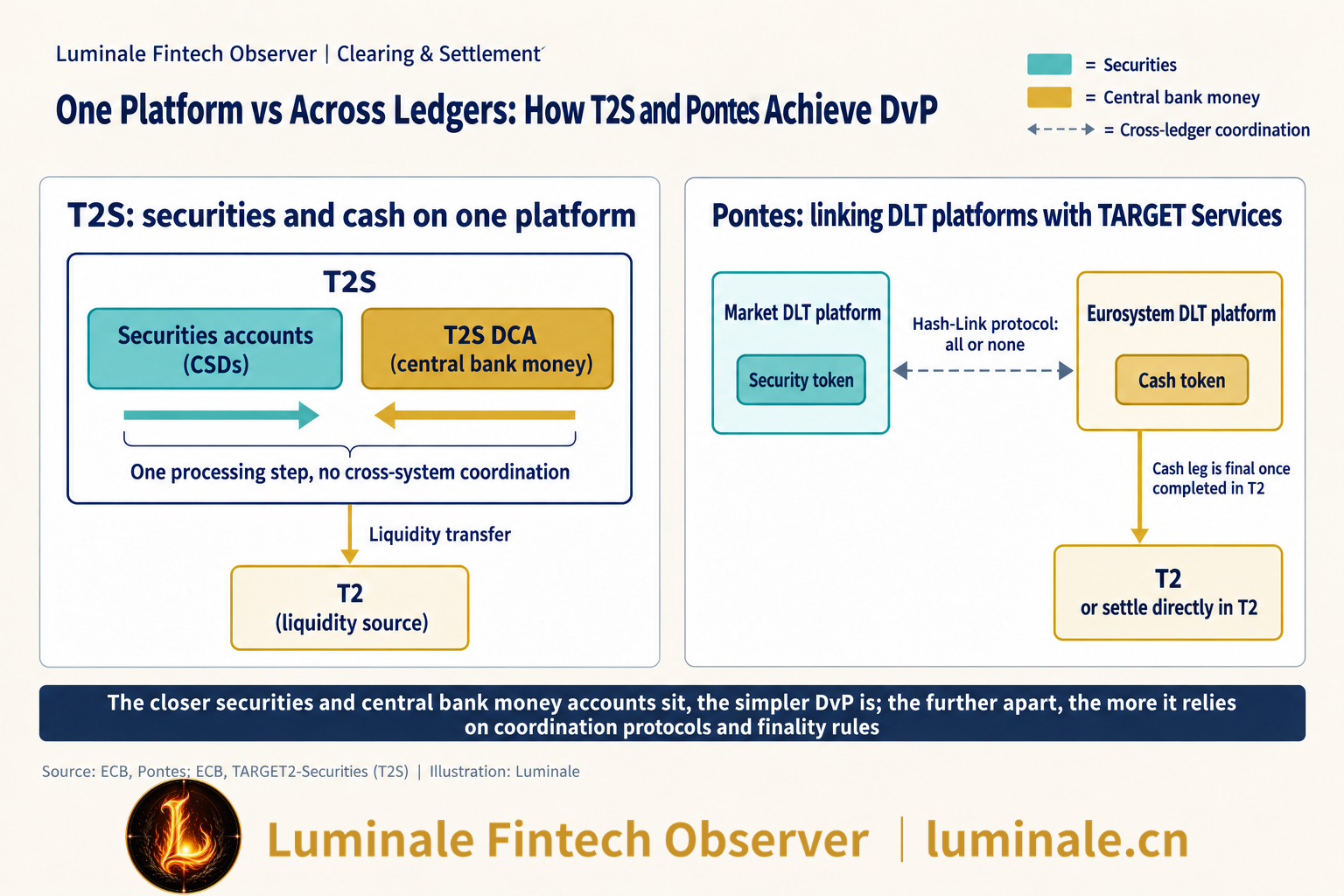
The Eurosystem's near-term answer is Pontes. Launched on 21 September 2026, it links market DLT platforms with TARGET Services so that wholesale transactions on DLT can settle in central bank money[23]. According to the ECB, participants can settle with cash tokens on the Eurosystem DLT platform or settle directly in T2; either way, the cash leg becomes final only once the corresponding transaction is completed in T2. DvP and other transactions that require all-or-none settlement are coordinated between the two ledgers through the Hash-Link protocol[24].
Using T2S as a reference point shows the trade-off Pontes makes. T2S brought securities accounts and cash accounts onto one platform and so removed the need for cross-system coordination. Pontes deals with securities that are already spread across separate DLT platforms, so it has to return to coordination between two ledgers, replacing message confirmations with a cryptographic protocol and relying on central bank money and finality in T2 as the backstop. Structurally, this path is closer to the cross-system DvP of Bond Connect. We described the two cash settlement models of Pontes in detail in From Pontes to Appia: Rebuilding the Cash Leg for Tokenised Securities.
T2S itself is also becoming connected with DLT. From 30 March 2026, marketable securities issued by CSDs using DLT-based services can be accepted as eligible collateral for Eurosystem credit operations, provided they meet existing criteria. One of those criteria is that the securities can be settled in a securities settlement system that complies with the Central Securities Depositories Regulation (CSDR) and is reachable via T2S[25]. DLT assets issued and settled entirely outside the CSD framework are not yet covered. In other words, on the central bank collateral side, T2S remains the main gateway through which euro securities enter the central bank money system.
The longer-term direction is Appia. The Eurosystem plans to publish a blueprint for a tokenised financial ecosystem in 2028, examining different DLT network configurations, including a single shared network and multiple interconnected networks[26]. The question it has to answer is much like the one T2S faced: if Europe ends up with many DLT platforms each running separately, will it repeat the situation of twenty-odd years ago, when national settlement systems each went their own way? The lesson of T2S was to unify the settlement layer first and let each institution keep its own business. For the tokenisation era, the Eurosystem is currently pursuing two paths in parallel: building a new unified shared ledger, and establishing standardised interoperability between heterogeneous ledgers.
Whichever path is chosen, the yardstick T2S leaves behind still applies: the closer securities accounts and central bank money accounts sit, the simpler DvP becomes; the further apart they are, the more it depends on reliable coordination protocols and legal finality arrangements. From the point-to-point linkage of Bond Connect, to the shared platform of T2S, to the cross-ledger bridge of Pontes, which form of interconnection is chosen depends on legal sovereignty, monetary arrangements and how much each institution is willing to give up. Technology is only one part of it.
References
[1]: The Giovannini Group, Cross-Border Clearing and Settlement Arrangements in the European Union, European Commission, November 2001; see also Bank of Finland Bulletin, From Giovannini barriers to Capital Markets Union, 2019. https://www.bofbulletin.fi/en/2019/articles/from-giovannini-barriers-to-capital-markets-union/ ↩
[2]: Decision of the European Central Bank of 16 November 2009 on the T2S Programme Board (ECB/2009/6 as amended), recitals. https://www.ecb.europa.eu/ecb/access_to_documents/document/legal_act/shared/data/ecb.dr.leg2009_L102_12.en.pdf ↩
[3]: Deutsche Bundesbank, T2S: Migration of all markets successfully completed, 2017-09-19. https://www.bundesbank.de/en/tasks/topics/t2s-migration-of-all-markets-successfully-completed-626950 ↩
[4]: European Central Bank, Danish krone now available for settlement in T2S, MIP News, 2018-10-29. https://www.ecb.europa.eu/press/intro/news/html/ecb.mipnews181029.en.html ↩
[5]: BTA, Central Securities Depository, Government Securities Depository Migrate to TARGET2-Securities, 2023-09-12. https://bta.bg/en/news/521061-central-securities-depository-government-securities-depository-migrate-to-targe ↩
[6]: European Central Bank, TARGET2-Securities (T2S). https://www.ecb.europa.eu/paym/target/t2s/html/index.en.html ↩
[7]: European Central Bank, T2S: Special Series, October 2012. https://www.ecb.europa.eu/paym/intro/publications/pdf/ecb.targetsecspecial121001.en.pdf ↩
[8]: Guideline (EU) 2022/912 of the European Central Bank of 24 February 2022 on a new-generation Trans-European Automated Real-time Gross settlement Express Transfer system (TARGET). https://eur-lex.europa.eu/eli/guideline/2022/912/oj ↩
[9]: European Central Bank, T2S Guide for Payment Banks. https://www.ecb.europa.eu/paym/target/target-professional-use-documents-links/t2s/shared/pdf/t2s_guide_for_payment_banks.pdf ↩
[10]: European Central Bank, What is T2?. https://www.ecb.europa.eu/paym/target/t2/html/index.en.html ↩
[11]: European Central Bank, T2-T2S Consolidation: User Requirements Document for T2 Central Liquidity Management, v1.2. https://www.ecb.europa.eu/paym/pdf/consultations/T2-T2S_Consolidation_User_Requirements_Document_T2_Central_Liquidity_Management_v1.2_CLEAN.pdf ↩
[12]: Committee on Payment and Settlement Systems, Delivery versus payment in securities settlement systems, BIS, September 1992. https://www.bis.org/cpmi/publ/d06.htm ↩
[13]: Deutsche Bundesbank, TARGET balances. https://www.bundesbank.de/en/tasks/payment-systems/t2/target-balances-920752 ↩
[14]: Banco de España, Schedule of a settlement day. https://www.bde.es/f/webbde/SPA/sispago/doc_trabajo/ficheros/es/Schedule_of_a_settlement_day.pdf ↩
[15]: AMI-SeCo, Clarification note on the T2S functionalities in the context of cross-CSD settlement for non-T2S issued securities, 2018-03-20. https://www.ecb.europa.eu/paym/groups/shared/docs/ce3ff-ami-seco-2018-03-20-item-04.4-clarification-note-on-the-t2s-functionalities-in-the-context-of-cross-csd-settlement-for-non-t2s-issued-securities.pdf ↩
[16]: European Central Bank, T2S User Requirements Document, R2024.JUN. https://www.ecb.europa.eu/paym/target/target-professional-use-documents-links/t2s/sdd/shared/pdf/T2S_URD_R2024.JUN_clean_20240222.en.pdf ↩
[17]: Clearstream Banking, T2S incident - Update, Operational News, 2025-05-05. https://www.clearstream.com/clearstream-en/res-library/ops250505-2-4427776 ↩
[18]: European Commission, A shorter settlement cycle, 2025-07-03. https://finance.ec.europa.eu/news/shorter-settlement-cycle-2025-07-03_en ↩
[19]: ICMA ERCC, Response to the AMI-SeCo/AMI-Pay survey on T2S DvP cut-off extension, 2026-02-18. https://www.icmagroup.org/assets/T2S-DvP-cut-off-extension-survey-ICMA-ERCC-response.pdf ↩
[20]: European Central Bank, T2S Auto-collateralisation. https://www.ecb.europa.eu/paym/target/t2s/profuse/shared/pdf/T2S_Auto_collateralisation.pdf ↩
[21]: European Central Bank, T2S update, Money Market Contact Group, 2014-11-21. https://www.ecb.europa.eu/paym/groups/pdf/mmcg/20141121/2014-11-21_MMCG_Item_5_T2S_update.pdf ↩
[22]: European Central Bank, ECMS to go live on 16 June 2025, MIP News, 2025-05-16. https://www.ecb.europa.eu/press/intro/news/html/ecb.mipnews250516.en.html ↩
[23]: European Central Bank, ECB to invest part of own funds in tokenised securities, with settlement via Pontes, press release, 2026-09-21. https://www.ecb.europa.eu/press/pr/date/2026/html/ecb.pr260921_1~5a011ecbea.en.html ↩
[24]: European Central Bank, Pontes. https://www.ecb.europa.eu/paym/target/pontes/html/index.en.html ↩
[25]: European Central Bank, ECB paves way for acceptance of DLT-based assets as eligible Eurosystem collateral, press release, 2026-01-27. https://www.ecb.europa.eu/press/pr/date/2026/html/ecb.pr260127_1~a946167ce1.en.html ↩
[26]: European Central Bank, Update on the Eurosystem work on new technologies for wholesale central bank money settlement, press release, 2026-03-11. https://www.ecb.europa.eu/press/pr/date/2026/html/ecb.pr260311~14ddf51a77.en.html ↩
Originally published by Luminale Fintech Observer: https://luminale.cn/articles/t2s-securities-settlement-dvp-model-en