From Money Multiplier to Payment Settlement: Explaining Central Bank Reserves in One Go

In the previous article on interbank transfersAfter the "Transfer Was Successful": Payment Instruction, Account Posting, and Funds Transfer Are Actually Three Different Things', we looked at a set of account changes like this:
When Bank A's customer transfers 1,000 yuan to Bank B's customer. At the customer level, Customer A's deposit decreases by 1,000 yuan and Customer B's deposit increases by 1,000 yuan; at the bank level, Bank A's reserves decrease by 1,000 yuan and Bank B's reserves increase by 1,000 yuan.
| Level | Paying Side | Receiving Side |
|---|---|---|
| Customer Accounts | Customer A's deposit −1,000 yuan | Customer B's deposit +1,000 yuan |
| Bank Accounts | Bank A's reserves −1,000 yuan | Bank B's reserves +1,000 yuan |
In practice, payment instructions may go through netting or real-time gross settlement, and the reserves ultimately transferred may not equal the total of each customer payment. But no matter which path is taken, the same question arises:
Why don't banks directly accept each other's commercial bank deposits, and instead use a dedicated asset like central bank reserves?
The answer cannot be found solely in "how much money the central bank requires banks to hold." Reserves sit at the intersection of three systems simultaneously: they are the underlying asset for central bank monetary policy operations, the key asset for banks'liquidity management, and one of the most important settlement assets in the payment and clearing system.
To understand reserves, one must first answer a question:
Why do banks need to hold central bank money?
I. Whose Money Are Reserves, Exactly?
In the context of payment and settlement and central bank balance sheets discussed in this article, reserves mainly refer to the balances held in central bank accounts by eligible institutions such as commercial banks.
It has two sides:
- For commercial banks, reserves are an asset;
- For the central bank, reserves are a liability.
This is very similar to the accounting relationship of customer deposits. The 100 yuan in a customer's account is the customer's asset but constitutes a liability of the bank where the account is held for the customer; the 100 yuan in a commercial bank's reserve account is the commercial bank's asset but constitutes a liability of the central bank to the commercial bank.
Below is a simplified commercial bank balance sheet:
| Assets | Amount | Liabilities and Equity | Amount |
|---|---|---|---|
| Central bank reserves | 20 | Customer deposits | 90 |
| Customer loans | 80 | Bank funding | 5 |
| Equity | 5 | ||
| Total | 100 | Total | 100 |
What matters here is not "what proportion of bank assets reserves account for," but who issues the reserves.
Bank loans, corporate bonds, and other financial assets may all carry counterparty credit risk; central bank reserves are liabilities of the domestic currency central bank. Accordingly, PFMI defines central bank money as a liability of the central bank and identifies deposit balances held at the central bank that can be used for settlement as its typical form. CPMI-IOSCO Principles for Financial Market Infrastructures
Reserves therefore naturally sit above commercial bank deposits, forming a modern two-tier monetary system:
| Monetary Tier | Primary Holders | Issuer's Liability | Typical Uses |
|---|---|---|---|
| Central bank money | Commercial banks and other authorized institutions | Central bank | Interbank settlement, liquidity and monetary policy operations |
| Commercial bank money | Businesses and households | Commercial banks | Everyday payments, savings, and credit activities |
Ordinary businesses and households mainly use commercial bank deposits for payments; when commercial banks complete final fund settlement among themselves, they move up to the higher tier of the central bank's balance sheet.
II. Why Do Reserves Exist: Three Functional Threads
Reserves are difficult to explain through a single unified institutional history. Different countries'central banking systems, banking regulation, and payment systems have followed different paths. More useful than asking "in which year were reserves first born" is understanding how three types of demands gradually converged on central bank reserve accounts.
1. Banking Operations Require Liquidity
Banks'assets and liabilities are asymmetric in maturity.
Customer deposits may be withdrawn, used for payments, or transferred to other banks; banks'assets, however, may be loans with longer maturities that cannot be immediately liquidated. If a bank allocates all its funds to long-duration, low-liquidity assets, it may fail to meet its obligations on time when payment outflows occur in concentration.
Therefore, even without reserve requirements, banks have reason to hold a certain amount of highly liquid assets.
However, highly liquid assets are not limited to central bank reserves. Vault cash, high-quality government bonds, and other eligible assets can also be included in a bank's liquidity management. What is special about central bank reserves is that they are not only highly liquid but can also be used directly for final interbank fund settlement.
2. Central Banking Systems and Monetary Policy Create Demand for Reserves
With the development of modern central banking systems, banks'reserve behavior has entered an institutionalized framework. Central banks can stipulate that financial institutions maintain minimum reserves according to certain definitions and ratios, and can also influence the quantity and price of reserves through instruments such as open market operations, lending facilities, and reserve interest rates.
The required reserve system may therefore serve multiple functions:
- Influencing the minimum demand for central bank reserves in the banking system;
- Regulating the long-term liquidity of the banking system;
- Supporting the monetary policy operational framework;
- Influencing the aggregate or structure of money and credit during specific periods.
These functions do not all exist simultaneously in all countries at all times. The role of the reserve system evolves with changes in monetary policy operational methods and financial market development.
3. Interbank Payments Require a Common Settlement Asset
If Bank A and Bank B both require the other to settle with their own deposits, a circular problem arises:
Why would Bank A be willing to accept Bank B's liability? And why would Bank B be willing to accept Bank A's liability?
If final settlement depends on one particular commercial bank, other participants must bear the credit risk and liquidity risk of that settlement bank. Concentrating settlement on the central bank's books is equivalent to having all participating banks jointly use a higher-tier asset.
This is not merely a technical convenience but a collective choice of the issuer of the settlement asset.
The three threads can be summarized as follows:
| Perspective | Why Banks Need Reserves |
|---|---|
| Banking operations | To cope with payment outflows and liquidity fluctuations |
| Central banking system | To meet reserve requirements and participate in monetary policy operations |
| Payment and settlement | To use a settlement asset commonly accepted by the banking system |
The same reservoir can simultaneously serve water supply, peak shaving, and emergency functions. One should not understand the entire reservoir as "the portion of water that regulatory requirements mandate must be retained" simply because the reservoir has a minimum water level.
The same applies to reserves.
III. China's Reserve System: From Aggregate Control to Liquidity Management
In its China Monetary Policy Report, Q4 2024, the People's Bank of China (PBC) reviewed the evolution of China's deposit reserve system in a dedicated column. This historical thread illustrates one thing: the function of the reserve system is not fixed but adjusts along with the macroeconomic environment, payment system, and monetary policy framework.
China's deposit reserve system was established in 1984.
In 1998, following the abolition of loan scale controls and the shift of monetary policy regulation from direct to indirect controls, the reserve system underwent an important reform: required reserve accounts and excess reserve accounts were merged into a unified "reserve deposits" account; the required reserve ratio was lowered from 13% to 8%; the total amount and distribution of reserves above the required level were left to financial institutions'discretion; and required reserves were changed to be assessed on a consolidated basis at the legal entity level.
The PBC's summary of this reform is worth noting: it both improved the payment and clearing function of reserves and strengthened the reserve system's aggregate control capacity. That is to say, on the same reserve account, payment and settlement and monetary policy are no longer two separate issues.
From 2003 to 2011, foreign exchange inflows continued, and the central bank's foreign exchange purchases injected large amounts of base money into the banking system. The PBC raised reserve ratios multiple times to absorb and offset excess liquidity in the banking system.
After 2013, as the balance of payments situation and liquidity supply channels changed, reserve ratios began to be lowered continuously to supplement long-term liquidity for the banking system. In 2014, targeted reserve requirement cuts appeared to provide positive incentives for specific areas.
In 2015 and 2016, reserve assessment was changed from a point-in-time method to an averaging method in two steps. Averaging assessment allows financial institutions to adjust daily reserve balances within the assessment period, reducing violent fluctuations at any single point in time, expanding banks'room for liquidity management, and helping to smooth money market interest rates.
Subsequently, targeted arrangements, tier design, and some structural functions continued to be adjusted, the aggregate adjustment function of the reserve tool gradually became more focused, and the institutional framework trended toward greater simplicity. People's Bank of China China Monetary Policy Report, Q4 2024
This history demonstrates at least three things:
First, the reserve account serves not only statutory ratio assessment but also payment and clearing and day-to-day liquidity management.
Second, the reserve ratio can be used either to absorb liquidity or to release long-term liquidity through reductions; the specific role depends on the prevailing base money supply method and monetary policy environment.
Third, the reserve system evolves with the monetary policy framework. One should not treat the operational methods of a particular historical period as the immutable essence of the reserve system.
IV. Reserves Are Not the Same as Required Reserves
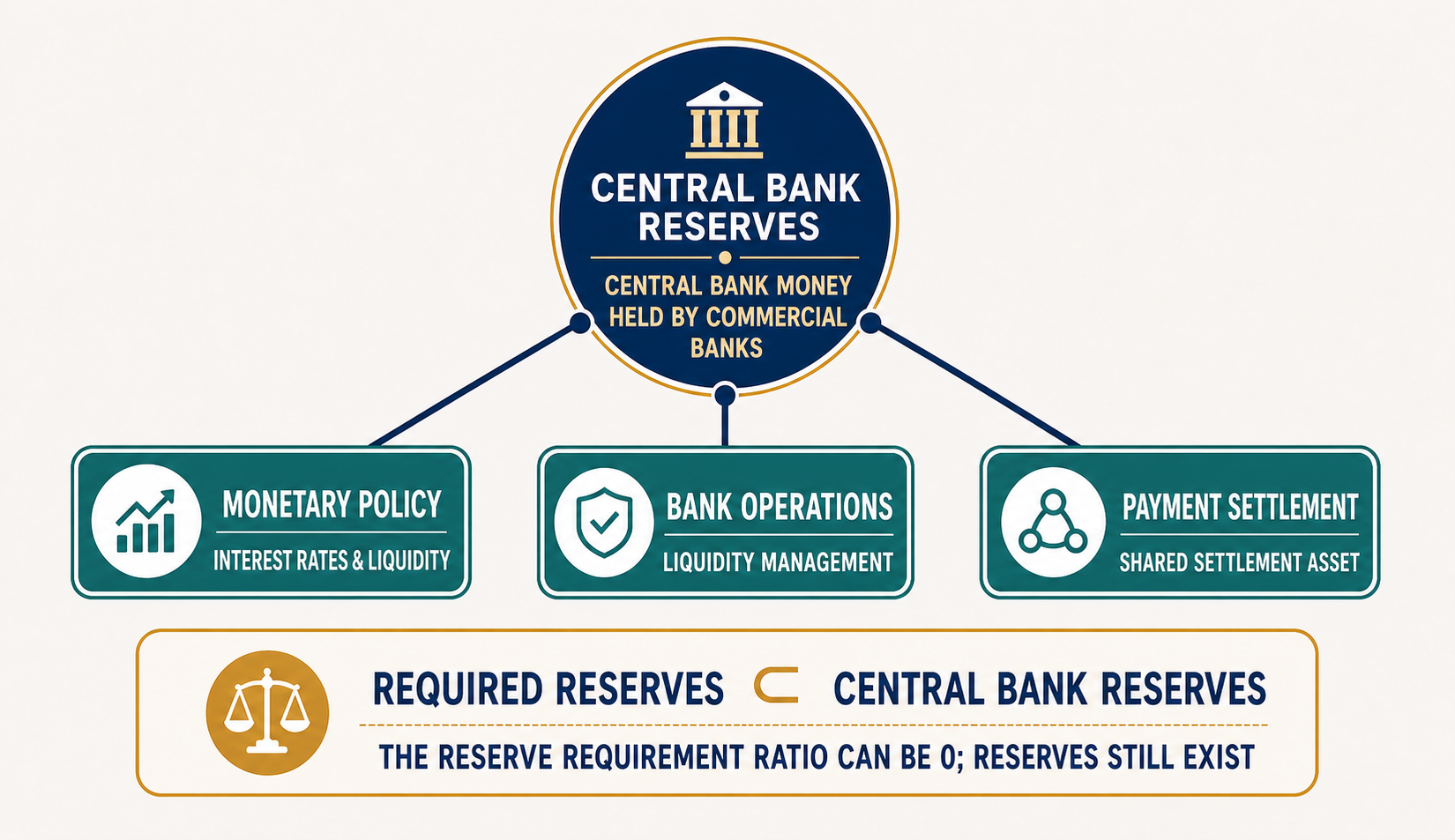
The public most often encounters reserves through news of "reserve requirement ratio cuts" (RRR cuts), which can easily create the impression that reserves are money locked away by the central bank and unavailable for use.
A more accurate conceptual relationship is as follows:
| Concept | Meaning |
|---|---|
| Central bank reserves | Central bank money held by commercial banks and other institutions |
| Required reserves | The minimum reserves that must be maintained according to the institutional framework |
| Excess reserves | The amount by which actual holdings exceed the minimum requirement |
| Reserve ratio | The percentage parameter used to calculate the minimum reserve requirement |
In a simplest model, the required reserve requirement can be written as:
Minimum reserve requirement = Liabilities base subject to assessment × Reserve ratio
But real-world systems may also involve averaging assessment, calculation and maintenance periods, differences across institutions or liability categories, exemption arrangements, and eligibility criteria for qualifying assets—one cannot look at a single percentage alone.
The US case provides a compelling counterexample.
The Federal Reserve reduced reserve requirement ratios to 0% effective March 26, 2020, eliminating reserve requirements for all depository institutions. The background is that the Fed had already shifted to an "ample reserves" operational framework, and required reserves no longer played their original role in monetary policy implementation. Federal Reserve: Reserve Requirements
But after the required reserve ratio was reduced to 0%:
- Banks still hold reserves in their Federal Reserve accounts;
- Systems such as Fedwire still complete interbank settlement through transfers across reserve accounts;
- The Fed still pays interest on reserve balances and uses the interest rate on reserves as a monetary policy tool.
The Federal Reserve's official explanation of reserves is also straightforward: reserve balances are liabilities of the Federal Reserve and simultaneously assets of the holding banks; ample liquidity remains important for the safety of the banking system, the efficiency of the payment system, and financial stability. Federal Reserve: Interest on Reserve Balances FAQs
Therefore:
The reserve ratio can be 0, but reserves can still be core assets of the payment system and the monetary policy framework.
Just as minimum inventory requirements can be reduced to zero while enterprises still hold inventory proactively due to daily operational needs, eliminating the minimum requirement does not mean inventory itself has lost its function.
V. The Money Multiplier: Understand the Model First, Then Move Beyond It
The most widely known theoretical story about reserves is probably the textbook money multiplier.
Assume a required reserve ratio of 10%, the banking system holds no excess reserves, there is no cash leakage, and all loans are redeposited into banks after being made.
When the first bank receives 100 yuan in new deposits, it keeps 10 yuan in reserves and lends out 90 yuan; after the 90 yuan enters the second bank, it keeps 9 yuan and lends out 81 yuan; the process continues:
| Round | New Deposits | New Reserves | New Loans |
|---|---|---|---|
| Round 1 | 100.00 | 10.00 | 90.00 |
| Round 2 | 90.00 | 9.00 | 81.00 |
| Round 3 | 81.00 | 8.10 | 72.90 |
| ... | ... | ... | ... |
| Theoretical Total | 1000.00 | 100.00 | 900.00 |
The mathematical relationship is:
Total deposits = 100 + 90 + 81 + ... = 100 ÷ 10% = 1000
From this, the simple multiplier is derived:
Deposit multiplier ≈ 1 ÷ Reserve ratio
This model has pedagogical value. It intuitively demonstrates that, under a strict set of assumptions, the reserve system can affect the room for deposit and credit expansion in the banking system.
The problem is that in reality, banks do not first check that they have 100 yuan more in reserves and then mechanically determine how much lending they can do by "1 ÷ reserve ratio."
In reality, loans create deposits first
Suppose a bank approves a 1 million yuan corporate loan. The initial account changes are typically:
| Bank Assets | Change | Bank Liabilities | Change |
|---|---|---|---|
| Customer loans | +1 million yuan | Customer deposits | +1 million yuan |
Both bank assets and liabilities expand simultaneously. The new loan creates a new bank deposit when it is booked; it does not require the bank to first move 1 million yuan out of another depositor's account.
Reserve needs typically only become apparent after the loan has been made. If the borrower pays funds to a customer of another bank, the lending bank will face a reserve outflow. It needs to use its existing reserves, attract deposits or other funding, borrow from the interbank market, or obtain liquidity through central bank facilities where eligible.
The Bank of England, in Money Creation in the Modern Economy, explicitly states that commercial banks do not simply "multiply up" central bank money; lending activity itself creates deposits. Bank lending and money creation are constrained by multiple factors including monetary policy, capital, risk, profitability, and loan demand. Bank of England Money creation in the modern economy
The constraints in reality are closer to the following table:
| Constraint or Condition | How It Affects Credit Creation |
|---|---|
| Effective loan demand | Whether there are customers willing and able to borrow |
| Credit risk | Whether expected losses and asset quality are acceptable |
| Capital constraints | Whether new risk-weighted assets require more capital support |
| Liquidity and funding | Whether deposit and reserve outflows can be handled after loan drawdown |
| Interest rates and profitability | Whether loan returns cover funding, risk, and operating costs |
| Regulatory requirements | Whether capital, liquidity, concentration, and other rules permit it |
| Central bank policy | How policy rates and liquidity conditions affect funding costs |
Reserves are not irrelevant. They determine whether banks can smoothly cope with payment outflows, and their quantity, distribution, and price affect the interbank funding market and credit costs.
But they are more like an important constraint and settlement condition in the bank credit creation process than a fixed multiplication button on a credit machine.
Therefore, directly multiplying "an RRR cut releasing 1 trillion yuan in reserves" by some theoretical multiplier to conclude that a certain number of trillions of yuan in new loans will inevitably be created is unreliable. The release of liquidity merely changes the constraint conditions of the banking system; how much financing ultimately materializes also depends on loan demand, risk, capital, prices, and policy transmission.
VI. Why Does PFMI Still Prefer Settling with Central Bank Money?
Returning from monetary policy to payment infrastructure, the core question is not how much reserves banks must hold, but:
Whose liability should a systemically important financial market infrastructure ultimately accept as its settlement asset?
Financial market infrastructures include systemically important payment systems, central securities depositories, securities settlement systems, and central counterparties, among others. They process large volumes of funds and financial assets every day, and if the settlement asset fails, risks can transmit to numerous participants simultaneously.
Suppose an infrastructure uses deposits at Commercial Bank X to settle funds. After the transaction, participants ultimately hold claims against Bank X.
This introduces two additional types of risk:
| Risk | Specific Meaning |
|---|---|
| Credit risk | If Bank X becomes insolvent, participants may be unable to recover settlement funds in full |
| Liquidity risk | Settlement funds may not be convertible into central bank money or other usable liquid assets in a timely manner |
PFMI Principle 9 therefore states:
Where practical and available, financial market infrastructures should use central bank money to settle funds; if central bank money is not used, the credit risk and liquidity risk arising from commercial bank money should be minimized and strictly controlled. CPMI-IOSCO Principles for Financial Market Infrastructures, Principle 9
The qualifier here is important: where practical and available.
PFMI does not mandate that all systems in all scenarios must use central bank money. Certain infrastructures may not be able to open central bank accounts directly, may need to handle currencies not covered by central bank settlement services, or may have settlement hours that do not align with central bank system operating hours.
If commercial bank money is used, what PFMI requires is not a vague statement that "this bank is very safe," but a comprehensive set of risk control measures:
- Settlement assets should have little or no credit risk and liquidity risk;
- Strictly assess the settlement bank's regulatory status, credit quality, capital, liquidity, and operational reliability;
- Monitor risk concentration to a single settlement bank;
- Assess the potential losses and liquidity pressure that would arise if the largest settlement bank failed;
- Clearly define when funds transfers become final;
- Ensure that received funds can be transferred promptly, available at least by the end of the day and ideally supporting intraday transfers.
Therefore, the core of Principle 9 is not that "central bank-operated systems are naturally superior to all market-based systems," but rather:
Do not let the settlement asset issuer's own credit and liquidity problems become an additional layer of systemic risk for financial market infrastructures.
VII. Reserves Are Also the Interface of Monetary Uniformity
The significance of reserves goes beyond reducing the risk of individual settlements.
One yuan of deposit at Bank A and one yuan of deposit at Bank B have different legal debtors. The former is a liability of Bank A, and the latter is a liability of Bank B. But under normal circumstances, we do not apply a discount to deposits at different banks when making payments; we treat them all as equivalent 1 yuan in RMB.
This is monetary uniformity(or singleness of money): the same currency unit can be converted at par across different banks and different payment scenarios.
Monetary uniformity is not maintained merely by habit. Behind it lie institutional arrangements including deposit insurance, prudential regulation, central bank liquidity support, and interbank settlement in central bank money.
The Bank for International Settlements, in discussing the two-tier monetary system, points out that the central bank anchors the par-value payment of commercial bank money by providing the safe asset needed for final settlement. A key reason deposits issued by different banks can function as a unified payment instrument is that banks can settle among themselves using central bank reserves. BIS Annual Economic Report 2025, Chapter 3
Reserves therefore act like the interface between the two tiers of the monetary system:
- For businesses and households, payments manifest as increases and decreases in commercial bank deposits;
- For commercial banks, interbank positions ultimately manifest as transfers of central bank reserves;
- For the central bank, reserve accounts connect monetary policy, liquidity provision, and payment settlement on the same balance sheet.
Conclusion: What Makes Reserves Special Is Whose Liability They Are
Reserves matter not merely because the central bank requires banks to set aside a portion of funds.
The required reserve ratio is only a rule specifying, under a particular institutional framework, how much reserves banks must maintain at minimum. The money multiplier is only a simplified model helping us understand the relationship between the reserve system and bank credit expansion.
What makes reserves special is that they are themselves a liability of the central bank.
It is precisely for this reason that they can simultaneously carry three identities:
| Perspective | Identity of Reserves |
|---|---|
| Monetary policy | The underlying asset for the central bank to adjust interest rates and banking system liquidity |
| Banking operations | An important asset for coping with payment outflows, liquidity fluctuations, and institutional requirements |
| Payment infrastructure | The central bank settlement asset commonly accepted by the banking system |
These three identities ultimately point to the same question:
Why is the entire commercial banking system willing to accept the same asset for settlement?
The answer is not because every bank unconditionally trusts every other bank, but because they all stand together on the higher tier of the central bank's balance sheet.
Once this is understood, the next question naturally emerges:
If reserves are the interbank settlement asset, how much does a bank actually need to prepare in a day? If it needs to pay 10 billion yuan in the morning but only receives 10 billion yuan in the afternoon, what happens to the liquidity gap in between?
This will bring us to the next layer of payment system design: real-time gross settlement, intraday liquidity, central bank intraday credit, collateral, and liquidity-saving mechanisms.
Originally published by Luminale Fintech Observer: https://luminale.cn/articles/central-bank-reserves-explained-en