
Open your banking app, and the balance shows 1,000 yuan. Open Alipay, and the balance in your payment account also shows 1,000 yuan.
When you scan a QR code to pay at a convenience store, the two seem to make no difference: choose your bank card and you can pay; choose your Alipay balance and you can pay as well. To the user, both are simply numbers on a phone screen, and both are "money" that can be spent at any time.
But if we follow these two numbers deeper into the financial system, we find that they represent two different sets of relationships.
The 1,000 yuan in a bank account is a deposit liability that a commercial bank owes to its customer. The 1,000 yuan in a payment account, by contrast, rests on the payment account, customer reserve funds, and a dedicated customer-fund protection regime.
The most fundamental difference lies in three questions:
What kind of obligation does the institution owe the customer, can the customer's funds enter the institution's own balance sheet, and is the institution allowed to use those funds for credit creation?
Once these three questions are clear, it becomes easier to understand why payment institutions cannot lend out customer funds, why payment-account balances cannot earn interest, and what the customer reserve-fund regime is actually designed to protect.
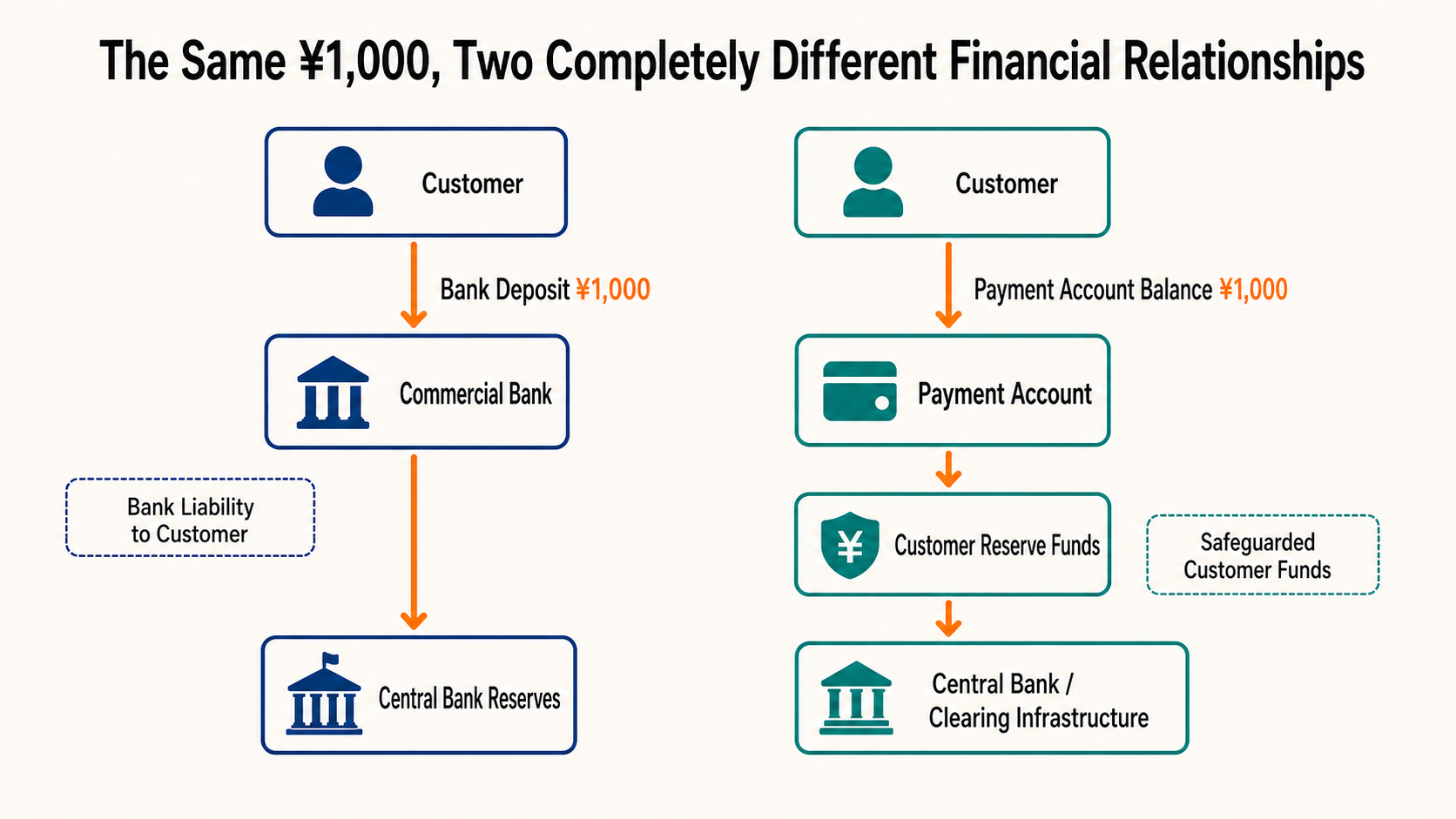
I. The Same 1,000 Yuan, but a Different Relationship Behind It
Before discussing "money in Alipay," we first need to separate three concepts that are often mixed together.
| Funds shown on the phone | Actual nature |
|---|---|
| Funds in a bank card linked to Alipay | Still a commercial bank deposit; Alipay merely helps initiate the payment |
| Alipay payment-account balance | A balance in a payment account, backed by customer reserve-fund protection arrangements |
| Products such as Yu'e Bao | Financial products such as money-market funds, with investment returns and corresponding risks |
So "there is 1,000 yuan in Alipay" may refer to a bank deposit, a payment-account balance, or fund units. This article discusses the second case: the payment-account balance.
Why a Bank Deposit Is a Bank Liability
When a customer deposits 1,000 yuan with a bank, the customer obtains a claim against the bank. The bank promises to make payments and withdrawals for the customer according to the account terms, so the 1,000 yuan is recorded on the liabilities side of the bank's balance sheet.
A highly simplified commercial-bank balance sheet looks roughly like this:
| Assets | Liabilities and shareholders'equity |
|---|---|
| Central bank reserves | Customer deposits |
| Cash in vault | Interbank and other liabilities |
| Loans | Shareholders'equity |
| Bonds and other investments | Other items |
For example, ignoring fees and other factors, when a customer deposits 1,000 yuan with a bank, the transaction can be simplified as follows:
| Bank account item | Change |
|---|---|
| Assets such as cash or reserves | +1,000 |
| Customer deposit liability | +1,000 |
A bank does not lock every customer's cash in a vault or lend all of it out. Subject to capital, liquidity, reserve, risk-management, and prudential-regulatory constraints, it allocates assets, extends loans or holds bonds, and assumes credit risk and maturity-transformation risk.
Therefore, a commercial bank provides account services while also acting as a credit intermediary.
A Payment-Account Balance Is Not a Bank Deposit
The core functions of a payment institution are different.
It opens payment accounts for users, records balances, identifies transactions, transmits payment instructions, and processes transfers of funds. But it is not authorized to accept public deposits or lend out customer funds.
But this point should not be oversimplified:
The fact that a payment-account balance is not a bank deposit does not mean that the payment institution has no obligation at all to repay or perform for the user.
A payment institution must still process balance withdrawals and transfers for users in accordance with the law, business rules, and user agreements. But this relationship is not a deposit relationship in the commercial-bank sense, and the corresponding customer funds cannot become the payment institution's own property, freely available for its use.
The two models can be summarized as follows:
| Comparison | Bank deposit | Payment-account balance |
|---|---|---|
| Institutional role | Deposit-taking institution, credit intermediary, and payment-service provider | Non-bank payment-service provider |
| Account basis | The bank's deposit liability to the customer | Payment account and customer-fund protection arrangements |
| Use of funds | The bank may allocate assets subject to prudential regulation | The payment institution may not use customer reserve funds as its own funds |
| Interest | The bank may pay interest under the deposit contract | The institution may not pay interest or other returns related to the balance to users |
| Main protection mechanisms | Bank prudential regulation, capital and liquidity requirements, deposit insurance, and so on | Reserve-fund segregation, custody, reconciliation, and clearing supervision, and so on |
| Is it a bank deposit? | Yes | No |
This does not mean that a payment-account balance "does not count as money." From the perspective of payment functions, it has strong characteristics as a medium of exchange. After the People's Bank of China adjusted its monetary-statistics definitions, it included customer reserve funds held by non-bank payment institutions in M1. This statistical change shows that these funds have real purchasing power, but it does not change their legal or institutional nature: they are not commercial-bank deposits. People's Bank of China explanation of the monetary-statistics definitions
Why Can't a Payment-Account Balance Pay Interest?
There are two layers to the answer.
The first is an explicit regulatory requirement. Current regulations stipulate that non-bank payment institutions may not pay users interest or other returns related to the balances they hold.
The second concerns the nature of the institution. If a payment institution could continuously take in public funds, pay users interest, and then use those funds for lending and investment, it would gradually move toward the banking model of "taking in funds, deploying funds, and paying interest."
Banks can operate this way because they hold a full banking license and are subject to prudential regulation. Payment institutions do not have the same business boundaries. They cannot take advantage of the convenience of holding customer funds without bearing the regulatory costs imposed on the banking system.
So the first conclusion is:
II. If Payment Institutions Cannot Touch Customer Funds, Where Are the Funds Held?
This brings us to "customer reserve funds."
The current Regulation on the Supervision and Administration of Non-Bank Payment Institutions defines reserve funds as "prepaid monetary funds awaiting payment" actually received by a payment institution for providing payment services. It also explicitly prohibits payment institutions from misappropriating, occupying, borrowing, or using reserve funds to provide guarantees for themselves or others. Regulation on the Supervision and Administration of Non-Bank Payment Institutions
But today's framework was not created all at once.
From Distributed Custody to Centralized Custody
In the early stage of the payment industry's rapid growth, customer reserve funds were mainly held across multiple commercial banks. The 2013 rules already required reserve funds to be held in dedicated accounts and prohibited their misappropriation, but payment institutions still opened and managed large numbers of reserve-fund accounts at different banks.
As payment institutions grew larger, this model gradually exposed several problems:
| Problem | What it looked like in practice |
|---|---|
| Customer-fund security | Some institutions misappropriated, occupied, or even defrauded customers of their reserve funds |
| Regulatory difficulty | Accounts were spread across many banks, making reconciliation and monitoring complex |
| Clearing order | Payment institutions moved funds between accounts at different banks, effectively taking on an interbank-clearing function |
| Information transparency | Payment information was scattered across one-to-one direct connections between payment institutions and banks |
| Business model | Large accumulated balances generated interest that could be used for price subsidies and unfair competition |
China subsequently began to restructure reserve-fund custody and the clearing system for online payments.
| Time | Main change |
|---|---|
| 2017 | Centralized deposit of customer reserve funds began, with an initial average deposit ratio of approximately 20% |
| Late 2017 to 2018 | The centralized-deposit ratio was raised in stages |
| 2018 | Online payment businesses began migrating to legally recognized clearing institutions such as NetsUnion Clearing |
| January 2019 | 100% centralized deposit of customer reserve funds was achieved |
The People's Bank of China's Financial Stability Report records this reform process: centralized deposit began in 2017, the ratio was gradually increased in 2018, and 100% centralized deposit of customer reserve funds was achieved in January 2019. People's Bank of China, China Financial Stability Report 2019
The current regulation uses the following formulation: reserve funds should be held at the People's Bank of China or at commercial banks that meet the PBOC's requirements. This leaves room for specific businesses and custody arrangements permitted by the rules. For example, when payment institutions conduct cross-border business, reserve-fund accounts for cross-border RMB payment services and cross-border foreign-exchange payment services are still opened at commercial banks and follow the requirements of the Measures for the Administration of Foreign-Exchange Business of Payment Institutions (Huifa [2019] No. 13).
Centralized Custody and "Breaking Direct Connections" Solve Two Different Problems
These two reforms are often mentioned together, but their functions are not the same.
Centralized custody of reserve funds answers: Where is the customer's money held, and who can use it?
Unified online-payment clearing answers: How do payment institutions and banks exchange information, calculate positions, and process transactions across institutions?
In the past, a large payment institution might connect separately to dozens or even hundreds of banks, creating many "one-to-one direct connections." The payment institution not only controlled the user interface; it could also move funds through its accounts at multiple banks, effectively taking on a clearing function.
After "breaking direct connections," relevant businesses carried out by payment institutions in cooperation with banks or other payment institutions must be processed through a clearing institution designated by the People's Bank of China. Payment institutions must submit true, accurate, and complete transaction information, and may not conduct clearing business directly or in disguised form.
More precisely:
Unified clearing infrastructure reduces the many-to-many direct connections and information fragmentation among institutions, providing a public foundation for transaction monitoring, standardization, and further interoperability.
III. Reserves and Reserve Funds: One Character Apart, but Not the Same Money
"Reserves" and "reserve funds" may both appear in the central-bank account system, which makes them particularly easy to confuse.
The PBOC's Measures for the Administration of Central Bank Deposit Accounts list licensed financial institutions, non-bank payment institutions, and financial-infrastructure operators separately as eligible account holders, and manage different accounts according to their purpose and the nature of the funds. Measures for the Administration of Central Bank Deposit Accounts
But the fact that accounts are held at the central bank does not mean that the funds have the same nature.
| Comparison | Bank reserves | Customer reserve funds |
|---|---|---|
| Corresponding relationship | Central bank–commercial banking system | Customer–payment institution–reserve-fund custody system |
| Source of funds | The commercial bank's own balance sheet and the reserve regime | Prepaid funds awaiting payment that users give to payment institutions |
| Core purpose | Interbank settlement, liquidity management, required reserves, and monetary-policy transmission | Protecting customer funds and completing payments entrusted by customers |
| Nature of funds | Central-bank money held by commercial banks | Customer payment funds subject to strict restrictions |
| Ratio meaning | Determined by the required reserve ratio | 100% centralized deposit |
| Permission to use | Banks manage available reserves according to PBOC rules | Payment institutions may not freely use them as their own funds |
| Monetary-policy function | Clear monetary-policy and banking-liquidity characteristics | Not the primary purpose of the institutional design |
The distinction can be summarized in one sentence:
Reserves are central-bank settlement assets needed for the banking system to operate; reserve funds are a regime for centrally protecting customer funds handled by payment institutions.
Are Reserve Funds a "Narrow Bank"?
From an economic-intuition perspective, payment-account balances are backed by strictly protected reserve funds. Payment institutions cannot lend these funds out and do not engage in typical maturity transformation. This bears some resemblance to the idea of a "narrow bank" whose liabilities are backed by central-bank money or highly safe assets.
But a payment institution cannot therefore be called a narrow bank.
It does not hold a commercial-bank license, a payment account is not a bank deposit, and the applicable legal relationships and regulatory rules are different. Its core function is to process payments, not to take deposits and act as a credit intermediary.
IV. What Happens to a 100-Yuan Top-Up, Payment, and Withdrawal?
Let's place bank deposits, payment accounts, reserve funds, and clearing institutions into a single transaction and follow the flow.
To make the main line clear, the following examples omit fees, refunds, the timing of netting, risk reserves, and special arrangements for different products. Real production systems are more complex, but the main point is to distinguish two lines:
One is the information flow; the other is the flow of funds and changes in account balances.
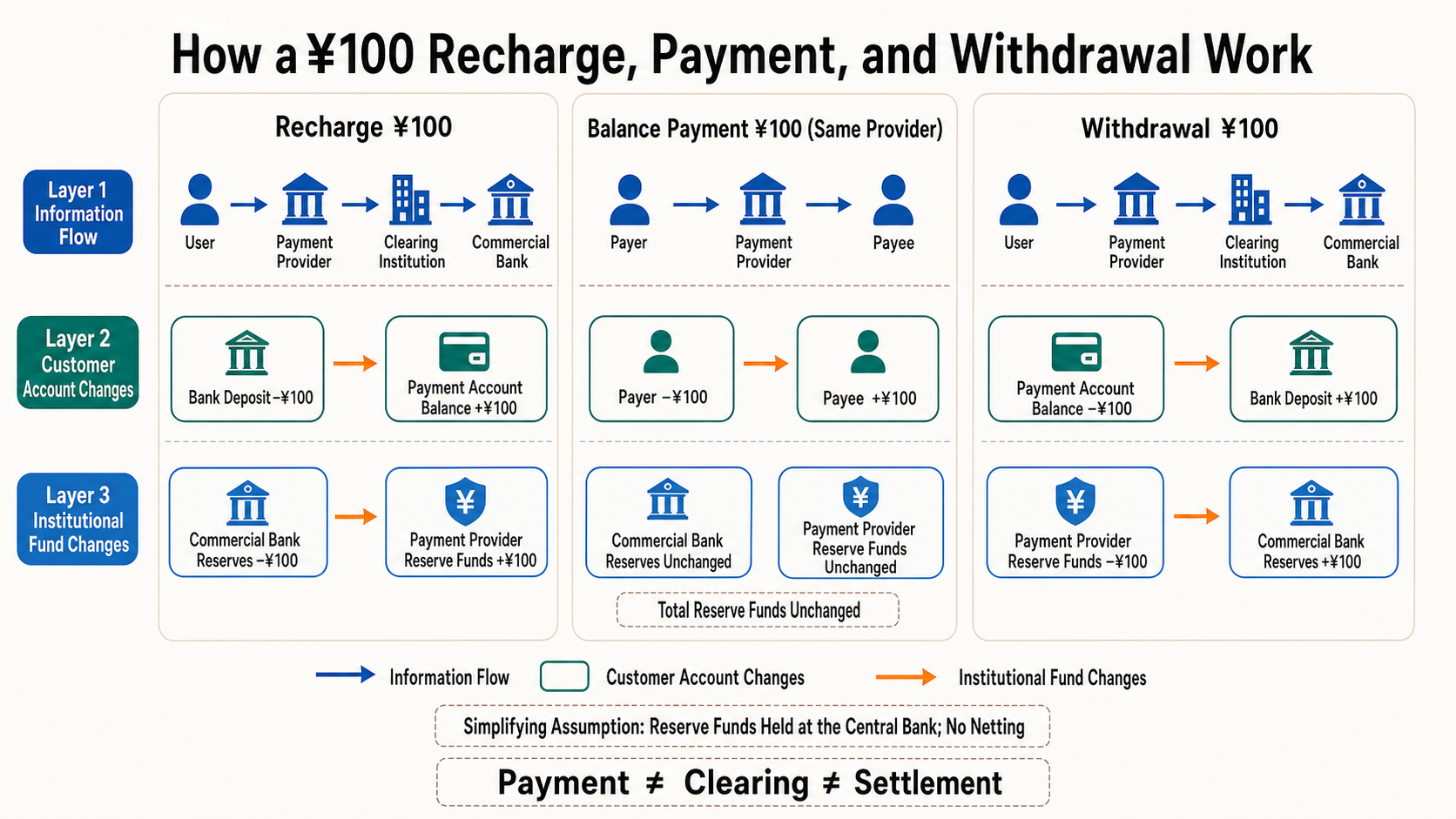
Scenario 1: Top Up the Payment Account with 100 Yuan from a Bank Card
The user selects a bank card to top up 100 yuan in the payment app.
The information flow can be simplified as:
User → Payment institution → Clearing institution → Account-opening bank
After the bank completes identity verification, risk checks, and the debit, the user sees:
| Account | Change |
|---|---|
| User's bank deposit | −100 |
| User's payment-account balance | +100 |
At the same time, the payment institution, clearing institution, bank, and reserve-fund custody system must process the corresponding clearing and changes in fund positions.
Scenario 2: Pay 100 Yuan from the Balance to a Merchant Using the Same Payment Institution
If the payer and the recipient both use the same payment institution, the internal ledger may initially show:
| Payment account | Change |
|---|---|
| Payer's balance | −100 |
| Recipient's balance | +100 |
| Total customer reserve funds held by the institution | Usually unchanged |
The payment has taken place, but the total amount of customer reserve funds may not need to change at the same time. What changes first is the record of claims between different customers within the same payment institution.
If the recipient later withdraws the balance to a bank card, or if the transaction involves another payment institution, it will trigger further inter-institutional clearing and settlement of funds.
Scenario 3: Withdraw 100 Yuan from the Payment Account to a Bank Card
The logic of a withdrawal is roughly the reverse of a top-up:
| Account | Change |
|---|---|
| User's payment-account balance | −100 |
| User's bank deposit | +100 |
The payment institution generates transaction information based on the user's instruction and completes the corresponding transfer of funds through the clearing institution, reserve-fund system, and banking system.
Here again, it is not accurate to draw this as "Alipay directly puts 100 yuan in cash into the customer's bank account." Payment-account balances, customer reserve funds, commercial-bank deposits, and central-bank settlement assets exist at different levels. The system must use multiple ledgers to create the corresponding records.
How Is Paying by Bank Card Different from Paying with a Balance?
After scanning a QR code, the payment app will usually ask the user to choose a payment method.
If the user chooses "pay by bank card," the first thing to decrease is the customer's deposit at the commercial bank. The payment institution mainly organizes transaction information, verifies the instruction, and connects to the clearing process.
If the user chooses "payment-account balance," the first thing to decrease is the customer balance on the payment institution's internal ledger, corresponding to customer funds protected by the reserve-fund system.
| Payment method | Account that decreases first | Main role of the payment institution |
|---|---|---|
| Pay with a linked bank card | Customer's bank deposit | Payment service, information organization, and access to payment channels |
| Pay with a payment-account balance | Customer's payment-account balance | Payment service, internal recordkeeping, and reserve-fund management |
What Are Payment, Clearing, and Settlement?
These three terms often appear together, but they do not mean the same thing.
Payment: The payer authorizes a transaction, and the relevant institutions process the transfer of value.
Clearing: Participating institutions exchange and verify transaction information and calculate how much each party should pay or receive. Clearing may be conducted transaction by transaction, or institutions may first net their positions.
Settlement: Agreed settlement assets are used to finally discharge claims and obligations between institutions, for example by transferring positions through central-bank accounts or another compliant settlement arrangement.
Therefore:
V. What Is Distinctive about China's Customer Reserve-Fund Regime?
China is not the only jurisdiction that requires payment institutions to protect customer funds. The European Union, the United Kingdom, and the United States are also concerned with the same question: when non-bank institutions handle large amounts of public funds, how can regulators prevent those funds from being commingled or misappropriated, or from becoming difficult to recover if the institution fails?
The main differences lie in the combination of institutions and rules.
The EU and the UK: A Greater Emphasis on Safeguarding
The basic approach of the EU's PSD2 is safeguarding, meaning the protection of customer funds. Eligible customer funds received by payment institutions must be segregated from the institution's own funds. They may be held in a separate account or invested in safe, liquid, low-risk assets; another route is to use insurance or a similar guarantee. Article 10 of the EU Payment Services Directive II
The UK uses a similar framework. Payment institutions and electronic-money institutions may protect customer funds through segregation or through insurance or guarantees. New supplementary rules taking effect on May 7, 2026 further strengthen daily reconciliation, monthly reporting, audits, third-party due diligence, and preparations for returning funds if an institution fails. FCA explanation of the current safeguarding requirements
This shows that the regulatory goals in China and Europe are not contradictory:
Neither permits payment institutions to take arbitrary risks with customer funds.
The difference is that China has developed a relatively centralized arrangement for the custody of reserve funds, while Europe and the UK have traditionally relied more on segregation, separate accounts, safe assets, insurance, and guarantees.
Customer-Fund Custody and Access to Central-Bank Settlement Are Not the Same Thing
Europe has also been expanding the possibility for non-bank payment service providers to access central-bank payment systems. The Eurosystem allows eligible non-bank payment service providers to connect to TARGET and use central-bank money for payment settlement.
At the same time, the European Central Bank clearly distinguishes between two types of accounts:
- Central-bank payment-system accounts used to meet same-day settlement obligations;
- Safeguarding accounts used to protect customer funds over the longer term.
The Eurosystem's policy allows access to the first type, but does not provide non-bank payment institutions with the second type of customer-fund custody account. ECB policy statement on access for non-bank payment service providers
This makes the distinction clear:
Whether an institution can enter the central bank's "general-ledger hall" and settle directly, and whether it can place customer funds with the central bank for safekeeping, are two different questions.
The US Payment Account Is Still at the Proposal Stage
The United States is also discussing a restricted central-bank account sometimes referred to by the market as a "skinny account." The formal name used by the Federal Reserve is Payment Account.
In May 2026, the Federal Reserve put forward a specific proposal that would allow institutions legally eligible for a Federal Reserve account to apply for a restricted account used only for payment clearing and settlement. Under the proposal:
- No intraday overdrafts would be provided;
- The discount window could not be used;
- Account balances would not earn interest;
- Only payment services that automatically prevent overdrafts could be used;
- End-of-day balances would be subject to limits;
- The proposal would not expand eligibility for accounts under existing law.
As of now, this remains a proposal rather than a fully implemented final regime. The United States therefore does not currently allow payment companies to open Federal Reserve accounts freely. Federal Reserve Payment Account proposal
Supporters of the proposal believe that restricted accounts could lower payment costs, shorten settlement chains, and support new payment models. Opponents worry about the prudential supervision of non-bank institutions, anti-money-laundering controls, financial stability, and regulatory arbitrage.
Putting these regimes together, we can draw the following conclusion:
| Institutional path | Main focus |
|---|---|
| China | Centralized custody of customer reserve funds, and bringing cross-institution online payments into a unified clearing infrastructure |
| The EU and the UK | Safeguarding centered on fund segregation, safe assets, insurance, or guarantees |
| The Eurosystem and the new US discussion | Gradually studying or expanding non-bank access to central-bank settlement under controlled risks |
Different regulatory approaches do not necessarily mean that one is "more advanced" than another. But they reveal that jurisdictions are all trying to answer the same questions:
Where are customer funds held? Who can use them? Can a payment institution enter the central-bank payment system directly to settle its books?
Conclusion: Looking the Same Does Not Mean Having the Same Financial Relationship
We can now answer the question we started with.
Are the 1,000 yuan in an Alipay payment account and the 1,000 yuan in a bank account the same thing?
From the user-experience perspective, they look increasingly similar. From the perspective of financial infrastructure, they cannot simply be treated as equivalent.
The 1,000 yuan in a bank account is a deposit liability that a commercial bank owes to its customer. Under strict regulation, the bank can allocate assets, extend loans, and pay deposit interest, while being subject to capital, liquidity, reserve, prudential-regulatory, and deposit-insurance requirements.
The 1,000 yuan in a payment account, by contrast, rests on the payment account, customer reserve funds, and dedicated customer-fund protection mechanisms. The payment institution processes payments, but cannot lend out customer reserve funds or turn the payment account into an interest-bearing deposit account.
One important reform in China's payment system over the past decade or more has been to move two matters that were previously hidden in payment institutions'back offices gradually into public infrastructure:
First, customer funds have been separated from the payment institution's own business activities.
Second, cross-institution clearing has moved from one-to-one direct connections between payment institutions and banks into regulated public clearing infrastructure.
So, to understand customer reserve funds, start with this analytical framework:
The same three questions can also serve as a starting point for analyzing electronic wallets, stablecoins, tokenized deposits, and even direct access by non-bank institutions to central-bank payment systems.
Originally published by Luminale Fintech Observer: https://luminale.cn/articles/customer-reserve-funds-explained-en