Scan a QR code, enter a password, tap a fingerprint — your phone flashes "Payment successful." What sits between the payer's bank account and the merchant's bank account is something most people never think about.
For industry practitioners, the words "Payment successful" actually break into three separate questions. Who receives and processes the customer's payment instruction? Who coordinates the accounts between different banks and payment institutions? And what money do institutions ultimately use to discharge the obligation?
Three questions, three layers. Payment institutions handle the instructions. Clearing institutions like NetsUnion (Nets Union Clearing Corporate, NUCC) and UnionPay sort out who owes whom. Discharge requires central bank money. This article focuses on the latter two layers: what clearing institutions actually "clear," and why the job is not done even after they finish.
1. "Payment Successful" on Your Screen Is Only the Beginning of the Chain
What the user sees is a QR code, a payment instruction, and a "Payment successful" message. What the backend has to answer are exactly those three questions from the opening.
From an infrastructure perspective, a single QR code payment can be placed across five layers:
| Layer | Actor | Role in the Chain |
|---|---|---|
| Layer 1 | Consumer / Merchant | Initiate and receive the payment |
| Layer 2 | Payment institution / Wallet | Accept payment instructions, maintain payment accounts |
| Layer 3 | Clearing networks (NetsUnion, UnionPay, etc.) | Exchange messages, calculate net settlement positions between institutions |
| Layer 4 | PBOC payment system | Execute inter-institution fund settlement |
| Layer 5 | Central bank money / Settlement accounts | Serve as the settlement asset to discharge obligations |
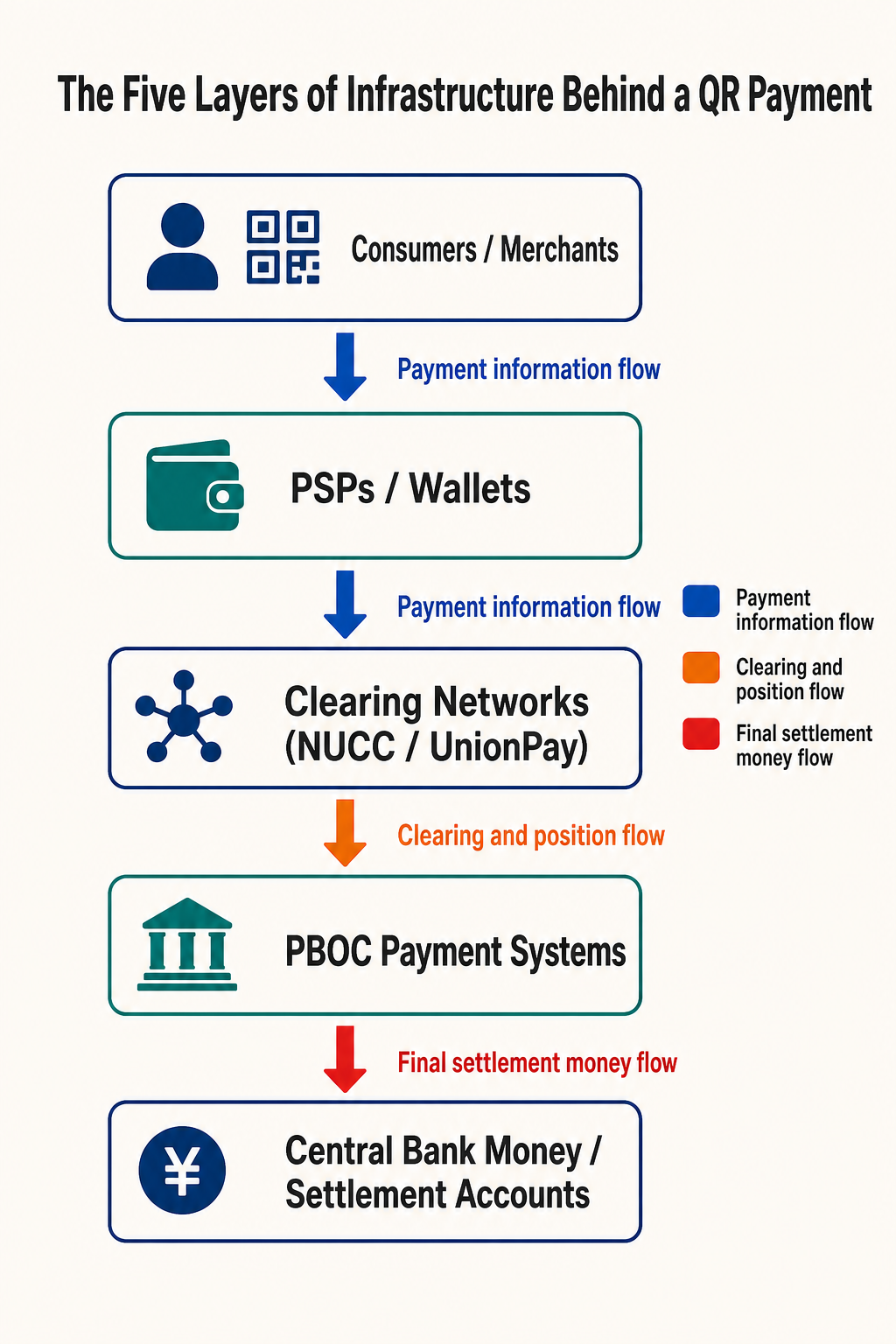
"Payment successful" is more like an order system accepting an instruction. Routing, reconciliation, and final delivery all come after it.
One thing to clarify: not every QR code payment travels the same path, transaction by transaction, through the High-Value Payment System. The actual arrangement can be real-time, batched, or netted. What we have just described is the institutional hierarchy, not an assembly line for every single transaction.
2. Why a Payment Institution Cannot Directly Modify Another Bank's Ledger
A payment institution can maintain its own payment accounts, accept payment instructions, and expose APIs. But customer deposits at Bank A are recorded on Bank A's balance sheet — they are Bank A's liabilities. A payment institution has no authority to edit Bank A's or Bank B's general ledger.
Start with the simplest case: a single bank's books.
| Assets | Liabilities |
|---|---|
| Reserves, loans, etc. | Customer deposits, etc. |
Now look at whose books an interbank transfer changes. Customer A at Bank A transfers 100 yuan to Customer B at Bank B. Simplified:
| Account | Change |
|---|---|
| A's deposit at Bank A | −100 |
| B's deposit at Bank B | +100 |
| Bank A's reserves at the central bank | −100 |
| Bank B's reserves at the central bank | +100 |
Bank A and Bank B each maintain their own ledgers. The 100 yuan disappearing from A's account is something Bank A can record on its own. The 100 yuan appearing in B's account must be recorded by Bank B. Neither bank can alter the other's books. The same holds for payment institutions — no matter how accurate their databases, they cannot change the balance sheets of two banks.
Once a transaction crosses an institutional boundary, the problem shifts from "how does one institution keep its own books" to "how do multiple independent financial institutions jointly confirm and execute a fund transfer." With no shared ledger, they can rely only on shared rules, a shared network, and a shared settlement mechanism.
Regulation has codified this. Article 30 of the Regulations on the Supervision and Administration of Non-Bank Payment Institutions stipulates that when a non-bank payment institution partners with a bank or another payment institution to conduct payment business, it must process transactions through a clearing institution designated by the People's Bank of China. Payment institutions may not engage in, or disguise, clearing activities on their own.[1]
APIs can certainly connect banks and payment institutions directly. What truly stands in the way are the legal relationships of accounts, control over the ledger, clearing rules, and the final settlement arrangement.
3. What Exactly Is a Clearing Institution? — The "Middle Layer" of the Payment System
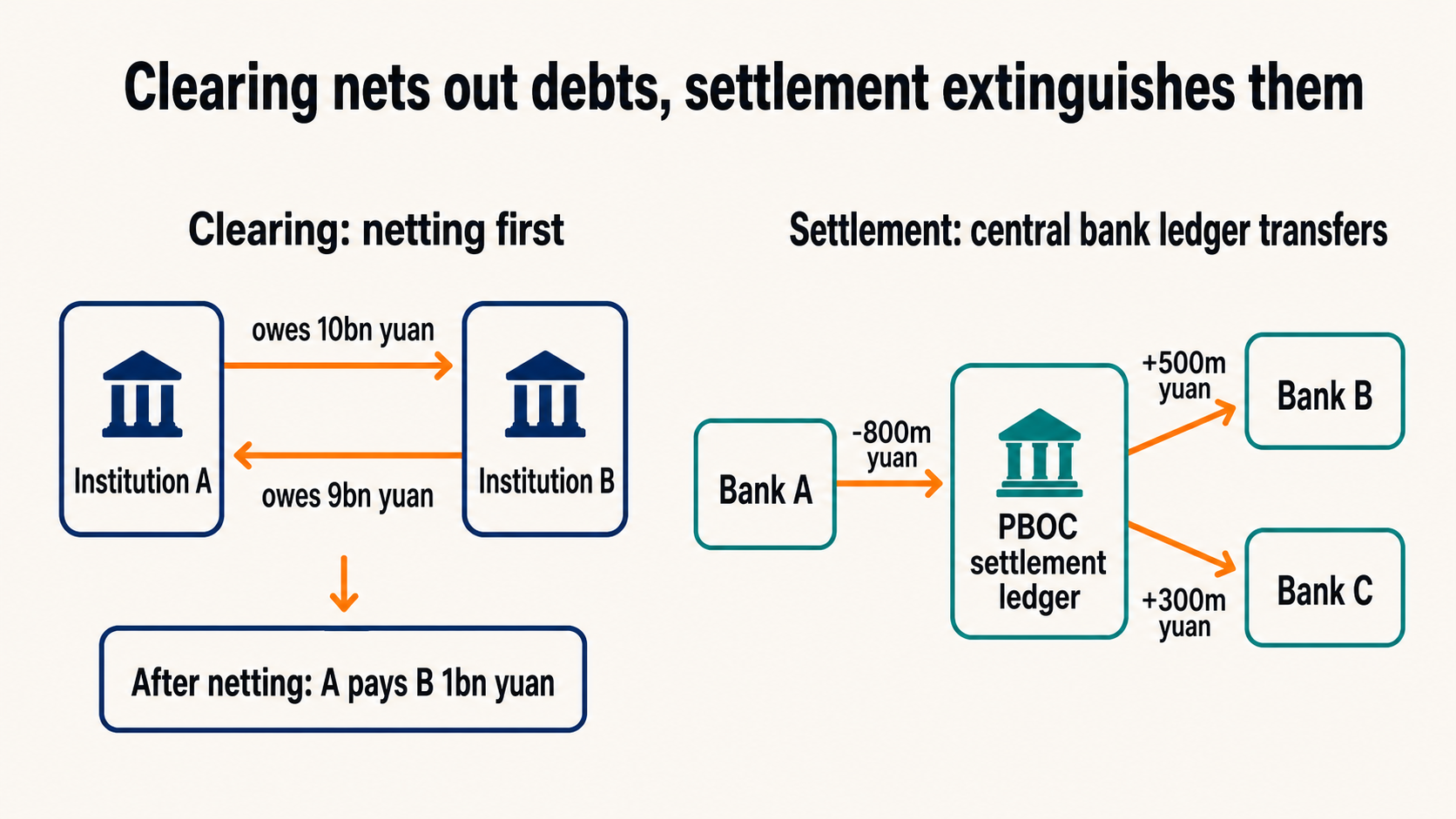
Clearing first answers the question: how do different institutions arrive at a single, agreed record? Participants exchange payment information, reconcile transactions, handle errors, and ultimately produce what each owes and is owed. Large volumes of transactions can be netted. For example, over one day:
| Institution | Payable | Receivable | Net Position |
|---|---|---|---|
| Institution A | 10 billion yuan | 9 billion yuan | Net payer of 1 billion yuan |
| Institution B | 9 billion yuan | 10 billion yuan | Net receiver of 1 billion yuan |
After netting, only Institution A owes Institution B a net 1 billion yuan. That 1 billion yuan is the funding obligation submitted to the settlement layer.
A clearing institution establishes a network access regime and a set of rules that link different institutions together. Payment institutions do not need to build point-to-point connections with thousands of banks individually. Banks do not need to maintain dedicated lines and clearing relationships with hundreds of payment institutions separately.
Think of NetsUnion as a "public switch": it is not the ultimate owner of every sum of money, nor the issuer of the ultimate money, but it brings institutions that would otherwise need a spiderweb of point-to-point connections into a single network.
Now look at the professional classification. PFMI does not have a generic "clearing institution" category. It covers five types of financial market infrastructure: payment systems, central securities depositories, securities settlement systems, central counterparties, and trade repositories. NetsUnion and UnionPay are better understood through the lens of a payment system / payment system operator; they should not be conflated with a securities-market central counterparty (CCP).[2]
Nor should a clearing institution be understood as "merely doing the arithmetic." Modern clearing infrastructure also handles message exchange, routing, rule management, risk control, dispute resolution, system access, and regulatory reporting.
The landscape of China's clearing institutions has a clear evolution. One of the original goals behind establishing NetsUnion was to take over the online payment clearing involving bank accounts originated by non-bank payment institutions, replacing the sprawling web of point-to-point direct connections between payment institutions and banks. The PBOC currently positions NetsUnion as primarily responsible for online payment and mobile payment clearing, a financial infrastructure covering both banks and non-bank payment institutions.[3]
UnionPay's role has also expanded. UnionPay's early core was interbank card transaction switching and clearing. In 2019, the PBOC issued it a bank card clearing business license. After the "cutting direct connections" reform, online payment clearing is not NetsUnion's alone. The PBOC's 2019 regulatory documents separately list agreement-based payments, authenticated payments, disbursement, and credit transfers processed through UnionPay, alongside the corresponding online payment business processed through NetsUnion.[4]
4. After NetsUnion and UnionPay Finish Clearing, Why Does the PBOC High-Value Payment System Still Need to Step In?
A clearing institution calculates "who owes whom how much," but the debt between institutions does not vanish. The real question is: what asset extinguishes that debt?
Principles 8 and 9 of PFMI answer exactly this. Principle 8 requires that settlement be final and irrevocable — once settlement is complete, the relevant obligations are discharged. Principle 9 requires that, where practical and available, money settlement be conducted in central bank money.[2]
In China, after NetsUnion and UnionPay produce clearing results, the pending settlement positions enter a deeper settlement arrangement. The High-Value Payment System (HVPS) handles this layer: it changes the fund positions of participating institutions at the central bank level. The current HVPS rules explicitly list "bank card interbank payment net amounts" and "payment institution online payment net amounts" among the fund clearing activities it handles.[5]
UnionPay, NetsUnion, the Shanghai Clearing House, and the Shanghai Commercial Paper Exchange are all participants in HVPS. When these infrastructures connect to HVPS, they extend the reach of central bank money settlement.[6]
Take an example. Suppose after a day's clearing, the following positions emerge:
| Institution | Net Position |
|---|---|
| Bank A | Payable 800 million yuan |
| Bank B | Receivable 500 million yuan |
| Bank C | Receivable 300 million yuan |
Turning these numbers into actual fund movements requires HVPS to transfer funds on the central bank's books.
NetsUnion / UnionPay answer "how much should be transferred." The central bank payment system answers "how does the final delivery actually happen."
Think of a group dinner. A clearing institution is like the person who tallies the bill at the end of the meal — who owes whom, netted down to a few balances. But after the bill is calculated, someone still has to pay. Clearing is calculating the debt; settlement is extinguishing it.
5. From China to the Global Trend: Can Payment Institutions Directly Access Central Bank Infrastructure?
The word "access" in international reports carries at least five distinct meanings:
- Scheme access: Can an institution join a particular payment scheme?
- Clearing access: Can it participate in clearing?
- Settlement access: Can it participate in fund settlement?
- Central bank account access: Can it hold a central bank account?
- RTGS access: Can it enter the real-time gross settlement system?
Before discussing "direct connection to the central bank," one needs to clarify which layer is being discussed. Different jurisdictions have made different choices.
United States: Still relatively bank-centric. FedNow access is built on statutory qualifications such as a Federal Reserve Master Account, generally limited to depository institutions, member banks, and U.S. branches of foreign banks. An ordinary payment technology company does not automatically gain direct settlement access to FedNow or Fedwire simply by operating a payment business. In May 2026, the Federal Reserve proposed a limited-purpose payment account arrangement that would allow legally eligible institutions to participate in payment clearing in a more restricted manner, while explicitly stating that this proposal does not expand existing statutory account access eligibility.[7]
Euro area: Opening the central bank settlement layer to non-bank PSPs. From October 2025, eligible payment institutions (PIs) and electronic money institutions (EMIs) may apply for direct access to TARGET, including T2 and TIPS, and hold central bank system accounts for payment settlement purposes. The ECB simultaneously stressed that these accounts are meant to meet payment settlement obligations, not to turn non-bank PSPs into banks or monetary policy counterparties in the ordinary sense.[8] As of the end of 2025, no non-bank PSP had formally gone live in the TARGET production environment. The institutional eligibility has been opened; actual access is a gradual process.[9]
Hong Kong: Opening clearing access while separating clearing participation from fund settlement. FPS allows stored value facility (SVF) operators to participate directly as Clearing Participants — AlipayHK, WeChat Pay HK, and other e-wallets are among them. However, SVFs must appoint a Settlement Participant to complete fund settlement. The HKD settlement ledger for FPS is provided by the Hong Kong Monetary Authority, and Settlement Participants are primarily licensed banks participating in CHATS.[10] This case illustrates one thing directly: a payment institution can enter the clearing network without holding a central bank settlement account.
Singapore: Opening retail payment infrastructure to non-bank institutions. From 2021, eligible non-bank financial institutions holding a Major Payment Institution license can directly access FAST and PayNow, allowing users to use the real-time payment network directly between bank accounts and non-bank wallets.[11] A caveat: access to FAST and PayNow should not be automatically understood as directly holding a central bank RTGS settlement account. MAS is currently the designated settlement institution for FAST. Analyzing Singapore requires treating retail payment network participation eligibility and the deeper central bank settlement eligibility as separate layers.[12]
| Jurisdiction | Non-bank PSP direct access to retail payment network | Direct access to central bank settlement layer | Typical Model |
|---|---|---|---|
| US | Relatively limited | Strong statutory eligibility restrictions | Still heavily reliant on banks / correspondent banks |
| Euro area | Yes | TARGET now open to eligible PIs/EMIs | T2 / TIPS direct access |
| Hong Kong | Yes | SVFs typically settle through banks | Clearing Participant + Settlement Participant |
| Singapore | Yes | Analyzed separately from FAST participation eligibility | MPIs can directly access FAST / PayNow |
| China | Unified clearing access via NetsUnion / UnionPay | Final settlement enters the central bank payment system | PSP — Clearing institution — HVPS |
The policy statuses above are verified as of August 2026. Both the EU and the US are still adjusting their central bank infrastructure access regimes for non-bank institutions; further changes are possible.
Conclusion: The Clearing Network Is an Easily Overlooked Layer of the Payment System
People used to think of the payment industry as two types of institutions — banks on one side, and payment companies like Alipay and WeChat Pay on the other. Once you truly understand the modern payment system, you realize there is a layer of infrastructure sandwiched between them: the clearing network.
The most important role of NetsUnion and UnionPay is not simply to relay a transfer for payment institutions. It is to build a public connectivity layer between banks and non-bank payment institutions, bringing a once highly fragmented set of payment relationships under a unified set of clearing rules.
But this bridge is not the end of the system. Clearing institutions solve who owes whom how much; the deeper payment and settlement system solves what money actually extinguishes that debt.
A single payment can thus be decomposed into three layers: payment institutions initiate and serve; clearing institutions connect and form settlement obligations; the central bank system provides the final settlement asset and the final settlement layer.
The same framework can be used to understand bank cards, fast payments, cross-border payments, stablecoins, and even CBDCs. When analyzing any new payment arrangement, ask the same four questions:
- Who can initiate a payment?
- Who can enter the clearing network?
- Who can enter the settlement system?
- What is the ultimate settlement asset?
References
[1]: Article 30, Regulations on the Supervision and Administration of Non-Bank Payment Institutions, People's Bank of China: https://www.pbc.gov.cn/tiaofasi/144941/144953/5174993/index.html ↩
[2]: BIS Committee on Payments and Market Infrastructures, PFMI framework overview (including Principle 8 on settlement finality, Principle 9 on money settlement and central bank money, and the five types of financial market infrastructure): https://www.bis.org/committees/cpmi/pfmi/overview ↩
[3]: PBOC Financial Stability Bureau, materials on the NetsUnion platform and the payment services market: https://www.pbc.gov.cn/jinrongwendingju/146766/146772/c618bf4413cf443493444014b6c85425/2018110716123679821.pdf ↩
[4]: PBOC Payment and Settlement Department, 2019 arrangements for bank card clearing and online payment clearing: https://www.pbc.gov.cn/zhifujiesuansi/128525/128527/3ba9b918220c415ea8fccb62156d1318/index.html ↩
[5]: HVPS rules republished by the Hunan Provincial People's Government (listing bank card interbank payment net amounts, payment institution online payment net amounts, and other fund clearing activities): https://hunan.gov.cn/zqt/zcsd/202604/t20260420_33958590.html ↩
[6]: PBOC China National Clearing Center, explanation of HVPS participants including UnionPay, NetsUnion, Shanghai Clearing House, and the Shanghai Commercial Paper Exchange, republished by CNCC: https://www.cncc.cn/ywfw/xxgg/201811/t20181107_556.html ↩
[7]: Federal Reserve Financial Services, FedNow Service Operating Procedures: https://www.frbservices.org/binaries/content/assets/crsocms/resources/rules-regulations/021326-fednow-service-operating-procedures.pdf ↩
[8]: European Central Bank, instant payment regulation and TARGET access: https://www.ecb.europa.eu/paym/retail/instant_payments/html/instant_payments_regulation.pl.html ↩
[9]: European Central Bank, TARGET Annual Report 2025: https://www.ecb.europa.eu/press/targetservar/html/ecb.targetservar2025.en.html ↩
[10]: Hong Kong Faster Payment System, FPS clearing and settlement participation arrangements: https://fps.hkicl.com.hk/eng/fps/about_fps/overview.php ↩
[11]: Monetary Authority of Singapore, announcement on non-bank financial institution access to FAST and PayNow: https://www.mas.gov.sg/news/media-releases/2020/non-bank-financial-institutions-to-have-access-to-fast-and-paynow ↩
[12]: Monetary Authority of Singapore, financial infrastructure directory (MAS as designated settlement institution for FAST): https://eservices.mas.gov.sg/fid/institution/detail/100429-MONETARY-AUTHORITY-OF-SINGAPORE ↩
Originally published by Luminale Fintech Observer: https://luminale.cn/articles/payment-clearing-middle-layer-en