You buy $100 worth of groceries at a convenience store, pull out your bank card, insert, swipe, or tap it, and within a few seconds, the POS terminal displays "Payment Successful." From the consumer's perspective, it feels as if that $100 has already moved straight from their bank account into the merchant's account.
1. Swiping a Card Takes Just One Second, but the $100 Journey Is Far from Finished
Behind the scenes, card payments are far more complex. A single card transaction must pass through credential and identity verification, issuer authorization, inter-institutional clearing, funds settlement, and merchant funding—involving five key participants: the cardholder, merchant, issuer, acquirer, and card network. Throughout this transaction lifecycle, three fundamental concepts run from start to finish:
| Concept | Problem It Solves |
|---|---|
| Authorization | Can this transaction proceed? |
| Clearing | After the transaction occurs, who owes whom and how much among institutions? |
| Settlement | How are the established obligations and claims finally discharged with funds? |
A successful card swipe does not mean that banks have completed final settlement. The complete lifecycle of this $100 transaction consists of the following steps:
| Step | Process | Phase |
|---|---|---|
| 1 | Insert, swipe, tap, or online payment | Payment Initiation |
| 2 | Authentication / Authorization | Transaction Verification & Approval |
| 3 | POS displays "Payment Successful" | Consumer-Side Process Concludes |
| 4 | Clearing | Institutional Back-End Accounting |
| 5 | Settlement | Inter-Institutional Fund Discharge |
| 6 | Merchant Funding | Merchant Account Crediting |
Therefore, when the consumer sees "Payment Successful" on the POS terminal, the process has only reached Step 3. The subsequent clearing, settlement, and merchant funding all take place in institutional back-end systems. Consumers cannot see them, but this does not prevent them from walking out of the store with their goods. This is precisely the elegance of card payment architecture: the front-end consumer and merchant experience concludes almost in real time, while the back-end inter-institutional discharge and merchant funding processes have only just begun.
2. Who Is Involved in a Card Payment? Cardholders, Merchants, Issuers, Acquirers, and Card Networks
Let us examine the five key roles revolving around this same $100 transaction.
The Cardholder: The Card Itself Is Not Money
The cardholder is the consumer initiating the payment. A payment card itself is not money; rather, it is a payment instrument used to access a bank account or credit line and initiate payment instructions. A debit card links to a bank deposit account; a credit card links to a credit facility extended by a bank. Swiping or tapping a card is an act of initiating a payment request to the bank, not pulling physical money directly out of the card.
The Merchant: A Single Store Cannot Connect to Thousands of Issuing Banks
The convenience store is the merchant. It provides goods and services to consumers and wishes to accept payments via the bank card ecosystem. The practical challenge is that no single merchant has the capacity to establish separate, direct connections with thousands of card-issuing banks worldwide. This creates the necessity for acquiring institutions.
The Acquirer: Serving the Merchant Side
Acquiring institutions enable merchants to enter the card payment ecosystem. Their responsibilities include assigning merchant IDs (MIDs), onboarding POS terminals and payment gateways, receiving and routing card transactions, processing clearing data, and ultimately disbursing funds to merchants according to their merchant agreements. Merchants connect to card networks through acquirers and do not directly interface with consumers'issuing banks.
The Issuer: Deciding Whether the $100 Can Be Paid
The issuer (card-issuing bank) is the financial institution that issues the card and manages the cardholder's account or credit line. Once the consumer swipes the card, the issuer determines whether this $100 transaction can be approved.
Consider an example. You hold a Visa card issued by Bank A and spend $100 at a merchant whose acquiring bank is Bank B. In this transaction, Bank A is the Issuer, and Bank B is the Acquirer. What appears as a simple commercial transaction between consumer and merchant turns into an inter-institutional transaction between an issuer and an acquirer on the back end.
The Card Network: Eliminating Point-to-Point Connections Between Issuers and Acquirers
The value of card schemes/networks like Visa, Mastercard, and UnionPay lies in sparing thousands of issuers and acquirers worldwide from having to build bilateral, point-to-point connections with one another. Issuers and acquirers both connect to the card network, and transaction messages are routed between them across this shared network.
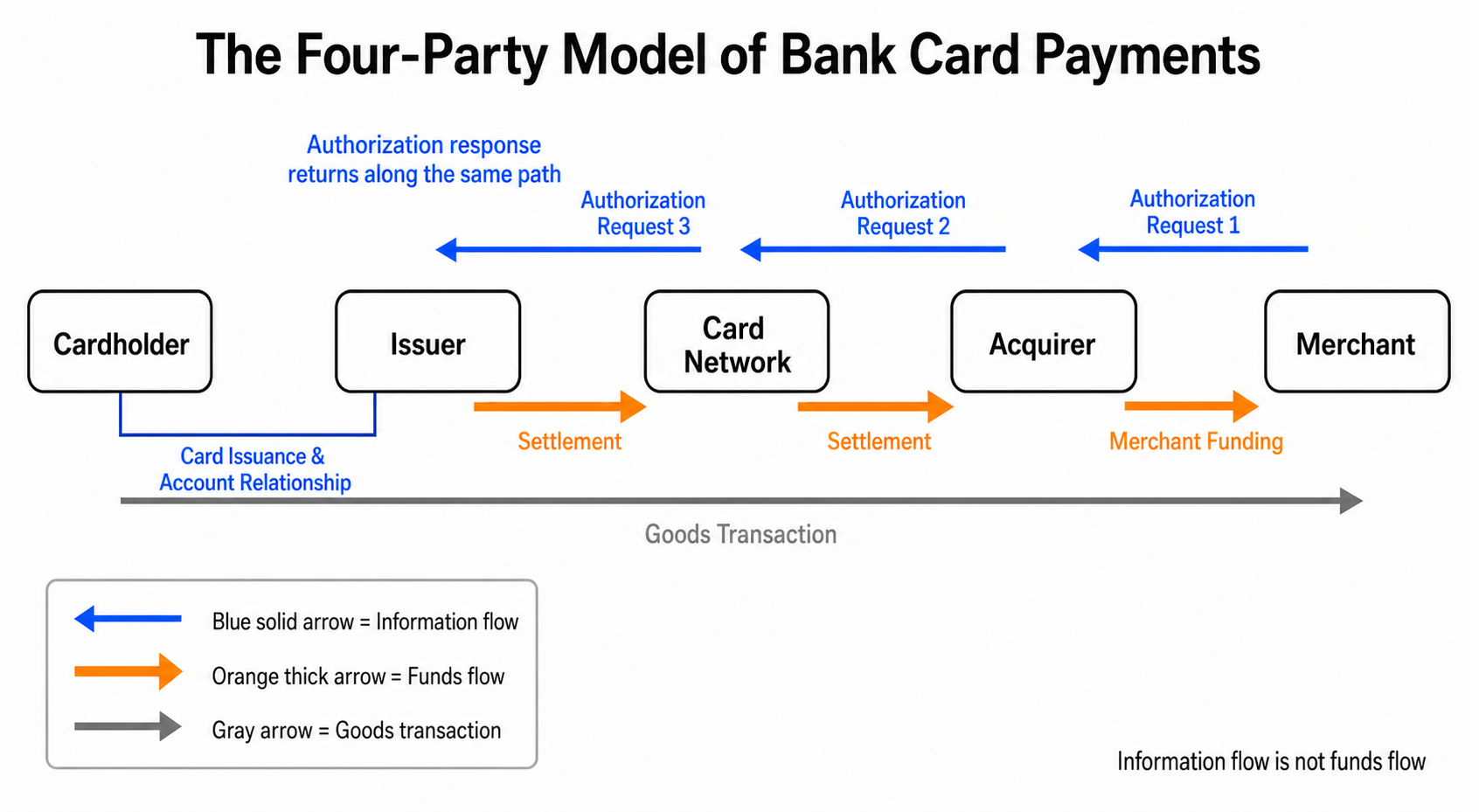
Consequently, what we commonly call the Four-Party Model refers to the Issuer, Cardholder, Acquirer, and Merchant interconnected through the card network [1][2].
| Role | Position in the Four-Party Model |
|---|---|
| Issuer | Connects to the network, serving the cardholder side |
| Card Network | Connects centrally, routing messages and clearing arrangements |
| Acquirer | Connects to the network, serving the merchant side |
Five Roles: Why Is It Called the Four-Party Model?
It is termed "Four-Party" rather than "Five-Party" because the model's structural definition excludes the network operator (the card scheme) as a principal party; although the card network is not counted among the four core commercial transactors, it provides essential switching, clearing, rule management, and message transmission services, acting as the indispensable infrastructure for the entire transaction chain. Visa, Mastercard, and UnionPay do not pay merchants on behalf of consumers; they organize and interconnect financial institutions.
3. What Happens After You Swipe for $100? From Authentication to Authorization
Authentication: Verifying Who You Are
Authentication addresses the authenticity of identity and payment credentials, answering two questions: Are you who you claim to be, and is this payment credential valid?
In-person (offline) payments may involve:
- EMV chip
- PIN
- Contactless NFC payment
- Device authentication
Online payments may involve:
- CVV / CVC
- 3-D Secure
- SMS one-time password (OTP)
- Banking app confirmation
- Biometric verification
Authorization: The Issuer Decides Whether the Payment Can Proceed
Returning to our $100 convenience store payment, the authorization request travels along the following path:
| Step | Participant |
|---|---|
| 1 | Cardholder |
| 2 | Merchant |
| 3 | Acquirer |
| 4 | Card Network |
| 5 | Issuer |
Upon receiving the request, the issuer performs several checks: whether the card is active and in good standing, whether the available balance or credit line is sufficient, transaction amount, geographic location, Merchant Category Code (MCC), device parameters, historical spending patterns, and risk scores from fraud detection models. Once these checks are complete, the issuer returns an Approved or Declined response, which is routed back along the reverse path through the card network and acquirer to the merchant—a cycle typically completed within seconds. Authorization messages are routed over specialized processing networks operated by card schemes, such as Visa's VisaNet or Mastercard's Banknet; messages are traditionally based on the ISO 8583 standard, with the industry steadily transitioning toward ISO 20022.
When the POS Shows Payment Successful, Has the Merchant Received the Money?
Usually not yet. Authorization indicates only that the issuer has approved the transaction and committed to honoring the corresponding payment obligation under card network rules.
At this moment, the changes in the cardholder's account typically appear as follows:
| Card Type | Common Accounting Action |
|---|---|
| Debit Card | Balance deducted, or available balance held/reserved |
| Credit Card | Available credit limit reduced |
These ledger entries are internal book adjustments made by the issuer on its own balance sheet for the cardholder. They are not equivalent to the issuer having transferred $100 in real time to the acquirer. Inter-institutional funds discharge occurs later in the settlement phase.
Thus, authentication verifies who you are, and authorization decides whether the payment can proceed; neither constitutes final interbank settlement.
4. The Customer Has Left, but Interbank Accounting Has Just Begun
Clearing: Calculating Who Owes Whom How Much
Over the course of a day, cards issued by Bank A may generate hundreds of thousands of transactions at merchants acquired by Bank B, while cards issued by Bank B also see massive transaction volume at merchants acquired by Bank A, with Banks C, D, and E similarly intertwined. The card payment system does not settle each $100 transaction individually in real time; instead, transactions first enter the clearing process:
| Clearing Step | Description |
|---|---|
| Transaction Aggregation | Grouping transactions over a specific cycle by participating institution |
| Transaction Verification | Exchanging and validating transaction data records |
| Fee Calculation | Computing various inter-institutional fees |
| Obligation Determination | Calculating net payables and receivables across institutions |
| Settlement Position Calculation | Generating final multilateral or bilateral settlement positions |
Why Card Transactions Are Typically Netted
Suppose that after daily clearing aggregation, the following totals emerge:
| Institution | Obligation |
|---|---|
| Bank A | Owes Bank B $100 million |
| Bank B | Owes Bank A $80 million |
After netting, the result becomes a single obligation: Bank A owes Bank B a net amount of $20 million. This $20 million represents Bank A's net settlement position, which is the actual amount to be discharged during the subsequent settlement phase.
How netting is executed, what clearing cycles are used, and in which settlement system final discharge takes place varies across jurisdictions and market arrangements, which will be explored in the next article.
Settlement: Discharging Obligations After Calculations Are Complete
Clearing determines how much the issuer needs to pay and how much the acquirer should receive; only then does the process enter the settlement stage.
Different countries, card schemes, and markets may utilize different settlement accounts, settlement banks, and infrastructure arrangements. Card networks organize and coordinate clearing and settlement arrangements according to established operating rules, and participating financial institutions then complete funds discharge through designated settlement mechanisms.
When Does the Merchant Get Paid?
Interbank settlement and merchant funding are two distinct processes. Although consumers see payment success instantly at checkout, merchant funding may take place on a T+1 or other contractually agreed schedule. The exact timing depends on:
- Terms specified in the merchant acquiring agreement
- Risk control and holdback arrangements
- Transaction type (e.g., in-person vs. card-not-present)
- Weekends and public holidays
- Local market regulations
- Whether the acquirer offers expedited settlement or funding advances
Consequently, the moment the consumer completes payment, the moment interbank settlement settles, and the moment the merchant receives funds do not coincide.
| Timing | Event |
|---|---|
| At the moment of swipe | Consumer sees "Payment Successful" |
| Upon clearing and settlement completion | Inter-institutional obligations and claims are fully discharged |
| According to contract schedule | Merchant receives usable funds in its bank account |
What the Merchant Receives Is Usually Less Than $100
The card payment process also involves fee distribution. Behind a single $100 transaction, several distinct fees are typically assessed:
| Fee | Collecting Entity |
|---|---|
| Interchange Fee | Card Issuer |
| Scheme / Network Fee | Card Network |
| Acquiring Fee | Acquiring Institution |
As a result, card payment back ends maintain two parallel streams: the principal flow and the fee flow. The total comprehensive fee borne by the merchant is known as the Merchant Discount Rate (MDR). Mastercard notes that the interchange fee is typically paid by the acquirer to the issuer and represents one component of the overall MDR charged to the merchant by the acquirer [3].
In China, fees for interbank card transactions are likewise collected by these three parties, designated as the issuer service fee, clearing institution network service fee, and acquiring service fee. Under Document Fa Gai Jia Ge [2016] No. 557 [11], the issuer service fee and clearing network service fee are subject to government-guided price caps set by the National Development and Reform Commission (NDRC) and the People's Bank of China (PBOC); acquiring fees are market-regulated and negotiated between acquirers and merchants—a structural difference from international card schemes that set interchange fees autonomously.
5. What Are the Major Global Card Networks? Who Exists Beyond Visa, Mastercard, and UnionPay?
The world's major card schemes include Visa, Mastercard, UnionPay, American Express, JCB, and Discover Global Network. While all are referred to as card schemes or networks, their underlying business and architectural models differ.
Open Four-Party Networks: Visa, Mastercard, UnionPay
The hallmark of these three networks is that issuers and acquirers are generally separate financial institutions. The card network sits in the center, providing shared infrastructure including network connectivity, brand licensing, operating rules, transaction switching, clearing, fraud risk management, and dispute resolution.
Closed-Loop Model: American Express
American Express traditionally operates a more vertically integrated model, possessing proprietary capabilities across issuing, acquiring, and network processing. However, the American Express Global Network also permits third-party issuers and acquirers to participate as network partners [4].
Comparison of Scale
Based on the latest publicly available disclosures compiled as of September 2026:
| Card Scheme | Origin | Typical Network Model | Global Acceptance | Card / User Scale | Merchant Acceptance Scale | Latest Public Operating Metrics |
|---|---|---|---|---|---|---|
| Visa | United States | Open four-party network | 200+ countries and territories | ~4.9 billion payment credentials [5] | 175M+ merchant locations [5] | FY2025 Payments Volume ~$14.2 trillion; ~257.5 billion network-processed transactions [5] |
| Mastercard | United States | Open four-party network | 220+ countries and territories [6] | — | Hundreds of millions of acceptance locations [6] | 2025 GDV ~$10.6 trillion; 175.5 billion switched transactions [6] |
| UnionPay | China | Open bank card network | Accepted in 183 countries and territories [7] | 8.4B+ UnionPay-branded cards globally [7] | Extensive worldwide coverage | Local card issuance in 84 countries and territories; 2,600+ partner institutions [7] |
| American Express | United States | Vertically integrated heritage with issuing and acquiring partners | Global network | Cards-in-force metric | ~160M merchant locations worldwide [8] | Highly integrated issuing, acquiring, and network capabilities |
| JCB | Japan | International payment card network | Expanding globally | 181.9M cardmembers [9] | ~72M merchants [9] | FY2025 transaction volume ~¥53.4 trillion [9] |
| Discover Global Network | United States | Vertically integrated heritage + alliance networks | 200+ countries and territories [10] | 305M+ global cardholders [10] | ~70M acceptance points [10] | Network spend $550B+ [10] |
Note: Discover figures are sourced from Capital One disclosures [10].
6. Tracing the $100 Again: Why Payment Success and Fund Settlement Are Two Different Things
Tracing that initial $100 payment through its full lifecycle ties every concept together:
| Stage | Process | Explanation |
|---|---|---|
| 1 | Payment Initiation | The cardholder swipes or taps; the transaction routes through the merchant, acquirer, and card network to reach the issuer. |
| 2 | Authentication & Authorization | Credentials and cardholder identity are verified; the issuer decides whether to approve. Upon approval, the POS displays "Payment Successful," though interbank funds have not yet settled. |
| 3 | Clearing | Transactions are aggregated, verified, fees calculated, and netted to produce final settlement positions, resolving who owes whom and how much. |
| 4 | Settlement | In accordance with clearing positions, funds are discharged between the issuer and acquirer, resolving how obligations are paid. |
| 5 | Merchant Funding | The acquirer credits funds to the merchant per their agreement, giving the merchant usable commercial bank funds. |
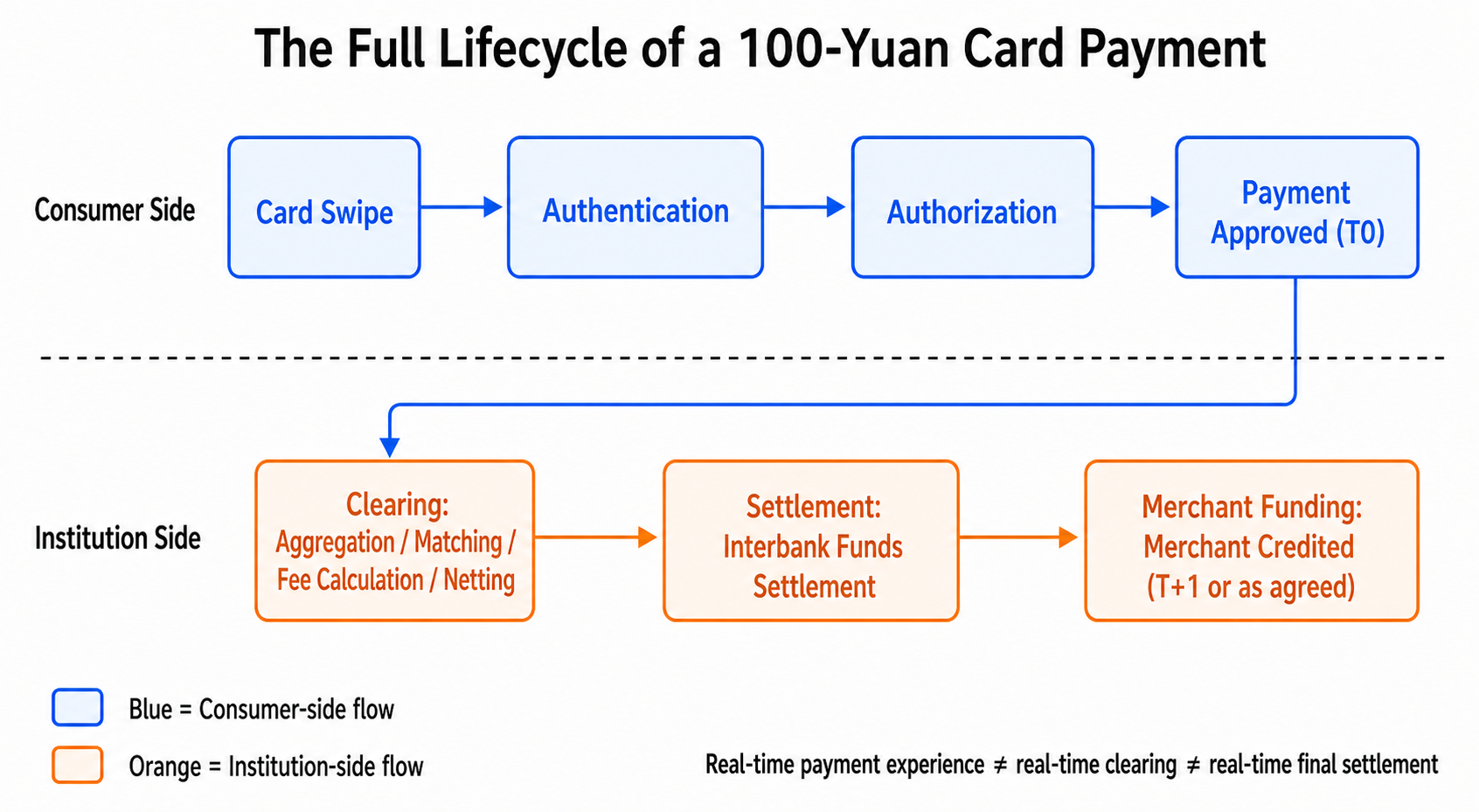
Only at this point has the back-end lifecycle of that $100 reached completion.
Conclusion: Returning to That Convenience Store
Let us summarize the division of responsibilities among the five key participants:
| Participant | Served Party | Primary Responsibilities |
|---|---|---|
| Cardholder | — | Initiates bank card payments |
| Merchant | — | Provides goods/services and accepts card payments |
| Issuer | Cardholder | Card issuance, account/credit management, coordinated authentication, authorization |
| Acquirer | Merchant | Merchant onboarding, transaction acquiring, clearing processing, merchant funding |
| Card Scheme / Network | Issuers & Acquirers | Operating rules, network connectivity, transaction switching, clearing arrangements, risk management |
In summary, a bank card is not money itself, but a payment instrument used to access a bank account or credit line; issuers serve cardholders, while acquirers serve merchants; card networks like Visa, Mastercard, and UnionPay connect numerous issuers and acquirers under unified rules and standards. The one-second "Payment Successful" seen by the consumer marks only the completion of authorization; the back-end clearing, settlement, and merchant funding processes have only just begun.
References
[1]: Visa Corporate, Commercial Solutions Knowledge Hub: Tokenization (identifying Issuer, Cardholder, Acquirer, and Merchant as the four parties): https://corporate.visa.com/en/solutions/commercial-solutions/knowledge-hub/tokenization.html ↩
[2]: Mastercard, About Us (describing the typical card transaction flow: merchant submits to acquirer, routed via Mastercard network to issuer for authorization; clearing involves transaction data exchange, fee calculation, and position formation): https://www.mastercard.com/europe/en/for-the-world/about-us/eu-regulations.html ↩
[3]: Mastercard, Merchant Interchange Rates (noting that interchange fees are typically paid by acquirers to issuers and constitute a component of merchant MDR): https://www.mastercard.com/us/en/business/support/merchant-interchange-rates.html ↩
[4]: American Express Global Network, Power of the Network (highlighting proprietary issuer, acquirer, network capabilities, and closed-loop data): https://network.americanexpress.com/globalnetwork/v4/partners/issuers/power-of-the-network/ ↩
[5]: Visa Inc. FY2025 Annual Report (Fiscal year ended Sept. 30, 2025: 4.9 billion payment credentials, $14.2 trillion payments volume, 257.5 billion transactions processed on Visa networks; corporate factsheet reports 175M+ merchant locations): https://annualreport.visa.com/financials/default.aspx ↩
[6]: Mastercard Incorporated 2025 Form 10-K (operating across 220+ countries and territories; 2025 gross dollar volume of $10.6 trillion, 175.5 billion switched transactions; acceptance points reported in hundreds of millions): https://www.sec.gov/Archives/edgar/data/1141391/000140316126000013/ma-20251231.htm ↩
[7]: UnionPay International, Company Profile (UnionPay acceptance network extends to 183 countries and territories, with 8.4B+ UnionPay cards issued globally, local issuance in 84 countries/regions, and 2,600+ partner institutions; verified Sept. 1, 2026): https://www.unionpayintl.com/en/aboutUs/companyProfile/introductiontoUPI/ ↩
[8]: American Express Newsroom, American Express Is Accepted at 160 Million Merchants Around the World (approx. 160 million merchant acceptance locations worldwide as of June 2025): https://www.americanexpress.com/en-us/newsroom/articles/products-and-services/american-express-is-accepted-at-160-million-merchants-around-the.html ↩
[9]: JCB Global, Corporate Overview (as of March 2026: 181.9 million cardmembers, approx. 72 million merchants; FY2025, April 2025–March 2026, transaction volume approx. ¥53.4 trillion, including estimates): https://www.global.jcb/en/about-us/company/overview/index.html ↩
[10]: Capital One, Discover Global Network Public Disclosures (network coverage in 200+ countries and territories, approx. 70 million acceptance points, 305M+ global cardholders, network spend $550B+): https://investor.capitalone.com/static-files/cfa11729-0aec-43dc-b531-200e250c8413 ↩
[11]: National Development and Reform Commission and People's Bank of China, Notice on Improving the Pricing Mechanism for Bank Card Swipe Fees (Fa Gai Jia Ge [2016] No. 557): https://zfxxgk.ndrc.gov.cn/web/iteminfo.jsp?id=2413 ↩
Originally published by Luminale Fintech Observer: https://luminale.cn/articles/card-payment-four-party-model-en