In the study of securities transactions and payment clearing, we frequently discuss Settlement Finality, Delivery versus Payment (DvP), and Payment versus Payment (PvP). Among them, the core issue DvP resolves is ensuring that securities delivery and cash payment occur conditionally and simultaneously, eliminating principal risk—the danger of delivering securities without receiving payment, or paying cash without receiving the securities.
Yet when discussing DvP, it is easy to overlook a foundational premise: Where does the "securities leg" that runs parallel to the cash leg actually take place?
Suppose Commercial Bank A sells 10 million RMB face value of book-entry sovereign bonds to Commercial Bank B. At the moment of settlement, two synchronized actions must take effect:
- Securities Leg: Bank A's bond balance is debited by 10 million RMB, and Bank B's bond balance is credited by 10 million RMB.
- Cash Leg: Bank B's reserve account at the central bank is debited, and Bank A's reserve account at the central bank is credited with the corresponding funds.
As is well established, the transfer of funds relies on reserve accounts within a Real-Time Gross Settlement (RTGS) system. But where are those 10 million RMB of bonds themselves held? Who records the total lawful issuance volume across the entire market? Who confirms the exact holdings of each financial institution at any given moment? And once the two banks strike a trade, which financial market infrastructure is legally and operationally responsible for transferring the securities from Bank A's name to Bank B's name?
This is precisely the core mandate of Central Securities Depositories (CSD) and Securities Settlement Systems (SSS) within the financial architecture.
I. How Are Bonds Issued?
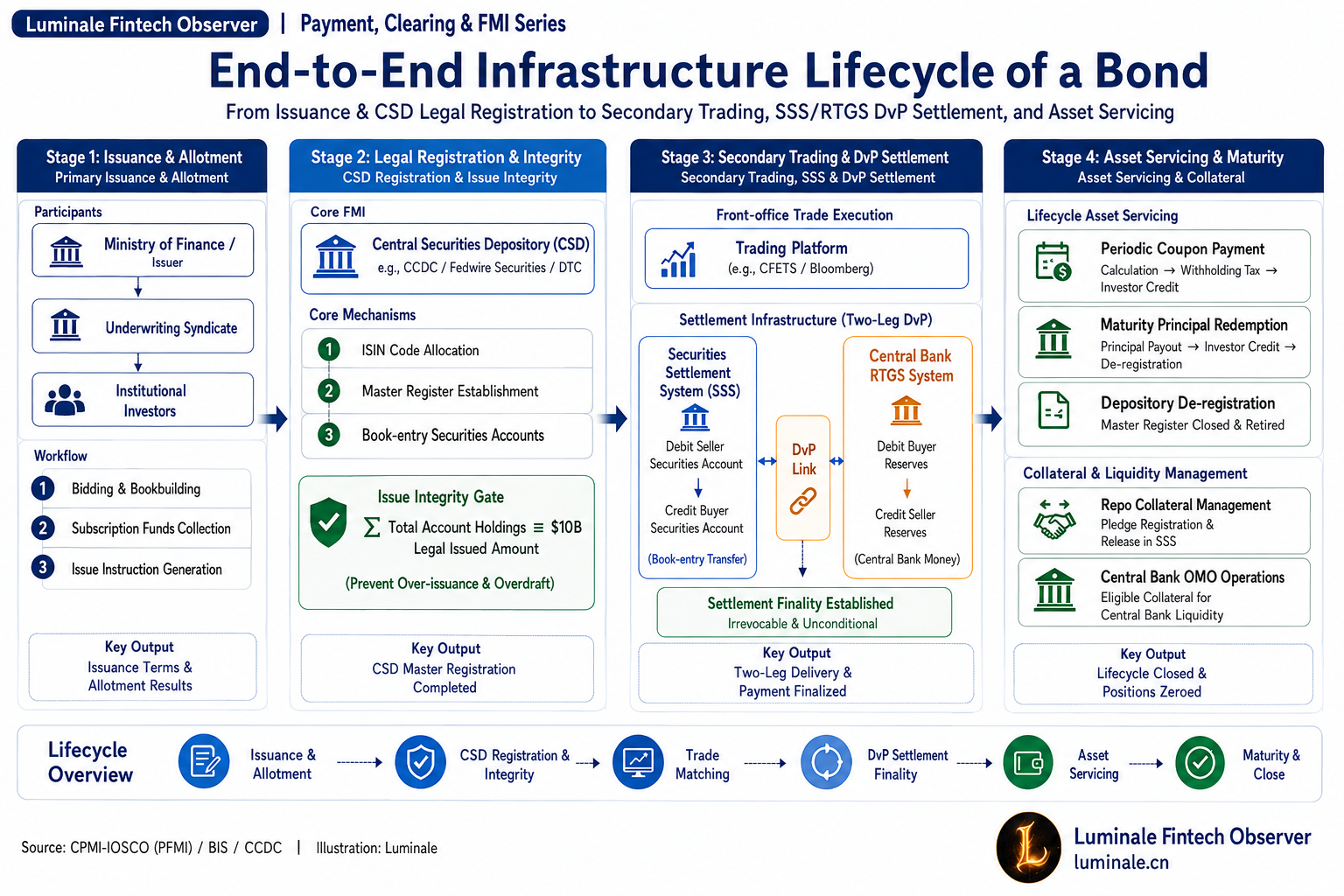
To grasp what CSDs and SSSs do, one does not need to memorize abstract definitions from the Principles for Financial Market Infrastructures (PFMI). It is far more illuminating to trace the lifecycle of a bond from inception.
1. The Fundamental Legal Nature of Bonds and Dematerialization
From a legal standpoint, a bond is a negotiable debt instrument through which an issuer borrows funds from investors and pledges to pay interest and repay principal. For example, when a Ministry of Finance issues 10 billion RMB of 10-year fixed-rate book-entry treasury bonds, investors provide capital, and the treasury commits to periodic interest payments and principal redemption upon maturity. Beyond finance ministries, issuers also include policy banks, commercial lenders, and non-financial corporations.
Historically, securities existed as physical certificates. Owners had to store these paper bearer certificates in vaults, physically transport them during transactions, and clip paper coupons to redeem interest at bank counters.
As trading volumes and liquidity demands surged, physical delivery became impractical, encumbered by exorbitant logistics costs, inventory delays, theft, counterfeiting, and physical damage. Modern securities markets responded by transitioning to two primary arrangements:
- Immobilisation: Physical certificates still exist (often as a single, indivisible Global Certificate representing the entire issue) but remain permanently locked in a central depository vault, while all subsequent secondary trading and transfers take place exclusively via account ledger entries.
- Dematerialisation: Physical paper is eliminated entirely. From its very inception, the security exists solely as electronic records on central accounting ledgers.
When a government issues 10 billion RMB of treasury bonds today, no stacks of certificates are printed, nor are copyable electronic files generated. Bond issuance fundamentally means establishing authoritative records on an official, legally enforceable central ledger: verifying the issuer, total issuance size, International Securities Identification Number (ISIN), tenor, coupon rate, payment frequency, maturity date, and the initial allotment across participant securities accounts.
2. Why Bonds Are the Ideal Vehicle for Understanding Securities Infrastructure
In institutional trading and financial market infrastructure analysis, bonds are far more illustrative than equities for examining the deep mechanics of CSDs, SSSs, and payment systems.
The fixed-income market is vast, with the overwhelming majority of liquidity concentrated in over-the-counter (OTC) and interbank wholesale transactions among commercial banks, securities firms, asset managers, and insurance companies. Sovereign and quasi-sovereign bonds possess impeccable credit quality and liquidity; they serve not only as investment assets but also as the primary eligible collateral for liquidity management, overnight and term repurchase agreements (Repos), interbank secured lending, and central bank open market operations.
High-frequency, large-value inter-institutional transfers impose exacting standards on transfer efficiency and principal safety. It is in the pledging, lending, and trading of bonds that the synchronization between securities ledgers and central bank cash ledgers dictates the liquidity circulation of the entire financial system.
II. Issuance, Registration, and Custody: Why CSDs Are the Legal Master Ledgers of Securities Markets
Once securities are understood as pure ledger-based assets, the next question arises: Who maintains this inviolable, authoritative master record? This is the raison d'être of the Central Securities Depository.
In the PFMI standards, the Committee on Payments and Market Infrastructures (CPMI) and the International Organization of Securities Commissions (IOSCO) define a Central Securities Depository (CSD) as: a financial market infrastructure that provides securities accounts, central safekeeping services, and asset servicing, whose primary objective is to safeguard the integrity of securities issues by preventing unauthorized creation, inflation, or deletion of securities[1].
1. The Cardinal Rule: Maintaining Issue Integrity
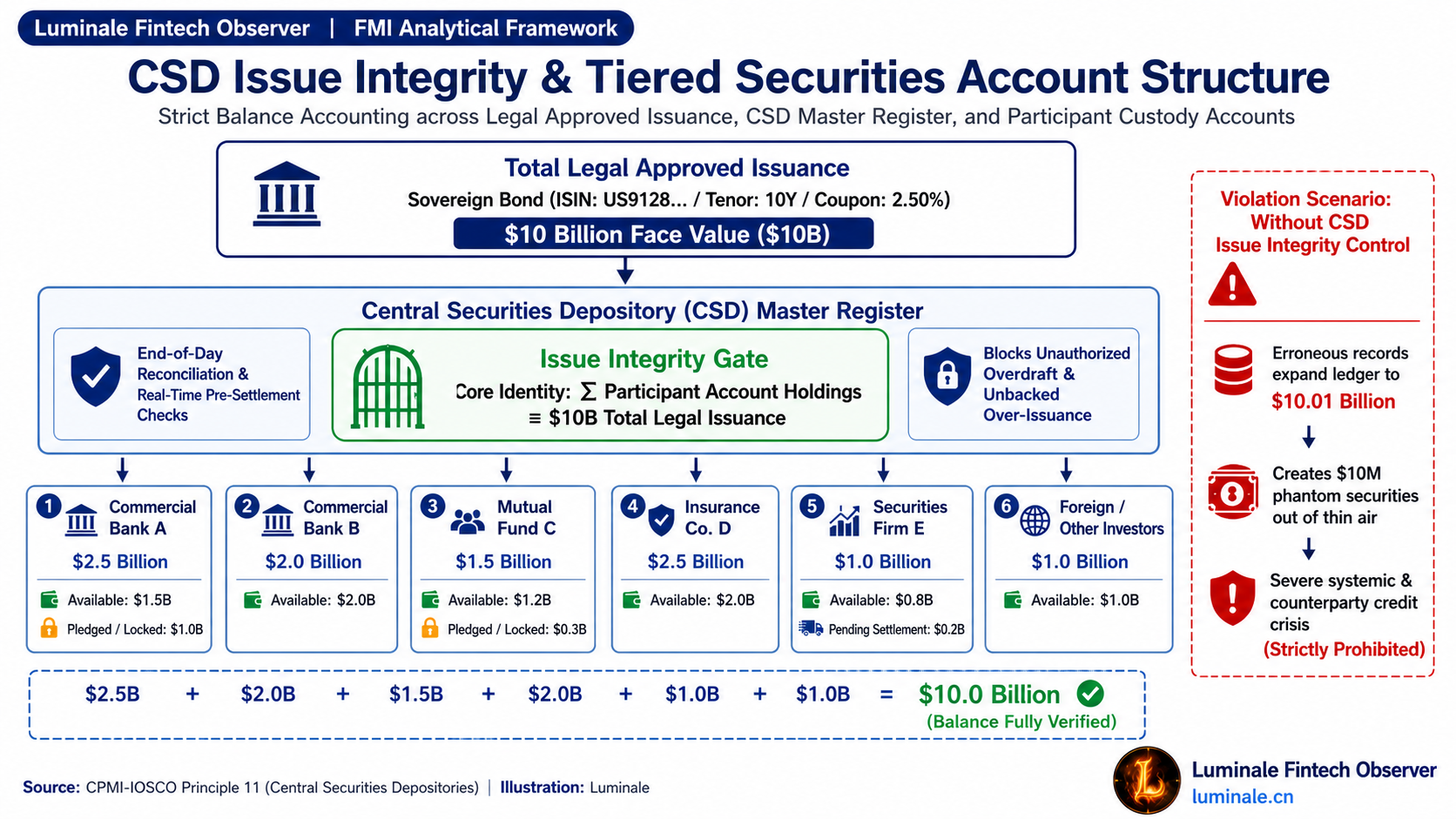
A CSD's foremost duty is ensuring an absolute, unbroken balance between the legally authorized issuance volume and the aggregate holdings across all participant accounts—a principle known as Issue Integrity.
Suppose an issue of sovereign bonds is legally authorized at 10 billion RMB. At any given second, the sum of holdings across all participant custody accounts in the depository must equal exactly 10 billion RMB. Under no circumstances may system accounting glitches, software bugs, or unauthorized overdrafts expand that aggregate figure to 10.01 billion RMB. Any such ledger expansion would mean the system had conjured unbacked securities out of thin air, fatally compromising market integrity.
Through end-of-day reconciliations, pre-settlement transaction validations, and stringent account controls, a CSD ensures that from initial registration to maturity redemption, aggregate securities quantities remain strictly invariant.
2. The Practical Meaning of Registration and Custody
Within a CSD's operational framework, registration and custody carry distinct legal and functional meanings:
- Securities Registration: Establishing legal ownership by recording rights on an official statutory register. The register is the definitive legal proof of who owns the security.
- Depository and Custody Services: Far from storing files on a server, custody involves providing ongoing account and asset servicing to participants. This includes opening and maintaining tiered securities accounts, tracking available balances, performing periodic reconciliations, processing interest and principal payouts on behalf of issuers, handling early calls or extensions, executing judicial freezes and unfreezes, and managing pledge registrations and collateral transfers.
3. Dedicated Bond Depository Systems in the Chinese Market
In China's bond market, registration, custody, and settlement infrastructures exhibit high institutional specialization:
- China Central Depository & Clearing Co., Ltd. (CCDC, or "ChinaBond"): Serving as a national-level FMI, CCDC manages centralized registration, custody, and settlement for treasury bonds, local government debt, policy financial bonds, and enterprise bonds, acting as the foundational infrastructure of the interbank bond market.
- Shanghai Clearing House (SHCH): Beyond functioning as a central counterparty (CCP), SHCH provides registration, custody, and settlement services for corporate credit bonds, negotiable certificates of deposit (NCDs), and other financial instruments.
These specialized institutions act as central registrars and custodians, maintaining segregated securities custody accounts for banks, dealers, and mutual funds, ensuring that every bond's issuance, servicing, and transfer is traceable on fully regulated, legally binding ledgers.
III. Primary Issuance and Secondary Circulation: Why Registration Requires Settlement
Once a static CSD ledger is established, securities inevitably enter the dynamic realm of circulation.
1. Allotment and Subscription Payment in the Primary Market
In the primary market, once an issuer completes auction bidding or bookbuilding, subscribing institutions (such as underwriting syndicate banks) remit subscription funds to the treasury or issuer's designated receiving account. Concurrently, the CSD makes initial book entries according to the allotment schedule, crediting corresponding bond balances to the participants'custody accounts.
Thus, even in initial primary issuance, the process intrinsically entails two interdependent operations: the remittance of subscription capital and the initial booking of securities.
2. Secondary Market Trading and Settlement
After bonds enter the secondary market, financial institutions trade them continuously. Understanding back-office mechanics requires distinguishing between two separate milestones: Trade Execution and Trade Settlement.
When traders at Bank A and Bank B execute a transaction over electronic trading platforms, the system generates a trade confirmation—a binding agreement specifying the bond ID, direction, face value, clean price, settlement amount, settlement method, and value date.
However, trade execution does not equal asset transfer:
- Bank A's custody account has not yet been debited by 10 million RMB of bonds;
- Bank B's custody account has not yet received the bonds;
- Bank B's agreed payment has not yet reached Bank A.
To prevent counterparty default risk, there must be specialized operating rules, communication protocols, and processing engines to translate the execution data into enforceable legal ownership transfers and cash remittances. This marks the entry into securities settlement.
IV. SSS Mechanics and Closing the Two-Ledger Loop
The infrastructure responsible for translating trade executions into actual asset transfers is the Securities Settlement System (SSS).
1. What Is a Securities Settlement System (SSS)?
PFMI defines a Securities Settlement System (SSS) as: an entity and operational arrangement that enables securities to be transferred and settled by book-entry according to predetermined rules, facilitating the simultaneous settlement of securities and funds[1].
While a CSD focuses on ownership verification, custody, and preventing over-issuance, an SSS focuses on executing the lawful, irreversible transfer of securities between accounts on the value date pursuant to settlement instructions.
2. The Essence of Book-Entry Transfer
In dematerialized markets, securities delivery is performed through debit and credit entries across securities accounts—a process known as book-entry transfer.
Returning to Bank A selling 10 million RMB of sovereign bonds to Bank B:
| Settlement Phase | Bank A Securities Account Balance | Bank B Securities Account Balance | Account Dynamics |
|---|---|---|---|
| Pre-Settlement | 10M RMB Bond A | 0 RMB Bond A | Trade matched; settlement pending execution |
| Settlement in Progress | 10M RMB Bond A (Temporarily Earmarked) | 0 RMB Bond A | Securities verified and locked pending cash confirmation |
| Post-Settlement | 0 RMB Bond A | 10M RMB Bond A | Debits and credits take effect; final legal transfer complete |
Throughout this sequence, no digital files are transferred between banks'local servers. The transfer of legal title occurs entirely via balance adjustments on the central depository ledger.
Within an SSS, institutional bond settlement follows five standardized stages:
Trade Confirmation
       │
       ▼
Matching & Validation
       │
       ▼
Provision Checking
       │
       ▼
Book-entry Transfer
       │
       ▼
Settlement Finality
3. Functional Division of Labor Between CSDs and SSSs
In many jurisdictions, CSDs and SSSs are operated by the same legal entity or housed within a unified technology platform. For instance, Euroclear Bank, Clearstream, or CCDC often present integrated depository and settlement offerings, leading practitioners to conflate the two.
Yet from an infrastructure perspective, they perform distinct institutional functions:
- CSD (Static Governance): Handles issuer services, legal registration, issue integrity control, statutory freezes, and corporate actions/coupon distributions throughout the asset lifecycle;
- SSS (Dynamic Settlement): Governs post-trade transfers, instruction queueing algorithms, settlement optimization, intraday liquidity management, and fails management.
4. Closing the Two-Ledger Loop: Linking Securities and Cash Ledgers
A bond trade with cash settlement inherently requires adjustments across two completely independent ledgers:
- Securities Ledger (Maintained by CSD/SSS): Debits and credits bond holdings between institutional custody accounts;
- Cash Ledger (Maintained by Central Bank RTGS): Debits and credits statutory reserve deposits between commercial banks.
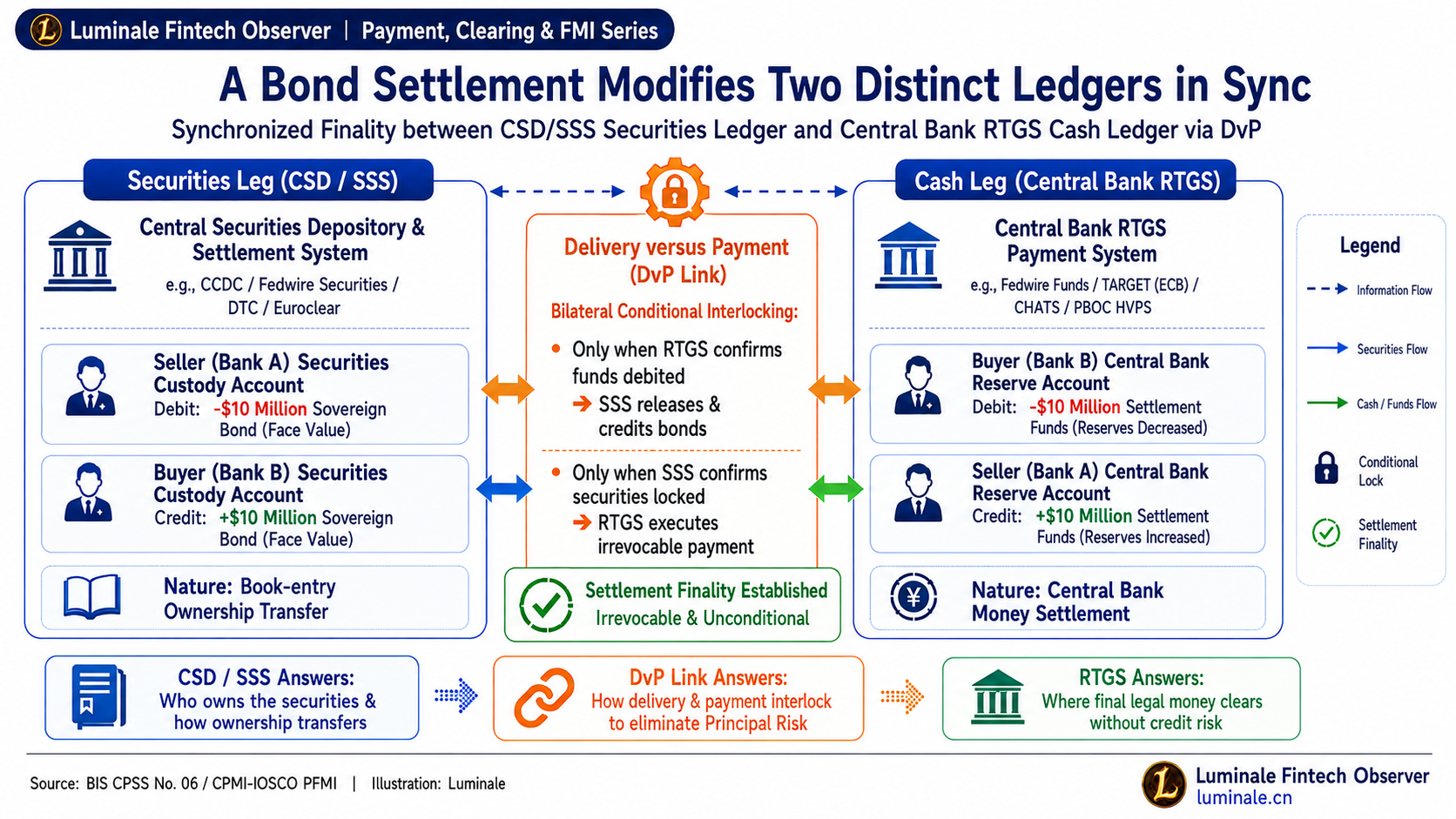
Without structural linkage between these two ledgers, transacting parties face a zero-sum dilemma: if securities are delivered first, the seller bears the risk of buyer default; if payment is remitted first, the buyer bears the risk of seller non-delivery. This settlement lag creates principal risk.
To eliminate principal risk, financial market infrastructures established Delivery versus Payment (DvP)—a mechanism ensuring that securities delivery and cash payment are mutually conditional and legally synchronized. For a comprehensive analysis of how DvP eliminates principal risk and the operational mechanics of Model 1 (gross-gross), Model 2 (gross-net), and Model 3 (net-net), please refer to our dedicated study, Securities Settlement and DvP .
In summary: The CSD establishes who owns the securities; the SSS executes book-entry debits and credits on securities accounts; the RTGS system executes definitive fund transfers; and the DvP link ensures that ledger updates across both systems occur interdependently and simultaneously reach settlement finality.
V. Why the Bond Market Is Inextricably Bound to Liquidity
In modern finance, bond depository and settlement infrastructures do far more than support secondary investment; they serve as the operational bedrock for central bank monetary policy implementation, interest rate transmission, and commercial bank intraday liquidity management.
1. Bonds as Core Collateral for Liquidity Management
Commercial banks must maintain robust liquidity buffers to accommodate depositor withdrawals, interbank clearing obligations, and regulatory standards such as the Liquidity Coverage Ratio (LCR). Secured bond financing is the primary avenue for securing short-term liquidity.
Through repurchase agreements (Repos), commercial banks pledge sovereign and prime bonds in the money market to obtain cash. Borrowers transfer bonds to lenders under an agreement to repurchase them at a specified future date and interest rate.
This operational chain requires CSDs to provide pledge registration, real-time collateral eligibility tracking, automated intraday collateral substitution, and maturity release services. Securities balances recorded on CSD ledgers effectively function as a core pillar of a bank's liquidity reserves alongside central bank deposits.
2. Distinguishing Government Debt Issuance from Central Bank Open Market Operations
Understanding bond market plumbing requires differentiating between government fiscal financing and central bank monetary operations:
┌────────────────────────────────────────────────────────┐
│             Fiscal Issuance vs Central Bank OMO        │
└────────────────────────────────────────────────────────┘

     [Ministry of Finance]                     [Central Bank]
              │                                      │
              ▼                                      ▼
       Issue Sovereign Debt                   Open Market Operations
              │                                      │
              ▼                                      ▼
      Finance Fiscal Deficits                 Manage Banking Reserves
              │                                      │
              ▼                                      ▼
  Broadly Liquidity-Neutral                   Direct Base Money Impact
(Funds Move to Treasury) (Expands or Absorbs Reserves)- Fiscal Debt Issuance: A government funding exercise. The treasury issues bonds to fund public expenditures. When primary dealers purchase bonds, commercial bank reserves are transferred to the treasury's central bank account, temporarily draining interbank liquidity; liquidity is subsequently restored as the government disburses budget funds. Fiscal debt issuance does not aim to actively steer base money supply.
- Central Bank Open Market Operations (OMO): A monetary policy exercise. The central bank conducts outright bond purchases/sales or pledge-based reverse repo/repo operations with primary dealers to steer market rates and reserve conditions. When injecting liquidity via reverse repos or outright purchases, the central bank directly credits dealer reserve accounts with newly created central bank money; when absorbing liquidity via repos or bond sales, it debits those reserve accounts.
Both macro mechanisms rely on the very same CSD/SSS infrastructure to record ownership, execute transfers, and freeze pledged assets. Thus, bond depository and settlement systems constitute the foundational plumbing of monetary governance.
VI. Global CSD/SSS Architectures Across Major Jurisdictions
Across international financial centers, securities ledger and settlement systems have evolved distinct institutional configurations shaped by legal traditions, monetary regimes, and market structures.
1. United States: Asset-Segregated Dual Track with Integrated Sovereign Debt
The US securities market operates without a singular monolithic CSD, organizing infrastructure strictly by underlying asset classes:
- US Treasuries & Agency Securities: Maintained on the Fedwire Securities Service (FSS), operated directly by the Federal Reserve Bank of New York. FSS represents a classic "central-bank-integrated" architecture, serving simultaneously as the centralized depository and real-time gross settlement system for federal debt. Because FSS operates within the same core technical environment as Fedwire Funds Service, participants execute real-time, gross DvP settlements with sub-second finality.
- Corporate Bonds, Municipal Debt, Equities & ABS: Deposited and settled through The Depository Trust Company (DTC), a subsidiary of the DTCC. DTC maintains corporate book-entry records, settling net cash obligations via the Fed's National Settlement Service (NSS) at batch times.
2. Europe: Fragmented Depository with a Unified Settlement Engine (T2S)
European markets have long grappled with national legal borders and fragmented local depositories (including Euroclear national CSDs, Clearstream Banking, and independent national depositories).
To eliminate cross-border settlement frictions, the Eurosystem launched TARGET2-Securities (T2S):
- T2S Is Not a CSD: It does not handle statutory primary registration. Legal ownership and issuer servicing remain anchored in local CSDs.
- T2S Is a Shared Settlement Platform: Participating CSDs outsource their settlement execution to T2S, while euro-area national central banks link their Dedicated Cash Accounts (DCAs) to the platform.
Within T2S, bonds deposited across different European CSDs settle seamlessly using central bank money on a single shared engine, creating a "Multi-CSD Depository + Unified Settlement Engine" framework.
3. Hong Kong: CMU and Multi-Currency RTGS Connectivity
The Central Moneymarkets Unit (CMU), operated by the Hong Kong Monetary Authority (HKMA), serves as the central debt securities depository and settlement system for Hong Kong.
CMU's hallmark is its native multi-currency settlement ecosystem:
- CMU connects directly with all four independent real-time gross settlement systems operated by the HKMA: HKD CHATS, USD CHATS, EUR CHATS, and RMB CHATS.
- Regardless of whether debt is denominated in Hong Kong dollars, US dollars, euros, or offshore renminbi, CMU executes real-time gross DvP settlement across the corresponding RTGS rail.
Furthermore, CMU acts as the central hub for Bond Connect, interfacing with the mainland's CFETS, CCDC, and SHCH to facilitate northbound and southbound institutional fixed-income investment.
4. Singapore: Integrated Sovereign Debt and Segregated Commercial Clearing
The Monetary Authority of Singapore (MAS) operates MEPS+, which handles Singapore dollar RTGS payments alongside an integrated electronic book-entry system for Singapore Government Securities (MEPS+-SGS).
Issuance, custody, and settlement of Singapore government bonds and T-bills are handled directly within the central bank perimeter. Meanwhile, The Central Depository (CDP), a subsidiary of the Singapore Exchange (SGX), acts as an independent commercial CSD for equities, corporate bonds, and retail assets.
Comprehensive Comparison of Global Fixed-Income CSD/SSS Architectures
| Jurisdiction / Market | Core Debt Depository Ledger (CSD) | Primary Securities Settlement System (SSS) | Cash Leg Settlement Rail | DvP Architecture | Structural Archetype |
|---|---|---|---|---|---|
| China (Onshore) | CCDC, SHCH | CCDC / SHCH Settlement Engines | PBOC High-Value Payment System (HVPS) | Model 1 Real-time Gross DvP Predominant | Deep integration between specialized bond FMIs and central bank payment rails |
| United States | Fedwire Securities (Treasuries); DTC (Corporate/Muni) | Fedwire Securities (RTGS); DTC (Netting) | Fedwire Funds / NSS (Central Bank Money) | Treasuries settle RTGS gross; Corporates settle multilateral net | Structural separation by asset class; sovereign debt fully integrated in central bank |
| Europe | Local National CSDs & ICSDs (Euroclear/Clearstream) | TARGET2-Securities (T2S) | Eurosystem Central Bank DCAs (Central Bank Money) | Cross-CSD real-time gross DvP on unified shared engine | Decentralized custody combined with centralized cross-border settlement engine |
| Hong Kong | Central Moneymarkets Unit (CMU) | CMU Settlement Engine | HKD / USD / EUR / RMB CHATS | Direct connectivity to four independent RTGS currency rails | Robust multi-currency DvP capabilities serving as an international gateway |
| Singapore | MEPS+-SGS (Govt Debt); CDP (Corporate/Equities) | MEPS+ Internal Engine; SGX-CDP | MEPS+ SGD Central Bank Accounts | Sovereign debt settles RTGS gross; commercial assets settle batch net | Sovereign debt closed-loop anchored directly by the central bank |
This comparison highlights that while organizational titles differ worldwide, the underlying mechanical triad is identical:
VII. Four Structural Archetypes of Securities Settlement Infrastructure
- Central Bank Integrated Model: Exemplified by US Fedwire Securities and Singapore MEPS+-SGS. The central bank directly owns and operates the CSD and SSS for sovereign debt, deploying the securities leg within the same institutional and technical perimeter as the RTGS cash leg. This minimizes settlement lag and credit risk, serving government debt financing and monetary policy execution.
- Specialized Independent CSD + RTGS Interconnected Model: Exemplified by China's CCDC and Hong Kong's CMU. The depository operates as a dedicated financial market infrastructure distinct from the central bank, linking to the central bank's RTGS system via private networks and bilateral DvP protocols. This preserves distinct institutional boundaries, allowing the CSD to focus on complex issuance, asset servicing, and collateral management.
- Multi-CSD Custody + Unified Settlement Engine Model: Pioneered by Europe's T2S. Investor accounts remain distributed across independent national CSDs under varying domestic legal frameworks, while post-trade settlement algorithms and cash sweeps are delegated to a centralized shared technology utility.
- Asset-Segregated Dual-Track Model: Archetyped by the United States. Risk-free sovereign debt is managed directly by monetary authorities, whereas credit-sensitive corporate bonds, mortgage-backed securities, and equities are handled by an industry-owned commercial depository utility (DTC).
This structural diversity demonstrates that FMI designs reflect not only technological choices, but also legal traditions, sovereign boundaries, and domestic market depth.
Conclusion: The Back-Office Master Ledger Is the True Anchor of Asset Ownership
Across a bond's complete trajectory from issuance to redemption, financial market infrastructures integrate disparate transactional steps into a closed operational loop:
Lawful Issuance
       │
       ▼
CSD Master Registration & Issue Integrity
       │
       ▼
Primary Market Allotment & Cash Collection
       │
       ▼
Secondary Market Trade Execution
       │
       ▼
Settlement Instructions Submitted to SSS
       │
       ▼
Securities Leg (SSS) & Cash Leg (RTGS) Synchronized
       │
       ▼
DvP Achieved & Settlement Finality Established
       │
       ▼
Asset Servicing, Collateral Management & Redemption
When observing financial markets, attention is naturally drawn to flashing trade terminals, yield curves, interest rate decisions, and trading volumes. Yet before those market transactions can convert into legally protected ownership transfers, they depend entirely on the silent operation of back-office financial market infrastructures:
- The CSD establishes how many valid securities exist and who owns them;
- The SSS enforces the lawful, irreversible transfer of securities between accounts;
- The payment system establishes where definitive legal money settles without credit risk;
- The DvP mechanism ensures that securities delivery and cash payment occur simultaneously, eliminating counterparty default exposure.
The foundation of modern securities markets is not the physical movement of certificates, nor the local storage of digital files. It is the coordinated, rule-based modification of two master ledgers: the securities ledger and the cash ledger.
Ultimately, what determines whether a financial institution truly owns a bond is not the trade confirmation on its dealing screen, but the final, legally binding entry recorded on the master ledgers of the CSD and SSS.
References
[1]: CPMI-IOSCO, Principles for Financial Market Infrastructures (PFMI), Committee on Payments and Market Infrastructures and Technical Committee of the International Organization of Securities Commissions, April 2012. https://www.bis.org/cpmi/publ/d101a.pdf ↩
[2]: Bank for International Settlements (CPMI), Delivery versus payment in securities settlement systems, Reports by the Committee on Payment and Settlement Systems, September 1992. https://www.bis.org/cpmi/publ/d06.pdf ↩
[3]: Bank for International Settlements (CPMI), A glossary of terms used in payments and settlement systems, CPMI Papers No. 101, 2012. https://www.bis.org/cpmi/publ/d101.htm ↩
[4]: Federal Reserve Bank of New York, Fedwire Securities Service Operating Circular No. 7, 2024/2025. https://www.frbservices.org/resources/rules-regulations/operating-circulars ↩
[5]: European Central Bank, TARGET2-Securities (T2S) Annual Report, Frankfurt am Main, 2025. https://www.ecb.europa.eu/paym/target/t2s/html/index.en.html ↩
[6]: Hong Kong Monetary Authority, Central Moneymarkets Unit (CMU) Service Reference Manual, HKMA, 2024/2025. https://www.hkma.gov.hk/eng/key-functions/international-financial-centre/debt-market/cmu/ ↩
[7]: Monetary Authority of Singapore, Monetary Authority of Singapore (Electronic Payment System) Regulations (MEPS+ SGS), 2024/2025. https://www.mas.gov.sg/ ↩
[8]: China Central Depository & Clearing Co., Ltd. (CCDC), Business Rules and Operating Procedures for Bond Registration, Custody, and Settlement, ChinaBond, 2024/2025. https://www.chinabond.com.cn/ ↩
[9]: Shanghai Clearing House (SHCH), Business Guide for Cash Bond and Derivatives Registration, Custody, and Clearing, 2024/2025. https://www.shclearing.com.cn/ ↩
Originally published by Luminale Fintech Observer: https://luminale.cn/articles/where-are-bonds-held-csd-and-sss-en