In everyday spending, when we scan a QR code, tap a card, or make a bank transfer on a mobile phone, funds typically appear as "payment successful" within seconds. Yet behind this frictionless front-end experience, moving money from the payer's account until the payee actually receives irrevocable funds requires a sophisticated inter-institutional relay of information transmission and ledger adjustments.
To understand how the modern financial system operates, payment systems hold a central position. A payment system is far more than an information transmission highway; it is an institutional and technological framework governing the transfer of monetary claims and risk management among financial institutions.
I. Core Components and Conceptual Distinctions of Payment Systems
The Committee on Payments and Market Infrastructures (CPMI) of the Bank for International Settlements (BIS) defines a payment system as a set of instruments, procedures, and rules for the transfer of funds among two or more participants, comprising both the system operator and the participants themselves[1].
A payment system is neither a mere software platform nor a standalone telecommunications network. It is an integrated fabric of legal rules, operational procedures, technical protocols, and account structures. Understanding this mechanism requires untangling several frequently conflated concepts.
1. The Hierarchical Relationship Among Payment, Clearing, and Settlement
An inter-institutional transaction typically spans three tightly linked stages:
- Payment: The comprehensive operational process through which a payer transfers monetary claims to a payee, encompassing initiation, authorization, clearing, and ultimate settlement.
- Clearing: The intermediate process occurring prior to final settlement in which payment instructions are transmitted, verified, and confirmed. In many systems, it also involves calculating bilateral or multilateral net debit and credit obligations among participating institutions.
- Settlement: The actual transfer of funds across designated account ledgers, thereby legally fulfilling and discharging the monetary claims and debt obligations between the participating parties.
Financial messaging networks such as the Society for Worldwide Interbank Financial Telecommunication (SWIFT) focus primarily on transmitting standardized payment instructions securely among financial institutions. SWIFT operates within the clearing and communication tier; it does not maintain customer or reserve funds accounts, nor does it execute final cash movements. Consequently, SWIFT is a messaging carrier rather than a payment system in itself.
2. A Six-Dimensional Analytical Framework for Payment Systems
Within Luminale's payment infrastructure analytical framework, observing and assessing a specific payment system cannot rely on simplistic labels such as "high-value vs. retail" or "real-time vs. non-real-time". Instead, it can be analyzed across six distinct dimensions:
- By Transaction Nature: Retail Payment Systems (RPS, handling high-frequency, relatively low-value transactions between individuals, merchants, and small businesses) vs. High-Value Payment Systems (HVPS, processing large-value, time-critical interbank money market transfers, foreign exchange transactions, and securities settlements; frequently termed Wholesale Funds Transfer Systems).
- By Settlement Timeliness: Batch scheduled processing vs. Same-day processing vs. Real-time or instant processing.
- By Settlement Mechanism: Real-Time Gross Settlement (RTGS) vs. Deferred Net Settlement (DNS) vs. Hybrid Settlement Systems.
- By Settlement Asset: Central Bank Money (such as commercial bank statutory reserve deposits held at the central bank) vs. Commercial Bank Money (such as demand deposit claims maintained on a commercial settlement bank's books).
- By Geographic Scope: Domestic single-currency systems vs. Cross-border multi-currency systems vs. Offshore settlement infrastructures.
- By Participation Model: Direct Participants (holding accounts directly with the settlement institution and submitting instructions autonomously) vs. Indirect Participants (accessing settlement services through direct member sponsor banks).
CPMI guidelines emphasize that high-value payment systems rarely impose rigid minimum amount thresholds; their distinguishing feature lies in handling high-priority, systemically important fund transfers among market institutions[2].
Comparing a national payment ecosystem to an urban transportation network clarifies these roles:
- Payment cards, QR codes, mobile phone numbers, and consumer apps serve as access ramps;
- Automated Clearing Houses (ACH) and Faster Payment Systems (FPS) act as urban roads and expressways;
- High-value RTGS systems function as the central interchange routing high-speed freight;
- Central bank reserve accounts serve as the foundational master ledger documenting the sovereign monetary baseline.
II. Core Settlement Mechanisms: The Trade-off Among RTGS, DNS, and Hybrid Systems
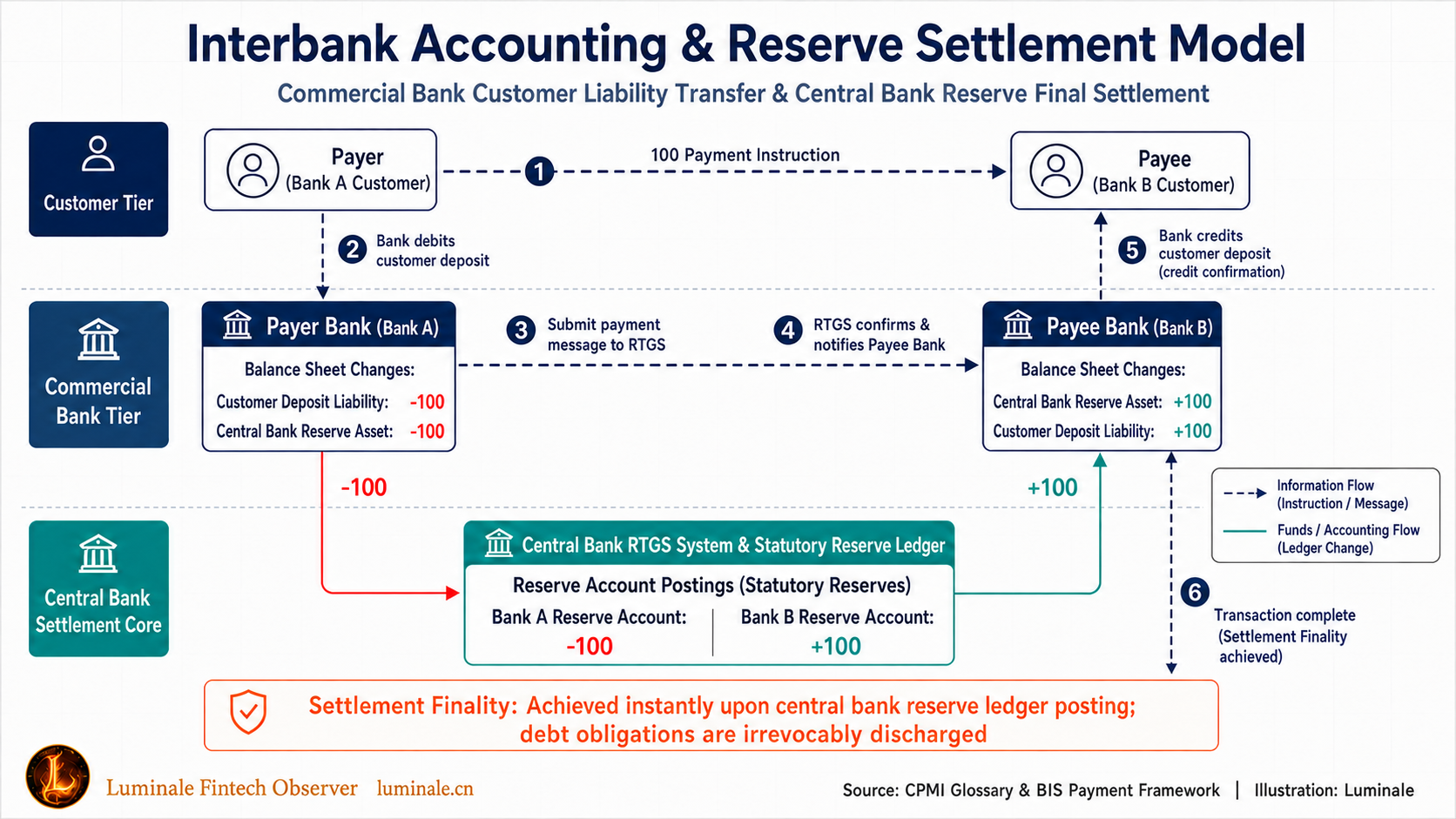
At the heart of interbank payments lies the fundamental question of how monetary claims across independent commercial banks are securely transferred. When a customer transfers $100 from Bank A to Bank B, the customer accounts and the banks'accounts at the central bank adjust simultaneously:
| Institution | Asset Side Changes | Liability Side Changes |
|---|---|---|
| Payer Bank (Bank A) | Central Bank Reserve Deposits -100 | Customer Demand Deposits (Liability) -100 |
| Payee Bank (Bank B) | Central Bank Reserve Deposits +100 | Customer Demand Deposits (Liability) +100 |
| Central Bank Ledger | Unchanged (Total Assets Balanced) | Bank A Reserve Balance -100Bank B Reserve Balance +100 |
When orchestrating millions of daily transactions, payment architectures have developed three primary settlement mechanisms, each striking a distinct balance between liquidity costs and settlement risk.
1. Real-Time Gross Settlement (RTGS)
Real-Time Gross Settlement (RTGS) processes every payment instruction individually and immediately on a transaction-by-transaction basis. Provided the paying bank maintains sufficient account balances or intraday credit lines at the central bank, the system debits the paying bank's account and credits the receiving bank's account instantaneously.
- Advantages: Each transaction achieves immediate, unconditional, and irrevocable finality upon posting, eliminating intraday and overnight interbank credit exposure.
- Costs: It demands substantial intraday liquidity. If a participating bank faces a temporary liquidity squeeze, queued instructions can cascade into gridlock across the broader network.
2. Deferred Net Settlement (DNS)
Deferred Net Settlement (DNS) aggregates payment instructions across a predetermined clearing cycle (such as hourly, semi-daily, or end-of-day). The system calculates the net multilateral credit or debit position for each participant, executing fund transfers only for the net difference at the end of the window.
- Advantages: Exceptional liquidity efficiency. For example, if Bank A owes Bank B $1,000,000 while Bank B owes Bank A $800,000, DNS requires transferring only a net $200,000 to discharge $1,800,000 in total transaction volume.
- Risks: Until net settlement settles definitively, all cleared transactions remain exposed to settlement risk. Should a major net debtor default before final settlement, the batch may require unwinding and recalculation, triggering severe systemic liquidity shocks.
3. Hybrid Settlement Systems and Liquidity Saving Mechanisms (LSM)
To capture the certainty of RTGS while preserving the capital conservation of DNS, modern high-value payment systems incorporate Liquidity Saving Mechanisms (LSM) within hybrid architectures.
These systems establish centralized queues alongside continuous bilateral and multilateral offsetting algorithms. Once the algorithm discovers a cluster of queued payments that neutralize each other within participants'available intraday balances, it triggers atomic, synchronized gross settlement across the ledger, releasing the entire batch immediately.
| Mechanism Type | Settlement Basis | Finality Timing | Intraday Liquidity Demand | Credit & Default Risk |
|---|---|---|---|---|
| RTGS | Gross, transaction-by-transaction | Immediate upon execution | High (requires full prefunding) | Minimal (zero interbank exposure) |
| DNS | Net aggregated position | At cycle cut-off | Minimal (settles net differential) | Elevated (unwinding risk prior to cut-off) |
| Hybrid (LSM) | Queuing & algorithmic matching | Upon algorithmic matching & posting | Moderate (saves significant intraday capital) | Low (combines certainty with capital efficiency) |
4. Critical Distinction: Instant Crediting Does Not Equal Real-Time Interbank Settlement Finality
As Faster Payment Systems (FPS) expand worldwide, consumers and businesses enjoy near-instant fund availability. Nevertheless, immediate crediting of a customer's account does not necessarily signify immediate gross final settlement on central bank books[3].
In many retail fast payment networks, the front end credits the beneficiary's balance within seconds (with the receiving bank extending short-term credit to its customer), whereas the underlying interbank settlement obligations settle in net batches via the central bank's RTGS system periodically. To mitigate credit risk, system operators mandate that participants post eligible collateral or prefund dedicated reserve accounts at the central bank.
Under Principle 9 of the CPMI-IOSCO Principles for Financial Market Infrastructures (PFMI), financial market infrastructures should conduct money settlements in central bank money where practical and available; where commercial bank money is utilized, robust controls must strictly curb credit and liquidity vulnerabilities[4].
III. Payment Systems Are Not Silos: The Central Role of RTGS in Financial Market Infrastructures
Evaluating a national payment ecosystem requires looking beyond standalone rails to comprehend the wider Financial Market Infrastructure (FMI) matrix.
The PFMI framework identifies five core FMI pillars: Payment Systems (PS), Central Securities Depositories (CSD), Securities Settlement Systems (SSS), Central Counterparties (CCP), and Trade Repositories (TR)[4].
BIS studies on interdependencies demonstrate that modern FMIs form a tightly woven network where the central bank RTGS system functions as the supreme liquidity anchor[5].
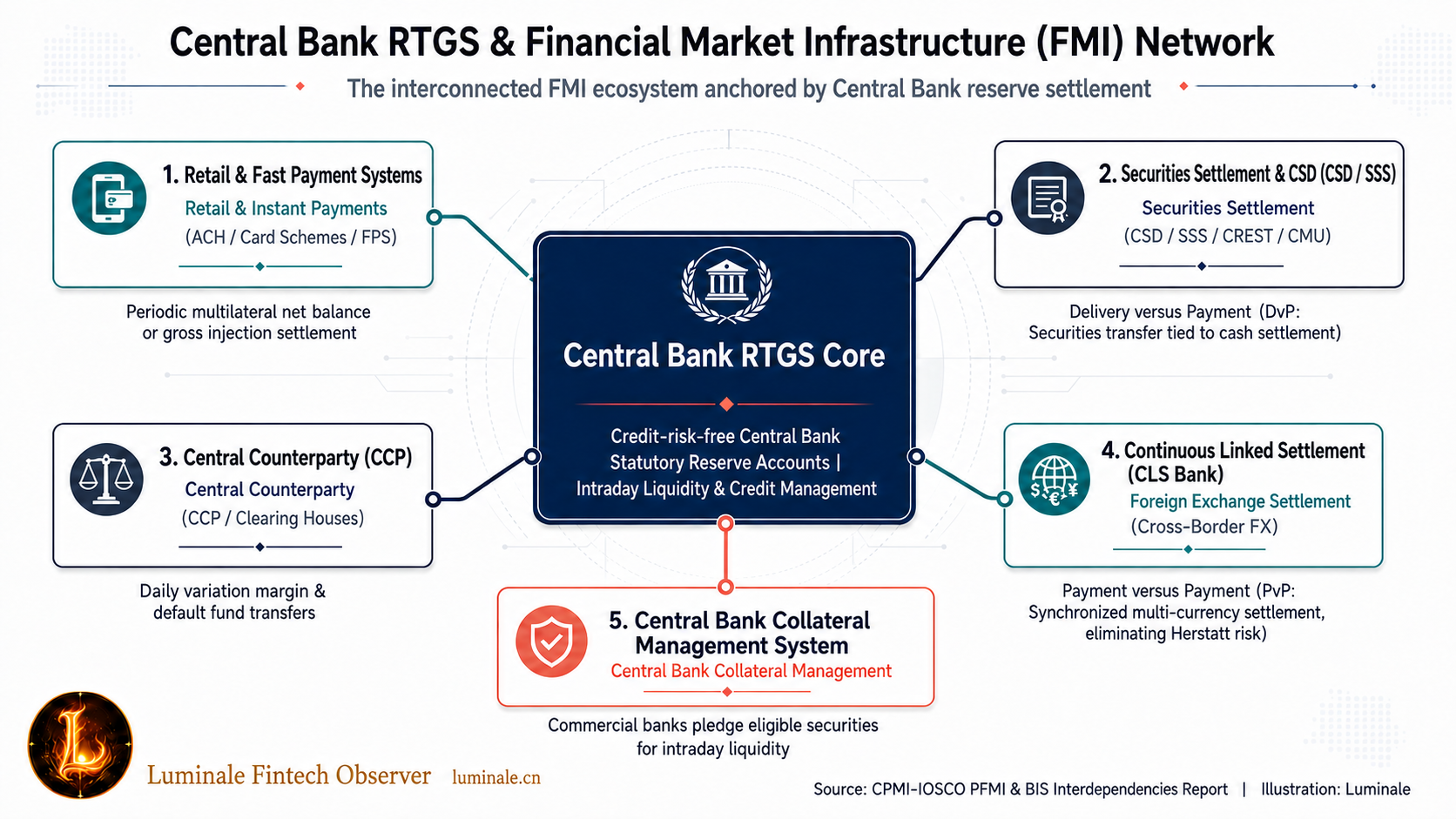
Five critical connection conduits link core financial infrastructure to the RTGS anchor:
- Retail Payment System Connections: Millions of daily low-value transactions processed by ACH, card schemes, or instant networks net out periodically, injecting net debit and credit obligations into the RTGS for final reserve reallocation.
- Securities Settlement System (CSD/SSS) Connections: In bond and equity settlements, Delivery versus Payment (DvP) links securities ownership changes with RTGS cash legs, ensuring assets transfer if and only if funds transfer.
- Central Counterparty (CCP) Connections: Derivatives and cash clearing houses manage daily mark-to-market variation margins and default fund contributions through RTGS accounts to secure cash settlement with absolute certainty.
- Continuous Linked Settlement (CLS Bank) Connections: Foreign exchange settlements involve cross-currency, cross-timezone risks. Continuous Linked Settlement (CLS) operates Payment versus Payment (PvP) across national RTGS systems, synchronizing currency legs simultaneously to eliminate Herstatt risk[5].
- Central Bank Collateral and Liquidity Facilities: When banks face midday cash squeezes, central bank collateral management systems allow them to pledge eligible securities in exchange for intraday liquidity facilities, keeping high-value payment channels unobstructed.
Case Studies: Infrastructure Synergy in the UK and Hong Kong
- The United Kingdom: The Bank of England anchors the financial system through a unified RTGS core. It settles high-value gross transfers via CHAPS, processes net settlement obligations for Faster Payments, Bacs, and the Image Clearing System, and supports the sterling leg of CREST securities settlement and CLS foreign exchange operations[9].
- Hong Kong: The Hong Kong Monetary Authority (HKMA) operates an advanced multi-currency RTGS infrastructure supporting HKD, USD, EUR, and RMB CHATS. The Central Moneymarkets Unit (CMU) integrates directly with CHATS for multi-currency DvP, foreign exchange trades settle via PvP, and the Faster Payment System (FPS) extends CHATS to provide 24/7 instant retail settlement in HKD and RMB[7].
IV. Comparative Architecture of Major Global Payment Systems
Different jurisdictions configure their payment infrastructures according to domestic market traditions, banking structures, and regulatory mandates.
| Jurisdiction | Wholesale / High-Value Core Systems | Retail & Instant Payment Infrastructures | Core Settlement Features & Interconnection Design |
|---|---|---|---|
| Mainland China | High-Value Payment System (HVPS) Cross-Border Interbank Payment System (CIPS) | Bulk Electronic Payment System (BEPS) Internet Banking Payment System (IBPS) China UnionPay / NetsUnion Clearing Platform | HVPS anchors central bank real-time gross settlement; CIPS serves cross-border RMB clearing via a hybrid mechanism combining RTGS and scheduled DNS; UnionPay and NetsUnion clear retail card and mobile payments, settling net balances through PBOC systems[6]. |
| Hong Kong | Clearing House Automated Transfer System (CHATS) for HKD, USD, EUR, and RMB | Faster Payment System (FPS) | Distinctive four-currency RTGS architecture; CMU debt depository connects directly with CHATS for multi-currency DvP; PvP supports multi-currency FX transactions; FPS delivers 24/7 instant retail and corporate settlement[7]. |
| Singapore | MAS Electronic Payment System (MEPS+) | Fast and Secure Transfers (FAST) GIRO Batch System / PayNow Proxy Service | MEPS+ provides SGD interbank RTGS and government securities DvP settlement; FAST delivers 24/7 SGD real-time consumer transfers; PayNow links mobile numbers and national IDs to bank accounts[8]. |
| United Kingdom | Clearing House Automated Payment System (CHAPS) Bank of England RTGS | Faster Payments Service Bacs Payment Schemes / Image Clearing System | The Bank of England's singular RTGS engine combines high-value gross transfers with net retail settlements, deeply integrated with CREST (securities) and CLS (FX)[9]. |
| United States | Fedwire Funds Service Clearing House Interbank Payments System (CHIPS) | FedNow Service The Clearing House RTP Network FedACH Batch System | Dual public-private architecture. Fedwire delivers gross central bank finality; private-sector CHIPS utilizes sophisticated multilateral algorithms to clear high-value payments with minimal liquidity; FedNow and RTP advance instant payments[10]. |
| Eurozone | Trans-European Automated Real-time Gross settlement Express Transfer system (T2) EURO1 (Private Large-Value Net System) | TARGET Instant Payment Settlement (TIPS) RT1 (EBA CLEARING Instant System) STEP2 Pan-European Batch Clearing | Eurosystem-operated T2 and TIPS provide round-the-clock central bank money settlement; privately owned EURO1 and STEP2 offer pan-European commercial clearing networks[11]. |
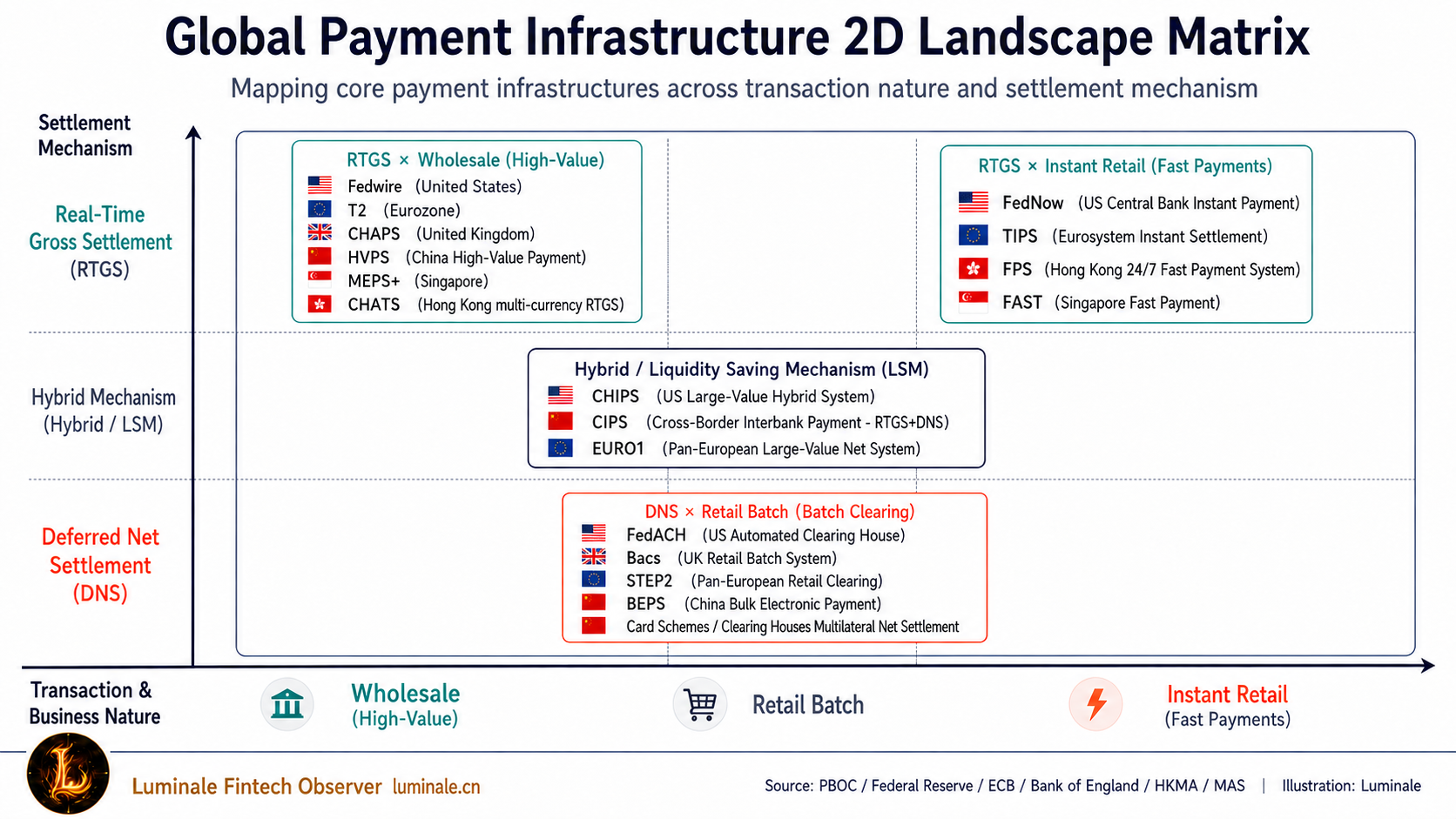
Comparative analysis across global models yields three fundamental insights:
- Insight 1: Retail payment systems do not rely exclusively on net settlement. Fast payment rails such as FedNow, TIPS, and FPS increasingly execute around-the-clock gross settlement in central bank money.
- Insight 2: High-value wholesale systems do not operate solely on basic RTGS. Sophisticated platforms such as CHIPS and CIPS demonstrate that algorithmic liquidity-saving features can drastically reduce capital requirements without sacrificing finality.
- Insight 3: Systemic resilience depends on legal clarity regarding settlement finality and the underlying credit quality of the settlement asset (whether claims settle in risk-free central bank money).
V. The Evolution of Payment Systems: From Messaging Interconnection to Synchronized Settlement and Tokenised Assets
According to the Financial Stability Board (FSB) progress report on the G20 Cross-Border Payments Roadmap, enhancing infrastructure interoperability, aligning regulatory oversight, and implementing standardized messaging frameworks remain paramount international priorities[12].
Next-generation payment infrastructures are progressing across six transformative dimensions:
1. Extended RTGS Operating Hours and Overlapping Global Settlement Windows
Traditional RTGS systems operate within domestic banking hours, generating time-zone misalignments in cross-border settlements. The Bank of England, the Federal Reserve, and the European Central Bank are actively extending operating windows toward near-24/7 regimes, broadening global overlapping settlement windows and reducing the capital required to prefund foreign currency positions.
2. Bilateral and Multilateral Interconnection of Fast Payment Systems
Central banks are linking national instant payment networks directly to compress cross-border remittance costs.
- Singapore PayNow & Thailand PromptPay: The world's first bilateral linkage between national fast payment systems enables users to transfer funds cross-border in real time using recipient mobile numbers.
- Hong Kong FPS & Thailand PromptPay: A cross-border QR code collaboration allowing Hong Kong travelers to scan PromptPay QR codes in Thailand, while Thai visitors scan FPS QR codes in Hong Kong for point-of-sale payments.
- Underlying Architectural Hurdles: Beyond establishing API connections, system linkages must address five foundational challenges:
- FX Conversion Mechanics: Designating market-making commercial banks to deliver competitive real-time exchange rates;
- Cross-Border AML/CFT Coordination: Performing sanctions screening and fraud monitoring within sub-second latencies;
- Settlement Sequencing & Transit Risk: Establishing when each domestic currency leg posts irrevocably;
- Liquidity Provisioning: Balancing and replenishing foreign exchange settlement positions;
- Payment versus Payment (PvP): Ensuring one currency leg completes if and only if the corresponding leg settles, preventing principal loss.
3. Data Standard Upgrades: Comprehensive Implementation of ISO 20022
Global high-value payment systems—including Fedwire, T2, CHAPS, and CIPS—have adopted the ISO 20022 messaging standard. Compared to legacy syntax, ISO 20022 provides rich, structured data fields that preserve end-to-end payer, payee, ultimate beneficiary, and remittance invoice details. This rich data reduces straight-through-processing exceptions, streamlines automated reconciliations, and bolsters compliance screening.
4. Expanding Direct Access to Central Bank Payment Systems
Historically, direct access to central bank RTGS ledgers was restricted to prudentially supervised commercial banks. Recently, authorities such as the Bank of England and the Swiss National Bank have extended direct settlement access to eligible non-bank payment service providers (PSPs) and specialized FMIs. Broadening access shortens payment chains and mitigates correspondent tiering costs, though it requires robust risk surveillance to manage operational and liquidity exposures.
5. Settlement Upgrades: From Asynchronous Reconciliation to Synchronized Atomic Settlement
In conventional securities or cross-border asset transactions, asset ownership transfer and cash leg settlement reside on isolated ledgers, relying on asynchronous messaging relays and post-trade manual reconciliations:
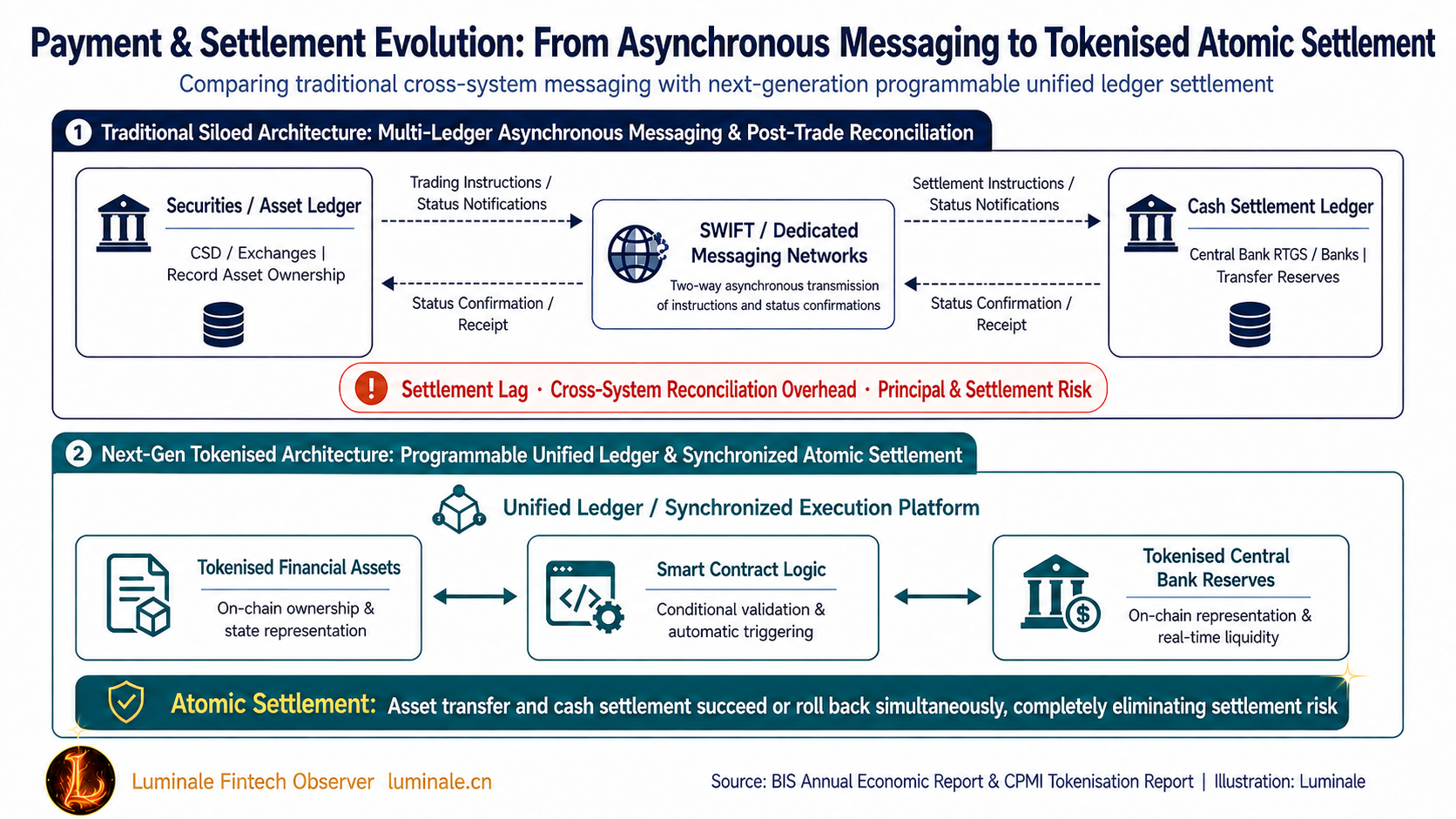
With Distributed Ledger Technology (DLT) and tokenisation, markets are pioneering models where asset transfers and cash settlements operate within a coordinated or shared ledger environment. Through smart contract conditional logic, counterparties can achieve atomic settlement—where asset transfer and cash settlement execute simultaneously or fail entirely—eliminating in-flight settlement risk at the protocol layer[13].
6. Technical Evolution of Settlement Assets: Wholesale CBDC and Tokenised Reserves
Studies by the BIS and leading central banks demonstrate that tokenised financial ecosystems do not bypass central bank money; rather, they explore new technological representations of sovereign currency in digital environments[14]:
- Trigger Solutions via Synchronized RTGS: Interfacing legacy RTGS systems with external DLT platforms, where on-chain asset events trigger traditional reserve transfers over API gateways.
- Wholesale Central Bank Digital Currency (wCBDC): Issuing central bank liabilities directly on distributed ledgers for round-the-clock interbank atomic settlement.
- Tokenised Reserves & Unified Ledgers: The BIS blueprint envisions a Unified Ledger integrating tokenised central bank reserves, tokenised commercial bank deposits, and tokenised securities on a shared, programmable partition. This design preserves the singleness of money and the anchor of central bank finality while unlocking programmable composability[15].
The BIS's recent evaluations adopt a pragmatic stance: traditional RTGS systems retain substantial modernization headroom, while tokenised rails must resolve cyber-resilience, legal finality, and cross-platform interoperability hurdles. The future financial infrastructure will likely see modernized conventional architectures and tokenised ledgers coexisting and interconnecting over the long term.
Conclusion
The payment innovations visible in everyday life concentrate at the consumer front end. Yet the safety and resilience of the global economy are determined by the institutional infrastructure operating out of sight in the background.
QR interfaces, digital wallets, and messaging wrappers evolve continuously, but every payment system ultimately answers the same fundamental questions:
- Who owes whom?
- Who maintains the authoritative ledger?
- How are interbank claims cleared?
- Across whose trusted balance sheet does final settlement occur?
- What asset functions as the settlement medium?
- At what precise legal point does settlement finality become irrevocable?
- If a participant defaults or faces liquidity insolvency, how is risk contained?
Decades of evolution have established enduring institutional pillars: Real-Time Gross Settlement (RTGS), Deferred Net Settlement (DNS), multilateral netting, Delivery versus Payment (DvP), Payment versus Payment (PvP), and settlement anchored in risk-free central bank money.
As financial infrastructure enters the era of tokenisation, these fundamental principles remain as vital as ever.
Technology will reshape ledger formats, communication interfaces, and settlement execution, but the fundamental mission of payment infrastructures remains unchanged: to transfer monetary claims between disparate entities safely, promptly, and definitively, at the lowest possible liquidity cost.
The next frontier in payment systems is not merely launching isolated blockchains or placing money on-chain. It is the transition from siloed payment, securities, and foreign exchange ledgers toward an interconnected, synchronized settlement infrastructure—where, regardless of technical form, risk-free settlement assets and irrevocable settlement finality remain the steadfast anchor of the monetary system.
References
[1]: Bank for International Settlements (CPMI), A glossary of terms used in payments and settlement systems, CPMI Papers No. 101, 2012. https://www.bis.org/cpmi/publ/d101a.pdf ↩
[2]: Bank for International Settlements (CPMI), Core Principles for Systemically Important Payment Systems, 2001. https://www.bis.org/cpmi/publ/d69.pdf ↩
[3]: CPMI, Fast payment systems: emerging themes in design, uptake and use, 2021. https://www.bis.org/cpmi/publ/d223.pdf ↩
[4]: CPMI-IOSCO, Principles for Financial Market Infrastructures (PFMI), 2012. https://www.bis.org/cpmi/publ/d101.htm ↩
[5]: Bank for International Settlements, Interdependencies of payment and settlement systems, CPMI Papers No. 84, 2008. https://www.bis.org/cpmi/publ/d84.htm ↩
[6]: People's Bank of China, Payment System Operations Report, 2025. https://www.pbc.gov.cn/zhifujiesuansi/128525/128545/128643/2026021217345429754/2026021217343023236.pdf ↩
[7]: Hong Kong Monetary Authority, Payment and Settlement Systems in Hong Kong, HKMA Annual Report, 2025. https://www.hkma.gov.hk/eng/data-publications-and-research/publications/annual-report/2025/ ↩
[8]: Monetary Authority of Singapore, Monetary Authority of Singapore, Monetary Authority of Singapore Payment System Regulations*. https://www.mas.gov.sg/regulation/payments/regulations-and-guidance ↩
[9]: Bank of England, The Bank of England's Real-Time Gross Settlement (RTGS) service and CHAPS, 2025/2026. https://www.bankofengland.co.uk/payment-and-settlement ↩
[10]: Board of Governors of the Federal Reserve System, Federal Reserve Policy on Payment System Risk & FedNow Service Overview, 2025. https://www.federalreserve.gov/paymentsystems.htm ↩
[11]: European Central Bank, T2 and TIPS operational overview and TARGET services, 2025. https://www.ecb.europa.eu/paym/target/t2/html/index.en.html ↩
[12]: Financial Stability Board (FSB), G20 Roadmap for Enhancing Cross-border Payments: Consolidated Progress Report for 2025, October 2025. https://www.fsb.org/2025/10/g20-roadmap-for-cross-border-payments-consolidated-progress-report-for-2025/ ↩
[13]: CPMI, Tokenisation in the context of money and other assets: concepts and implications for central banks, CPMI Papers, 2024. https://www.bis.org/cpmi/publ/d217.htm ↩
[14]: Bank for International Settlements, Wholesale Central Bank Money for Settlement in a Digital Era, Joint Report, 2025. https://www.bis.org/publ/othp99.htm ↩
[15]: Bank for International Settlements, Next-generation monetary and financial system, BIS Annual Economic Report, 2025/2026. https://www.bis.org/publ/arpdf/ar2026e.pdf ↩
Originally published by Luminale Fintech Observer: https://luminale.cn/articles/what-is-a-payment-system-en