Who Can Hold an Account at the Central Bank? Decoding the Central Bank Account Hierarchy
When discussing interbank fund transfers in daily finance, attention frequently centers on the reserve accounts held by commercial banks at the central bank: when Bank A's client transfers money to Bank B's client, two commercial banks must ultimately settle debit and credit transfers across reserve ledgers at the central bank. On the central bank's balance sheet, bank reserves represent liabilities owed to commercial banking institutions.
Those newly introduced to payment and clearing often develop a misconception: assuming that central bank deposit accounts are synonymous with commercial bank reserve accounts. The Provisions on the Administration of Central Bank Deposit Accounts issued by the People's Bank of China (PBOC) in 2023[1] helps dispel this illusion. Beyond deposit-taking commercial banks, central securities depositories, clearing houses, non-bank payment service providers, and foreign monetary authorities can also establish deposit accounts with the central bank under specific statutory conditions.
Balances held by account holders at the central bank all appear as liabilities on the central bank's balance sheet, yet their underlying legal character, remuneration rules, and transactional permissions are far from identical. Decoding this account architecture illuminates which financial activities the central bank anchors with ultimate, risk-free settlement infrastructure.
1. The Central Bank Balance Sheet: Who Holds Central Bank Liabilities?
Understanding central bank accounts requires first examining the liability side of the central bank's balance sheet.
Commercial bank deposits represent liabilities of commercial banks to the public. Physical banknotes issued by the central bank and institutional deposits absorbed by it, by contrast, constitute direct liabilities of the central bank to society and institutional holders. Because the central bank faces no credit or default risk in its own currency, central bank liabilities serve as the safest ultimate settlement asset in modern financial architecture.
Institutions entitled to deposit funds directly onto the central bank's balance sheet extend well beyond commercial banks. A simplified liability structure of the central bank encompasses several distinct components:
| Liability Component | Eligible Entity & Account Vehicle | Fund Nature & Economic Purpose |
|---|---|---|
| Reserve Money: Deposits of Financial Institutions | Reserve deposit accounts held by commercial banks, rural credit cooperatives, foreign bank branches | Statutory required reserves and excess reserves; used for liquidity management and interbank clearing and settlement |
| Reserve Money: Currency in Circulation | Physical banknotes held by the public and bank vault cash | Direct cash liabilities of the central bank to society, existing outside account ledgers |
| Deposits of Non-Financial Institutions | Centralized custody accounts for customer reserve funds held by non-bank payment institutions | Customer in-transit payment balances under 100% centralized custody, isolating platform operational and embezzlement risks |
| Government Deposits | Treasury single accounts held by fiscal authorities, fiscal deposit accounts at designated agent banks | Budgetary fiscal revenues, Treasury bond proceeds, and administrative revenues managed through the single treasury system |
| Other Deposits & Liabilities | Settlement accounts of FMIs, foreign central bank accounts, central bank dedicated operational accounts | Securities settlement and inter-institution clearing margins, foreign exchange reserve placements, and official mandate funds |
Establishing an account at the central bank provides institutions with an institutionalized conduit to directly hold central bank money.
The PBOC Provisions on the Administration of Central Bank Deposit Accounts[1] specifies six categories of eligible applicants:
- Financial institutions holding financial business licenses;
- Non-bank payment institutions;
- Financial market infrastructure (FMI) operating entities;
- Foreign central banks, monetary authorities, and international financial organizations;
- Internal departments and operational units of the People's Bank of China;
- Other institutions approved by the People's Bank of China.
Eligibility under the regulations does not imply unconditional access. Applicants must substantiate genuine operational necessity or clear statutory policy mandates. For settlement accounts that generate significant market externalities, the central bank evaluates necessity across multiple dimensions, including systemic financial stability, credit risk mitigation, and fair market competition[1].
2. Functional Classification: The Full Architecture of Central Bank Deposit Accounts
The PBOC regulatory framework divides central bank deposit accounts into two broad classes: Reserve Deposit Accounts and Special Deposit Accounts.
Reserve deposit accounts are restricted to institutions subject to statutory reserve requirement assessments. Entities outside the reserve assessment regime that demonstrate specialized custody, settlement, or mandate fulfillment requirements utilize special deposit accounts.
Central Bank Deposit Account Framework
├── Reserve Deposit Accounts (Depository institutions: reserve requirement compliance, cash replenishment, interbank settlement)
└── Special Deposit Accounts
    ├── Fiscal Deposit Accounts (Treasury single account pooling, fiscal disbursement agency services)
    ├── Special Policy Accounts (Structural liquidity absorption and targeted macroprudential management)
    ├── Customer Reserve Custody Accounts (100% segregated custody of non-bank payment customer funds)
    ├── Settlement Accounts (Non-reserve financial institutions and FMIs for securities and funds final settlement)
    ├── Other Dedicated Accounts (FX settlement, cross-border settlement, foreign central bank facilities)
    └── Operations Dedicated Accounts (Central bank internal mandate execution, OMO, standing lending facilities)
Within the financial infrastructure and account capability analytical framework developed by Luminale, central bank deposit accounts function as standardized interfaces connecting participants to the sovereign balance sheet. Each account type reflects a distinct supervisory mandate and clearing objective:
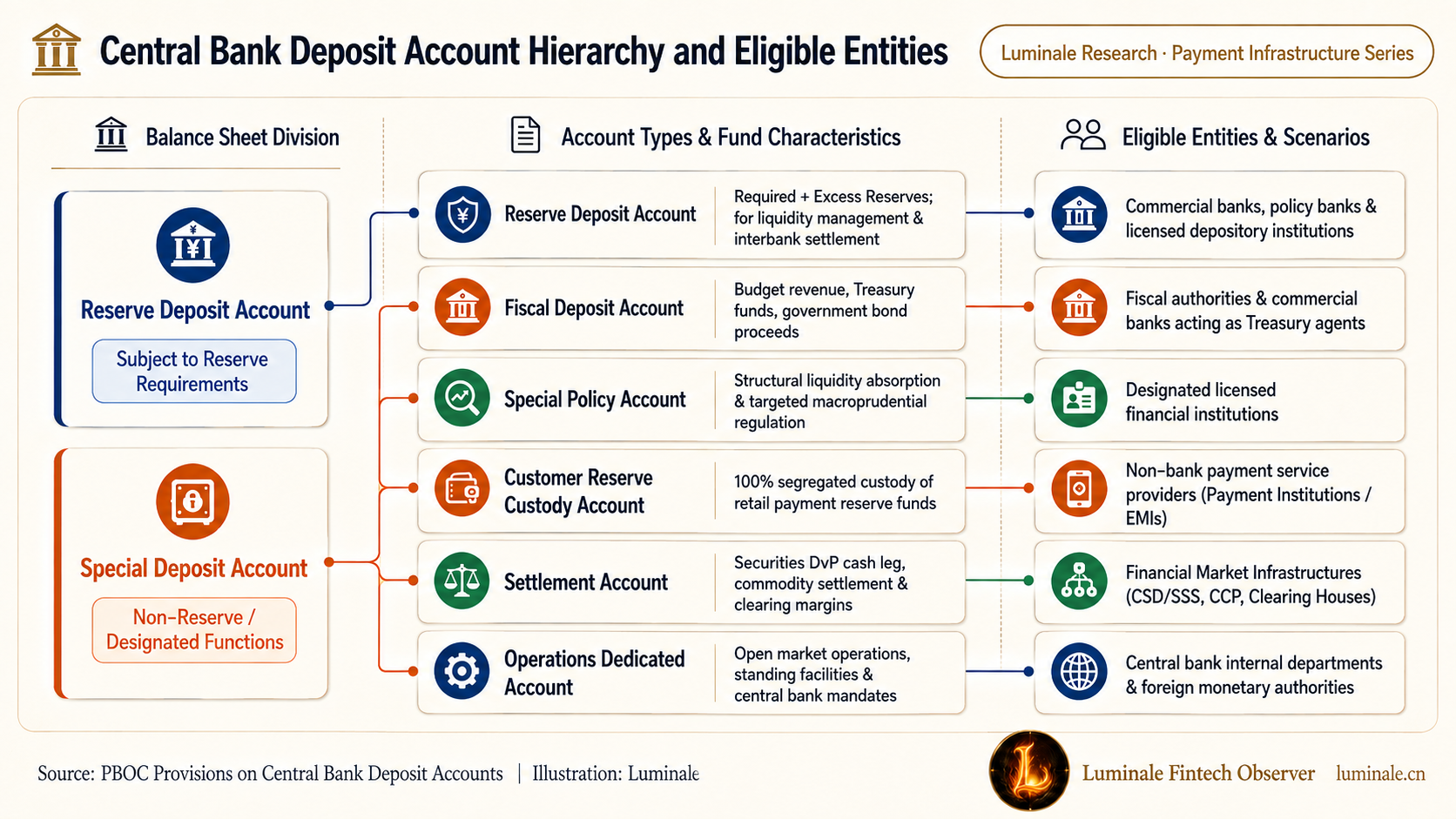
| Account Category | Specific Account Type | Primary Account Holders | Fund Characteristics & Primary Uses | Corresponding Central Bank Mandate |
|---|---|---|---|---|
| Reserve Deposit Account | Reserve Deposit Account | Commercial banks, policy banks, rural cooperative banks, and licensed depository institutions | Statutory required reserves and excess reserves. Used for reserve ratio compliance, cash services, and high-value interbank gross settlement | Monetary policy transmission, financial stability, liquidity monitoring, and core payment settlement |
| Special Deposit Account | Fiscal Deposit Account | Ministry of Finance, fiscal bureaus, and commercial banks acting as Treasury agents | Budgetary revenues, fiscal single account funds, Treasury bond sales proceeds | Managing the Treasury, executing government budget disbursements, and fiscal oversight |
| Special Deposit Account | Special Policy Account | Designated financial institutions | Funds frozen or absorbed by the central bank for targeted liquidity sterilization or macroprudential adjustments | Macroeconomic stabilization and countercyclical policy instruments |
| Special Deposit Account | Customer Reserve Custody Account | Licensed non-bank payment institutions (online payment, prepaid card issuers) | Pre-funded customer balances and in-transit funds held during online checkout and digital wallet top-ups | Protecting retail consumer funds, eliminating misappropriation risk, and curbing contagion |
| Special Deposit Account | Settlement Account | Non-reserve financial entities, Financial Market Infrastructure (FMI) operating entities | Securities transaction cash legs, bulk commodity trade clearing, derivative margins, and centralized multilateral settlements | Eliminating settlement asset credit risk, guaranteeing legal settlement finality |
| Special Deposit Account | Other Dedicated Account | Foreign monetary authorities, FX clearing centers, designated entities | Foreign exchange purchase/sale settlement funds, cross-border payment clearings, foreign central bank deposits | Foreign exchange market supervision, local-foreign currency coordination, international cooperation |
| Special Deposit Account | Operations Dedicated Account | PBOC operational departments, open market operations desks, regional branches | Ledger accounting for open market operations, central bank bond issuance, and re-lending facilities | Implementing monetary policy tools, maintaining daily liquidity and market operations |
As demonstrated across this matrix, while all balances reside on the central bank's balance sheet, bank reserves represent only one specific category. Treating all funds deposited with the central bank as bank reserves is conceptual and accounting error.
3. Delimiting the Scope and Powers of Central Bank Accounts
Central bank account access entails varying tiers of rights and constraints. To prevent conflating account ownership with full-spectrum central bank services, four institutional boundaries must be delineated:
4. Why Do These Institutions Need Accounts at the Central Bank?
Institutions seek direct central bank accounts because the central bank fulfills four foundational public mandates within the financial ecosystem.
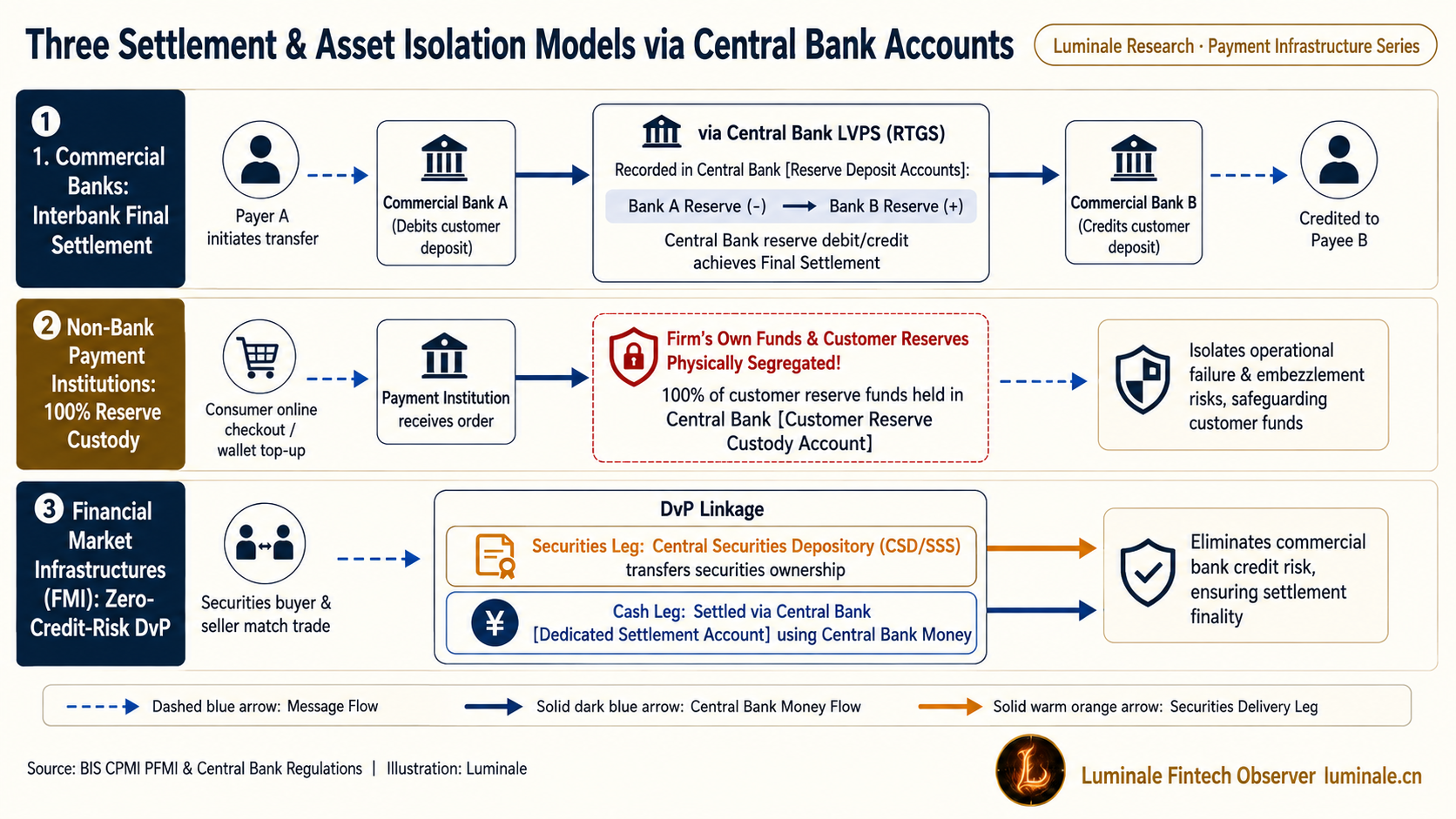
1. Commercial Banks: Monetary Policy Transmission and Interbank Settlement
Commercial banks serve as the primary engines of credit creation. In absorbing public deposits and underwriting loans, they generate commercial bank money. To constrain excessive credit expansion, the central bank mandates that they immobilize a statutory percentage of deposits in central bank reserve accounts.
When funds transfer between institutions, the ultimate discharge of interbank claims cannot be accomplished by trading private bank IOUs. Interbank discharge requires reciprocal debits and credits across their reserve accounts on the central bank's ledger. This mechanism forms the operational core of modern Large-Value Payment Systems (LVPS).
2. Non-Bank Payment Institutions: Safeguarding and Full Segregation of Customer Funds
Funds transferred by consumers before confirming receipt during online shopping, or stored as prepaid digital wallet balances, constitute customer reserve funds.
Historically, customer funds were dispersed across multiple commercial bank accounts, creating vulnerabilities where intermediaries misappropriated client balances for yield-seeking or incurred liquidity shortfalls. Following centralized custody reforms, non-bank payment institutions must place 100% of customer funds into centralized custody accounts at the central bank.
This arrangement does not empower payment institutions to intermediate credit; rather, it divorces customer funds entirely from the payment firm's corporate balance sheet. In the event of an intermediary's insolvency, client assets remain safely sheltered at the central bank, legally exempt from bankruptcy liquidation pools.
3. Financial Market Infrastructures: Eliminating Principal Credit Risk in Multilateral Settlement
Principle 8 of the Principles for Financial Market Infrastructures (PFMI), established by the Committee on Payments and Market Infrastructures (CPMI) of the Bank for International Settlements (BIS) and IOSCO, explicitly recommends that financial market infrastructures settle funds obligations in central bank money wherever practical and available[2].
Securities transactions require Delivery versus Payment (DvP), and foreign exchange transactions require Payment versus Payment (PvP).
If a central securities depository maintained its cash settlement accounts at a commercial bank, any insolvency or freeze at that settlement institution would subject market-wide securities cash flows to severe liquidity shocks or outright principal loss.
By equipping core financial market infrastructures—such as bond depositories, clearing houses, and central counterparties—with direct settlement accounts at the central bank, the market's cash leg settles in central bank money devoid of commercial counterparty risk. This eradicates credit risk in the settlement asset itself.
4. Foreign Central Banks and International Financial Institutions: Reserve Management and Cross-Border Cooperation
Foreign monetary authorities, sovereign wealth funds, the Bank for International Settlements, and the International Monetary Fund establish dedicated deposit accounts at the central bank when engaging in offshore currency operations, allocating onshore sovereign assets, or executing bilateral local currency swap facilities. These accounts serve as secure sovereign corridors for official foreign reserve storage and cross-border official settlements.
5. Global Practice: How Broadly Do Central Banks Open Account Access?
With advancements in financial technology, instant retail rails, and market infrastructure modernization, determining how widely to open the central bank balance sheet beyond commercial banks has become a shared challenge across global monetary authorities.
| Jurisdiction | Typical Account Architecture & Core System | Primary Eligible Entities | Direct Access for Non-Bank PSPs | Core Regulatory Principles & Access Conditions |
|---|---|---|---|---|
| Mainland China | Reserve deposit accounts, customer reserve custody accounts, settlement accounts (HVPS) | Depository institutions, non-bank payment institutions, FMIs, foreign central banks | Permitted through specialized accounts; 100% reserve custody mandate | Unified under a comprehensive regulatory code with differentiated account tiers, strictly separating bank reserves from customer funds |
| United States | Reserve Bank Master Account (Fedwire, FedNow) | Depository institutions holding statutory eligibility under the Federal Reserve Act | Severely restricted by statute; novel fintech charters face immense hurdles | 2022 Tiered Risk Guidelines (Tier 1/2/3) impose rigorous compliance and prudential hurdles on non-federally insured entities |
| Eurozone | TARGET system (Master Cash Account MCA, RTGS accounts, T2S cash accounts, TIPS accounts) | Commercial banks, select public sector entities, clearing houses, and CSDs | Formally expanded to eligible non-bank PSPs from 2025 | Access strictly confined to payment settlement; no overnight credit, liquidity support, or general safeguarding facilities provided |
| Hong Kong SAR | HKD CHATS settlement accounts (RTGS) | Licensed commercial banks | No direct settlement accounts; clearing via bank sponsorship | Faster Payment System (FPS) permits Stored Value Facility (SVF) entry, but final positions settle through sponsoring clearing banks |
| Singapore | MEPS+ RTGS settlement accounts (Funds & Securities) | Commercial banks, eligible finance companies, CDP, and clearing houses | Banks and regulated FMIs qualify directly | Consolidates interbank cash settlement and domestic sovereign bond DvP legs within a unified central bank RTGS system |
1. United States: Statutory Eligibility and Tiered Risk Review
In the United States, a Federal Reserve Bank Master Account serves as the credential for direct entry into the Fed's settlement architecture. Holding a Master Account grants access to settlement rails such as Fedwire and FedNow without commercial bank intermediation.
In 2022, the Board of Governors of the Federal Reserve System adopted unified guidelines for evaluating account requests, establishing a three-tiered review framework:
- Tier 1: Federally insured traditional depository institutions, subject to streamlined evaluation;
- Tier 2: Depository institutions subject to federal prudential supervision but lacking federal deposit insurance, facing enhanced capital and liquidity examinations;
- Tier 3: Novel institutions operating under state charters without federal prudential oversight, subjected to the most stringent review with very low approval rates[3].
The Federal Reserve maintains an independent classification of Official Accountholders specifically designed for foreign governments, foreign central banks, and designated international entities, illustrating a dual-track framework between domestic operational Master Accounts and official diplomatic mandate accounts[4].
2. Eurozone: Cautious Expansion of TARGET to Non-Bank PSPs
The European Central Bank has recently introduced meaningful access reforms. Under the TARGET framework, account architecture is segmented into Master Cash Accounts (MCA), dedicated RTGS accounts, T2S cash accounts for securities settlement, and TIPS accounts for instant retail payments[5].
Beginning in 2025, the Eurosystem formally expanded TARGET eligibility to qualified Non-Bank Payment Service Providers (NB-PSPs), encompassing authorized payment institutions and electronic money institutions (EMIs)[5].
Crucially, European authorities erected a strict regulatory boundary: accounts granted to non-bank PSPs are strictly confined to the submission and settlement of payment instructions. The Eurosystem explicitly withholds standing facilities, emergency liquidity assistance, and broad safeguarding deposit accounts from non-bank entrants[6]. This policy underscores that granting access to central bank clearing rails remains wholly decoupled from according comprehensive central bank credit status.
3. Hong Kong SAR: Decoupling System Participation from Account Ownership
Hong Kong's architecture exemplifies an agency settlement approach. Within the Hong Kong Dollar Clearing House Automated Transfer System (HKD CHATS), operated by Hong Kong Interbank Clearing Limited, only licensed banks hold settlement accounts with the Hong Kong Monetary Authority (HKMA)[7].
Following the launch of the retail Faster Payment System (FPS), Stored Value Facility (SVF) licensees—including digital wallet operators—became direct participants in the messaging system. In the ultimate settlement of multilateral balances across the HKMA's books, however, non-bank entities must designate a licensed settlement bank to sponsor their net positions.
This shows that direct system participation at the user-facing layer does not equate to holding a statutory liability account on the central bank's ledger.
6. Further Discussion: Why Can't Individuals and Non-Financial Corporations Hold Central Bank Accounts?
Observing this specialized account hierarchy naturally prompts a fundamental question: since central bank credit is absolute and immune from default, why does modern monetary design exclude individuals and ordinary non-financial corporations from opening direct accounts? If all depositors banked directly with the central bank, commercial bank insolvency would cease to threaten retail savings.
The answer lies in the structural division of labor embedded in the modern Two-Tier Monetary System.
Two-Tier Monetary System Architecture
├── Tier 1: Central Bank (Issues Central Bank Money: cash, reserves, and central bank deposits)
│   └── Direct Creditors: Commercial banks, policy banks, systemic FMIs, Treasury
└── Tier 2: Commercial Banks (Creates Commercial Bank Money: retail and corporate deposits)
    └── Direct Creditors: Individuals, households, commercial enterprises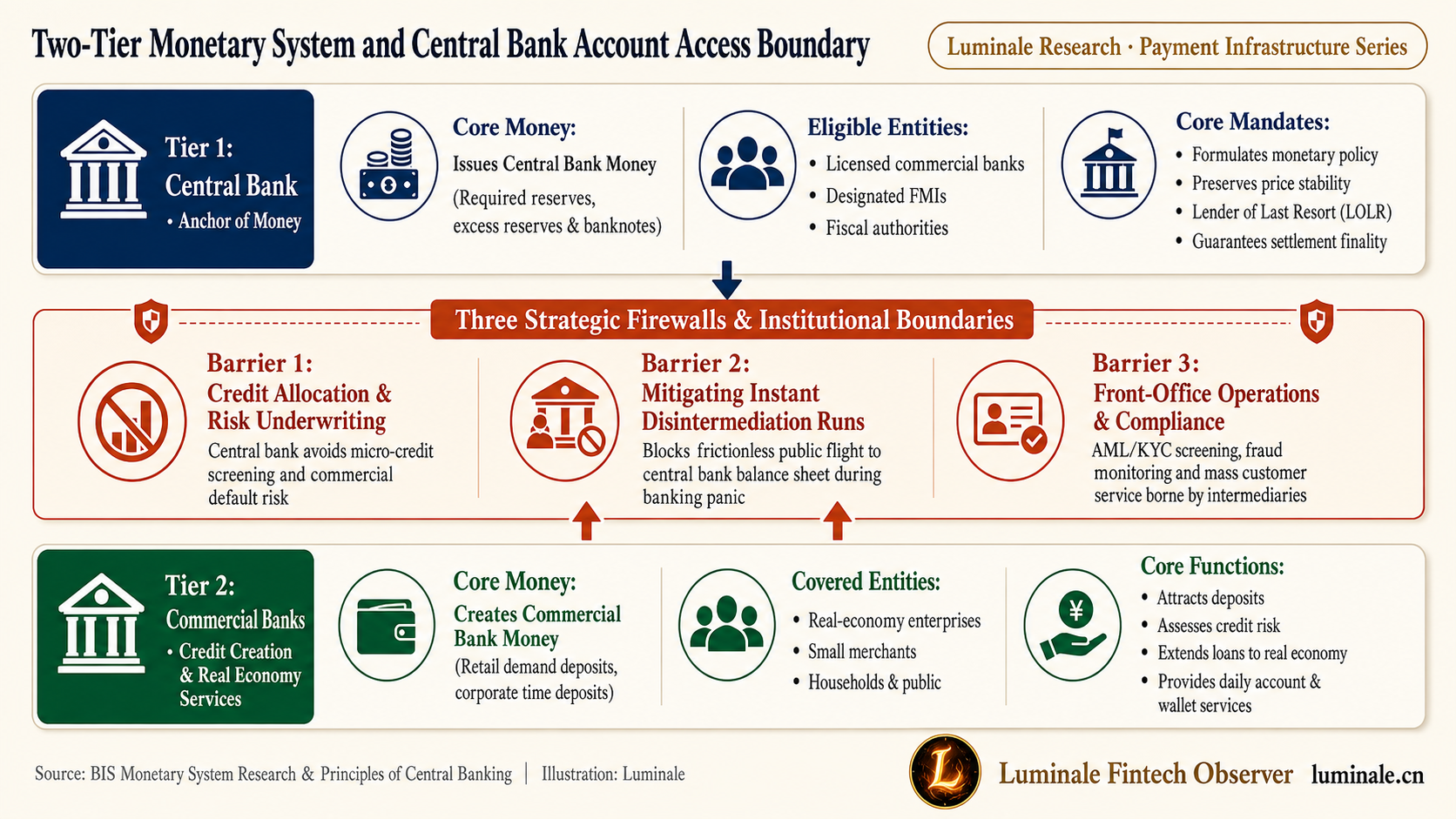
The central bank focuses on monetary policy implementation, price stability, and systemic financial risk oversight. It is not engineered to deliver day-to-day retail banking services to millions of citizens:
- Credit Resource Allocation and Risk Underwriting: When commercial banks absorb public deposits, they extend loans across the real economy. Evaluating creditworthiness, monitoring repayments, and absorbing non-performing loans require extensive physical branch networks, sector underwriters, and commercial loan officers. If all capital migrated directly to the central bank's ledger, deposits would be stripped from the banking sector. Macroeconomic credit allocation would either stall or revert to a centralized state-directed lending apparatus with severe allocative inefficiencies.
- Mitigating Instant Disintermediation Runs: If the public possessed frictionless retail accounts at the central bank, any rumors surrounding a commercial bank's solvency could trigger instant, app-based fund migrations into default-free central bank liabilities. This near-zero friction asset substitution would dramatically accelerate bank runs, precipitating liquidity crises across solvent private banks.
- Front-Office Operations and Compliance Costs: Anti-Money Laundering (AML) monitoring, Know Your Customer (KYC) identity verification, fraud screening, physical cash handling, and retail customer service demand vast operational workforces and branch technology infrastructures. The central bank's public mandate is designed around macroprudential governance, not managing micro-retail client services.
This institutional logic directly informs ongoing policy debates surrounding retail Central Bank Digital Currencies (rCBDC). Across major economies, central banks overwhelmingly commit to a two-tier operational model: the central bank issues digital currency as a direct sovereign claim, while licensed commercial intermediaries manage client distribution, digital wallets, KYC onboarding, and customer support.
7. The Central Bank Account as the Bedrock of Financial Infrastructure
Evaluating a nation's monetary and financial framework involves examining not only central bank benchmark interest rates and asset-side operations, but also assessing to whom the central bank extends its balance sheet liabilities.
A central bank deposit account is not a standardized entitlement. It represents a structured, institutionalized interface linking diverse financial entities to the sovereign ledger:
- For commercial banks, it provides the conduit for reserve enforcement and ultimate interbank fund discharge;
- For payment institutions, it acts as an absolute safeguarding vault, legally detaching consumer in-transit balances from private corporate risk;
- For financial market infrastructures, it provides the final settlement venue that eliminates credit risk across bond, equity, and derivative clearing legs;
- For the broader economy, the two-tier division of labor balances credit intermediation efficiency with overall systemic stability.
Emerging financial innovations—including non-bank cross-border instant rails, stablecoin reserve custody frameworks, tokenized commercial deposits, and wholesale Central Bank Digital Currencies (wCBDC)—all converge upon the same fundamental question: in what form, under what risk constraints, and to which entities should sovereign liabilities on the central bank's balance sheet be made directly accessible.
References
[1]: People's Bank of China. Provisions on the Administration of Central Bank Deposit Accounts (Yinfa [2023] No. 118)[EB/OL]. (2023-07-07)[2026-09-05]. https://www.pbc.gov.cn/chubanwu/114566/114579/4940535/5124674/2023110715152690458.pdf ↩
[2]: Committee on Payments and Market Infrastructures, Technical Committee of the International Organization of Securities Commissions. Principles for financial market infrastructures (PFMI)[R]. Basel: Bank for International Settlements, 2012: 61-64. https://www.bis.org/cpmi/publ/d101a.pdf ↩
[3]: Board of Governors of the Federal Reserve System. Guidelines for Evaluating Account and Services Requests[R]. Federal Register, 2022, 87(160): 51099-51111. https://www.federalreserve.gov/newsevents/pressreleases/other20220815a.htm ↩
[4]: Board of Governors of the Federal Reserve System. Federal Reserve Act: Section 11. Powers of Board of Governors of the Federal Reserve System[EB/OL]. [2026-09-05]. https://www.federalreserve.gov/aboutthefed/section11c.htm ↩
[5]: European Central Bank. Guideline (EU) 2022/912 on a new-generation Trans-European Automated Real-time Gross Settlement Express Transfer system (TARGET) (ECB/2022/8)[J]. Official Journal of the European Union, 2022 (Consolidated text: 2025). https://eur-lex.europa.eu/legal-content/EN/TXT/?qid=1782971060741&uri=CELEX%3A02022O0912-20251006 ↩
[6]: European Central Bank. Decision (EU) 2025/222 of the European Central Bank of 4 February 2025 on access by non-bank payment service providers to TARGET[J]. Official Journal of the European Union, 2025. https://eur-lex.europa.eu/legal-content/EN/TXT/?uri=celex%3A32025D0222 ↩
[7]: Hong Kong Monetary Authority. Hong Kong Dollar Clearing House Automated Transfer System (HKD CHATS) Descriptive Factsheet[R]. Hong Kong: HKMA, 2023. https://www.hkma.gov.hk/media/eng/doc/key-functions/financial-infrastructure/infrastructure/HKD_CHATS_DF.pdf ↩
[8]: Monetary Authority of Singapore. Singapore Government Securities Markets and MEPS+ Infrastructure Overview[R]. Singapore: MAS, 2023. https://www.mas.gov.sg/-/media/mas/sgs/sgs-announcements-pdf/bonds-pdf/green-sgs-infrastructure-and-syndication/offering-circular.pdf ↩
Originally published by Luminale Fintech Observer: https://luminale.cn/articles/who-can-open-an-account-at-central-bank-account-hierarchy-en