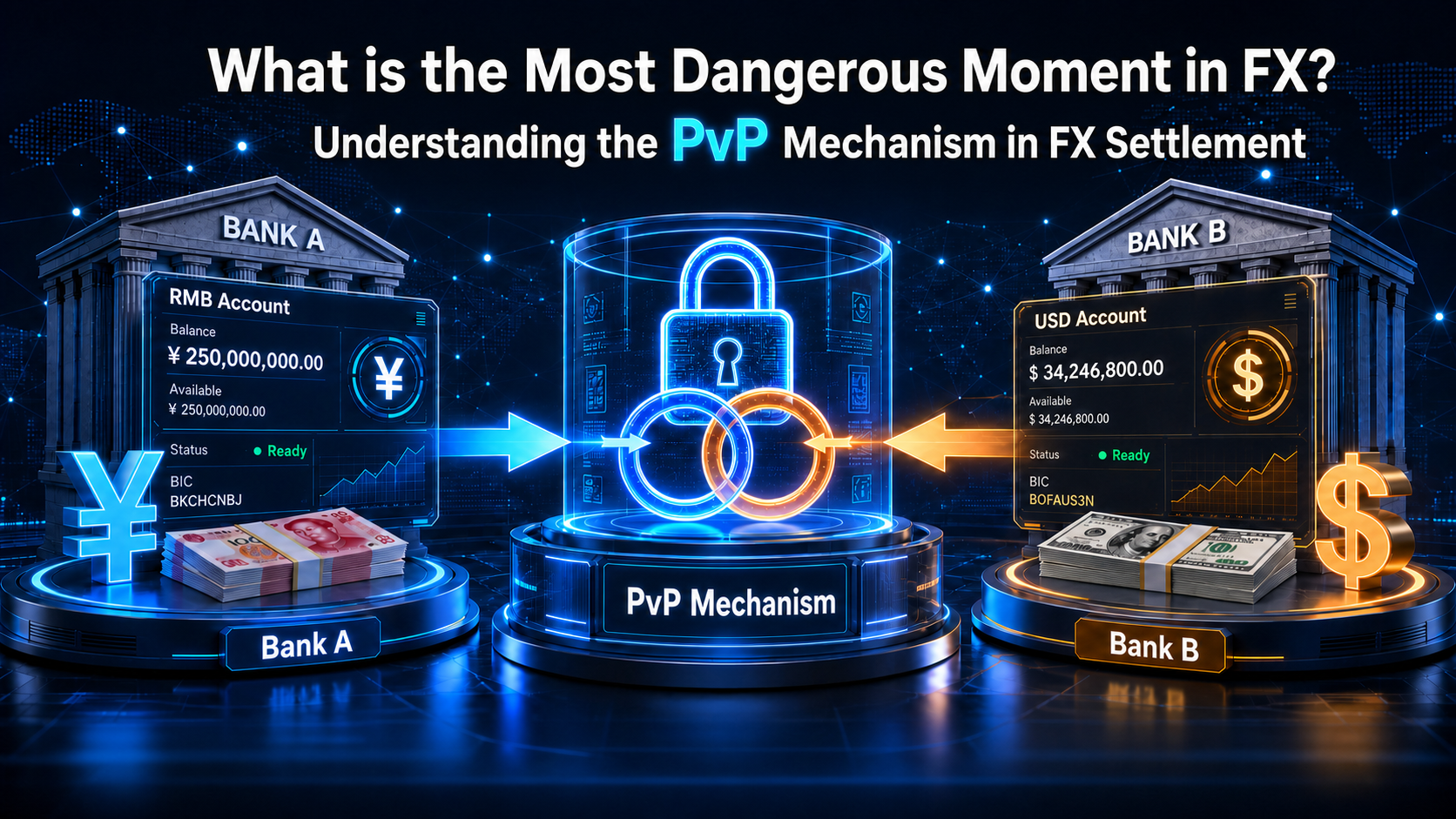
On a retail or front-end trading screen, exchanging one currency for another usually takes just a single click. The exchange rate locks in, and the account balance updates almost instantly.
Behind the scenes in bank operations and financial market infrastructure, however, foreign exchange (FX) trades work very differently. In clearing and settlement, an FX trade is split into two separate, opposing fund transfers, each operating across different sovereign currency clearing systems and commercial banking networks.
This separation creates the most critical systemic vulnerability in the foreign exchange market: Principal Risk. The foundational mechanism designed to eliminate this risk is known as PvP (Payment versus Payment).
1. Currency Exchange Means Moving Two Payments Across Two Separate Systems
Understanding FX settlement risk starts with distinguishing trade execution from trade settlement.
When two financial institutions match an FX buy/sell order in an electronic trading system, they have only established a legally binding contract locking in the exchange rate and transaction amount. At this stage, no funds have actually moved.
Suppose Chinese commercial bank Bank A and foreign commercial bank Bank B execute an FX trade: Bank A sells 700 million RMB and buys 100 million USD.
Once the trade moves to the settlement stage, the infrastructure splits the transaction into two independent payment legs:
- RMB Leg: Bank A pays 700 million RMB to Bank B.
- USD Leg: Bank B pays 100 million USD to Bank A.
These two payments are not completed by "editing a single row" in a shared central database. Instead, each leg enters its respective sovereign clearing and settlement network.
The RMB leg is processed via the Cross-Border Interbank Payment System (CIPS) or the High-Value Payment System (HVPS), transferring funds between the reserve accounts held by the two banks at the People's Bank of China (PBOC). Meanwhile, the USD leg moves through the Federal Reserve's Fedwire or the privately operated CHIPS network, settling across correspondent bank accounts in New York or reserve accounts at the Fed.
We can trace how these two payment legs settle in their respective systems using simplified bank balance sheets and reserve changes:
Within the RMB Settlement System (Domestic Clearing Network):
| Institution | Asset Side | Liability Side |
|---|---|---|
| Bank A | Central Bank Reserves (RMB) −700M | Net assets / equity adjusted accordingly |
| Bank B | Central Bank Reserves (RMB) +700M | Net assets / equity adjusted accordingly |
Within the USD Settlement System (Federal Reserve / New York Clearing Network):
| Institution | Asset Side | Liability Side |
|---|---|---|
| Bank B | Fed Reserves (USD) −100M | Net assets / equity adjusted accordingly |
| Bank A | Fed Reserves (USD) +100M | Net assets / equity adjusted accordingly |
Settlement Mechanism Note: The two payments belong to different sovereign jurisdictions, each governed by its own clearing system operating hours, operational rules, and statutory definitions of Settlement Finality. As long as these two legs operate independently, a timing gap can emerge between the moments when each achieves final settlement.
This structural vulnerability mirrors Delivery versus Payment (DvP) in securities settlement:
Whenever a single transaction consists of two mutually dependent legs, any breakdown or desynchronization between them creates dangerous risk exposure.
2. The Most Dangerous Exposure in Settlement: Principal Risk and the Herstatt Crisis
In foreign exchange trading, exchange rate fluctuations represent market risk, which typically involves only the difference in value between the two legs. Settlement risk is fundamentally different: it can jeopardize the entire principal value of the trade.
Consider the hypothetical transaction above:
- In the morning Beijing time, Bank A irrevocably delivers 700 million RMB to Bank B through the RMB payment system.
- In the afternoon Eastern Time, before Bank B fulfills its obligation to transfer 100 million USD, Bank B suffers a sudden liquidity collapse and is shut down by banking regulators.
Bank A now faces a disastrous reality: its 700 million RMB has already been paid out irrevocably, while the 100 million USD it purchased will never be recovered in full. This risk—where a counterparty defaults midway through settlement, resulting in the total loss of the transaction principal—is known as FX Settlement Principal Risk.
The 1974 Collapse of Bankhaus Herstatt
In international financial history, this hazard is famously known as "Herstatt Risk," stemming from the 1974 bankruptcy of the German private bank Bankhaus Herstatt[1].
On June 26, 1974, the German Federal Banking Supervisory Office revoked Bankhaus Herstatt's banking license at 3:30 p.m. Frankfurt time and ordered its liquidation. By that time, several international counterparty banks had already irrevocably paid Deutsche Marks to Herstatt through the German domestic clearing system.
Due to timezone differences, it was still morning in New York. Upon receiving notice of Herstatt's shutdown, Herstatt's New York correspondent bank immediately suspended all outgoing US dollar payment instructions. The counterparties that had delivered Deutsche Marks never received their expected dollars in New York, leaving them fully exposed to a total loss of principal. The incident caused settlement volume on the Clearing House Interbank Payments System (CHIPS) to plummet for days, triggering a severe liquidity freeze across the global foreign exchange market.
How the Principal Risk Window Forms
The magnitude of principal risk exposure depends directly on the degree of time lag between the two payment legs:
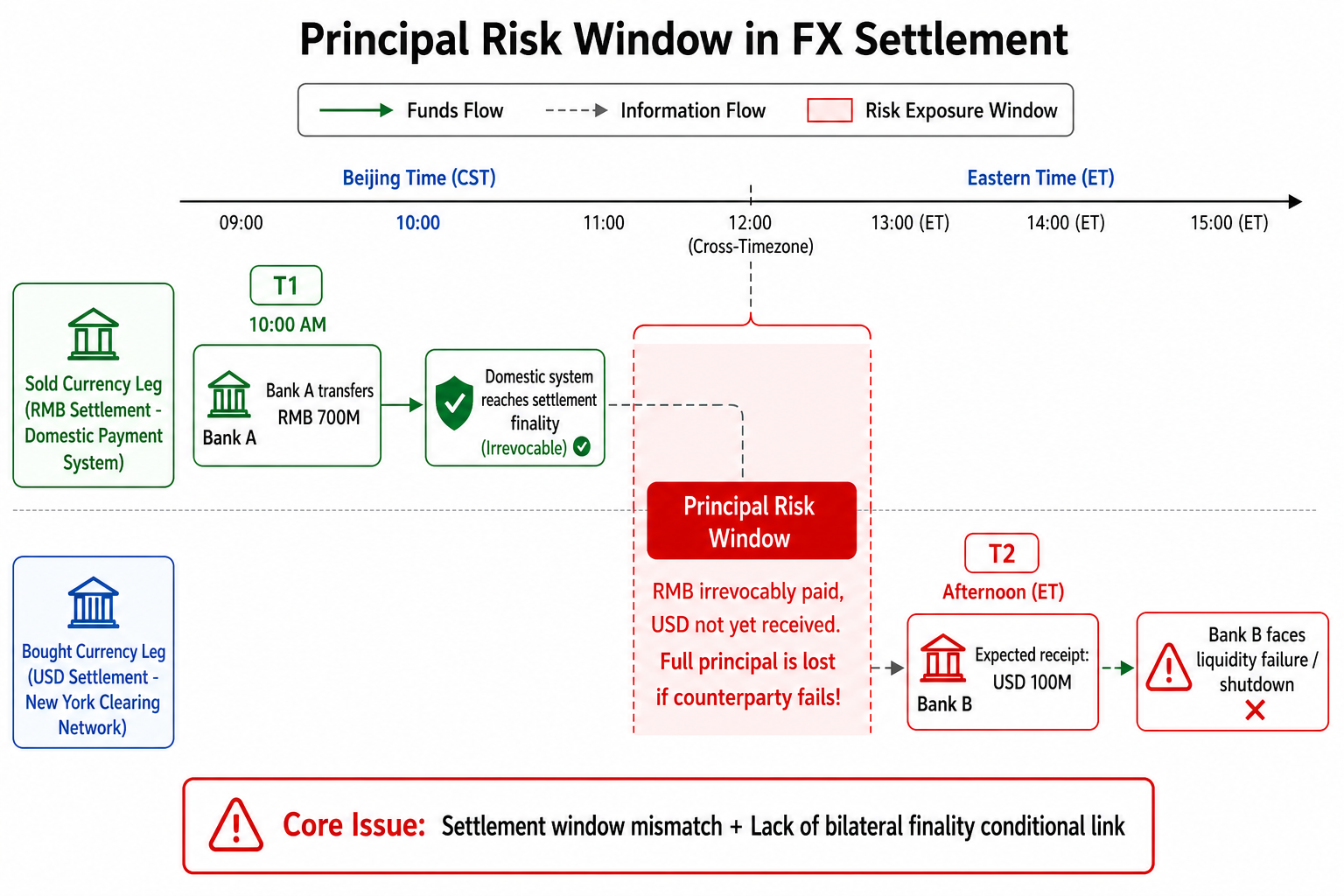
- Risk Window Opens: The currency being sold reaches "settlement finality" (irrevocable and unconditional) in its clearing system.
- Risk Window Closes: The corresponding currency being purchased reaches settlement finality in its respective system.
Because real-time gross settlement (RTGS) systems run by central banks in different currency zones operate during different local business hours, cross-timezone transactions widen this gap. However, time differences merely magnify the exposure; the root cause is that the two payment legs lack a conditional interlocking mechanism.
3. The Core Logic of PvP: Establishing Mutual Conditional Dependency Between Two Settlements
To systematically eliminate principal risk at both the regulatory and technical levels, the Committee on Payments and Market Infrastructures (CPMI) at the Bank for International Settlements established the Payment-versus-Payment (PvP) mechanism.
The Bank for International Settlements (BIS) defines PvP with precision: a settlement mechanism which ensures that the final transfer of one currency occurs if and only if the final transfer of the other currency or currencies takes place[2].
Comparing Settlement Outcomes: Without PvP vs. With PvP
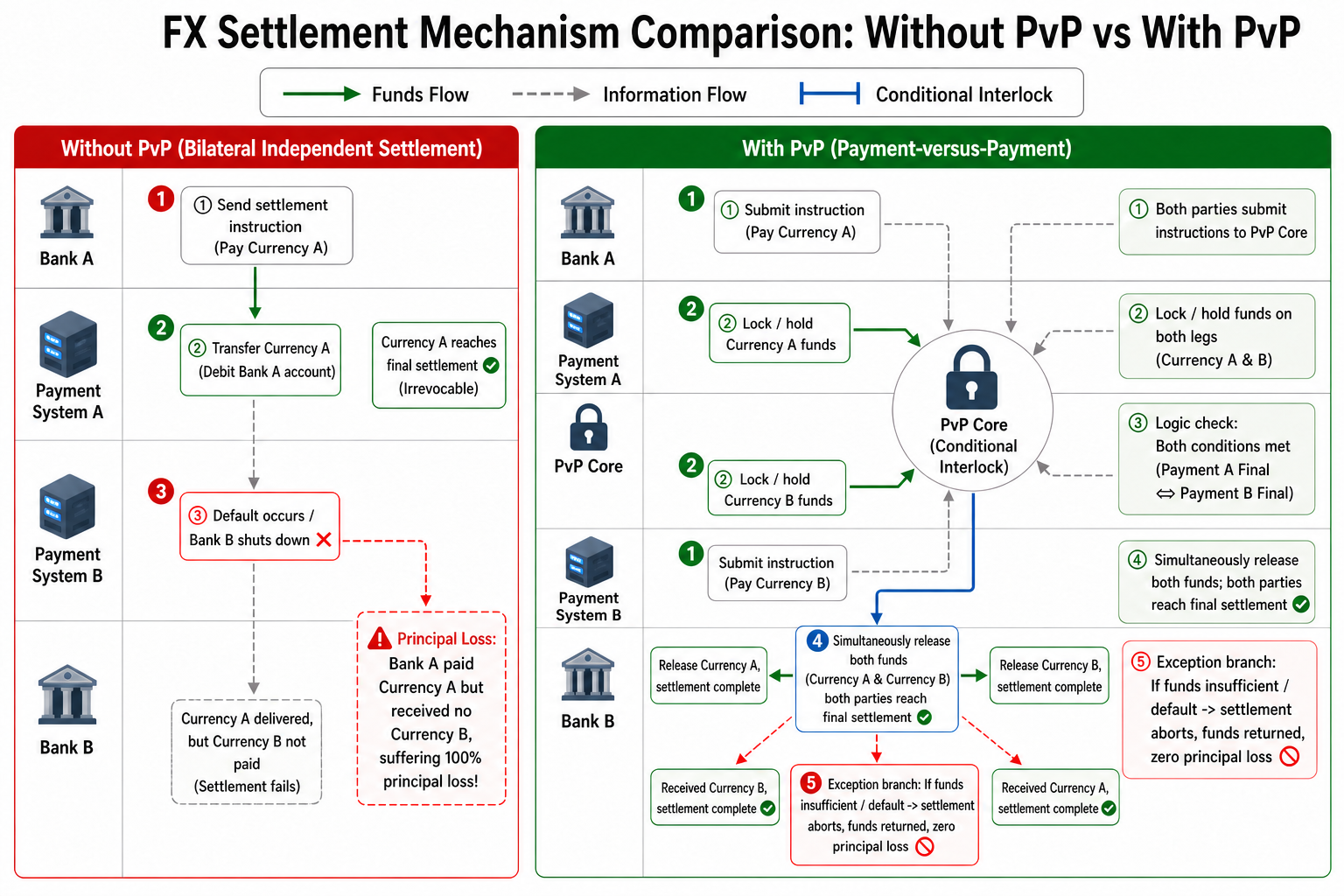
The PvP mechanism transforms how settlement finality is triggered. It establishes a strong, conditional link between the finality states of two independent clearing systems: either both legs achieve legal final settlement simultaneously and ownership of both funds transfers bidirectionally, or neither leg settles and neither party unilaterally forfeits ownership of its assets.
Distinguishing Principal Risk, Replacement Cost Risk, and Liquidity Risk
It is critical to note that while PvP eliminates principal risk in FX settlement, it does not eliminate all trading risks[3]:
- Principal Risk: Completely eliminated. If a trade fails to settle, the principal is not lost.
- Replacement Cost Risk: Still exists. If a counterparty defaults and the settlement fails, the non-defaulting institution must re-enter the market to execute the trade at prevailing spot rates. If market exchange rates have moved unfavorably, the institution will incur a replacement cost loss.
- Liquidity Risk: Still exists. When expected funds do not arrive at the scheduled time, the institution may need to borrow intraday or short-term liquidity in the money market at potentially high cost to cover its payment obligations.
4. CLS: The Core Infrastructure for Global FX PvP
The PvP principle cannot rely solely on bilateral agreements; it requires dedicated financial market infrastructure capable of settling across multiple sovereign jurisdictions. Today, the world's largest and most prominent FX PvP settlement system is CLSSettlement (Continuous Linked Settlement)[4].
How CLS Operates
CLS Bank is an Edge Act corporation regulated by the Federal Reserve and owned by dozens of the world's leading foreign exchange market makers. As of 2026, CLS supports 18 eligible currencies, including the US Dollar (USD), Euro (EUR), Japanese Yen (JPY), British Pound (GBP), Australian Dollar (AUD), Swiss Franc (CHF), and Canadian Dollar (CAD).
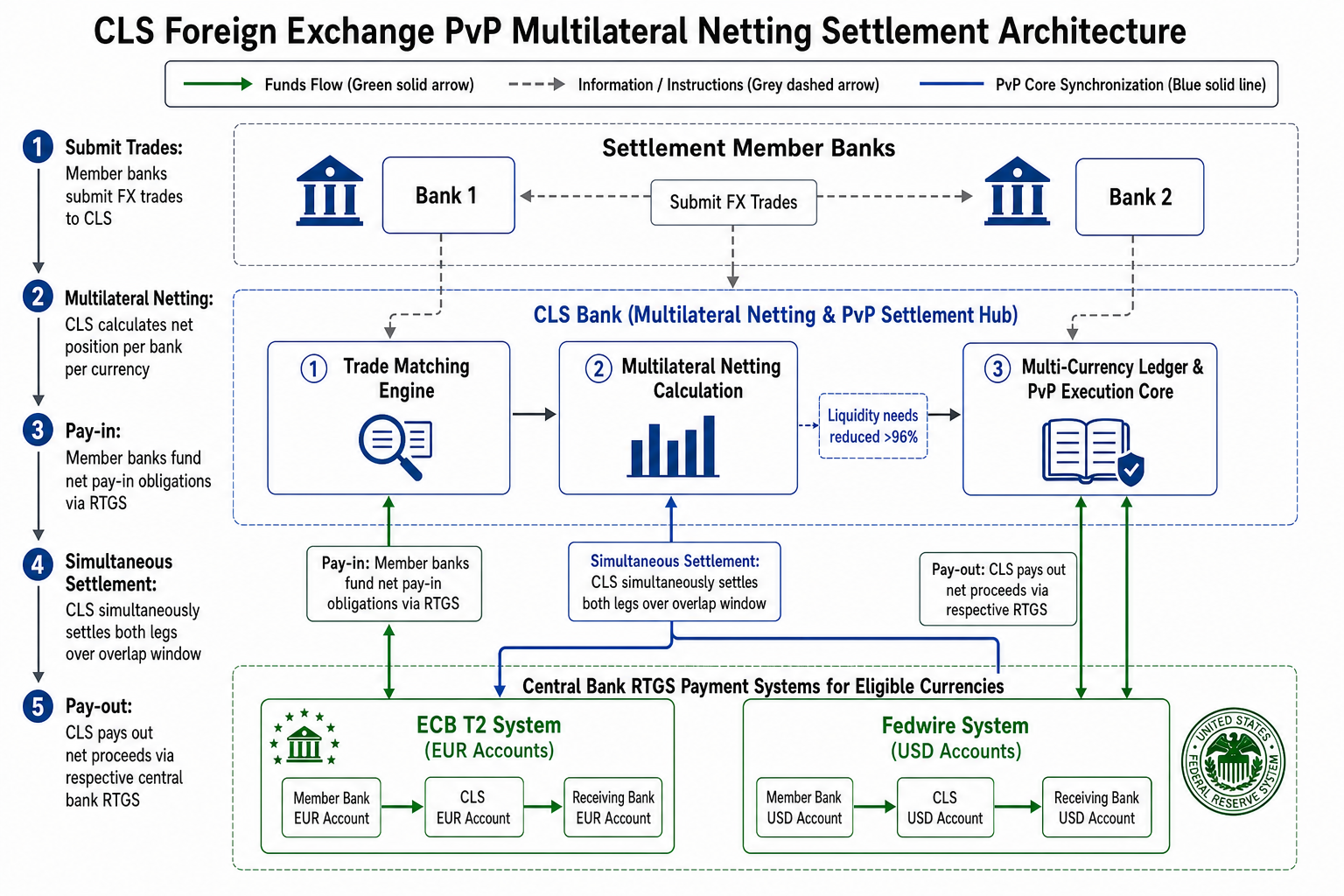
Taking a EUR/USD FX trade as an example (note: RMB is currently not among the 18 CLS settlement currencies), the CLS settlement process works as follows:
- Trade Submission and Matching: After counterparties execute a EUR/USD trade, both submit their settlement instructions to CLS for bilateral matching.
- Position Calculation and Multilateral Netting: CLS aggregates hundreds of thousands of bilateral transactions submitted by member banks and performs multilateral netting on a per-currency basis, calculating a single net pay-in or pay-out obligation for each bank in each currency.
- Pay-in: During the overlapping operational window between the ECB's T2 system and the Fed's Fedwire, banks with net debit positions transfer funds via their national central bank RTGS systems into CLS Bank's account at the respective central bank.
- PvP Final Settlement: CLS executes simultaneous gross transfers across its internal ledgers. Settlement across all currencies takes effect if and only if the funding requirements for both the bought and sold currencies are fully met.
- Pay-out: CLS transfers the net credit amounts through the respective central bank RTGS systems back to the receiving banks'accounts.
Liquidity Savings from Multilateral Netting
In addition to eliminating principal risk through PvP, CLS dramatically reduces the intraday liquidity needed to settle global FX transactions. According to CLS data, its multilateral netting mechanism reduces the actual funding required to settle transactions by over 96%[4]. A multinational bank that would otherwise need tens of billions of dollars in gross liquidity for bilateral settlements typically requires only a few hundred million dollars in intraday liquidity to settle its net obligations.
5. From PvP to Atomic Settlement: The Evolution of Multicurrency Infrastructure
Despite its proven track record, PvP does not yet cover the entirety of global foreign exchange trading.
According to the latest data from the 2025 BIS Triennial Central Bank Survey released by the Bank for International Settlements, across the average daily global FX settlement volume in April 2025[1]:
- Approximately 36% (.2 trillion): Settled via systems with strict PvP arrangements such as CLS, where principal risk is completely eliminated;
- Approximately 54%: Settled using risk mitigation techniques such as bilateral or multilateral netting, which significantly compress gross exposures but do not mechanically eliminate one-sided settlement risk;
- Approximately 10% (.4 trillion): Still settled on a traditional bilateral gross basis, leaving transactions fully exposed to the Herstatt risk window.
Because several emerging market currencies remain outside major global PvP mechanisms due to capital controls, legal constraints, or timezone limitations, over a trillion dollars in daily turnover is still exchanged without institutional PvP protection.
Project Agorá: Exploring Atomic Settlement for Tokenised Multicurrency Systems
To overcome the challenges of traditional infrastructure—such as complex multi-system linkages, high participation barriers, and cross-timezone coordination costs—the Bank for International Settlements (BIS), alongside multiple central banks and private financial institutions, launched Project Agorá[5].
Project Agorá investigates a next-generation architecture based on a "shared programmable ledger." It places commercial banks' tokenised deposits and central banks' tokenised wholesale central bank money (wholesale CBDC) onto the same programmable platform.
While traditional PvP requires coordinating two geographically separate and legally distinct external clearing systems, Project Agorá's programmable architecture enables foreign exchange trades to achieve atomic settlement directly via smart contracts:
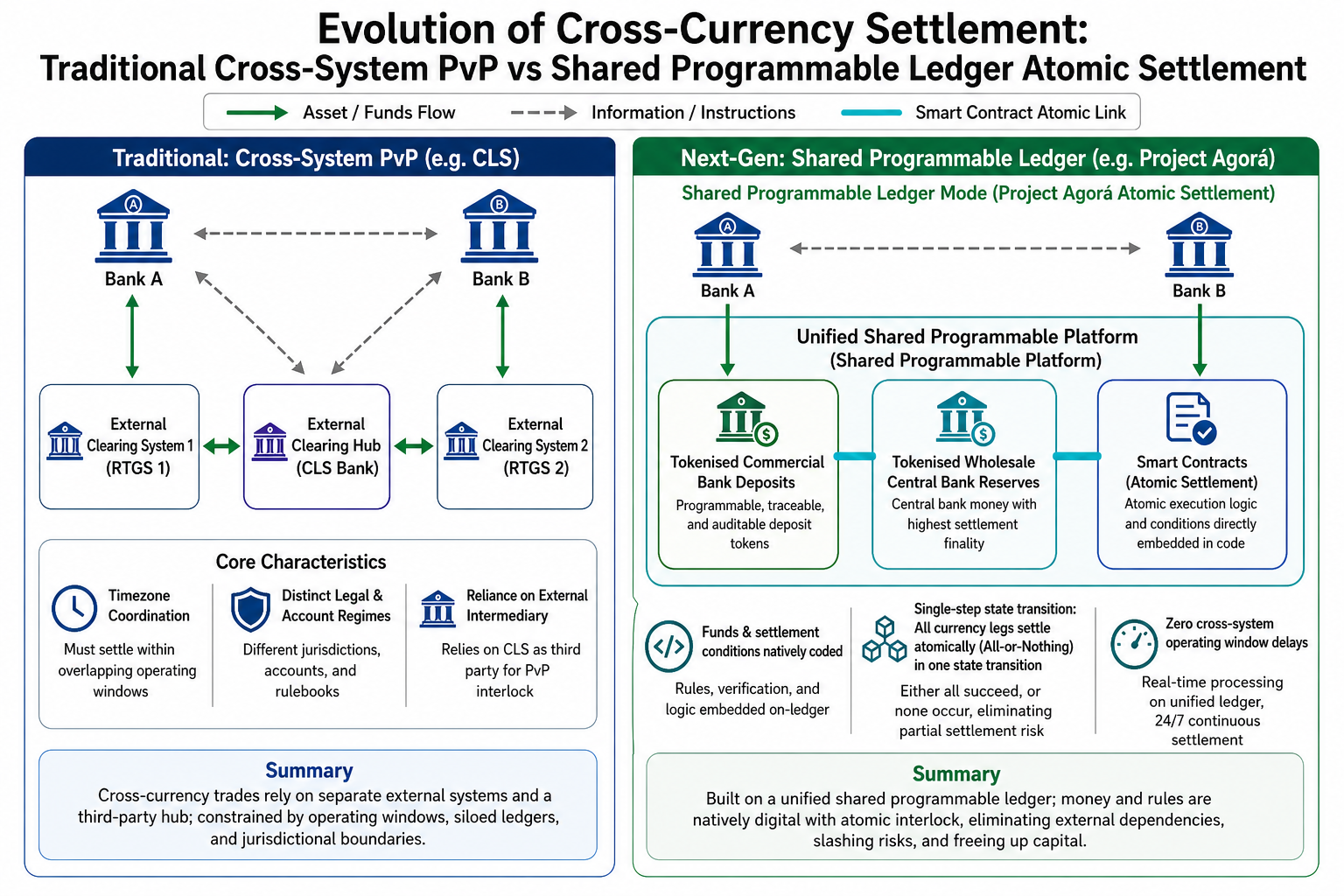
In July 2026, the BIS and participating institutions completed a real-value test of Project Agorá: 28 commercial financial institutions and multiple central banks across six currency jurisdictions executed transactions valued at approximately 800,000 Swiss Francs equivalent. The test validated 17 core business scenarios, with a central focus on cross-border, multicurrency interbank PvP settlement[5].
This breakthrough illustrates a clear evolution in multicurrency settlement: moving from "linking two independent systems through a third-party intermediary" toward "natively interlocking payment conditions on a unified programmable ledger."
Conclusion: In an FX Trade, Who Should Pay First?
Returning to our opening question: in a foreign exchange transaction, who should pay first?
Without institutional safeguards, whichever party makes the first irrevocable payment bears the full principal risk of counterparty default.
The true value of PvP lies in ending this standoff through deterministic legal and technical design. It redefines the very condition of settlement finality in foreign exchange: an irrevocable payment by one party is legally and technically contingent on an irrevocable payment by the other.
From DvP in securities settlement to PvP in FX markets, and onward to atomic settlement on distributed programmable ledgers, the technical architecture continues to evolve, but the core risk principle remains timeless: when a transaction depends on multiple interdependent legs, one leg must never settle while the other is left hanging in the air.
References
[1]: Bank for International Settlements. (2025/2026). Uncovering FX settlement risk: new measures from the 2025 BIS Triennial Survey. BIS Quarterly Review. https://www.bis.org/publ/qtrpdf/r_qt2606c.htm ↩
[2]: Committee on Payments and Market Infrastructures (CPMI). (2012/2022). Principles for financial market infrastructures (PFMI) & Facilitating increased adoption of payment-versus-payment (PvP). Bank for International Settlements. https://www.bis.org/cpmi/publ/d101a.pdf ↩
[3]: Basel Committee on Banking Supervision (BCBS). (2013). Supervisory guidance for managing risks associated with the settlement of foreign exchange transactions. Bank for International Settlements. https://www.bis.org/publ/bcbs241.pdf ↩
[4]: CLS Group. (2026). CLSSettlement: Mitigating settlement risk for the global FX market & Eligible Currencies. https://www.cls-group.com/products/settlement/clssettlement/ ↩
[5]: Bank for International Settlements (BIS). (2026). Project Agorá: Exploring the integration of tokenised commercial bank deposits with tokenised wholesale central bank money. BIS Innovation Hub. https://www.bis.org/project/agora ↩
Originally published by Luminale Fintech Observer: https://luminale.cn/articles/fx-settlement-pvp-principal-risk-en