In September 2026, market participants took note of reports that Chinese authorities were considering allowing the National Social Security Fund to invest in offshore bonds via the Southbound Link of Bond Connect[1]. Beyond asset allocation strategies and yield differentials, this report raises a more fundamental infrastructure question:
When a mainland institutional investor purchases an offshore-issued bond via Southbound Bond Connect, on whose ledger is the bond ultimately registered? How do renminbi or foreign currency funds move across the border? When does the offshore seller receive payment? And what mechanism ensures that funds are not remitted without the corresponding securities being delivered?
Bond Connect is far more than an expanded trading interface on a broker's terminal. When Northbound Trading opened in July 2017, it allowed offshore investors to access the China Interbank Bond Market (CIBM); when Southbound Trading launched in September 2021, it enabled mainland investors to allocate capital into Hong Kong and offshore bond markets[2][3]. The core pillar underpinning both mechanisms is a pair of financial market infrastructure solutions that bridge two distinct jurisdictions, two different central securities depositories (CSDs), and separate payment and clearing systems.
To understand how Bond Connect operates, one must trace three foundational settlement questions:
- Where does the securities leg effect book-entry transfer?
- Where does the cash leg settle?
- Through what mechanism do the two underlying infrastructures lock both legs together?
I. Interoperability Is More Than Trading Connectivity: It Is Backend Account Integration
General market observers often see only the front-end trading screens: real-time quotes, bid-ask spreads, and trade confirmations. At the layer of financial market infrastructure (FMI), however, every completed bond trade relies on three tightly coupled tiers:
- Trading Connectivity: Electronic trading platforms in both markets are linked, facilitating price discovery, request-for-quotation (RFQ), order matching, and execution confirmation between counterparties;
- Custody Connectivity: Central securities depositories (CSDs) in both jurisdictions establish account linkages, governing statutory title registration and multi-tier entitlement passing;
- Cash Settlement Connectivity: Settlement banks on both sides transfer funds across large-value payment systems (LVPS) to achieve final discharge of payment obligations.
Northbound: Offshore Investors ──via HK Infrastructure──> Invest in China Interbank Bond Market
Southbound: Onshore Institutions ──via Mainland Infrastructure──> Invest in HK & Offshore Bond Markets
Securities custody arrangements differ fundamentally between the two markets. The China Interbank Bond Market has long adhered to a direct, look-through Tier-1 holding model anchored by China Central Depository & Clearing Co., Ltd. (CCDC) and Shanghai Clearing House (SHCH). Conversely, international bond markets rely predominantly on multi-tier custody structures intermediated hierarchically by global and local sub-custodians.
The architecture of Bond Connect does not force offshore institutions to overhaul their conventional custody relationships, nor does it dismantle the onshore market's look-through statutory principles. Instead, financial authorities and infrastructure operators deployed a nominee holder structure paired with central securities depository linkages (CSD Linkage), building an operational bridge between two fundamentally different account regimes[2].
II. Northbound Trading: Offshore Investors Purchasing Onshore Bonds
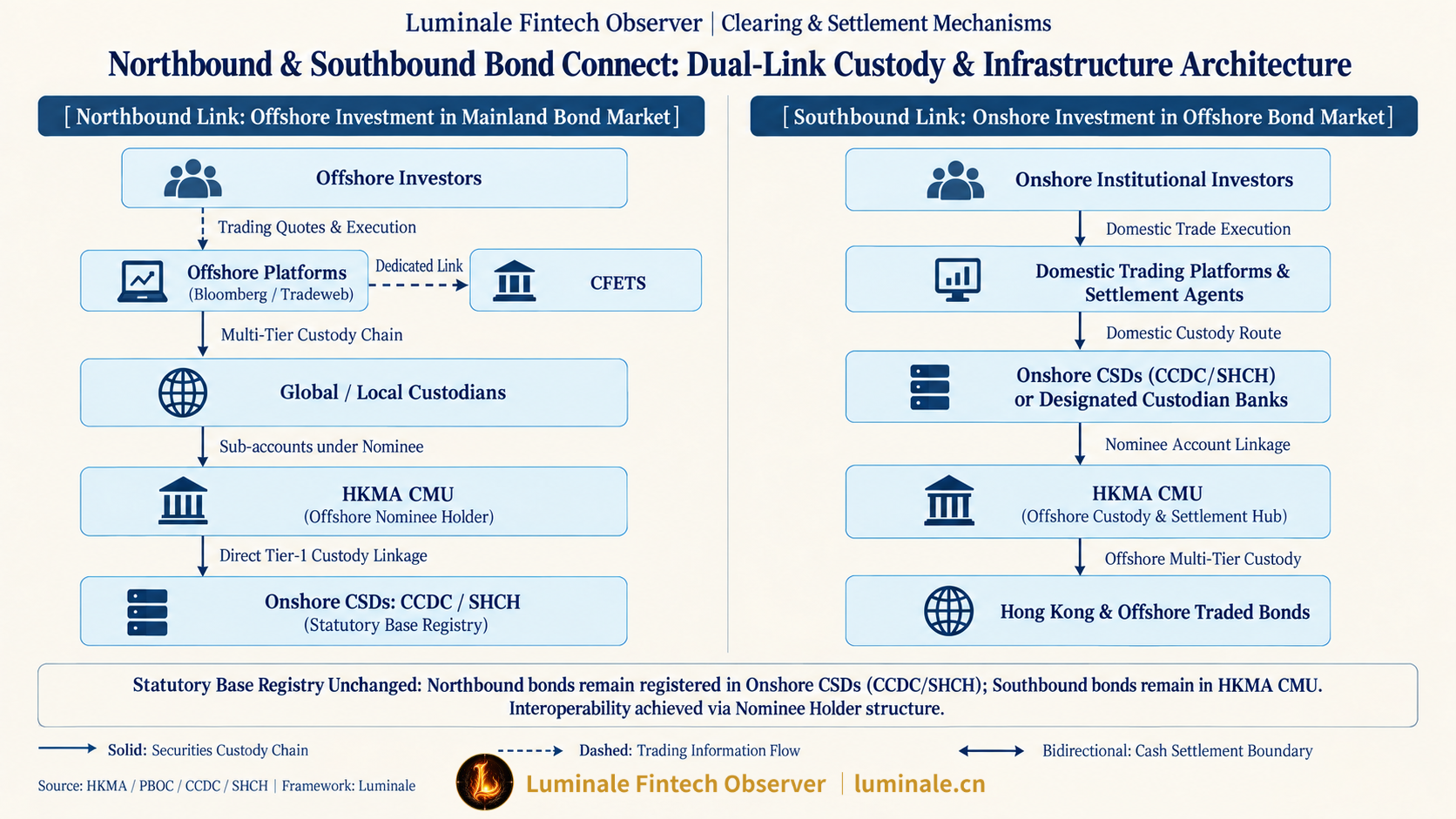
Under the Northbound Link, offshore investors purchase treasury bonds, policy financial bonds, or credit debt instruments traded in the China Interbank Bond Market. The backend processing decomposes into three distinct layers: trading, securities custody, and cash settlement.
1. The Trading Layer: Electronic Trading Platform Direct Links
Offshore investors do not need to connect directly to the local dedicated trading network of China Foreign Exchange Trade System (CFETS). Instead, they continue to interface with familiar offshore electronic trading platforms such as Bloomberg and Tradeweb.
Quotations and execution orders from these offshore platforms are routed through dedicated communication interfaces to CFETS, which executes automated matching against onshore interbank bond market-makers and generates legally binding trade execution slips[2].
2. The Securities Layer: CMU as Nominee Holder Opening Omnibus Accounts at Onshore CSDs
The securities custody chain is the vital link in understanding Northbound Trading.
The Central Moneymarkets Unit (CMU), operated by the Hong Kong Monetary Authority (HKMA), opened nominee accounts directly with CCDC and SHCH respectively[2][4].
| Custody Tier | Institution | Account Name / Attribute | Recorded Holdings |
|---|---|---|---|
| Tier 1 (Statutory Base Registry) | Onshore CSDs (CCDC / SHCH) | CMU Nominee Account | Aggregate volume of specific onshore bonds held by all Northbound offshore investors |
| Tier 2 (Offshore Depository Hub) | HKMA CMU | Offshore Custodian / Clearing Member Accounts | Detailed sub-holdings allocated to individual offshore custodian institutions |
| Tier 3 (Beneficial Entitlement Holders) | Offshore Custodians (Global / Local Custodians) | Ultimate Investor Securities Accounts | Actual underlying bond holdings credited to asset managers, sovereign wealth funds, and pension funds |
Offshore investors do not hold direct Tier-1 custody accounts on CCDC's central registry. On the legal books of the onshore CSD, the registered legal titleholder is the HKMA CMU in its capacity as nominee holder. CMU's internal ledger tracks the entitlements of offshore clearing members, which in turn record the holdings of the end investors on their own books.
Statutory ownership of the underlying bond assets remains formally registered within the onshore central securities depositories, while the CMU acts as the cross-border interoperability hub and legal nominee.
3. The Cash Layer and the 2018 Real-Time DvP Upgrade
When Northbound Trading launched in 2017, cash and securities settlement initially underwent a transitional phase of non-fully real-time settlement. Offshore investors converted foreign currencies into offshore renminbi (CNH) or funded accounts through Hong Kong settlement banks, transferring cash onshore on settlement date.
In August 2018, financial infrastructures in both markets implemented a major technical upgrade, rolling out full real-time Delivery versus Payment (Real-time DvP) across Northbound Trading[4]. Under this setup, onshore CSDs release and transfer bond titles only after receiving definitive settlement confirmation that matching funds have arrived, completely eliminating principal risk arising from timing gaps between cash remittance and securities delivery.
III. Southbound Trading: Multi-Tier Custody and Cash Clearing in the Reverse Direction
The Southbound Link serves as the structural mirror image of Northbound Trading. However, because it involves onshore entities acquiring offshore multi-currency assets, its account links, regulatory loops, and settlement coordination are even more tightly governed.
Under regulatory guidelines issued by the People's Bank of China (PBOC) and the HKMA, onshore investors participating in Southbound Trading utilize two primary custody and settlement routes: the CSD Linkage route and the onshore custodian clearing bank route[3][5].
1. Distinctions Between the Two Custody and Settlement Routes
| Comparison Dimension | CSD Linkage Route | Onshore Custodian Bank Route |
|---|---|---|
| Offshore Nominee Holder | CCDC and SHCH | Designated Onshore Custodian Clearing Banks (Tier-1 Commercial Banks) |
| Direct Counterpart Account | Onshore CSDs open nominee accounts directly at HKMA CMU | Onshore custodian banks open sub-accounts via offshore branches or global custodians |
| Eligible Onshore Participants | Interbank bond market institutional investors (e.g., market makers, non-bank institutions) | Various qualified onshore institutional investors |
| Clearing & Settlement Rails | CCDC / SHCH ↔ CMU ↔ CIPS / Hong Kong Settlement Banks | Commercial banks'proprietary cross-border custody networks and correspondent systems |
Under the CSD Linkage route, CCDC and SHCH each open nominee securities accounts with HKMA CMU, holding Hong Kong and internationally traded debt securities on behalf of onshore investors.
2. The Practical DvP Workflow Interlocking CMU and CIPS
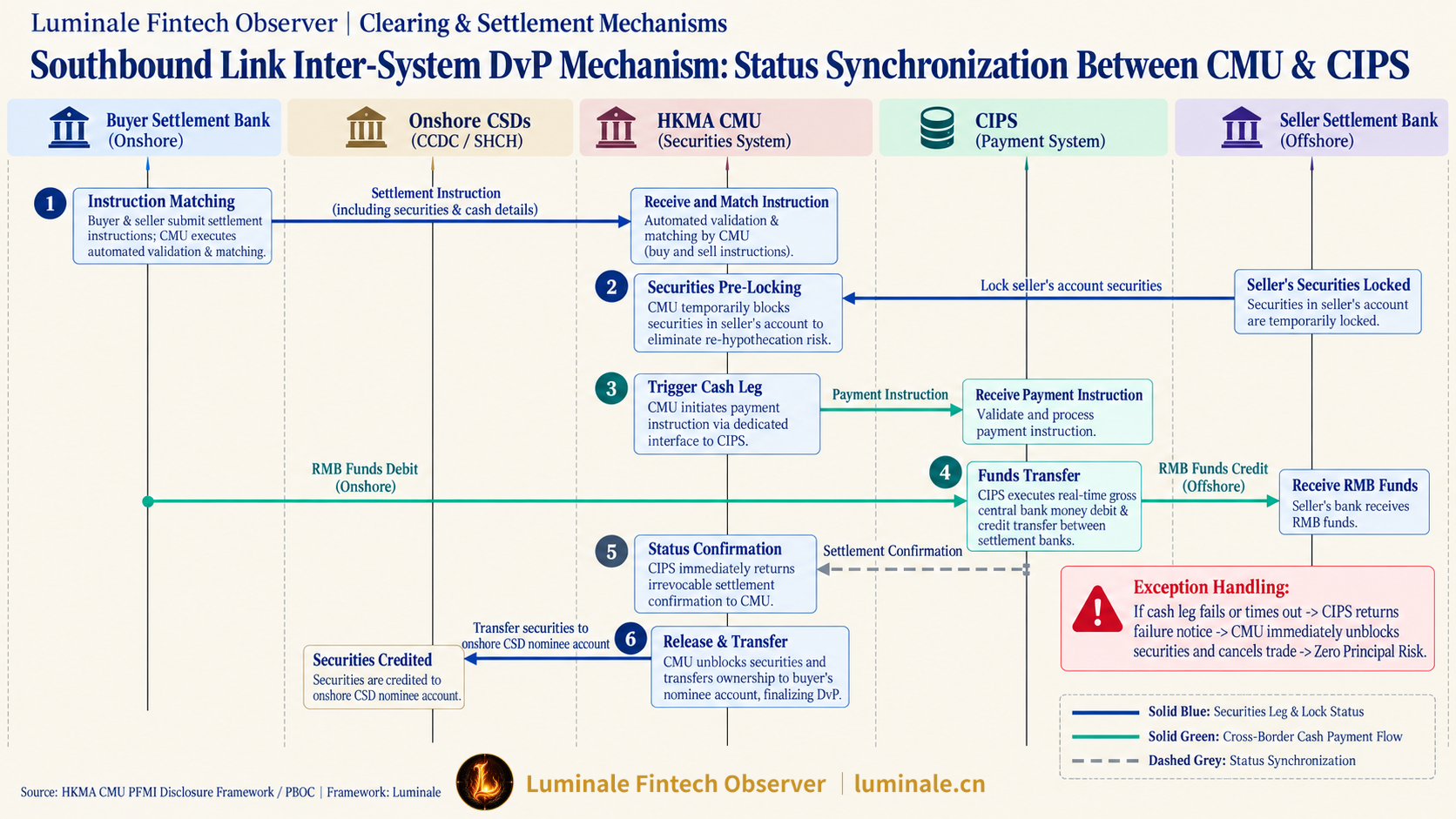
Within the cross-border financial infrastructure analytical framework formulated by Luminale, state synchronization between the securities settlement system and the cross-border payment system provides the structural foundation for safe settlement. In the HKMA's CMU disclosure framework under the Committee on Payments and Market Infrastructures (CPMI) and International Organization of Securities Commissions (IOSCO) Principles for Financial Market Infrastructures (PFMI), the automated DvP workflow for Southbound RMB bond transactions is detailed as follows[5]:
Onshore Buyer Bank ──(1. Settlement Instruction)──> Onshore CSD ──> HKMA CMU ──[Securities Blocked]
                                                                      │
                                            (2. Payment Instruction MT103/pacs.008)
                                                                      ▼
Offshore Seller Bank <──(4. Funds Settled)── Cross-Border Interbank Payment System (CIPS)
                                                                      │
                                            (3. Real-Time Confirmation)
                                                                      ▼
Onshore Buyer Bank <──(5. Securities Credited)── HKMA CMU ──[Securities Unblocked & Transferred]
When an RMB-denominated Southbound bond trade is executed, the backend infrastructures execute automated Delivery versus Payment through the following sequential stages:
- Instruction Matching: Both buyer and seller submit settlement instructions through electronic systems, and CMU automatically validates and matches core trade parameters (ISIN, nominal amount, settlement currency, settlement date);
- Securities Pre-Locking: On settlement day, CMU temporarily freezes and blocks the designated securities in the seller's account, preventing the seller from re-hypothecating or transferring the asset during settlement processing;
- Triggering Cross-Border Payment: CMU interfaces with the Cross-Border Interbank Payment System (CIPS), dispatching a dedicated payment instruction to initiate the cash leg;
- Central Bank Money Transfer: The buyer's settlement bank executes a gross, real-time transfer of agreed RMB funds through CIPS into the seller's settlement bank account (or offshore clearing bank account), achieving final debit and credit accounting;
- Irrevocable Status Notification: Upon final settlement of funds, CIPS immediately transmits an irrevocable settlement confirmation message back to CMU;
- Securities Release and Transfer: Upon receipt of confirmation, CMU unblocks the seller's securities and credits them into the buyer's designated custody account (i.e., the onshore CSD nominee account at CMU).
3. Multi-Currency Settlement Expansion and Closed-Loop Capital Management
Southbound Trading initially focused primarily on RMB-denominated bonds. As onshore institutional demand for global asset allocation broadened, the HKMA accelerated the modernization of the CMU (CMU Omni), expanding CSD Linkage settlement capabilities to support Hong Kong Dollars (HKD), US Dollars (USD), and Euros (EUR)[6].
Multi-currency support introduces distinct cash-leg routing mechanisms:
- RMB Transactions: Settle primarily via CIPS, or through the Hong Kong RMB Real Time Gross Settlement system (RMB CHATS);
- HKD Transactions: Settle intraday in real time via Hong Kong's domestic HKD CHATS (RTGS mode);
- USD and EUR Transactions: Settle via Hong Kong's local USD CHATS and EUR CHATS, or through offshore foreign exchange correspondent banking networks.
Regardless of currency diversification, Southbound Trading remains strictly governed by a closed-loop fund flow framework and quota management. Investment principal remitted offshore, along with proceeds from bond sales, coupon payments, or bond redemptions, must be remitted back onshore through the original route and cannot remain offshore or be diverted to other purposes. Furthermore, total Southbound capital flows are regulated dynamically through an aggregate annual ceiling and daily quota controls[3].
IV. Achieving Cross-Border DvP: Synchronizing Two Independent Ledgers
The mechanics of Delivery versus Payment and the theoretical defense against principal risk were explored in detail in our previous article, Securities and Money Must Move "Delivery Versus Payment": What Risk Does DvP Actually Prevent?.
In a single domestic market, CSDs typically maintain direct interfaces with the central bank's large-value RTGS system (such as CCDC directly linking with the PBOC High-Value Payment System, HVPS). Under a unified sovereign framework, both securities book-entry and central bank money transfers operate synchronously, rendering DvP Model 1 (gross-gross) or DvP Model 2 (gross-net) straightforward.
In cross-border and multi-currency scenarios like Bond Connect, the technical nature of the problem changes fundamentally: securities are controlled by one entity (HKMA CMU), while cash is processed by another (onshore CIPS or offshore CHATS). The two ledgers operate under independent legal jurisdictions, distinct operating hours, separate messaging protocols, and sovereign settlement finality laws.
1. Cross-Border Settlement Mechanics Comparison: Northbound vs. Southbound
| Mechanism Element | Northbound Link | Southbound Link |
|---|---|---|
| Capital Direction | Offshore Investors → Mainland Interbank Bond Market | Onshore Institutional Investors → Hong Kong & Offshore Bond Markets |
| Underlying Asset Depository | Onshore (CCDC / SHCH) | Hong Kong & Offshore Markets (HKMA CMU) |
| Cross-Border Nominee Holder | HKMA CMU holds onshore bonds on behalf of offshore investors | CCDC/SHCH or onshore custodian banks open accounts at CMU |
| Core DvP Execution Path | Executed within onshore CSDs, transferring title upon verified fund receipt | CMU locks securities ↔ Triggers CIPS/CHATS payment ↔ Unblocks on confirmation |
| Primary Settlement Currencies | Renminbi (Onshore RMB or converted offshore CNH) | Multi-currency (RMB, HKD, USD, EUR) |
| Capital Loop & Quotas | Trade-backed currency conversion; open capital inflow/outflow | Strict closed-loop management; funds return onshore; aggregate & daily quotas |
2. DvP Does Not Eliminate All Risks
The universal implementation of DvP eliminates principal risk in cross-border settlements. However, the elimination of principal risk does not mean that all cross-border settlement frictions vanish.
In multi-currency, multi-time-zone environments, market participants continue to face notable operational risks:
- Liquidity Risk: Multi-currency bond settlement requires buyers to fund offshore currency accounts within strict intraday windows. If USD or EUR funding fails to reach Hong Kong clearing accounts prior to cutoff deadlines, settlement will fail or be delayed;
- Time-Zone and Operating Window Mismatches: Time zone differences between Western financial centers and Asian trading hours can compress cross-border clearing windows, exposing trades to severe cut-off pressures;
- Settlement Finality Conflicts: Reconciling the point of irrevocable transfer under the PRC Securities Law with the insolvency carve-outs provided by Hong Kong's Clearing and Settlement Systems Ordinance (CSSO) in a distressed counterparty scenario requires robust cross-border legal harmonization and regulatory Memoranda of Understanding (MOUs).
V. International Paradigms for Cross-Border Bond Settlement: ICSDs, T2S, and Dedicated Links
The institutional arrangement between Mainland China and Hong Kong is not the sole model for cross-border securities settlement. Evaluating Bond Connect within the broader taxonomy of global financial market infrastructures illuminates its unique positioning and institutional parallels.
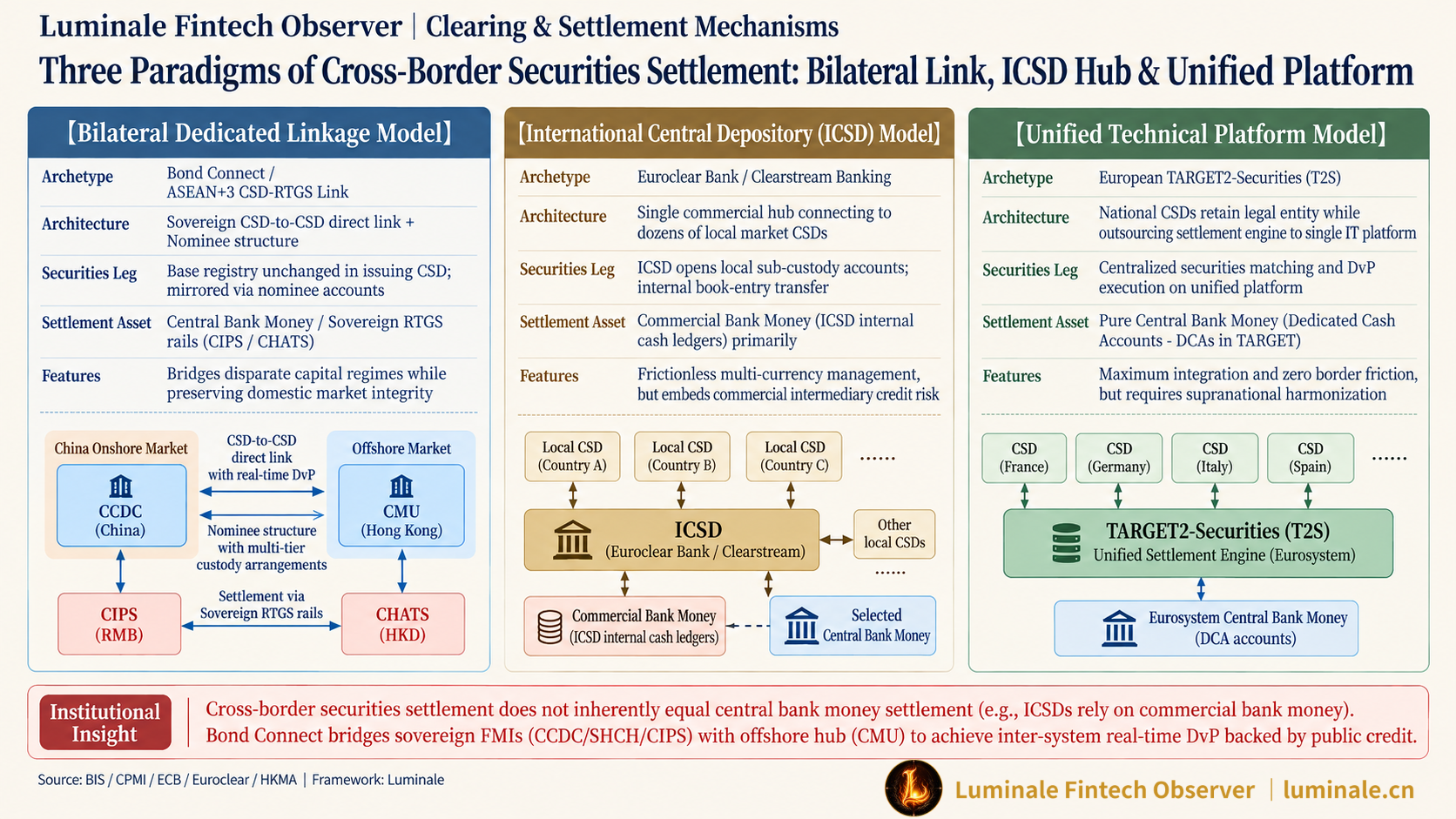
Globally, cross-border securities investment is intermediated predominantly across three institutional paradigms:
| Model Category | Representative Platforms | Core Architectural Structure | Settlement Asset Nature |
|---|---|---|---|
| International Central Securities Depository (ICSD) | Euroclear Bank, Clearstream Banking Luxembourg | Centralized commercial international hub connecting to dozens of local CSDs | Commercial Bank Money predominantly (ICSD internal book-entry cash ledgers); selective central bank money access |
| Unified Technical Platform Model | European TARGET2-Securities (T2S) | Sovereign CSDs outsource their settlement engine to a single Eurosystem IT platform | Central Bank Money (Dedicated Cash Accounts - DCAs held at Eurosystem central banks) |
| Bilateral Dedicated Linkage Model | Bond Connect, ASEAN+3 CSD-RTGS Link | Bilateral infrastructure-to-infrastructure links paired with nominee holding | Central Bank Money / Sovereign LVPS (e.g., CIPS, CHATS) predominantly |
1. The International Central Securities Depository (ICSD) Model
Euroclear Bank and Clearstream Banking Luxembourg serve as the primary international settlement hubs for global debt securities[7][8].
Investors do not need to open separate custody accounts in each individual nation; maintaining an omnibus account with Euroclear provides access to dozens of domestic bond markets through Euroclear's network of direct links with local CSDs.
An essential distinction lies in the nature of the settlement asset:
When two Euroclear participants settle international bond transactions internally, funds transfers represent book-entry debit and credit adjustments across Euroclear Bank's own balance sheet. Settlement occurs in commercial bank money. Only when transactions interface with domestic CSDs and connect directly to national central banks is central bank money deployed.
2. The European T2S Platform Model
The European Central Bank's TARGET2-Securities (T2S) platform represents an integrated approach to post-trade technical consolidation[9].
Participating national CSDs across Europe retain their separate legal identities, governing laws, and core issuance registries, but outsource their underlying securities settlement engines to a single technical platform run by the Eurosystem.
T2S brings the securities accounts of participating CSDs and the Dedicated Cash Accounts (DCAs) of commercial banks held at Eurosystem central banks onto the same technical infrastructure. Within T2S, securities transfers and central bank money transfers are processed synchronously by a single integrated state engine, achieving unified Delivery versus Payment.
3. Institutional Characteristics of Bond Connect
In contrast to the two paradigms above, Bond Connect exhibits distinct and flexible characteristics:
- It did not attempt to build a monolithic supranational settlement engine superseding domestic systems, as T2S did;
- Nor did it rely entirely on the commercial credit and balance sheet of private ICSD balance sheets, choosing instead direct institutional integration between sovereign-level financial market infrastructures:
- Securities custody is anchored between CCDC/SHCH and HKMA CMU;
- Cash transfers are executed across national large-value payment systems (CIPS and HK CHATS).
HKMA CMU operates effectively as a regional international depository hub. It connects directly onshore with CCDC and SHCH, while maintaining bilateral links with Euroclear, Clearstream, and other international depositories[5]. Bond Connect successfully interfaces China's look-through interbank bond market with the multi-tier global custody network anchored around CMU.
VI. Conclusion: Interoperability Depends on Underlying Infrastructure Integration
Frictions in cross-border bond investment have never been confined to investor onboarding documentation or front-end trading interfaces.
Behind every cross-border bond allocation, post-trade infrastructures must definitively resolve:
- On which sovereign central depository is the bond asset immobilized and transferred?
- How is the offshore investor's property right legally protected across multi-tier custody chains?
- Through which payment system are funds cleared, and what is the legal nature of the settlement asset?
- Which system transmits the irrevocable confirmation before locked securities are formally released?
- When market volatility spikes or offshore liquidity tightens, how is systemic default risk isolated?
From Northbound to Southbound trading, the opening of China's bond market has not taken the form of simple account deregulation. Instead, it represents a sophisticated post-trade governance architecture built on nominee holding, central securities depository linkages, and inter-system synchronization via CIPS.
The true anchor enabling trillions of yuan in capital to circulate securely across borders is this invisible, robust clearing and settlement network operating across milliseconds.
References
[1]: Zaobao. Report: China Considers Allowing National Social Security Fund to Invest in Hong Kong Bonds. September 9, 2026. https://www.zaobao.com.sg/news/china/story20260909-9649049 ↩
[2]: Hong Kong Monetary Authority (HKMA). Bond Connect: Expanding Access to China's Bond Market. HKMA Quarterly Bulletin, September 2021. https://www.hkma.gov.hk/media/eng/publication-and-research/quarterly-bulletin/qb202109/fa1.pdf ↩
[3]: People's Bank of China (PBOC), Hong Kong Monetary Authority (HKMA). Joint Announcement on the Launch of Southbound Trading under Bond Connect (PBOC Public Notice [2021] No. 13) and Press Q&A. September 15, 2021. https://www.jyg.gov.cn/zfxxgk/zc/zcjd/zyzcjd/art/2022/art_f0f431be30504e17aa7140e066794981.html ↩
[4]: Hong Kong Monetary Authority (HKMA). Annual Report 2018: Financial Infrastructure - Bond Connect DvP Enhancement. 2019. https://www.hkma.gov.hk/media/eng/publication-and-research/annual-report/2018/AR2018E.pdf ↩
[5]: Hong Kong Monetary Authority (HKMA) / Central Moneymarkets Unit (CMU). Assessment of the Central Moneymarkets Unit against the CPSS-IOSCO Principles for Financial Market Infrastructures (PFMI Disclosure Framework). 2025. https://www.cmu.org.hk/home/upload/document/CMUDisclosureFrameworkJan2025.pdf ↩
[6]: Hong Kong Monetary Authority (HKMA). Developing Hong Kong's Fixed Income and Currency Market Infrastructure: The Evolution of CMU. HKMA Quarterly Bulletin, March 2025. https://www.hkma.gov.hk/media/eng/publication-and-research/quarterly-bulletin/qb202503/fa1.pdf ↩
[7]: Euroclear Bank. Settlement Services and Model: Commercial Bank Money vs Central Bank Money. https://www.euroclear.com/services/en/settlement/settlement-euroclear-bank.html ↩
[8]: Asian Development Bank (ADB) / ASEAN+3. Cross-Border Settlement Infrastructure Forum (CSIF) Progress and Recommendations. Asian Bond Markets Initiative (ABMI). https://asianbondsonline.adb.org/abmf/publications/csif/ ↩
[9]: European Central Bank (ECB). TARGET2-Securities (T2S): Integrated cross-border securities settlement in central bank money. https://www.ecb.europa.eu/paym/target/t2s/html/index.en.html ↩
Originally published by Luminale Fintech Observer: https://luminale.cn/articles/bond-connect-cross-border-settlement-mechanisms-en