
In everyday mobile banking or online transfers, when a screen flashes "Payment Successful," both payer and payee typically assume the transaction is definitively concluded. Within Financial Market Infrastructure (FMI) and interbank clearing and settlement systems, however, a front-end status update does not necessarily mean the transaction has attained conclusive legal and operational effect.
Consider a representative scenario:
At 10:00 AM, a corporate client at Bank A transfers 1 million RMB to a client at Bank B. Through the central bank's Real-Time Gross Settlement (RTGS) system, the central bank reserve accounts of both commercial banks are debited and credited on a transaction-by-transaction basis:
Bank A's central bank reserve account is debited by 1 million RMB, while Bank B's reserve account is credited with 1 million RMB.
The central bank ledger marks the settlement as completed.
At 15:00 PM that same afternoon, however, Bank A experiences a sudden liquidity collapse, is placed under regulatory resolution, and enters formal insolvency proceedings.
At this juncture, Bank A's bankruptcy administrator and creditors'committee file a claim: they demand the clawback of all outbound funds transferred by Bank A earlier that morning, attempting to return that 1 million RMB to Bank A's bankruptcy estate.
If these funds were clawed back, how would Bank B—having already credited its client and deployed those funds into subsequent payments—handle the shortfall? If they cannot be clawed back, what underlying legal principles and settlement rules prevent such reversals?
This is precisely the core systemic problem that the institution of Settlement Finality is designed to resolve.
1. "Funds Credited": Why Isn't It the Whole Story?
Before analyzing settlement finality, one must distinguish between the payment status perceived by end-users and the actual accounting layers of interbank clearing and settlement. A typical interbank transfer encompasses multiple distinct milestones and legal relationships:
[Payer submits payment order]
       ↓
[Commercial bank debits payer account]
       ↓
[Payment order enters clearing system]
       ↓
[Central bank reserve transfer (Interbank Settlement)]
       ↓
[Receiving bank credits payee account]
When a payee's bank balance increases, the receiving bank recognizes a liability (customer deposit) on its own balance sheet. However, whether the receiving bank can unconditionally retain the settlement asset transferred from the sending bank without recourse depends entirely on whether interbank settlement has achieved finality.
In a modern central bank RTGS system, the balance sheet transformations for an interbank transfer proceed as follows:
| Institution | Asset Side Changes | Liability Side Changes |
|---|---|---|
| Bank A (Sending Bank) | Central Bank Reserves: −1 Million RMB | Customer Deposits (Payer): −1 Million RMB |
| Central Bank | Total Assets Unchanged | Bank A Reserve Deposit: −1 Million RMB Bank B Reserve Deposit: +1 Million RMB |
| Bank B (Receiving Bank) | Central Bank Reserves: +1 Million RMB | Customer Deposits (Payee): +1 Million RMB |
Nature of Settlement Asset: The asset transferred in interbank settlement is Central Bank Money (CeBM)—a direct claim on the central bank balance sheet. Transferring reserves legally discharges the interbank debt obligation.
Determining whether a payment is truly complete requires verifying several critical dimensions:
- Form of Settlement Asset: Whether settlement occurs in commercial bank credit, specialized clearing house balances, or central bank reserves.
- Ledger of Record: Whether the transfer is recorded on an internal private clearing house ledger or the central bank core general ledger.
- System Rule Determination: The exact timestamp at which system operating rules deem the payment irrevocable.
- Legal Enforcement Boundary: Whether bankruptcy law upholds the settlement determination of the system rules, or applies general insolvency law to unwind prior transactions.
The Committee on Payments and Market Infrastructures (CPMI) under the Bank for International Settlements (BIS), together with IOSCO, explicitly mandates in Principle 8 (Settlement finality) of the Principles for Financial Market Infrastructures (PFMI): An FMI should clearly define the point at which settlement is final in its rules and procedures, and ensure that such finality is legally certain and enforceable across all relevant jurisdictions [1].
Without robust statutory protection, technical updates on a database remain vulnerable to being overturned in subsequent judicial disputes or insolvency proceedings.
2. Irrevocability vs. Settlement Finality: Key Differences
In payment system operations, order irrevocability and settlement finality are frequently referenced together, yet they occupy distinct operational phases and carry different legal effects.
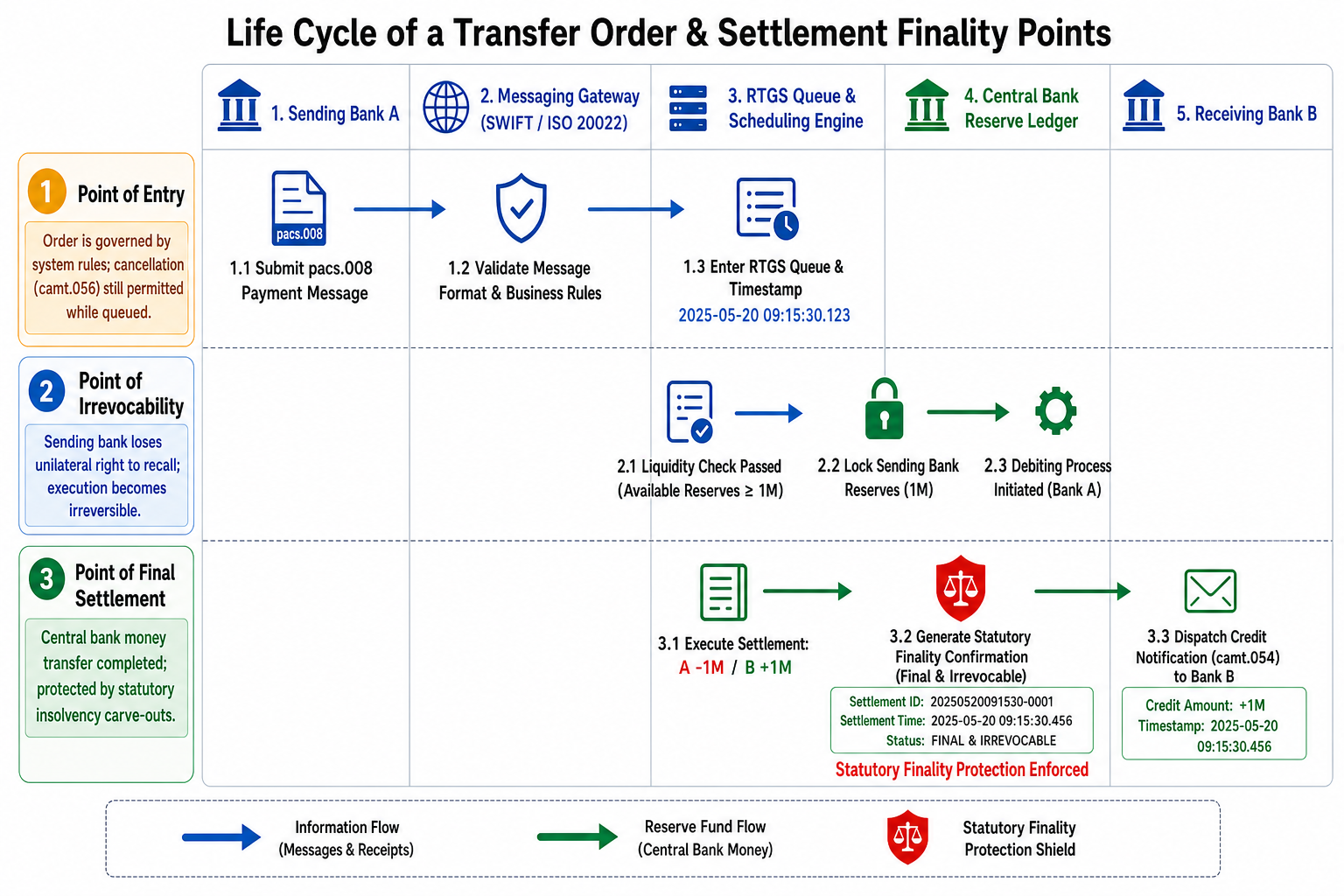
A payment order moves through three pivotal milestones from submission to completion:
Payment Order Submission
     ↓
【Point of Entry】 —— Order formally becomes subject to system rules and queuing mechanics
     ↓
【Point of Irrevocability】 —— Participating institution loses the unilateral right to recall or amend
     ↓
【Point of Final Settlement】 —— Irreversible transfer of assets completed; statutory insolvency protection applies
1. Core Concept Definitions
- Point of Entry: The point at which a payment message passes pre-validation checks, is formally accepted by the clearing and settlement system, and receives a system timestamp. From this moment, the order is bound by system rules and queuing algorithms.
- Point of Irrevocability: The point reached under system rules after which the sending bank can no longer unilaterally cancel the transaction via recall messages (e.g., SWIFT MT192 or ISO 20022
camt.056). The order is locked by the system, awaiting liquidity execution. - Point of Final Settlement: The point at which the asset transfer is fully posted on the clearing house or central bank ledger. Once completed, the transfer is unconditional, irreversible, and legally final, immune from challenge by the parties or any third party.
The Bank of England's CHAPS Reference Manual provides a clear definition of these three milestones for the UK large-value payment system [2]:
| Phase | CHAPS System Operation & Rule Definition | Legal & Operational Status |
|---|---|---|
| Point of Entry | Payment message passes SWIFT validation and enters the Bank of England RTGS core routing engine. | Governed by system rules; sending bank may still request cancellation while queued. |
| Point of Irrevocability | RTGS engine begins real-time debiting phase against Bank A's reserve account. | Bank A completely forfeits cancellation rights; internal failures cannot halt execution. |
| Point of Final Settlement | Bank of England ledger completes debit to Bank A and credit to Bank B. | Asset transfer completed; fully protected under the UK Financial Markets and Insolvency (Settlement Finality) Regulations 1999. |
Key Distinction: Irrevocability binds the sending participant against unilateral recall (you cannot take it back); settlement finality binds all third parties, including judicial bodies and bankruptcy liquidators (the law cannot unwind it). Irrevocability is a prerequisite for settlement finality, but only upon reaching the statutory final settlement point does legal certainty become absolute.
3. Systemic Risk in a Settlement Unwind Chain
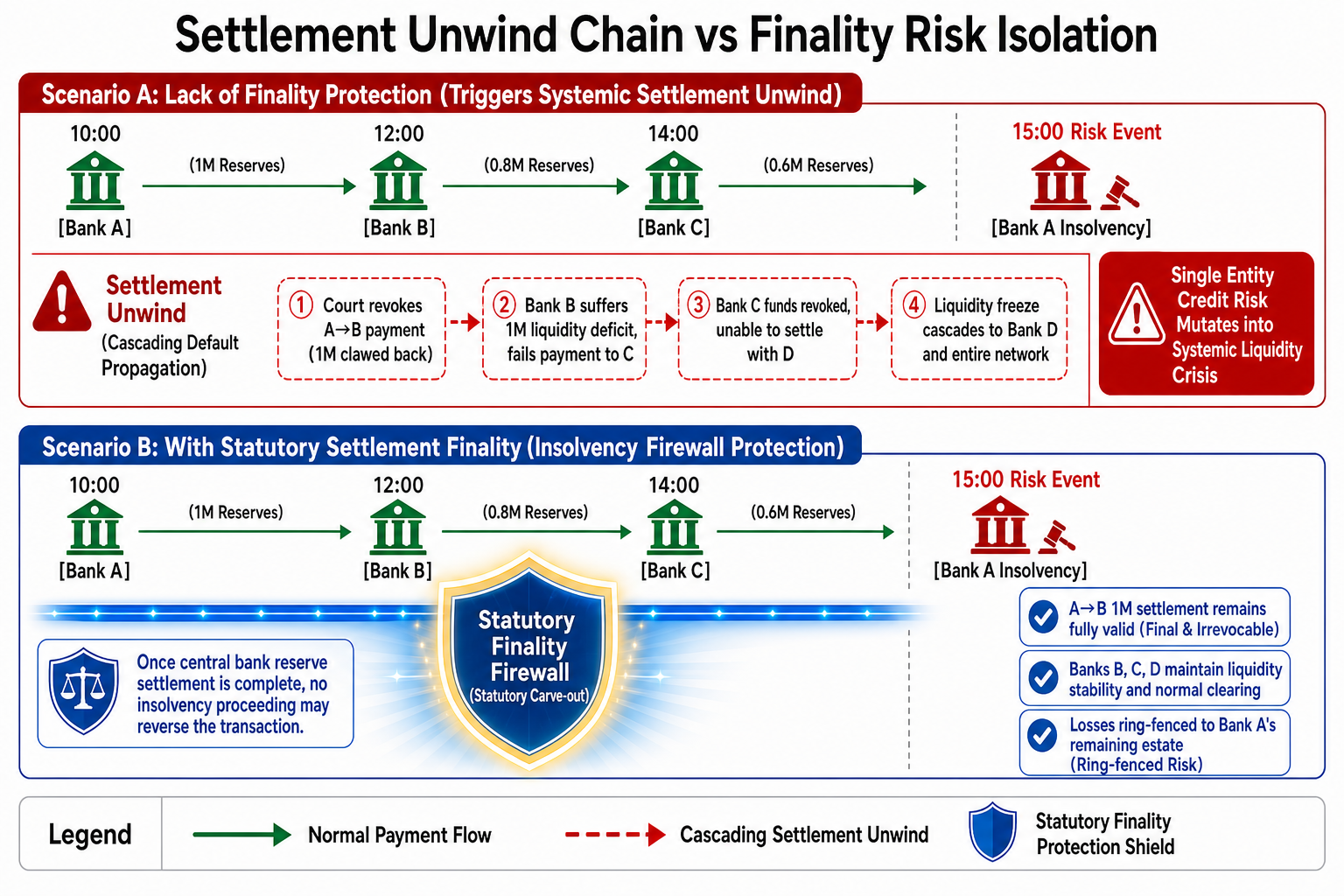
If a payment system lacks statutory settlement finality and permits insolvency liquidators to claw back settled payments, the entire financial system faces the risk of a cascading settlement unwind.
Interbank fund flows form an intensely interconnected, high-frequency liquidity network. Funds received by a commercial bank are frequently redeployed within seconds or minutes as intraday liquidity for subsequent payments or interbank money market obligations.
Consider the liquidity transmission chain among four institutions:
10:00                12:00                14:00
Bank A ──[ 1.0M RMB ]──> Bank B ──[ 0.8M RMB ]───> Bank C ──[ 0.6M RMB ]───> Bank D- At 10:00, Bank B receives 1.0 million RMB in central bank reserves from Bank A.
- At 12:00, based on its updated liquidity position, Bank B transfers 0.8 million RMB to Bank C.
- At 14:00, Bank C utilizes incoming liquidity to transfer 0.6 million RMB to Bank D.
Suppose Bank A enters liquidation at 15:00, and general bankruptcy law allows the administrator to unwind Bank A's 10:00 payment of 1.0 million RMB:
[ Bank A enters liquidation; court orders reversal of Bank A → Bank B transfer ]
                                      ↓
[ Bank B reserve account debited 1.0M RMB; sudden liquidity deficit emerges ]
                                      ↓
[ Underlying liquidity for Bank B → Bank C payment collapses; transfer subject to unwind ]
                                      ↓
[ Bank C loses 0.8M RMB; unable to sustain 0.6M RMB payment to Bank D ]
                                      ↓
[ System-wide Settlement Unwind Chain triggered across the network ]
Consequences of a Settlement Unwind
- Mutation of Credit Risk into Systemic Liquidity Risk: What began as isolated counterparty insolvency at Bank A (credit risk) instantly metastasizes into acute intraday liquidity shortfalls at solvent institutions like Bank B, C, and D (systemic liquidity risk).
- Total Recalculation in Netting Systems: In Deferred Net Settlement (DNS) systems, multilateral net obligations depend on the integrity of the entire transaction batch. If a single transfer is declared void, the clearing house must strip out the transaction and recompute multilateral net positions for all participants (Unwinding / Recalculation). This can flip a bank from a net creditor to a net debtor, triggering widespread settlement failures.
- Precautionary Liquidity Hoarding: If participants fear that settled funds may be clawed back by judicial decree, banks will withhold incoming intraday funds, maintaining oversized excess reserve buffers. This depresses liquidity velocity across the interbank market and escalates systemic funding costs.
Statutory settlement finality establishes a decisive firewall: losses from Bank A's insolvency are strictly confined to Bank A's remaining estate and unsettled claims, preventing contagion across the broader financial network.
4. The Zero-Hour Rule: When Bankruptcy Law Collides with Payment Systems
Understanding the necessity of settlement finality legislation requires examining a historical conflict between payment systems and traditional bankruptcy jurisprudence—the Zero-Hour Rule.
1. What Is the Zero-Hour Rule?
In many civil law jurisdictions and traditional corporate insolvency regimes, court insolvency orders carry retroactive effect:
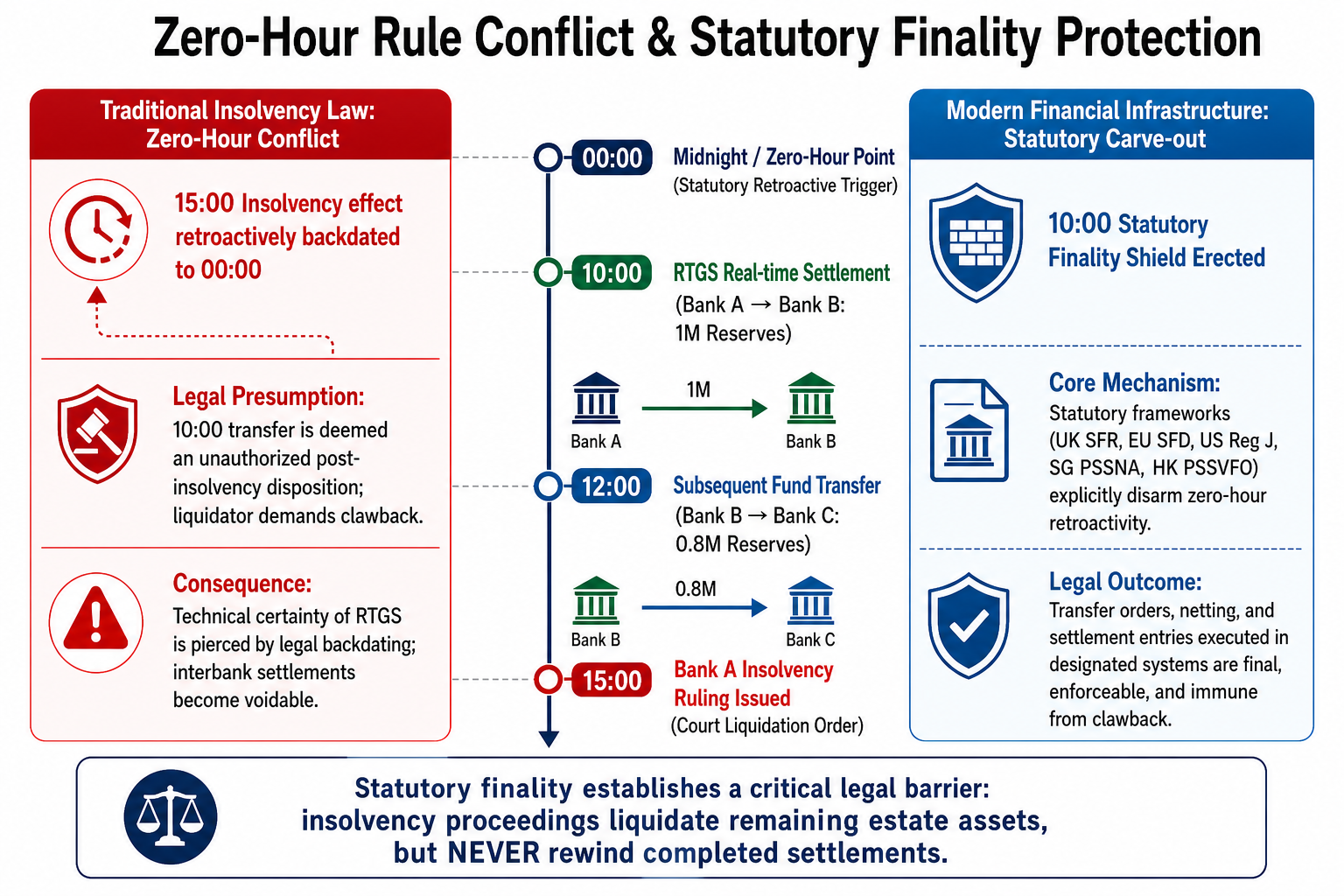
Zero-Hour Rule Definition: Although an insolvency judgment is rendered at a specific time of day (e.g., 15:00), its legal effect retroactively backdates to midnight (00:00:00) of that same calendar day.
In traditional insolvency law, the zero-hour rule aims to prevent distressed debtors from dissipating assets or making fraudulent preferential transfers on the verge of bankruptcy. Applied to high-speed, real-time payment systems, however, this doctrine generates a catastrophic conflict of timing.
2. The Collision of Two Temporal Frameworks
00:00 ── Statutory retroactive effective point under the Zero-Hour Rule
  │
10:00 ── Bank A transfers 1.0M RMB to Bank B (RTGS debits and credits completed)
  │
12:00 ── Bank B transfers 0.8M RMB to Bank C
  │
15:00 ── Court formally issues bankruptcy order against Bank A
On this timeline:
- From the Payment System Perspective: The 10:00 fund transfer was completed in real time on the central bank ledger in full compliance with operating rules, rendering it irreversible.
- From the Bankruptcy Law Perspective: Bank A is legally deemed to have lacked disposition rights over its assets since 00:00 that morning. Consequently, the 10:00 transfer represents an unauthorized disposition post-insolvency, entitling the liquidator to demand clawback.
If bankruptcy retroactivity overrides payment system rules, RTGS "real-time finality" becomes an illusion—any transaction settled earlier in the day remains legally vulnerable if a counterparty collapses before midnight.
3. Statutory Carve-Outs and Legal Boundaries
To eliminate this systemic vulnerability, major financial jurisdictions enacted specialized statutes establishing a clear legal boundary between general insolvency law and financial market infrastructure:
These statutory regimes explicitly provide that payment orders (Transfer Orders), netting arrangements, and final settlement entries executed within designated systems are exempt from the zero-hour rule and general bankruptcy clawback provisions.
Critical Legal Boundary: Settlement finality protects the conclusiveness and irreversibility of clearing and settlement ledger entries; it does not grant blanket immunity to the underlying commercial transaction. If a transaction involves fraud, money laundering, or illicit intent, aggrieved parties or prosecutors may pursue civil claims or restitution against the counterparties, but they cannot demand that the payment system reverse completed interbank ledger transfers.
5. Statutory Carve-Outs Across Major Financial Centers
Settlement finality cannot rely solely on central bank technology; it requires explicit statutory backing and regulatory designation. Different global financial centers have developed distinct legal frameworks to achieve this objective.
1. United Kingdom: CHAPS & The Settlement Finality Regulations
The UK established its statutory regime through The Financial Markets and Insolvency (Settlement Finality) Regulations 1999 (SFR) [3].
- Mechanism: HM Treasury empowers the Bank of England to designate critical systems, including CHAPS and CREST (the securities settlement system), as Designated Systems.
- Legal Effect: Transfer orders and settlements within designated systems take precedence over ordinary provisions of the UK Insolvency Act 1986. Even if a participant enters insolvency, orders entered into the system prior to the opening of proceedings remain valid and enforceable; orders entered post-insolvency but before closing of the settlement day are also protected if the system operator had no notice of the insolvency.
2. European Union: The Settlement Finality Directive (SFD)
The EU enacted Directive 98/26/EC on settlement finality in payment and securities settlement systems (SFD) in 1998, establishing one of the most comprehensive multilateral frameworks against zero-hour risk [4].
- Insolvency Carve-Out: Article 8 of the SFD directly targets and disables the zero-hour rule, mandating that insolvency proceedings shall not have retroactive effects on the rights and obligations of participants arising from system participation on the day proceedings open.
- Cross-Border Protection: The Directive ensures that multilateral netting and cross-border settlement in systems such as T2 (for euro payments) and central securities depositories remain legally binding and irrevocable across all member state jurisdictions.
3. United States: Fedwire, Regulation J, and the Uniform Commercial Code
The US framework synthesizes central bank administrative regulation with state commercial law.
- Regulation J: Formulated by the Federal Reserve Board (12 CFR Part 210, Subpart B), Regulation J directly governs the Fedwire Funds Service. It stipulates that when a Federal Reserve Bank credits the account of a receiving bank or dispatches advice of credit, the funds transfer constitutes an immediate, irrevocable final settlement [5].
- UCC Article 4A: Article 4A of the Uniform Commercial Code (Funds Transfers) provides the statutory foundation for wholesale electronic funds transfers, integrating with federal bankruptcy law and the FDIC resolution regime to protect Fedwire transfers from post-insolvency avoidance.
4. Singapore: Payment and Settlement Systems (Finality and Netting) Act
Singapore enacted standalone legislation via the Payment and Settlement Systems (Finality and Netting) Act (PSSNA) [6].
- Designation Regime: The Monetary Authority of Singapore (MAS) evaluates and designates critical payment systems, with MEPS+ (MAS Electronic Payment System) operating as the core RTGS infrastructure.
- Statutory Exemption: Designated systems receive comprehensive statutory protection: system rules defining the point of irrevocability and final settlement override general corporate insolvency provisions regarding avoidance of uncompleted contracts or preferential clawbacks.
5. Hong Kong: Payment Systems and Stored Value Facilities Ordinance & Certificate of Finality
Hong Kong SAR established a distinctive certification mechanism under the Payment Systems and Stored Value Facilities Ordinance (Cap. 584, PSSVFO) [7].
- Certificate of Finality: The Hong Kong Monetary Authority (HKMA) issues a formal Certificate of Finality to designated systems that satisfy rigorous operational soundness and risk management standards (such as HKD RTGS and the Central Moneymarkets Unit, CMU).
- Legal Protection: Holding this certificate legally shields transfer orders, collateral dispositions, and multilateral netting within the system from the Companies (Winding Up and Miscellaneous Provisions) Ordinance and the Bankruptcy Ordinance, ensuring liquidators cannot challenge completed settlements.
Comparison of Settlement Finality Regimes Across Major Jurisdictions
| Jurisdiction | Primary Legal Foundation | Typical Infrastructure | Finality Determination | Insolvency Ring-Fencing Approach |
|---|---|---|---|---|
| United Kingdom | Financial Markets and Insolvency (Settlement Finality) Regulations 1999 (SFR) | CHAPS, CREST | System rules define 3-stage milestones confirmed by regulations | Statutory carve-out from general insolvency clawback; protects accepted transfer orders |
| European Union | Settlement Finality Directive (Directive 98/26/EC, SFD) | T2, EURO1 | Member state transposition laws + Designated system status | Article 8 explicitly eliminates zero-hour retroactivity; safeguards netting and collateral |
| United States | Regulation J (12 CFR Part 210) + UCC Article 4A | Fedwire Funds Service | Real-time reserve account debit/credit by Federal Reserve Banks | Central bank rules establish immediate irrevocability; coordinates with FDIC resolution powers |
| Singapore | Payment and Settlement Systems (Finality and Netting) Act (PSSNA) | MEPS+ | MAS system designation + System rule timing definitions | Standalone statute overrides bankruptcy avoidance powers; confirms netting and finality |
| Hong Kong SAR | Payment Systems and Stored Value Facilities Ordinance (Cap. 584) | HKD RTGS, CMU | HKMA issues "Certificate of Finality" | Statutory certificate creates a legal shield against winding-up liquidators |
6. Conclusion
Returning to the 1 million RMB interbank transfer presented at the outset:
At 10:00 AM, Bank A transfers reserves to Bank B via the central bank RTGS system; at 15:00 PM, Bank A enters liquidation.
The legal and operational conclusion is definitive:
- Technically & Operationally: The central bank ledger completed the debit and credit entries at 10:00 AM, reaching the Point of Final Settlement.
- Legally & Regulatorily: The statutory settlement finality regime applicable to the designated system disarms the zero-hour rule, prohibiting the bankruptcy liquidator from unwinding the transfer or clawing back funds from Bank B.
- Systemically: Bank B can safely deploy the 1.0 million RMB into subsequent payments to Bank C and Bank D, insulating the broader financial network from a cascading liquidity freeze.
Settlement finality fundamentally defines the exact point at which the financial system can stop looking back.
Once an asset transfer crosses this statutory threshold, it becomes an immutable historical fact—serving as a reliable foundation of credit and liquidity upon which all subsequent transactions may safely proceed.
This legal foundation is precisely what enables modern financial infrastructure to construct advanced cross-market settlement mechanisms—such as Delivery versus Payment (DvP) in securities markets and Payment versus Payment (PvP) in foreign exchange markets.
Without guaranteed finality on the cash leg, synchronized settlement across assets and currencies would be impossible to achieve.
References
[1]: Committee on Payments and Market Infrastructures (CPMI), Technical Committee of the International Organization of Securities Commissions (IOSCO). Principles for financial market infrastructures (PFMI). Bank for International Settlements, April 2012. https://www.bis.org/cpmi/publ/d101a.pdf ↩
[2]: Bank of England. CHAPS Reference Manual. Section: System Rules and Timings. Bank of England, 2023. https://www.bankofengland.co.uk/payment-and-settlement/chaps ↩
[3]: UK Government. The Financial Markets and Insolvency (Settlement Finality) Regulations 1999 (SI 1999/2979). UK Legislation. https://www.legislation.gov.uk/uksi/1999/2979/contents/made ↩
[4]: European Parliament, Council of the European Union. Directive 98/26/EC of the European Parliament and of the Council on settlement finality in payment and securities settlement systems. Official Journal of the European Communities, May 1998. https://eur-lex.europa.eu/legal-content/EN/TXT/?uri=CELEX:31998L0026 ↩
[5]: Electronic Code of Federal Regulations. 12 CFR Part 210 - Collection of Checks and Other Items by Federal Reserve Banks and Funds Transfers Through Fedwire (Regulation J). Subpart B: Funds Transfers Through Fedwire. https://www.ecfr.gov/current/title-12/chapter-II/subchapter-A/part-210 ↩
[6]: Singapore Statutes Online. Payment and Settlement Systems (Finality and Netting) Act 2002 (2020 Revised Edition). Singapore Government. https://sso.agc.gov.sg/Act/PSSNA2002 ↩
[7]: Hong Kong e-Legislation. Payment Systems and Stored Value Facilities Ordinance (Cap. 584). Hong Kong Monetary Authority. https://www.elegislation.gov.hk/hk/cap584 ↩
Originally published by Luminale Fintech Observer: https://luminale.cn/articles/settlement-finality-risk-mechanisms-en