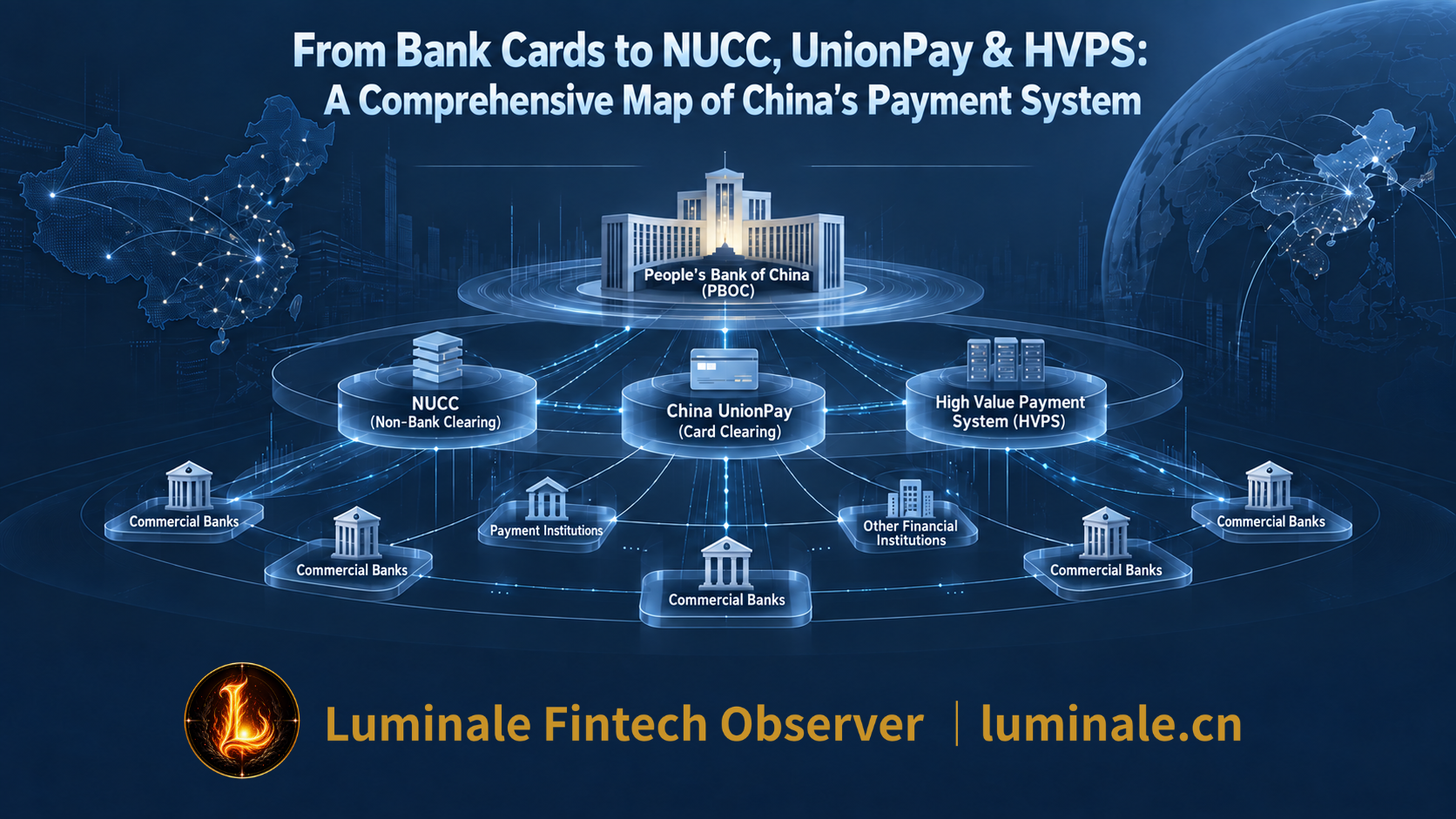
Every quarter, the People's Bank of China (PBOC) publishes a report titled Payment System Operations Overview[1]. In the second-quarter 2026 report released in early September 2026, several macroeconomic metrics illustrate the vast operational scale of China's payment system: nationwide, 115.658 billion bank accounts were maintained; commercial banks processed 168.393 billion non-cash payment transactions totaling RMB 1,698.40 trillion in Q2 alone; and payment systems across the country cleared 437.286 billion transactions valued at RMB 3,628.33 trillion. Expanding the timeline to the full-year 2025 Payment System Operations Overview[2], national payment systems processed an aggregate of 1,624.216 billion transactions valued at RMB 12,807.07 trillion.
Browsing this report, newcomers often encounter an immediate point of confusion: the statistical sections catalog bank cards and commercial drafts alongside online and mobile payments, followed immediately by the High Value Payment System, the NetsUnion Clearing Corporation (NUCC) platform, and the China UnionPay interbank payment network.
Applying these categories to an everyday transaction—such as scanning a QR code with a mobile banking app at a convenience store to pay RMB 100—prompts an obvious question: Should this transaction be classified as mobile payment, bank card transaction, online payment, or a system operation of UnionPay or NUCC?
The answer is that these statistical categories are not mutually exclusive; rather, they reflect different operational projections of the same underlying transaction across distinct vantage points. Understanding China's payment system requires moving beyond the literal table of contents of regulatory statistics and constructing a structured, multi-dimensional operational map.
1. Statistical Indicators and Analytical Dimensions in PBOC Reports
The Payment System Operations Overview published by the PBOC is fundamentally a supervisory statistical bulletin tailored for macroeconomic oversight and financial monitoring, rather than an academic textbook organized around financial market infrastructure taxonomies. To comprehensively capture market dynamics, the report simultaneously collects operational data across multiple distinct dimensions.
The various indicators highlighted throughout the report can be grouped into four primary analytical tiers:
- Account Tier: The ledgers recording asset ownership and debtor-creditor claims. This encompasses enterprise bank settlement accounts, personal bank settlement accounts, and payment accounts maintained by non-bank payment institutions.
- Payment Instrument & Media Tier: The physical or digital media carrying payment information and instructions. This includes traditional paper instruments (such as cheques, promissory notes, and drafts) as well as bank cards (both magnetic stripe and IC chip cards).
- Business & Channel Tier: The channels and transaction structures through which end users initiate payments. Online and mobile payments describe initiating devices and transmission channels; transfers, merchant purchases, pre-authorizations, direct debits, and disbursements reflect specific business intentions.
- Clearing & Settlement Infrastructure Tier: The inter-institutional networks and systems responsible for transmitting payment instructions, calculating multilateral net obligations, and executing the final transfer of funds. This includes the High Value Payment System (HVPS), the Bulk Electronic Payment System (BEPS), the Internet Banking Payment System (IBPS), China UnionPay, NUCC, and the Cross-border Interbank Payment System (CIPS).
These four dimensions resemble an urban transportation report: a municipality reports automobile registrations (instruments), ride-hailing orders (business and channels), and expressway traffic alongside metro ridership (infrastructure). That an automobile travels on an expressway does not prevent it from being simultaneously a registered motor vehicle and a dispatched ride-hailing trip.
Similarly, when an account holder uses a mobile banking app to send money to a friend holding an account at another bank:
- In terms of funding source, commercial bank demand deposits are debited;
- In terms of initiation channel, it operates as a mobile payment;
- In terms of business nature, it is a customer-initiated interbank credit transfer;
- In terms of backend infrastructure, the payment instruction is routed and processed via the central bank's Internet Banking Payment System (IBPS) or High Value Payment System (HVPS).
In Luminale's financial infrastructure analytical framework, any real-world payment transaction can be deconstructed across five sequential layers:
Customer / Enterprise Initiator
       │
       ▼
[Layer 1: Accounts & Monetary Assets] (Central Bank Reserves / Bank Deposits / Payment Account Balances)
       │
       ▼
[Layer 2: Payment Instruments & Channels] (Bank Cards / Commercial Drafts / Mobile Apps / Online Banking / QR Interfaces)
       │
       ▼
[Layer 3: Payment Business & Transactions] (Fund Transfers / Merchant Acquiring / Direct Debits / Draft Acceptance & Discounting)
       │
       ▼
[Layer 4: Clearing Infrastructures] (HVPS / BEPS / IBPS / UnionPay / NUCC / CIPS / Core Banking)
       │
       ▼
[Layer 5: Final Funds Settlement] (Central Bank Reserve Debits & Credits / Settlement Agent Book Entries)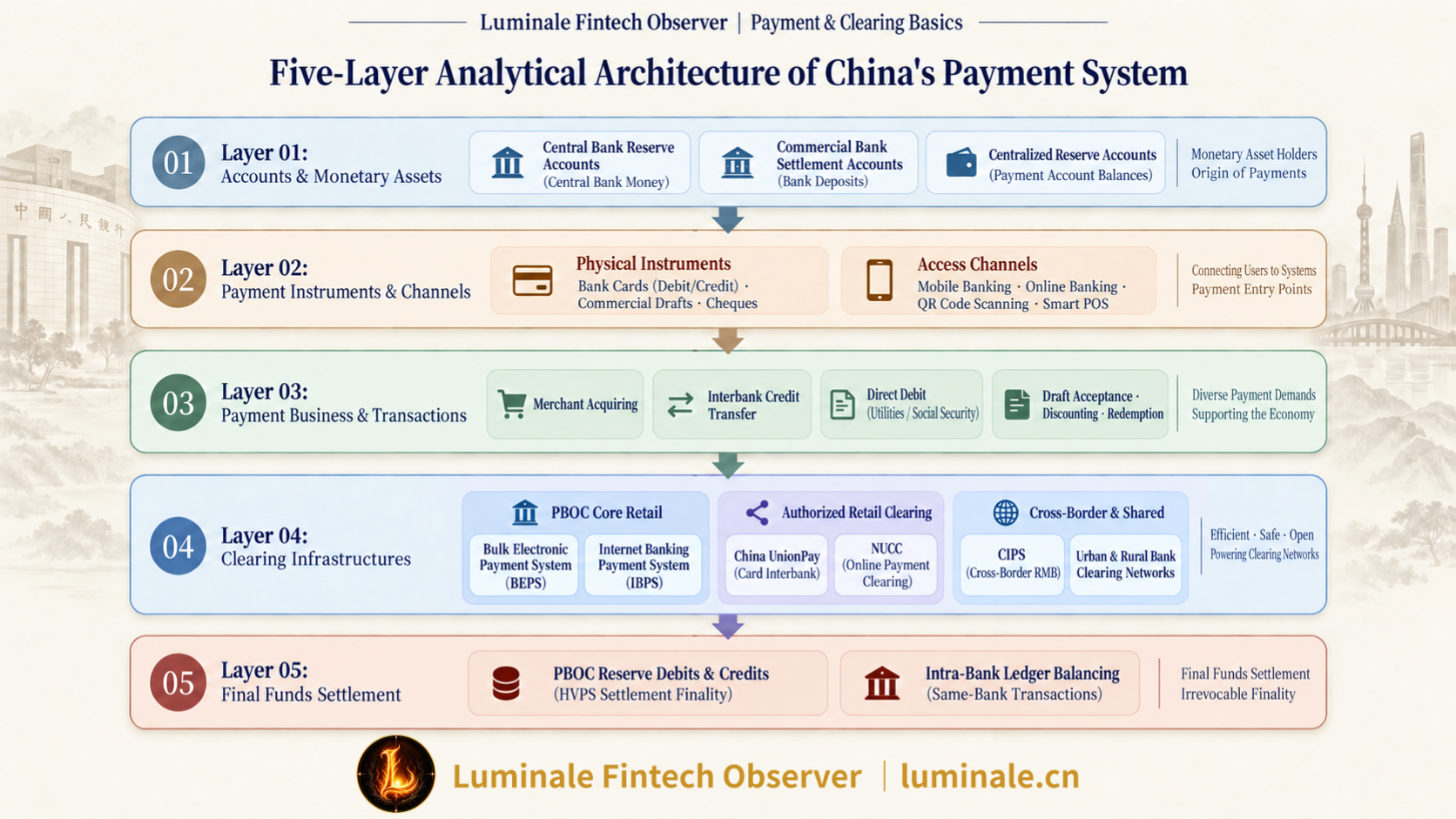
Before analyzing the specific division of responsibilities across these clearing systems, readers interested in foundational concepts—such as the legal and operational distinction between payment, clearing, and settlement, and how Real-Time Gross Settlement (RTGS) differs from Deferred Net Settlement (DNS)—may consult our earlier foundational analysis: What Is a Payment System: From BIS Definitions to the Global FMI Landscape.
2. Core Infrastructures Comprising China's Payment System
Supporting the circulation of the renminbi, national payment clearing and settlement infrastructures consist of central bank-operated systems, authorized clearing institutions, and internal commercial bank core systems.
1. Core Systems Operated by the PBOC National Processing Center
The China National Advanced Payment System (CNAPS) forms the institutional backbone of national financial stability, comprising four principal sub-systems:
- High Value Payment System (HVPS):
Operates on a transaction-by-transaction, gross accounting, real-time interbank clearing model. Running on the PBOC's high-value private network, HVPS directly links to the reserve deposit accounts maintained by commercial banks at the central bank. Throughout 2025, HVPS processed 404 million transactions totaling RMB 8,964.68 trillion. While transaction volume represented less than 2% of total NPC-processed items, it accounted for over 94% of total cleared transaction value. HVPS handles interbank wholesale money market transactions, high-value corporate fund movements, and the final net settlement of external clearing houses, serving as the central circulatory artery of China's financial architecture.
- Bulk Electronic Payment System (BEPS):
Designed for recurring, low-frequency, or batched commercial and retail transactions. Operating continuously on a 24/7 basis, payment orders are batched and transmitted in packages. Multilateral net obligations are calculated across designated processing cycles and settled through debits and credits on central bank reserve accounts. Typical operations include ordinary credit transfers, recurring credit transfers (such as payroll and pension distributions), real-time direct debits, and recurring direct debits (such as municipal utility collections and insurance premium deductions). In 2025, BEPS handled 5.092 billion transactions totaling RMB 206.18 trillion.
- Internet Banking Payment System (IBPS, commonly known as "Super Online Banking"):
Built to fulfill the strict low-latency requirements of internet-based retail and commercial transactions. IBPS supports real-time interbank transfers under designated single-transaction thresholds (typically capped at RMB 50,000 or contractually agreed limits), cross-bank account balance inquiries, and automated account balance sweeps. On the front end, funds are credited within seconds; on the backend, net clearing balances are submitted periodically to the central bank's accounting system for final reserve settlement. In 2025, IBPS processed 17.041 billion transactions totaling RMB 280.67 trillion.
- China Foreign Exchange Payment System (CFXPS):
Developed to handle domestic interbank foreign currency clearing across multiple major currencies, including USD, EUR, HKD, JPY, and GBP. The structural significance of CFXPS lies in its institutional bifurcation: while the messaging and routing system is built and administered by the PBOC, foreign currency settlement funds do not reside on the central bank's balance sheet. Instead, final transfers are booked across accounts maintained at designated commercial bank foreign exchange settlement agents (settlement banks). This operational reality illustrates a core principle of financial market infrastructure theory: clearing networks and final settlement assets constitute two independent operational dimensions.
2. Specialized Retail Clearing Networks and Authorized Institutions
Surrounding the central bank's wholesale infrastructure, specialized clearing institutions operate high-volume retail, bank card, and digital payment networks:
- China UnionPay Interbank Payment System:
Operated by China UnionPay, this network focuses on interbank switching and clearing for bank card transactions, encompassing ATM cash withdrawals, point-of-sale (POS) terminal processing, the QuickPass mobile network, and online payment acquiring. In 2025, UnionPay handled 380.380 billion interbank transactions valued at RMB 279.41 trillion. For detailed analysis on the rights, obligations, and interchange mechanics among issuing banks, acquirers, merchants, and card schemes, see our dedicated analysis: When You Swipe $100 , Who Does It Pass Through? A Guide to Issuers, Acquirers, Card Networks, and Merchants.
- NetsUnion Clearing Platform (NUCC):
Operated by NetsUnion Clearing Corporation, NUCC serves as the centralized inter-institutional switching and clearing house for online payments initiated by non-bank payment institutions. Under regulatory "Direct Connection Cutoff" (断直连) mandates, any non-bank payment provider (such as Alipay or Tenpay/WeChat Pay) handling transactions involving commercial bank accounts must route transactions through an authorized clearing house. In 2025, NUCC cleared 1,119.424 billion transactions valued at RMB 598.23 trillion, reflecting high transaction volume paired with small average ticket sizes. For an analysis of why direct fintech-to-bank connections were prohibited, see: What Do NUCC and UnionPay Actually "Clear"? The Middle Layer of Payment Clearing, Explained.
- Shared Clearing Networks for Small and Medium-Sized Banks:
These include City Commercial Banks Clearing Co., Ltd. (serving national city commercial banks and private banks) and the Rural Credit Banks Funds Clearing Center (serving rural commercial banks, rural cooperative banks, and rural credit unions). Mid-sized and smaller depository institutions possess constrained technical budgets; building bilateral connections and private lines to every banking counterparty nationwide is cost-prohibitive. These shared facilities provide standardized gateways into the national payment system.
3. Cross-Border Interbank Payment System (CIPS)
The Cross-Border Interbank Payment System (CIPS) caters to cross-border trade settlements, multinational investments, financial market transactions, and global correspondent banking in renminbi[4]. Operating with bilingual messaging standards compliant with ISO 20022, system participants are categorized into Direct Participants and Indirect Participants.
In 2025, CIPS processed 8.4419 million cross-border transactions valued at RMB 180.15 trillion, averaging over RMB 21 million per transaction and highlighting its wholesale cross-border character. CIPS additionally supports specialized capital market settlement arrangements, including Payment versus Payment (PvP) to eliminate cross-currency principal risk, and Delivery versus Payment (DvP) for cross-border securities transactions. For comprehensive explanations of these settlement models, refer to:
- What Is the Most Dangerous Moment in FX? Why PvP Is the Market's "Payment-versus-Payment"
- Securities and Money Must Move "Delivery Versus Payment": What Risk Does DvP Actually Prevent?
4. Commercial Bank Internal Core Systems
Beyond external clearing networks, internal core banking platforms represent an essential pillar of the national payment fabric. When the debtor and creditor hold accounts at the exact same commercial bank, the transfer is executed entirely as an internal ledger rebalancing (debiting one customer's deposit ledger and crediting another's). No payment message is dispatched to external interbank clearing networks, and no central bank reserves are mobilized. In 2025, domestic commercial bank internal systems executed 24.521 billion transactions valued at RMB 2,248.95 trillion.
3. Distinguishing Payment Instruments, Media, and Channels
Regulatory and financial reports frequently place diverse payment terms side by side. In operational analysis, these concepts must be disentangled into their respective functional categories to avoid analytical confusion.
1. Commercial Drafts: Separation of Instrument Attributes and Lifecycle Phases
Market observers frequently treat "commercial drafts" as a single uniform business category. In reality, a commercial draft is a legally defined negotiable instrument. Under the operational rules of the Shanghai Commercial Paper Exchange's new-generation bill system[5], an electronic draft traverses distinct operational phases throughout its lifecycle:
- Instrument Classification: Categorized by accepting entity into Bank Acceptance Drafts (BAD) and Commercial Acceptance Drafts (CAD);
- Lifecycle Transactions:
- Issuance and Acceptance: The drawer issues the draft, and the acceptor commits to an unconditional obligation to pay at maturity;
- Endorsement and Transfer: Before maturity, the holder transfers draft rights to an upstream supplier to satisfy commercial trade payables;
- Discounting: Prior to maturity, the holder endorses the draft over to a commercial bank; the bank deducts discount interest and advances net cash to the holder, effectively extending credit financing;
- Pledging: An enterprise pledges unexpired drafts to a bank as collateral to secure bank credit lines;
- Presentment and Liquidation: Upon maturity, the final holder initiates presentment for payment through the bill exchange, the acceptor honors the obligation, and the draft is canceled.
This lifecycle breakdown explains why PBOC statistics separately track "commercial draft acceptances," "commercial draft discounts," and "commercial drafts actually settled." Each reflects draft activity at distinct operational phases rather than additive parallel transactions.
2. Bank Cards: Product Types, Business Operations, and Acceptance Channels
Bank cards also exhibit multi-layered characteristics:
- Product Dimension: Segregated into debit cards (pay-first), credit cards (revolving credit line), and semi-credit cards;
- Business Dimension: Transactions encompass cash withdrawals, deposits, merchant purchases, balance transfers, or pre-authorization holds;
- Acceptance Channel Dimension: Operations are conducted via teller counters, automated teller machines (ATMs), merchant point-of-sale (POS) terminals, e-commerce gateways, mobile banking applications, or QR code optical scanners.
3. Credit Transfers vs. Direct Debits: Push vs. Pull Instructions
In banking settlement systems, all account-to-account funds transfers adhere to two fundamental directional mechanics:
- Credit Transfer ("Push" Instruction):
Initiated directly by the debtor (payer), instructing their bank to "push" funds outward to the creditor's (payee's) account. Common mobile banking transfers, corporate payroll disbursements, and vendor bill payments are predominantly credit transfers. The flow of funds mirrors the direction of the payment instruction.
- Direct Debit ("Pull" Instruction):
Initiated by the creditor (payee), based on prior authorization granted by the debtor, requesting their bank to "pull" funds from the debtor's account across clearing networks. Routine household utility auto-debits and recurring mortgage payments represent typical direct debits. Here, the initiating instruction moves in the opposite direction of the actual fund transfer.
4. QR Codes and Electronic Payments: Interface Technology vs. Regulatory Categories
Equating "QR code payment" directly with "NUCC clearing" or "third-party payment" represents a common category mistake.
A QR code is fundamentally an optical information-carrier and encoding interface. It compresses merchant identifiers, terminal data, transaction IDs, or encrypted payment tokens into a machine-readable graphic. When a scan occurs:
- The deducted source funds can represent an electronic wallet balance inside WeChat Pay or Alipay, demand deposits drawn from an ICBC debit card, or credit lines extended by a CMB credit card;
- Transaction instructions can route through the NUCC platform or alternatively traverse China UnionPay's interbank clearing network (e.g., UnionPay QR aggregation);
- If the transaction debits an electronic wallet balance, the underlying funds are drawn from the customer reserve funds centralized at the PBOC; if a debit card is charged, commercial bank deposit liabilities adjust directly. For detailed mechanics on payment institution balances, see: What Are Customer Reserve Funds Held by Payment Institutions?.
Under the Regulations on the Supervision and Administration of Non-Bank Payment Institutions (State Council Decree No. 768)[6], regulatory classifications have moved away from historical categories like "internet payment, card acquiring, and prepaid cards," establishing a functional two-tier regime:
- Stored-Value Account Operations: Services capable of opening accounts that hold customer funds;
- Payment Transaction Processing: Services that route transaction data, verify instructions, and process settlement without holding customer funds.
Statistical metrics (mobile/online payments), interface forms (QR codes/NFC), and statutory business categories (stored-value operations/transaction processing) operate on separate conceptual planes.
4. Operational Landscape of China's Clearing and Settlement Infrastructures
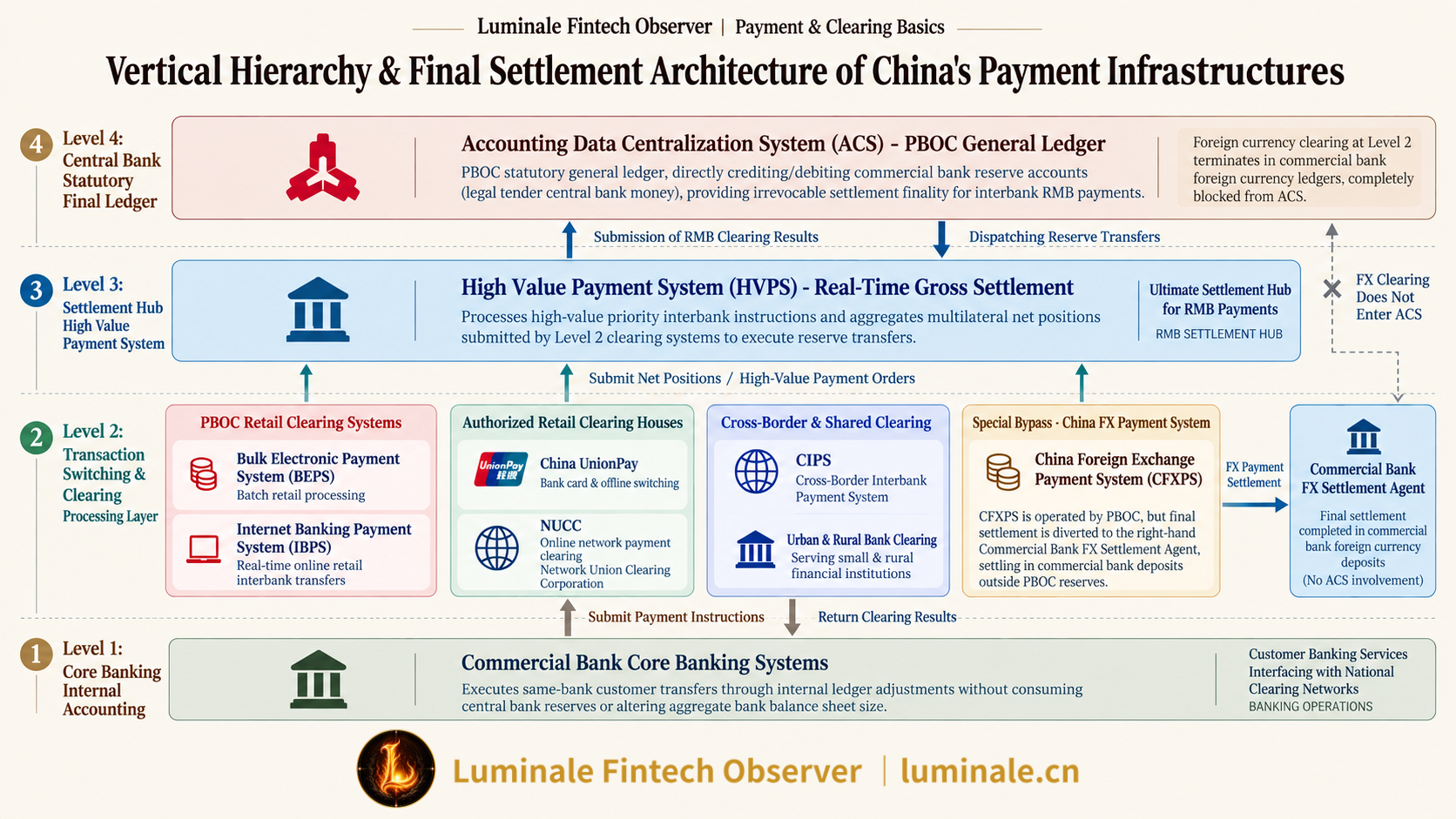
To clearly delineate the operational divisions across China's financial market infrastructures, the following matrix maps out the primary clearing systems, participant scopes, typical transaction profiles, and settlement mechanics:
| System Name | Operating Entity | Primary Participants | Typical Business Scope | Front-End Applications | Interbank? | Settlement Mechanism & Settlement Asset | Further Reading |
|---|---|---|---|---|---|---|---|
| High Value Payment System (HVPS) | PBOC National Processing Center (NPC) | Commercial banks, policy banks, foreign bank branches, authorized FMIs | Wholesale credit transfers, capital market cash settlements, clearing house netting settlements | Interbank lending, high-value corporate procurement, securities settlement cash leg | Yes | Real-Time Gross Settlement (RTGS); settled across PBOC central bank reserve accounts | FMI Landscape & System Definitions |
| Bulk Electronic Payment System (BEPS) | PBOC National Processing Center (NPC) | Commercial banks, rural credit cooperatives, financial institutions | Routine batched credit transfers, recurring direct debits, payroll and utility sweeps | Utility bill collections, fiscal and social welfare distributions, ordinary retail transfers | Yes | Deferred Net Settlement (DNS); multilateral net balances settled across PBOC reserve accounts | FMI Landscape & System Definitions |
| Internet Banking Payment System (IBPS) | PBOC National Processing Center (NPC) | Authorized commercial banks | Real-time credit transfers up to RMB 50,000, interbank account balance inquiries | Real-time mobile banking transfers, cross-bank automated cash sweeps | Yes | Real-time gross processing of transactions, periodic multilateral net settlement across PBOC reserves | FMI Landscape & System Definitions |
| China Foreign Exchange Payment System (CFXPS) | PBOC National Processing Center (NPC) | Domestic banks licensed for FX business, designated FX settlement banks | Multi-currency domestic interbank FX transfers, FX trading cash settlements | Domestic interbank foreign currency remittances (USD, EUR, HKD, etc.) | Yes | Centralized settlement across correspondent accounts at designated commercial FX settlement agent banks; settled in commercial bank FX deposits | - |
| China UnionPay Interbank Payment System | China UnionPay | Issuing banks, acquiring banks, licensed card acquirers | Bank card interbank transactions, ATM withdrawals, UnionPay QR code clearing | POS card payments at physical retailers, interbank ATM cash withdrawals, QuickPass QR scans | Yes (Inter-bank / Inter-institution) | Multilateral periodic net clearing; net obligations settled through PBOC HVPS reserve transfers | Card Payment Four-Party Model |
| NetsUnion Clearing Platform (NUCC) | NetsUnion Clearing Corporation | Non-bank payment institutions, commercial banks | Online payment inter-institutional switching, mobile quick-pay clearing | Alipay / WeChat Pay transactions backed by bank cards, e-commerce checkouts | Yes (Inter-bank / Inter-institution) | Multilateral periodic net clearing; net obligations settled through PBOC HVPS reserve and customer reserve transfers | Clearing Middle Layer & Direct Connection Cutoff |
| Cross-Border Interbank Payment System (CIPS) | CIPS Co., Ltd. | Global direct participants (clearing banks), indirect participants | Cross-border trade settlement, FDI / ODI capital transfers, cross-border syndicated loans, PvP / DvP cash legs | Cross-border corporate RMB remittances, offshore RMB investment repatriation, FX PvP settlement | Yes (Cross-border / Interbank) | Hybrid settlement model (combining real-time gross settlement and deferred net settlement); settled in central bank legal tender | FX Settlement PvP Securities Settlement DvP |
| Urban & Rural Bank Clearing Networks | City Commercial Banks Clearing Co. / Rural Credit Banks Center | City commercial banks, rural commercial banks, rural credit unions | Shared counter transactions, intra-network fund transfers, interbank bill exchanges | Counter deposits/withdrawals across regional bank networks, inter-branch rural fund transfers | Yes (Inter-institution) | Internal multilateral netting within platform; final net balances settled via PBOC CNAPS | - |
| Core Banking Internal Systems | Individual commercial banks | Branch networks, internal retail and corporate customers | Same-bank account transfers, internal batch salary disbursements, ledger transfers | Intra-bank transfers between accounts at the same bank, own-bank ATM card transactions | No (Intra-bank only) | Internal double-entry accounting adjustments; does not consume PBOC reserves, aggregate balance sheet size unchanged | - |
As the table demonstrates, front-end payment instruments and channels do not map one-to-one to specific backend clearing networks.
When an individual initiates a transfer in a mobile banking app, the bank's intelligent routing engine selects IBPS or HVPS based on transaction amount (whether exceeding the IBPS threshold), time of day (operating windows), and liquidity conditions. Similarly, when scanning a QR code, instructions are routed to UnionPay or NUCC depending on the merchant acquirer's technical integration and scheme agreements.
5. Tracing Three Everyday Transactions: From Initiation to Final Settlement
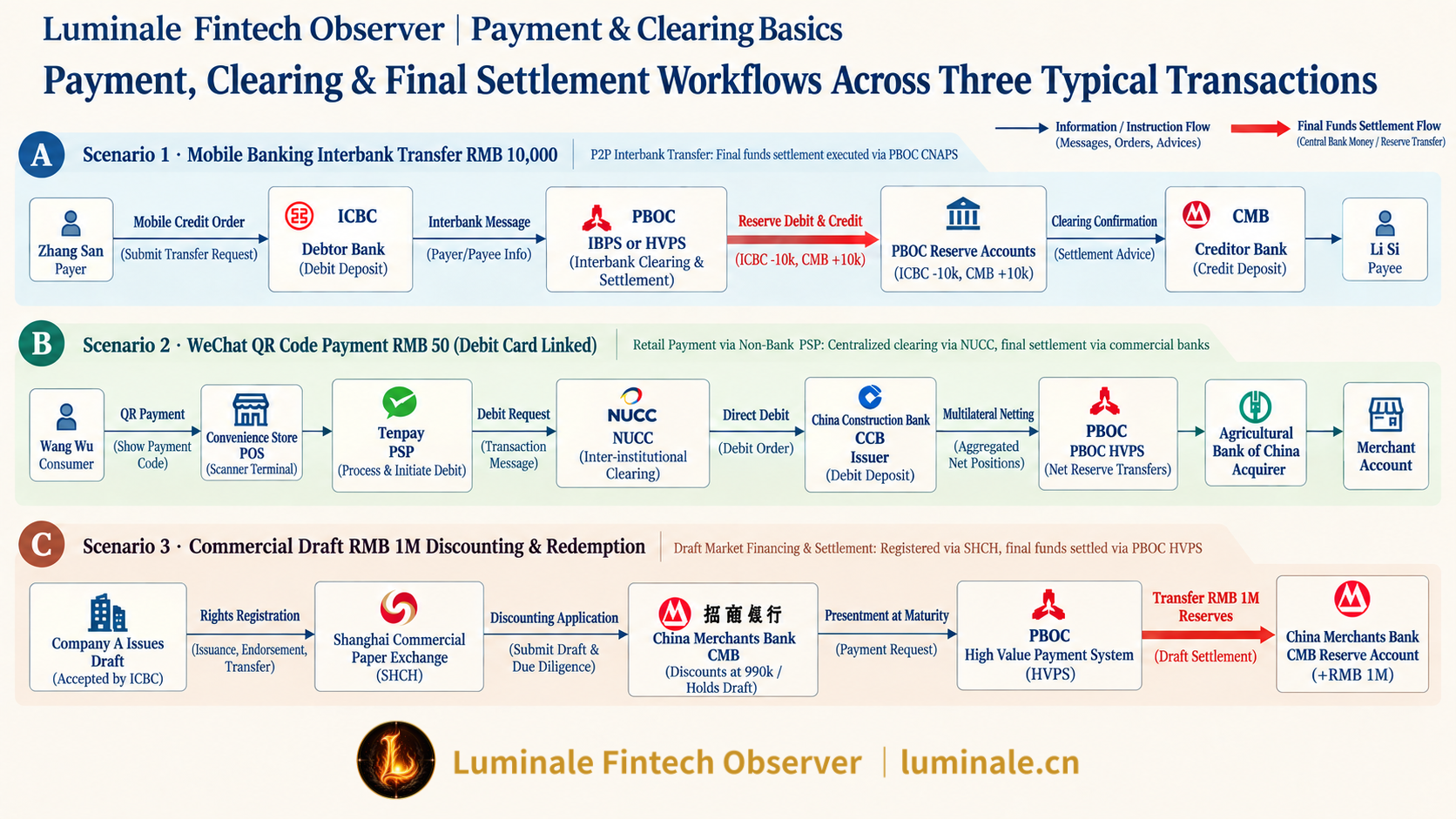
To translate abstract infrastructure relationships into tangible accounting mechanics, we trace the full end-to-end routing paths of three distinct everyday financial transactions.
Scenario 1: P2P Interbank Transfer of RMB 10,000 via Mobile Banking
Assume customer Zhang San uses the ICBC mobile banking application to transfer RMB 10,000 to Li Si's bank account at China Merchants Bank (CMB).
Zhang San (Payer)
   │ Initiates mobile credit transfer instruction
   ▼
Industrial and Commercial Bank of China (ICBC, Debtor Bank)
   │ Verifies account and debits Zhang San's deposit by RMB 10,000
   ▼
PBOC Payment System (IBPS / HVPS)
   │ Validates message and executes interbank clearing
   ▼
Central Bank Reserve Account Settlement (Final Settlement)
   ├─ ICBC Reserve Account debited by RMB 10,000
   └─ CMB Reserve Account credited by RMB 10,000
   ▼
China Merchants Bank (CMB, Creditor Bank)
   │ Receives settlement confirmation and credits Li Si's deposit by RMB 10,000
   ▼
Li Si (Payee)
The corresponding balance sheet entries across all three institutions proceed as follows:
| Institution | Asset Side Changes | Liability Side Changes |
|---|---|---|
| ICBC | Reserves at PBOC: −RMB 10,000 | Zhang San's Demand Deposit: −RMB 10,000 |
| CMB | Reserves at PBOC: +RMB 10,000 | Li Si's Demand Deposit: +RMB 10,000 |
| People's Bank of China (PBOC) | Total Assets Unchanged | ICBC Reserve Account: −RMB 10,000 CMB Reserve Account: +RMB 10,000 |
Scenario 2: WeChat QR Code Payment of RMB 50 at a Convenience Store (Backed by Debit Card)
Customer Wang Wu purchases lunch at a convenience store, scanning the merchant's aggregated QR code via WeChat Pay, backed by a China Construction Bank (CCB) debit card. The store's acquiring institution is the Agricultural Bank of China (ABC).
Wang Wu (Consumer) ── Scans QR Code ──> Convenience Store POS
    │
    ▼
Tenpay (WeChat Pay Payment Institution)
    │ Dispatches debit authorization request
    ▼
NetsUnion Clearing Platform (NUCC)
    │ Routes debit order to issuing bank
    ▼
China Construction Bank (CCB, Issuer)
    │ Debits Wang Wu's account by RMB 50, returns authorization success
    ▼
NetsUnion Clearing Platform (NUCC)
    │ Records multilateral net clearing positions between CCB and ABC
    ▼
Agricultural Bank of China (ABC, Merchant Acquirer)
    │ Receives settlement confirmation, credits merchant deposit account (net of MDR)
    ▼
PBOC High Value Payment System (HVPS, End-of-Cycle Netting)
    │ NUCC submits aggregated netting positions to PBOC
    └─ CCB Reserve Account debited, ABC Reserve Account credited
In this flow:
- The QR code serves purely as an optical data exchange interface;
- The mobile wallet acts as the user interaction portal;
- Tenpay initiates the transaction as a licensed non-bank payment provider;
- NUCC executes switching, protocol translation, and multilateral net calculations between the issuer and acquirer;
- Final fund settlement returns to the PBOC's High Value Payment System, settling irrevocably across commercial bank reserve ledgers.
Scenario 3: Enterprise Issuance, Discounting, and Maturity Redemption of a RMB 1 Million Commercial Draft
Company A purchases raw materials from Supplier B. Lacking immediate cash liquidity, Company A applies to ICBC to issue and accept a 6-month electronic bank acceptance draft for RMB 1,000,000.
- Issuance and Acceptance: Company A registers draft rights on the Shanghai Commercial Paper Exchange (SHCH) platform. ICBC accepts the draft, assuming an unconditional commitment to pay upon maturity. Company A posts security collateral or utilizes pre-approved bank credit lines.
- Holding and Endorsement: Supplier B receives the draft. Two months later, requiring operational working capital, Supplier B applies for draft discounting at China Merchants Bank (CMB).
- Discounting Accounting: CMB discounts the draft based on prevailing market discount rates (assuming RMB 10,000 interest), crediting Supplier B's demand deposit with RMB 990,000 while recording a discounted bill asset of RMB 1,000,000 on CMB's asset ledger.
- Maturity Liquidation: Upon expiration of the 6-month term, CMB as the current holder initiates presentment for payment via the SHCH system against acceptor ICBC. ICBC debits Company A's account and mobilizes RMB 1,000,000 in central bank reserves via the PBOC's High Value Payment System (HVPS) to CMB's reserve account.
In this scenario, the Shanghai Commercial Paper Exchange manages the information, entitlement, and registration lifecycle of the draft, while the final liquidation of cash obligations is completed across the central bank's High Value Payment System.
Conclusion: The "Five-Question Framework" for Deconstructing Any Payment Product
Synthesizing these infrastructure relationships yields a universal methodology for analyzing any payment instrument, present or future:
- Where do the funds originate?
Are they held in central bank statutory reserves, commercial bank demand deposits, or centralized payment institution reserve accounts?
- What instrument and channel initiate the transaction?
Is it an optical QR code, a smart chip card, an online banking portal, a mobile app, or a paper draft?
- What is the substantive legal and financial nature of the transfer?
Is it a customer-pushed credit transfer, a pre-authorized pulled direct debit, a bill discount with recourse, or a merchant acquiring settlement?
- Which infrastructure clears and switches the payment instructions?
Is it an internal bank core system, the central bank's CNAPS (HVPS/BEPS/IBPS), China UnionPay, NUCC, or CIPS?
- Where does final settlement occur, and what asset serves as the settlement medium?
Across which two institutions'ledgers does the irrevocable, final movement of value take place, and does it settle in sovereign central bank money (reserves) or commercial bank money (correspondent balances)?
Whether evaluating traditional card payments, mobile wallets, or emerging innovations such as central bank digital currencies (CBDC, e-CNY), tokenized commercial bank deposits, or fiat-backed stablecoins, applying this five-tier analytical framework pierces through superficial interface novelties, anchoring each transaction precisely within the architecture of the financial system.
References
[1]: People's Bank of China. Q2 2026 Payment System Operations Overview [EB/OL]. (2026-09-02). http://www.pbc.gov.cn/zhifujiesuansi/128525/index.html ↩
[2]: People's Bank of China. 2025 Payment System Operations Overview [EB/OL]. (2026-02-12). http://www.pbc.gov.cn/zhifujiesuansi/128525/128545/128643/index.html ↩
[3]: PBOC National Processing Center. Business Operational Guidelines for High Value Payment System and Bulk Electronic Payment System [EB/OL]. http://www.cncc.cn/ ↩
[4]: Cross-Border Interbank Payment System Co., Ltd. CIPS Business Rules and Participant Guidelines [EB/OL]. https://www.cips.com.cn/ ↩
[5]: Shanghai Commercial Paper Exchange. Operational Rules for the New-Generation Commercial Paper System [EB/OL]. https://www.shcpe.com.cn/ ↩
[6]: State Council of the People's Republic of China. Regulations on the Supervision and Administration of Non-Bank Payment Institutions (Decree No. 768) [EB/OL]. (Promulgated 2023-12-28, Effective 2024-05-01). http://www.gov.cn/zhengce/zhengceku/202312/content_6922982.htm ↩
Originally published by Luminale Fintech Observer: https://luminale.cn/articles/china-payment-system-map-cards-nucc-unionpay-cnaps-en