When mobile banking shows "Transfer Successful," or a trading app displays "Stock Order Filled," users often assume the transaction is complete.
From the perspective of financial infrastructure, the "success" displayed on the front-end page may only mean that the payment instruction has been accepted, the trade has been matched, or the order has been confirmed. Behind this, a longer chain of processes may follow: transmitting instructions, matching trades, clearing, settling funds, delivering securities, registering and safekeeping, and reporting regulatory data.
Whether a transaction can be completed safely depends on the institutional arrangements behind the page, not just on what the front end displays.
These arrangements, taken together, constitute financial infrastructure.
Financial infrastructure certainly cannot function without servers, databases, and communication networks, but its scope extends far beyond technology. How participants gain access, what rules govern business operations, what accounts and assets are used to complete settlement, how defaults are handled, how settlement is guaranteed legal finality, and how systems recover after disruption—all of these are part of infrastructure. Compared with technology, these institutional issues are often more difficult to resolve.
To understand financial infrastructure, two questions must first be clarified: what it actually is, and how different regulatory frameworks classify it.
I. What Is Financial Infrastructure?
The Principles for Financial Market Infrastructures (PFMI), issued by CPMI-IOSCO, defines financial market infrastructures as multilateral systems among participating institutions, including the system operator, used for clearing, settling, or recording payments, securities, derivatives, or other financial transactions.
This definition can be broken down into three characteristics.
1. It Is a Multilateral Arrangement
Financial infrastructure is typically not the internal business system of a single institution. It serves multiple financial institutions, providing them with shared account arrangements, processing procedures, and business rules.
Participants must submit instructions, fulfill settlement obligations, post margin, and handle business errors in accordance with uniform standards. When someone defaults, all participants must also accept the pre-agreed disposal rules.
2. It Performs Critical Functions for Financial Transactions
An infrastructure typically performs one or more of the following functions:
- Transferring funds;
- Calculating transaction obligations;
- Completing delivery of securities or other assets;
- Maintaining registration and safekeeping records for financial assets;
- Interposing itself between transacting parties and centrally managing risk;
- Aggregating transaction data and providing information to regulators.
These functions move a transaction that has already been "agreed upon" through to final completion.
3. It Can Generate Broad Risk Spillovers
Many financial institutions conduct business with one another through the same infrastructure. If a system experiences a prolonged outage, or a significant participant defaults, or legal disputes arise over settlement rules, the impact can spread rapidly through payment, margin, liquidity, and asset-custody relationships.
Financial infrastructure improves market operating efficiency on the one hand, while also centrally managing systemic risk on the other. It is a critical node in the financial system.
Financial Infrastructure Is Not the Same as Fintech Platforms
Not every system that supports financial activity qualifies as financial infrastructure.
For example:
- Mobile banking is a customer service channel;
- A payment institution's wallet is a payment instrument and account service;
- A bank's core system primarily maintains the bank's own customer accounts;
- SWIFT mainly provides standardized financial messaging and communication services;
- Cloud platforms, digital identity, and anti-fraud systems may be critical technology services.
These systems may be important, and some are services that financial infrastructure cannot do without, but processing large volumes of data or possessing advanced technology does not automatically make an arrangement a financial market infrastructure under the PFMI.
Four dimensions can be used to assess whether an arrangement has infrastructure attributes:
| Assessment Dimension | Core Question |
|---|---|
| Multilateralism | Does it establish common processing rules for multiple financial institutions? |
| Critical Functions | Does it perform payment, clearing, settlement, registration/safekeeping, or central clearing functions? |
| Indispensability | If the system goes down, can the market quickly migrate to alternative arrangements? |
| Risk Spillover | Is a failure or participant default likely to affect a large number of institutions or the entire market? |
Discussions should also distinguish between the "operating institution," the "infrastructure," and the "technical system."
A single operating institution may operate multiple financial market infrastructures; a financial market infrastructure may also be supported by multiple technical systems. Within the same group, there may be multiple legal entities responsible respectively for central securities depository, central counterparty, and trade reporting functions.
II. How Does PFMI Classify Financial Market Infrastructures?
Under the PFMI, systemically important financial market infrastructures fall mainly into five categories:
- Payment systems (PS);
- Central securities depositories (CSD);
- Securities settlement systems (SSS);
- Central counterparties (CCP);
- Trade repositories (TR).
The PFMI does not list multilateral trading facilities (MTF) as a sixth category of FMI. In markets such as Europe, MTFs fall under the regulatory scope of trading venues. Although closely connected to clearing and settlement infrastructure, they are not among the five categories of FMI formally defined by the PFMI. CPMI-IOSCO Principles for Financial Market Infrastructures
1. Payment Systems: Completing Fund Transfers
A payment system is a multilateral arrangement, composed of participants, instruments, procedures, and rules, used to transfer funds between participants.
Different payment systems adopt different settlement models:
- Real-time gross settlement;
- Deferred net settlement;
- Continuous net settlement;
- Hybrid settlement with liquidity-saving mechanisms;
- Final fund settlement through another settlement system.
Real-time gross settlement reduces the accumulation of credit exposure among participants but consumes more intraday liquidity. Net settlement requires fewer funds but accumulates unsettled positions, placing higher demands on default management, settlement guarantees, and queue management.
Therefore, "RTGS" and "DNS" cannot be simplistically understood as advanced versus outdated. The choice of model must weigh settlement speed, credit risk, liquidity consumption, and operating costs simultaneously.
2. Central Securities Depositories: Maintaining Securities Issuance and Holding Records
A central securities depository (CSD) typically provides securities accounts, centralized safekeeping, and asset services, and may also be responsible for securities issuance registration, corporate actions, interest payments, and redemption processing.
The issues it must address include:
- Whether a security has been validly issued;
- Whether the total issued quantity matches account balances;
- Whether securities are held in dematerialized or immobilized physical form;
- Whether entitlement records are accurate after securities are transferred;
- How rights such as dividends, interest, voting, and redemption are passed through.
In an indirect holding system, the CSD's records may primarily reflect the securities positions of participating institutions. The entitlements of ultimate investors must be recorded layer by layer through intermediaries such as securities firms and custodian banks.
Therefore, determining "who owns a security" may sometimes require looking beyond the CSD's own ledger, considering account hierarchies, custody relationships, and the national property rights framework.
3. Securities Settlement Systems: Completing Book-Entry Delivery of Securities
A securities settlement system (SSS) transfers and settles securities through book entries in accordance with pre-determined multilateral rules.
CSD and SSS have different emphases:
- The CSD focuses on issuance integrity, centralized safekeeping, and securities account records;
- The SSS focuses on the transfer and settlement of securities after a transaction is concluded.
In practice, these two functions are often provided by the same operating institution or the same technical framework. The PFMI distinguishes functions but does not require each function to be performed by a separate legal entity.
4. Central Counterparties: Centrally Managing Counterparty Risk
A central counterparty (CCP) interposes itself between the original transacting parties, becoming the buyer to every seller and the seller to every buyer.
The original transaction relationship is:
Institution A ↔ Institution B
After the CCP interposes, it becomes:
Institution A ↔ CCP ↔ Institution B
Through contract substitution, multilateral netting, margin requirements, position limits, and default management, the CCP reduces bilateral risk exposures between participants and the final number of settlement transactions.
Risk does not disappear; it simply changes location. Risk that was previously dispersed among market participants becomes concentrated at the CCP—a systemically important node.
5. Trade Repositories: Establishing Regulatory Visibility
A trade repository (TR) centrally maintains financial transaction data, particularly common in over-the-counter (OTC) derivatives markets.
It may not directly transfer funds or securities, but regulators can use this data to identify:
- Risk exposures between counterparties;
- Market positions and concentration;
- Interconnections between institutions;
- Transaction volumes for specific products;
- Whether risk is transmitting across markets and institutions.
Collecting data is only the first step. Trade identifiers, product classifications, participant identities, valuation methodologies, and data formats must also be standardized; otherwise, no matter how much data is collected, a credible picture of system-wide market risk cannot be assembled.
III. How Does China Define Financial Infrastructure?
In July 2025, the People's Bank of China and the China Securities Regulatory Commission issued the Measures for the Supervision and Administration of Financial Infrastructure, effective from October 1, 2025.
The Measures classify financial infrastructure into six categories:
- Financial asset registration and safekeeping systems;
- Clearing and settlement systems, including central counterparties that conduct central clearing business;
- Trading facilities;
- Trade repositories;
- Important payment systems;
- Basic credit information systems.
The Measures also clarify that the People's Bank of China and the China Securities Regulatory Commission are the regulatory authorities for financial infrastructure. PBC Measures for the Supervision and Administration of Financial Infrastructure
Correspondence Between China's Classification and the PFMI
| PFMI Classification | Approximate Counterpart in China's Classification | Key Differences |
|---|---|---|
| Payment systems | Important payment systems | China's framework emphasizes "important" payment systems brought under unified regulation |
| CSD | Financial asset registration and safekeeping systems | China's classification may cover a broader range of financial assets |
| SSS | Clearing and settlement systems | China's classification places clearing and settlement in the same broad category |
| CCP | Central counterparties within clearing and settlement systems | No longer listed as a separate first-level category |
| TR | Trade repositories | Roughly corresponds |
| No direct counterpart | Trading facilities | The five PFMI categories do not include trading venues |
| No direct counterpart | Basic credit information systems | Part of fundamental data infrastructure in China's financial governance system |
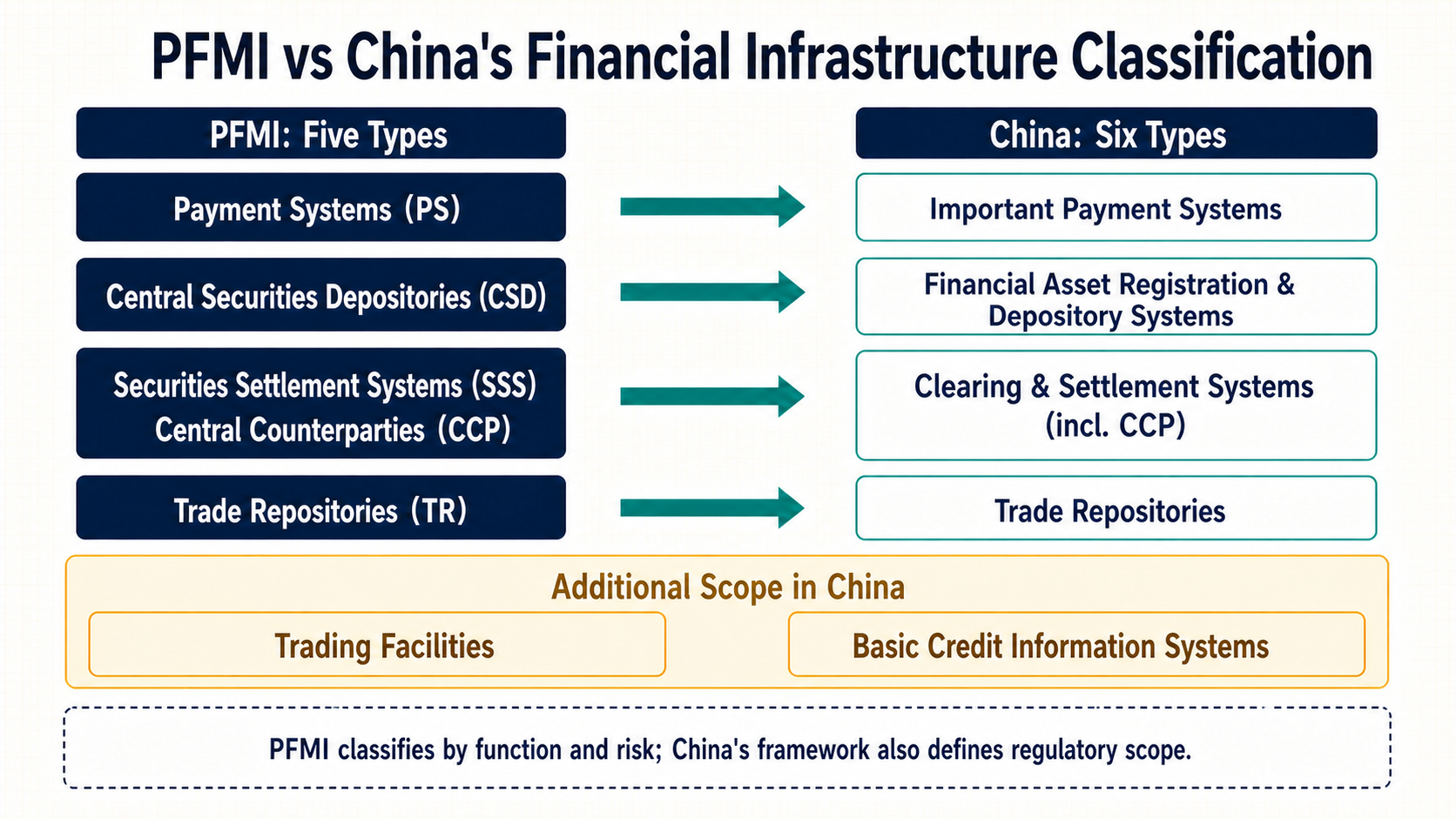
The two classifications differ primarily because their regulatory purposes differ.
The PFMI is mainly concerned with:
What market functions does a multilateral system perform, and what credit, liquidity, settlement, and operational risks may arise?
China's Measures must also address more specific domestic regulatory concerns:
Which systems should be included in domestic financial infrastructure regulation, which authority is responsible for access and ongoing supervision, what governance requirements should operating institutions satisfy, and how should recovery, resolution, and exit be handled after material risks emerge?
The Measures clarify:
- New financial infrastructure involving securities, futures, and related activities is subject to access approval by the China Securities Regulatory Commission;
- Payment systems, basic credit information systems, and interbank market financial infrastructure are subject to access approval by the People's Bank of China;
- Infrastructure that may have a material impact on the financial system may also need to be reported to the State Council for approval.
It is evident that China's classification serves not only to distinguish functions but also to delineate regulatory boundaries and define departmental responsibilities.
Article 7 of the Measures further stipulates that the construction, operation, maintenance, and regulation of financial infrastructure should be grounded in China's actual conditions while remaining aligned with international standards such as the PFMI.
China's classification and the PFMI are not two mutually exclusive frameworks. A more appropriate understanding is:
- The PFMI provides a globally comparable risk-based regulatory benchmark;
- China's framework determines the regulatory scope, access rules, and division of departmental responsibilities for domestic infrastructure;
- Chinese financial market infrastructures to which the PFMI applies must simultaneously satisfy the relevant international principles and domestic regulatory requirements.
IV. Understanding Payment, Clearing, and Settlement Through a Cross-Bank Transfer
With the classification above in mind, examining a specific transaction makes it easier to understand how different infrastructures work together.
Payment, clearing, and settlement are frequently mentioned together, but they are not the same thing.
| Stage | Primary Task | Problem It Solves |
|---|---|---|
| Payment | Initiating, transmitting, and processing fund transfer instructions | Who intends to pay whom, and how much? |
| Clearing | Verifying transactions, confirming obligations, and calculating receivables and payables | What does each participant ultimately owe or receive? |
| Settlement | Actually transferring funds or assets according to clearing results | Has the obligation been finally discharged? |
This is a functional division; the three functions are not necessarily performed by three separate systems.
A real-time gross settlement system can process payment instructions and per-transaction fund settlement within a single infrastructure. A retail payment system may receive transactions in real time, subsequently calculate the net positions of each participating institution, and finally settle through another large-value payment system.
How a Cross-Bank Payment Is Completed
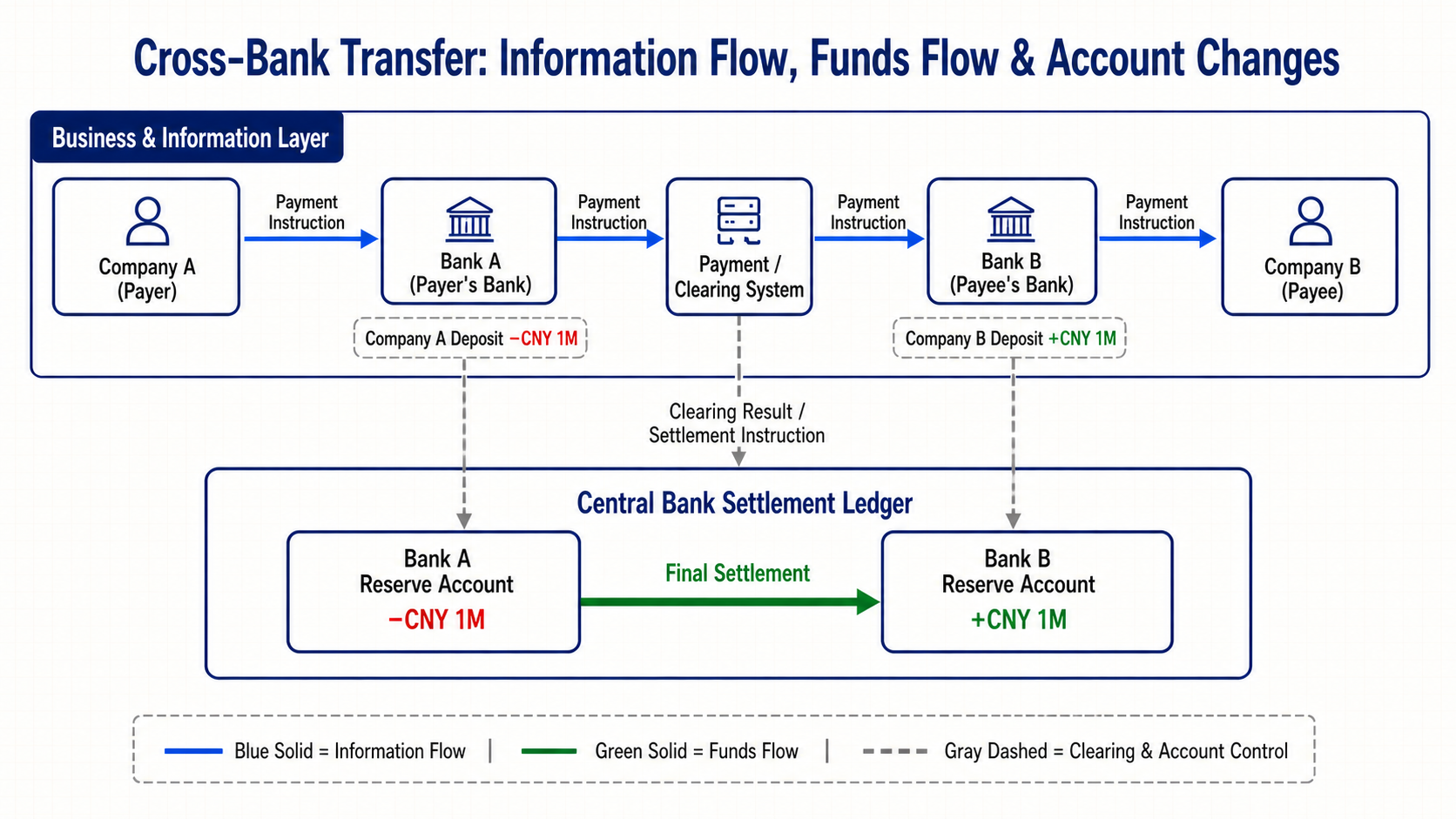
Assume Company A has an account at Bank A, and Company B has an account at Bank B. Company A pays Company B 1 million yuan.
At the customer account level:
| Institution | Account Change |
|---|---|
| Bank A | Company A's deposit decreases by 1 million yuan |
| Bank B | Company B's deposit increases by 1 million yuan |
Customer deposits are commercial banks'liabilities to their customers. Bank A cannot merely debit Company A's deposit and have Bank B increase Company B's deposit out of thin air. Settlement must also occur between the two banks.
If both banks maintain settlement accounts at the central bank, the interbank fund changes can be simplified as:
| Account on the Central Bank's Books | Change |
|---|---|
| Bank A reserve account | Decrease of 1 million yuan |
| Bank B reserve account | Increase of 1 million yuan |
A complete cross-bank payment may go through the following steps:
- Company A submits a payment instruction to Bank A;
- Bank A verifies the customer's identity, balance, authority, and compliance status;
- The payment system or clearing institution transmits the instruction to the relevant participants;
- The system processes each transaction individually, or calculates the net settlement obligations between Bank A and Bank B;
- Bank A and Bank B transfer reserves or other agreed settlement assets;
- Bank B credits Company B's account;
- Participants complete reconciliation, exception handling, and regulatory data reporting.
"Funds Received" Does Not Necessarily Mean "Final Settlement"
When users see "Payment Successful" or "Funds Received," legal final settlement may already have occurred, or it may still require more time.
Some retail payment services display results to users in real time, but positions between participating institutions are net-settled only later.
The opposite situation can also occur: large-value payments have already been settled on central bank accounts on a transaction-by-transaction, real-time, and final basis, yet the receiving bank may temporarily prevent the customer from using the funds due to internal compliance checks.
Therefore, four speeds and statuses must be distinguished:
- Processing speed: How quickly the system receives and processes instructions;
- Crediting speed: How quickly the receiving account displays funds;
- Availability: When the recipient can use the funds;
- Settlement finality: When the fund transfer becomes legally irrevocable.
PFMI Principle 8 requires financial market infrastructures to provide clear and certain final settlement, at a minimum by the end of the value date; where necessary or desirable, settlement should be completed intraday or in real time.
Principle 9 further requires that, where practical and available, central bank money should be used for cash settlement; if commercial bank money is used, the resulting credit and liquidity risks must be strictly controlled. BIS: PFMI Principle Directory
Finality is determined first and foremost by law and business rules, not merely by whether the status in a database reads completed.
V. Understanding Post-Trade Infrastructure Through a Securities Transaction
Securities transactions are more complex than simple fund transfers because they involve two delivery chains: securities and funds.
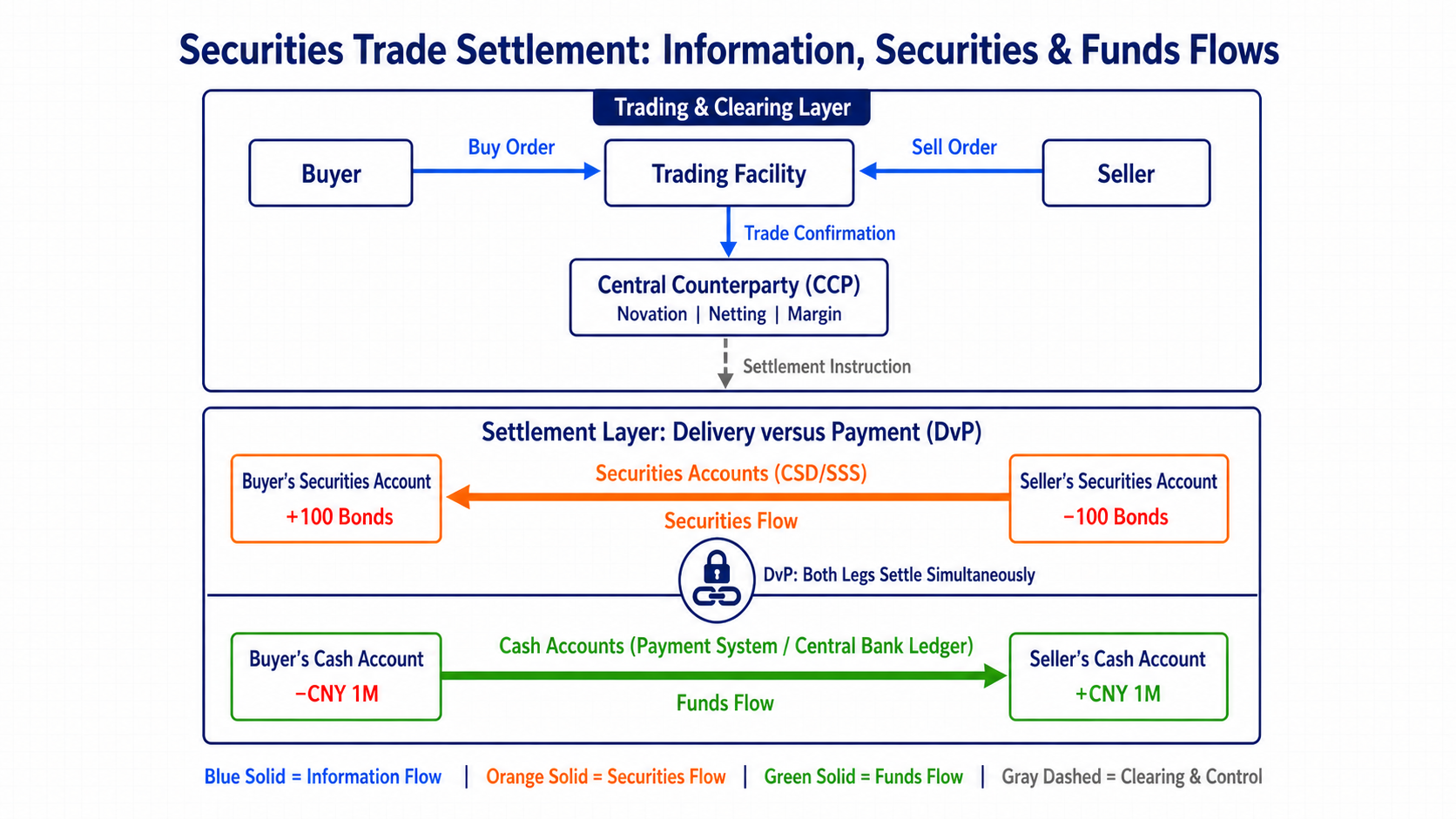
Assume an institution purchases a batch of bonds for 1 million yuan. The complete transaction lifecycle can be simplified as:
| Stage | Primary Function | Typical Participant or Infrastructure |
|---|---|---|
| Trade execution | Matching buy and sell intentions, forming a transaction | Exchanges, trading platforms, market makers |
| Trade confirmation | Verifying price, quantity, account, and settlement information | Trade confirmation or matching systems |
| Clearing | Calculating each party's obligations, potentially conducting netting and central clearing | Clearing institutions, CCPs |
| Securities delivery | Transferring securities from the seller's securities account to the buyer's | CSD, SSS |
| Fund settlement | Transferring funds from the buyer's funds account to the seller's | Payment systems, settlement banks |
| Registration and safekeeping | Maintaining securities issuance, balances, and entitlement records | CSD |
| Trade reporting | Retaining transaction data and providing regulatory information | TR or regulatory reporting systems |
A stock or bond "trade" only means that a buyer and seller have formed a transaction. Whether the buyer has actually acquired the securities and the seller has received final funds depends on the subsequent clearing and settlement arrangements.
What Does a Central Counterparty Change?
Once a trade enters central counterparty clearing, the CCP interposes itself into the original transaction relationship.
It can multilaterally net multiple purchases and sales from the same participant, reducing the final quantity of securities and funds that must be delivered.
At the same time, the CCP begins to assume the risk of participant default. It must therefore collect margin, manage collateral, conduct stress testing, and establish default funds and recovery tools.
CCPs can improve market standardization and risk management efficiency, but they themselves also become highly concentrated risk nodes.
Why Is DvP Important?
Securities settlement typically employs delivery versus payment, commonly abbreviated as DvP.
DvP is not merely "the buyer pays, and the seller delivers." It requires securities delivery and fund payment to be linked: the securities leg completes only if the funds leg completes, and vice versa.
| Participant | Securities Change | Fund Change |
|---|---|---|
| Buyer | Bonds increase | Decrease of 1 million yuan |
| Seller | Bonds decrease | Increase of 1 million yuan |
Foreign exchange settlement uses a similar arrangement called payment versus payment (PvP): one currency is finally paid only if the other currency can also be finally paid.
These two examples—payments and securities—illustrate that financial infrastructure must not only process transactions but also organize information confirmation, obligation calculation, risk management, and final delivery into a set of executable institutional processes.
VI. The Core of PFMI Is Risk Control
The PFMI comprises 24 principles and defines five responsibilities for central banks, market regulators, and other relevant authorities.
These 24 principles form a governance framework covering all aspects of financial market infrastructure operations, with a scope broader than technical security standards.
| Risk Area | Key Requirements |
|---|---|
| Legal and governance | Clarifying legal basis, governance structure, and a comprehensive risk management framework |
| Credit and liquidity | Managing credit exposure, collateral, margin, and liquidity needs |
| Settlement | Specifying finality, settlement assets, and DvP or PvP mechanisms |
| Default management | Establishing participant default rules, resource arrangements, and resolution procedures |
| Business risk | Managing general business risk, custody risk, and investment risk |
| Operational risk | Establishing information security, capacity, business continuity, and recovery capabilities |
| Access and link | Managing participant access, tiered participation, and system link risk |
| Efficiency and transparency | Improving transparency of rules, fees, data, and risk information |
| Recovery and exit | Maintaining critical services after material losses or achieving orderly exit |
1. Credit Risk
A participant may be unable to fulfill an obligation to pay or deliver that has already arisen.
In a net settlement system, the default of one participant may force the system to recalculate the original netting results. In a CCP framework, a default may consume margin, default funds, and other mutualized resources.
2. Liquidity Risk
A participant may be solvent yet unable to obtain sufficient settlement funds or deliverable securities within the required timeframe.
When liquidity is insufficient, payments may queue, securities may fail to settle, and institutions may even be forced to sell assets under duress.
Real-time gross settlement reduces credit risk but may increase intraday liquidity needs. To address this, relevant systems often provide:
- Payment queue management;
- Payment priority mechanisms;
- Liquidity-saving algorithms;
- Collateralized financing arrangements;
- Central bank intraday liquidity support.
3. Principal Risk
One party has irrevocably delivered assets while the other has not completed the corresponding delivery. DvP and PvP are infrastructure arrangements designed to control this risk.
4. Custody and Investment Risk
Financial market infrastructures may hold participants'cash, margin, securities, or other collateral.
If these assets are not effectively segregated, or are invested in high-risk, illiquid assets, the infrastructure's own operational problems can transmit to participants.
5. Operational and Cyber Risk
Financial market infrastructure business is highly concentrated. Software defects, cyberattacks, data corruption, capacity shortfalls, or third-party service disruptions can all have market-wide impact.
A high system availability rate does not by itself indicate adequate operational resilience. Regulators will further probe:
- How quickly can the system recover after a failure?
- Can it recover to an accurate transaction state?
- Are there geographically dispersed and heterogeneous backups?
- Can participants connect through alternative channels?
- How is duplicate payment prevented during recovery?
- Can the last final transaction be accurately identified?
6. Interconnection and Concentration Risk
Modern financial market infrastructures do not operate in isolation.
A CCP may depend on settlement banks, CSDs, payment systems, market data services, cloud platforms, and identity authentication services. When one infrastructure fails, the impact is likely to propagate through these connections to other infrastructures.
Systemic risk can lurk both within a single node and in the dependencies between nodes.
This is also a fundamental proposition of the PFMI: the more transactions and risks an infrastructure aggregates, the harder it becomes for any single institution to bear the impact of a failure alone.
Evaluating an infrastructure cannot rely solely on processing speed, transaction capacity, or average availability; it must also consider whether the infrastructure can continue to provide critical services under extreme but plausible stress scenarios.
VII. China's Practical Arrangements for Financial Infrastructure
China does not have a single financial infrastructure that handles all business. Markets for payments, securities, bonds, foreign exchange, bills, derivatives, and credit reporting each have their own systems and institutions.
1. Payment Infrastructure
The PBC payment systems include:
- The High Value Payment System (HVPS);
- The Bulk Electronic Payment System (BEPS);
- The Internet Banking Payment System (IBPS);
- The China Foreign Exchange Payment System (CFXPS).
China's payment system also includes:
- China UnionPay's cross-bank payment system;
- NetsUnion Clearing Platform;
- The Cross-Border Interbank Payment System (CIPS);
- City Commercial Bank Clearing Center payment and clearing systems;
- Rural Credit Banks payment and clearing systems, among others.
The payment system operating data released by the PBC reports separately on each of these systems. This also demonstrates that the "national payment system" is not a single monolithic system. PBC Overall Operation of the Payment System in Q1 2025
Their respective responsibilities are not identical:
- The Huge Value Payment System focuses on large-value interbank fund transfers and settlement of related financial markets;
- The Bulk Electronic Payment System handles batch and retail cross-bank payments;
- The Internet Banking Payment System supports cross-bank online payments and related services;
- UnionPay and NetsUnion each play important roles in card-based clearing and online payment clearing for non-bank payment institutions, respectively;
- CIPS primarily serves cross-border RMB payment and settlement needs.
2. Securities and Other Financial Market Infrastructure
In the capital markets and the interbank market, the principal infrastructure arrangements include:
- The Shanghai, Shenzhen, and Beijing Stock Exchanges;
- China Securities Depository and Clearing Corporation Limited;
- China Central Depository & Clearing Co., Ltd.;
- Shanghai Clearing House;
- Shanghai Commercial Paper Exchange Corporation;
- China Foreign Exchange Trade System;
- Shanghai Gold Exchange;
- Related trade reporting and market data facilities.
The functions of these institutions and infrastructures do not map to one another in a simple one-to-one relationship.
The same operating institution may simultaneously handle registration and safekeeping, clearing, settlement, or central counterparty business. A single transaction may also need to pass through a trading platform, CCP, CSD, payment system, and settlement bank before it is fully completed.
To understand China's financial infrastructure, it is best to examine it at three levels:
| Level | What to Observe |
|---|---|
| Legal entity level | Which institution is responsible for operation? |
| System level | Which specific system processes the transaction? |
| Functional level | What responsibilities does the system assume in the transaction lifecycle? |
Classifying only by institution name obscures situations where a single institution operates multiple systems; focusing only on technical systems risks overlooking the legal entity, business rules, and risk responsibilities behind them.
VIII. How Do Major Global Economies Arrange Financial Infrastructure?
All economies must accomplish payment, clearing, settlement, registration, and risk management, but differing monetary systems, market structures, legal traditions, and regulatory frameworks produce different specific arrangements.
1. The United States: Coexistence of Public Infrastructure and Market-Based Operation
In the U.S. large-value dollar payment system, the Fedwire Funds Service is owned and operated by the Federal Reserve Banks and is a real-time gross settlement system that settles in central bank money.
Once processed by the system, payments create final and irrevocable fund transfers on Federal Reserve accounts. Federal Reserve Financial Services: Fedwire Funds Service
CHIPS is operated by The Clearing House and processes high-value dollar payments using continuous intraday settlement and liquidity-saving mechanisms.
This arrangement demonstrates that high-value payments do not only follow the traditional RTGS model. Payment matching, queueing, and netting algorithms can also reduce liquidity consumption while preserving finality. The Clearing House: CHIPS
When discussing the U.S. securities market, "DTCC" as a whole should not be treated as a single type of infrastructure:
- DTC is a central securities depository and also provides securities settlement services;
- NSCC provides central counterparty services for major U.S. equity and other trades;
- FICC performs clearing functions for government securities and mortgage-backed securities markets.
Under one corporate brand, there can be multiple legal entities performing different FMI functions. DTCC: Clearing & Settlement Services
2. Europe: Cross-Border Integration Under a Single Currency
The euro area faces a distinctive challenge: a single currency, but markets, legal systems, and financial institutions distributed across multiple countries.
TARGET Services include:
- T2, for payment settlement;
- T2S, for securities settlement;
- TIPS, for central bank money settlement of instant payments;
- ECMS, for Eurosystem collateral management.
These services bring funds, securities, and collateral management into a more unified cross-border framework. European Central Bank: TARGET Services
At the same time, Europe still has Euroclear, Clearstream, national CSDs, and multiple CCPs.
Europe has not centralized all functions at the European Central Bank. Instead, public settlement infrastructure, cross-border market infrastructure, and member state legal systems operate in tandem.
3. Hong Kong: Multicurrency and Cross-Border Connectivity
As an international financial center, Hong Kong must simultaneously handle the Hong Kong dollar, U.S. dollar, euro, RMB, and other currencies, while also connecting payment and securities infrastructure across different regions.
Hong Kong's financial infrastructure includes:
- Multicurrency RTGS systems;
- The Central Moneymarkets Unit (CMU) for debt instruments;
- The Hong Kong Trade Repository (HKTR);
- Clearing and settlement systems for the securities market.
Hong Kong uses DvP, PvP, and cross-border system linkages to reduce settlement risk across different currencies and asset markets.
The HKMA's 2025 annual report shows that the four interbank RTGS systems, the CMU, and the HKTR together form the territory's multicurrency, multi-dimensional payment and settlement platform. Hong Kong Monetary Authority 2025 Annual Report
What Should Truly Be Compared Across Different Systems?
| Market | Main Structural Characteristics |
|---|---|
| China | Central bank payment infrastructure plays a core role; financial market infrastructure is built in layers by market segment |
| United States | Public-sector settlement systems coexist with market-operated clearing institutions |
| Europe | Unified currency infrastructure operates alongside member-state market systems |
| Hong Kong | Emphasizes multicurrency settlement, DvP, PvP, and cross-border connectivity |
There is no single global model for organizing financial infrastructure.
When comparing across markets, rather than matching institution names, it is more instructive to examine how each jurisdiction addresses the following issues:
- Settlement finality;
- Use of central bank money;
- Credit and liquidity risk;
- Participant default;
- Cross-border legal conflicts;
- Interconnections between infrastructures;
- Division of responsibilities between the public and private sectors.
IX. How Will the Latest Fintech Developments Change Financial Infrastructure?
Financial infrastructure traditionally relied on batch processing, closed private networks, and distributed databases. Today it is extending operating hours, introducing standardized messaging, API connectivity, real-time processing, shared data environments, and programmable settlement.
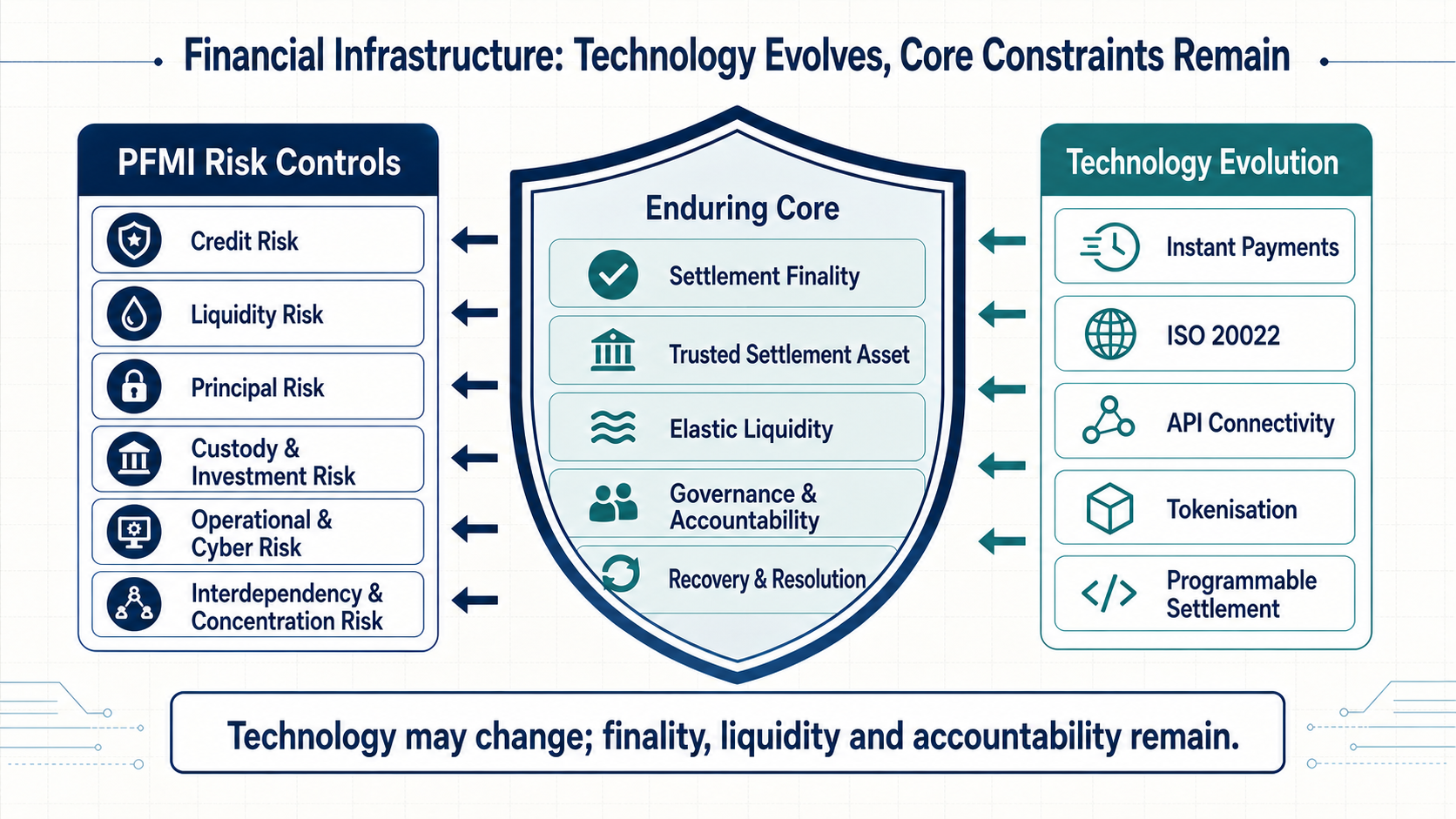
Technology is changing, but the fundamental problems that financial infrastructure must address have not disappeared—they have simply appeared in new forms.
1. Real-Time Payments Are Reshaping Liquidity Management
Retail payments are shifting from "next-day crediting" to 7×24 real-time processing, and back-end settlement must also adapt to longer operating hours.
If retail payments operate in real time around the clock while interbank settlement systems close at night or on weekends, financial institutions must make separate arrangements for pre-funding, credit lines, and liquidity.
What users experience is faster payments. For financial institutions, liquidity management, fraud control, exception handling, and business continuity must all be adjusted accordingly.
2. ISO 20022 and APIs Improve Information Flow but Do Not Directly Create Finality
Structured messaging improves automation levels, reduces manual repair and reconciliation costs, and provides richer data for compliance screening and regulatory analysis.
However, messaging standards themselves cannot answer these questions:
- Where are the funds held;
- Who bears the credit risk;
- When a payment becomes irrevocable;
- How participant defaults are handled.
Upgrading the communication layer must be coordinated with the account layer, the settlement layer, and legal rules.
3. Tokenisation May Recombine the Transaction Lifecycle
In traditional architectures, trade execution, information transmission, clearing, reconciliation, and settlement are typically distributed across different systems.
Tokenisation and programmable platforms may place asset records, transaction conditions, and transfer logic within the same environment, reducing duplicate reconciliation and supporting atomic settlement and automated execution.
BIS and CPMI research in 2024 specifically noted that the risks faced by traditional financial market infrastructures will also appear in tokenised arrangements, albeit potentially in different forms. Governance, risk management, settlement assets, and the design of central bank wholesale payment systems remain issues to be resolved. BIS-CPMI: Tokenisation in the context of money and other assets
Atomic settlement also has costs.
Synchronizing the completion of every transaction reduces principal risk but may require participants to prefund more funds and assets. Without liquidity saving, collateralized financing, and elastic liquidity supply, instant settlement could instead reduce market liquidity.
4. Digital Assets May Have Similar Technical Forms but Different Legal Characteristics
| Digital Asset | Primary Claim of the Holder | Main Credit Source |
|---|---|---|
| Central bank digital currency or tokenised reserves | Central bank | Sovereign currency and the central bank's balance sheet |
| Tokenised bank deposits | Commercial bank | Bank balance sheet, prudential regulation, and deposit system |
| Fiat-referenced stablecoins | Stablecoin issuer or related arrangement | Reserve assets, redemption commitment, and governance mechanism |
| Tokenised securities | Security issuer or underlying asset arrangement | Issuer credit, asset rights, and securities law |
These assets may adopt similar technical forms, yet they represent different legal claims, with different liquidity, credit, and resolution mechanisms.
The BIS Annual Economic Report 2026 further emphasizes that whether technological innovation improves the monetary and financial system still depends on singleness of money, interoperability, elastic liquidity supply, financial integrity, and credible final settlement arrangements.
Distributed ledgers can reduce reconciliation work and support programmable processes, but they may also introduce network fragmentation, bridge risk, and new governance issues. BIS Annual Economic Report 2026: Anchoring trust in money
Blockchain will change how ledgers are organized, how participants collaborate, and may recombine the transaction lifecycle. Nevertheless, clearing, settlement, governance, and risk management still require accountable parties.
Conclusion: Technology Can Rebuild the Roads, but It Cannot Abolish the Traffic Rules
End users rarely notice financial infrastructure, yet the financial system can hardly function without it.
It enables different institutions to exchange funds and assets under common rules, and it concentrates transaction, credit, and liquidity risks—which were previously dispersed—onto a small number of critical nodes. For this reason, financial infrastructure must not only improve market efficiency but also be subject to rigorous risk management and public regulation.
The PFMI identifies systemically important financial market infrastructures across five functions: payment systems, CSDs, SSSs, CCPs, and TRs. China's framework, by contrast, brings financial asset registration and safekeeping, clearing and settlement, trading facilities, trade repositories, important payment systems, and basic credit information systems into its domestic regulatory scope.
The two frameworks operate at different levels:
- The PFMI focuses on what functions an infrastructure performs and what risks may arise;
- China's framework goes further to specify which systems are subject to regulation, who regulates them, and how access, operation, recovery, and exit are managed.
Real-time payments, CBDC, tokenised deposits, stablecoins, and blockchain may rearrange transaction flows and may even bring previously dispersed trading, clearing, and settlement functions onto a single platform.
Regardless of the technological form, evaluating a new type of financial infrastructure still requires answering the following questions:
- Who maintains the ledger?
- What legal rights do the ledger records represent?
- What is the final settlement asset?
- When does a transaction achieve legal finality?
- Who provides liquidity in normal times and under stress?
- Who bears losses when a participant defaults?
- How does the system connect with other infrastructures?
- Who has the authority to modify rules and handle emergencies?
- How does the system recover an accurate transaction state after disruption?
- Can regulators obtain complete, accurate, and aggregateable data?
Without clear answers to these questions, a faster system, a better interface, or newer technology cannot by itself establish that it is a safer financial infrastructure.
Future financial assets may appear as account balances or as digital tokens; the underlying ledger may use a centralized database or a distributed ledger. Whichever form is adopted, financial infrastructure cannot escape several fundamentals:
Who keeps the books?
Who bears the credit?
Who provides liquidity?
What assets are used for settlement?
When is a transaction finally complete?
And when failures or defaults occur, who is responsible for restoring the system?
Technology can rebuild the roads of the financial market, but traffic rules, responsibility boundaries, and final adjudication mechanisms will not disappear as a result.
Originally published by Luminale Fintech Observer: https://luminale.cn/articles/financial-infrastructure-overview-en