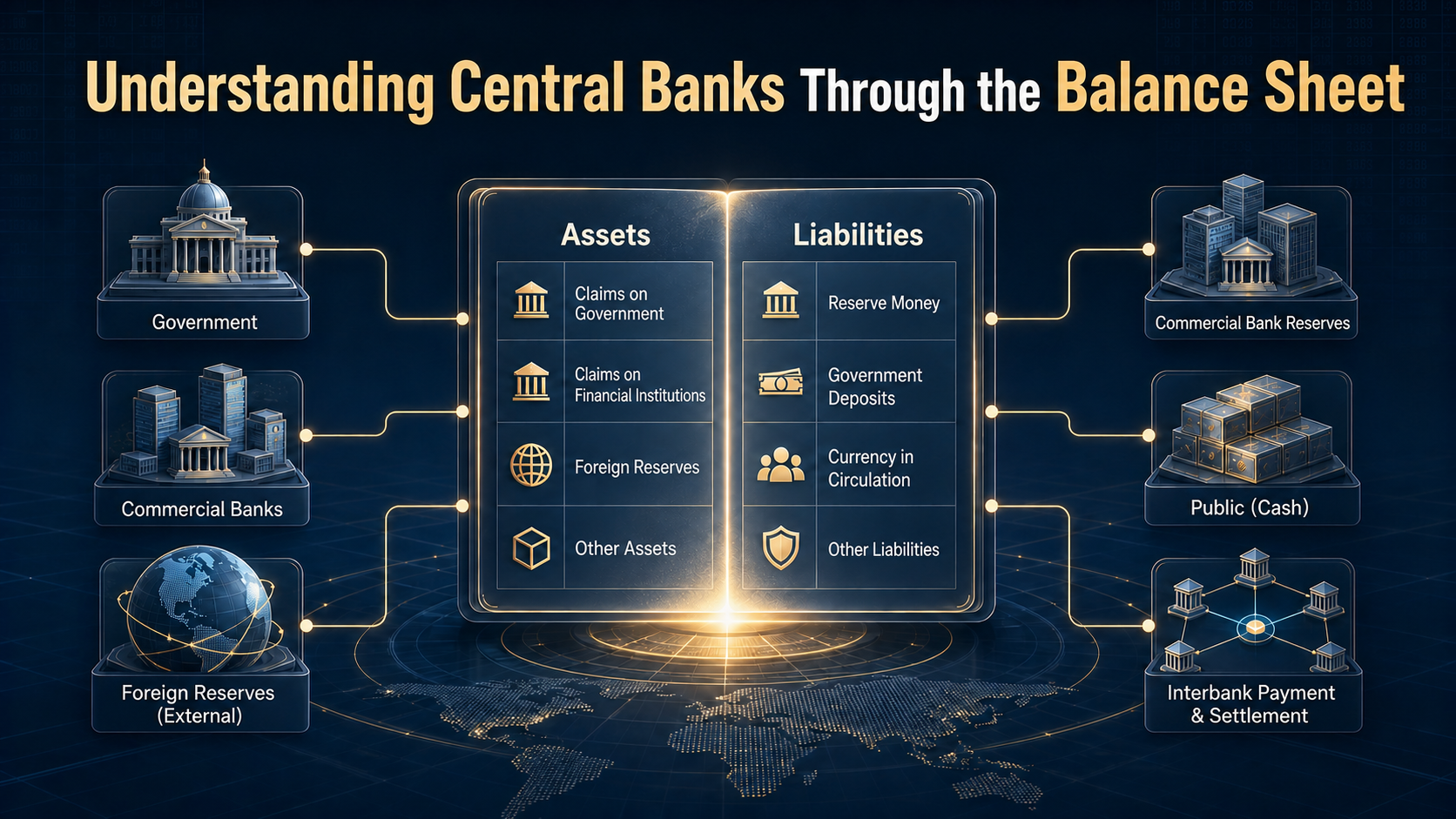
If we only view the central bank as "the institution that issues currency," many questions become difficult to explain: Why does it hold foreign exchange and government bonds? Why do commercial banks need to open accounts at the central bank? What is the relationship between open market operations, fiscal expenditure, interbank settlement, and the lender of last resort function?
All of these operations ultimately land on the same statement: the central bank balance sheet.
This statement records not only how many assets and liabilities the central bank has, but also the creditor-debtor relationships between the central bank and commercial banks, the government, the public, the external sector, and financial markets. Purchasing assets, extending loans, fiscal receipts and payments, cash issuance, and interbank settlement are all reflected as changes in account balances.
When reading this balance sheet, don't rush to memorize the items. For each asset or liability you see, you can first ask three questions:
- Whom does this asset or liability connect to?
- Through what transaction was it created?
- When the transaction occurs, how does the other side of the balance sheet change?
Currency issuance, final settlement, liquidity management, foreign exchange reserve management, and the lender of last resort function can all be connected along these three questions.
1. Why Must We Look at the Central Bank's Balance Sheet First to Understand It?
Like an ordinary enterprise, the central bank follows the accounting identity "Assets = Liabilities + Owner's Equity." But part of the central bank's liabilities are themselves money, sitting at the top of the monetary system.
For an ordinary enterprise, liabilities usually mean that money must be repaid in the future; the cash issued by the central bank is itself legal tender, while the reserves that commercial banks hold at the central bank are assets used for final settlement between banks.
A highly simplified central bank balance sheet can be written as:
| Assets | Liabilities and Capital |
|---|---|
| Foreign assets | Currency issued |
| Claims on government | Commercial bank reserves |
| Claims on commercial banks and other financial institutions | Government deposits |
| Other assets | Other liabilities |
| Capital and reserves |
The asset side answers: To whom has the central bank extended credit, or what assets has it obtained in exchange for its own liabilities issued? The liability side answers: Who holds claims on the central bank, and which of these claims have monetary or final settlement attributes?
For example, when the central bank purchases foreign exchange, foreign assets increase on the asset side; when the central bank provides loans to commercial banks, claims on banks increase on the asset side and the reserves of those banks increase on the liability side; when the government deposits funds at the central bank, this creates a central bank liability to the government. When commercial banks absorb public deposits, the reserves they are required to deposit according to regulatory requirements are also recorded on the central bank's liability side.
Therefore, this is not an isolated financial statement but a map of financial relationships.
Using the People's Bank of China's Statement as an Example
The "Balance Sheet of the Monetary Authority" published by the People's Bank of China (PBC) is more detailed than the simplified table above. Taking the statement at the end of July 2026 as an example, the main items include:
| Assets | Liabilities and Own Funds |
|---|---|
| Foreign assets | Reserve money |
| Claims on government | Deposits of financial companies not included in reserve money |
| Claims on other depository corporations | Bond issuance |
| Claims on other financial corporations | Foreign liabilities |
| Claims on non-financial sectors | Government deposits |
| Other assets | Own funds |
| Other liabilities |
People's Bank of China, "Balance Sheet of the Monetary Authority (2026)"
In this article, this statement is mainly used to illustrate the items. When comparing the central banks of other countries, one must first confirm the statistical entity and accounting scope, and then trace the transactions corresponding to each asset and liability.
2. First Look at the Asset Side: What Does the Central Bank Hold?
Central bank assets are not an investment portfolio configured by an ordinary enterprise to earn commercial profits. Different assets correspond respectively to monetary policy, financial stability, foreign exchange reserves, government financial relationships, and banking system liquidity management.
When reading the asset side, the question can be put more directly: To whom has the central bank provided money or credit, and what assets has it obtained in return?
2.1 Foreign Assets: The Central Bank's Connection to the External Monetary System
Foreign assets typically include foreign exchange, monetary gold, claims on international financial institutions, and other overseas assets. They are related to international reserves, cross-border payments, the foreign exchange market, and exchange rate policy.
Suppose the central bank purchases foreign exchange worth RMB 10 billion from a commercial bank. The most simplified bookkeeping result is:
| Central Bank Assets | Change | Central Bank Liabilities | Change |
|---|---|---|---|
| Foreign assets | +RMB 10 billion | Bank reserves | +RMB 10 billion |
The central bank obtains foreign exchange assets, and the commercial bank's account at the central bank increases by RMB 10 billion in reserves. The commercial bank's assets then undergo a transformation:
| Commercial Bank Assets | Change | Commercial Bank Liabilities | Change |
|---|---|---|---|
| Foreign exchange assets | −RMB 10 billion | — | — |
| Central bank reserves | +RMB 10 billion | — | — |
If the seller of the foreign exchange is an enterprise, there is an additional layer: the enterprise sells foreign exchange to a commercial bank, and the commercial bank increases the enterprise's RMB deposits; the central bank then purchases the foreign exchange from the commercial bank and increases that bank's reserves. The commercial bank holds central bank reserves, while the enterprise holds commercial bank deposits.
The RMB book value of foreign assets is also affected by exchange rate conversion and asset valuation, so changes in the balance do not come only from foreign exchange buying and selling.
2.2 Claims on Government: Government Debt Instruments Held by the Central Bank
When the central bank holds government bonds, this forms a claim on the government, listed on the asset side. Suppose the central bank purchases RMB 10 billion of government bonds from commercial banks:
| Central Bank Assets | Change | Central Bank Liabilities | Change |
|---|---|---|---|
| Claims on government | +RMB 10 billion | Bank reserves | +RMB 10 billion |
| Commercial Bank Assets | Change | Commercial Bank Liabilities | Change |
|---|---|---|---|
| Government bonds | −RMB 10 billion | — | — |
| Central bank reserves | +RMB 10 billion | — | — |
The commercial bank has exchanged government bonds for central bank reserves. Two things must be distinguished here: when the central bank holds government bonds, the central bank has a claim on the government; when the government deposits money at the central bank, the government has a claim on the central bank. One is on the asset side, the other on the liability side.
The Law of the People's Bank of China stipulates that the central bank shall not overdraw the government's fiscal account, nor may it directly subscribe to, underwrite, or purchase treasury bonds and other government bonds; however, for the purpose of implementing monetary policy, it may buy and sell treasury bonds, other government bonds, financial bonds, and foreign exchange in the open market. Therefore, the central bank holding government bonds cannot be directly equated with the central bank directly financing the fiscal authorities. Interpretation of Article 29 of the Law of the People's Bank of China
2.3 Claims on Commercial Banks and Other Financial Institutions: The Record of Central Bank Liquidity Provision
Relending, rediscounting, repurchase operations, and other liquidity tools cause the central bank to form claims on financial institutions on the asset side.
Suppose the central bank provides RMB 10 billion in financing to commercial banks:
| Central Bank Assets | Change | Central Bank Liabilities | Change |
|---|---|---|---|
| Claims on banks | +RMB 10 billion | Bank reserves | +RMB 10 billion |
| Commercial Bank Assets | Change | Commercial Bank Liabilities | Change |
|---|---|---|---|
| Central bank reserves | +RMB 10 billion | Liabilities to central bank | +RMB 10 billion |
The central bank does not carry batches of banknotes into commercial banks; instead, it increases reserve balances in the account system; the commercial bank simultaneously recognizes a financing liability to the central bank. When the loan matures and is repaid, the two directions reverse:
| Central Bank Assets | Change | Central Bank Liabilities | Change |
|---|---|---|---|
| Claims on banks | −RMB 10 billion | Bank reserves | −RMB 10 billion |
When loans are created, reserves increase; when loans are repaid, reserves are withdrawn. In the PBC's statement, "Claims on other depository corporations" mainly reflects claims on banking depository institutions; "Claims on other financial corporations" corresponds to other financial institutions. The names of the instruments may differ, but the account relationships are the same.
2.4 Other Assets: A Summary Item
"Other assets" accommodates items that cannot be classified into foreign assets, claims on government, claims on financial institutions, and other categories. It is a summary item and does not represent a unified economic relationship, so this article will not elaborate on it.
3. Now Look at the Liability Side: Who Holds Central Bank Liabilities?
The central bank's liability side records the claims that different entities hold against the central bank. Some liabilities are money, some are used for payments and final settlement, and others are merely account balances held at the central bank by the government, foreign institutions, or financial institutions.
Therefore, "central bank liabilities" and "base money" (基础货币) are not the same concept. One must first look at the holder, and then determine whether this liability is included in base money and for what purposes it can be used.
3.1 Currency Issued: Cash Issued by the Central Bank
Cash is an asset to the holder and a liability to the central bank that issued it. Under a credit money system that is not convertible into gold, cash itself is the final payment instrument circulating at face value, and it does not mean that the holder can require the central bank to redeem it with another asset.
The PBC balance sheet uses the item "currency issued" , while money supply statistics use "currency in circulation M0." "Currency issued" includes issued banknotes, part of which remains in the cash vaults of commercial banks; M0 mainly refers to cash held by the public outside the banking system and circulating in society.
Currency issued = cash in circulation + banknotes such as bank vault cash that have not yet entered public circulation.
When residents withdraw cash, bank deposits decrease and cash held by the public increases. The central bank's total assets usually do not increase as a result; rather, bank reserves within central bank liabilities are converted into currency issued.
3.2 Deposits of Financial Institutions: The Account Foundation of Reserves
Commercial banks and other depository financial institutions open accounts at the central bank. For banks, the account balance is an asset; for the central bank, it is a liability. The balances used for reserve requirements, interbank payment settlement, and liquidity management are commonly referred to as bank reserves.
Suppose a customer of Bank A pays RMB 1 million to a customer of Bank B, ignoring intermediate clearing and netting:
| Central Bank Liability Accounts | Change |
|---|---|
| Bank A reserves | −RMB 1 million |
| Bank B reserves | +RMB 1 million |
| Total central bank liabilities | Unchanged |
| Commercial Bank Liability Accounts | Change |
|---|---|
| Bank A: payer's deposit | −RMB 1 million |
| Bank B: payee's deposit | +RMB 1 million |
What is transferred between customers is commercial bank deposits; what is transferred between banks is central bank reserves. Payment is the overall process of value transfer; clearing is responsible for transmitting and verifying instructions and determining amounts receivable and payable; settlement is the final discharge of creditor-debtor obligations. The transfer of reserves corresponds to the final settlement layer between banks, while customer payments have already been recorded in the banks'internal books.
The PBC undertakes by law the responsibility of maintaining the normal operation of payment and clearing systems, which is also the institutional foundation of the central bank as the "bank of banks." Interpretation of Article 4 of the Law of the People's Bank of China
3.3 Customer Reserve Funds Deposited by Payment Institutions
"Deposits of non-financial institutions" in the PBC's statement refers to customer reserve funds deposited by payment institutions. When customers top up funds into non-bank payment accounts such as WeChat Pay wallets or Alipay wallets, the related customer reserve funds are centrally deposited with the PBC according to regulatory requirements, and this balance is recorded on the liability side.
Three levels must be distinguished here: users hold payment account balances recorded by payment institutions; payment institutions bear the obligations of redemption and payment services; and the centrally deposited customer reserve funds appear as PBC liabilities. Ordinary enterprises cannot directly open reserve accounts at the PBC. "Deposits of non-financial institutions" is an item name in the statistical statement, not a central bank deposit product available to the general public.
3.4 What Is Reserve Money in the PBC's Statement?
Reserve money in the PBC's statement consists of three categories:
| Components of Reserve Money | Meaning of the Item |
|---|---|
| Currency issued | Banknotes issued by the central bank, including cash in social circulation and bank vault cash |
| Deposits of financial companies | Account balances of financial institutions held at the central bank, of which the relevant balances of depository companies constitute bank reserves |
| Deposits of non-financial institutions | Customer reserve fund deposits that payment institutions have deposited with the PBC |
The three categories are not the same type of account and are not held by the same type of entity: cash can be held by the public and banks; reserves are mainly held by financial institutions eligible for central bank accounts; and customer reserve funds are centrally deposited by payment institutions according to regulatory arrangements. Together they form an important part of the central bank's liability side with base money or basic payment attributes, but their usage rights and legal relationships differ.
3.5 Government Deposits: Fiscal Funds in the Central Bank's Account
When the government deposits fiscal funds at the central bank, it is an asset to the government and a liability to the central bank. Fiscal receipts and payments change the relationship between government deposits, bank reserves, and deposits of enterprises and residents.
Suppose the government pays RMB 10 billion to an enterprise that has an account at a commercial bank:
| Central Bank Liabilities | Change |
|---|---|
| Government deposits | −RMB 10 billion |
| Commercial bank reserves | +RMB 10 billion |
| Total central bank liabilities | Unchanged |
| Commercial Bank Assets | Change | Commercial Bank Liabilities | Change |
|---|---|---|---|
| Central bank reserves | +RMB 10 billion | Enterprise deposits | +RMB 10 billion |
Fiscal expenditure converts central bank liabilities held by the government into reserves held by commercial banks, while simultaneously forming enterprise deposits on the commercial bank's liability side. When taxes are collected, the direction is usually the reverse: taxpayer deposits and bank reserves decrease, and government deposits at the central bank increase.
3.6 Other Central Bank Liabilities
The central bank's liability side may also include deposits of financial institutions not included in reserve money, bonds or bills issued by the central bank, liabilities to foreign institutions, corresponding liabilities formed by the allocation of IMF Special Drawing Rights, other liabilities, capital, reserves, and revaluation accounts. Not all of these items have monetary attributes, and the scope of base money must be confirmed according to each country's statistical system.
4. Why Do the Balance Sheets of the PBC, the Fed, and the Eurosystem Differ?
Different countries have different financial structures, exchange rate regimes, fiscal systems, and monetary policy instruments, so the items on central bank balance sheets naturally will not be exactly the same.
4.1 People's Bank of China: Foreign Assets and Claims on Banks Have Important Positions
The PBC's asset side includes foreign assets, and it also records financing to the banking system through items such as "Claims on other depository corporations." Foreign exchange assets and foreign exchange purchases were once an important channel for base money injection, while financing operations and liquidity operations for commercial banks are part of modern monetary policy implementation. Customer reserve funds centrally deposited by payment institutions are classified under "Deposits of non-financial institutions" within reserve money, which makes the relationship between the non-bank payment system and the central bank directly reflected on the statement.
4.2 Federal Reserve: Treasury Securities and Agency Mortgage-Backed Securities Are the Main Assets
The Fed's asset side mainly includes U.S. Treasury securities, federal agency bonds, and agency mortgage-backed securities (MBS) held in the System Open Market Account. Discount window loans, repurchase operations, central bank liquidity swaps, and other credit facilities also create assets, and their size changes with policy and market conditions.
The liability side mainly includes Federal Reserve notes in circulation, reserve balances of depository institutions, the U.S. Treasury General Account (TGA), liabilities formed by policy operations such as reverse repurchase agreements, and other deposits and liabilities. When the Fed purchases securities, securities assets and bank reserves usually increase simultaneously; when securities mature and are not reinvested, assets and related liabilities contract.
Compared with the PBC, the prominent feature of the Fed's asset side is not foreign exchange assets but local-currency-denominated government bonds and agency MBS. Its H.4.1 statement presents assets, cash, bank reserves, and Treasury accounts on a consolidated basis for the Federal Reserve Banks. Federal Reserve H.4.1 Balance Sheet
4.3 European Central Bank: Look at the "Eurosystem," Not Just the ECB as a Single Entity
The Eurosystem consists of the European Central Bank (ECB) and the national central banks of all countries that have adopted the euro. Unified monetary policy is decided by the ECB, while many operations are carried out in a decentralized manner by national central banks. Therefore, to understand euro area monetary policy and base money, one should mainly look at the "consolidated balance sheet of the Eurosystem"; intra-system claims and liabilities are offset against each other upon consolidation. ECB: Eurosystem Balance Sheet
The asset side of the Eurosystem mainly includes gold and foreign exchange assets, monetary policy loans to euro area credit institutions, securities held for monetary policy purposes, and other assets. The liability side mainly includes euro banknotes in circulation, current accounts of credit institutions and deposit facility balances, deposits of governments and other euro area entities, liabilities to non-euro area entities, revaluation accounts, capital, and reserves.
At the end of 2025, securities held for monetary policy purposes remained the main category on the asset side of the Eurosystem, including the securities portfolios formed by the Asset Purchase Programme (APP) and the Pandemic Emergency Purchase Programme (PEPP). Eurosystem 2025 Consolidated Balance Sheet
Euro banknote issuance is allocated between the ECB and national central banks according to institutional rules: the ECB bears an 8% accounting share, and the rest is allocated to national central banks according to capital allocation rules. ECB Decision on the Allocation of Euro Banknotes
The three systems can be compared as follows:
| Central Bank System | Prominent Features of the Asset Side | Liabilities and Institutional Particularities |
|---|---|---|
| People's Bank of China | Foreign assets and claims on depository corporations have important positions | Reserve money includes customer reserve funds deposited by payment institutions |
| Federal Reserve | U.S. Treasury securities and agency MBS are the main assets | Bank reserves, Federal Reserve notes, Treasury TGA, and reverse repo liabilities are relatively important |
| Eurosystem | Monetary policy securities, loans to credit institutions, gold and foreign exchange assets coexist | The ECB and national central banks together form the system, with intra-system balances offset upon consolidation |
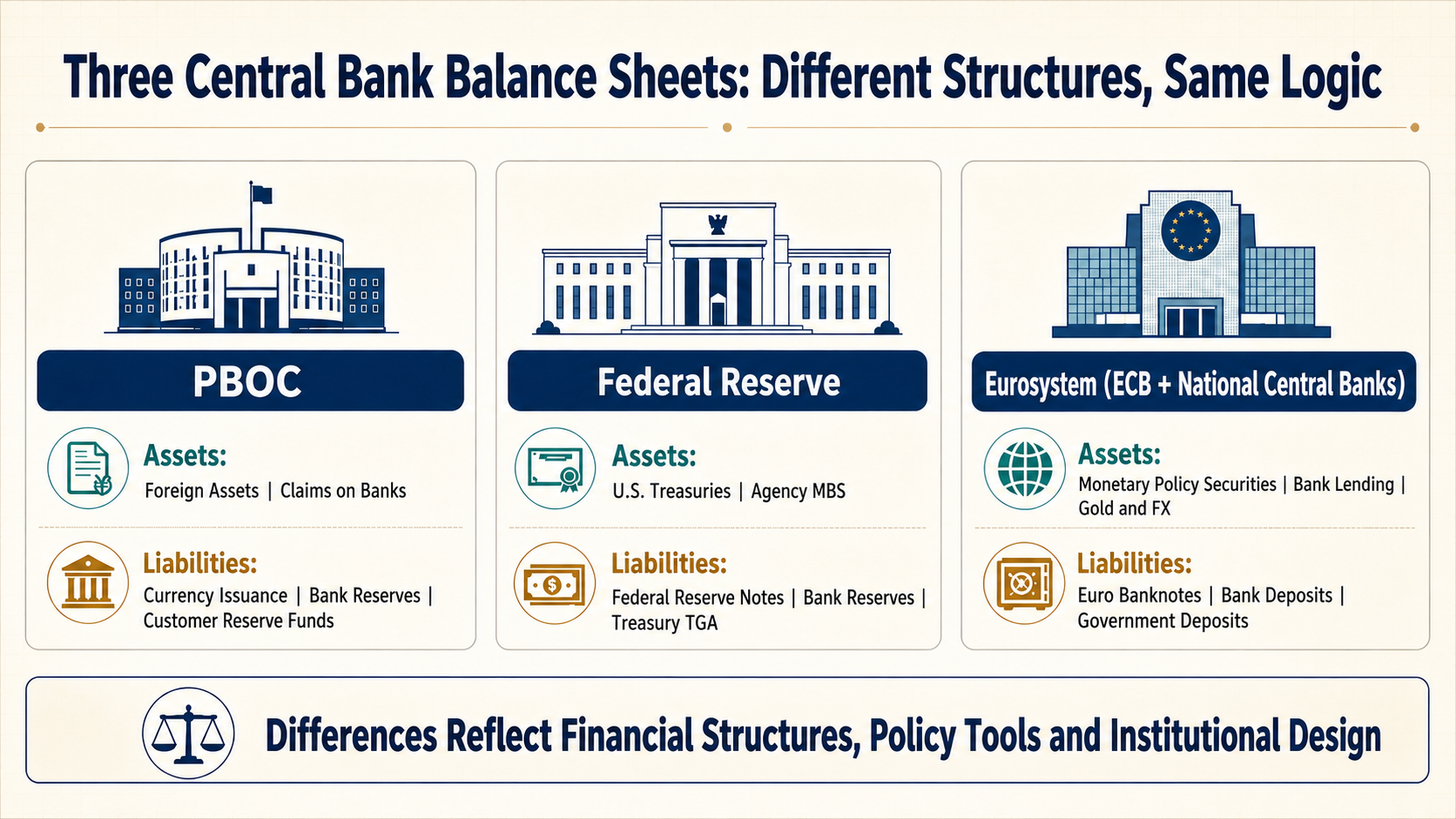
The difference is not about which central bank is "wealthier," but about which assets they use to implement policy and who holds their liabilities.
5. Connecting the Left and Right Sides: How Is Base Money Created and Transformed?
Seeing how a transaction simultaneously changes both the asset side and the liability side is more useful than memorizing item definitions in isolation.
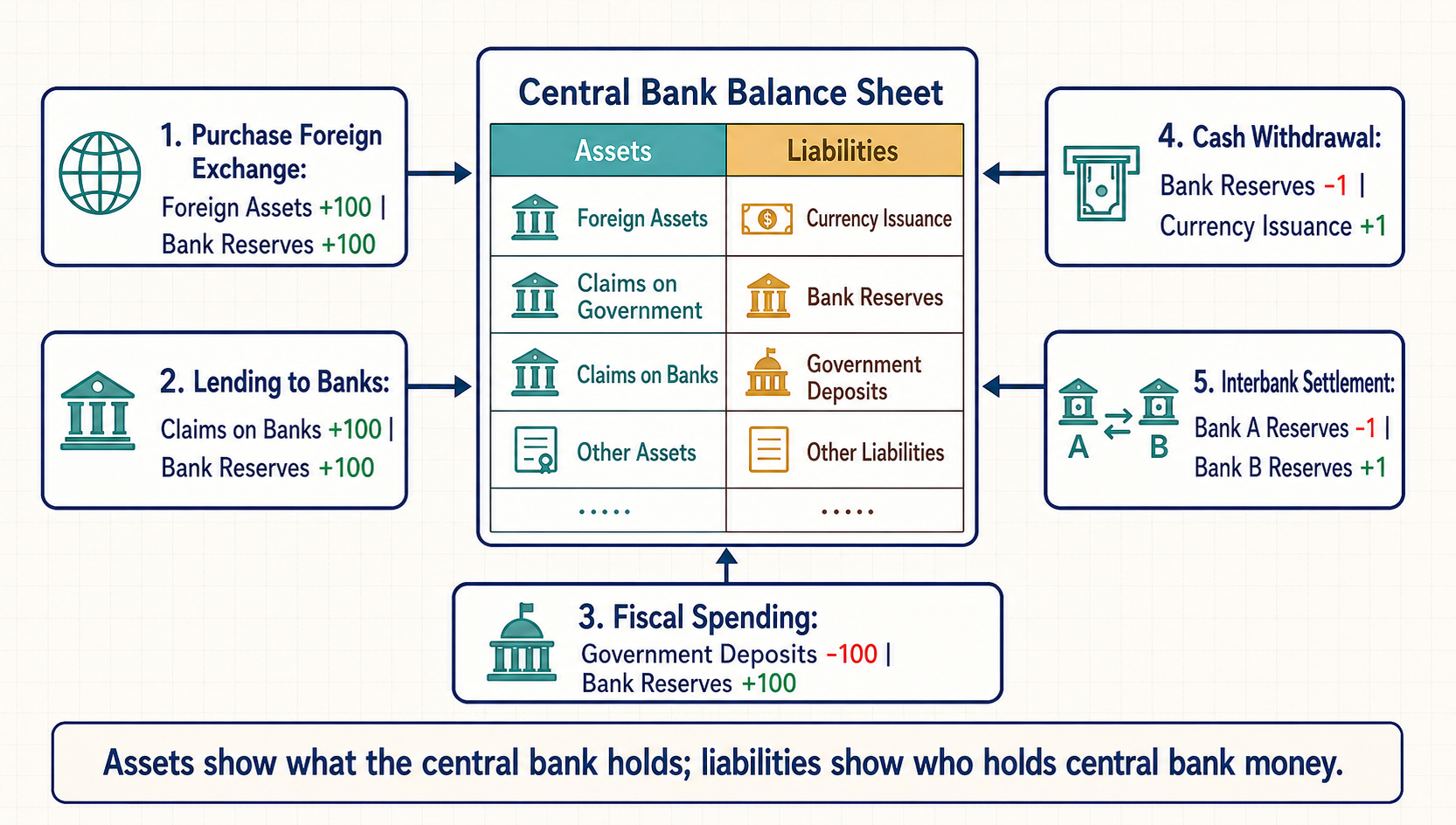
Transaction 1: The Central Bank Purchases Foreign Exchange
| Central Bank Assets | Change | Central Bank Liabilities | Change |
|---|---|---|---|
| Foreign assets | +100 | Bank reserves | +100 |
The central bank obtains foreign exchange assets, the banking system obtains reserves, and both assets and liabilities increase simultaneously.
Transaction 2: The Central Bank Provides Financing to Commercial Banks
| Central Bank Assets | Change | Central Bank Liabilities | Change |
|---|---|---|---|
| Claims on banks | +100 | Bank reserves | +100 |
| Commercial Bank Assets | Change | Commercial Bank Liabilities | Change |
|---|---|---|---|
| Reserves | +100 | Liabilities to central bank | +100 |
The commercial bank obtains central bank liquidity while simultaneously assuming a financing liability.
Transaction 3: The Central Bank Purchases Securities from Commercial Banks
| Central Bank Assets | Change | Central Bank Liabilities | Change |
|---|---|---|---|
| Securities purchased | +100 | Bank reserves | +100 |
| Commercial Bank Assets | Change |
|---|---|
| Securities | −100 |
| Reserves | +100 |
The commercial bank exchanges securities assets for central bank reserves.
Transaction 4: The Central Bank Purchases Securities from a Non-Bank Institution
If the seller has an account at a commercial bank, the bank acts as a payment channel:
| Central Bank Assets | Change | Central Bank Liabilities | Change |
|---|---|---|---|
| Securities purchased | +100 | Commercial bank reserves | +100 |
| Commercial Bank Assets | Change | Commercial Bank Liabilities | Change |
|---|---|---|---|
| Reserves | +100 | Seller's deposits | +100 |
| Non-Bank Seller Assets | Change |
|---|---|
| Securities | −100 |
| Bank deposits | +100 |
When the central bank purchases assets, bank reserves and the non-bank seller's commercial bank deposits both increase.
Transaction 5: Fiscal Expenditure
| Central Bank Liabilities | Change |
|---|---|
| Government deposits | −100 |
| Bank reserves | +100 |
| Total liabilities | Unchanged |
The central bank's total size is unchanged; liabilities shift from government deposits to bank reserves, while the payee's commercial bank deposits increase simultaneously.
Transaction 6: Residents Withdraw Cash
The bank first obtains cash from the central bank:
| Central Bank Liabilities | Change |
|---|---|
| Bank reserves | −RMB 10,000 |
| Currency issued | +RMB 10,000 |
| Total liabilities | Unchanged |
After the resident completes the withdrawal:
| Commercial Bank Assets | Change | Commercial Bank Liabilities | Change |
|---|---|---|---|
| Vault cash | −RMB 10,000 | Resident deposits | −RMB 10,000 |
The resident exchanges commercial bank deposits for central bank cash, and money shifts from commercial bank liabilities to central bank liabilities.
Transaction 7: Interbank Payment
| Central Bank Liability Accounts | Change |
|---|---|
| Bank A reserves | −RMB 1 million |
| Bank B reserves | +RMB 1 million |
| Total liabilities | Unchanged |
The central bank has not created new reserves; it has only transferred balances between the accounts of two banks. This is precisely the manifestation of central bank money as the final settlement asset between banks.
6. Why Are Central Bank Balance Sheet Expansion, Money Printing, and M2 Growth Not the Same Thing?
"Central bank balance sheet expansion," "injecting base money," "printing money," "banks increasing loans," and "M2 growth" are at different levels:
| Concept | Main Meaning |
|---|---|
| Central bank balance sheet expansion | Central bank total assets and total liabilities increase simultaneously |
| Increase in reserves | An increase in the balance of central bank accounts held by banks |
| Cash injection | An increase in banknotes held by the public and the banking system |
| Increase in bank loans | Commercial bank loan assets and customer deposit liabilities usually increase simultaneously |
| M2 growth | An increase in the total amount of monetary instruments included in broad money statistics |
Under the PBC's current definitions, M1 includes M0, demand deposits of individuals and entities, and customer reserve funds of non-bank payment institutions; M2, on the basis of M1, also includes time deposits of individuals and entities and other deposits. PBC Glossary: Narrow Money and Broad Money
Bank reserves are mainly held by eligible institutions such as banks, not by enterprises and residents as ordinary deposits that can be directly used for daily payments. Therefore, an increase in central bank reserves does not mean that resident deposits increase by an equal amount immediately; central bank balance sheet expansion does not mean that banknotes in circulation increase by an equal amount; and ample reserves do not mean that banks will necessarily expand lending. When commercial banks create deposits through lending, they are likewise not transferring an existing pool of reserves to the borrower.
"Balance sheet contraction" is also not simply a matter of pulling banknotes back. When central bank assets mature, are sold, or are repaid, corresponding categories of liabilities decrease; government deposits, cash, and bank reserves also continuously convert among one another. When analyzing balance sheet expansion or contraction, one can confirm in sequence: which type of asset changed, which type of liability corresponds to it, who first receives or loses central bank liabilities, and whether the change remains at the reserve level or further affects bank deposits, credit, and asset prices.
7. Understanding This Balance Sheet Means Understanding the Central Bank's Main Functions
7.1 Currency Issuance
Currency issuance is on the central bank's liability side. When the public holds central bank cash, it is directly holding a central bank liability.
7.2 The Bank of Banks and the Final Settlement Institution
Commercial banks hold reserves at the central bank, and creditor-debtor relationships between different banks can be finally settled through reserve accounts. The central bank thereby becomes an important account infrastructure for the interbank payment system.
7.3 Monetary Policy and Liquidity Management
Through asset purchases, financing to banks, and other open market operations, the central bank changes the asset side and reserve balances, thereby influencing short-term market interest rates and banking system liquidity. Monetary policy first changes the balance sheets of the central bank and financial institutions, and then transmits to the real economy through interest rates, asset prices, credit, and expectations.
7.4 Lender of Last Resort
When financial institutions face temporary liquidity pressure, the central bank can provide support within the limits permitted by institutional conditions:
| Central Bank Assets | Central Bank Liabilities |
|---|---|
| Claims on financial institutions increase | Financial institution reserves increase |
The lender of last resort function does not mean unconditional rescue of all losses. Liquidity support remains subject to constraints on institutional solvency, collateral, risk control, and loss-sharing mechanisms.
7.5 Foreign Exchange Reserve Management
Foreign exchange, gold, and other foreign assets enable the central bank to manage international reserves and participate in cross-border finance and the international monetary system.
7.6 The Government's Bank
Government deposits, treasury fund receipts and payments, and fiscal payments reflect the central bank's role as the government's bank. Fiscal receipts and expenditures are completed through central bank accounts and also change the reserve position of the banking system.
8. Why Is the Central Bank at the Top of the Monetary System?
The modern monetary system is composed of layers of liabilities issued by multiple entities; it is not just one kind of "money."
| Holder | Main Monetary Assets Held | Corresponding Issuing Entity |
|---|---|---|
| Public | Cash | Central bank |
| Enterprises and residents | Bank deposits | Commercial banks |
| Commercial banks | Reserves | Central bank |
| Payment institution customers | Payment account balances | Payment institutions and their customer reserve fund arrangements |
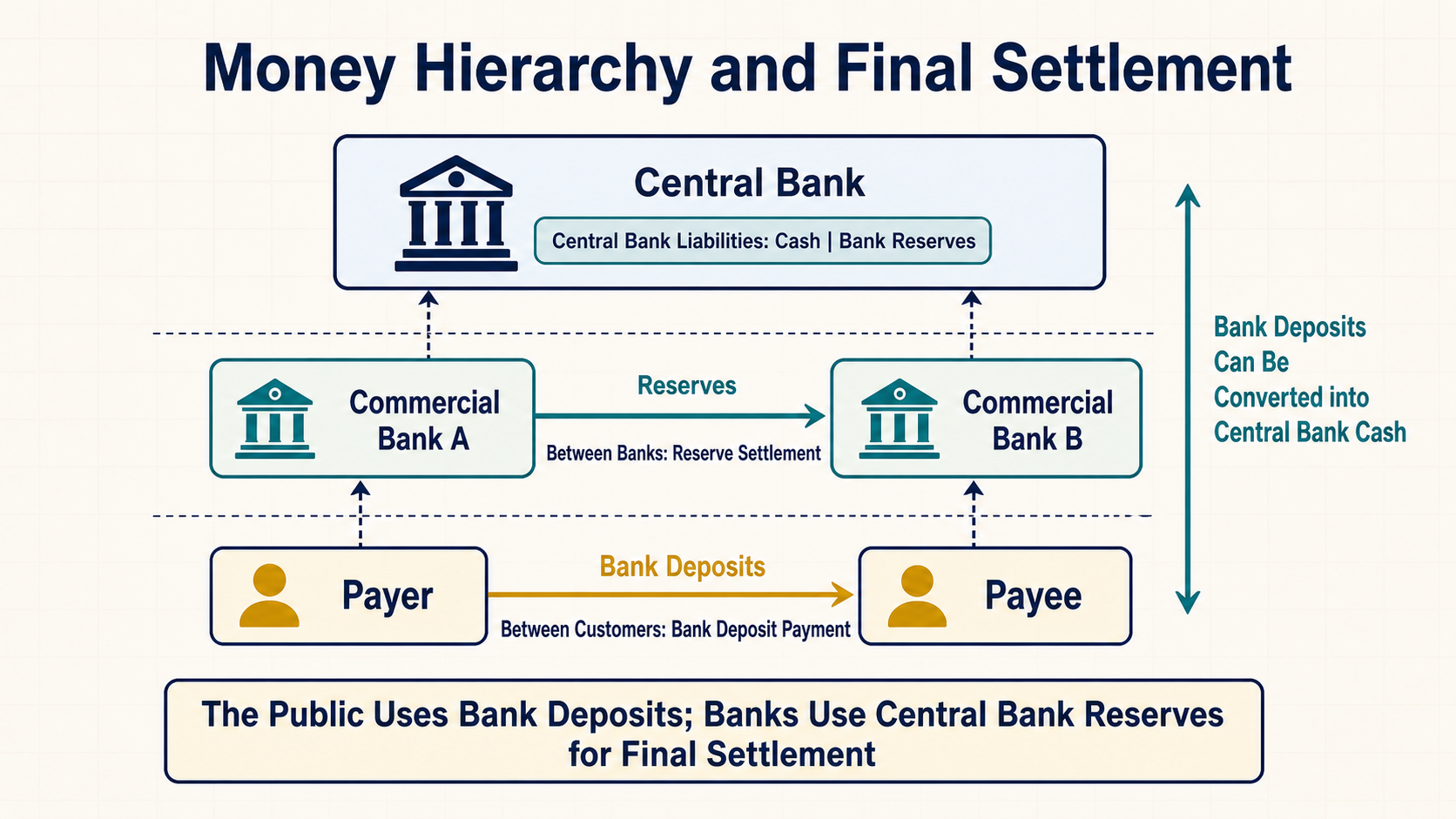
An important reason commercial bank deposits can be transferred between different banks at face value is that commercial banks can use central bank reserves for final settlement. When the public needs cash, bank deposits can also be converted into central bank cash at face value.
Therefore, the central bank issues cash and reserves, commercial banks issue the deposits used by enterprises and residents, banks use reserves for interbank settlement, and the public can convert bank deposits into central bank cash. The special nature of the central bank lies not only in issuing banknotes, but more importantly in the fact that its liabilities sit at the top of the monetary system: cash is a central bank liability directly held by the public, and reserves are the foundational asset for final settlement in the banking system.
Conclusion: Behind the Numbers Are Financial Relationships
The central bank balance sheet is not a list of items to be memorized one by one, but a relational map of the modern monetary system.
The asset side tells us through what transactions the central bank obtains which assets: foreign assets, claims on government, or claims on commercial banks and other financial institutions. The liability side tells us who holds central bank liabilities, and whether these liabilities take the form of cash, bank reserves, customer reserve funds deposited by payment institutions, government deposits, or other liabilities without monetary attributes.
By connecting the left and right sides, currency issuance, foreign exchange purchases, open market operations, bank financing, fiscal expenditure, cash withdrawals, and interbank settlement can all be reduced to a set of account changes: who holds central bank liabilities, through what transactions the central bank creates, transfers, or withdraws these liabilities, and how these liabilities become the foundation for payment and final settlement in the banking system.
Therefore, when seeking to understand a central bank, instead of asking how much money it "has," it is better to ask what liabilities it has issued, who is holding those liabilities, and through what transactions those liabilities enter the monetary and payment system.
Originally published by Luminale Fintech Observer: https://luminale.cn/articles/central-bank-balance-sheet-en