What Actually Happens in Bank Accounting Behind a Transfer?
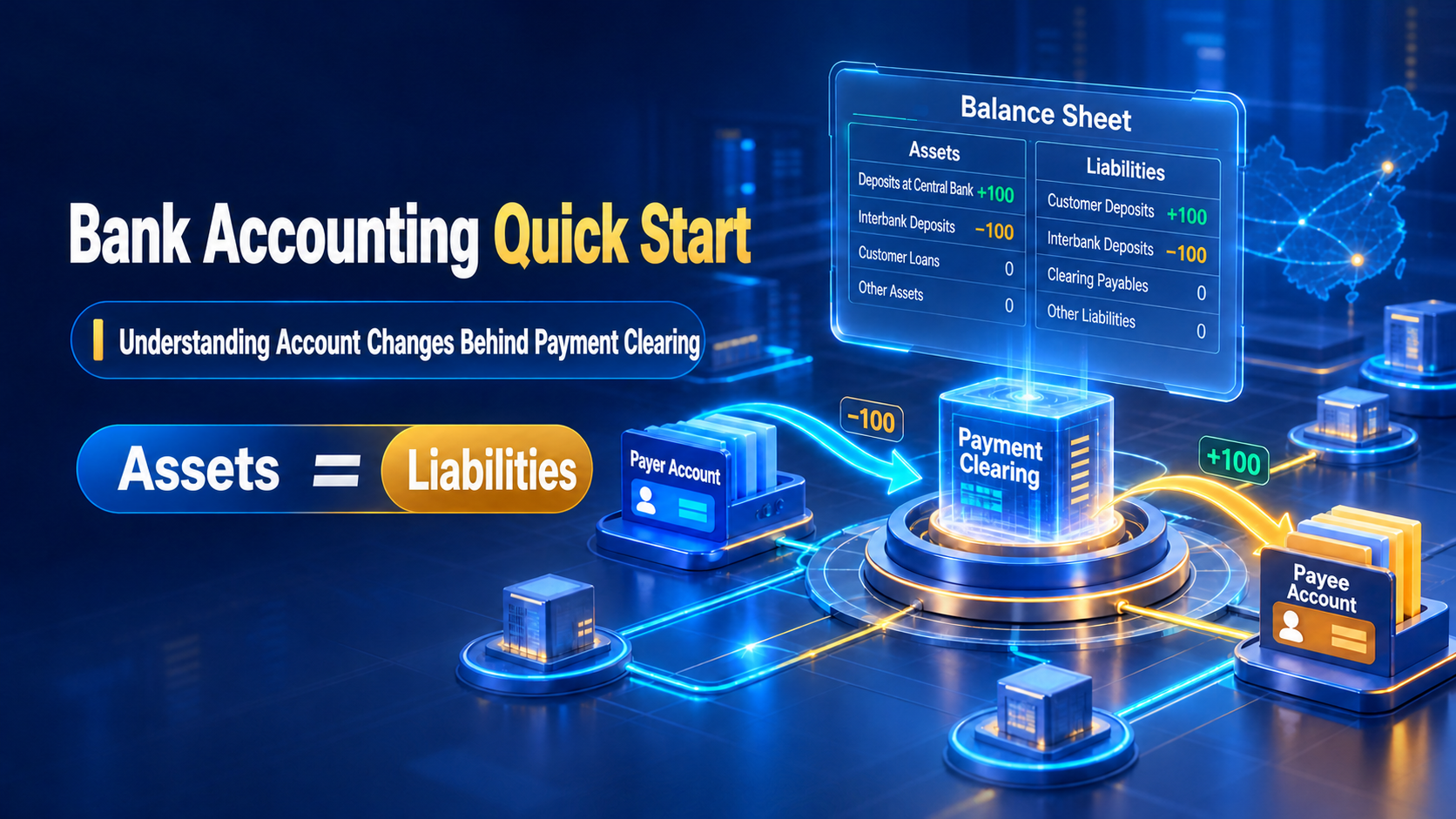
We make transfers every day.
Open the mobile banking app, enter the amount, tap "Confirm," and a few seconds later the payer's balance goes down and the payee's balance goes up. To ordinary users, it seems as if only two numbers have changed.
But from the perspective of banks and payment systems, a transfer is not "money flying from one account to another." Instead, it is an adjustment of the creditor-debtor relationships among a set of accounts.
To understand bank accounting, the most important thing is to grasp three questions:
- Who owns this asset?
- Who bears this liability?
- What asset is ultimately used to settle?
1. First Understand the Bank's Balance Sheet
Let's simplify the bank's balance sheet and keep only the most important items: reserves and customer deposits.
              Bank Balance Sheet

        Assets                         Liabilities
    ┌─────────────┐             ┌─────────────┐
    │ Reserves 100│             │ Deposits 100│
    └─────────────┘             └─────────────┘

              Assets = Liabilities
For customers, bank deposits are assets, because customers have a right to pay, transfer, or withdraw.
But for banks, customer deposits are liabilities, because the bank has to bear the obligation to redeem.
Therefore, the same 100 yuan appears in different positions on the balance sheets of different entities:
Customer: Bank deposits 100 = Customer's asset

Bank: Customer deposits 100 = Bank's liability
This does not mean the bank "took away" the customer's money. Rather, it means that the customer holds a claim against the bank, and the bank bears a promise to pay the customer.
2. Customer Deposits 100 Yuan: Assets and Liabilities Increase Simultaneously
Suppose a customer deposits 100 yuan in cash at the bank. To simplify, we record the cash received by the bank as an asset the bank can use.
Change in the Bank's Balance Sheet

        Assets                         Liabilities
    ┌─────────────┐             ┌─────────────┐
    │ Bank assets +100│          │ Deposits +100│
    └─────────────┘             └─────────────┘
Using T-accounts:
Bank Asset Account                     Bank Liability Account
┌────────────────┐                 ┌────────────────┐
│      +100      │                 │      +100      │
│  Bank assets increase │          │ Customer deposits increase │
└────────────────┘                 └────────────────┘
The change can be summarized as:
Assets +100 = Liabilities +100This is a basic expression of the balance sheet identity. The bank receives an asset and at the same time incurs a liability to the customer.
3. Customer Withdraws 30 Yuan: Assets and Liabilities Decrease Simultaneously
If the customer subsequently withdraws 30 yuan, the bank needs to deliver cash or other redeemable assets, while reducing the deposit balance in the customer's account.
Change in the Bank's Balance Sheet

        Assets                         Liabilities
    ┌─────────────┐             ┌─────────────┐
    │ Bank assets −30│          │ Deposits −30│
    └─────────────┘             └─────────────┘
The T-accounts can be represented as:
Bank Asset Account                     Customer Deposit Liability Account
┌────────────────┐                 ┌────────────────┐
│      −30       │                 │      −30       │
│  Bank assets decrease │          │  Customer deposits decrease │
└────────────────┘                 └────────────────┘
After the withdrawal:
Assets 70 = Liabilities 70The key here is that the decrease in customer deposits is not the bank wiping out a sum of money out of thin air. Instead, the customer's claim against the bank decreases, and the bank's corresponding redemption obligation also decreases.
4. Intra-Bank Transfer: The Bank's Internal Liability Object Changes
Suppose both the payer and the payee hold accounts at Bank A. Xiao Wang transfers 20 yuan to Xiao Li.
Before the transaction:
Bank A liabilities:

Xiao Wang's deposit: 100
Xiao Li's deposit: 0
Total: 100
After the transaction:
Bank A liabilities:

Xiao Wang's deposit: 80
Xiao Li's deposit: 20
Total: 100
Using T-accounts:
Payer's Deposit Account                 Payee's Deposit Account
┌────────────────┐                 ┌────────────────┐
│      −20       │                 │      +20       │
│  Xiao Wang's deposit decreases │  │  Xiao Li's deposit increases │
└────────────────┘                 └────────────────┘
Bank A's total liabilities do not change:
Total bank liabilities: −20 + 20 = 0Therefore, an intra-bank transfer is essentially a reallocation of liabilities among different customers within the same bank.
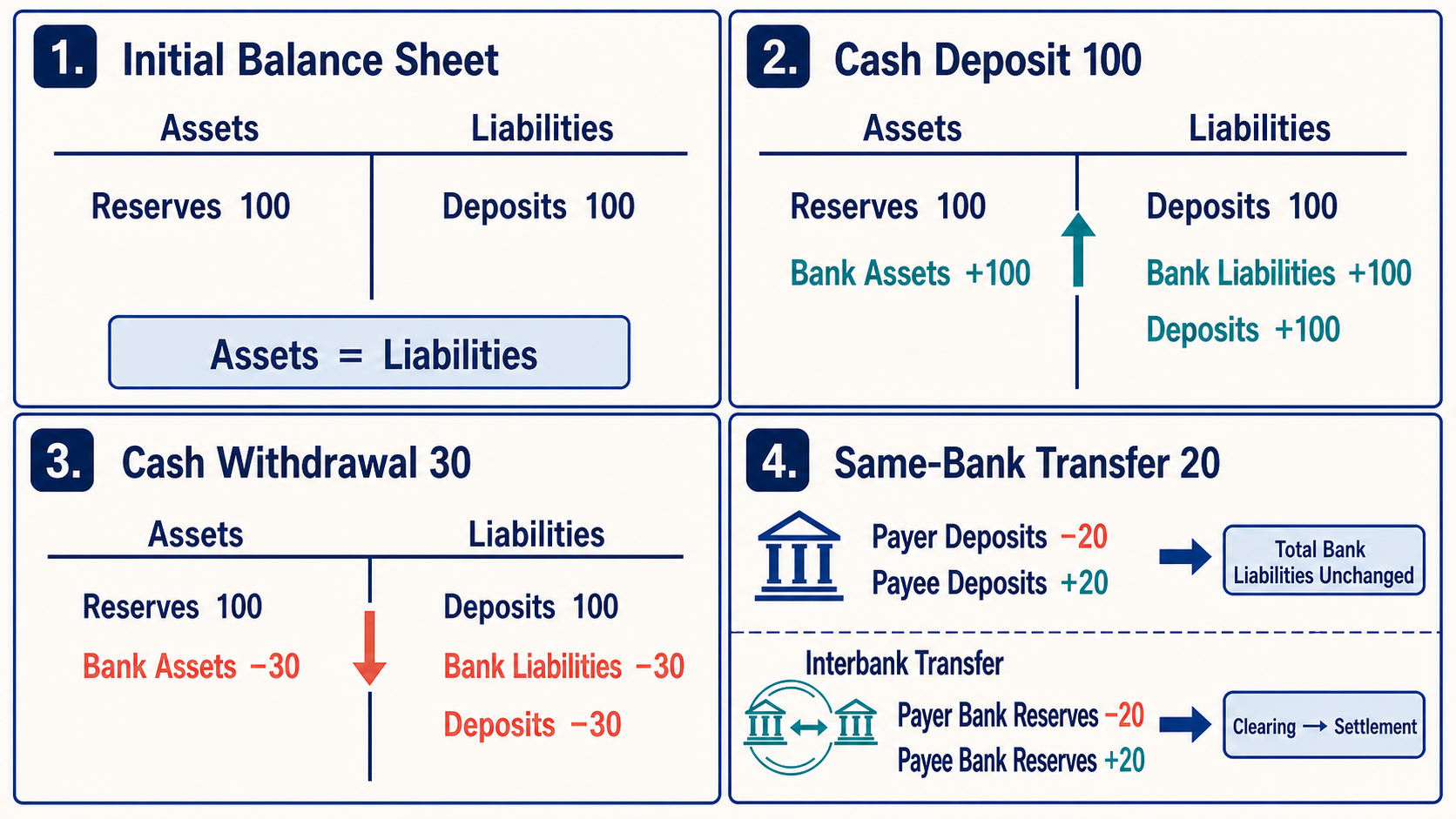
What the user sees is "the balance moves from one account to another." What the bank sees is:
Liability to the payer −20
Liability to the payee +20
Total bank liabilities unchanged
5. Inter-Bank Transfer: Banks Need Clearing and Settlement
If Xiao Wang holds an account at Bank A and Xiao Li holds an account at Bank B, the situation is different.
After Xiao Wang transfers 20 yuan to Xiao Li:
For Bank A:
Xiao Wang's deposit −20
Bank A's reserves −20
For Bank B:
Xiao Li's deposit +20
Bank B's reserves +20
This can be represented with T-accounts for both banks:
Bank A                                Bank B
┌────────────────┐                 ┌────────────────┐
│ Assets: Reserves −20│             │ Assets: Reserves +20│
│ Liabilities: Deposits −20│        │ Liabilities: Deposits +20│
└────────────────┘                 └────────────────┘
At this point, the banks need to calculate through the clearing system:
How much does Bank A owe?
How much is Bank B owed?
If there are a large number of two-way transactions between Bank A and Bank B in a day, the clearing system can also calculate net amounts first.
But clearing only makes the accounts clear; it does not mean final settlement has been completed.
Final settlement also requires the use of settlement assets recognized between banks. In the modern banking system, this is usually reflected in the changes in banks'reserve accounts at the central bank.
Therefore, an inter-bank transfer can be broken down into three levels:
Payment: The user sends the transfer instruction

Clearing: Calculate the receivables and payables between Bank A and Bank B

Settlement: Complete the discharge of debt through final settlement assets such as reserves
6. Why Are Bank Deposits Not Cash with Names Stuck in a Safe?
Many people understand bank deposits as "a stack of cash the bank keeps for them."
But from the perspective of bank accounting, a more accurate understanding of customer deposits is: a liability borne by the bank to the customer.
The 100 yuan in a customer's account does not mean that there must be a 100-yuan note with the customer's name written on it in the bank's safe.
What it represents is:
A liability on the bank's books
+
The customer's right to use this claim for payment
When a customer transfers money, the bank usually does not move a banknote from one safe to another. Instead, through account bookkeeping, clearing, and settlement mechanisms, it completes the changes in bank liabilities and inter-bank settlement assets.
7. Looking at CBDC and Stablecoins from the Perspective of Bank Accounting
Many fintech products today appear in the form of "wallet balances."
But balances that look similar may have completely different accounting attributes behind them.
CBDC (Central Bank Digital Currency) corresponds to a central bank liability.
Commercial bank deposits correspond to commercial bank liabilities.
Stablecoins usually correspond to liabilities or redemption promises of a non-bank issuer.
To judge what a digital currency or payment instrument is, you cannot just look at its name and wallet interface. You need to keep asking:
- Who issues it?
- Whose liability is it?
- What are the reserve assets?
- Can it be redeemed in time?
- What asset is ultimately used for settlement?
- Who bears the risk?
Tokenized deposits also cannot simply be understood as "putting deposits on the blockchain."
More precisely, they are bank liabilities expressed and circulated through a new technological form. Technology changes the way of recording and transferring, but it does not automatically change the issuer, the liability relationship, or the risk-bearing entity.
8. Conclusion: Bank Accounting Is the Gateway to Understanding Payment and Clearing
The payment and clearing system looks complex because it connects multiple layers: customer accounts, commercial banks, clearing institutions, and the central bank.
But the underlying logic can be reduced to a few basic questions:
Whose assets have changed?

Whose liabilities have changed?

How do banks clear with each other?

What asset is ultimately used to settle?
Intra-bank transfers are often just an adjustment of liability objects within the same bank.
Inter-bank transfers further introduce inter-bank clearing and reserve settlement.
Central bank digital currencies, stablecoins, and tokenized deposits may all appear as "wallet balances," but their issuers, liability attributes, and final settlement mechanisms are not the same.
So bank accounting is not auxiliary knowledge for payment and clearing; it is the underlying language for understanding financial infrastructure.
As long as you grasp the three questions — "whose assets, whose liabilities, and what is ultimately used for settlement" — many seemingly complex payment innovations become clear.
Originally published by Luminale Fintech Observer: https://luminale.cn/articles/bank-accounting-quick-start-en