
In mobile banking, a 100-yuan transfer usually completes in a few seconds.
A taps "Transfer," fills in B's account details, and the screen quickly shows "Transfer successful"; sometimes B's balance also rises by 100 yuan at the same time. From the user's point of view, it is easy to read this as: A's money has moved from A's Bank to B's Bank.
But ask the question differently and things get complicated: where exactly did this 100 yuan move?
When the user taps the button, what is issued first is a payment instruction. Based on this instruction, the bank modifies the customer's account; if the payer and the payee are not at the same bank, the banks also have to handle the resulting claims and debts between them and complete settlement as agreed.
So "the payment instruction has been issued," "the payer's account has been debited," "the payee's balance has increased," and "the interbank final settlement has been completed" are not the same thing, and they do not necessarily happen at the same time.
Separating these layers is what lets us see clearly what clearing, settlement, real-time gross settlement ( RTGS), cross-border payments, and digital currency systems each handle.
1. A 100-yuan transfer is not a banknote running across the network
Suppose A transfers 100 yuan to B through mobile banking.
On the interface, the operation is simple: fill in the payee, confirm the amount, complete verification. What the banking system receives, however, is not "move the 100 yuan that belongs to A over to B," but an instruction that can be validated and executed:
Debit 100 yuan from payer A's account and pay 100 yuan to payee B.
The system then handles account-status validation, identity verification, risk control, instruction routing, account posting, transaction notifications, and, where necessary, interbank clearing and settlement.
What the payment system processes is not a specific unit of physical funds bearing A's name, but how account relationships and performance obligations change.
If you think of money as a courier package, it is natural to assume it is loaded onto a truck at place A and carried along a route to place B. Bank-deposit payments are more like several ledgers updating in concert around one valid instruction. What the customer sees is a balance change; what the financial infrastructure has to handle is who owes whom how much, how that debt is confirmed, and how it is discharged.
"Transfer successful" is only a business status. It matters to the user, but it alone cannot be used to judge how far the interbank settlement has progressed.
2. The 100 yuan in the account is, first of all, a deposit claim
Why payment first appears as bookkeeping has to start with the nature of bank deposits.
The 100 yuan shown in A's account is, for A, a deposit claim against the bank; for the bank, it is a deposit liability it owes A. The bank must perform this liability in accordance with contracts, regulatory rules, and payment arrangements.
Simplified, the bank's balance sheet can be written as:
| Assets | Liabilities |
|---|---|
| Reserves, loans, bonds, cash, and other assets | Customer deposits, interbank liabilities, other liabilities |
Assets must equal liabilities plus owners'equity — an accounting identity. This should not be read as "every deposit is individually locked behind a stack of banknotes." More precisely, deposits are real financial liabilities of the bank; customers can assert this claim, and the bank relies on its assets, liquidity management, and solvency to bear the obligation of redemption.
Therefore, when A pays out, the bank first reduces part of its deposit liability to A; when B receives, the receiving bank increases part of its deposit liability to B.
Payment is therefore not merely the transmission of information. The information tells the system who is to pay whom; for the payment to actually take effect, the corresponding account relationships must also be correctly modified, and the performance obligation assumed by the appropriate party.
3. Same-bank transfers: a redistribution of liabilities within one bank
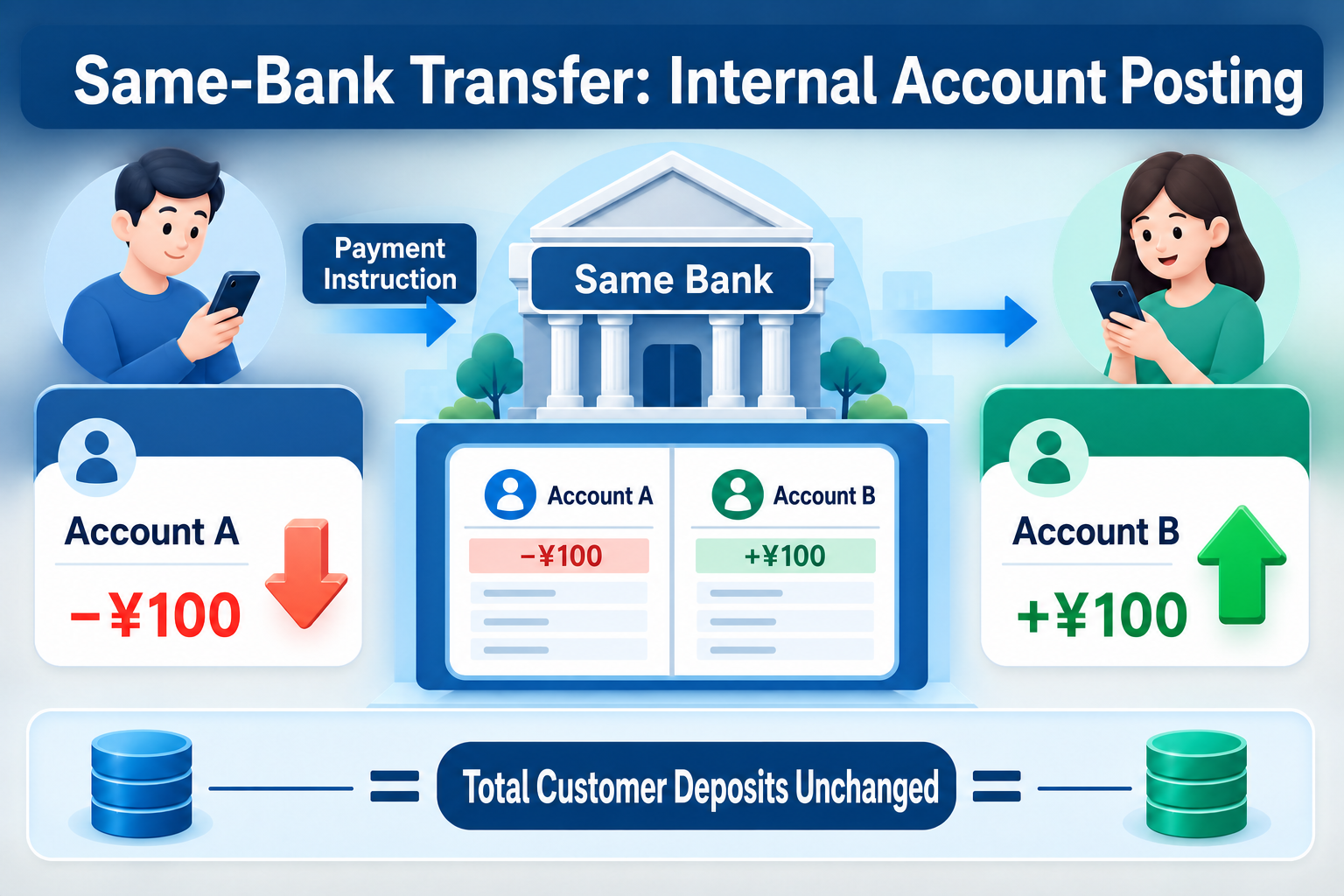
Start with the simplest case: A and B both hold accounts at Bank A.
After A transfers 100 yuan to B, Bank A validates the instruction, the balance, and the transaction conditions. Once the transaction is approved, Bank A completes two changes in its internal ledger at the same time:
| Bank A's deposit liabilities to customers | Before transfer | Change | After transfer |
|---|---|---|---|
| Deposit liability to A | 100 yuan | −100 yuan | 0 yuan |
| Deposit liability to B | 0 yuan | +100 yuan | 100 yuan |
| Total customer deposit liabilities | 100 yuan | 0 yuan | 100 yuan |
For Bank A as a whole, total customer deposit liabilities usually neither increase nor decrease because of this transfer. What changes is whom the bank owes: it originally owed A 100 yuan; after the transfer it owes A 100 yuan less and B 100 yuan more.
A's spendable deposit falls and B's spendable deposit rises — economic value has already moved between the two of them. Because both accounts are maintained by Bank A, it only needs to complete this redistribution in its internal ledger; it generally does not need to handle settlement between two banks.
This distinction also affects the design of payment products and systems. Whether the accounts are at the same institution, whether the payment is closed-loop, and whether the transaction involves external participants all influence the processing chain, cost, timeliness, risk, and the available settlement methods.
4. Cross-bank transfers: below the customer layer, an additional interbank layer appears
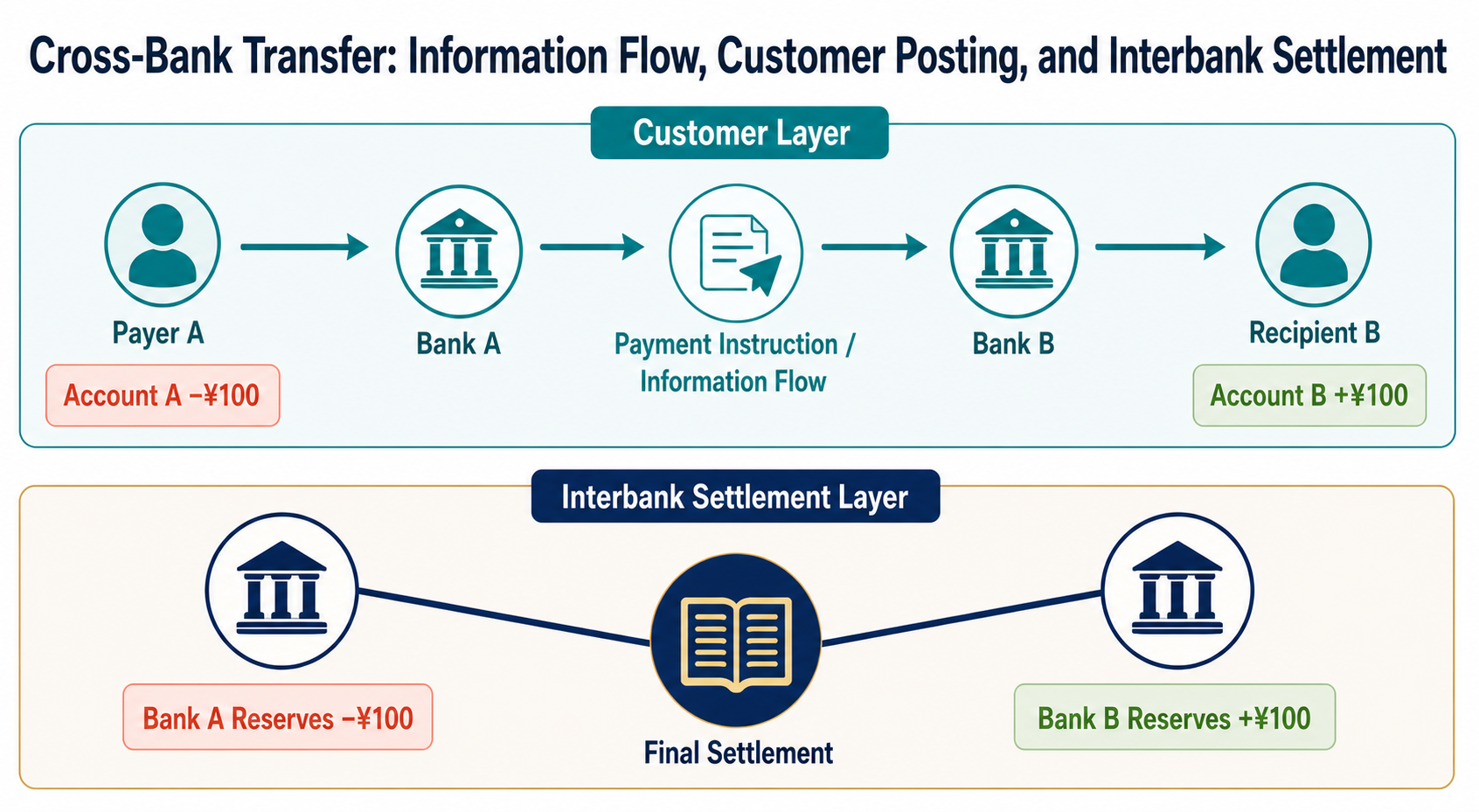
Now change the scenario: A is at Bank A, B is at Bank B.
Bank A reducing A's balance by 100 yuan and Bank B increasing B's balance by 100 yuan is still the most direct thing customers see. But the matter cannot stop there.
Bank B cannot unconditionally increase its 100-yuan liability to B merely because it received an external message. Since it has assumed an additional payment obligation to B, it needs to obtain equivalent value from Bank A, or at least form a claim against Bank A that can be settled later.
A cross-bank payment can be divided into at least three layers that are interrelated but must not be conflated:
| Layer | Core question | Typical actions |
|---|---|---|
| Customer layer | Who pays whom? | A initiates the payment; A's balance decreases; B's balance increases |
| Information and processing layer | How do participants identify, confirm, and process the instruction? | Identity verification, risk control, routing, message transmission, acknowledgement |
| Interbank layer | How does Bank A perform its obligation to Bank B? | Creating, netting (轧差), or discharging interbank claims and debts; final settlement |
It can be seen as two chains:
- Upper layer: A issues a payment instruction to Bank A. The payment information travels through the processing chain to Bank B, which credits B accordingly.
- Lower layer: Bank A and Bank B handle the inter-institutional funds relationship arising from this payment.
The upper layer handles customer experience and instruction; the lower layer handles which participating institutions owe whom and how the debt is repaid. The two depend on each other, but they are not the same ledger, nor do they need to run on the same rhythm.
The extra difficulty of cross-bank payments lies right here: after customer accounts change, the banks still have to resolve performance between themselves.
5. In cross-bank payments, posting and settlement can follow different timing arrangements
Suppose A pays 100 yuan to B, and Bank 甲 and Bank 乙 each maintain their own customer ledgers. Expressed conceptually, this transaction brings about the following changes:
| Party | Account or relationship | Change |
|---|---|---|
| A | Deposit claim against Bank A | −100 yuan |
| Bank A | Deposit liability to A | −100 yuan |
| Bank B | Deposit liability to B | +100 yuan |
| B | Deposit claim against Bank B | +100 yuan |
| Bank A and Bank B | Interbank claims/debts or settlement-asset positions | Must be handled accordingly |
The last row shows that analyzing a cross-bank payment cannot focus only on customer balances.
In the most simplified per-transaction settlement description, Bank A may reduce its holdings of some category of interbank settlement assets, and Bank B increases correspondingly. Other payment arrangements may instead accumulate multiple receivables and payables first and, after netting, settle the net amount; still other arrangements use clearing houses, guarantee mechanisms, liquidity support, or prefunded accounts.
The designs of various systems differ greatly, and cross-bank payments cannot all be described as "each transaction draws on central-bank reserves in real time." Regardless of the technical and institutional path, once Bank B increases its liability to B, Bank A must perform in a way that Bank B accepts.
This is also why "instant arrival" (秒到账) cannot directly equate to "each interbank final settlement has been completed transaction by transaction." The front end can arrive in real time, while the clearing and settlement at the back end may proceed according to a separate set of risk-control and liquidity-management arrangements.
6. What exactly did "success" accomplish?
A single payment can be in multiple states at once. More than asking "has it arrived?", the following questions help us analyze a payment system:
| State | The question it answers |
|---|---|
| Instruction submitted | Has the payer expressed the intent to pay? |
| Instruction accepted | Has the system accepted and begun processing this transaction? |
| Payer's account debited | Has the payer's bank reduced its deposit liability to the payer? |
| Payee's account credited | Has the payee's bank increased its deposit liability to the payee? |
| Cleared | Have the receivables and payables between institutions been confirmed, aggregated, or netted? |
| Final settlement complete | Have inter-institution debts been performed irrevocably using the agreed settlement assets? |
The payment instruction answers who is asking to pay whom how much; information transmission handles how each participant learns of and confirms the transaction; account posting determines which customer accounts change and how.
Clearing and settlement, in turn, handle the interbank relationship. Clearing generally includes confirming the transaction, calculating receivables and payables, netting, and risk arrangements; final settlement must answer with what assets, and in what final form, the debts between participating institutions are performed.
This distinction lands on concrete issues of product design and risk management. If a system allows the payee to use funds before final settlement, it must make clear who bears counterparty risk, liquidity risk, or revocation risk; if a system emphasizes finality, it must also look at what settlement assets it uses and how the rules and legal arrangements are designed.
7. From the front-end experience toward payment infrastructure
When talk turns to payments, people easily focus on whether scanning to pay worked, whether the balance refreshed, and whether funds arrived in seconds. Fintech practitioners also need to keep asking:
- Who modified whose account?
- Which bank assumed an additional customer liability because of this?
- Are the information flow and the value flow carried by the same mechanism?
- What claims and debts relationship formed between the banks?
- How is this relationship finally discharged, and who bears the risk during the not-yet-settled period?
A same-bank transfer is a redistribution of deposit liabilities within one bank. A cross-bank transfer, by contrast, creates an interbank layer beneath the customer accounts, and as long as the payer and the payee belong to different institutions, that layer cannot be bypassed.
Payment, then, is not just "minus one, plus one on the balance." It must coordinate customer ledgers, inter-institution claims and debts, information transmission, and final performance.
The next article continues to answer one concrete question:
In the end, with what money does Bank A repay this 100 yuan it owes Bank B?
The answer will lead us to discuss the settlement asset in payment systems: central-bank reserves, and the settlement accounts that banks hold at the central bank.
Originally published by Luminale Fintech Observer: https://luminale.cn/articles/payment-instruction-account-posting-and-funds-transfer-en