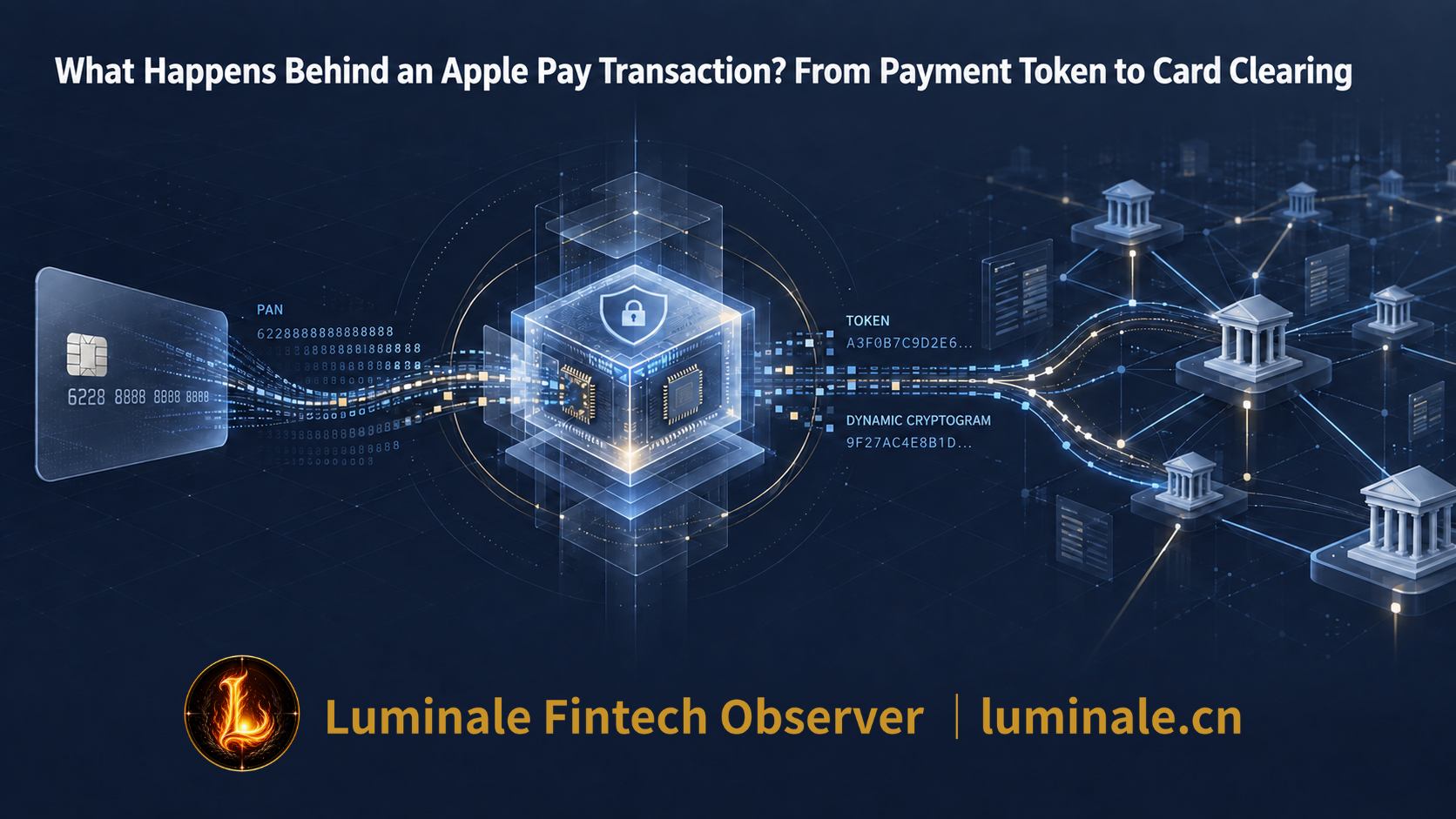
You buy coffee at a convenience store, double-click the side button on your iPhone, verify via Face ID, and hold your phone near the contactless reader on the POS terminal. With a beep, a blue checkmark pops up on the screen, signaling that the payment is complete. The whole interaction takes only two to three seconds.
An intuitive reaction for many is that the bank card has simply been loaded into the phone, that the phone replaces the physical plastic card, or even that Apple has built an independent proprietary account and clearing network similar to Alipay or WeChat Pay behind the scenes.
In reality, Apple Pay has not established its own issuing bank or acquiring bank, nor has it built an interbank clearing network that bypasses the existing card payment rails. The underlying funds for bank cards provisioned in a consumer's phone remain housed in commercial bank accounts; merchants continue to receive payments through their standard card acquiring channels; and the backend message routing, inter-institutional clearing, and multilateral net settlement remain handled by established card schemes such as Visa, Mastercard, or China UnionPay.
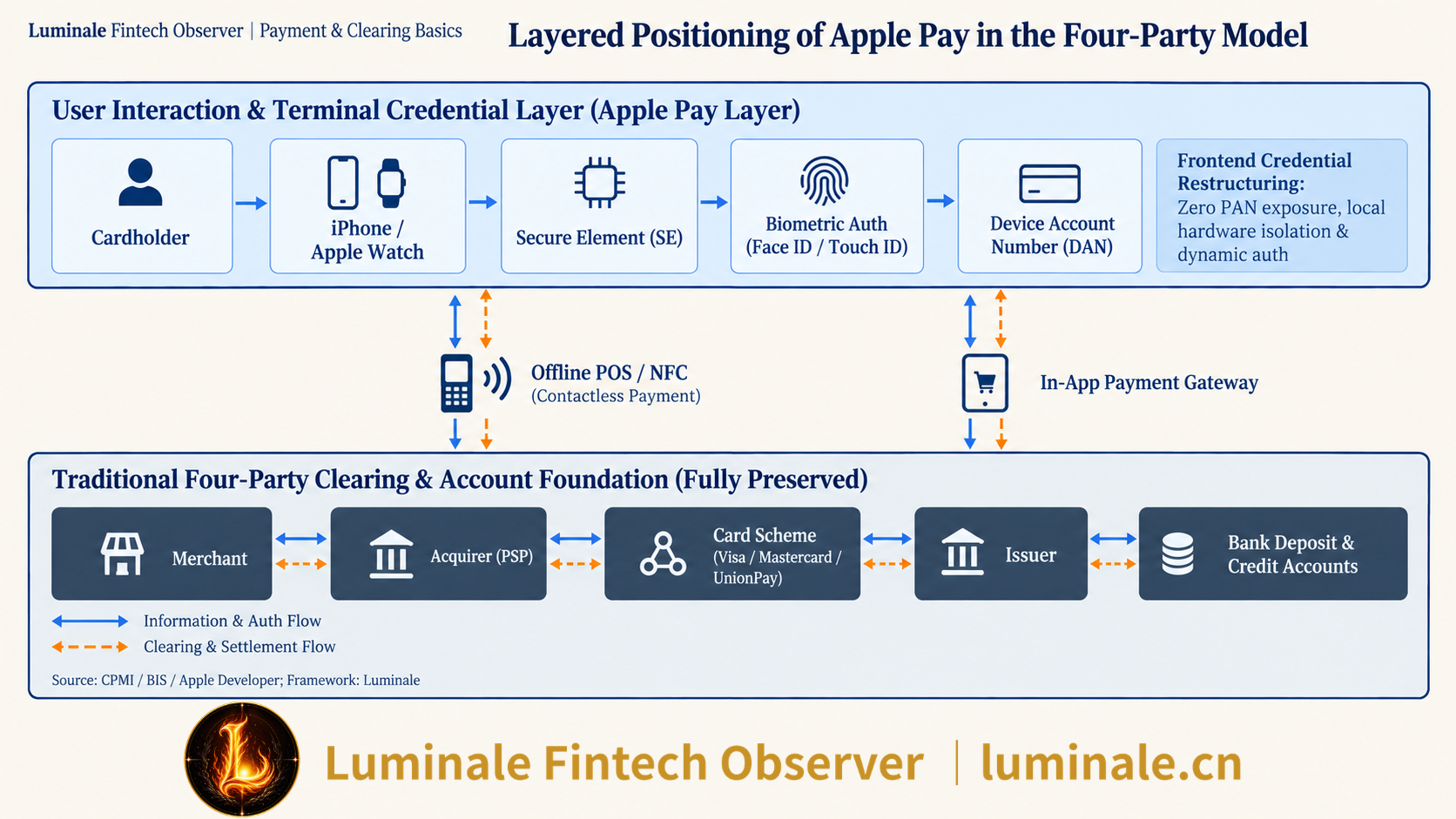
In "When You Swipe $100 , Who Does It Pass Through? A Guide to Issuers, Acquirers, Card Networks, and Merchants," we examined the foundational architecture of the card payment "four-party model": the cardholder, merchant, issuer, acquirer, and the central connecting card network. What Apple Pay truly accomplished was constructing an entirely redesigned interaction layer between the cardholder and the existing card network—driven by hardware-level security isolation, biometric authentication, and payment tokenization.
Apple Pay changed how payment credentials are generated and verified, without altering the underlying account and clearing infrastructure.
1. What Exactly Is Apple Pay?
To understand Apple Pay's position within the payment value chain, one can look back at the fundamental strategic crossroads when it was introduced. In September 2014, Apple officially announced Apple Pay.[1] At that time, Apple faced two potential paths: build a closed-loop digital wallet and stored-value account system from scratch, or securely integrate smart devices into the existing commercial bank card network. Apple chose the latter.
From day one, Apple Pay launched in partnership with American Express, Mastercard, Visa, and several major commercial banks. In late 2015, Apple announced a partnership with China UnionPay, officially launching in the Chinese market the following year over UnionPay's QuickPass network and directly utilizing the extensive contactless merchant acceptance terminals already deployed by UnionPay.[2]
To delineate the boundaries of Apple Pay, it helps to distinguish three concepts that are frequently conflated:
| Concept | Core Positioning | Problem It Solves |
|---|---|---|
| Apple Wallet | Local digital credential container | Manages bank cards, transit passes, access keys, boarding passes, and identity credentials at the OS level |
| Apple Pay | Mobile payment technical service | Invokes hardware security modules and biometrics to initiate transaction requests and dynamic authentication for existing bank cards |
| Bank Account | Underlying financial account and source of funds | The commercial bank providing demand deposits or credit lines, while bearing compliance and final settlement obligations |
In terms of functional division:
- Apple Wallet is merely a local software container that holds various digital passes and credentials;
- Apple Pay is a payment enablement technical service responsible for coordinating underlying hardware to initiate transactions when users present those credentials;
- The entities providing funds, underwriting credit risk, and bearing regulatory liability remain, from beginning to end, commercial banks;
- The entities connecting the issuing side with the acquiring side, routing transaction messages, and calculating multilateral net settlement remain card schemes.
Apple Pay provisions bank card credentials into the device's secure hardware and links into existing card scheme networks; it has not established a new Visa or UnionPay. Within Luminale's payment infrastructure analytical framework, the diagram below illustrates the relationship between Apple Pay and the constituent elements of the traditional card payment four-party model:
2. What Happens When You Add a Bank Card to Apple Pay?
Some users assume that scanning a bank card with the iPhone camera or typing in the card number simply copies the card details into the phone's storage.
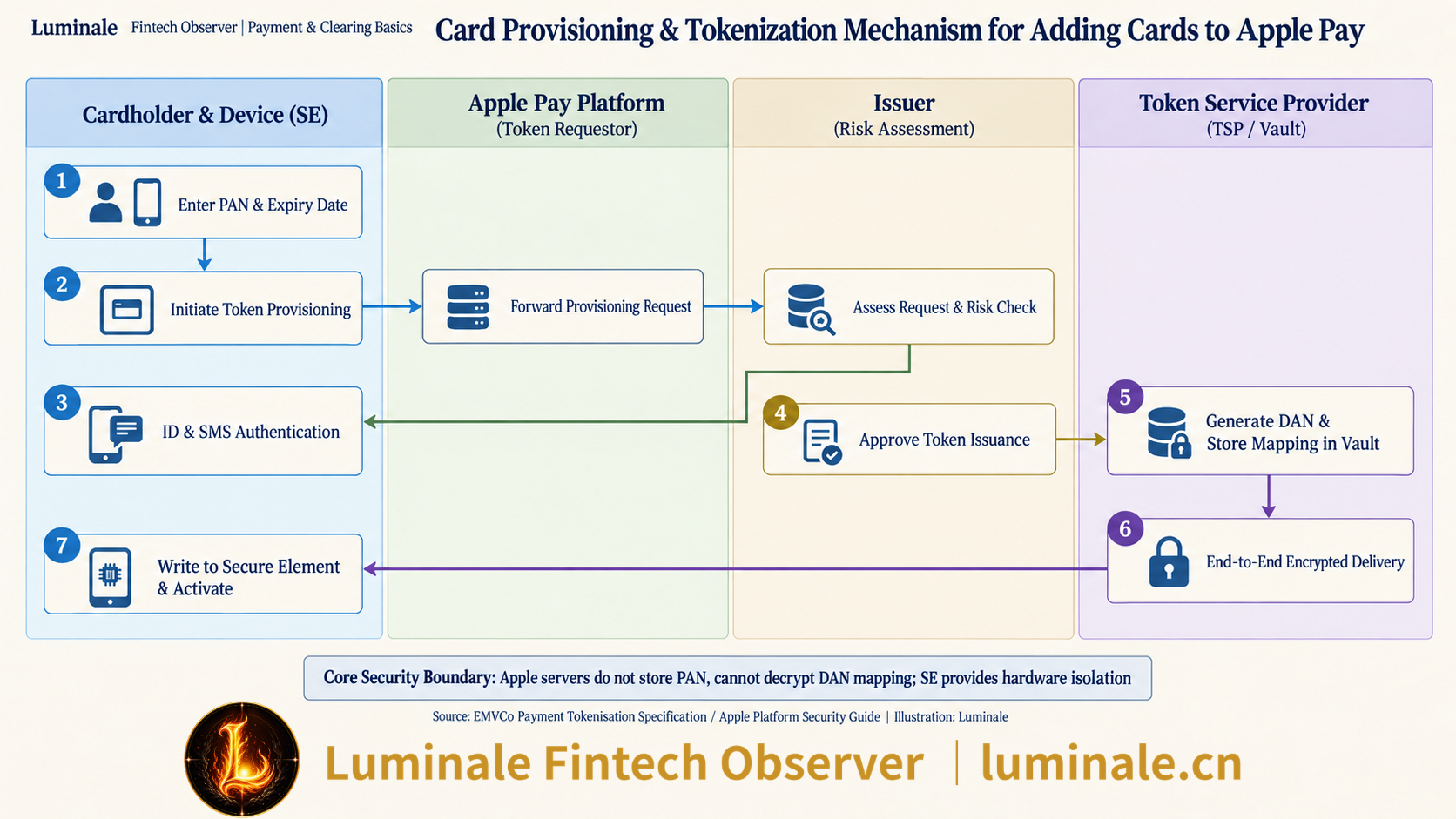
In reality, the backend executes a rigorous process of card provisioning and payment tokenization.[3]
Cardholder inputs card details (Primary Account Number / PAN)
       ↓
Apple Pay initiates card provisioning request
       ↓
Issuer and Token Service Provider (TSP)
       ↓
Risk assessment and credential eligibility authorization
       ↓
Generate Device Account Number (DAN) and configure cryptographic keys
       ↓
End-to-end encrypted provisioning payload delivery
       ↓
Stored in hardware-isolated Secure Element (SE)
1. From Primary Account Number (PAN) to Payment Token
In the era of traditional plastic bank cards, the centerpiece of a transaction was the Primary Account Number (PAN) embossed on the card face. Whether swiping at a supermarket, handing the card to a restaurant server, or typing the card number, expiration date, and Card Verification Value (CVV) into an e-commerce website, the raw card number was exposed across the entire transaction chain. If a merchant database was breached or a POS terminal compromised by a skimming device, the real PAN was directly vulnerable to theft.
The EMVCo Payment Tokenisation Specification was developed specifically to mitigate this vulnerability.[4]
Payment tokenization refers to replacing the original PAN with a surrogate surrogate value—a Payment Token—that shares a similar format and length. Crucially, this token can be restricted within tightly defined operational domains:
- Device restriction: Permitted to initiate transactions only from a specific secure hardware chip;
- Channel restriction: Restricted strictly to contactless point-of-sale (NFC) terminals, or specific mobile in-app / web checkout environments;
- Merchant restriction: In certain use cases, limited to transacting with a designated merchant.
Outside its designated device or operational domain, the token cannot be used to complete a transaction, rendering it practically worthless if intercepted.
2. Device Account Number (DAN)
In Apple Pay terminology, the payment token provisioned inside the device is designated as the Device Account Number (DAN).
It serves as the digital surrogate for the bank card on that specific Apple device. If you bind the same credit card to both your iPhone and your Apple Watch, the two devices do not share a single DAN. The issuer and card scheme generate completely distinct DANs and dedicated cryptographic keys for the Secure Element of the iPhone and the Apple Watch, respectively. If you lose your Apple Watch, you can immediately suspend or delete that specific watch token via "Find My"; your iPhone's Apple Pay continues to function normally, and there is no need to report the physical plastic card lost or request a replacement card from your bank.
3. Who Generates and Manages the Token?
A common misconception is that Apple generates the token and stores encrypted card numbers on its proprietary servers.
In truth, Apple servers neither store real bank card numbers nor generate payment tokens.
The entities possessing the authority to generate tokens, maintain mapping databases, and manage credential lifecycles are the issuing banks and authorized Token Service Providers (TSPs) operated by card networks. Examples include the Visa Token Service (VTS), Mastercard Digital Enablement Service (MDES), and China UnionPay's Token Service Platform.
Within this architecture, Apple acts as a Token Requestor:
| Role | Entity | Core Responsibility |
|---|---|---|
| Token Requestor | Apple Pay / Device side | Captures user intent and initiates token provisioning requests to the network on behalf of the cardholder |
| Token Service Provider (TSP) | Visa / Mastercard / UnionPay / Issuer platforms | Generates tokens, manages the secure Token Vault mapping database linking tokens to real PANs |
| Token Vault | Token Vault repository | Highly secure backend database storing mappings between tokens, real PANs, and device bindings |
| Issuer | Issuing Bank | Performs final risk evaluation and authorizes token issuance to the specific device |
When you initiate card provisioning on an iPhone, Apple securely encrypts the card data and transmits it to the issuer or card network. Once the issuer verifies cardholder identity—via SMS one-time passwords (OTP) or mobile banking app authentication—it instructs the TSP to generate a Device Account Number (DAN).
The TSP then transmits the DAN along with associated public/private keys and key-derivation parameters over an end-to-end encrypted channel directly to the iPhone, where the phone's Secure Element decrypts and writes the data into hardware. Throughout this process, Apple cannot access the plaintext DAN-to-PAN mapping, nor can it touch the underlying cryptographic keys.
4. The Hardware Firewall of the Secure Element (SE)
The provisioned DAN and the cryptographic keys required to generate dynamic transaction signatures are stored in the device's dedicated Secure Element (SE).
The Secure Element is an industry-standard, tamper-resistant microchip certified to financial-grade security standards. It possesses an isolated computing core, secure memory, and encrypted storage, maintaining strict physical hardware isolation from the Application Processor that runs the iOS operating system.[5]
Consequently, even if malicious software were to compromise the iOS operating system and obtain elevated system privileges, it cannot directly access or extract the cryptographic keys and credentials sealed inside the Secure Element. In offline contactless transactions, the Near Field Communication (NFC) radio frequency controller routes data over a dedicated hardware bus directly to the Secure Element, bypassing the primary iOS host processor entirely.
3. How Does an Apple Pay Transaction Actually Flow?
When a consumer holds an iPhone near a checkout terminal to complete a contactless payment, the transaction progresses through multiple distinct phases within a matter of seconds.
Phase 1: Local Device User Authentication
The user double-clicks the iPhone side button, prompting the system to invoke Face ID or Touch ID.
Biometric data itself is never part of the payment payload. Facial recognition data is never transmitted to the POS terminal, acquirer, or bank.
Biometric verification functions purely as a local authorization gate:
- The user's biometric characteristics are verified locally inside the isolated Secure Enclave;
- Upon successful verification, the Secure Enclave sends a hardware-protected authorization signal to the Secure Element;
- Upon receiving this signal, the Secure Element unlocks the corresponding Device Account Number (DAN), allowing it to respond to NFC RF field interactions for a tightly bounded temporal window (typically several tens of seconds).
Through local authentication, the device confirms that the person holding the phone is the authorized user.
Phase 2: Generating a Single-Use Dynamic Transaction Credential
When the phone is brought into proximity with the POS terminal, the Secure Element engages in an NFC protocol handshake.
The Secure Element does not merely hand over the static Device Account Number; it dynamically generates two critical elements:
- Device Account Number (DAN): The foundational surrogate token replacing the real PAN;
- Dynamic Payment Cryptogram: A single-use transaction cryptogram calculated by cryptographic algorithms inside the Secure Element using an internal Transaction Counter, a unique session key, and transaction-specific context provided by the terminal (such as transaction amount, currency code, terminal unpredictable number, and merchant code).
In the era of traditional magnetic stripe cards, static card numbers and CVVs could be skimmed and cloned for repeated unauthorized use. Even traditional chip cards often relied on static credentials for online card-not-present processing.
In Apple Pay, the transaction payload becomes:
Because the dynamic cryptogram is valid only for a single transaction, even if an eavesdropper were to capture the complete radio frequency data packet over the air, the captured payload cannot be reused for a subsequent transaction. The transaction counter will have incremented, and any replay attempt will be flagged and rejected by the card network and issuing bank.
Phase 3: Re-entering the Traditional Card Four-Party Network
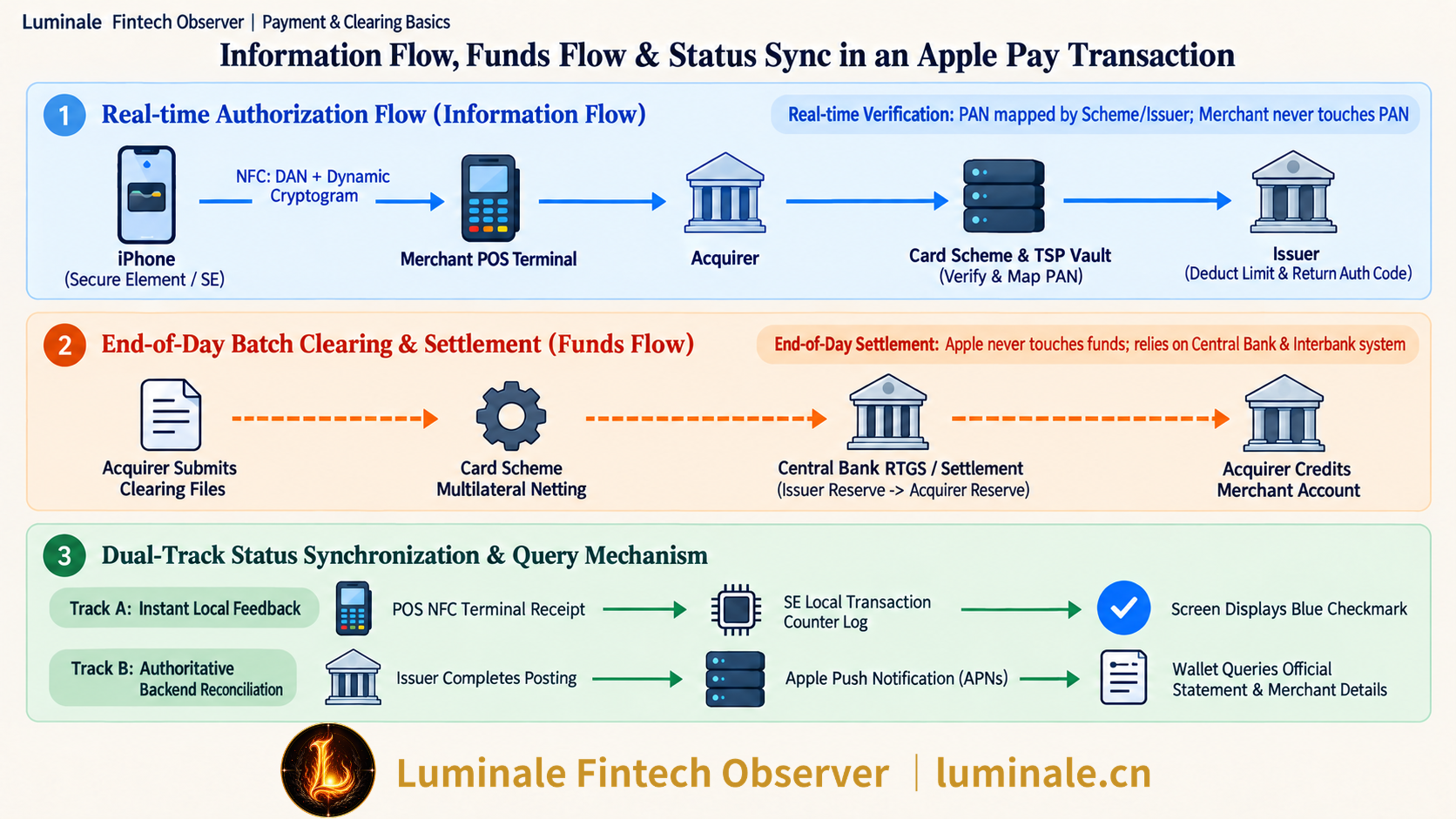
Once the POS terminal reads the DAN and dynamic cryptogram, the transaction transitions into the conventional four-party card payment lifecycle, independent of Apple's device ecosystem.
iPhone / Secure Element (SE)
       ↓ (NFC Interaction: Transmits DAN & Cryptogram)
Merchant POS Terminal
       ↓
Merchant Acquirer (Acquirer / PSP)
       ↓
Card Scheme Network & Token Service Provider (Card Scheme & TSP)
       ↓ (Validates Cryptogram, retrieves real PAN from Token Vault)
Issuing Bank (Issuer)
       ↓ (Risk evaluation, balance/limit check, debits account, returns approval code)
Authorization response returns along original path to POS terminal
Here lies an essential technical operational detail: Who de-tokenizes the transaction to restore the real card number, and when does this occur?
A common misconception is that the POS terminal contacts Apple upon receiving the token, and Apple decrypts the real card number before passing it to the bank.
In reality, Apple plays zero role in routing or processing offline transaction messages. The entire flow adheres to standard EMVCo tokenization message specifications:
- Acquirer Perspective: The POS terminal packages the DAN and dynamic cryptogram into standard financial transaction messages (such as ISO 8583) and transmits them to the merchant's acquiring institution. To the acquirer, the DAN appears as a syntactically valid bank card number; the acquirer performs standard pre-routing checks and forwards the message to the appropriate card scheme;
- Card Scheme and TSP Perspective: When the message reaches the card scheme (Visa, Mastercard, or UnionPay), the network identifies that the number falls within an allocated Token Bank Identification Number (Token BIN) range. The scheme invokes its integrated TSP platform to verify the dynamic cryptogram and ensure replay protection; upon successful verification, it queries the secure Token Vault to retrieve the real underlying Primary Account Number (PAN);
- Issuer Authorization Perspective: The card scheme routes the authorization request—populated with the real PAN and token security flags—to the issuing bank. The issuer checks account status, available balance, or credit limits. If approved, the issuer places a hold on funds, generates an authorization approval code, and transmits the response back through the network;
- Terminal Confirmation: The POS terminal receives the approval response via the acquirer, prints a receipt, and displays "Approved" on screen.
Throughout this process, the information flow (authorization message) traverses the acquirer, card scheme, and issuer within seconds; the funds flow (settlement) has not yet occurred.
At end-of-day or cut-off, the acquirer submits batched clearing files of completed transactions to the card scheme. The card scheme conducts multilateral net settlement across all member institutions, calculating the net debit or credit position for each issuer and acquirer. Final funds transfers are subsequently executed across central bank reserve accounts (such as China's High-Value Payment System, HVPS, or the Federal Reserve's Fedwire). The acquirer then credits the merchant's commercial bank settlement account.
Throughout the clearing and settlement process, Apple never holds customer funds, never participates in central bank reserve transfers, and maintains no settlement accounts with central banks.
Phase 4: How Apple Pay Queries Transaction Status and Records
Many users notice that upon completing a transaction, their iPhone immediately displays a banner notification showing the deducted amount, and opening Apple Wallet displays the transaction amount and merchant name. Given that offline POS terminals are not connected to Apple servers, how does the phone learn the transaction outcome?
Transaction status presentation in Apple Wallet relies on two parallel, complementary information flows:
Mechanism A (Local Immediate Feedback): POS Terminal ──(NFC Response)──> Secure Element (SE Local Log) ──> Wallet Displays Initial Checkmark
Mechanism B (Authoritative Online Sync): Issuer / Scheme ──(Backend Posting)──> Apple Push Notification (APNs) ──> Wallet Queries Full Statement Data- Terminal Receipt and Secure Element Local Log (Immediate Perception):
In the final step of the offline NFC exchange, after receiving confirmation from the acquirer, the POS terminal transmits an execution receipt message back to the phone's Secure Element. The Secure Element maintains a hardware-protected, lightweight transaction counter log recording transaction amounts, terminal random numbers, and timestamps for the most recent transactions. The iOS PassKit framework reads this restricted local log via dedicated internal APIs, instantly rendering the blue checkmark on screen and populating an initial local pending record.[5]
- Asynchronous Push Notifications from Banks and Schemes (Authoritative Reconciliation):
The local transaction log provides limited information and typically lacks clean, normalized merchant names. The authoritative, full transaction record is driven by the issuing bank or card scheme backend. After authorization and posting, the financial institution dispatches an encrypted silent notification via the Apple Push Notification service (APNs).[6]
Upon receiving this push trigger, the iPhone Wallet app reaches out in the background to the issuer's or scheme's API endpoints to retrieve incremental statement details—fetching exact settlement amounts, normalized merchant branding, category tags, and geolocation data. This hybrid architecture achieves sub-second UI responsiveness at the counter even under offline or weak-signal conditions, while ensuring subsequent statement accuracy.
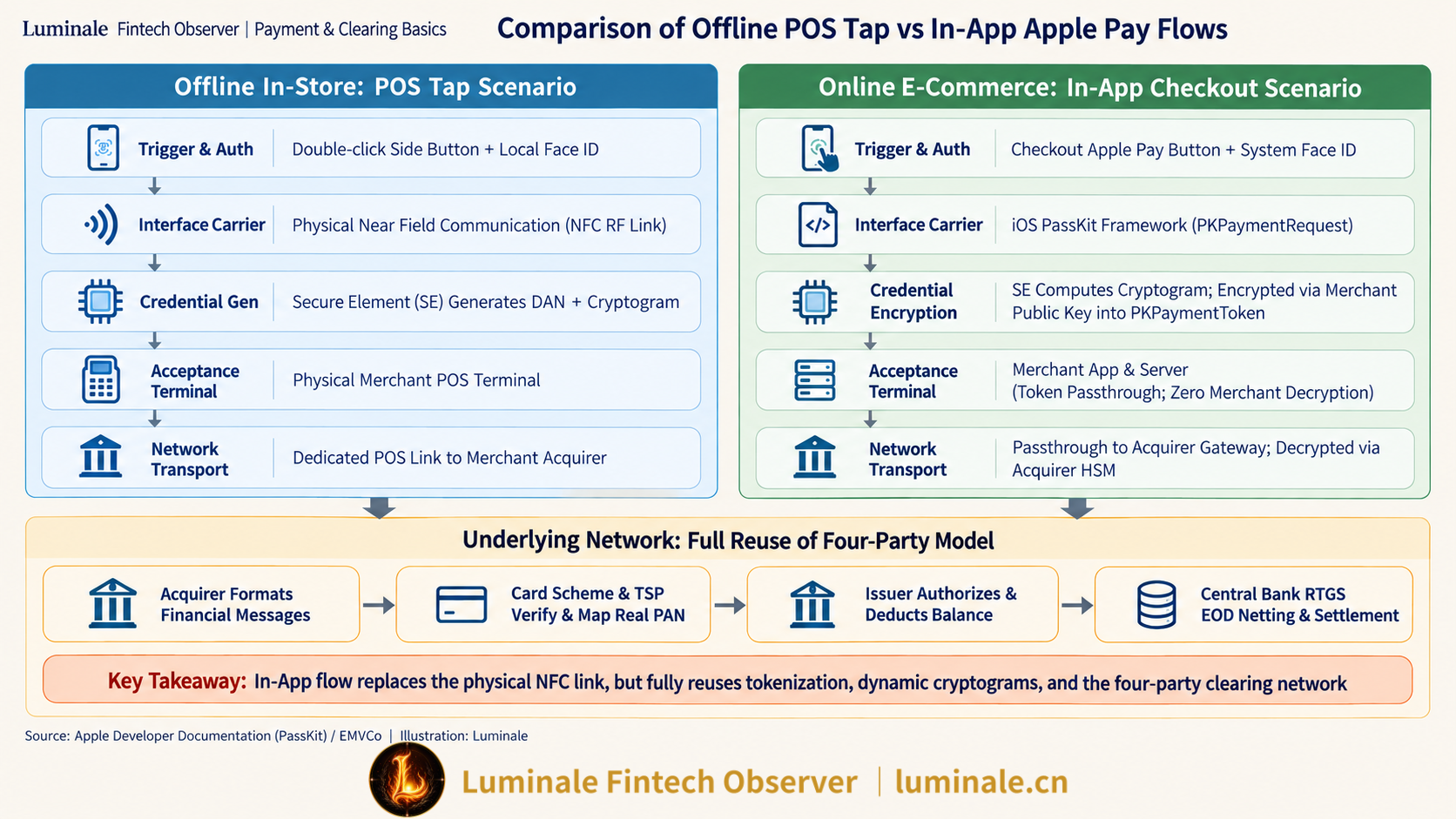
How Do E-Commerce Apps Trigger Apple Pay?
Beyond brick-and-mortar checkout counters, consumers can also check out using Apple Pay within mobile e-commerce apps such as JD.com, Taobao, and Pinduoduo.
In-app payment replaces the physical NFC radio link with an operating-system-level payment request, while fully reusing the four-party clearing network for downstream processing:
E-Commerce App (e.g., JD.com / Taobao / Pinduoduo)
       ↓ (1. Instantiates PKPaymentRequest, displays Apple Pay sheet)
User authorizes transaction via Face ID
       ↓ (2. Secure Element generates DAN & dynamic cryptogram)
Apple Pay Payment Server
       ↓ (3. Encrypts payload with merchant/acquirer public key certificate into PKPaymentToken)
Merchant Backend Server
       ↓ (4. Passes encrypted token through; merchant cannot decrypt raw card data)
Merchant Acquirer / Payment Gateway (e.g., UnionPay Online / Bank Gateway)
       ↓ (5. Decrypts payload with private key in HSM, recovers DAN & cryptogram, builds network message)
Card Scheme Network & Issuing Bank (Re-enters four-party authorization & clearing pipeline)
In mobile e-commerce scenarios:
- What is replaced: It replaces the physical NFC radio frequency link between the POS terminal and phone. Rather than reading card data via radio waves, the e-commerce app leverages iOS's
PassKitframework to construct aPKPaymentRequestobject containing the Merchant Identifier, transaction amount, currency code, and order details, presenting the native Apple Pay authorization sheet.[7] - What is reused: It fully reuses the hardware-isolated authentication of the Secure Element, the Device Account Number (DAN) architecture, and the dynamic cryptogram generation engine. The Secure Element computes a single-use cryptogram specifically tied to that merchant and transaction amount.
- Public-Key Cryptographic Envelope for In-App Data: To prevent malicious apps or network intermediaries from intercepting transaction credentials, payment data generated by the Secure Element is not exposed directly to the e-commerce merchant. Apple Pay servers retrieve the Payment Processing Certificate Public Key registered by the merchant in the Apple Developer portal, sealing the DAN, dynamic cryptogram, and transaction metadata inside an encrypted cryptographic envelope (
PKPaymentToken).[7]
The e-commerce app receives this encrypted token and passes it transparently to its backend server. Neither the app nor the merchant server possesses the private key required to decrypt it. The merchant forwards the encrypted token to its acquiring payment gateway (such as China UnionPay Online or a partner acquiring bank). The acquirer decrypts the payload inside its Hardware Security Module (HSM), extracts the DAN and dynamic cryptogram, and packages them into standard interbank clearing messages sent through the card scheme network to the issuer.
This architecture grants online merchants the same tokenized fraud-prevention protections found at physical point-of-sale terminals, sparing consumers the friction of repeatedly entering 16-digit card numbers, SMS codes, and CVVs on their mobile devices.
4. What Is the Business Model of Apple Pay?
If the foundational network remains governed by issuers, card schemes, and acquirers, why did Apple develop Apple Pay, and why were banks and merchants eager to participate?
Apple Pay expanded across international markets because it integrated into the existing four-party model without requiring participants to undertake massive infrastructure overhauls or disrupting established interchange fee structures.
1. For Consumers: Zero Added Fees, Lower Exposure Risk
Apple does not levy transaction fees on consumers. Using Apple Pay in retail stores, apps, or websites incurs zero additional charges from Apple.
The value proposition for consumers is straightforward:
- Convenience: Eliminates the need to carry physical cards and wallets;
- Fraud Mitigation: Real card numbers and 3-digit CVVs are never shared with merchants, sharply curbing skimming and database breach vulnerabilities;
- Frictionless Digital Checkout: Streamlines online shopping to a single biometric verification step, removing repetitive manual entry of card numbers, billing addresses, and expiry dates.
2. For Merchants: Zero Overhaul Burden, Seamless Compatibility
For merchants, adopting Apple Pay does not require replacing existing accounting or reconciliation backends.
Apple does not establish merchant settlement accounts or impose a dedicated "Apple Pay fee." Merchants continue paying their standard Merchant Discount Rate (MDR) to their acquirer or Payment Service Provider (PSP) under their existing acquiring contracts. Standard POS terminals equipped with contactless EMV capabilities (such as UnionPay QuickPass, Visa payWave, or Mastercard PayPass) support Apple Pay natively. Merchants need not purchase proprietary hardware for a single device brand.
3. For Issuing Banks: Ceding the Frontend Portal While Preserving Customer Relationships
During the early growth of smartphones, commercial banks were concerned that Big Tech platforms would introduce closed-loop stored-value wallets, interposing themselves between banks and customers and relegating banks to passive funding utilities.
Apple Pay's integration model provided banks with essential safeguards:
- Retaining Core Balance-Sheet Relationships: Customers remain direct depositors and cardholders of the issuing bank, keeping funds within the commercial banking system;
- Retaining Credit Economics: Revolving credit interest, installment fees, and late penalties remain entirely with the issuing bank;
- Mitigating Fraud Losses: The introduction of dynamic cryptograms and biometric authentication significantly decreases counterfeit and stolen card fraud, lowering credit loss provisions.
Banks conceded the initial interface touchpoint on mobile devices, but secured the digital engagement and ongoing utility of their card portfolios in the mobile era.
4. Apple's Platform Strategy and Ecosystem Economics
Apple Pay serves Apple's broader hardware ecosystem. By integrating seamless payment functionality into the iPhone and Apple Watch, Apple enriches the daily utility of its devices, reinforcing customer retention and premium ecosystem pricing.
Regarding direct revenue-sharing agreements, comprehensive global contract terms are not publicly disclosed. However, in March 2024, the U.S. Department of Justice alleged in an antitrust complaint against Apple that in the United States, Apple negotiated commercial agreements with issuing banks charging approximately 15 basis points (0.15%) on credit card transactions and a flat 0.5-cent fee per debit transaction routed through Apple Pay.[8]
This represents specific commercial terms under U.S. market conditions and should not be generalized as a uniform global standard. In regions such as Europe and China, where multilateral interchange fees are tightly capped or structural payment models differ, issuer commercial arrangements follow distinct frameworks.
For Apple, the primary strategic value of Apple Pay lies in weaving its hardware, operating system, Secure Element, and biometric authentication into the fabric of everyday commerce.
Traditional Card Path:
Cardholder ── Plastic Card ── POS Terminal ── Acquirer ── Card Scheme ── Issuer

Mobile Smart Device Path:
Cardholder ── OS & Interaction Layer ── Payment Token & Secure Element ── POS Terminal ── Acquirer ── Card Scheme ── Issuer
                          ↑
          (Apple's Position in the Value Chain)
Apple did not become a commercial bank, nor does it control central bank settlement accounts; rather, Apple Pay established a strategic position at the intersection of consumer device hardware and payment initiation.
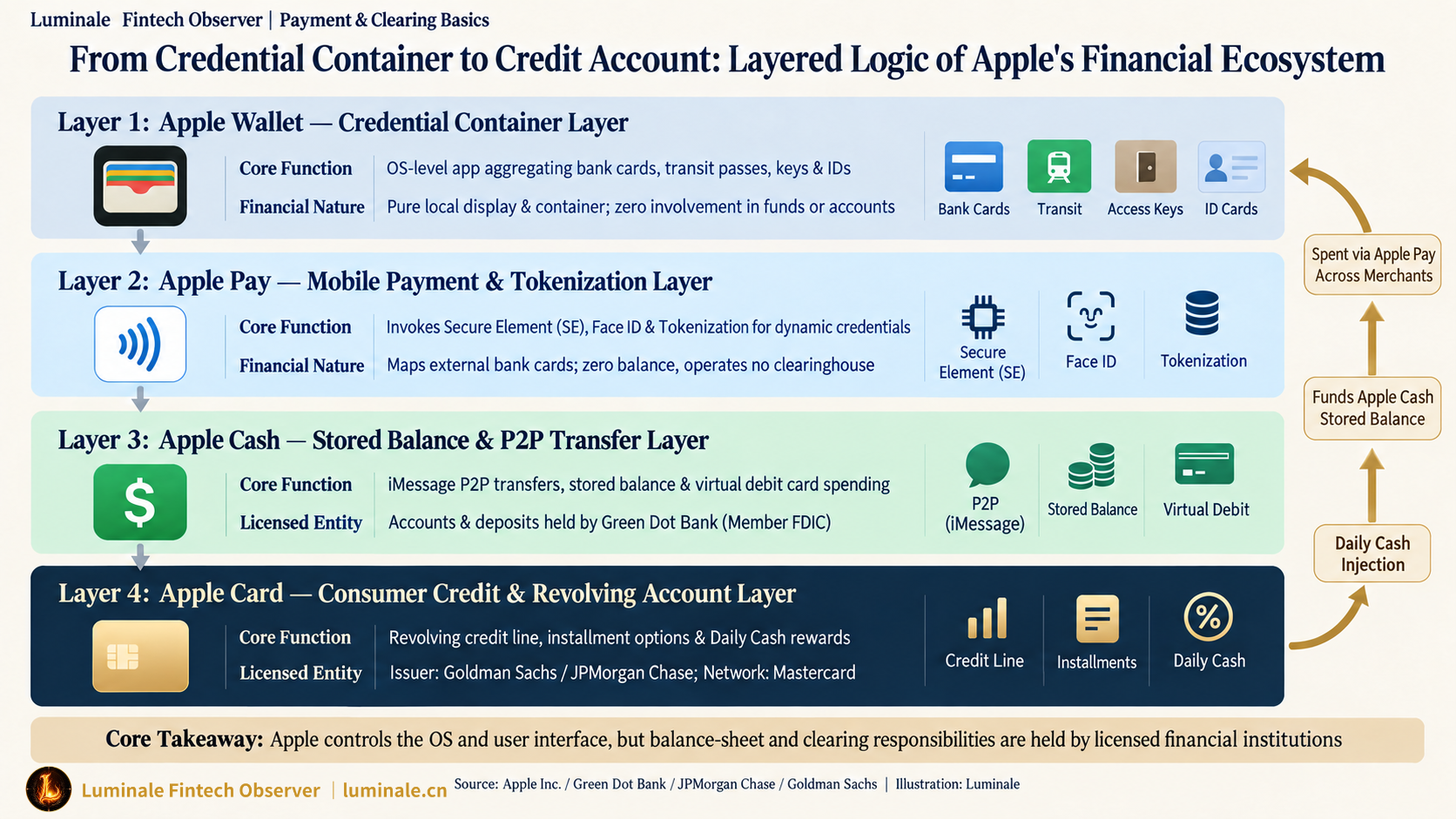
5. From Apple Pay to Apple Cash and Apple Card: Different Products Across Different Layers
Consumers occasionally confuse Apple Pay, Apple Cash, and Apple Card, wondering: if Apple Pay is merely a payment service, why does Apple also provide stored balances and credit cards?
These three offerings occupy distinct tiers within the financial services stack:
| Product | Product Nature | Fund & Account Balance Custodian | Primary Use Case |
|---|---|---|---|
| Apple Wallet | OS-level credential container | Local device storage; holds zero funds | Consolidates debit cards, credit cards, transit passes, access keys, and identity cards |
| Apple Pay | Mobile payment tokenization service | Maps external bank accounts | Substitutes physical cards for in-store and online checkout |
| Apple Cash | Stored balance & P2P transfer account | Green Dot Bank (Member FDIC) | Small-dollar P2P transfers via iMessage, balance accumulation |
| Apple Card | Co-branded consumer credit card | Goldman Sachs Bank USA / JPMorgan Chase | Consumer credit line, installments, revolving borrowing |
1. Apple Pay: A Zero-Balance Payment Conduit
Apple Pay itself does not maintain financial balances. If you bind a commercial bank debit card to Apple Pay, you cannot "deposit $1,000 into Apple Pay." When you spend, funds are debited in real time from your underlying commercial bank demand deposit account.
2. Apple Cash: A Deposit-Insured Digital Wallet
Apple Cash (originally introduced as Apple Pay Cash) introduces stored-value account balances. Users can send and receive peer-to-peer funds via iMessage, storing accumulated funds within an Apple Cash balance.
However, Apple has not transformed into a deposit-taking institution. Apple's customer disclosures state that Apple Cash accounts and underlying debit card services are provided by Green Dot Bank, an FDIC-insured institution; Apple Payments Services LLC operates as a technical service provider facilitating user interface access.[9]
Funds held in Apple Cash can be transferred out to personal commercial bank accounts or spent directly as a virtual debit card via Apple Pay at merchant locations.
3. Apple Card: A Commercial Bank Credit Card
Apple Card represents Apple's foray into consumer lending, yet Apple does not carry the credit portfolio or loan receivables on its corporate balance sheet.
Apple Card is an authentic credit card featuring revolving credit, monthly billing, and installment plans. Since its 2019 rollout, the issuing bank has been Goldman Sachs Bank USA, operating over the Mastercard payment network. Apple oversees customer experience design, Wallet integration, Daily Cash reward calculations, and system interfaces.
In January 2026, Apple announced that JPMorgan Chase will assume the role of issuing bank for Apple Card, with a transition window of approximately 24 months, while Mastercard continues to serve as the exclusive payment network.[10]
The structural division across these offerings can be represented as:
Apple Card (Credit line & consumer financing)
       ↓ Daily Cash cashback accumulation
Apple Cash (Stored balance repository)
       ↓ Provisioned as spending credential
Apple Pay (Contactless payment technical engine)
       ↓ Consolidated interface presentation
Apple Wallet (Operating-system-level container)
Cardholders spend using Apple Card, earning 1% to 3% in Daily Cash rewards; cash-back amounts are automatically deposited into their Green Dot Bank-administered Apple Cash account; consumers can then deploy that Apple Cash balance or their primary Apple Card line to make purchases via Apple Pay.
These offerings integrate fluidly within Apple Wallet, yet credit risk, deposit taking, and payment settlement remain anchored with chartered financial institutions (Goldman Sachs, JPMorgan Chase, Green Dot Bank) and card networks (Mastercard).
Apple did not replace financial infrastructure; rather, it provided an intuitive, cohesive digital interface layered over established financial utilities.
Conclusion: Upgrading Payment Experiences over Established Networks
Looking back at Apple Pay's trajectory, the initial consumer takeaway was simply "leaving the wallet at home."
From a financial market infrastructure perspective, Apple Pay demonstrated a distinct approach to retail payment innovation: transforming how consumers experience payments does not require dismantling established bank accounts, messaging networks, and interbank settlement systems.
Financial commerce rests on trust, risk underwriting, and legal finality in settlement. The clearing and settlement frameworks operated by commercial banks and central banks have evolved over decades, providing liquidity backstops, large-value settlement capabilities, and well-defined legal certainty. Building a completely parallel payment system from the ground up entails immense regulatory burdens and requires convincing millions of merchants to deploy redundant acceptance infrastructure.
Apple Pay preserved the established foundation, layering payment tokenization, hardware Secure Elements, and single-use dynamic cryptograms over the existing four-party model. When a consumer uses an iPhone at a checkout terminal, the payload transmitted to the POS terminal consists of a surrogate token and a dynamic cryptogram rather than the static card number printed on a plastic card. The card payment network processes the transaction through established clearing channels, while the consumer completes the purchase securely through native device biometrics.
This dynamic offers a meaningful lesson for retail payments: in mature financial markets, valuable payment innovation often does not arise from discarding existing rails to erect standalone networks. Instead, it stems from deeply understanding incumbent clearing mechanisms and commercial models, leveraging established capabilities, and re-architecting user touchpoints, connection protocols, and service boundaries to address unmet consumer needs.
In many instances, payment innovation is less about rebuilding infrastructure from scratch and more about recombining existing infrastructure in smarter ways. Those who understand the operational mechanics of incumbent rails—and identify the intersection of technical capabilities, sustainable economics, and real-world user friction—are best positioned to build financial products that achieve meaningful, enduring scale.
References
[1]: Apple Inc. Apple Announces Apple Pay. Apple Newsroom, September 9, 2014. https://www.apple.com/sg/newsroom/2014/09/09Apple-Announces-Apple-Pay/ ↩
[2]: Apple Inc. Apple & China UnionPay to Bring Apple Pay to China. Apple Newsroom, December 18, 2015. https://www.apple.com/newsroom/2015/12/18Apple-China-UnionPay-to-Bring-Apple-Pay-to-China/ ↩
[3]: Apple Inc. Apple Platform Security: Apple Pay overview & card provisioning. Apple Support Guide, 2024. https://support.apple.com/guide/security/sec0f005981a/web ↩
[4]: EMVCo. Payment Tokenisation Specification: Technical Framework. EMVCo Official Specifications, 2021. https://www.emvco.com/emv-technologies/payment-tokenisation/ ↩
[5]: Apple Inc. Apple Platform Security: Secure Element. Apple Support Guide, 2024. https://support.apple.com/guide/security/seccb53a35f0/web ↩
[6]: Apple Inc. Apple Support: View your account balance and transaction history in the Wallet app. Apple Support, 2024. https://support.apple.com/en-us/111117 ↩
[7]: Apple Developer Documentation. Payment Token Format Reference & About Apple Pay. Apple Developer, 2024. https://developer.apple.com/documentation/PassKit/payment-token-format-reference ↩
[8]: U.S. Department of Justice. Justice Department Sues Apple for Monopolizing Smartphone Markets. Office of Public Affairs, March 21, 2024. https://www.justice.gov/opa/pr/justice-department-sues-apple-monopolizing-smartphone-markets ↩
[9]: Apple Inc. Apple Cash Terms and Conditions. Apple Support, 2024. https://support.apple.com/apple-cash ↩
[10]: Apple Inc. Chase to become the new issuer of Apple Card. Apple Newsroom, January 13, 2026. https://www.apple.com/newsroom/2026/01/chase-to-become-new-issuer-of-apple-card/ ↩
Originally published by Luminale Fintech Observer: https://luminale.cn/articles/what-happens-behind-apple-pay-payment-token-clearing-en