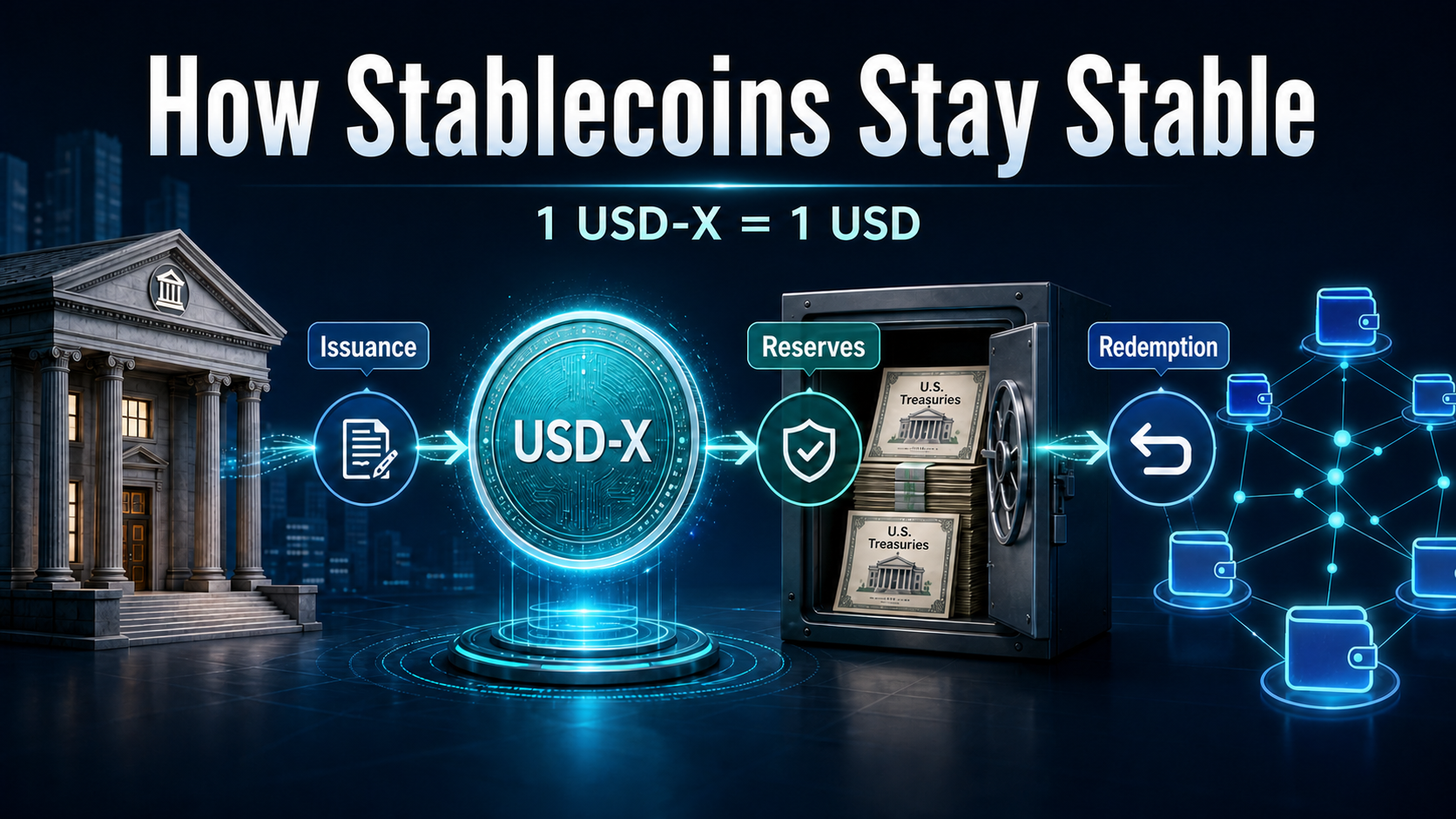
Many people, upon first encountering stablecoins, understand them as "cryptocurrencies with relatively stable prices." This statement isn't wrong, but it misses the core point.
A stablecoin is a monetary liability issued by a private institution and circulated on a blockchain network. The issuer promises to reference the value of a certain asset—most commonly the U.S. dollar—and allows holders to redeem at face value under specific conditions.
The key point isn't whether the price on screen always displays as $1. Stablecoins reorganize the credit relationships that originally existed in bank accounts, treasury bonds, and payment systems into Tokens that can flow 7×24 hours globally on-chain.
Therefore, understanding stablecoins requires looking beyond wallet balances and on-chain transfer records—you also need to examine the issuer, reserve assets, bank accounts, custody arrangements, redemption channels, and regulatory frameworks.
1. Why Stablecoins Emerged: What People Needed Wasn't Another Bitcoin
Cryptocurrency assets like Bitcoin are highly volatile. They can be used for trading, investing, or speculation, but they struggle to serve as a stable unit of account: a product worth $100,000 today might require a completely different amount of Bitcoin to purchase tomorrow.
The early crypto market needed an "on-chain cash balance."
Imagine a trader who sells Bitcoin but doesn't want to transfer the funds back to a bank account just yet. They need an asset whose price is close to the U.S. dollar, and which can be immediately used for the next on-chain transaction. Stablecoins were initially developed to meet precisely this kind of demand.
Bank deposits are equally stable, but they are recorded within the bank's own account system and cannot be directly invoked by smart contracts on public blockchains. Stablecoins, by contrast, bring the "U.S. dollar unit of account" into the blockchain network: users can transfer them to another address, deposit them into on-chain protocols, or use them as settlement assets for digital asset trading.
This does not mean stablecoins have already broadly replaced everyday payments. BIS research reminds us that while stablecoin on-chain transfer volumes are large, not every on-chain transfer should be counted as a real payment; a significant amount of activity occurs in trading, lending, arbitrage, and liquidity operations. BIS research on stablecoin transaction structure
As of 2026, stablecoins are still primarily used for crypto asset trading, as well as offshore dollar holdings in certain economies; the scale of real-economy payments is significantly smaller than total on-chain transaction volume. BIS: A discussion framework for stablecoins
The Current Stablecoin Market: Looks Large, But Is Actually Highly Concentrated
The stablecoin market does not consist of a large number of similarly sized products. According to DefiLlama data, the global stablecoin circulation is approximately $300.3 billion; of this, USDT accounts for approximately $183.4 billion, or about 61%, and USDC accounts for approximately $71.8 billion, or about 24%. Together they account for approximately 85% of the total market.
| Stablecoin | Category | Approximate Circulating Supply | Approximate Market Share |
|---|---|---|---|
| USDT | Fiat-reserve backed | $183.4 billion | 61% |
| USDC | Fiat-reserve backed | $71.8 billion | 24% |
| USDS | Multi-collateral stablecoin system | $6.7 billion | 2% |
| DAI | Crypto-asset over-collateralized | $4.8 billion | 1.6% |
| USD1 | Fiat-reserve backed | $4.0 billion | 1.3% |
This means that discussing the stablecoin market today is largely a discussion about the reserve management, redemption capabilities, and compliance arrangements of a small number of large issuers. Market concentration brings deeper liquidity and network effects; however, if confidence in a leading stablecoin is ever shaken, the impact could quickly spread through trading platforms, on-chain protocols, and cross-border fund networks.
Circulating supply does not equal real payment volume, nor does it represent the quality of an issuer's reserves. The former answers "how many Tokens are out there in the market," while the latter determines whether those Tokens can be cashed out under stress. DefiLlama stablecoin data
What stablecoins first solved was not replacing fiat currency, but rather the problem of there being no stable settlement asset within digital asset networks.
2. Stablecoins Are Not a Single Thing: First Look at What They Peg To, Then How the Peg Is Maintained
"Stablecoin" is an umbrella term. To assess the risk of a stablecoin, you need to answer at least two questions:
- What price is it trying to stay stable at?
- What mechanism does it rely on to maintain that price?
| Type | Common Peg Target | Primary Stabilization Mechanism | Primary Risks |
|---|---|---|---|
| Fiat-reserve backed | Fiat currencies like USD, EUR | Issuer holds reserves such as cash, bank deposits, short-term treasuries, and offers redemption | Issuer, reserve, redemption, and custody risk |
| Crypto-asset over-collateralized | Usually U.S. dollar value | Locks up crypto assets worth more than the issuance amount, with liquidation mechanisms | Collateral volatility, liquidation congestion, smart contract risk |
| Algorithmic | Usually U.S. dollar value | Maintains price through supply adjustments, incentives, or conversion relationships with another token | Confidence collapse and "death spiral" risk |
| Synthetic | U.S. dollar or other market prices | Collateral combined with derivatives hedging to gain exposure to the target asset price | Counterparty, leverage, derivatives, and liquidity risk |
The type most relevant to payment infrastructure—and the primary focus of regulation—is typically the fiat-reserve-backed payment stablecoin, such as USDT and USDC.
Algorithmic stablecoins demonstrate that a price "appearing close to $1" does not mean there are sufficient assets backing redemption. The UST de-pegging event in 2022 showed that stabilization arrangements dependent on market confidence and incentive mechanisms can fail quickly under stress.
3. How a Stablecoin Operates: The Key Lies Between On-Chain and Off-Chain
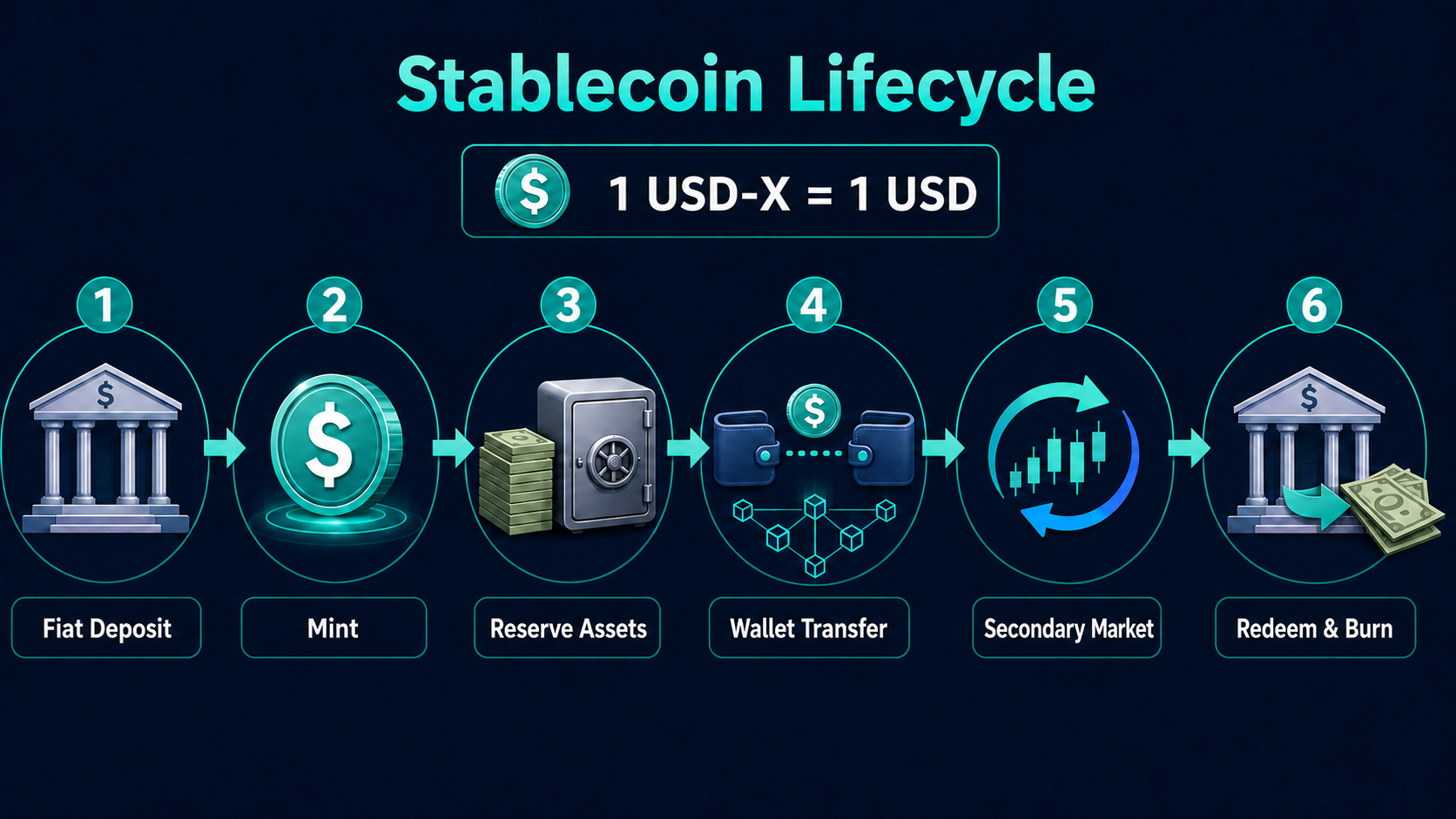
Take a hypothetical USD-X as an example. The issuer promises that eligible customers can redeem 1 USD-X for $1.
Suppose an institutional client wishes to obtain 1 million USD-X. The process can be divided into six steps.
1. Fiat Deposit and Issuance
The client wires $1 million to a bank account designated by the issuer. Once the funds arrive, the issuer mints 1 million USD-X and sends the Tokens to the wallet address specified by the client.
At this point, the client's bank deposit has been converted into a claim against the stablecoin issuer: the client holds 1 million USD-X, and the issuer bears the obligation to pay out according to the rules.
2. Reserves: The Money Behind Stablecoins Is Not on the Blockchain
The $1 million received by the issuer is not "stored on the blockchain." It is typically allocated into bank deposits, short-term U.S. Treasury bonds, reverse repos, or other highly liquid assets.
This is precisely the point most easily overlooked when understanding stablecoins:
Take USDC as an example: Circle states that its reserves are backed by highly liquid cash and cash equivalents, and it continuously discloses monthly reserve attestation information. Circle's USDC documentation
To judge whether a stablecoin is reliable, you cannot simply look at which blockchain it uses—you also need to examine the composition of reserve assets, the custodian, the adequacy of information disclosure, and whether it can be quickly liquidated under stress.
3. On-Chain Transfer: What Moves Is Token Ownership
Once the client receives USD-X, they can transfer it to another wallet or use it for on-chain trading and smart contracts.
What is updated on-chain is the record of control or ownership of the Token, not reserve accounts between commercial banks.
Therefore, saying "a stablecoin transfer is a dollar transfer on the blockchain" is inaccurate. What moves on-chain is a Token issued by the issuer; whether it can be exchanged for dollars at face value depends on the issuer's reserves, redemption arrangements, and market confidence.
4. Custody: Owning the Token Doesn't Necessarily Mean Controlling the Private Key
Stablecoins can be held in self-custody wallets, or they can be held on behalf of users by trading platforms, banks, or professional custodians.
There is an easily overlooked distinction here:
- Who holds the economic rights to the Token;
- Who holds control of the private key or account.
Self-custody reduces reliance on platforms, but users must bear the responsibility for private key management, address mis-transfers, and operational security; platform custody is more convenient, but users assume the risks arising from the platform and its custody arrangements.
5. Secondary Market Trading: The Price Can Fluctuate Around $1
Most ordinary users do not directly subscribe to or redeem with the issuer; instead, they buy and sell stablecoins on trading platforms or in over-the-counter markets. Therefore, USD-X might be quoted at $0.999 or $1.001 on the secondary market.
Such minor deviations are not uncommon. What matters is whether the market believes it can be redeemed at face value.
If USD-X drops to $0.98, while eligible customers can still redeem at $1, arbitrageurs may buy USD-X at the low price and submit it to the issuer for redemption in dollars. The increase in buy orders would push the price back up.
6. Redemption and Burning: The Final Link in the Peg
When a client submits 1 million USD-X back to the issuer and requests redemption, the issuer burns those Tokens and pays the client $1 million from its reserve system.
The entire process can be summarized as:
Fiat deposit → Minting → Reserve allocation → On-chain transfer → Secondary market pricing → Redemption → Burning
Issuance and redemption in the primary market establish the peg relationship, while arbitrage in the secondary market pulls the price back toward the peg in day-to-day trading.
A stablecoin's anchor is not the "1.00" on screen, but whether the market believes it can be exchanged at face value when needed.
4. Five Concepts Easiest to Confuse with Stablecoins
| Concept | Issuer | Primary Right Held by the Holder | Operating Network | Equivalent to Bank Deposit? |
|---|---|---|---|---|
| Bank deposit | Commercial bank | Deposit claim against the bank | Bank accounts and payment systems | Yes |
| Electronic money | Licensed e-money institutions, etc. | Right to exchange for fiat currency per rules | Payment institution account systems | No |
| Stablecoin | Private issuer | Redemption claim against the issuer, subject to specific terms and law | Blockchain network | No |
| Tokenized deposit | Commercial bank | Deposit claim against the bank, represented in Token form | Typically a controlled or permissioned network | Essentially yes |
| CBDC | Central bank | Direct claim against the central bank | Digital currency system designed by the central bank | No, but it is central bank money |
All of these may appear in digital form, yet they correspond to different issuers, balance sheets, and legal relationships.
Stablecoins are generally not central bank money, nor do they automatically enjoy deposit insurance or central bank liquidity support. Whether they remain stable depends on the commitments and institutional arrangements of private issuers, not on the blockchain itself.
5. What Regulation Is Really About: Not Just Governing the Blockchain, But Governing Private Money Commitments
The concern of stablecoin regulation is not whether a Token can be transferred at 3 a.m., but whether, when all holders simultaneously demand redemption, the issuer has sufficient and quickly liquidatable assets to fulfill its obligations.
Regulatory frameworks vary across jurisdictions, but the points of focus are increasingly converging:
- Who can issue;
- What reserve assets may be held;
- Whether reserves are segregated from the issuer's own assets;
- Whether users can redeem at face value within a reasonable timeframe;
- How disclosure, auditing, and liquidity management are handled;
- How custody, technology, anti-money laundering, and sanctions compliance are addressed;
- How the legal status of holders is defined in the event of issuer bankruptcy.
In the United States, the GENIUS Act became law in July 2025, establishing a basic federal framework for payment stablecoins; key elements include requirements for qualified issuers, reserves, and disclosure, with specific implementation still awaiting further regulatory rules. U.S. Congressional record
The EU's MiCA distinguishes between asset-referenced tokens (ART) and e-money tokens (EMT). For EMTs pegged to a single official currency, the rules emphasize relevant authorization and redemption at face value. European Banking Authority's MiCA explanation
Hong Kong's licensing regime for fiat-referenced stablecoin issuers took effect in August 2025. The Hong Kong Monetary Authority has explicitly brought fiat-referenced stablecoin issuance into its licensing and regulatory framework. HKMA Legislative Council document
Global rules are not yet unified. In its 2025 assessment, the FSB noted that jurisdictions still show significant gaps and inconsistencies in implementing global stablecoin arrangements, and cross-border regulatory coordination remains a challenge. FSB assessment
The regulatory environments of Mainland China and Hong Kong need to be examined separately: Hong Kong has established a local licensing regime for fiat-referenced stablecoin issuers; Mainland China maintains a strictly restrictive regulatory stance on virtual currency-related financial activities. The two cannot be simply equated.
6. Have Stablecoins Changed Payments? What Has Changed Is the Way Value Movement Is Organized
The potential value of stablecoins goes beyond merely making card payments faster.
It places payment instruments, settlement assets, and programmable digital assets into the same technological environment: value can be transferred around the clock on blockchain networks and combined with smart contracts, digital asset trading, or delivery conditions.
This makes them attractive for cross-border transfers, on-chain finance, tokenized asset settlement, and corporate treasury management.
But "fast on-chain transfers" does not mean the entire payment process is faster and cheaper. Moving fiat currency into and out of the stablecoin system still requires going through banks and payment institutions; cross-border payments still must handle KYC, anti-money laundering, sanctions, foreign exchange controls, and capital flow rules; different blockchains also present issues of bridging, interoperability, network fees, and smart contract risks.
Traditional payments primarily rely on:
Bank credit + payment systems + central bank money for final settlement.
Stablecoin payments additionally introduce:
Issuer risk + reserve asset risk + custody risk + smart contract risk + blockchain operational risk.
Technology can shorten parts of the payment chain, but it does not make risk disappear. More often than not, it simply moves the risk elsewhere.
BIS has also noted that stablecoins may offer potential benefits such as faster cross-border payments, programmability, and atomic settlement; however, they do not settle in central bank money and cannot be naturally guaranteed to remain redeemable at face value at all times during stress periods. BIS explanation of stablecoin risks and potential
Conclusion: When Assessing Stablecoins, Don't Just Ask "Is It $1?"
A stablecoin is not an ordinary bank deposit, nor is it a CBDC. A price close to $1 does not mean it can be directly equated with the U.S. dollar.
From an infrastructure perspective, a fiat-backed stablecoin has two systems behind it:
- On-chain: the Token, wallet, address, smart contracts, and blockchain;
- Off-chain: the issuer, bank accounts, reserve assets, custodians, redemption mechanisms, and regulatory frameworks.
What makes stablecoins unique is that they connect these two originally relatively independent systems.
To judge whether a stablecoin is reliable, in addition to looking at whether it is $1, you should continue to ask:
- Who issues it?
- What are the reserves?
- Where are the reserves held?
- Who can redeem, and how quickly?
- In extreme scenarios, can the issuer satisfy concentrated redemption demand?
- What can the on-chain Token ultimately be exchanged for?
- Throughout the entire process, who bears the credit and liquidity risks?
These questions help us understand stablecoins, and they also help us determine who bears the risks in cross-border payments, tokenized deposits, and digital currency infrastructure.
Originally published by Luminale Fintech Observer: https://luminale.cn/articles/what-is-stablecoin-en