
On October 12, 2026, Andrew Bailey, Chair of the Financial Stability Board (FSB), sent a letter to G20 Finance Ministers and Central Bank Governors introducing a package of reports prepared for their October 15 meeting. Accompanying the letter was an explanatory note on global stablecoin arrangements[1][2]. The 9-page document, containing about 5 pages of main text excluding the cover and table of contents, brings together two ongoing strands of FSB work: cross-border vulnerabilities of global stablecoins and the data required to monitor them.
The baseline numbers provided in the note show that as of mid-2026, total stablecoin market capitalization stood at approximately USD 300 billion, largely unchanged from a year earlier. Measured by value, 99% remain pegged to the US dollar[1].
Even though market size has stayed essentially flat for a year, the FSB dedicated focused attention to its cross-border risks due to the inherent structure of stablecoins. A holder can sell stablecoins or transfer them to a wallet address in another country in the early hours of a Saturday morning; an issuer needing to pay out US dollars, however, must wait for reserve asset markets to open, banks to begin operating hours, and payment systems to come online. The report repeatedly underscores this core mismatch: liabilities circulate globally around the clock, while reserve assets, bank accounts, and fiat currency redemptions continue to operate within specific jurisdictions and business hours.
Tracing the path of a single redemption, this article examines where these mismatches emerge, how stress transmits into the traditional financial system, and why authorities struggle to track where funds are moving.
1. USD 300 Billion and 99% Pegged to the US Dollar: Why the FSB Focuses on Cross-border Issues
1. The Note's Place in the FSB's Work
In July 2023, the FSB published its High-level Recommendations for the Regulation, Supervision and Oversight of Global Stablecoin Arrangements[3]. In October 2025, the FSB followed up with a thematic peer review assessing implementation of its global regulatory framework for crypto-asset activities. The review found that as of August 2025, while jurisdictions had progressed in regulating crypto-asset activities, regulation of global stablecoin arrangements lagged behind, revealing notable implementation gaps and inconsistencies across borders[4].
Building on this foundation, the current note advances the analysis across three key dimensions: the structural setup of global stablecoin arrangements, the potential transmission channels of vulnerabilities, and the monitoring indicators needed to safeguard financial stability[1]. The note does not introduce new regulatory standards; it serves as a progress report. It complements ongoing work by sectoral standard-setting bodies across monetary sovereignty, safety and efficiency of payments and settlements, consumer protection, and anti-money laundering and countering the financing of terrorism (AML/CFT).
2. What Qualifies as a Global Stablecoin
The FSB defines a Global Stablecoin (GSC) as a stablecoin with an existing or potential reach and use across multiple jurisdictions, which could become systemically important in and across one or more jurisdictions[1][3]. Systemic importance can arise from its widespread adoption as a means of payment or store of value, or through its direct interconnectedness with other financial markets.
Operating a global stablecoin typically requires the coordination of multiple entities: issuance and redemption, reserve asset management and custody, wallet services, trading platforms, and distribution channels may all reside in separate legal entities regulated in different countries. The FSB refers to this collective ecosystem as a Global Stablecoin Arrangement. Because both its usage and participating entities span borders, no single jurisdiction can adequately assess or mitigate its cross-border vulnerabilities on its own[1].
3. Where Stablecoins Are Currently Used
The report notes that stablecoins are currently used primarily as a bridge and source of liquidity for entering, exiting, and trading in crypto-asset markets. In some emerging market and developing economies (EMDEs), they can serve as alternative stores of value or support financial inclusion. Looking ahead, stablecoins may enable faster, cheaper, and more transparent domestic and cross-border payments. The FSB notes, however, that some of these potential benefits stem from distributed ledger technology (DLT) and tokenization more broadly, rather than being unique to stablecoins[1].
We previously analyzed how stablecoins maintain their peg and how their reserve assets are structured in Understanding Stablecoins: How Do They Actually Stay Stable?. For context on the crypto-asset markets they primarily serve, see What Are Crypto-Assets? The Financial Logic from Bitcoin and Ether to Unbacked Assets. This article focuses on the vulnerabilities that arise once stablecoins are used across borders.
A 99% peg to the US dollar means that regardless of where a holder resides, final redemption inevitably depends on US dollar assets and the US dollar payment infrastructure.
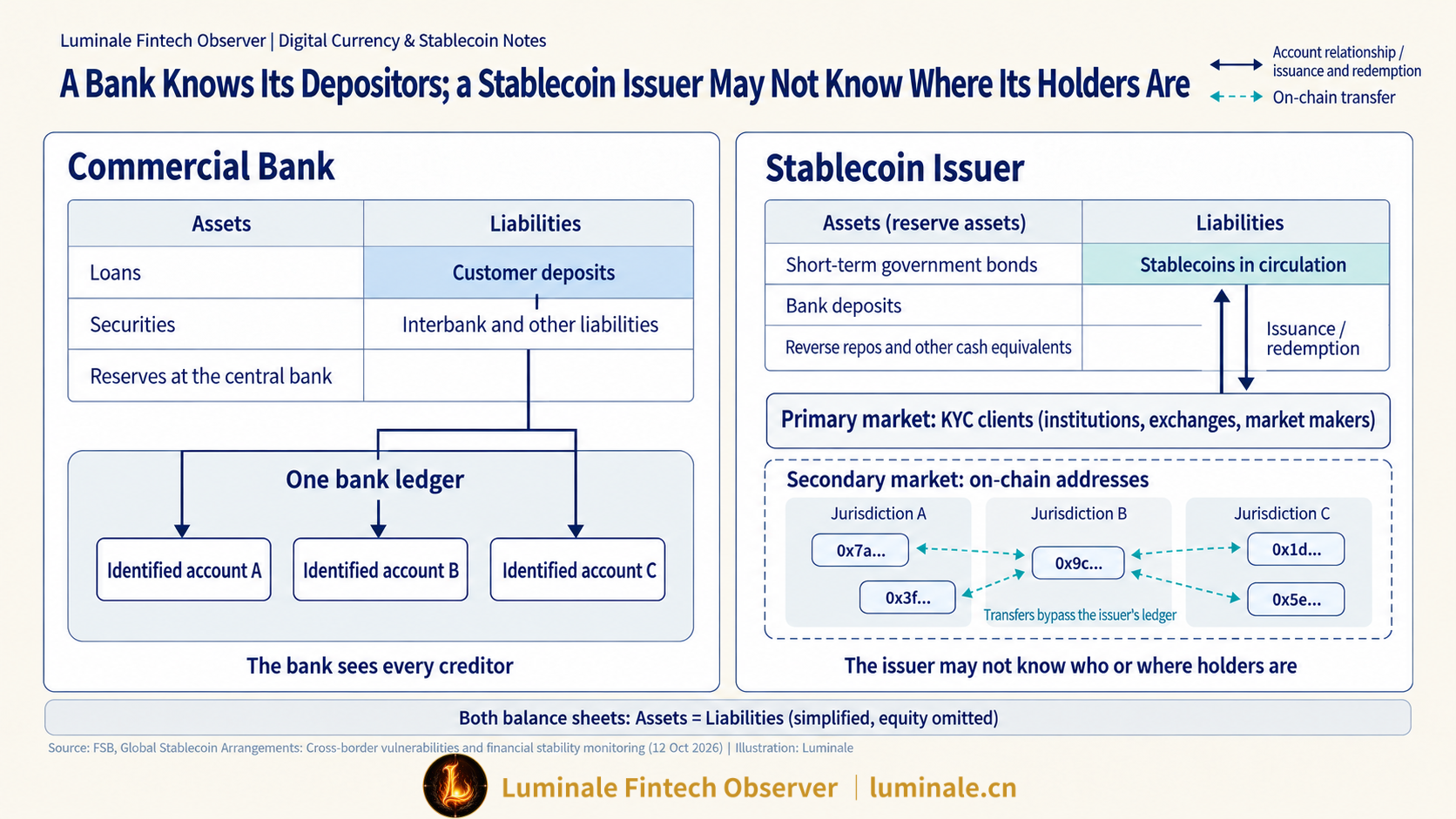
2. A Bank Knows Its Depositors; a Stablecoin Issuer May Not Know Where Its Holders Are
The FSB report draws a direct contrast with commercial banks. The relationship between a bank and its depositors is account-based: balance changes are managed and reconciled holistically across the bank's balance sheet. By contrast, a global stablecoin issuer may not know who holds its liabilities, where those holders reside, or where redemption demand might suddenly emerge. As the report describes it, the issuer's liabilities can move internationally and remain partially unobservable[1].
Two simplified balance sheets highlight this structural difference:
Commercial Bank (Simplified)
| Assets | Liabilities |
|---|---|
| Loans | Customer deposits (each tied to an identified account) |
| Securities | Interbank and other liabilities |
| Reserves at the central bank |
Stablecoin Issuer (Simplified)
| Assets (Reserve Assets) | Liabilities |
|---|---|
| Short-term government bonds | Stablecoins in circulation |
| Bank deposits | |
| Reverse repos and other cash equivalents |
1. Primary and Secondary Markets
The circulation of stablecoins operates across two distinct layers. In the primary market, direct issuance and redemption with the issuer are typically restricted to clients who have completed Know Your Customer (KYC) onboarding—mostly institutions, trading platforms, and market makers. During issuance, the issuer receives US dollars and mints new tokens, expanding both assets and liabilities. During redemption, the issuer burns tokens and disburses US dollars, contracting both assets and liabilities.
In the secondary market, tokens are traded between trading platforms or transferred peer-to-peer across on-chain addresses, with transactions executed directly between buyers and sellers. The issuer's total liabilities remain unchanged; all that changes is who is owed.
A USD 100 million example illustrates the ledger impact on the issuer:
| Operation | Issuer Assets | Issuer Liabilities | Does Issuer Know the Counterparty? |
|---|---|---|---|
| Primary Market Issuance | Reserve assets +USD 100M | Stablecoins in circulation +USD 100M | Yes (KYC client) |
| Secondary Market Transfer | Unchanged | Unchanged (Holder changes) | Typically no |
| Primary Market Redemption | Reserve assets −USD 100M | Stablecoins in circulation −USD 100M | Yes (KYC client) |
A single token may change hands multiple times in a day across wallet addresses in different countries, yet on the issuer's ledger, it remains the exact same liability. When a bank processes an on-us transfer, the payer's deposit decreases and the payee's deposit increases, with both debited and credited on the bank's own internal ledger. When a stablecoin changes hands on the secondary market, absolutely nothing registers on the issuer's ledger. For a deeper discussion of the accounting differences between account-based and token-based architectures, see How Do Digital Currencies Keep Books? From Accounts and Tokens to CBDC Ledger Design.
2. The Distinction Between Pseudonymous and Anonymous
On public blockchains, addresses and balances are publicly visible and queryable by anyone; however, the identity and geographic location of the party behind an address often cannot be determined. The FSB characterizes this state as pseudonymous, which is fundamentally distinct from complete anonymity. An issuer knows its primary-market clients, but has little visibility into the ultimate holders trading in secondary markets.
This differs markedly from tokenized deposits, even though both represent money on a ledger. Tokenized deposits remain liabilities of a commercial bank owed to known customers, with holding generally restricted to the bank's verified client base; see Tokenized Deposits: How Commercial Bank Money Enters the On-Chain World.
This structural difference on the liabilities side directly influences the market pricing of stablecoins. Bank deposits convert one-to-one at par, anchored by central bank settlement and deposit insurance schemes. Stablecoins, by contrast, can see their secondary-market prices trade away from USD 1.00, reflecting differing reserve asset quality and redemption mechanics across issuers. This dynamic is central to the concept explored in Why Is One Dollar in Any Bank Always One Dollar, but Not Always in Stablecoins? Understanding the BIS "Singleness of Money".
While identifying these vulnerabilities, the FSB also notes that the ability of global stablecoins to be accessed and transferred internationally is precisely one of the factors underpinning their potential benefits[1].
3. On-chain 24/7, Off-chain on Business Hours: Where Redemptions Get Stuck
The FSB points out that the reserve assets backing tokens, as well as the legal protections available to holders, are anchored—at least in part—in specific jurisdictions. Issuers structure their arrangements so that commitments regarding reserves and fiat redemptions are enforceable under the legal framework of at least one jurisdiction, making them subject to that framework's rules. Furthermore, redemptions and reserve management must follow the operating hours and settlement conventions of local markets, and are increasingly subject to local regulatory requirements[1].
1. Five Steps of a Single Redemption
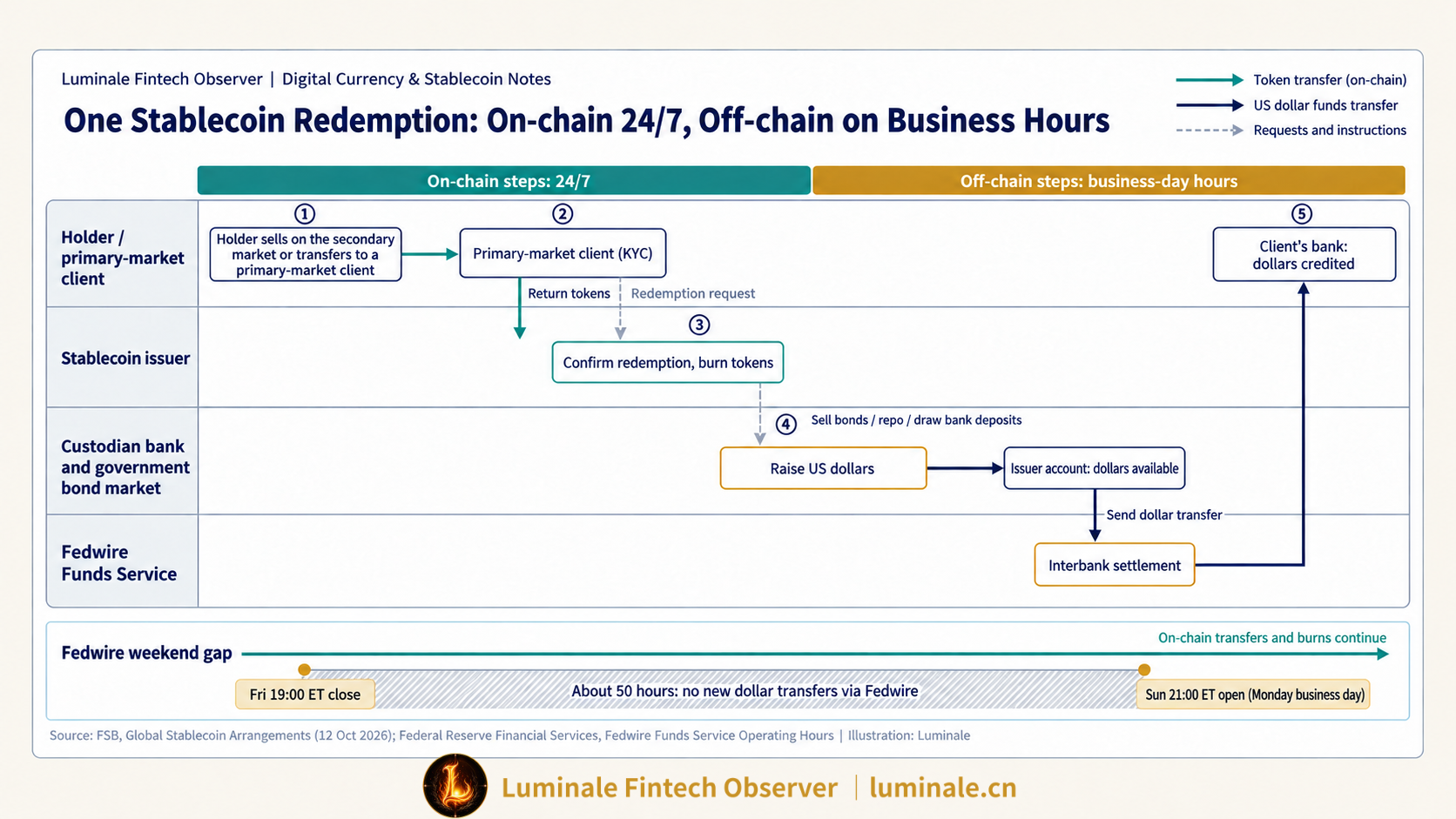
When a holder seeks to convert stablecoins back into fiat US dollars, the end-to-end process typically spans five steps:
| Step | Where It Takes Place | Operating Hours |
|---|---|---|
| ① Holder sells tokens on secondary market or transfers to an eligible primary-market client | Trading platforms, on-chain | 24/7 |
| ② Primary-market client submits redemption request and returns tokens to issuer | On-chain, issuer internal systems | On-chain 24/7; issuer processing per operating rules |
| ③ Issuer confirms redemption and burns tokens | On-chain | 24/7 |
| ④ Issuer raises US dollars to fund payment: draws bank deposits, sells Treasuries, or executes repos | Custodian banks, Treasury market | Primarily US business days |
| ⑤ US dollars transferred from issuer's bank to redeemer's bank account | Commercial banks and wholesale RTGS systems like Fedwire | Business-day operating hours |
The first three steps take place on-chain and can run continuously 24/7; the final two steps occur off-chain and are bound to the calendars of banks and financial markets.
Take the US large-value payment infrastructure as an example. The Federal Reserve's Fedwire Funds Service currently operates Monday through Friday, opening at 9:00 p.m. Eastern Time (ET) on the preceding calendar day and closing at 7:00 p.m. ET; it does not operate on Saturdays, Sundays, or Federal Reserve holidays[5]. Between Friday at 7:00 p.m. and Sunday at 9:00 p.m., there is a window of roughly 50 hours during which issuers cannot initiate new interbank dollar transfers over Fedwire. In October 2025, the Federal Reserve Board announced plans to expand operating days for the Fedwire Funds Service to include Sundays and weekday holidays, with implementation targeted for no earlier than 2028; even after that expansion, Saturdays will remain non-operational[6].
Completing an on-chain token transfer does not mean US dollars have achieved final settlement. Once tokens are burned, the issuer's stablecoin liability is canceled on-chain, but the redeemer's fiat US dollars may still be waiting for step ⑤ to execute. Interbank wholesale dollar transfers rely primarily on real-time gross settlement (RTGS) systems like Fedwire; for more on the operational mechanics, see Why Don't Payment Systems Settle Every Payment Instantly? Understanding RTGS and DNS. For the critical distinction between on-chain confirmation and legal settlement finality, see Can a "Successful Payment" Still Be Reversed? What Risks Settlement Finality Really Solves.
The diagram below, compiled by Luminale based on the FSB note and public Federal Reserve documentation, uses distinct line styles to distinguish on-chain token transfers, off-chain funds transfers, and instruction flows:
2. A Weekend Stress Scenario
Consider the following illustrative scenario (not a historical case study from the FSB report).
On a Friday evening, market confidence in a stablecoin's reserves begins to fray. Over Saturday and Sunday, secondary-market selling intensifies, nudging the price below USD 1.00. Under normal conditions, market makers would buy discounted tokens and submit them to the issuer for par redemption, pocketing the arbitrage spread and restoring the peg. Over the weekend, however, dollars from redemptions will not arrive until Monday at the earliest. Facing two days of price volatility and funding lockup, arbitrageurs demand a wider discount before stepping in, weakening the stabilizing force of arbitrage. By Monday morning, a backlog of redemption requests hits the issuer at once, forcing a rapid, large-scale liquidation of Treasuries to raise cash.
The FSB's assessment of secondary markets recognizes this dual dynamic. During stress, secondary markets operating 24/7 at high speed can accelerate and amplify selling pressure; if redemptions fail to keep pace, the peg comes under strain. Conversely, deep and liquid secondary markets facilitate arbitrage that helps restore the peg[1]. The effectiveness of arbitrage depends on how confident arbitrageurs are in par redemption and the duration of price risk and funding costs they must shoulder while waiting. Operating-hour closures erode both conditions simultaneously.
3. What Stablecoins Lack Compared to Bank Runs
Commercial banks face bank runs as well. The difference is that most jurisdictions have established safety nets for banks: institutions can access central bank liquidity facilities, such as the Federal Reserve's Discount Window, while depositors are protected by deposit insurance schemes. Stablecoin issuers generally have no access to these arrangements.
Liquidity backstops for banks are also constrained by operating hours. Alongside expanding Fedwire operating days, the Federal Reserve noted it is evaluating whether to adjust Discount Window operations accordingly[6].
A comparison can also be made with customer reserve funds held by payment institutions. Payment institutions hold client funds in centralized custody, where both the funds and customers operate within a single regulatory jurisdiction; see Are Funds in Alipay and Bank Cards the Same Thing? An Explainer on Customer Reserve Funds. For global stablecoins, holders are spread worldwide while reserve assets remain concentrated in a handful of jurisdictions, creating a structural mismatch between the two.
4. Three Channels Through Which Spillover Occurs
The FSB outlines three primary channels through which a run on a global stablecoin could spill over into the traditional financial system[1]:
| Channel | Transmission Mechanism | Affected Entities |
|---|---|---|
| Reserve Assets and Bank Deposits | Fire sales of reserve assets to meet redemptions; heavy deposit withdrawals from custodian banks | Short-term government bond and repo markets, custodian banks |
| Payment and Settlement Dependencies | If the real economy relies on a stablecoin for payments and settlements, disruptions halt economic transactions | Firms and individuals relying on the stablecoin for payments |
| Foreign Exchange Markets | Where stablecoins are used for cross-border transactions, stress transmits to related FX markets | FX conversions and cross-border capital flows in relevant currencies |
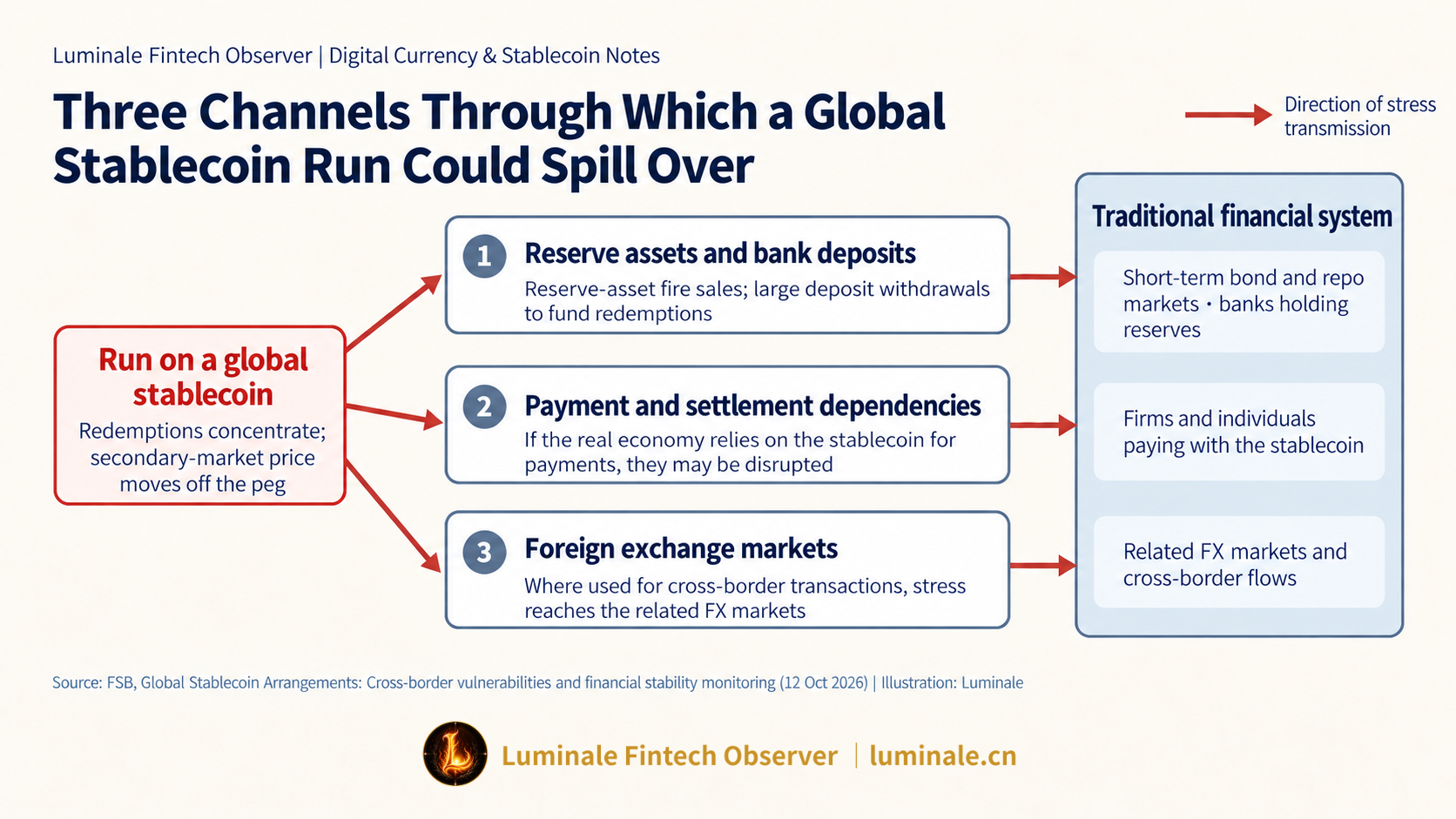
The first channel depends directly on reserve composition. A higher share of short-term government bonds and reverse repos forces the issuer to rely heavily on the Treasury market for liquidity; a higher share of bank deposits means custodian banks risk sudden, large-scale deposit outflows. The second channel remains limited today because stablecoins are primarily used within the crypto-asset ecosystem, but its systemic weight grows as real-economy adoption increases. The third channel is most directly tied to cross-border usage: wherever stablecoins facilitate cross-border receipts and payments, stress can ripple into local currency FX markets.
Accelerated transaction speeds also hasten risk transmission—a concern highlighted by the IMF regarding tokenization; see Reading the Latest IMF Report: Tokenization Makes Trading Faster, but Does It Make Risk Faster Too?. Stablecoins present an even more acute friction: 24/7 on-chain selling collides with business-day off-chain asset liquidation, compressing days of accumulated pressure into the opening hours of the market week.
4. One Coin, Multiple Reserve Books: Multi-issuer Structures and Cross-border Regulatory Gaps
While Section 3 examined the mismatch in time, global stablecoins also exhibit a spatial mismatch: liabilities circulate worldwide, while reserve assets and legal protections are anchored in one or a few jurisdictions. Multi-issuer structures magnify this friction.
1. How Multi-issuer Arrangements Operate
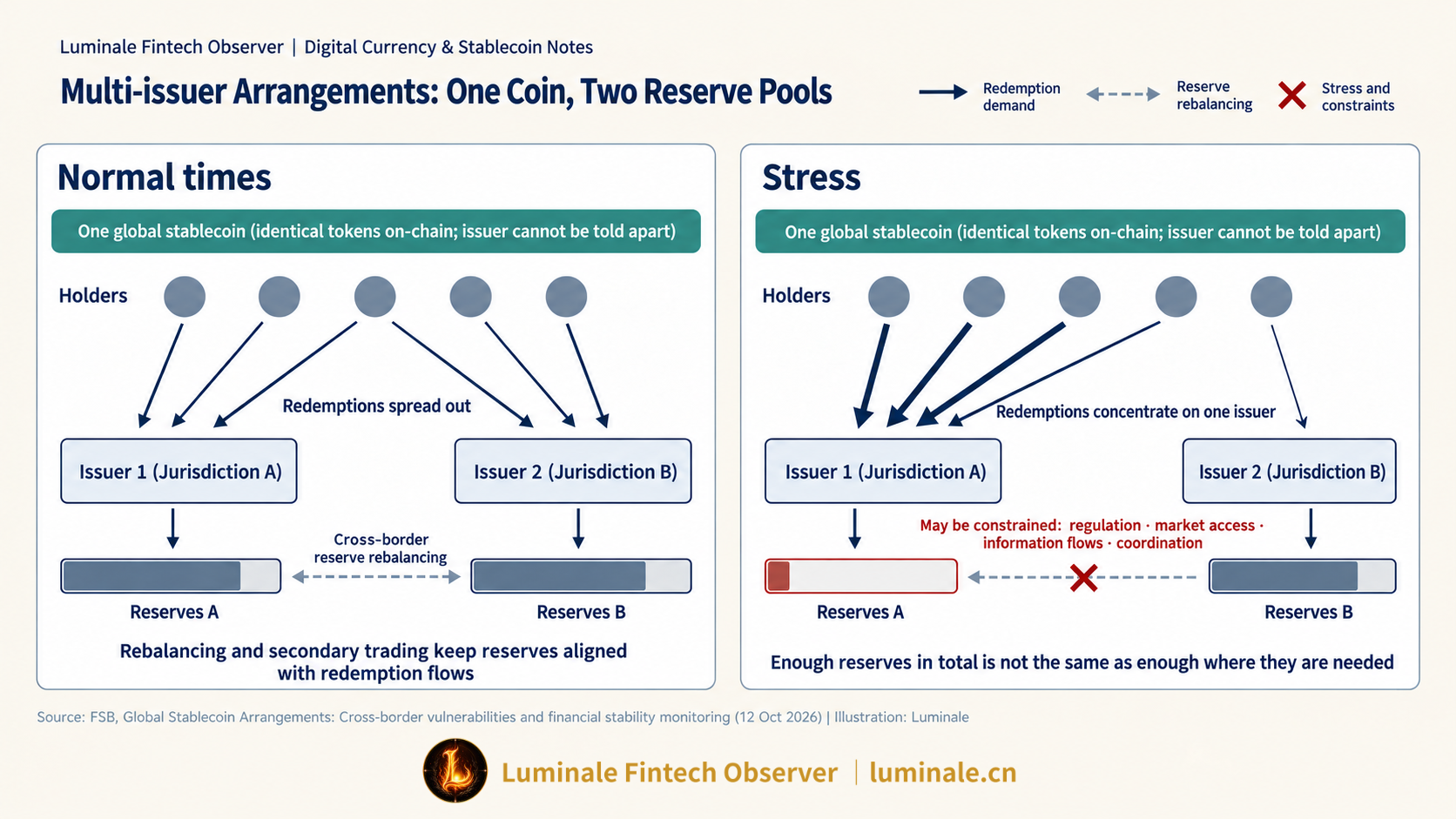
The FSB specifically examined multi-issuer arrangements: setups where multiple affiliated issuers back the same global stablecoin, each holding their own pool of reserves, while holders may be entitled to redeem against any issuer in the group. These arrangements rely on cross-border reserve rebalancing and secondary-market trading to keep reserve locations aligned with redemption flows[1].
Consider a simplified example. A stablecoin is jointly issued by two affiliated entities: Issuer A in Jurisdiction A and Issuer B in Jurisdiction B, each maintaining reserves under its domestic rules. The token shares identical on-chain smart contract properties, meaning holders cannot discern from the token itself which entity originally minted it.
| Scenario | Redemption Demand | Can Reserves Keep Pace? |
|---|---|---|
| Normal Times | Distributed across Issuer A and Issuer B, roughly in line with respective issuance shares | Cross-border reserve rebalancing and secondary trading keep reserve locations broadly aligned with redemption flows |
| Stress | Holders concentrate redemptions on whichever issuer is perceived to offer faster execution or stronger legal protections, such as Issuer A | Issuer A's local reserves prove insufficient, requiring inflows from Issuer B; transfers may be impeded by regulation, market access, data flows, and coordination |
In the FSB's words: where holders are entitled to redeem against any issuer regardless of where tokens were issued, redemption demand can concentrate on a single entity within the group. While reserve rebalancing and secondary trading can re-align reserves with redemption flows, their effectiveness hinges on asset mobility, market access, information flows, and operational coordination—all of which can break down in times of stress[1].
This setup mirrors a multinational banking group operating subsidiaries in two separate countries: depositors can withdraw funds at either subsidiary, yet reserves cannot be transferred instantly between them across borders. Having enough total reserves across the group does not mean having enough where redemptions are concentrated.
2. When Things Go Wrong, Who Owns the Debt?
Multi-issuer arrangements also introduce severe legal uncertainty in insolvency. If the location of some holders cannot be established, determining which issuing entity holds the liability and what claims holders possess becomes murky in resolution or bankruptcy. More broadly, if a global stablecoin arrangement fails, identifying which jurisdiction's insolvency framework applies—or how multiple national frameworks interact—presents formidable legal challenges[1].
The FSB further observes that complex cross-border corporate governance and distribution chains, combined with holding less liquid or lower-quality reserve assets in jurisdictions that have not adopted FSB recommendations, exacerbate liquidity and operational vulnerabilities. The quantity and quality of reserve assets, together with the regulatory framework governing the arrangement, remain fundamental determinants of resilience[1].
Cross-jurisdictional and cross-time-zone settlement risk is familiar terrain in traditional finance. Historically, in foreign exchange transactions settled across disparate national payment systems operating in different time zones, one party could irrevocably pay out funds without receiving the counter-currency; see What Is the Most Dangerous Moment in FX Trading? Why PvP Is the Foundation of Settlement. The FX market resolved this principal risk by establishing Payment versus Payment (PvP) settlement. Stablecoin redemptions and cross-border reserve transfers currently lack any comparable cross-border coordination mechanism.
3. Gaps Between National Regulatory Frameworks
The FSB finds that in many jurisdictions, how cross-border regulatory frameworks interface remains uncertain or undefined, including the treatment of foreign-issued stablecoins. Variations in regulatory requirements across borders have contributed to complex cross-border structures, leaving room for regulatory arbitrage as issuers choose to incorporate and operate in jurisdictions with lighter regulatory regimes[1].
The FSB acknowledges that there is no uniform blueprint. As jurisdictions implement the 2023 recommendations in line with their domestic mandates and legal traditions, the interaction among different frameworks remains complex and uncertain. A global stablecoin arrangement operating across multiple entities and regulatory regimes complicates ongoing supervision, crisis management, accountability, and cross-border cooperation during distress or insolvency. In the FSB's assessment: neither global stablecoins nor national regulatory frameworks have yet been tested by a severe crisis or disorderly insolvency[1].
Singapore's regulatory framework for single-currency stablecoins, including its criteria for recognizing foreign-issued stablecoins, offers one practical example of how individual jurisdictions are navigating these issues; see Singapore's Digital Finance Roadmap: From Tokenization to Payment and Settlement Infrastructure.
5. Opaque Capital Flows: Data Gaps and Emerging Market Risks
The third layer of friction centers on information: issuers cannot clearly see where holders reside, and regulatory authorities face significant hurdles in tracking the scale, geographic distribution, and economic uses of stablecoins.
1. Plentiful On-Chain Data, Limited Usable Monitoring Insights
The second section of the note focuses specifically on data challenges. While stablecoin activity generates massive volumes of raw on-chain data, several obstacles limit its practical utility for financial stability monitoring. The FSB groups these challenges into two categories[1]:
- Structural challenges: Transactions on public blockchains are pseudonymous, a feature likely to persist unless the crypto-asset ecosystem undergoes fundamental structural changes.
- Addressable challenges: First, some data exists technically but is not disclosed to the public or authorities; second, there is a lack of standardized methodologies, inference assumptions, formatting, and coverage when compiling and sharing data.
Currently, authorities rely predominantly on private third-party data vendors. These commercial providers compile, filter, and aggregate raw blockchain data using proprietary algorithms. Transparency and methodological rigor vary widely, making results difficult to compare across vendors. While authorities could invest in building internal blockchain analytics capabilities, the FSB acknowledges that this requires substantial financial and technical resources, particularly for emerging market and developing economies[1].
The most difficult challenge lies in attribution: mapping stablecoin activity to specific real-world uses and geographic locations. Such aggregate data is essential for identifying risk concentrations and tracking cross-border capital flows. The pseudonymous nature of public blockchains, combined with the smart contract architectures underpinning most stablecoins, makes attribution exceptionally difficult; even where attempted, non-standardized and opaque heuristics render the findings unreliable[1].
To understand why smart contracts compound attribution challenges, consider that many transfers route through liquidity pools, decentralized lending protocols, or cross-chain bridges. On-chain records show transactions interacting with automated contract code rather than named counterparties, requiring indirect inference to identify the underlying users. For foundational concepts, see Smart Contracts, Programmability, and On-Chain Settlement: Foundations of Automated Financial Transactions. By contrast, traditional cross-border wire transfers involve identified banking intermediaries, structured messaging that carries sender and receiver identifiers, and balance-of-payments reporting; see What Really Happens During a Cross-Border Wire? From Correspondent Banking and SWIFT to Global Payment Reform.
The FSB also identifies encouraging trends. Data availability has improved meaningfully in recent years through combining multi-source datasets, publishing and validating inference methodologies, and pioneering new approaches to estimate stablecoin usage. To date, these efforts have been driven primarily by the private sector. Emerging disclosure mandates, smart contract design refinements, and reporting standards are expected to produce more consistent on-chain and off-chain data over time[1].
2. Additional Risks Confronting Emerging Markets
The FSB highlights that emerging market and developing economies face heightened risks, including currency substitution, bank disintermediation, and challenges in managing cross-border capital flows. Consequently, stablecoins could reach systemic significance at much lower adoption thresholds in these economies[1].
At the account level, these three risks manifest directly: when residents swap local bank deposits for USD stablecoins, domestic banks lose deposit funding, reducing the credit available to the real economy; when stablecoins are stored in unhosted self-custody wallets and transferred across borders outside domestic banking rails, traditional foreign exchange controls and capital flow management measures struggle to maintain oversight. For a structural breakdown of cross-border financial account classifications, see From the Current Account to the Capital Account: How Cross-Border Capital Flows Are Classified.
3. The FSB's Recommended Next Steps
To address cross-border vulnerabilities, the FSB recommends monitoring secondary-market depth, liquidity, and microstructure, alongside tracking the geographic distribution of holdings, redemptions, and reserve assets—a priority underscored for multi-issuer setups. The note identifies three forward-looking priorities[1]:
- Deepen monitoring of cross-border vulnerabilities by leveraging these indicators and the FSB's ongoing work on stablecoin data;
- Support implementation of the 2023 recommendations, particularly by promoting cross-border supervisory cooperation and information sharing to bridge national regulatory frameworks;
- Stocktake crisis management and resolution practices for distressed or failing global stablecoin arrangements, with a particular focus on cross-border dimensions.
On the data front, the FSB suggests member jurisdictions and authorities pursue a three-step roadmap: establish a core set of financial stability indicators and identify data gaps; optimize the use of existing data by building cross-border analytical capabilities, enhancing information sharing, and coordinating across agencies; and explore industry best practices for collecting and compiling on- and off-chain data to incrementally improve data quality and cross-border comparability[1].
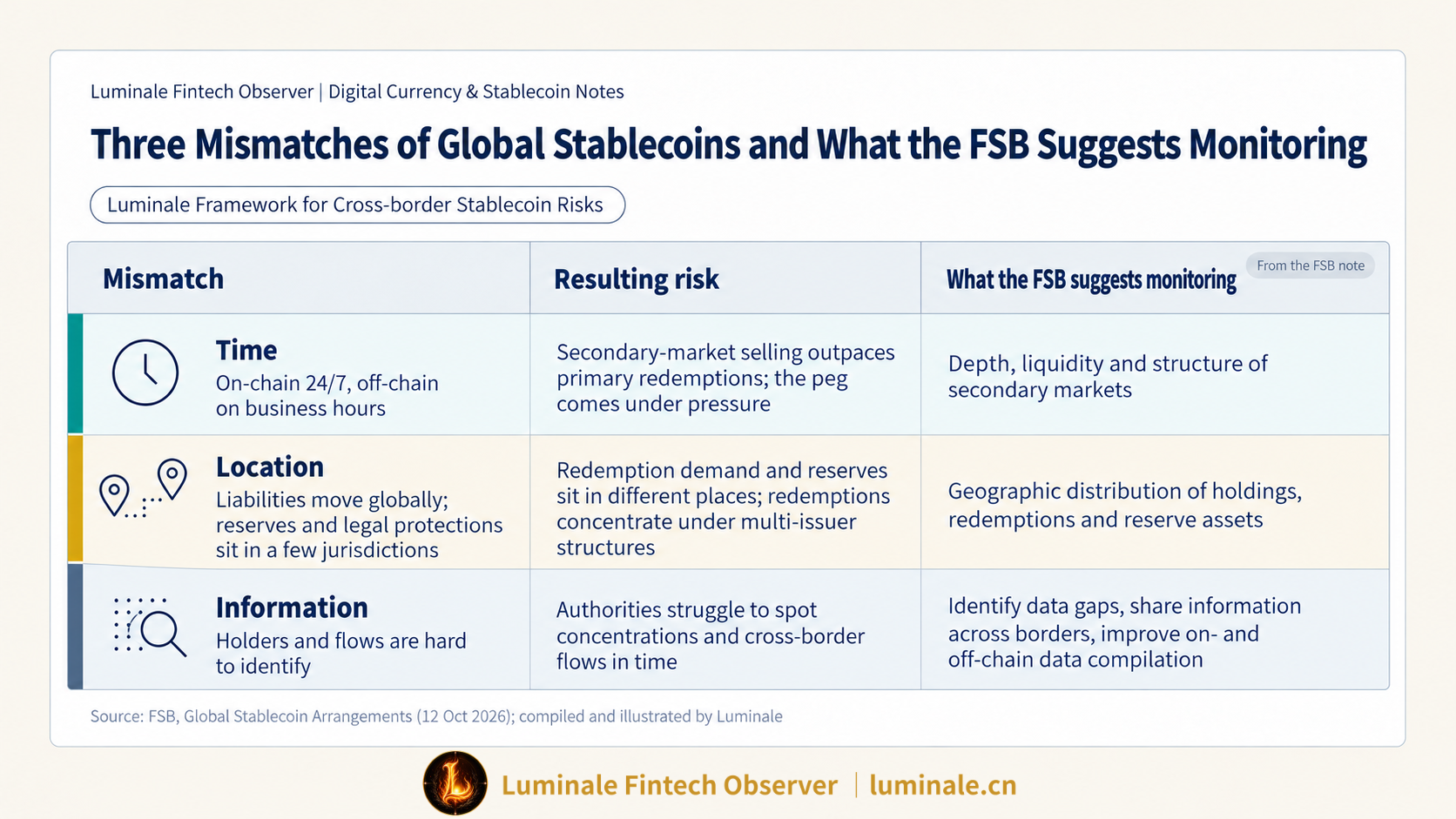
Synthesizing the core findings of the report alongside the FSB's recommended monitoring indicators yields the comparison matrix below. The left two columns summarize the structural mismatches analyzed here, while the right column reflects the FSB note's specific monitoring priorities:
| Mismatch | Resulting Risk | What the FSB Suggests Monitoring |
|---|---|---|
| Time: On-chain 24/7, off-chain on business hours | Secondary-market selling outpaces primary redemptions; the peg comes under pressure | Depth, liquidity, and structure of secondary markets |
| Location: Liabilities move globally; reserves and legal protections sit in a few jurisdictions | Redemption demand and reserves sit in different places; redemptions concentrate under multi-issuer structures | Geographic distribution of holdings, redemptions, and reserve assets |
| Information: Holders and flows are hard to identify | Authorities struggle to spot concentrations and cross-border flows in time | Identify data gaps, share information across borders, improve on- and off-chain data compilation |
6. Conclusion: Risks Are Concentrated in Off-chain Mechanics
Stablecoins transplant an age-old banking friction into a novel technological setting: liabilities demand immediate, continuous redemption on demand, while backing assets require time to liquidate and settle. Commercial banking has developed extensive institutional scaffolding to manage this tension, including customer identification, central bank lender-of-last-resort facilities, deposit insurance, and established resolution regimes. For global stablecoins—whose liabilities move globally 24/7 among partially unobservable holders—these protections are largely absent.
The speed of on-chain token transfers cannot bypass off-chain business hours, national legal jurisdictions, or the legal realities of insolvency. Assessing whether a global stablecoin is truly sound requires looking well beyond reserve coverage ratios; it demands evaluating where reserves are domiciled, how quickly they can be converted into central bank money during market stress, and which legal systems and regulatory authorities will govern resolution if the arrangement fails.
The FSB's note delivers a structured catalog of these pressing questions. While the USD 300 billion market size has remained stable over the past year, these questions address the systemic risks global stablecoins could present in the future. As stablecoins see expanding use in cross-border payments and the broader economy, the answers become increasingly vital—and will ultimately depend on whether national regulatory frameworks can successfully align through cross-border cooperation, supervisory information sharing, and coordinated crisis management.
References
[1]: Financial Stability Board (FSB). Global Stablecoin Arrangements: Cross-border vulnerabilities and financial stability monitoring. 12 October 2026. https://www.fsb.org/uploads/P121026-2.pdf ↩
[2]: Financial Stability Board (FSB). FSB Chair sets out FSB work on AI and stablecoins. Press release, 12 October 2026. https://www.fsb.org/2026/10/fsb-chair-sets-out-fsb-work-on-ai-and-stablecoins/ ↩
[3]: Financial Stability Board (FSB). High-level Recommendations for the Regulation, Supervision and Oversight of Global Stablecoin Arrangements: Final report. 17 July 2023. https://www.fsb.org/2023/07/high-level-recommendations-for-the-regulation-supervision-and-oversight-of-global-stablecoin-arrangements-final-report/ ↩
[4]: Financial Stability Board (FSB). FSB finds significant gaps and inconsistencies in implementation of crypto and stablecoin recommendations. Press release, 16 October 2025; Thematic Review on FSB Global Regulatory Framework for Crypto-asset Activities: Peer review report. https://www.fsb.org/2025/10/fsb-finds-significant-gaps-and-inconsistencies-in-implementation-of-crypto-and-stablecoin-recommendations/ ; https://www.fsb.org/uploads/P161025-1.pdf ↩
[5]: Federal Reserve Financial Services. Fedwire Funds Service and National Settlement Service Operating Hours. https://frbservices.org/resources/financial-services/wires/operating-hours.html ↩
[6]: Board of Governors of the Federal Reserve System. Federal Reserve Board announces expanded operating days of two large-value payments services, Fedwire Funds Service and the National Settlement Service (NSS), to include Sundays and weekday holidays. Press release, 9 October 2025; Federal Reserve Action to Expand Fedwire Funds Service and National Settlement Service Operating Hours (Docket No. OP-1870). https://www.federalreserve.gov/newsevents/pressreleases/other20251009a.htm ; https://www.federalreserve.gov/newsevents/pressreleases/files/other20251009a1.pdf ↩
Originally published by Luminale Fintech Observer: https://luminale.cn/articles/fsb-global-stablecoin-cross-border-vulnerabilities-en