When a Chinese resident buys a book on an overseas e-commerce platform with a credit card, a domestic enterprise wires equipment payments to an overseas supplier, an international student pays tuition to a British university, or a multinational corporation remits dividends back to its overseas parent—on online banking portals or payment service provider (PSP) interfaces, these actions look remarkably alike: enter the currency, amount, beneficiary account, and routing bank, click send, and the account balance is deducted.
Yet in the backend financial market infrastructures of various economies, these funds enter vastly different statistical classifications and regulatory channels.
For any given outbound transaction, regulatory authorities and macroeconomic statisticians care less about whether the payment relied on Society for Worldwide Interbank Financial Telecommunication (SWIFT) messages, international card network rails, or digital wallets. What they care about most is the underlying economic nature of the transaction: is it for physical goods or technical services, labor compensation or familial support, cross-border corporate borrowing or direct investment?
To comprehend the compliance boundaries and operational mechanics of cross-border payments, one must look past the frontend payment rails and grasp the classification architecture underpinning the national balance of payments ledger.
1. Why Classify Cross-Border Payments?
In cross-border payment operations, wire transfers, bank card clearing, QR code wallet scans, and even Central Bank Digital Currencies (CBDCs) are pipelines for moving money. Payment rails address the operational question of how funds travel safely, accurately, and swiftly. In contrast, regulators and macroeconomists address the economic question: what underlying transaction has occurred between residents and non-residents?
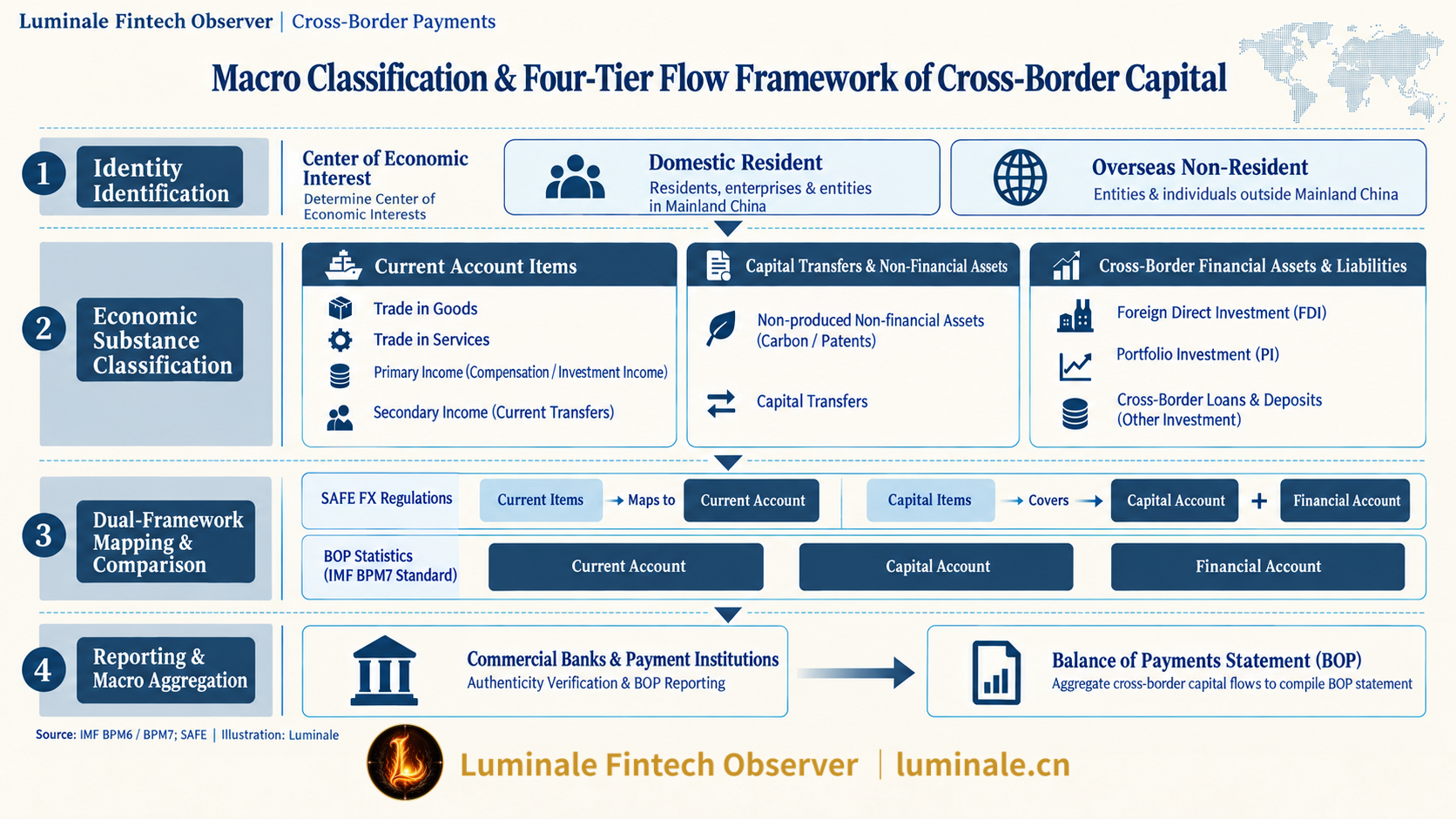
In balance of payments statistics, resident status is determined by an entity's center of economic interest, rather than nationality or passport. A foreign national who has lived and worked in Mainland China for more than one year is classified as a domestic resident for BOP purposes; conversely, a Chinese citizen residing permanently overseas is treated as a non-resident.
The same $1,000 sent overseas represents fundamentally different macroeconomic entries depending on its economic substance: remitted to a foreign university, it is a purchase of overseas education services; wired to a foreign brokerage to purchase equities, it is cross-border portfolio investment; sent to relatives overseas for daily living expenses, it is a unrequited current transfer. While the debiting mechanism at the frontend is identical, the transactions belong to entirely different accounts on the macroeconomic ledger.
In cross-border capital flows, market participants frequently encounter two parallel vocabularies:
- Foreign Exchange Administration Framework: Colloquially known in regulatory practice as Current Account Items and Capital Account Items.
- Balance of Payments Statistics Framework: The international macroeconomic standard governed by the International Monetary Fund (IMF), consisting of the Current Account (CA), the Capital Account (KA), and the Financial Account (FA).
These two frameworks are not in conflict, but their overlapping terminology often causes confusion. In everyday business discussions, cross-border equity investments, securities trading, and foreign bank borrowings are commonly lumped under "capital account items." However, under strict international BOP standards, the vast majority of these transactions are recorded in the Financial Account. The narrow statistical "Capital Account" is actually quite small, covering primarily capital transfers and acquisitions or disposals of non-produced, non-financial assets.
| Dimension | Everyday FX Regulatory Classification | IMF Balance of Payments Macro Classification | Core Coverage |
|---|---|---|---|
| Basic Consumption & Trade | Current Account Items | Current Account (CA) | Trade in goods, trade in services, compensation of employees, investment income, and current transfers |
| Minor Property Rights & Specialized Transfers | Classified under Capital Account | Capital Account (KA) | Debt forgiveness, migrant transfers, and non-produced non-financial assets (e.g., carbon allowances, permanent patent transfers) |
| Investment, Financing & Financial Transactions | Classified under Capital Account | Financial Account (FA) | Foreign direct investment (FDI), portfolio investment, cross-border loans and deposits, trade credit, and official reserve assets |
In the cross-border capital flow and accounting model compiled by Luminale, regardless of whether funds move across card rails, SWIFT messaging networks, or local clearing houses, they must ultimately be categorized within this statistical matrix on the national balance sheet.
Cross-Border Transaction Occurs (Determine Resident / Non-Resident Status)
   │
   ├─► Exchanging goods, services, primary income, or current transfers ──► Current Account (CA)
   │
   ├─► Transferring non-financial property rights or capital grants ───────► Capital Account (KA)
   │
   └─► Altering cross-border claims, liabilities, or equity ownership ─────► Financial Account (FA)
In Mainland China, the State Administration of Foreign Exchange (SAFE) governs cross-border payment reporting through the Guidelines for Balance of Payments Statistics Reporting through Banks[1]. Internationally, the IMF's Balance of Payments and International Investment Position Manual serves as the global standard. The IMF officially released the seventh edition (BPM7) in 2025, which is being phased in across member economies worldwide[2]. Cross-border capital classification is not unique to China's foreign exchange regime; it represents a shared macroeconomic statistical infrastructure underpinning the global financial system.
2. The Current Account in Everyday Life: Goods, Travel, Tuition, Payroll, and Family Remittances
The vast majority of cross-border transactions conducted by individuals and enterprises belong to the Current Account.
The Current Account records real economic resource flows between an economy and the rest of the world, comprising four major components: Goods, Services, Primary Income, and Secondary Income.
1. Trade in Goods and Trade in Services
Trade in goods is the most tangible cross-border flow. When an exporter receives telegraphic transfer payments from overseas buyers, or when a cross-border e-commerce merchant pays for imported consumer goods, funds move in tandem with physical customs clearance.
Trade in services involves no physical goods passing through customs checkpoints. Maritime freight charges, consulting fees paid to overseas professional firms, software licenses for cloud services, international travel, and studying abroad all fall under trade in services.
- Overseas Travel Spending: When domestic residents spend money at overseas hotels, restaurants, or retail stores—whether swiping UnionPay, Visa, or Mastercard credit cards, or scanning WeChat Pay and Alipay QR codes—they are purchasing services and goods provided by non-residents, categorized statistically as travel debits.
- Inbound Tourist Consumption: When foreign travelers make payments within China using foreign-issued bank cards or overseas digital wallets, it represents non-residents purchasing domestic services, recorded under travel credits. SAFE maintains specialized reporting guidelines for inbound mobile payments, allowing clearing houses and acquiring banks to aggregate and report transactions in the backend.
- Overseas Tuition and Living Expenses: When parents wire tuition and living expenses to children studying abroad, the funds constitute education-related travel debits under trade in services. In banking practice, specific BOP reporting codes are assigned based on the student's planned study duration.
2. Primary Income and Secondary Income
Primary income reflects returns accrued from providing labor, financial assets, or renting natural resources to non-residents, centered around two components: compensation of employees and investment income.
If a technical consultant is seconded overseas and receives compensation directly from a foreign entity, remitting that salary home constitutes employee compensation under primary income. Similarly, cross-border equity dividends, bond coupons, and repatriated subsidiary profits all fall under investment income.
Secondary income consists of current transfers. Its hallmark is a unilateral transfer without a quid pro quo economic return. When an overseas worker sends funds home to support parents, or when a domestic resident gifts living funds to relatives abroad, these qualify as personal current transfers. In common parlance, "remittances" must be carefully distinguished: funds sent for pure familial maintenance belong to secondary income, whereas foreign earnings from overseas employment belong to primary income. The two cannot be conflated on the BOP ledger.
[A Typical Family's Four Cross-Border Payments in a Year]

1. Spending 20,000 RMB via credit card at a department store in Japan during holidays
   └─► Current Account - Trade in Services (Personal Travel Expenditure)

2. Wiring £40,000 to a UK university official tuition account
   └─► Current Account - Trade in Services (Education-Related Travel)

3. Father receiving an $8,000 consulting advisory salary from an overseas employer
   └─► Current Account - Primary Income (Compensation of Employees)

4. Receiving a $3,000 living stipend remittance from an overseas relative
   └─► Current Account - Secondary Income (Personal Current Transfers)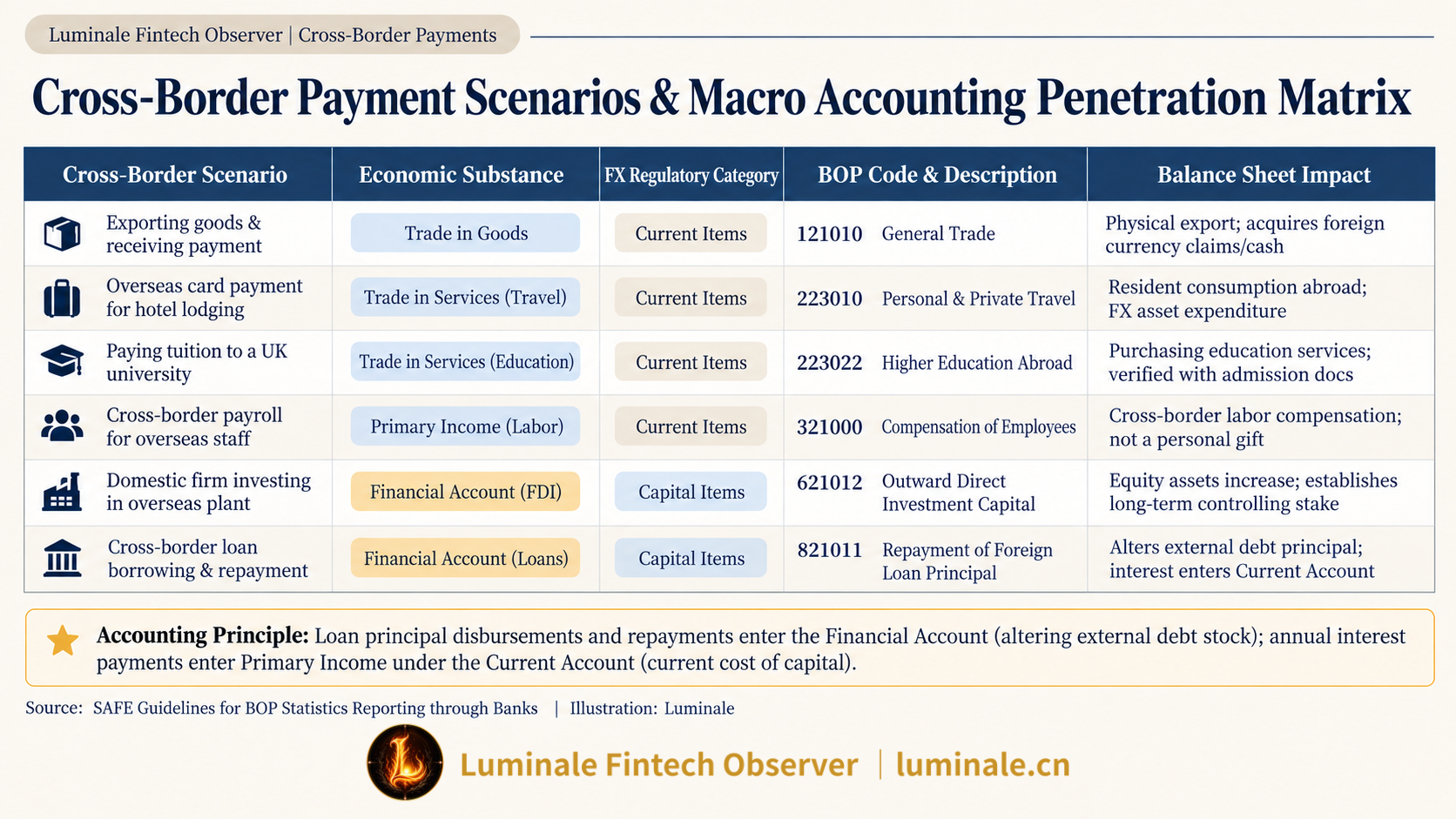
3. The Capital and Financial Accounts Alter Cross-Border Balance Sheets
When cross-border transactions are no longer undertaken for consumption or current labor returns, but to acquire future financial claims, equity ownership, or debt repayment obligations, funds enter the realm of balance sheet transformations.
In macroeconomic statistics, the primary vehicle for these activities is the Financial Account (FA). The Financial Account records the net acquisition and disposal of financial assets and liabilities between residents and non-residents.
1. Financial Account Classifications: Direct Investment, Portfolio Investment, and Other Investment
Cross-border capital flows under the Financial Account are divided into several core categories:
- Foreign Direct Investment (FDI): An overseas parent injecting capital into a domestic subsidiary, or a domestic enterprise acquiring an overseas manufacturing plant. Direct investment emphasizes lasting interest and effective control (conventionally benchmarked at holding 10% or more of voting power).
- Portfolio Investment (PI): Cross-border purchases of equities and debt securities via mutual market access programs such as Shanghai-Hong Kong Stock Connect, Bond Connect, or the Qualified Foreign Institutional Investor (QFII) scheme. Investors focus on liquidity and investment returns rather than operational control.
- Other Investment: Encompassing trade credit, cross-border bank borrowings (external debt), interbank deposits, and bilateral loans between residents and non-residents.
2. How a Cross-Border Financing Traverses Multiple Accounts
In corporate cross-border debt and equity financing, a single financial arrangement frequently spans both the Financial Account and the Current Account, with principal movements and interest returns separated across distinct accounting lines.
Consider a Chinese enterprise borrowing a 3-year, $100 million syndicated loan at 5% annual interest from a commercial bank in Singapore:
| Stage | Funds Flow & Nature | BOP Statistical Classification | Balance Sheet Impact on Enterprise & Bank |
|---|---|---|---|
| Day 1: Loan Drawdown | Singapore bank wires $100M to domestic enterprise account | Financial Account (Other Investment - Loans): Incurring $100M external liability | Enterprise: Bank deposit assets +$100M, external loan liabilities +$100M |
| Years 1-3: Annual Interest | Enterprise pays $5M interest annually to Singapore bank | Current Account (Primary Income - Investment Income): $5M interest debit | Enterprise: Cash deposits -$5M, retained earnings decrease by $5M interest expense |
| End of Year 3: Principal Repayment | Enterprise remits $100M principal to settle debt | Financial Account (Other Investment - Loans): Extinguishing $100M external liability | Enterprise: Bank deposit assets -$100M, external loan liabilities -$100M (cleared) |
Equity investments follow an identical logic. When an overseas shareholder injects $50 million into a domestic firm, it enters the Financial Account as direct investment. When the firm generates operating profits in subsequent years and pays out a $3 million dividend remittance, that distribution enters the Current Account as primary income.
Principal movements alter asset and liability stocks, whereas interest and dividend flows represent compensation for the use of capital. This distinction forms the bedrock of cross-border financial accounting.
4. From Individual Remittances to Cross-Border E-Commerce: Managing Authenticity, Data, and Risk
Having understood macroeconomic statistical categories, consider the microeconomic perspective: why do commercial banks require extensive declarations, contracts, and invoices before processing outbound payments?
This highlights the operational division between statistical reporting and FX administration: statistical reporting answers "what is the economic nature of this capital flow," whereas FX administration answers "under what regulatory conditions may this transaction proceed."
1. The Reality Behind the $50,000 Quota
One of the most prevalent misconceptions among retail consumers is that "individuals can only remit up to $50,000 abroad per year."
Overseas bank card payments are likewise monitored through a robust data collection mechanism. Since 2017, SAFE has enforced a reporting system for overseas bank card transactions, requiring domestic financial institutions to report all cash withdrawals and single merchant transactions exceeding the equivalent of 1,000 RMB made with domestic cards abroad[4]. This system captures payment network data directly at the interbank clearing level for macroeconomic surveillance and anti-money laundering monitoring, without encroaching upon individuals' $50,000 convenience quotas.
2. How Cross-Border E-Commerce Reshaped Reporting Frameworks
Under traditional general trade regimes, authenticity verification relied strictly on physical paperwork: exporters and importers brought paper customs declarations, bills of lading, trade contracts, and commercial invoices to bank branches for manual verification, stamping, and foreign exchange settlement.
With the rise of cross-border retail and e-commerce platforms, this manual, transaction-by-transaction model became obsolete. An overseas consumer on a direct-to-consumer (DTC) storefront can trigger thousands of fragmented, micro-value orders every minute—transactions that lack single bulk customs declarations or individual paper invoices.
To accommodate these trade innovations, SAFE introduced policies supporting new trade formats, allowing qualified commercial banks and non-bank payment institutions to verify authenticity and execute settlements based on electronic transaction data[5].
[Cross-Border E-Commerce Data-Restoration Reporting Flow]

Overseas Buyers (Massive Micro-Orders)
   │
   ├─► International Credit Cards / Digital Wallets
   ▼
Overseas Acquirers / Clearing Networks
   │ Bulk Settlement (Lump-Sum FX Fund)
   ▼
Domestic Licensed PSPs / Processing Banks
   │
   ├─► Sync with E-Commerce Systems: Ingest order, logistics & payment data (Verify Authenticity)
   ├─► Netting or Batch FX Settlement & Merchant Account Credit
   ▼
Submit Data to SAFE ASOne Platform:
   └─► Restore the lumped FX inflow into itemized underlying trade in goods classifications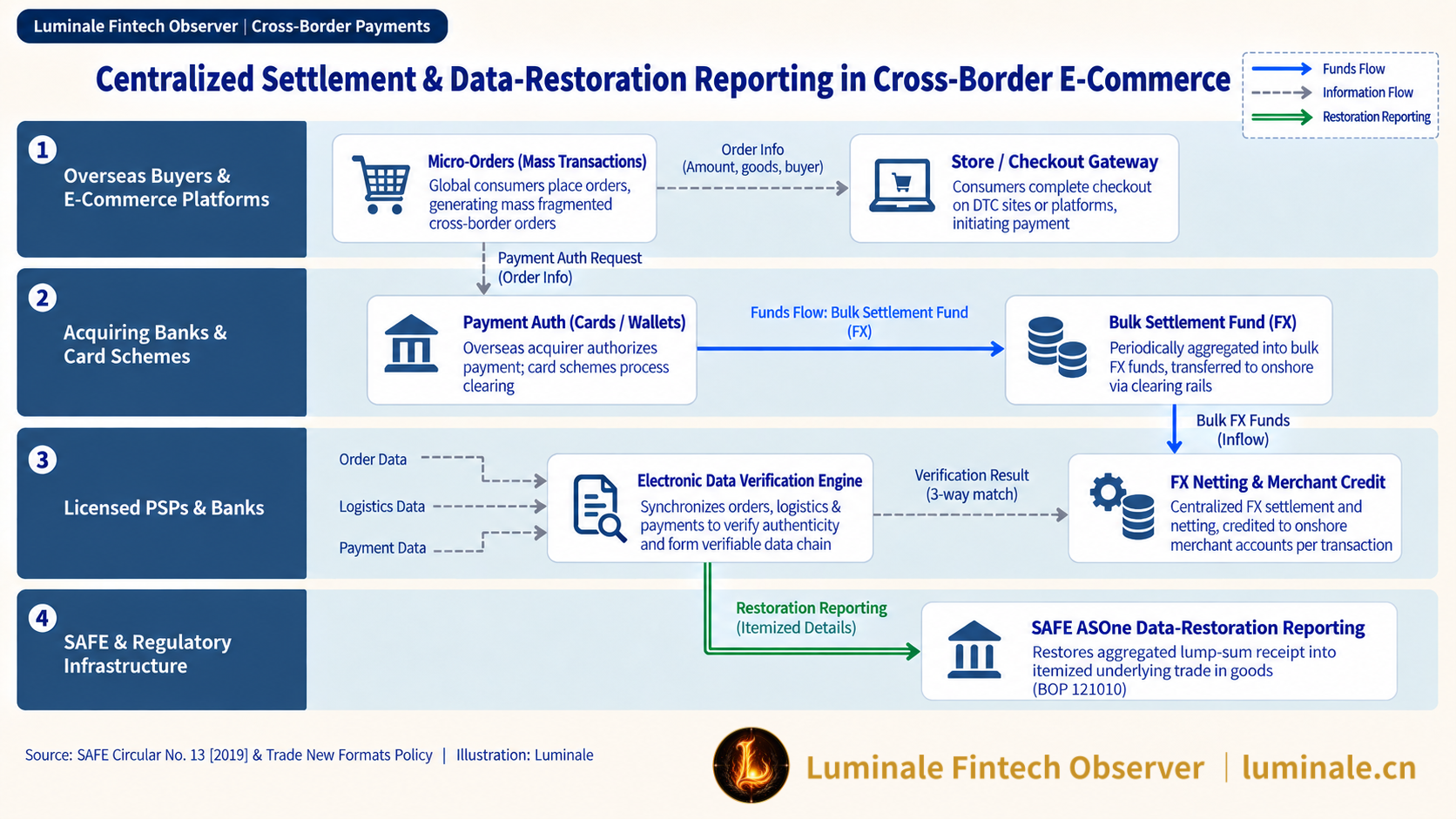
Under this paradigm, banks and payment institutions transitioned from manual paper verification to automated API data synchronization across orders, logistics tracking, and payment slips. When a bulk foreign currency settlement lands onshore, payment institutions execute "data-restoration reporting" within the BOP reporting system, disaggregating the lump-sum transfer across thousands of micro-merchants under their respective trade-in-goods codes.
3. Common Cross-Border Payment Scenarios and BOP Reporting Codes
When processing cross-border receipts or disbursements through corporate online banking or counter services, users are required to input a 6-digit Balance of Payments Transaction Code (BOP Code). Under the Guidelines for Balance of Payments Statistics Reporting through Banks (2023 Edition), various economic activities map to granular codes:
| Transaction Scenario | Economic Substance | FX Regulatory Category | BOP Transaction Code & Category | Key Documentation & Verification |
|---|---|---|---|---|
| Exporting electronics & receiving payment | Trade in Goods (General Trade) | Current Items | 121010 General Trade | Export customs declaration, commercial invoice, sales contract |
| Resident paying overseas hotel bill by card | Trade in Services (Personal Travel) | Current Items | 223010 Personal & Private Travel | Reported via card clearing rails; consumer receipts for wire transfers |
| Paying UK university undergraduate tuition | Trade in Services (Education Travel) | Current Items | 223022 Higher Education Abroad | University admission letter, tuition invoice, student visa |
| Multinational paying salaries to expatriates | Primary Income (Employee Compensation) | Current Items | 321000 Compensation of Employees | Employment contract, tax assessment slip, work permit |
| Receiving family living stipend from abroad | Secondary Income (Personal Transfers) | Current Items | 421010 Personal Current Transfers | Proof of kinship or gift declaration (proof of source for large amounts) |
| Domestic firm investing in overseas plant | Financial Account (Outward Direct Investment) | Capital Items | 621012 Outward Direct Investment Capital | NDRC/MOFCOM filing approvals, SAFE registration certificates |
| Domestic enterprise repaying foreign bank loan | Financial Account (Other Investment - Debt) | Capital Items | 821011 Repayment of Foreign Loan Principal | External debt registration certificate, loan agreement, repayment schedule |
5. Balance of Payments Is Universal: Why Open Economies Also Classify Every Cross-Border Cent
Many newcomers to cross-border finance harbor the misconception that balance of payments reporting and current/capital account distinctions exist solely in jurisdictions with capital controls.
This assumption is fundamentally mistaken.
Capital account convertibility regimes and balance of payments statistical architectures are two distinct concepts. Whether to impose quotas, licenses, or administrative approvals on cross-border capital flows is a matter of sovereign capital control policy. In contrast, measuring the volume, direction, and economic substance of transactions between residents and non-residents is an indispensable statistical infrastructure required by all modern economies participating in global commerce.
Even in jurisdictions with complete capital mobility and zero foreign exchange restrictions, central banks and statistical agencies rigorously compile the Balance of Payments (BOP) and the International Investment Position (IIP):
- United States: The Bureau of Economic Analysis (BEA) under the U.S. Department of Commerce regularly publishes the International Transactions Accounts (ITAs), structured across the Current Account, Capital Account, and Financial Account. While the U.S. does not restrict capital mobility, the U.S. Department of the Treasury enforces high-frequency, mandatory asset and liability reporting via the Treasury International Capital (TIC) system to monitor global dollar liquidity and cross-border systemic risks[6].
- Eurozone: The European Central Bank (ECB) and Eurostat compile unified BOP statements for the euro area and its individual member states. Whether Germany exports industrial machinery to France or European funds invest globally, every flow is tracked to help the ECB assess euro exchange rate dynamics and current account imbalances[7].
- Hong Kong, China: As an international financial center with free capital movement and no foreign exchange controls, Hong Kong's Census and Statistics Department compiles the territory's BOP and IIP in accordance with IMF standards. Financial intermediaries are mandated to submit data on trade in goods and services, as well as the massive cross-border asset and liability positions held in the financial sector, to the Hong Kong Monetary Authority (HKMA) and the statistical authority[8].
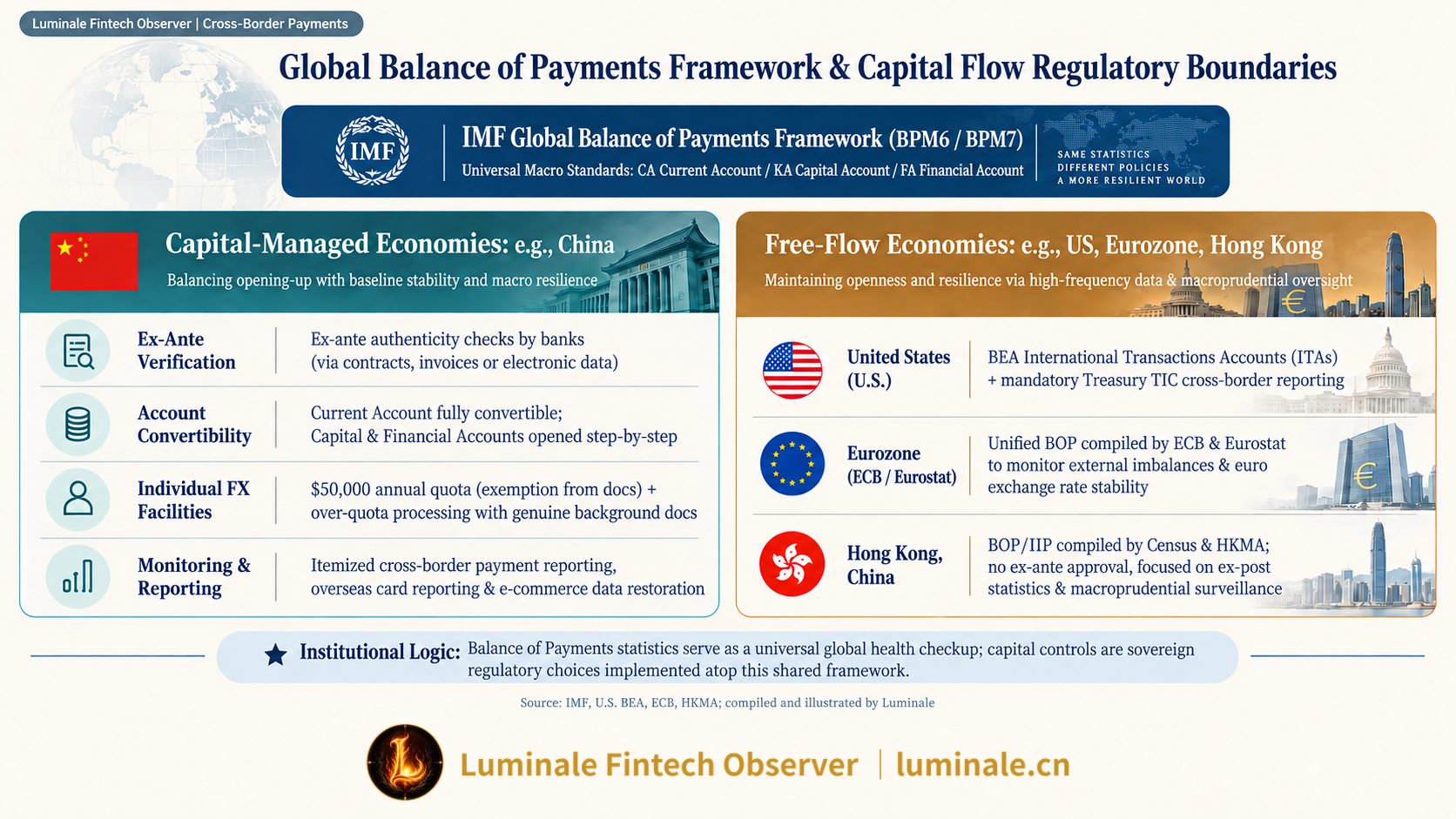
As international practice demonstrates, balance of payments accounting is not designed to impede payment efficiency. Rather, it serves as a macroeconomic diagnostic checkup, enabling an economy to understand its genuine standing with the world: whether the current account is in surplus or deficit, whether external funding is anchored in long-term productive facilities or volatile hot money, and whether national external debt remains within sustainable prudential thresholds.
Conclusion
On the surface, cross-border payments address the operational task of moving funds from Account A in one nation to Account B in another. At its foundation, however, the system addresses three enduring questions: how funds travel securely, what economic activity motivated the transfer, and how an economy records its changing obligations with the rest of the world.
Whether relying on the SWIFT messaging network that has operated for half a century, or advancing toward tokenized commercial bank deposits on shared distributed ledgers, technological progress accelerates transaction speed, enhances clearing finality, and transforms data formats. Yet above these plumbing layers, the fundamental question of why money crossed borders never disappears.
As cross-border transactions become increasingly real-time, fragmented, and embedded within digital platforms, manual paper-based documentary checks will continue to give way to automated data verification. Future regulatory and statistical frameworks will increasingly rely on automated data extraction from payment messages, commerce platforms, and compliance nodes to achieve real-time economic classification and risk monitoring. Understanding how cross-border capital is classified—from current account items to capital account operations—provides the master key to decoding the macroeconomic foundations of the global cross-border payments landscape.
References
[1]: State Administration of Foreign Exchange (SAFE). Guidelines for Balance of Payments Statistics Reporting through Banks (2023 Edition). May 6, 2023. https://www.safe.gov.cn/safe/2023/0506/23784.html ↩
[2]: International Monetary Fund. IMF and Statistical Community Release New Global Standards for Macroeconomic Statistics (BPM7). March 20, 2025. https://www.imf.org/en/news/articles/2025/03/20/pr25072-imf-and-statistical-community-release-new-global-standards-for-macroeconomic-stats ↩
[3]: State Administration of Foreign Exchange Tianjin Branch. FAQ and Operational Guidance on Individual Foreign Exchange Convenience Policies. July 6, 2026. https://www.safe.gov.cn/tianjin/2026/0706/3085.html ↩
[4]: State Administration of Foreign Exchange (SAFE). Notice of the State Administration of Foreign Exchange on Financial Institutions Reporting Information on Bank Card Transactions Conducted Abroad (Huifa [2017] No. 15). June 2, 2017. https://www.safe.gov.cn/neimenggu/file/file/20241202/90e42438e44448f1a8d2725e52c175c1.pdf ↩
[5]: State Administration of Foreign Exchange (SAFE). Measures for the Administration of Foreign Exchange Business of Payment Institutions (Huifa [2019] No. 13) and Guidelines for New Trade Formats. June 30, 2020. https://www.safe.gov.cn/safe/2020/0630/16542.html ↩
[6]: U.S. Bureau of Economic Analysis (BEA). International Transactions Accounts (ITAs) Methodology and Concepts. 2024. https://www.bea.gov/help/glossary/international-transactions-accounts-itas ↩
[7]: European Central Bank (ECB). What are current and capital account balances? Balance of Payments Methodology. https://data.ecb.europa.eu/methodology/what-are-current-and-capital-account-balances ↩
[8]: Census and Statistics Department, Hong Kong Special Administrative Region. Balance of Payments, International Investment Position and External Debt Statistics. https://www.censtatd.gov.hk/en/scode260.html ↩
Originally published by Luminale Fintech Observer: https://luminale.cn/articles/cross-border-capital-classification-current-account-capital-account-en