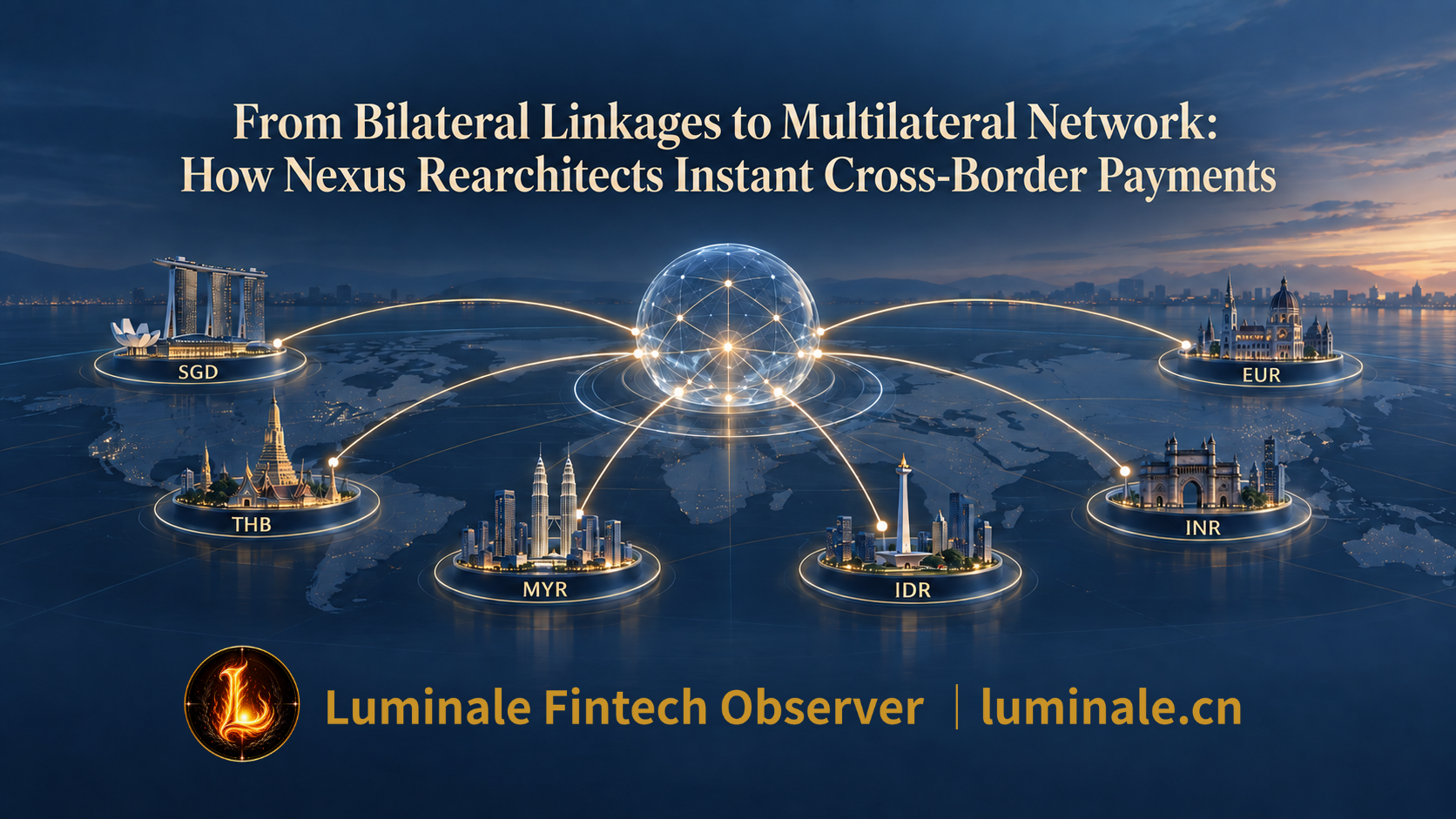
In our previous article, From PayNow–PromptPay to Payment Connect: How Fast Payment Systems Turn into Cross-Border Networks, we explored the operating mechanics of bilaterally interlinking domestic instant payment systems across jurisdictions. Whether through the bilateral connection between Singapore and Thailand or the cross-boundary linkage between Mainland China and Hong Kong, these initiatives have proven the viability of utilizing mature domestic Fast Payment Systems (FPS) to facilitate cross-border retail remittances and merchant QR code payments.
However, once bilateral connectivity is proven, a fundamental structural hurdle emerges: if hundreds of national fast payment systems across the globe were to be connected on a bilateral basis, the number of connection corridors would expand exponentially. This is far from a mere technical integration challenge; behind every bilateral corridor lies a bespoke set of bilateral legal agreements, foreign exchange market-making commitments, and operational settlement arrangements.
Project Nexus—originally incubated by the Bank for International Settlements Innovation Hub (BISIH) and now transitioned to the dedicated operating entity Nexus Global Payments (NGP)—was conceived precisely to resolve this bottleneck. It does not attempt to construct a supranational "global central bank" that holds sovereign funds. Instead, it overlays a standardized set of connection protocols, operational rules, and multilateral orchestration mechanisms atop existing domestic fast payment infrastructures.
I. Why Can Bilateral Linkages Not Scale Indefinitely?
Connecting two domestic fast payment systems is, in essence, an exercise in synchronizing two disparate fiat clearing rulebooks. In a bilateral model, the two participating jurisdictions can resolve technical and commercial divergences through custom engineering. For instance, non-bank financial institutions in Singapore can access PayNow directly via APIs, whereas Thailand's PromptPay initially admitted commercial banks primarily. The two sides reconciled these architectural differences by building a dedicated bilateral cross-border gateway and appointing designated settlement banks on each end.
Once the scale of interlinking expands from two parties to many, this tailored bilateral approach becomes unsustainable.
1. The Exponential Compounding of Institutional and Operational Overhead
In network topology, if independent domestic fast payment systems were to interlink via bilateral connections, they would theoretically require dedicated corridors. Yet far more challenging than the physical explosion of technical interfaces is the accompanying institutional friction:
Every single bilateral corridor requires negotiating and resolving six complex dimensions:
- Interface Specifications and Technical Adaptation: Harmonizing disparate network communication protocols, concurrency thresholds, and high-availability standards.
- Message Semantic Mapping: Even when both sides adopt the ISO 20022 financial messaging standard, their local market practice guidelines, mandatory fields, character sets, and proprietary extensions frequently diverge.
- Cross-Border Proxy Addressing: Resolving and validating mobile phone numbers, tax IDs, national identity numbers, and business registration numbers across borders.
- FX Market-Making and Position Squaring: Determining who quotes firm, binding exchange rates, and who absorbs intraday currency fluctuation risk.
- Domestic Clearing and Settlement Finality: Structuring the cross-currency leg settlement, and defining the precise legal moment of irrevocable settlement finality.
- Governance Frameworks and Dispute Resolution: Aligning Anti-Money Laundering (AML) standards, sanctions screening obligations, fraud recall mechanisms, and incident escalation protocols during unscheduled outages.
If every jurisdiction had to negotiate these arrangements bilaterally with every counterparty, emerging markets and low-volume currency corridors would be marginalized, as transaction fees could never amortize the upfront capital expenditures and ongoing operational costs.
2. Standardized Multilateral Integration
Nexus reorients the connectivity paradigm: moving away from a complex mesh of bilateral negotiations toward a standardized multilateral framework ("One Connection to Many").
Under this model, each domestic Instant Payment System Operator (IPSO) connects just once to the standardized Nexus Gateway under a unified technical specification and Scheme Rulebook. Once connected, financial institutions within that domestic system can, in principle, reach all other participating members across the global Nexus network.
The project began in 2021 when the BISIH Singapore Centre published the initial conceptual blueprint. By 2022, it validated technical feasibility via a proof-of-concept connecting the Eurosystem's TARGET Instant Payment Settlement (TIPS), Malaysia's Real-time Retail Payments Platform (RPP), and Singapore's Fast and Secure Transfers (FAST). In 2024, BISIH released the comprehensive Phase 3 blueprint detailing the governance, technical, and commercial arrangements[1]. In 2025, the central banks and system operators of India, Malaysia, the Philippines, Singapore, and Thailand jointly established Nexus Global Payments (NGP) as an independent non-profit company in Singapore, marking the official transition from a central bank research initiative into a production-bound cross-border financial market infrastructure.
II. Deconstructing Nexus: Four-Layer Architecture and Participant Roles
To understand the operational logic of Nexus, one must recognize its system boundaries. Nexus is neither a pure financial messaging switch like SWIFT, nor a centralized global clearing house holding fiat currency balances.
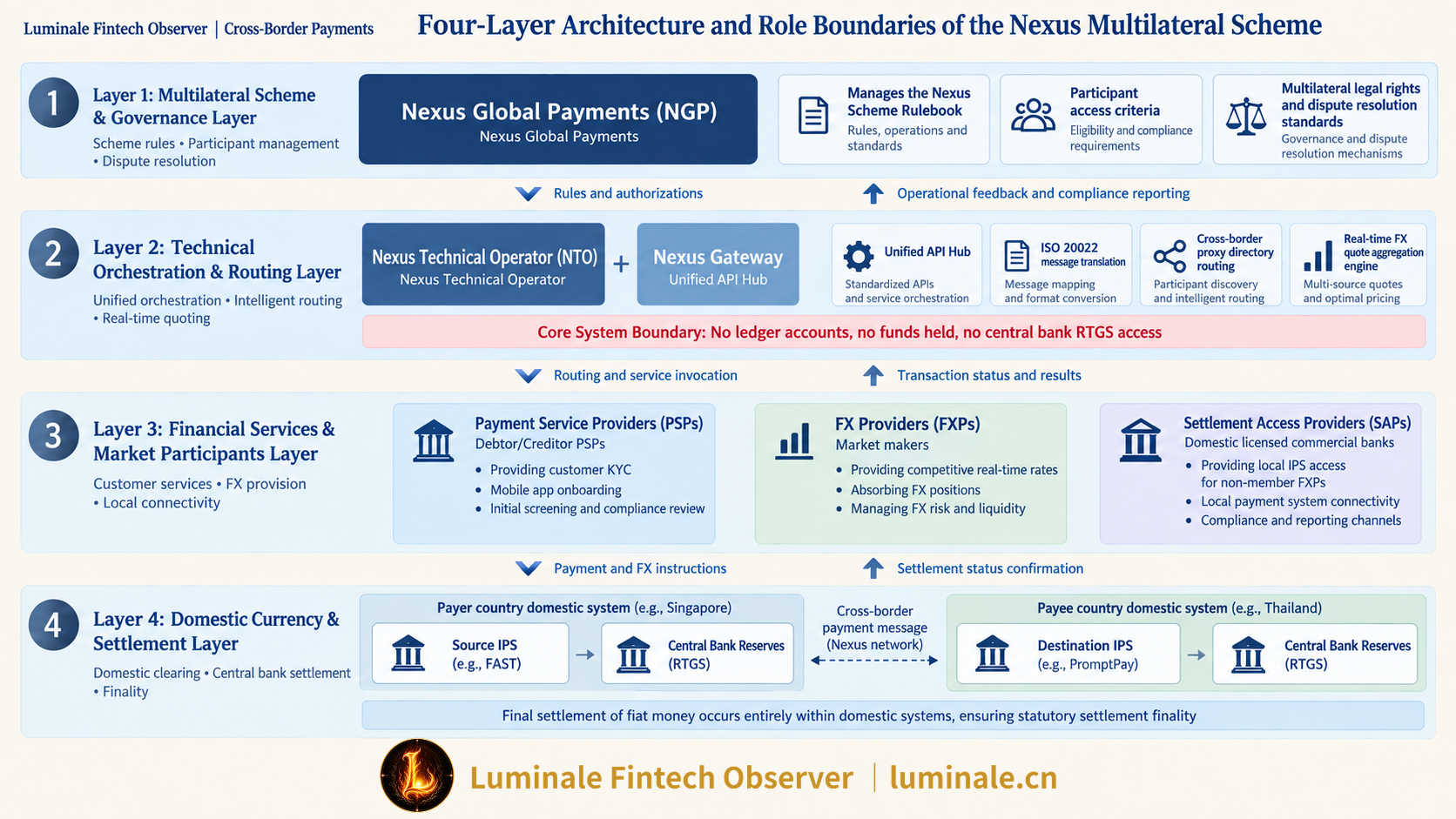
In Luminale's cross-border payment infrastructure analysis framework, the Nexus ecosystem comprises four distinct functional layers:
| Architectural Layer | Core Entities & Components | Primary Responsibilities & Boundaries |
|---|---|---|
| Layer 1: Multilateral Scheme & Governance Layer | Nexus Global Payments (NGP) Scheme Rulebook | Formulates unified multilateral operating rules, access criteria, fee schedules, legal rights, and dispute resolution procedures. |
| Layer 2: Technical Orchestration & Routing Layer | Nexus Technical Operator (NTO) Nexus Gateway, API Hub, Message Translators | Maintains addressing routing, aggregates real-time FX quotes, and coordinates end-to-end messaging sequences without holding funds or maintaining balance ledgers. |
| Layer 3: Financial Services & Market Participants Layer | Debtor/Creditor PSPs FX Providers (FXPs) Settlement Access Providers (SAPs) | Delivers end-user customer onboarding and KYC, provides cross-currency liquidity, and grants domestic clearing access to non-direct participants. |
| Layer 4: Domestic Currency & Settlement Layer | Source IPS / Central Bank RTGS Destination IPS / Central Bank RTGS | Executes final fiat fund transfers, confirming balance adjustments and legal settlement finality under domestic statutory frameworks. |
1. Delineation of Key Roles
Within the Nexus network, institutions operate under a clear division of responsibilities:
- Payment Service Providers (PSPs): Commercial banks or licensed e-wallet operators that interface with end customers. They perform Know Your Customer (KYC) verification, initial sanctions and AML screening, and originate or receive payment instructions. End users transact directly through their existing mobile banking apps or e-wallets without needing a standalone "Nexus app."
- Instant Payment System Operators (IPSOs): Domestic payment system operators and clearing houses (such as NETS in Singapore, PayNet in Malaysia, and ITMX in Thailand) that act as the national gateway interfacing with the Nexus Gateway.
- Foreign Exchange Providers (FXPs): Commercial banks or institutional market makers that connect to Nexus to stream binding, competitive bid/ask quotes and absorb cross-currency position-squaring obligations.
- Settlement Access Providers (SAPs): Domestically licensed commercial banks holding direct clearing seats in a national IPS and accounts at the central bank. An FX Provider (FXP) may not hold direct clearing membership in every destination country where it makes markets. To send or receive funds in the local currency, the FXP opens a commercial bank account with a local SAP, which acts as its agent bank to inject or withdraw liquidity via the domestic IPS.
2. The "No Funds Held, No Accounts Maintained" Boundary
The definitive architectural feature of Nexus is its strict operational self-restraint regarding monetary assets. Official technical documentation establishes this boundary unequivocally:[2]
The Nexus platform does not maintain balance-sheet accounts for participants, does not hold fiat funds, does not ledger participant asset-liability positions, and does not directly interface with central bank Real-Time Gross Settlement (RTGS) systems.
Nexus records transaction states, unique end-to-end identifiers, locked FX quote parameters, and execution timestamps. All physical legal tender transfers take place entirely across existing domestic central bank reserve ledgers and commercial bank accounts in the source and destination jurisdictions.
III. Information Flow and Funds Flow in a Nexus Cross-Border Payment
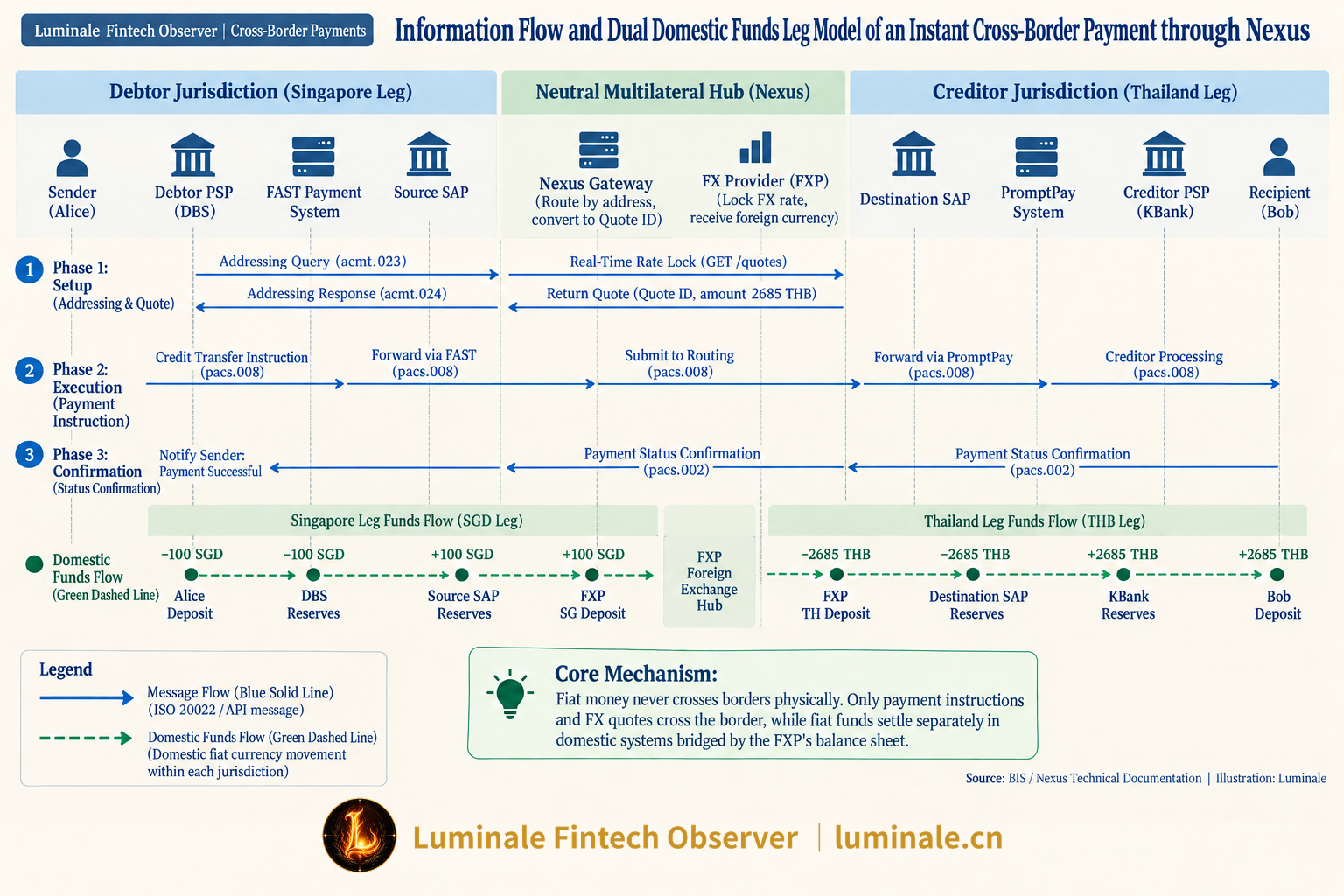
To trace how an end-to-end transaction unfolds, consider a representative use case: a worker in Singapore (the debtor, Alice) initiates a transfer through DBS Bank (the Source PSP) to send the Thai Baht (THB) equivalent of 100 Singapore Dollars (SGD) to a recipient in Bangkok (the creditor, Bob, who banks with Kasikornbank / KBank, the Destination PSP).
The entire lifecycle is split into two phases: Payment Setup and Payment Execution.
1. Payment Setup Phase
Before Alice confirms the transfer, Nexus coordinates across both domestic systems within seconds to execute three prerequisites: verifying the recipient's identity, resolving the underlying bank account, and locking in a firm, binding exchange rate.
[Sender (Alice)]
      │ Enters Bob's mobile number and 100 SGD
      ▼
[Debtor PSP: DBS Bank]
      │ 1. Fetches corridor rules (GET /countries/TH)
      │ 2. Initiates proxy lookup (acmt.023 -> Nexus Gateway -> Destination IPS -> PromptPay Proxy Directory)
      │ 3. Receives lookup result (acmt.024 carrying Bob's masked name and KBank account number)
      │ 4. Requests competitive FX rates (GET /quotes)
      ▼
[Nexus Gateway]
      │ Aggregates streaming rates from FXPs and generates a locked Quote ID with fee breakdown and THB payout
      ▼
[Sender UI (Alice's Mobile App)]
      Displays: "Recipient: B** S*****, Pay: 100 SGD, Rate: 26.85, Fee: 0, Recipient Gets: 2685 THB"
In the Addressing & Proxy Resolution step, Nexus avoids creating a centralized global directory of personal identifiers. The debtor bank dispatches an account inquiry message (acmt.023). The Nexus Gateway inspects the destination country code and routes the request to Thailand's Proxy Directory Operator (PDO). PromptPay resolves the mobile number into Bob's specific KBank account and returns an acmt.024 message containing his masked name. This enables Confirmation of Payee (CoP) across international borders, mitigating misdirected payments.
Concurrently, participating FXPs stream base exchange rates into Nexus. When the debtor bank requests a quote, Nexus calculates the final rate—factoring in any allowable PSP retail markups—and locks it under a time-bound Quote ID. This isolates market-risk exposure within the selected FXP, eliminating the unpredictable post-settlement deductions characteristic of legacy correspondent telegraphic transfers.
2. Payment Execution Phase: Message Flow
Once Alice confirms, DBS generates an ISO 20022 customer credit transfer message (pacs.008)[9], initiating the cross-border message relay:
- Source Domestic Processing: DBS debits Alice's account, conducts sanctions screening, and dispatches a local instruction to Singapore's FAST clearing network.
- Nexus Hub Orchestration: FAST hands the message over to the Nexus Gateway. Nexus validates message syntax, verifies that the
Quote IDremains valid, translates the message into standardized cross-border ISO 20022 formatting, and alerts the designated FXP that its rate commitment has been triggered. - Destination Domestic Ingestion: Nexus forwards the translated
pacs.008message into Thailand's PromptPay network, which routes the credit instruction to KBank. - Beneficiary Crediting and Confirmation: KBank performs local AML screening, credits 2,685 THB to Bob's account in real time, and sends an execution confirmation (
pacs.002) back to PromptPay. - Final Status Return: The
pacs.002travels back through the Nexus Gateway to Singapore's FAST, enabling DBS to display a real-time completion notification to Alice.
3. Payment Execution Phase: Funds Flow
Although end users perceive this as a single "cross-border money transfer," on a balance-sheet level, no physical fiat currency crosses sovereign borders.
The fiat movement is decomposed into two distinct domestic clearing legs:
- Singapore Domestic Leg (SGD Leg): Alice surrenders a 100 SGD commercial bank deposit claim to DBS. In Singapore's FAST system, DBS transfers 100 SGD of central bank reserve balances to the local settlement bank (Source SAP) hosting the selected FXP's account.
- Thailand Domestic Leg (THB Leg): The FXP's THB account at the local settlement bank (Destination SAP) is debited for 2,685 THB. The Destination SAP transfers 2,685 THB in central bank reserves through PromptPay to KBank, which credits Bob with an equivalent commercial bank deposit liability.
The corresponding balance-sheet and reserve ledger entries across the four participating financial institutions are detailed below:
| Institution | Asset Adjustments | Liability Adjustments | Economic Meaning |
|---|---|---|---|
| Debtor PSP (DBS Bank) (Singapore) | Central Bank Reserves (SGD) −100 | Customer Deposits (Alice) −100 | Debits sender's deposit; surrenders equivalent central bank reserves. |
| Source SAP (Singapore Agent Bank) | Central Bank Reserves (SGD) +100 | Due to Banks / FXP Deposits (SGD) +100 | Absorbs central bank reserves; increases local SGD deposit liability to FXP. |
| Destination SAP (Thailand Agent Bank) | Central Bank Reserves (THB) −2685 | Due to Banks / FXP Deposits (THB) −2685 | Debits FXP's local THB deposit; delivers central bank reserves to destination IPS. |
| Creditor PSP (KBank) (Thailand) | Central Bank Reserves (THB) +2685 | Customer Deposits (Bob) +2685 | Receives central bank reserves; immediately credits recipient's deposit account. |
In this dual-leg mechanism, the FX Provider serves as the balance-sheet liquidity bridge across jurisdictions. The FXP undergoes an asset currency rebalancing: it accumulates a 100 SGD deposit claim in Singapore while relinquishing a 2,685 THB deposit claim in Thailand. Nexus does not move funds across borders; rather, it coordinates two synchronized domestic fiat settlements coupled with an institutional market maker's cross-currency position adjustment.
4. Settlement Finality and Risk Mitigation
The primary threat in cross-border settlements is Principal Risk (often referred to as Herstatt risk): the exposure that one party irrevocably transfers a currency leg, only for the counterparty to default before delivering the offsetting leg.
In high-value wholesale foreign exchange markets, specialized settlement mechanisms such as the Continuous Linked Settlement (CLS) system eliminate principal risk through genuine Payment versus Payment (PvP) settlement[8], where the settlement of both currency legs is atomically linked across central bank ledgers—one leg settles if, and only if, the other settles simultaneously.
Nexus does not enforce atomic, simultaneous distributed settlement across sovereign domestic fast payment systems. Instead, to achieve Settlement Certainty across heterogeneous infrastructures, it implements a conditional sequential orchestration protocol:
The destination leg verifies recipient account validity and ensures domestic settlement finality before an irrevocable confirmation message is relayed back to trigger the final debiting of the source leg. If an unexpected technical disruption occurs mid-sequence, Nexus relies on pre-agreed timeout rules and unilateral cancellation/reversal protocols defined in the Scheme Rulebook. Depending on their domestic architectures, participating IPSs ensure settlement certainty through real-time central bank reserve transfers, prefunding accounts, or intraday credit caps backed by loss-sharing arrangements. This design significantly curtails cross-currency credit risk, but it represents procedurally orchestrated settlement certainty rather than atomic central-bank-to-central-bank PvP in the classical legal sense.
IV. What Friction Does Nexus Actually Resolve?
Nexus represents a milestone in the evolution of retail cross-border payments. It uses modular systems engineering to streamline international payment workflows, though technical standardization cannot erase the inherent structural costs of the global financial system.
1. Structural Improvements in Connectivity and Efficiency
- Radical Reduction in Marginal Integration Costs: Domestic networks build and maintain a single adapter to the Nexus Gateway, eliminating redundant integration outlays when onboarding new member countries.
- Bypassing Intermediary Correspondent Cascades: Payment instructions no longer hop across multiple correspondent tiers. Messages flow directly into domestic retail clearing systems, cutting end-to-end processing times from days to seconds.
- Upfront Pricing Transparency: All applicable fees and foreign exchange rates are locked in during the payment setup phase, eliminating the hidden deductions and landing fees common in correspondent wire transfers.
- Frictionless Export of Domestic User Experiences: Low-barrier addressing formats that consumers take for granted domestically—such as phone numbers, national IDs, and static/dynamic QR codes—are extended seamlessly into cross-border ecommerce and remittances.
2. Persistent Financial Frictions and Regulatory Realities
- FX Liquidity Scarcity Remains Real: Nexus streamlines exchange rate discovery, but it does not eliminate the funding cost of providing liquidity. While FXPs can provide razor-thin bid/ask spreads along high-volume corridors like SGD/THB or SGD/MYR, low-liquidity or highly volatile corridors face structural imbalances. When remittance corridors exhibit heavily one-way payment volumes (such as migrant worker flows), FXP balances in the destination market deplete rapidly, forcing market makers to rebalance via onshore or offshore treasury markets. This unavoidably widens bid/ask spreads or causes temporary liquidity gaps.
- Decentralized Compliance Burdens: The Nexus platform is not a statutory entity responsible for AML/CFT enforcement. Customer Due Diligence (CDD), politically exposed person (PEP) screening, transaction monitoring, and UN/OFAC sanctions checks remain the non-delegable legal duty of the originating PSP, beneficiary PSP, and intermediary SAPs. Far from relaxing regulatory oversight, sub-second execution windows require participating banks to deploy sophisticated real-time screening engines capable of sub-second risk decisioning.
- Capital Account and Foreign Exchange Controls: Many emerging markets enforce rigorous capital account regulations, requiring proof of underlying transaction genuineness, balance-of-payments reporting, and individual quota monitoring. Nexus provides a messaging and routing conduit; it cannot circumvent domestic foreign exchange laws. Consequently, Nexus is tailored primarily for high-frequency, low-value retail payments and P2P remittances, and is ill-suited for large-scale, documentation-heavy corporate trade or capital account transactions.
- Exceptions and Disputes Retain Operational Complexity: While standard transactions process in seconds, handling exceptions in an instant, irrevocable cross-border environment is exceptionally complex. Once funds are credited to a beneficiary account, reversing the transaction requires legal cause. Under NGP's initial rollout plans, investigation, recall, and dispute workflows will rely partly on manual Service Desk procedures before automated ISO 20022 exception handling messages are phased in.
V. Current Project Trajectory and Milestones
Transforming a cross-border financial market infrastructure from a concept into an operating reality involves navigating intricate multilateral legal and technical coordination cycles. The evolution of Nexus illustrates this trajectory from central bank proof-of-concept to regulated operating institution:
- Theoretical Blueprint and Concept Formation (2021): The BIS Innovation Hub Singapore Centre, together with partner central banks, published the inaugural blueprint establishing the multilateral connectivity model.
- Cross-System Prototype Testing (2022–2023): Nexus successfully demonstrated technical proof-of-concept across test environments connecting the Eurosystem's TIPS, Malaysia's RPP, and Singapore's FAST, validating the viability of a neutral orchestration hub.
- Comprehensive Implementation Blueprint (2024): BISIH published the Phase 3 report, formalizing the Scheme Rulebook foundations, governance charters, technical API schemas, and participant eligibility criteria.
- Establishment of Dedicated Governance (2025): In March 2025, the Reserve Bank of India (RBI), Bank Negara Malaysia (BNM), Bangko Sentral ng Pilipinas (BSP), Monetary Authority of Singapore (MAS), and Bank of Thailand (BOT) oversaw the incorporation of Nexus Global Payments (NGP) as an independent non-profit company in Singapore; in August 2025, senior payments executive Andrew McCormack was appointed as the inaugural Chief Executive Officer[3] to lead operationalization.
- Network Expansion and Operator Selection (2026): In February 2026, Bank Indonesia (BI) signed accession agreements, making Indonesia the sixth founding jurisdiction[5] and completing the participation of Southeast Asia's major economies. Concurrently, a joint venture formed by Malaysia's PayNet and Singapore's NETS was appointed as the Nexus Technical Operator (NTO)[4], tasked with platform engineering delivery and live operations.
- Cross-Regional Explorations (2026): The project's reach expanded beyond ASEAN. The Latin American Reserve Fund (FLAR) signed an agreement with NGP to assess connecting Latin American fast payment systems, while senior officials at the European Central Bank (ECB) confirmed ongoing evaluations regarding a future link between TIPS and Nexus[6].
Notwithstanding this institutional momentum, official NGP technical documentation explicitly notes that the system is currently "not yet operational." Platform engineering, end-to-end participant testing, and live corridor rollout remain scheduled toward a targeted production go-live in late 2027.
Conclusion
The international attention surrounding Project Nexus stems from its close alignment with the priorities set out in the G20 Roadmap for Enhancing Cross-Border Payments[7].
To meet the G20 targets for 2027—substantially slashing average remittance costs, ensuring that a significant majority of cross-border retail payments settle within one hour, enhancing transparency, and widening financial inclusion—the Financial Stability Board (FSB) and CPMI identified the interlinking of domestic fast payment systems as one of the most practical and scalable avenues available to central banks.
Analyzing the architecture of Nexus offers three enduring insights into the structural evolution of global payment infrastructures:
1. The Competitive Paradigm: From Proprietary Network Monopolies to Interoperability Protocols
Historically, cross-border payment networks expanded by building closed, proprietary global footprints—as seen with traditional card networks, legacy wire transfer switches, and international money transfer operators.
Nexus illustrates a different paradigm: rather than migrating all banks and jurisdictions into a single monolithic clearing system, it relies on neutral protocols that enable fragmented sovereign networks to interoperate seamlessly. This represents a structural shift from a centralized closed network to a "Network of Networks," analogous to how the TCP/IP protocol unified disparate local area networks into the global internet. Future strategic influence in financial infrastructure will belong not to those who operate proprietary pipes, but to those who define open, interoperable multilateral scheme rulebooks.
2. The Operational Focus: Messaging Becomes Standardized; Governance, Liquidity, and Rules Become the Decisive Bottlenecks
With cloud infrastructure, API microservices, and ISO 20022 message transformation engines widely available, technical connectivity is largely an engineering problem. Routing an encrypted financial packet from System A to System B in sub-second time is no longer a technological hurdle.
Instead, as multilateral payment networks expand, multilateral governance, FX liquidity provisioning, and legal risk allocation become the true operational constraints. Crafting a Scheme Rulebook that simultaneously satisfies diverse national banking regulations, ensuring private market makers have economic incentives to provide liquidity along one-way remittance corridors, and structuring binding legal recourse for cross-border fraud recalls—these institutional and economic architectures will dictate the long-term survival of multilateral platforms like Nexus.
3. The Philosophy of Financial Innovation: Connecting Existing Systems Rather Than Replacing Sovereign Currencies
Discussions regarding the future of cross-border finance frequently divide into two schools of thought:
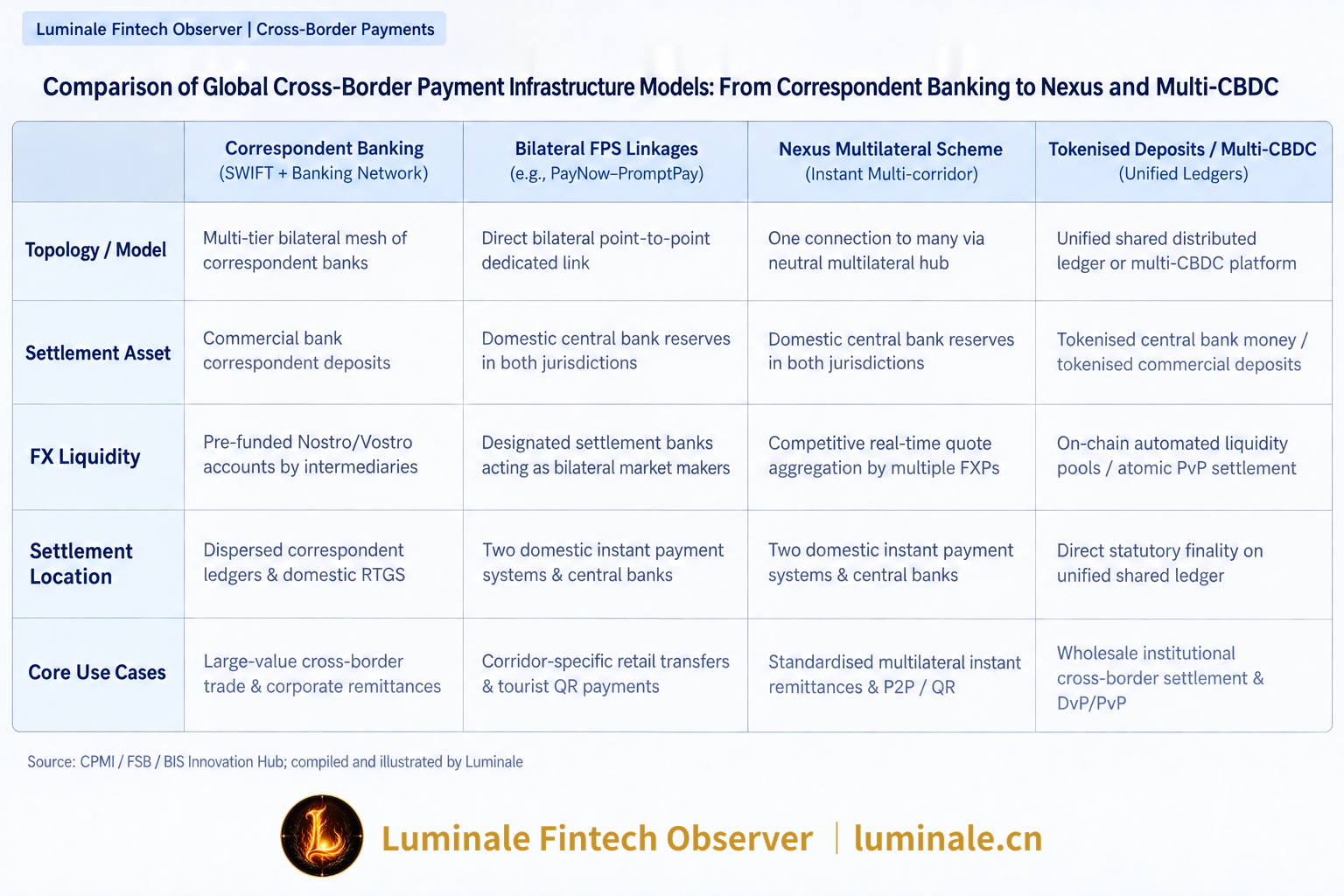
One promotes a "clean slate" overhaul—issuing cross-border stablecoins, deploying unified multi-CBDC ledgers, or constructing tokenized deposit platforms designed to eliminate the multi-currency banking system altogether.
The other, embodied by Nexus, pursues a pragmatic path of institutional interlinking. It does not introduce a synthetic global settlement unit, does not require central banks to surrender domestic clearing autonomy, and does not dismantle commercial bank deposit tiers. Instead, it introduces standardized connection rails between established sovereign payment highways, leaving legal tender safely anchored within its respective national jurisdiction.
The future of global cross-border payments will likely not be a winner-take-all replacement of legacy rails. Rather, multiple models will co-exist across specialized market tiers: high-value wholesale transactions may gravitate toward atomic PvP on multi-CBDC or tokenized platforms, whereas high-volume, low-value retail remittances and merchant payments will find their most efficient equilibrium on standardized multilateral networks like Nexus.
References
[1]: Bank for International Settlements (BIS). (2024). Nexus: Enabling instant cross-border payments (Report and Blueprint). https://www.bis.org/publications/nexus-enabling-instant-cross-border-payments ↩
[2]: Nexus Global Payments (NGP). (2026). Nexus Technical Documentation: Payment Processing, Architecture & Scheme Rules. https://docs.nexusglobalpayments.org/ ↩
[3]: Nexus Global Payments (NGP). (2025). Nexus Global Payments welcomes inaugural Chief Executive Officer. https://nexusglobalpayments.org/nexus-global-payments-welcomes-inaugural-chief-executive-officer-to-lead-operationalisation-of-instant-cross-border-payment-scheme/ ↩
[4]: Network for Electronic Transfers (NETS) & Payments Network Malaysia (PayNet). (2026). Nexus Global Payments appoints Technical Operator. https://www.nets.com.sg/newsroom/nexus-global-payments-appoints-technical-operator ↩
[5]: Nexus Global Payments (NGP). (2026). Nexus Global Payments appoints first Board Chair and expands network with the addition of Indonesia. https://nexusglobalpayments.org/nexus-global-payments-welcomes-inaugural-chief-executive-officer-to-lead-operationalisation-of-instant-cross-border-payment-scheme/ ↩
[6]: European Central Bank (ECB). (2026). Connecting fast payment systems globally: exploring TIPS and Nexus linkage. https://www.ecb.europa.eu/ ↩
[7]: Financial Stability Board (FSB). (2020). Enhancing Cross-Border Payments: Stage 3 roadmap. https://www.fsb.org/wp-content/uploads/P131020-1.pdf ↩
[8]: CPMI-IOSCO. (2012). Principles for financial market infrastructures (PFMI). Bank for International Settlements. https://www.bis.org/cpmi/publ/d101a.pdf ↩
[9]: ISO 20022 Financial Services. (2023). Universal financial industry message scheme: pacs and acmt messages. https://www.iso20022.org/ ↩
Originally published by Luminale Fintech Observer: https://luminale.cn/articles/from-bilateral-linkages-to-multilateral-network-how-nexus-rearchitects-instant-cross-border-payments-en