I. Cross-Border Payments Have Become Faster. Why Do They Need a New Set of Rules?
When you send money to family abroad, the questions are simple. Before paying, can you see the exchange rate, the fee and the amount the recipient will actually receive? Once the money has left, can you see where it is? And when will it actually land in the recipient's account?
Transfers between banks have indeed become faster. Swift's research shows that about 75% of cross-border payments over its network reach the receiving institution within 10 minutes. Most of the remaining time is spent at the destination: the cross-border leg accounts for less than 20% of total processing time, and roughly 80% falls in processing in the receiving country[2]. Two measures need to be kept apart here: reaching the beneficiary bank, and crediting the beneficiary's account. Between the two sit compliance checks, foreign exchange controls, local posting and manual handling.
We have already analyzed the main frictions of the last mile of cross-border payments in an earlier article, so we will not go through them one by one here. What makes the Swift Payments Scheme worth watching is that it tries to write the responsibility for a better customer experience into rules that participating institutions all follow.
A cross-border retail remittance usually passes through the sending bank, intermediary banks, the receiving bank and a local payment system. A single bank can optimize its own systems, but it cannot control what time the receiving country posts the payment, who bears which fee, or who handles exceptions. However fast the message travels, it covers only one segment. With the network already fast enough, the question that remains is who defines the service requirements for the whole payment path, and who delivers on them.
II. What Is the Scheme: From Messaging Capability to Shared Service Rules
2.1 Why a "Scheme" Rather Than a New Payment System
In the payments industry, a scheme is a set of business rules that participating institutions agree by contract to follow; the rulebooks of the card networks are a familiar example. The Swift Payments Scheme belongs to the same family. It is built on existing payment rails and financial infrastructure, and what it governs is the business conduct and service quality of its participants[3].
Under Luminale's payments infrastructure analysis framework, a cross-border payment can be viewed in three layers:
| Layer | Content | Performed by |
|---|---|---|
| Messaging, standards and tracking | Payment instructions, ISO 20022 messages, status tracking | The Swift network |
| Business rules and service levels | Fee and FX disclosure, amount received, delivery time, tracking and exception-handling requirements | Followed jointly by Scheme participants |
| Accounts, clearing and settlement | Bank account postings, correspondent relationships, local clearing and settlement systems | The banks and payment infrastructures that actually process the funds |
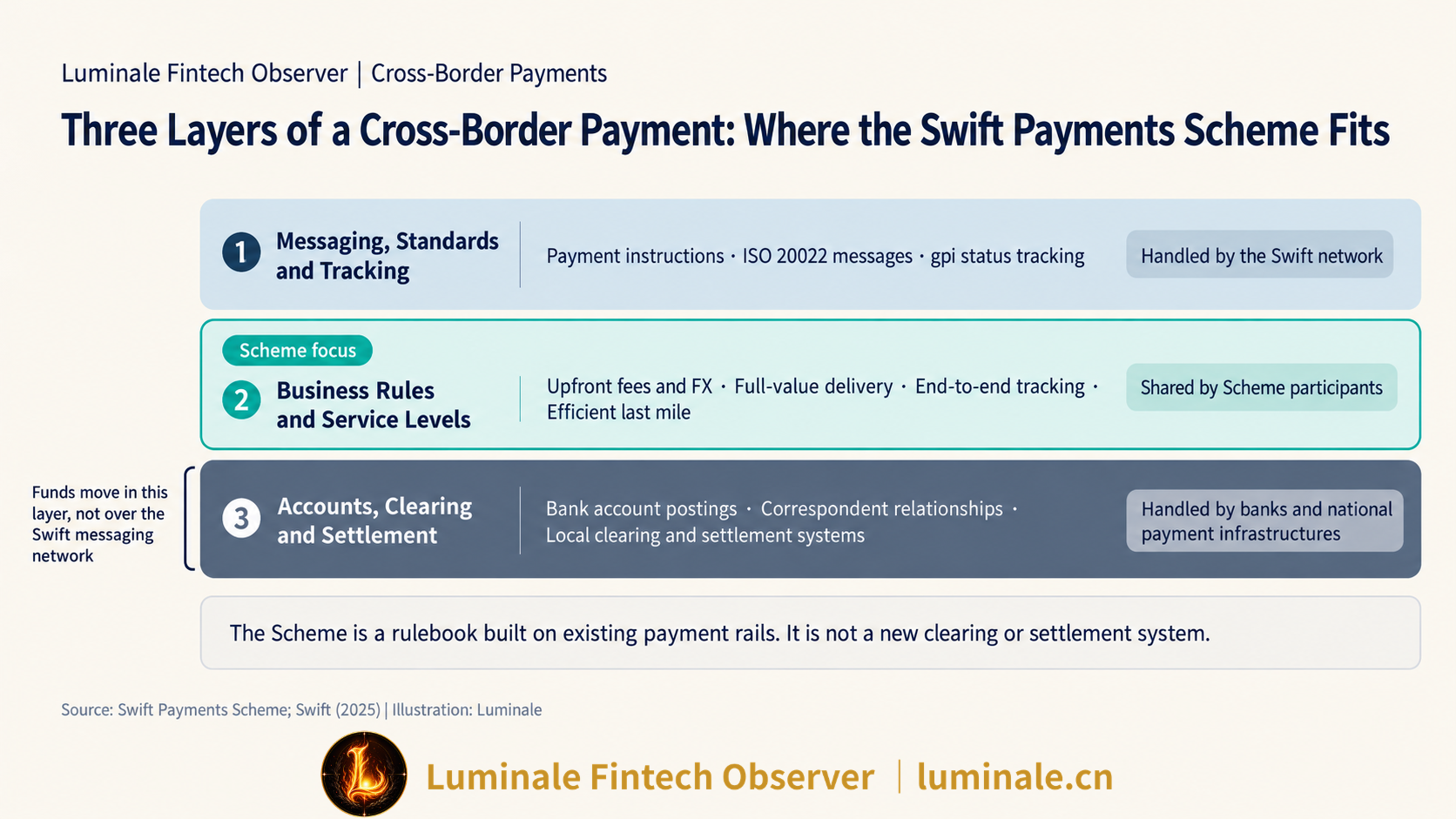
Its scope is also limited. It covers cross-border payments originated by consumers and small and medium-sized enterprises[1], and does not require wholesale cross-border payments to move to a new platform. How funds move between bank accounts still follows the existing correspondent banking and remittance funds-flow mechanism.
2.2 Which Customer Experiences Become Shared Requirements
According to what Swift has said publicly, participants commit to roughly four things[1][3]:
- Upfront transparency: before confirming a payment, the customer can see the fees, the exchange rate and the expected delivery time.
- Full-value delivery: the recipient receives the amount they were told in advance, with no unannounced deductions along the way. This only rules out extra charges in transit; the remittance itself can still carry a fee.
- End-to-end tracking: payment status can be checked, and the credit to the beneficiary can be confirmed.
- An efficient last mile: institutions on the receiving side work together to shorten processing time at the destination and, where local infrastructure and regulation allow, credit the funds instantly.
None of these requirements is new in itself, and many banks already pursue them on their own. The value of shared rules is that when a payment passes through three or four institutions, each one quotes, passes on information, posts the funds and reports back to the same standard, so the customer's experience does not break at one of the segments.
2.3 How the Scheme, Swift gpi and Swift Go Divide the Work
| Capability | Positioning |
|---|---|
| Swift global payments innovation (gpi) | Existing services for cross-border payment tracking, transparency and processing experience |
| Swift Go | Existing service arrangements for low-value cross-border payments |
| Swift Payments Scheme | Business rules, role allocation and end-to-end service commitments shared across institutions |
The three are not a case of a new system replacing an old one. When the Scheme operates, it draws on existing tools such as Payment Pre-validation and the gpi Tracker[4]; the rules themselves fix how those tools are used and what service outcomes are expected.
Two points are easy to misread. The shared rules bind only the institutions that have signed up, so not every Swift member is automatically covered. And Swift neither holds nor moves customer funds.
III. How a Cross-Border Remittance Runs Under the Scheme: Roles, Information Flow and Funds Flow
3.1 Who Is Responsible for What
The Scheme defines several participant roles. Two matter most:
- Debtor Agent: faces the paying customer and is responsible for a simple, transparent and predictable experience at the front end, including disclosing fees, the exchange rate and the expected delivery time before the customer confirms[3].
- Gateway Intermediary: sits on the receiving side, between the Debtor Agent and the Creditor Agent. It is responsible for making sure the payment is processed under Scheme rules, the principal is passed on in full and tracking status is updated in real time, and, where conditions allow, for completing the credit through the local instant payment system or a book transfer[9].
The actual path may include other intermediary banks and local payment systems. The Gateway Intermediary is a role defined by the Scheme; it does not mean that every transaction adds a separate technical platform. One bank can also hold different roles at once, and the participant list Swift publishes marks the institutions that hold dual roles[3].
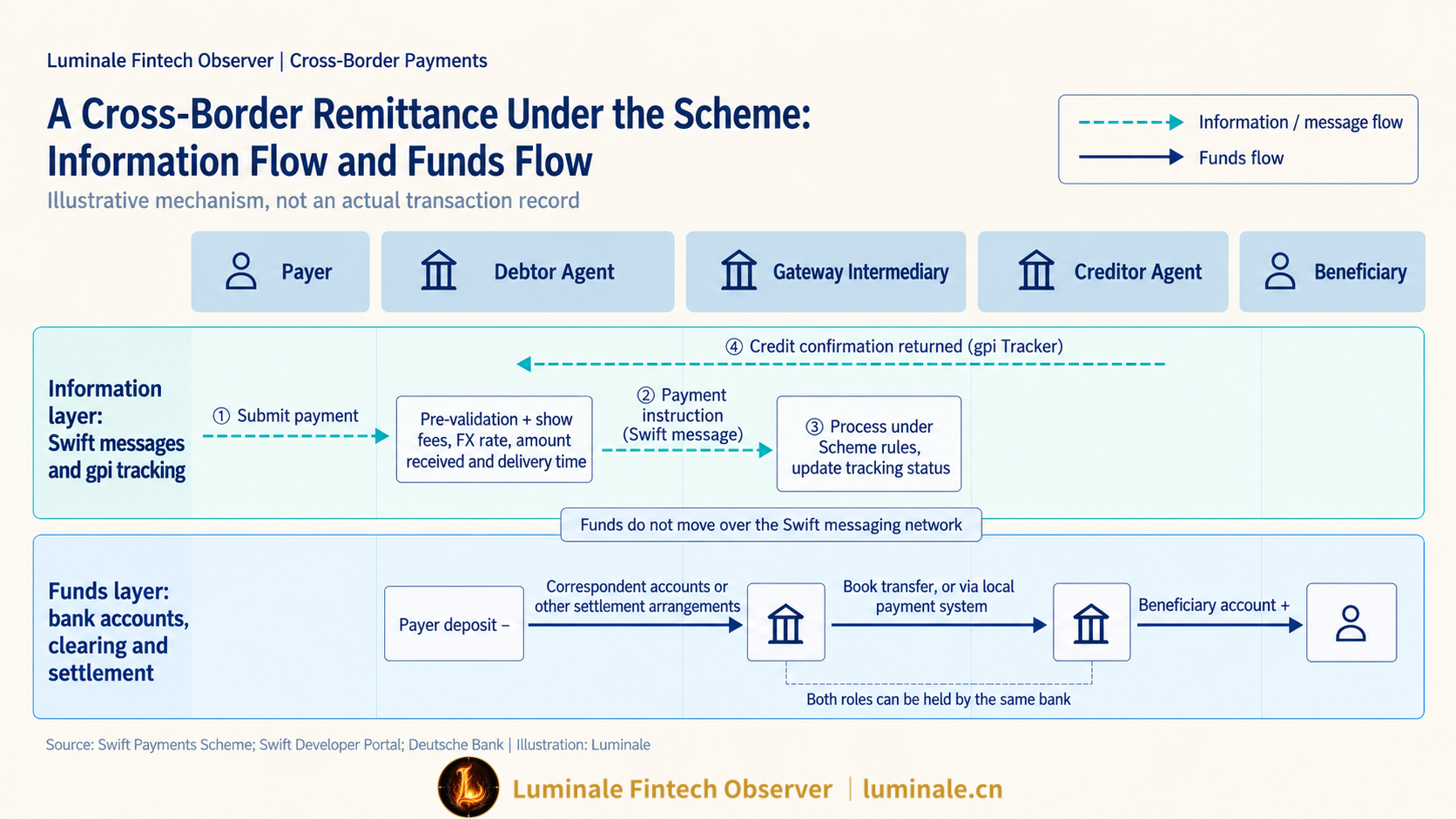
The table below is an illustration of the mechanism for a cross-border payment:
| Step | Information layer (Swift messages and tracking) | Funds layer (accounts, clearing and settlement) |
|---|---|---|
| ① Initiation | The payer submits the remittance to the Debtor Agent, which completes pre-validation and shows the quote | The Debtor Agent debits the payer's deposit |
| ② Cross-border transfer | The Debtor Agent sends the payment instruction to the Gateway Intermediary over Swift, and the Tracker records the status | Funds move through correspondent accounts or other settlement arrangements between the Debtor Agent and the Gateway Intermediary |
| ③ Delivery at the destination | The Gateway Intermediary updates the status | The Gateway Intermediary posts the funds on its own books, or passes them to the Creditor Agent through the local payment system |
| ④ Confirmation | The Creditor Agent confirms the credit, and the Tracker sends the final status back | The beneficiary's account balance increases |
3.2 Before the Payment Is Sent: Validate First, Then Send
Many cross-border remittances used to be sent first, with problems fixed afterwards through re-keying, returns or manual inquiries. The Scheme requires Payment Pre-validation before sending, which checks the beneficiary account, the message format and the destination's data requirements[4], so that wrong account numbers and missing fields can be caught at the source. The fee and FX quote is also shown before the customer confirms, so the customer has an expectation of the outcome before the money moves.
Pre-validation lowers the chance of errors. It does not guarantee that compliance checks will pass, nor that every destination condition will be met.
3.3 While the Payment Is in Progress: Message Delivery, Clearing and Settlement, and Final Posting Are Different Things
The information layer and the funds layer have to be read separately. Swift messages and tracking belong to the information layer, and the message format rests on ISO 20022 and payment message standardization. The changes at the funds layer happen in bank accounts and in clearing and settlement systems.
At the destination, the Gateway Intermediary can credit the customer through a local fast payment system, which is the same kind of infrastructure used in the cross-border interlinking of local fast payment systems. Whether this can be instant depends on whether the local system runs around the clock, how accounts are arranged and whether liquidity is in place.
A status of "credited" in the Tracker is also not the same as settlement finality in the legal sense. The former is status feedback among participating institutions, while the latter depends on the rules of the clearing and settlement system used and on the applicable law.
3.4 After the Payment: Status Feedback Becomes a Verifiable Service Outcome
Once the Creditor Agent confirms the credit, the Tracker sends the final status back to the sending side[4]. The Debtor Agent can use it to answer customer inquiries, and all participants can use it to reconcile, handle exceptions and check whether each segment met the Scheme's service requirements.
Take a personal remittance from Australia to India as an example. The payer enters the amount in a mobile banking app, and the screen shows the exchange rate, the fee and the amount of rupees the recipient will receive. After confirmation, the Debtor Agent sends the instruction, the funds reach the Gateway Intermediary on the Indian side through the settlement arrangements, and are then credited to the recipient's account through a local system. The payer sees in the app that the money has arrived.
IV. From Institutional Design to Real Transactions: What Does the 2026 Rollout Show?
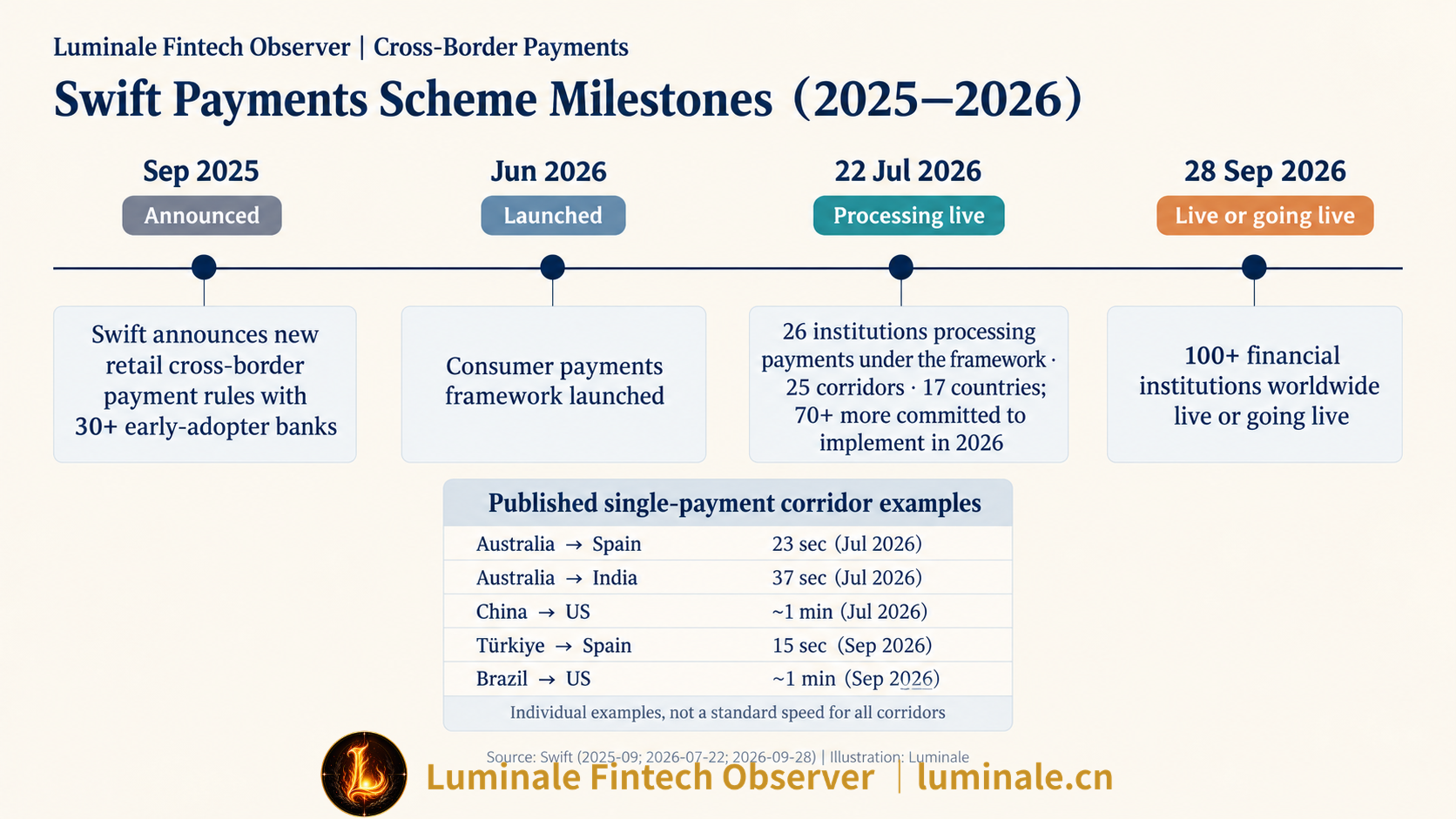
4.1 The Milestones, Stage by Stage
| Time | Development | Basis |
|---|---|---|
| September 2025 | Swift announces that it will build new rules for retail cross-border payments with more than 30 early-adopter banks | Announced |
| June 2026 | According to Swift's September announcement, the consumer payments framework is launched in June | Launched |
| 22 July 2026 | 26 financial institutions have started processing payments under the framework, opening 25 payment corridors across 17 countries; more than 70 other institutions have committed to implement it in 2026 | Live processing / Committed to implement |
| 28 September 2026 | More than 100 financial institutions worldwide are live or going live with the framework | Live or going live |
Sources for the table: Swift's September 2025 announcement[1], its 22 July 2026 announcement[5] and its 28 September 2026 announcement[6].
4.2 What the Few-Second Examples Do and Do Not Show
Among the examples Swift published in July, a payment from Australia to Spain was completed in as little as 23 seconds, Australia to India took 37 seconds, and China to the US took about 1 minute[5]. In September it added Türkiye to Spain in 15 seconds and Brazil to the US in about 1 minute[6].
These are single-payment results on specific corridors. They do not represent a uniform delivery time across all institutions, currencies and payments. More useful measures for judging a set of rules are how many corridors it covers, what the failure rate is, whether fees and exchange rates are transparent, what share of payments receive end-to-end credit confirmation, and whether performance holds up over time. Complete statistics on these measures are not yet publicly available and will need continued observation.
4.3 Citi's Multi-Market Launch: How Rules Are Delivered Through a Bank's Network
On 29 September 2026, Citi announced that it had become the first bank to go live with instant payments in multiple markets under the Swift Payments Scheme, delivered through its WorldLink Payment Services and global clearing network[7]. According to the announcement, Australian dollar payments are delivered through Australia's New Payments Platform (NPP), pound sterling through the UK's Faster Payments, and Indian rupees through India's Immediate Payment Service (IMPS). Citi has also extended its US dollar clearing, so that participating banks can credit funds in real time to beneficiaries holding accounts with Citi in the United States[7]. Participating bank clients connect through a single account arrangement and their existing Swift connection, without having to build a relationship and a technical connection with each local clearing system separately.
This case shows the division of labor fairly concretely. Swift provides the shared foundation of rules, messaging and network, and the commercial bank turns access to the destination payment system, accounts and liquidity into a payment service customers can use.
Two numbers need to be kept apart. Citi's announcement says the model is open to more than 12,500 financial institutions already connected to Swift[7]. That is the potential reach, not the number of banks that have joined the Scheme or enabled Citi's service. NPP, Faster Payments and IMPS are also only the implementation routes Citi has published, not a fixed path for every Scheme transaction.
V. How Far Can Rules Go: Value, Limits and Evolution for Banking Infrastructure
5.1 Value: From Speeding Up a Single Point to Coordinating the Service Outcome
For the Debtor Agent, front-end quoting, information validation, routing and customer service have to work more closely together, because the promise the customer sees at the moment of payment has to be delivered by every institution behind it. For the Gateway Intermediary and the banks on the receiving side, the speed of local posting, status feedback and exception handling directly determine delivery quality. For the person sending money, the change is that they can expect the actual cost, the amount received and the delivery time when they pay.
This arrangement could improve the competitiveness of the existing banking system in retail cross-border remittance. But a handful of examples is not enough to conclude that it has generally achieved the lowest cost.
5.2 Limits: Unified Rules Do Not Unify Funding, Regulation or Market Conditions
The rules set out the goals, but real obstacles remain: foreign exchange (FX) quoting and exposure management, pre-positioning of funds at the destination, the availability of correspondent banks and local settlement systems, anti-money laundering (AML) and sanctions screening, and the handling of disputes and returns. All of these depend on participating institutions committing resources to solve them.
When one link falls short, how responsibility is shared and how exceptions are handled depends on the Scheme's formal operating rules. Penalties for breach, liquidity safeguards and the detailed exception-handling provisions have not been disclosed in public materials.
5.3 Comparison: The Scheme, Nexus and Swift Shared Ledger Work at Different Layers
| Approach | Main point of intervention | Assessment |
|---|---|---|
| Swift Payments Scheme | Shared service rules and delivery performance on top of existing bank payment paths | Improves predictability and final delivery quality of the existing system first |
| Nexus | Multilateral interlinking of national fast payment systems, standardized access and related funding arrangements | Focuses on connecting scattered national payment systems into a scalable network |
| Swift Shared Ledger | Coordination of interbank payment obligations, status and execution, including tokenized deposit scenarios | Explores new ways for institutions to coordinate around digital forms of value, in parallel with the Scheme |
For the details of each, see our articles on the Nexus multilateral fast payment network and on how Swift Shared Ledger works.
Another direction to follow is the Pay-by-Alias initiative that Swift and 14 organizations announced on 28 September 2026. It would let consumers start a cross-border payment with an alias already used domestically, such as a mobile number or email address, with Spain's Bizum, Australia's PayID and Brazil's Pix connected first[8]. This work builds on the consumer payments framework launched in June. It is still at an early stage, and Swift has not announced a launch date or the first corridors.
Upgrades to payment infrastructure can be divided into a technology layer, an account and funds layer, a business rules layer and a regulatory layer. The Scheme's contribution sits in the business rules layer, where it organizes existing capabilities into end-to-end service commitments. How far it goes depends on whether participating banks keep delivering on those commitments.
VI. Conclusion: From Funds That Move Fast to Outcomes You Can Expect
The Swift Payments Scheme does not create a new global clearing center, and it does not replace the traditional settlement account system. What it does is have participating institutions on the sending and receiving sides act under shared rules, turning fees, exchange rates, amount received, delivery time and payment status, which used to be handled separately, into service commitments that can be delivered jointly.
Whether it succeeds cannot be judged by how many seconds a demonstration payment took. What matters more is whether more corridors and more banks can complete final delivery over the long term, reliably and with little friction. In the next stage of cross-border payments, the competition will be over whether speed, cost and delivery outcome become a service customers can reasonably expect every time. What the Swift Payments Scheme is trying to change is how participating institutions jointly deliver that certainty.
References
[1]: Swift, Swift to set new rules for retail cross-border payments on its network in bold move to further ramp up speed and predictability, 2025-09. https://www.swift.com/news-events/press-releases/swift-set-new-rules-retail-cross-border-payments-its-network-bold-move-further-ramp-speed-and-predictability ↩
[2]: Swift, Spotlight on speed: Why the last mile is the longest, 2025-09. https://www.swift.com/swift-resource/252489/download ↩
[3]: Swift, Swift Payments Scheme: A new standard for cross-border consumer-originated payments (official overview and participant list). https://www.swift.com/payments/payment-innovation/swift-payments-scheme ↩
[4]: Swift Developer Portal, About the Payments Scheme. https://docs.developer.swift.com/apis/payments-scheme ↩
[5]: Swift, A better cross-border payment experience is here, 2026-07-22. https://www.swift.com/insights/news/better-cross-border-payment-experience-here ↩
[6]: Swift, Swift platform transforms cross-border payments experience across existing rails and digital value, 2026-09-28. https://www.swift.com/insights/news/swift-platform-transforms-cross-border-payments-experience-across-existing-rails-and-digital-value ↩
[7]: Citi, Citi Becomes First Bank to Launch Multi-Market Instant Payments on the Swift Payments Scheme, 2026-09-29. https://www.citigroup.com/global/news/press-release/2026/citi-first-bank-launch-multi-market-instant-payments-swift-payments-scheme ↩
[8]: Swift, Swift and its community innovate to bring the ease of domestic consumer payments to the cross-border transaction experience, 2026-09-28. https://www.swift.com/news-events/migrated-news/press-releases/swift-and-its-community-innovate-bring-ease-domestic-consumer-payments-cross-border-transaction-experience ↩
[9]: Deutsche Bank, Swift goes live with payments scheme to tackle cross-border payments'last-mile challenge. https://corporates.db.com/more/latest-news/swift-goes-live-with-payments-scheme-to-tackle-cross-border-payments-last-mile-challenge ↩
Originally published by Luminale Fintech Observer: https://luminale.cn/articles/swift-payments-scheme-why-cross-border-payments-need-new-rules-en