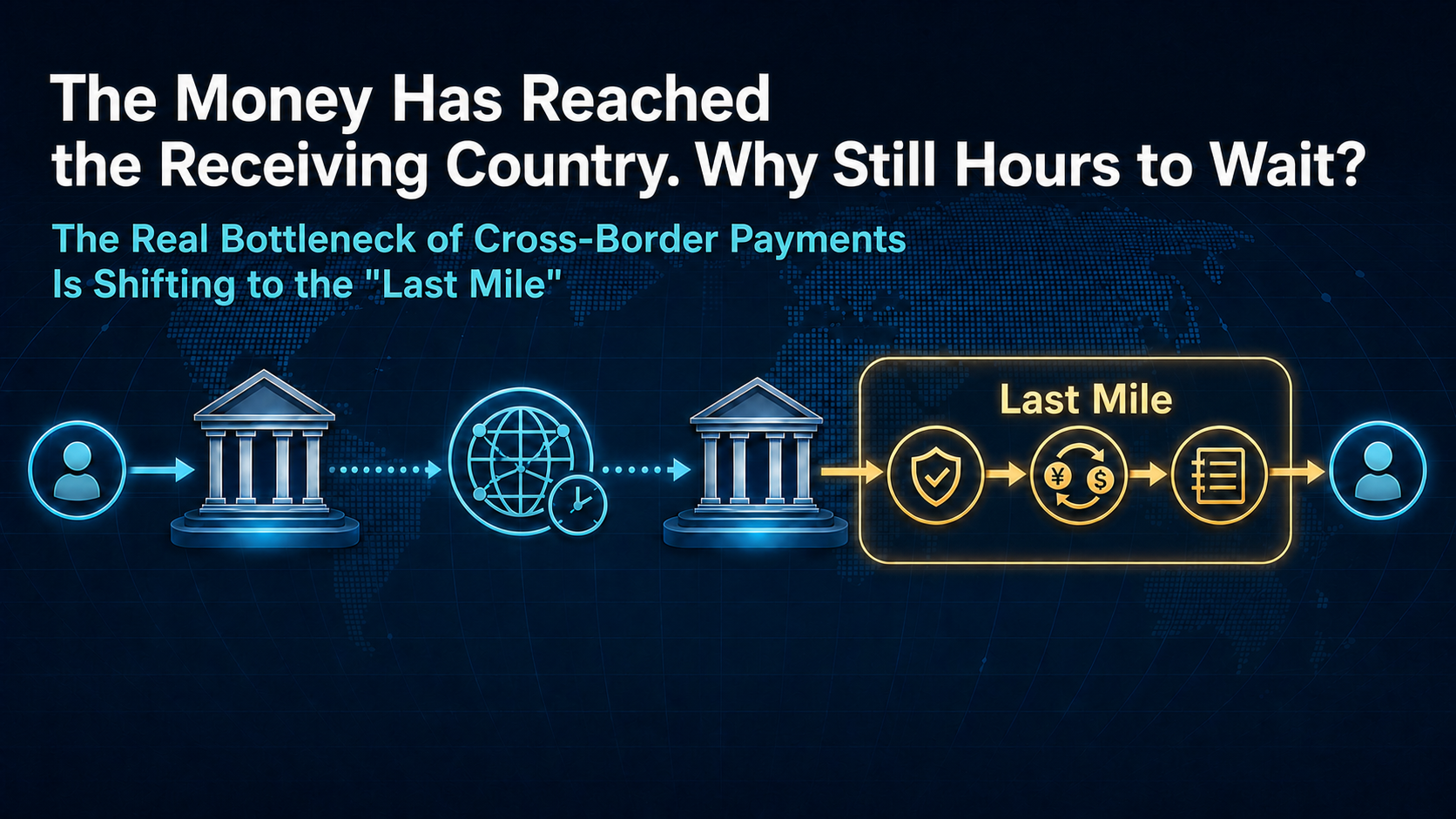
A cross-border remittance may take only minutes to travel from the sending bank to the receiving bank. Yet it might be hours before the beneficiary sees their account balance increase.
These extra hours are not spent on cross-border transmission. In a study published in July 2026, Swift provided concrete data: 75% of cross-border payments reach the beneficiary's financial institution within 10 minutes, and the lion's share of end-to-end latency occurs after the payment arrives at the beneficiary side. Swift refers to this stage as the "last mile."[1]
Competition in cross-border payments is shifting: from moving payments across borders faster to how final delivery is completed once they arrive.
1. Are Cross-Border Payments Still Slow? Three Timestamps
When discussing slowness in cross-border payments, many people's immediate reaction is to think of SWIFT messages and correspondent banking chains. While these were indeed the primary bottlenecks in the past, recent data paints a very different picture.
According to Swift statistics, 75% of cross-border payments reach the receiving bank within 10 minutes, and over 90% arrive within one hour.[2] In its research published on July 20, 2026, Swift termed the cross-border transmission phase between financial institutions "in-flight time," which on average accounts for less than 20% of the total end-to-end payment duration. The remaining ~80% occurs after the payment arrives at the final financial institution.[1]
Therefore, the speed of a cross-border payment must be broken down into at least three distinct timestamps:
| Timestamp | Meaning |
|---|---|
| Payment instruction dispatched | The sending bank completes transmission |
| Payment arrives at receiving bank | Cross-border message and funds reach the beneficiary-side institution |
| Funds credited to beneficiary account | The beneficiary's available balance increases |
Message arrival does not mean money has arrived, nor does the receiving bank's receipt of payment mean funds are immediately usable. Swift also notes on its official portal that after a payment reaches the beneficiary's bank, the institution may still need to perform compliance, anti-fraud screening, foreign exchange (FX) conversion, or manual processing. Weekends, holidays, cut-off times, and local banking rules can all defer crediting until the next business day or even longer.[2]
This is analogous to international courier delivery: a flight from Shanghai to Singapore takes only a few hours. The parcel's arrival at the destination airport does not mean it has been delivered to the recipient. Customs clearance, sorting, local dispatch, and address verification comprise an entirely separate workflow.
Over the past decade, cross-border payment optimizations have focused on the cross-border layer: faster messaging, fewer intermediaries, end-to-end tracking, and standardized data. As these issues were resolved one by one, frictions on the receiving side that were previously masked began to surface. Cross-border payments have not become slower; rather, as the preceding legs became faster, the last mile emerged as the new relative bottleneck.
There is also an institutional boundary to keep in mind: Swift's role is primarily financial messaging, standards, and connectivity services. The actual execution and final settlement of a payment depend on commercial banks'account relationships, liquidity arrangements, local market infrastructures, and regulatory requirements. Message transmission and final settlement of funds are two different matters, and metrics tracking payment speed must distinguish between these scopes.
2. What Exactly Is the Last Mile?
In its research, Swift defines the last mile as: the stage from when a payment reaches the financial institution holding the beneficiary's account or wallet, through processing and verification, until funds are ultimately credited to the beneficiary.[1]
This definition carries two implications. First, the last mile does not refer to a single system; it encompasses the entire end-to-end delivery process on the receiving side. Second, its starting point is the payment's arrival at the account-servicing institution, and its endpoint is the increase in the beneficiary's usable balance.
A cross-border payment can be broken down into four layers:
| Layer | Core Scope |
|---|---|
| Cross-border messaging layer | Networks like Swift transmit payment instructions and data |
| Cross-border interbank funds layer | Correspondent accounts, Nostro/Vostro, RTGS, etc., settle funds |
| Domestic delivery layer | Forwarding via domestic systems such as ACH, RTGS, and FPS |
| Beneficiary processing layer | Beneficiary bank compliance, FX, verification, and account crediting |
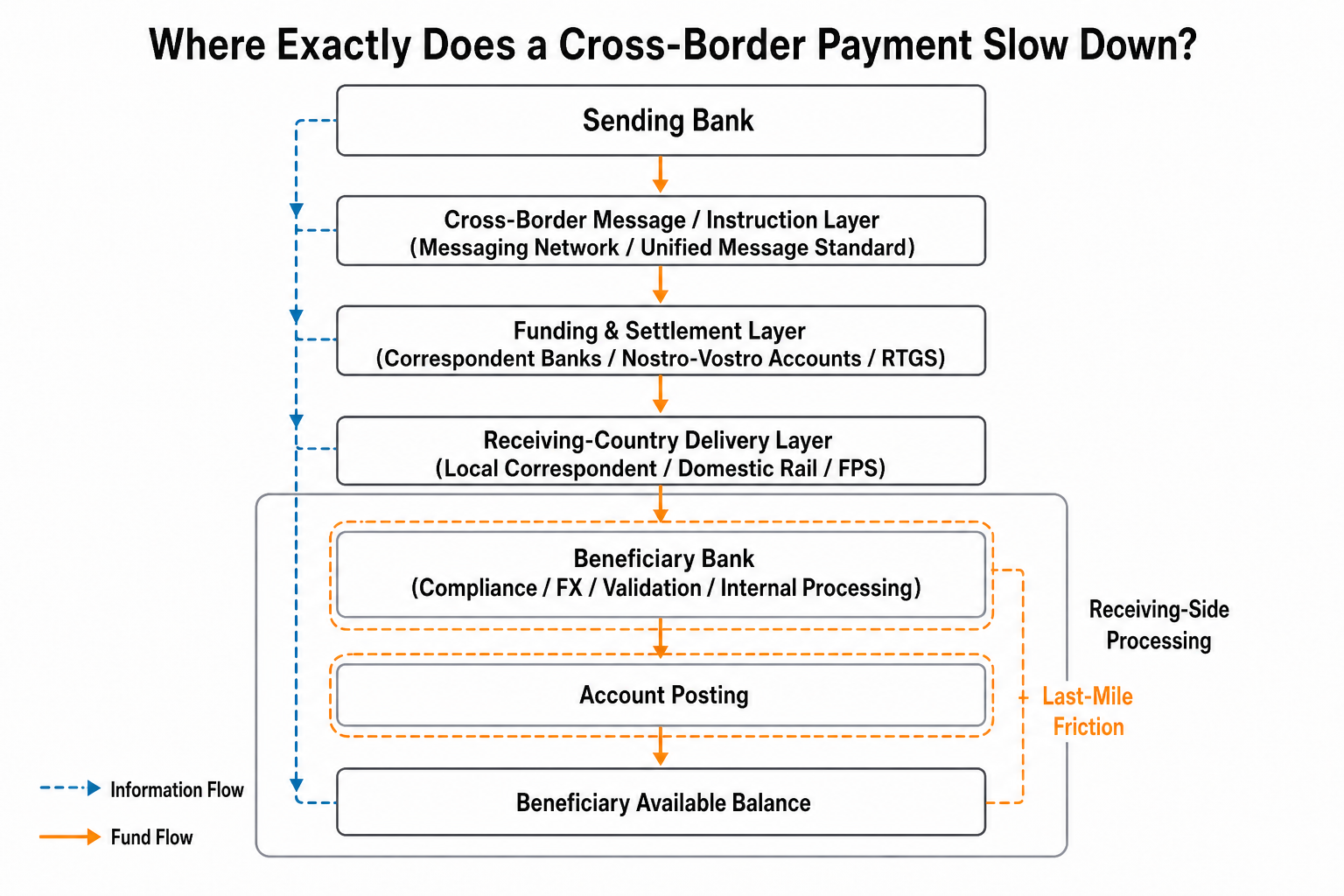
Not every payment traverses all four layers; the actual route depends on the account arrangements between the sending and receiving banks. Two typical routes:
| Route | Workflow |
|---|---|
| A: Direct to Beneficiary Bank | Correspondent bank → Beneficiary bank → Compliance / FX / Crediting → Customer account |
| B: Forwarded via Domestic System | Local correspondent bank → Domestic system (ACH / RTGS / FPS) → Beneficiary bank → Compliance / Crediting → Customer account |
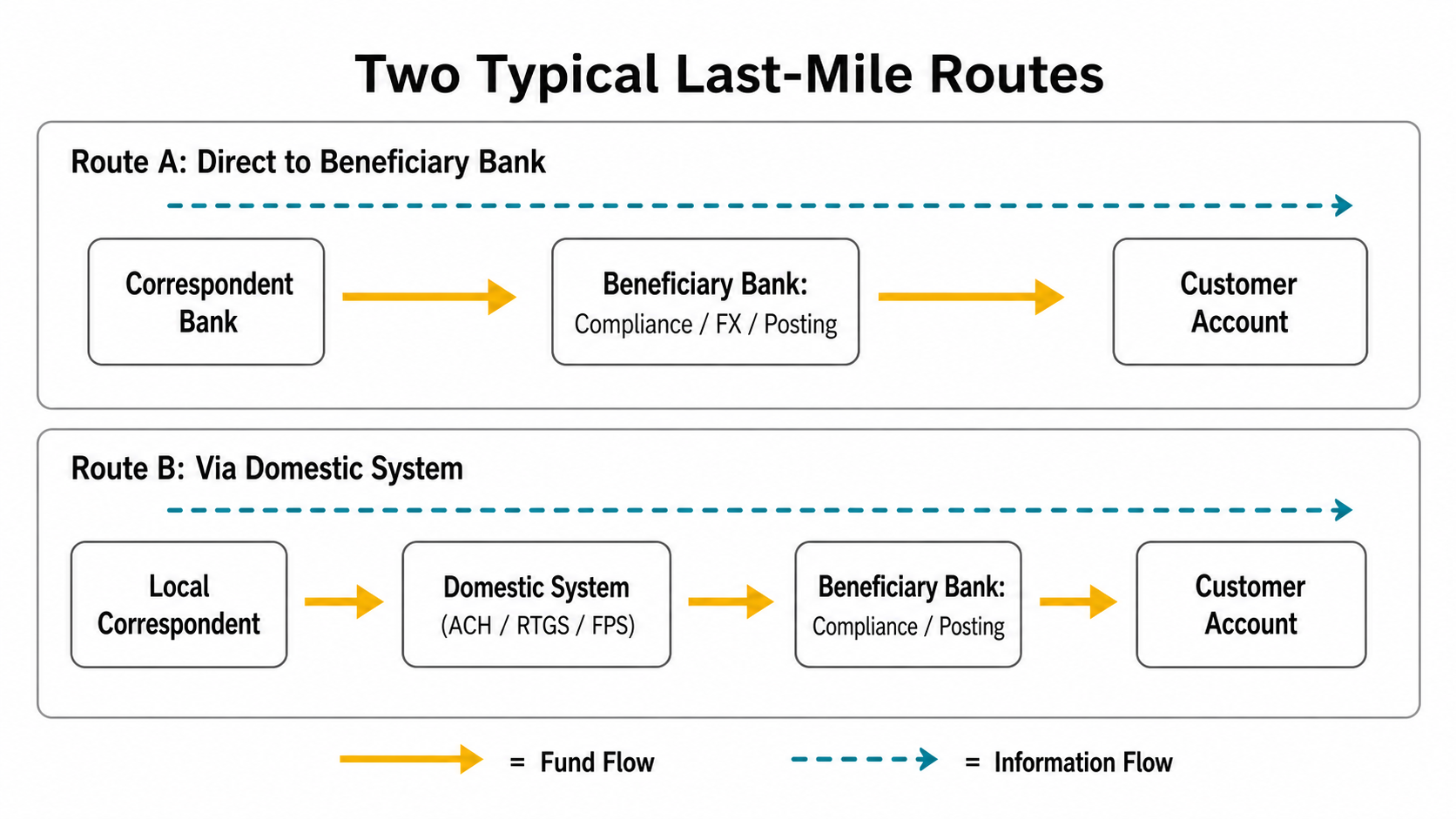
In Route A, after the offshore payment arrives directly at the beneficiary bank, what remains is mostly internal bank processing, without traversing a domestic clearing system. In Route B, funds first arrive at a local correspondent bank or clearing participant in the destination country, and are then forwarded to the actual beneficiary bank via a domestic payment system.
Equating the last mile solely with domestic fast payment systems is therefore inaccurate. Domestic systems are only one component; the beneficiary bank's own back-office processing, compliance engines, and core banking systems are equally integral parts of the financial infrastructure.
There are also four states that are easily conflated and must be distinguished: money reaching the destination country, money reaching the receiving bank, interbank settlement completion, and customer balance increase. These four states can occur at different points in time. The time lags between them constitute the exact latency of the last mile.
For example: a US dollar remittance is sent from the United States to an Asian country. Even if the interbank USD funding relationship has been fully settled, the receiving bank may still need to complete local regulatory reporting, currency conversion, beneficiary identity verification, and core banking ledger posting. As a result, the time when the customer sees the updated balance is noticeably later than when the banks finished processing the transaction.
3. What Happens After the Payment Reaches the Beneficiary Side?
On the receiving side, crediting an account is far more complex than simply incrementing a balance upon message arrival. From receiving a message to the customer seeing their balance, a typical beneficiary bank goes through six steps:
Step 1: Information Validation. Verify the beneficiary's name, account number, bank identifier code, payment purpose, address, and remittance information against account records for automated matching. A missing field or a spelling mismatch can immediately drop a transaction from straight-through processing (STP) into an exception queue.
Step 2: Compliance and Risk Control. Sanctions screening, anti-money laundering (AML) rules, transaction monitoring, and local regulatory mandates. Even if upstream banks have already conducted checks, the receiving bank cannot waive its statutory obligations. The same transaction is often screened repeatedly by multiple institutions along the routing chain.
Step 3: Funds and Foreign Exchange Processing. When the payment currency differs from the account currency, FX conversion is required. Certain markets also entail capital controls, foreign exchange restrictions, and local currency liquidity arrangements.
Step 4: Domestic Clearing or Internal Routing. If the institution receiving the cross-border payment is not the ultimate account-servicing bank, the transaction must be forwarded to the beneficiary bank via domestic clearing rails such as ACH, RTGS, or FPS.
Step 5: Account Crediting. The core banking system debits/credits the ledgers, generates accounting entries, and releases usable funds to the customer. Taking a bank's payment middle platform as an example: after an incoming message is ingested, it sequentially undergoes sanctions screening, FX handling, and account validation, before finally being translated into accounting postings recognized by the core system.
Step 6: Confirmation and Status Feedback. The fact that the customer's account has been successfully credited must itself be returned along the payment chain as a standardized status message, ensuring end-to-end tracking is complete.
Consider a hypothetical timeline:
| Time | Event |
|---|---|
| 08:00 | Sending bank dispatches cross-border payment instruction |
| 08:01 | Cross-border message arrives at beneficiary-side institution |
| 08:05 | Interbank funding conditions are substantially fulfilled |
| 08:20 | Transaction enters manual compliance queue due to missing fields |
| 10:30 | Customer account credited, balance becomes available |
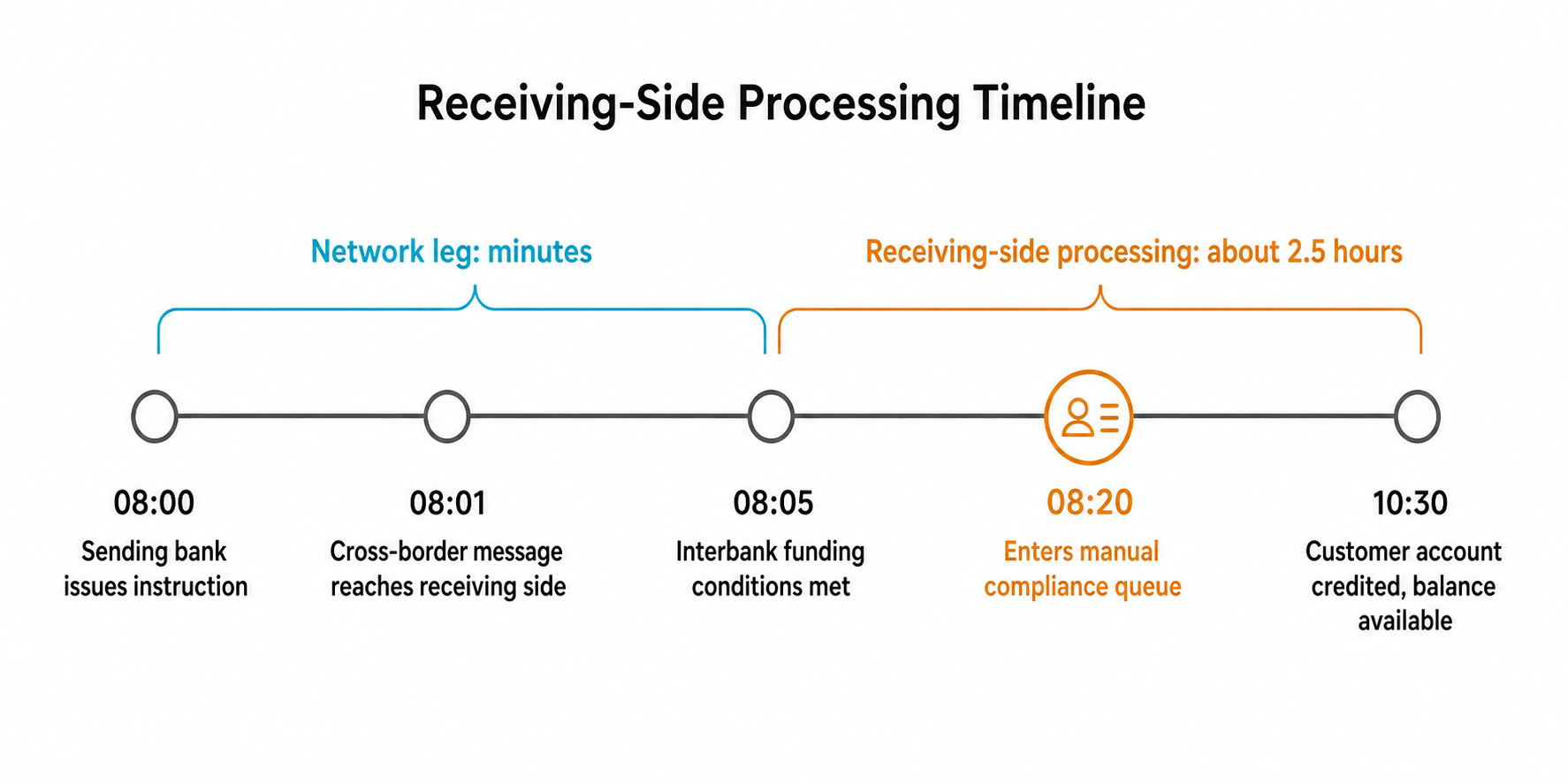
The network transmission took only minutes, yet the entire payment took two and a half hours. Time was consumed in stages invisible to the customer: compliance review queues, FX processing, and internal ledger posting.
Three distinct layers must be examined separately: message completion does not equal funds settlement completion, and funds settlement completion does not equal customer account crediting. The first two occur between financial institutions; the last occurs between the bank and its customer, operating on fundamentally different planes.
Latency cannot be resolved through technical automation alone. What technology can achieve is lowering cross-institutional coordination costs through higher-quality data exchange and boosting STP rates by automating routine steps. However, certain manual workflows stem from strict regulatory mandates and indispensable risk controls—aspects that cannot be solved by technology in isolation.
4. Five Structural Frictions Slowing Down the Last Mile
Swift's research synthesizes the frictions in the last mile into five structural factors:[1]
| Friction Type | Typical Manifestations |
|---|---|
| Regulatory Requirements | Certain markets require payment purpose disclosures, trade documentation, or regulatory reporting. The more rules rely on manual reviews, the harder it is for payments to achieve STP. |
| Capital and FX Environment | Capital controls, FX liquidity, and exchange mechanisms mean foreign currency arrival does not equate to immediate local currency availability. |
| Standards and Data Quality | While ISO 20022 enriches data payload, only when fields are standardized, data is accurate, and all upstream/downstream parties implement them consistently can repairs and manual intervention be reduced. |
| Risk Controls | Sanctions screening and transaction monitoring generate high volumes of false positives, routing payments that could settle in seconds into manual inspection queues. |
| Domestic Payment Infrastructure | In markets still relying on batch clearing or with restricted operating windows, no matter how fast the cross-border leg is, delivery cannot accelerate. |
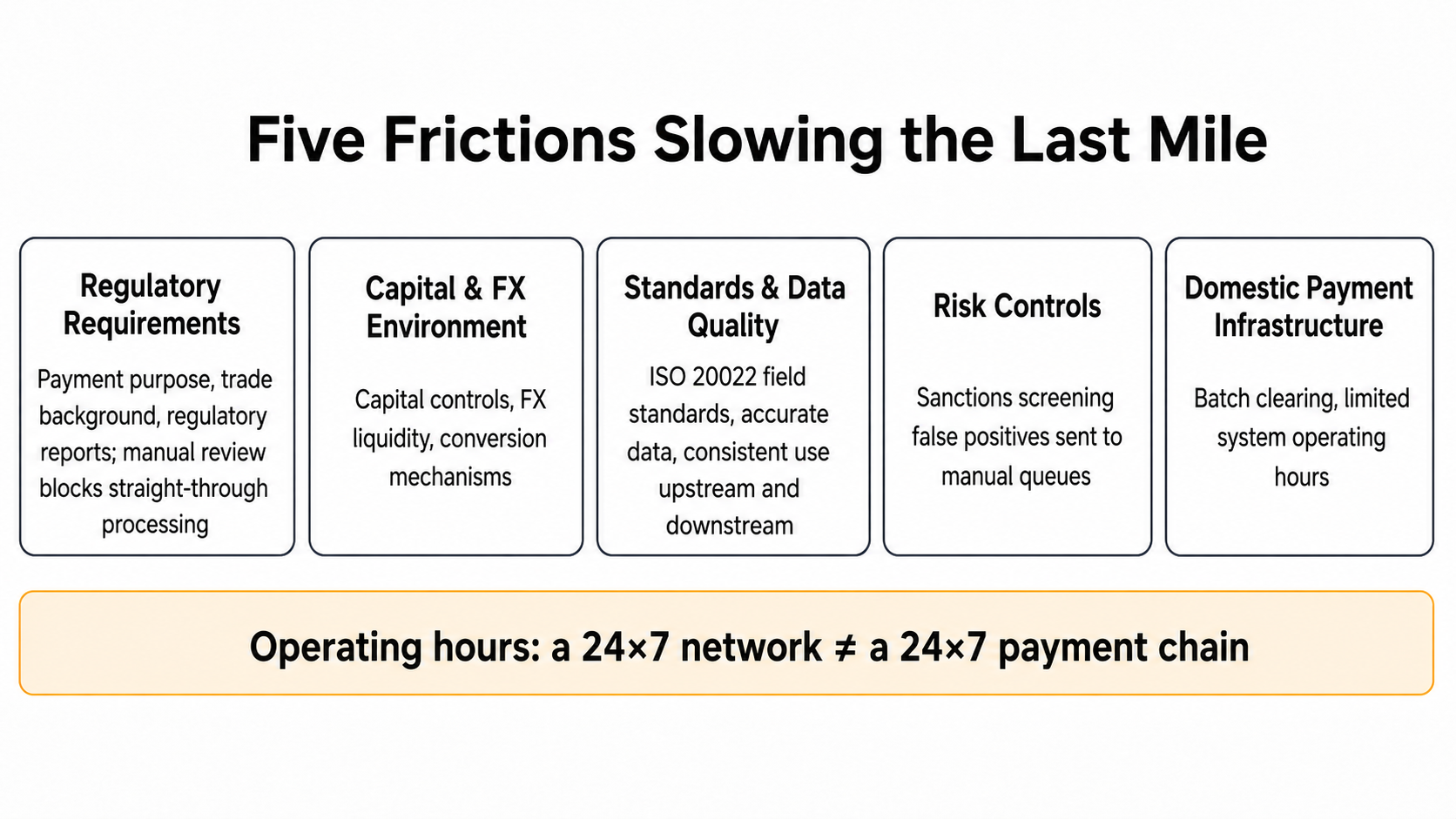
Based on these five frictions, Swift introduced the Payment Optimisation Index to measure the last-mile environment across different markets, accompanied by an operational playbook for banks and market authorities to guide targeted improvements.[1] The significance of this toolkit is that the last mile is now established as a measurable, incrementally improvable infrastructure challenge.
Operating Hours: The Network Operates 24/7, but the Payment Chain Does Not
A common explanation is that "banks are closed at night." This explanation is only half true. While cross-border messaging networks operate 24/7, many other links along the chain still run on business operating windows: FX trading desks, compliance operations teams, core accounting batches, liquidity management, and manual exception handling. As long as any single link operates strictly during daytime business hours, a payment initiated in the middle of the night may have to wait until the next business day.
Swift also explicitly identifies local regulation, capital controls, operating hours, and manual processing as key factors dictating the ultimate speed of customer crediting.[1]
The Bottleneck Principle (The Barrel Effect)
Whether an entire chain can achieve real-time speed depends on the slowest, yet unavoidable, link.
This is much like long-distance travel: the first 95 kilometers are on a high-speed highway, while the final 5 kilometers enter a congested urban corridor with manual toll booths. Raising the highway speed limit from 120 km/h to 150 km/h will not noticeably change the total travel time.
5. The Next Frontier of Competition: From Network Speed to End-to-End Orchestration
The industry already has real-world implementations underway. On July 22, 2026, Swift announced that 26 financial institutions are already processing transactions under its shared framework for retail cross-border payments, covering 25 corridors and 17 markets. In actual transactions, Australia to Spain took as little as 23 seconds, Australia to India 37 seconds, and China to the United States approximately 1 minute. Over 70 institutions have committed to joining within 2026. This framework emphasizes three core pillars: common service level agreements (SLAs), end-to-end tracking, and instant delivery where local infrastructure allows.[3]
This case illustrates that improving cross-border payments requires multiple banks collaborating under unified service standards; upgrading any single network alone cannot achieve it.
Consequently, the next phase of accelerating cross-border payments will focus heavily on the following areas:
- Fast Payment Systems (FPS): Shifting domestic rails from batch processing to 24/7 real-time operation makes FPS a vital last-mile infrastructure. However, connecting to an FPS does not guarantee end-to-end instant payments: if upstream data validation, FX conversion, compliance checks, and liquidity provisioning are not synchronized in real time, FPS will only accelerate one isolated segment.
- ISO 20022: A key value of ISO 20022 lies in providing downstream automation with more structured and complete data payloads—an essential prerequisite for reducing payment repairs and manual interventions.
- Payment Pre-validation: Shifting error detection from post-payment repair to pre-payment discovery, such as validating account status and required regulatory details before dispatch.
- Exception Handling and Investigations: As normal payments become increasingly fast, the costly and unpredictable friction lies in the small fraction of exception transactions. The efficiency of exception resolution dictates the baseline of the end-to-end user experience.
In the sequence of a payment lifecycle, the capabilities that cross-border payments must orchestrate include: Pre-validation, Message Transmission, Funds Settlement, Compliance Checks, Domestic Payment Systems, Account Crediting, Confirmation Feedback, and Exception Handling. The unit of competition is evolving from a single network or rail into end-to-end orchestration capabilities that link these steps into a resilient, predictable chain.
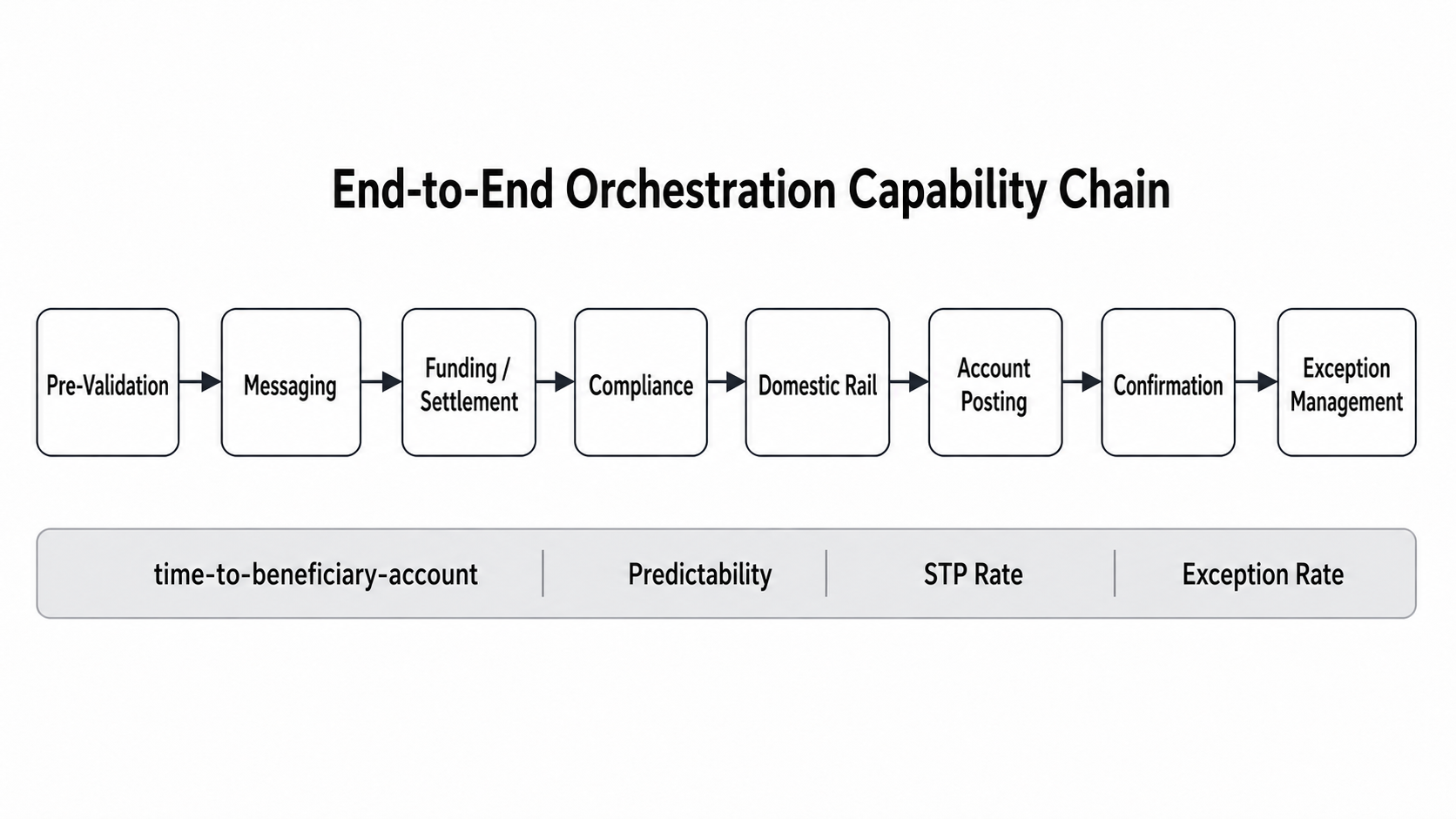
Measurement metrics are shifting accordingly. Beyond raw network speed, time-to-beneficiary-account, predictability, straight-through processing rates, and exception rates will command increasing attention.
Policy frameworks are driving in the same direction. The G20 Cross-Border Payments Roadmap establishes explicit targets: by the end of 2027, 75% of cross-border payments must be available to the beneficiary within one hour, with the remainder completed within one business day.[4] In its 2025 progress report, the FSB acknowledged that global metrics have seen limited improvement since 2023, and without enhanced implementation, the likelihood of meeting the 2027 targets on schedule is low.[5] Target setting and monitoring have long extended into the receiving-side account crediting stage.
In the past, the industry competed over who could build faster stretches of highway. Today, competition resembles an airline interline booking system: flights, luggage handling, customs clearance, transit connections, and ground services must be seamlessly coordinated. Passengers care about when they finally reach their destination, not how fast one single leg flew.
6. Conclusion
Over the past decade, the most visible aspects of cross-border payment reform were focused on the cross-border leg: messaging standard upgrades, correspondent banking optimizations, payment tracking, system interlinking, and the continuous emergence of new cross-border rails.
When 75% of Swift payments can already reach the beneficiary bank within 10 minutes, the next question naturally becomes: why hasn't the customer received the money after the bank has received it?[1]
Going forward, the speed of a payment will depend far more on whether the destination country's payment infrastructure operates in real time, whether regulatory data can be machine-processed, whether compliance screening can be automated, whether FX and liquidity are continuously available, and whether the beneficiary bank can execute real-time account crediting.
Competition in cross-border payments is shifting from network speed to end-to-end orchestration capability.
The moment a payment is truly completed is when the beneficiary account can freely use the funds. The dispatch of a message is not the finish line, nor is money crossing a national border.
References
[1]: Swift, Unlocking last mile speed in cross-border payments, July 20, 2026. https://www.swift.com/news-events/news/unlocking-last-mile-speed-cross-border-payments ↩
[2]: Swift, How long does a SWIFT payment take? https://www.swift.com/payments/how-long-does-swift-payment-take ↩
[3]: Swift, A better cross-border payment experience is here, July 22, 2026. https://www.swift.com/news-events/news/better-cross-border-payment-experience-here ↩
[4]: FSB, G20 Targets for Enhancing Cross-border Payments. https://www.fsb.org/work-of-the-fsb/financial-innovation-and-structural-change/cross-border-payments/g20-targets-for-enhancing-cross-border-payments-2/ ↩
[5]: FSB, G20 Roadmap for Cross-border Payments: Consolidated Progress Report for 2025, October 2025. https://www.fsb.org/2025/10/g20-roadmap-for-cross-border-payments-consolidated-progress-report-for-2025/ ↩
Originally published by Luminale Fintech Observer: https://luminale.cn/articles/cross-border-payments-last-mile-en