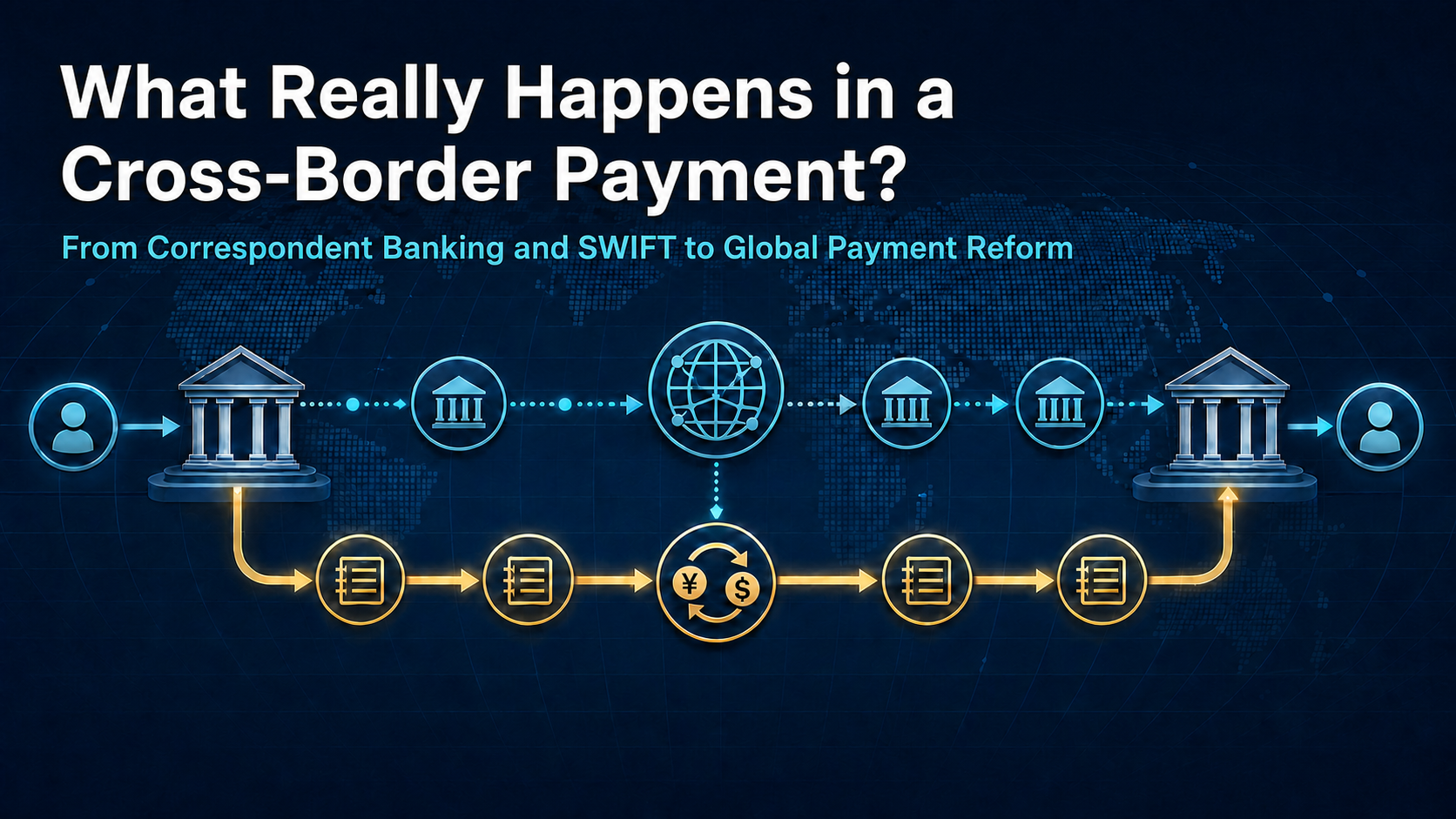
A Chinese company pays US$100,000 to an overseas supplier.
From the payer's perspective, the process seems simple: provide the beneficiary details, have the bank debit the account, and wait for the recipient to be credited. Behind the scenes, however, the payment may pass through the sending bank, a foreign-exchange transaction, one or more correspondent banks, the receiving bank, a local payment system, and several rounds of compliance checks.
The most common misunderstanding is to imagine cross-border payments as "money travelling from a server in China to a server in the United States."
In reality, money in bank accounts does not move across a network like an email attachment. What actually happens in a cross-border remittance is that payment instructions are exchanged between institutions, account balances on different ledgers change in sequence, interbank claims and obligations are discharged, and the receiving bank ultimately increases the beneficiary's deposit balance.
The real complexity of cross-border payments, then, is not "sending a message abroad." It is ensuring that financial institutions in different countries, using different currencies and payment systems and subject to different regulatory rules, arrive at mutually consistent, legally certain accounting outcomes.
1. How Does Money Actually Become "Cross-Border"?
First, break a cross-border remittance into several interconnected—but not necessarily fully synchronous—steps.
| Stage | What mainly happens |
|---|---|
| Payment initiation | The payer submits information such as the amount, currency, and beneficiary account to the bank. |
| Message transmission | Financial institutions exchange payment instructions, identity information, and compliance data. |
| Compliance screening | Banks conduct customer identification, anti-money-laundering, sanctions-list, and other checks. |
| Foreign-exchange conversion | If the payment and receiving currencies differ, a quotation and currency conversion are required. |
| Interbank processing | Banks confirm the route, calculate positions, and adjust account balances. |
| Final settlement | Payment obligations between the relevant banks are discharged using settlement assets. |
| Beneficiary credit | The receiving bank increases the beneficiary's deposit balance, making the funds available to the customer. |
Together these steps constitute a cross-border payment, but they are not the same thing.
What Is the Difference Between Payment, Clearing, and Settlement?
The scope of these terms can vary slightly by business context. For an introductory understanding, they can be distinguished as follows:
- Payment instruction: an instruction from the payer or sending bank saying, "Please pay this amount to this person."
- Clearing: participating institutions transmit, validate, and match transaction information, and calculate the amounts each party must pay or receive; some systems also net obligations.
- Settlement: payment obligations between financial institutions are discharged through the actual transfer of balances in accounts or other settlement assets.
This means that a bank's debit of the payer does not mean the receiving bank has already obtained settlement funds; receipt of a message by the receiving bank does not mean the beneficiary can immediately use the funds; and successful transmission of a payment message certainly does not mean interbank settlement is complete.
Domestic transfers usually occur in one currency, within one legal system and a relatively unified payment infrastructure. Cross-border payments must connect multiple systems. Even if banks in both countries have fast software, a transaction can still stop if payment-system operating hours differ, account relationships are unavailable, or compliance information cannot be verified automatically.
It is also important to distinguish cross-border payments from cross-currency payments.
A company may pay US dollars abroad from a domestic US-dollar account. That transaction is cross-border but needs no currency conversion. Conversely, some transactions in offshore markets may involve two currencies without necessarily being cross-border. Many cross-border payments do involve currency conversion, so foreign-exchange liquidity and settlement risk add to the chain's complexity.
Nor is "cross-border payment" a single category. It can include high-value wholesale payments between banks, retail payments by businesses and individuals, and small-value remittances from overseas workers. These types of payment differ substantially in amount, cost, participants, infrastructure, risk, and operational requirements.
2. Without a "Global Central-Bank Account," How Do Banks Pay into Another Country?
A commercial bank normally connects directly only to payment systems in its home market or a small number of other markets. There is neither a "global central-bank account" covering all commercial banks nor any bank that can participate directly in every country's payment systems for every currency.
When a bank cannot enter a particular market directly, it usually relies on a local bank or one that can clear the relevant currency. This is why correspondent banking exists.
A Correspondent Bank Does More Than "Forward Messages"
Suppose sending bank A needs to make a US-dollar payment but has no direct access to the relevant US-dollar payment system. It can open an account with bank C, which has US-dollar clearing capability, and have bank C provide payment, liquidity, and other interbank services.
That account has different names depending on the bank's perspective:
| Perspective | Name | Meaning |
|---|---|---|
| Bank A's view of the account | Nostro account | "Our account held with your bank" |
| Bank C's view of the account | Vostro account | "Your account held with our bank" |
Nostro and Vostro do not refer to two accounts. They are two names for the same account relationship. For bank A, the balance it holds with bank C is an asset; for bank C, that balance is a liability owed to bank A.
If the sending and receiving banks have no direct account relationship, a second or third correspondent bank may also be involved. A US-dollar payment can involve an institution with US-dollar clearing capability even when neither the sender nor the recipient is in the United States. The specific route, however, depends on the banks'account arrangements, the currency, the transaction structure, and the payment system used; it cannot be generalized.
Understanding a US$100,000 Remittance Through Account Movements
To see the main line clearly, assume that:
- The paying company already holds US-dollar deposits, so foreign exchange is not considered.
- Sending bank A and receiving bank B can both settle through the same correspondent bank C.
- Fees, credit lines, and intraday overdrafts are ignored for now.
Once settlement is completed, the main account movements can be simplified as follows:
| Participant and account | Change |
|---|---|
| Paying company's US-dollar deposit at bank A | −US$100,000 |
| Balance in bank A's account at correspondent bank C | −US$100,000 |
| Balance obtained by bank B at correspondent bank C | +US$100,000 |
| Overseas supplier's deposit at bank B | +US$100,000 |
From a bank-accounting perspective, customer deposits are liabilities that a commercial bank owes to its customers; balances held by the bank at a correspondent are assets.
Accordingly, on sending bank A's side, both its customer-deposit liability and correspondent-bank asset usually decline. On receiving bank B's side, its correspondent-bank asset increases, along with its deposit liability to the supplier.
| Bank | Change in assets | Change in liabilities |
|---|---|---|
| Sending bank A | Correspondent-bank deposit −US$100,000 | Customer deposit −US$100,000 |
| Receiving bank B | Correspondent-bank deposit +US$100,000 | Customer deposit +US$100,000 |
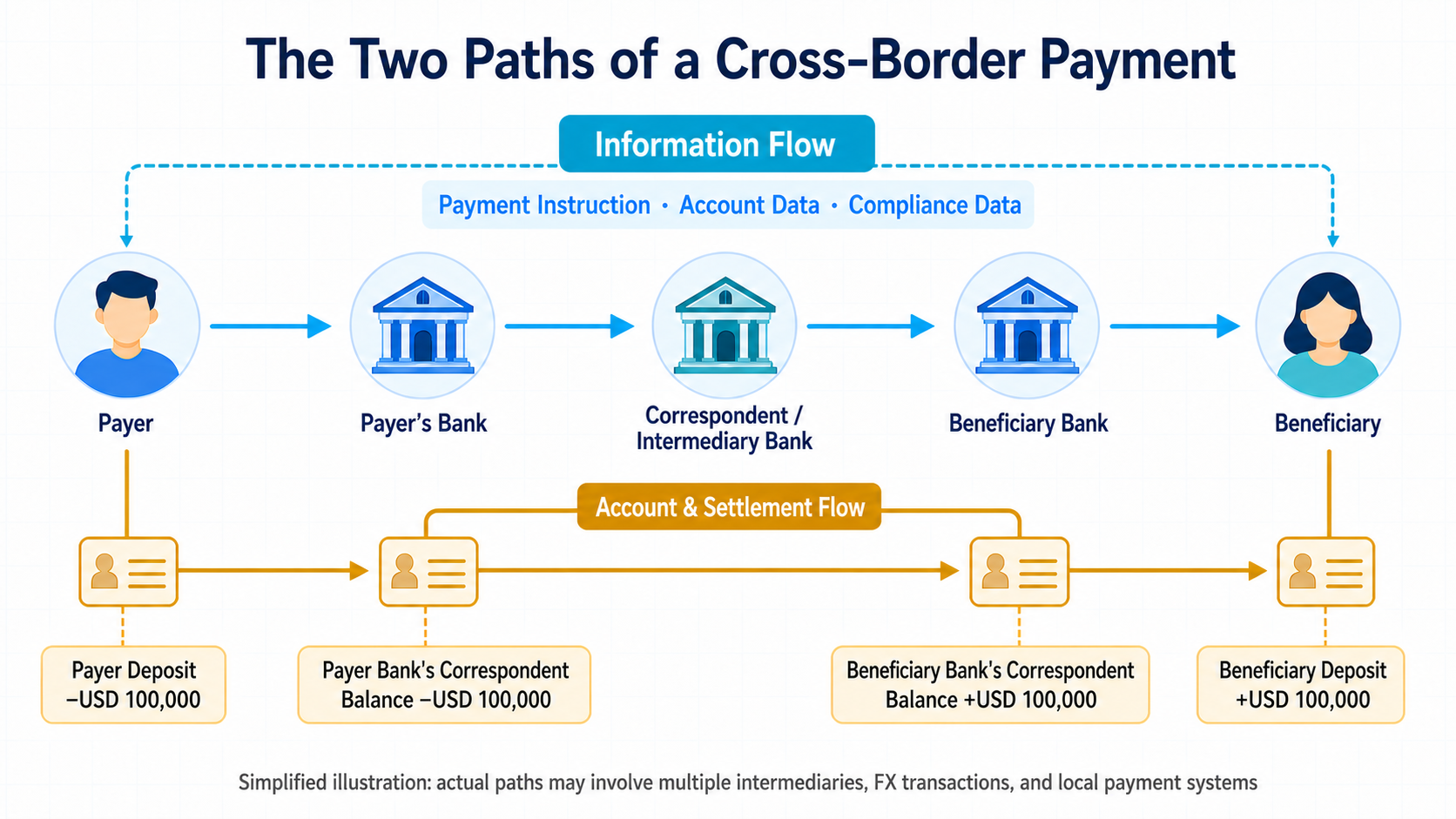
If the two banks use different correspondents, the funds route is longer, and the correspondents may settle with each other through a local large-value payment system. In some business models, the customer's payment instruction and the interbank instruction that provides the funds can even travel along different routes. Where information travels and where settlement positions change are not necessarily exactly the same line.
What Does SWIFT Actually Do Here?
SWIFT is, first and foremost, a secure, standardized financial-messaging network. It helps financial institutions identify counterparties and transmit payment instructions and related information in a common format.
SWIFT is not a bank, nor does it keep a single settlement account for the world's commercial banks. It does not itself move funds; banks, fintech companies, and other financial institutions transfer funds through the relevant accounts and payment arrangements. SWIFT's official explanation
It can be compared to the communications and ticketing language of an international multi-leg journey: it can tell participants who the traveller is, where the destination is, and how the next leg connects, but the traveller is still carried by railways, airports, and transport operators in different countries.
That is why "a SWIFT message was sent," "the sending bank debited the account," "the correspondent adjusted its balance," and "the beneficiary can use the funds" must be understood separately.
The traditional system has not stood still for decades. SWIFT gpi has improved traceability along correspondent-banking chains through a common transaction identifier, status updates, and payment tracking. Services such as payment pre-validation can identify account-information errors before a remittance is sent.
SWIFT's current published figures state that 75% of SWIFT payments reach the receiving bank within 10 minutes and 90% within one hour. But SWIFT also explicitly distinguishes "reaching the receiving bank" from final credit to the customer: delays often arise in the final leg, during compliance screening and local processing. SWIFT's official data
So, the arrival of an interbank message and funding position does not necessarily mean the end customer already has available funds.
Of course, not all cross-border payments rely on SWIFT. Card networks, international remittance companies, regional payment arrangements, interconnected fast-payment systems, and some digital-asset payment channels may use different information and settlement routes.
3. Why Are Cross-Border Payments Still Expensive, Slow, and Opaque?
Cross-border payment problems are often summarized as "expensive, slow, and opaque." The formal G20 framework adds a fourth dimension: access, meaning whether users and financial institutions can obtain cross-border payment services.
| Problem | Main sources of friction |
|---|---|
| High cost | Charges by intermediaries, foreign-exchange spreads, liquidity tied up, compliance investment, and manual repair. |
| Slow speed | Non-overlapping operating hours, sequential processing, information errors, repeated compliance checks, and waiting for FX settlement. |
| Lack of transparency | Intermediary deductions, blended exchange rates and fees, invisible status, and uncertain arrival times. |
| Insufficient access | Limited correspondent relationships, lack of direct access to payment systems for some institutions, and inadequate providers or infrastructure in some regions. |
Why Is It Expensive?
A cross-border payment may be handled in stages by multiple institutions. Each must operate accounts, systems, and compliance processes, and may charge fees.
When banks need to hold balances in advance across countries and currencies, that also creates liquidity costs. Bid-ask spreads in foreign-exchange quotations may be mixed with explicit fees, making the true cost hard for customers to see.
When transaction information is incomplete or formats are inconsistent, banks must investigate manually, request additional materials, and repair messages. The smaller the amount, the larger these fixed costs tend to be as a share of the transaction; small remittances are therefore particularly sensitive.
Why Is It Slow?
Banks, foreign-exchange markets, and payment systems do not all operate around the clock. As one country's payment system is nearing closing time, another may just be opening; weekends and holidays may not align either.
A transaction may pass in sequence through the sending bank, intermediary bank, receiving bank, and local payment system. Incomplete account-name, address, or purpose-of-payment information at any point can trigger manual processing.
CPMI has long treated the extension and coordination of real-time gross settlement system operating hours as a key foundation for improving cross-border payments. Its 2026 monitoring results still list broader system access, longer operating hours, and "interoperability by design" as implementation priorities. CPMI's 2026 monitoring report
Why Is It Opaque?
When a payer initiates a transaction, they generally cannot know in advance how much correspondent banks will deduct in fees. Nor does the foreign-exchange quotation they see necessarily separate the market rate, spread, and service charge clearly.
During processing, customers may see only "in progress," without knowing whether the payment is awaiting compliance screening or foreign-exchange settlement, or has reached the receiving bank but has not yet been credited.
Accordingly, any measure of payment speed must first distinguish whether a message has reached an intermediary bank, funds have reached the receiving bank, or the beneficiary has actually obtained available funds. Without that distinction, the same payment can appear to "arrive in minutes" and yet "take days to be credited."
Why Is It Difficult to Pay in Some Places at All?
Some smaller banks or particular regions have limited correspondent-banking relationships. Certain non-bank payment institutions and foreign banks cannot access key payment systems directly and must continue to rely on intermediaries.
When a correspondent bank considers a market too small, compliance costs too high, or risks too difficult to control, it may also reduce its services. This affects not only prices and speed, but may deprive some regions of stable cross-border payment channels.
Foreign-Exchange Conversion Is Another Hidden Layer of Infrastructure
If the paying company holds renminbi while the supplier requires US dollars, the transaction must also answer:
- Who quotes the renminbi-to-dollar exchange rate?
- Where does the bank obtain US-dollar liquidity?
- For how long can the exchange rate be locked in?
- When are the renminbi and US-dollar legs delivered?
- What happens if one party has delivered its currency and the other has not?
This is foreign-exchange settlement risk. Payment-versus-payment (PvP) mechanisms support simultaneous delivery: when one currency meets the conditions for delivery, the other is delivered at the same time.
Thus, even raising the speed of payment-message transmission to milliseconds does not automatically solve foreign-exchange liquidity, settlement risk, or compliance issues. The bottleneck in cross-border payments has never been network speed alone.
4. How Is the World Reforming Cross-Border Payments?
In 2020, the G20 launched its roadmap for enhancing cross-border payments, initially comprising 19 building blocks. In 2021, it adopted 11 quantitative targets covering wholesale payments, retail payments, and remittances, organized around cost, speed, transparency, and access. Many of the targets are due by the end of 2027.
The focus has since gradually shifted from diagnosing problems to driving implementation, concentrating on three themes:
- Payment-system interoperability, access, and functional extension;
- Coordination of legal, regulatory, and oversight frameworks;
- Cross-border data exchange and messaging standards.
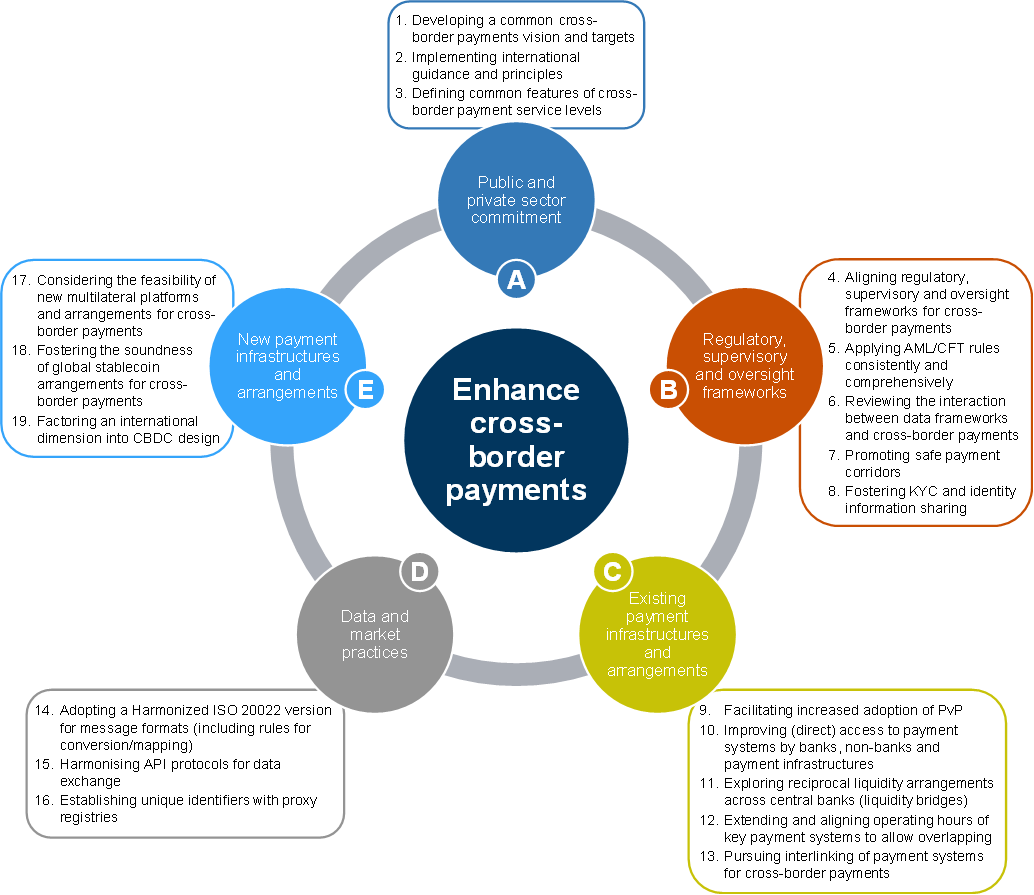
Figure: Five focus areas of the G20 roadmap for cross-border payments. Source: CPMI, "Enhancing cross-border payments: building blocks of a global roadmap" (July 2020).
This work is not about finding one "new system" to replace every old one. It is about improving different layers at the same time.
Path 1: Improve the Correspondent-Banking System
The first path leaves the basic account structure of correspondent banking intact while reducing information errors and opacity of status along the chain.
SWIFT gpi, payment tracking, payment pre-validation, fee transparency, and more structured message data all follow this approach. The goal is to help banks find errors earlier, reduce manual repair, and let participants see where a payment is in the process.
Its advantage is that existing bank networks and account relationships can be upgraded incrementally. Its limitation is that many frictions arise from operating hours, liquidity, foreign exchange, compliance, and local infrastructure; improving the messaging layer alone cannot resolve all of them.
Path 2: Upgrade Existing Payment Infrastructure
The second path includes:
- Extending the operating hours of large-value payment systems;
- Giving systems in different countries more overlapping operating windows;
- Broadening access for non-bank institutions and eligible foreign banks;
- Promoting standardized APIs;
- Coordinating how ISO 20022 is used.
ISO 20022 can carry richer, more structured payment data, supporting automated processing, compliance screening, and reconciliation. But a declaration by all systems that they "use ISO 20022" does not mean they are automatically interoperable.
If jurisdictions interpret field population, data meaning, and usage rules differently, new fragmentation will still emerge. CPMI updated its harmonization requirements in 2026 precisely to encourage more consistent ISO 20022 implementation by public and private payment systems. CPMI's update report
Path 3: Connect National Fast-Payment Systems
Retail payments within many countries can already be completed in seconds. Project Nexus aims to avoid building a dedicated link for every pair of countries by providing a standardized multilateral connection.
Once a domestic fast-payment system joins Nexus, it can in principle connect with other systems on the network. This is like designing a common interchange for the expressways of different countries.
In 2025, the central banks of India, Indonesia, Malaysia, the Philippines, Singapore, and Thailand jointly established Nexus Global Payments to move the project towards implementation; BIS subsequently transferred the project to that entity. Project Nexus official overview
Yet connecting payment systems does not automatically eliminate every problem. The network still needs rules for participation, foreign-exchange services, liquidity sources, dispute resolution, and governance responsibilities.
Path 4: Redesign Cross-Border Settlement Platforms
Other projects begin to address more foundational questions: what assets are ultimately used for cross-border settlement, whose liabilities those settlement assets represent, and whether payment, foreign exchange, and settlement can be coordinated on one platform.
mBridge explores a multi-CBDC platform shared by several central banks and commercial banks, supporting cross-border payments and foreign-exchange transactions. The project reached the minimum viable product stage in 2024, and BIS announced in October that year that it would hand the project to participating parties for further development. mBridge official overview
Project Agorá takes a different direction. Rather than excluding commercial-bank money, it studies how tokenized commercial-bank deposits and tokenized central-bank reserves could be combined on a shared programmable platform. A project report released in 2026 states that its prototype demonstrated the technical feasibility of atomic, multi-currency wholesale settlement using both forms of money on a shared platform. Project Agorá report
Neither should be reduced to "blockchain replacing SWIFT." SWIFT sits primarily at the messaging and transaction-management layer; these projects more directly examine account structures, settlement assets, and platform governance. They address different layers of the problem.
Likewise, a successful prototype does not mean it has become global financial infrastructure. Real-world adoption still depends on legal finality, liquidity, banks'willingness to participate, network effects, governance arrangements, and cross-border regulatory coordination.
Path 5: Modernize Foreign-Exchange and Compliance Processes Separately
Foreign exchange and compliance are often hidden behind the payment process, yet they are sources of many costs and delays.
Project Mandala seeks to encode policy and compliance requirements from different jurisdictions in a common protocol, allowing transactions to undergo compliance pre-validation and generating proofs that participants can verify. In November 2025, the project entered its second phase, continuing to study programmable compliance across a broader range of digital-asset and payment scenarios. Project Mandala official overview
Project Rialto places interconnected fast-payment systems, automated foreign-exchange mechanisms, PvP, and tokenized central-bank-money settlement in a single experimental framework. It focuses on foreign-exchange and settlement frictions in retail cross-border payments. A proof of concept completed in 2025 simulated both direct currency exchanges and exchanges using a third currency as a bridge currency. Project Rialto official overview
Viewed together, these projects show that global payments reform is not a contest over whether "SWIFT, CBDCs, or blockchain" will replace one another:
| What is being improved | Representative measures or projects |
|---|---|
| Messaging, tracking, and pre-validation | SWIFT gpi; payment pre-validation |
| Data standards | ISO 20022 harmonization requirements; standardized APIs |
| Payment-system access and operating hours | Longer RTGS hours; broader participant access |
| Interconnection of domestic fast-payment systems | Nexus |
| New settlement assets and shared platforms | mBridge; Agorá |
| Cross-border compliance | Mandala |
| Foreign exchange and synchronous settlement | Rialto; PvP arrangements |
Some improve information, some routing, some compliance, and some foreign exchange. Only a portion fundamentally change settlement assets or account structures.
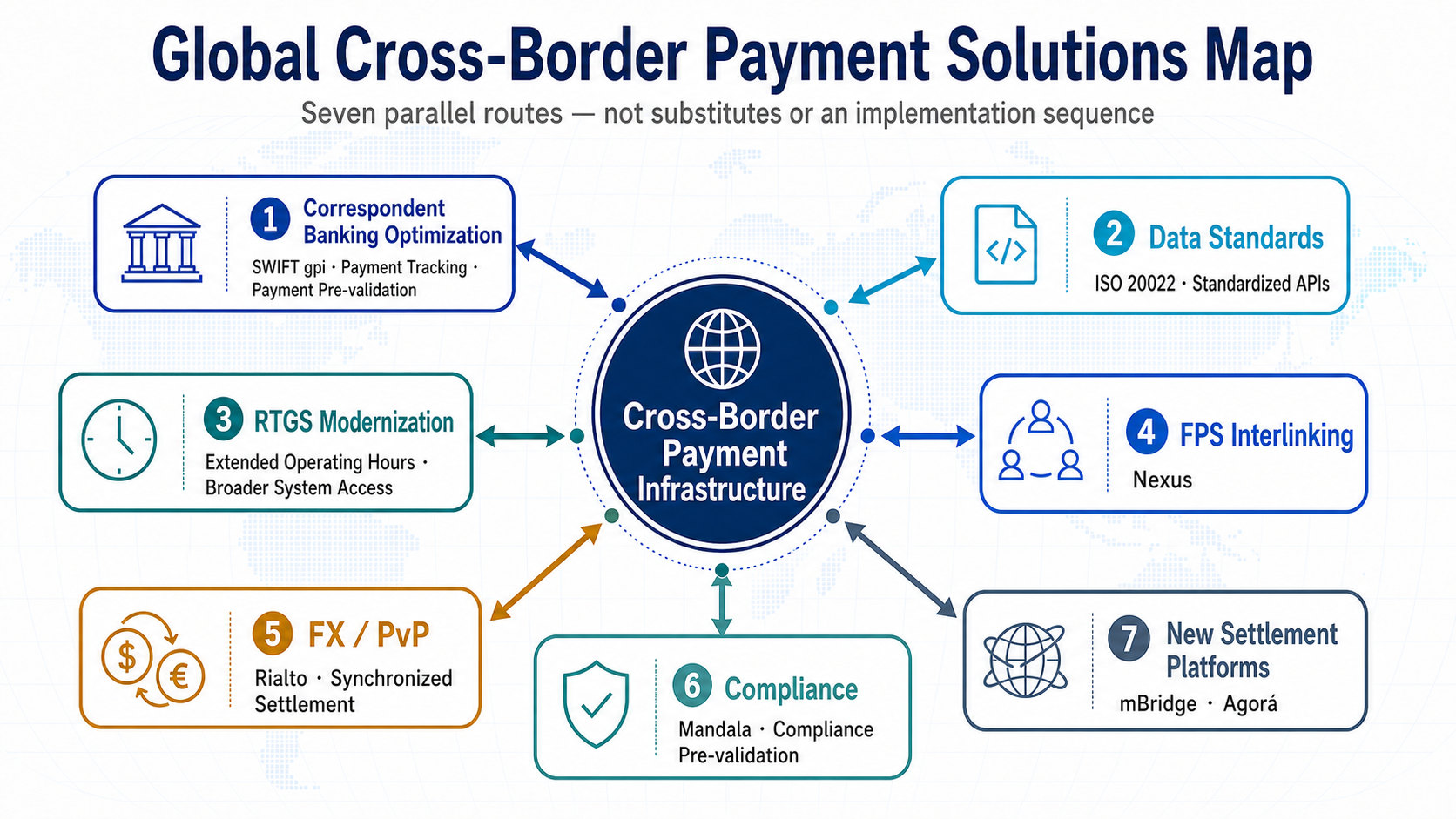
Figure: Seven paths are progressing in parallel; they are neither substitutes nor a sequence of implementation.
5. The Future of Cross-Border Payments: Technology Is Not the Only Challenge
Global cross-border payments reform has moved from "identifying problems" into a stage where standards coordination, infrastructure interconnection, and pilot projects advance in parallel. Yet end users have felt only limited improvement.
The FSB's 2025 progress report noted that much important policy work has been completed, but global metrics have improved only slightly since 2023. Achieving the 2027 targets fully at a global level on the original timetable is unlikely. FSB's 2025 progress report
This does not mean reform is meaningless. It shows that changes to financial infrastructure do not occur automatically simply because a technical prototype succeeds.
The genuinely difficult questions are increasingly about implementation and coordination:
- Who can access the new systems?
- Who provides liquidity in different currencies?
- Are settlements ultimately made in central-bank money, commercial-bank deposits, or other assets?
- How do different countries recognize the legal effect of the same settlement outcome?
- Can compliance data cross borders, and how is privacy protected?
- Who bears risk when there is a default, technical failure, or dispute?
- Who sets the rules for a cross-border platform, and who oversees it?
In its 2026 monitoring, CPMI identified broader payment-system access, extended operating hours, interoperability, ISO 20022 harmonization, and standardized APIs as concrete implementation priorities. This indicates that international work is shifting from "proposing solutions" to getting jurisdictions to actually adopt and carry them out. CPMI's 2026 monitoring report
When encountering any cross-border payment innovation in the future, it is useful to ask five questions instead of beginning with "Does it use blockchain or APIs?"
- Does it address information, routing, foreign exchange, compliance, or settlement?
- Which banks, payment institutions, or individuals can participate?
- What asset ultimately completes settlement for a transaction?
- Who provides foreign-exchange conversion and liquidity?
- Who bears risk and is responsible for governance when a default, failure, or legal dispute occurs?
This framework also applies to stablecoins, tokenized deposits, wholesale central bank digital currencies, and interconnections between fast-payment systems. The important question is not which will replace which, but exactly which layer of the cross-border payment chain each changes.
Cross-border payments appear to solve the problem of "how money moves from one country to another." In fact, they solve the problem of how different currency systems and financial infrastructures connect with one another.
Over the past several decades, correspondent banking and SWIFT have solved global reach through a highly networked banking system. The trade-offs have been long chains, fragmented liquidity, and the difficulty of fully coordinating the accounts, payment systems, and regulatory rules of different countries.
Today's ISO 20022, Nexus, Mandala, Rialto, mBridge, and Agorá can be understood as redesigns aimed at different points of friction. What will truly be worth watching is not which technology "wins," but whether information transmission, compliance screening, foreign-exchange conversion, and funding settlement can become more synchronized; whether gains in efficiency merely relocate credit, liquidity, and compliance risks into new corners; and whether countries are willing to connect their financial infrastructures in earnest while retaining monetary and regulatory sovereignty.
The front-end experience of "funds in seconds" is only the final user experience. What defines a cross-border payment system is always how back-end accounts change, how information travels, how foreign exchange is conducted, who bears the risks, and where settlement finality is achieved.
Originally published by Luminale Fintech Observer: https://luminale.cn/articles/how-cross-border-remittance-works-en