In many countries and regions, domestic retail transfers already operate with 24/7 real-time settlement. Whether through Singapore's PayNow, Thailand's PromptPay, Hong Kong's Faster Payment System (FPS), or Mainland China's Internet Banking Payment System (IBPS), individuals can transfer funds within seconds simply by entering a mobile phone number or scanning a QR code.
As this domestic instant payment experience has become second nature, a natural question arises: if individual jurisdictions already possess mature real-time payment systems, can we simply link these domestic infrastructures pairwise to make cross-border transfers as instantaneous as domestic payments?
Over the past few years, several landmark bilateral linkages have gone live. In April 2021, Singapore's PayNow linked with Thailand's PromptPay, marking the world's first bilateral retail fast payment system linkage. In late 2023, Hong Kong's FPS and Thailand's PromptPay launched cross-border QR code merchant payments. In June 2025, Payment Connect—linking Mainland China's IBPS with Hong Kong's FPS—officially commenced operations.
All three projects connect domestic Fast Payment Systems (FPS), yet each delivers a distinctly different product experience to end users. Understanding the underlying mechanisms of these three linkages clarifies how fast payment systems extend across borders, and how the underlying financial risks, clearing obligations, and settlement frictions are addressed once domestic rails connect.
1. The Fundamental Architecture of Domestic Fast Payment System Linkages
Traditional cross-border remittances rely heavily on the correspondent banking network. When a payer initiates a transfer, payment instructions pass through multiple tiers of correspondent banks over the Society for Worldwide Interbank Financial Telecommunication (SWIFT) network. At each hop, intermediary institutions conduct compliance reviews, debit and credit accounts, and allocate liquidity, before the beneficiary bank finally routes the payment through domestic clearing systems to credit the recipient. This sequential chain involves numerous intermediaries, takes hours or days, and frequently incurs unpredictable deduction fees.
Fast payment system linkages adopt a fundamentally different approach. Rather than dismantling existing commercial banking ledgers or attempting to construct a monolithic global clearing network from scratch, this model establishes direct conduits between two established domestic payment infrastructures via standardized application programming interfaces (APIs) and cross-border gateways. Funds disbursement and collection are handled directly by mature domestic real-time rails on both ends.
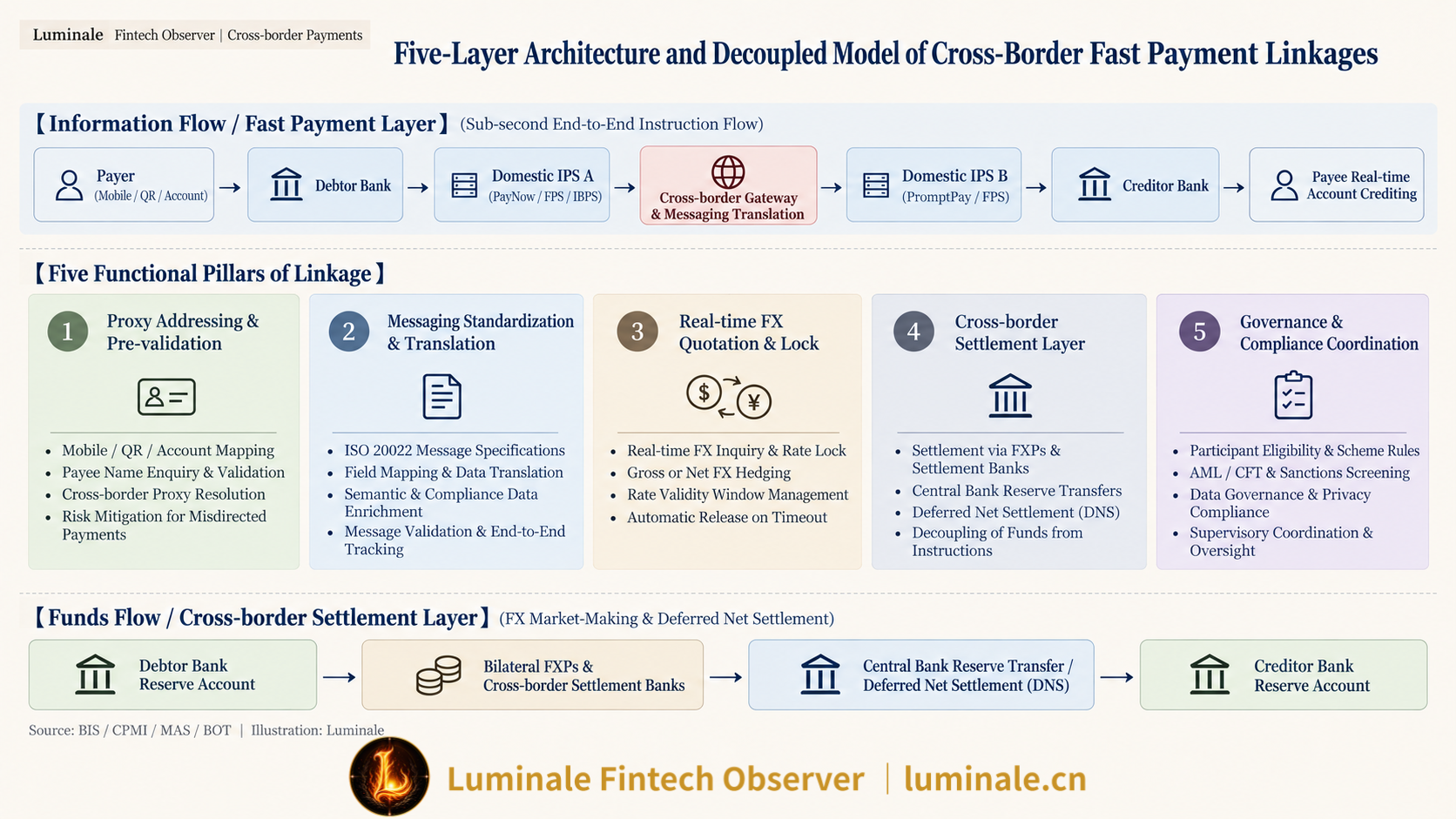
Under Luminale's analytical framework for cross-border payment infrastructures, a complete fast payment system linkage must coordinate five functional layers:
- Proxy Addressing and Alias Directory: Resolving mobile phone numbers, national identity numbers, or QR codes into specific bank account numbers, accompanied by real-time pre-validation and name enquiry prior to payment execution.
- Messaging Transformation and Interface Routing: Translating and validating payment messages between differing domestic standards (such as disparate versions of ISO 20022 or proprietary local formats) in real time.
- Real-time FX Quotation and Rate Locking: Locking binding foreign exchange rates at payment initiation, ensuring exact mathematical parity between the domestic currency debited from the payer and the foreign currency credited to the payee.
- Cross-border Funds Settlement and Liquidity Provision: Coordinating interbank positions between participating commercial banks and designated cross-border settlement banks to discharge clearing obligations.
- Operating Rules, AML, and Dispute Resolution: Harmonizing anti-money laundering (AML) screening, sanctions list filtering, transaction limit enforcement, refunds, and exception handling across disparate legal jurisdictions.
To analyze this structure, we must clearly separate information flow from funds flow:
Cross-border gateways can exchange payment messages within milliseconds, but domestic fast payment systems cannot directly transfer foreign currencies across their central bank reserve accounts. The Monetary Authority of Singapore (MAS) maintains central bank reserve ledgers denominated exclusively in Singapore Dollars (SGD), while the Bank of Thailand (BOT) maintains reserve ledgers denominated exclusively in Thai Baht (THB). Connecting two systems accelerates messaging and domestic posting, but the final discharge of cross-border currency obligations still depends on foreign exchange conversion and interbank settlement accounts.
2. PayNow × PromptPay: Cross-Border Payments Built on Proxy Addressing
In April 2021, the Monetary Authority of Singapore and the Bank of Thailand jointly announced the commercial launch of the PayNow–PromptPay linkage[1], representing the world's first linkage of domestic real-time retail payment systems.
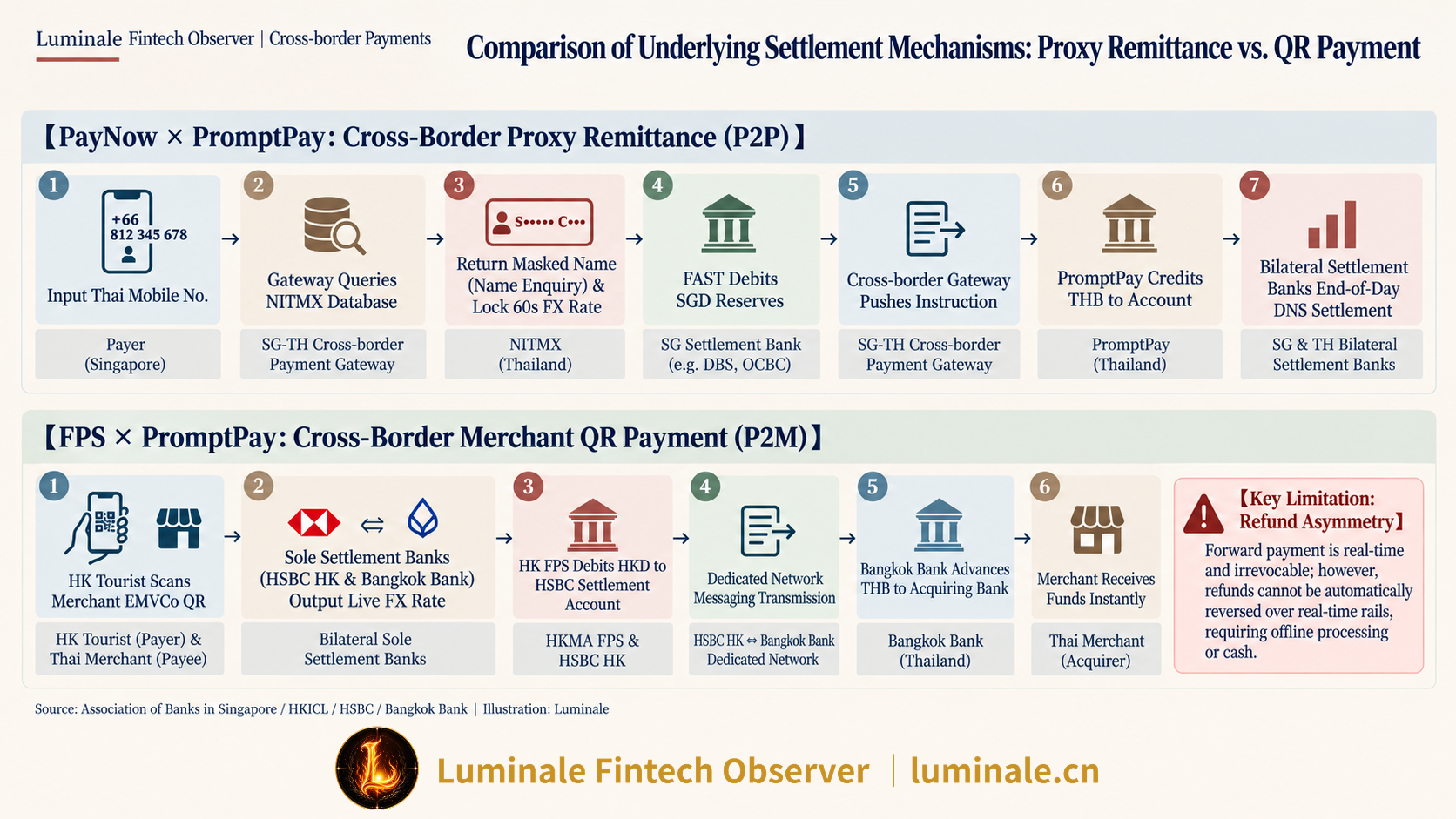
From a user-experience standpoint, the defining breakthrough was extending domestic proxy addressing across borders. When transferring funds to family abroad, users no longer need to input International Bank Account Numbers (IBAN) or SWIFT bank identifier codes. By entering the recipient's mobile phone number registered with PromptPay, the banking app displays the recipient's masked legal name (such as S*** T***). Once verified, the payer confirms the transaction, and funds typically reach the destination bank account within seconds.
1. Transaction Flow and Technical Architecture
Neither central bank required Thai banks to become direct clearing members of Singapore's Fast And Secure Transfers (FAST), nor did Singaporean banks join Thailand's PromptPay. Instead, technical integration occurs between the two domestic infrastructure operators: Banking Computer Services (BCS) in Singapore and National ITMX (NITMX) in Thailand, each deploying dedicated cross-border payment gateways[2].
A standard transfer from Singapore to Thailand proceeds through four synchronized steps:
- Proxy Resolution and Name Enquiry: The Singaporean payer enters the Thai mobile number in their mobile banking app. The Singapore gateway forwards a lookup instruction to Thailand's NITMX. NITMX queries the PromptPay centralized directory and returns the recipient's masked legal name to Singapore. The payer verifies the payee's identity before authorizing payment, substantially mitigating misdirected payment risks.
- Real-time FX Rate Locking: The system queries a designated Foreign Exchange Provider (FXP) for a firm quote. This quote is locked on the user's screen with an active countdown timer (typically 60 seconds). The payer sees the exact amount debited in SGD and credited in THB before final confirmation.
- Instruction Routing and Domestic Real-time Debiting: Upon confirmation, the Singapore sending bank debits the customer's deposit account and transfers reserves over FAST. The gateway pushes payment instructions across dedicated channels to NITMX. NITMX routes the instruction to PromptPay, which instantly credits the equivalent THB amount to the payee's Thai bank account.
- Reconciliation and Deferred Net Settlement: While the payee receives funds immediately, interbank claims between the two jurisdictions are not settled atomically at that exact microsecond. Designated settlement banks reconcile multilateral obligations at scheduled intervals, executing Deferred Net Settlement (DNS) via nostro and vostro accounts or foreign exchange swap operations.
2. Bank Balance Sheet Dynamics and Account Posting
From an accounting standpoint, we can track the balance sheet movements across participating institutions for a 500 SGD transfer (assuming an exchange rate of 1 SGD = 26 THB, totaling 13,000 THB):
| Institution | Asset Side Changes | Liability Side Changes |
|---|---|---|
| Singapore Remitting Bank (Bank S) | Central Bank Reserves (FAST) -500 SGD | Customer Deposits (Payer) -500 SGD |
| Singapore Settlement Bank (Settlement Bank S) | Central Bank Reserves (FAST) +500 SGD | Net Outbound Clearing Obligation +500 SGD |
| Thai Settlement Bank (Settlement Bank T) | Due from Foreign Bank (Pending FX Position) +13,000 THB | Central Bank Reserves (PromptPay) -13,000 THB |
| Thai Receiving Bank (Bank T) | Central Bank Reserves (PromptPay) +13,000 THB | Customer Deposits (Payee) +13,000 THB |
The immediate debiting and crediting experienced by end users are achieved via reserve transfers within their respective domestic fast payment systems. The cross-currency interbank obligations established between the two settlement banks are settled periodically at scheduled windows or at end-of-day, typically utilizing FX swaps or correspondent accounts.
3. Boundaries and Limitations
While this arrangement dramatically lowers friction for cross-border remittances, structural boundaries remain:
- Strict Transaction Limits: At launch, daily individual transfers were capped at 1,000 SGD or 25,000 THB[3], intentionally scoping the service to small-value person-to-person (P2P) remittances rather than commercial cross-border trade.
- FX Spread and Liquidity Costs: While less expensive than legacy wire transfers, foreign exchange providers incorporate spreads into live quotes during off-market hours or volatile sessions to insulate against overnight inventory risk.
- Selective Participation: Not all commercial banks participated initially; access was restricted to qualified banks and licensed digital banks that completed gateway integrations and regulatory onboarding.
3. FPS × PromptPay: Cross-Border QR Code Payment Products
In December 2023, the Hong Kong Monetary Authority (HKMA) and the Bank of Thailand launched another cross-border retail linkage: connecting Hong Kong's Faster Payment System (FPS) with Thailand's PromptPay[4].
Despite linking comparable real-time rails, Hong Kong and Thailand chose cross-border merchant QR code payments (P2M) rather than phone-number-based remittances.
1. Why QR Codes?
Product form factors reflect underlying economic corridors. Between Singapore and Thailand, steady labor migration and family support create sustained demand for bilateral P2P account transfers. Between Hong Kong and Thailand, however, cross-border flows are heavily concentrated in bilateral tourism and business travel.
In retail travel environments, merchants place static or dynamic QR codes linked directly to their point-of-sale (POS) acquiring systems. Consumers expect to scan and pay instantly using their familiar domestic mobile banking app or e-wallet, making merchant QR codes far more practical than soliciting a personal mobile number at checkout.
2. Operating Model and Settlement Bank Arrangements
On the technical layer, Hong Kong Interbank Clearing Limited (HKICL) and Thailand's NITMX established dedicated messaging connections conforming to EMVCo merchant-presented QR standards.
For cross-border funds settlement, the central banks designated specific commercial banks as exclusive settlement agents:
- Hong Kong Settlement Bank: The Hongkong and Shanghai Banking Corporation Limited (HSBC) serves as the sole settlement bank for Hong Kong participants[5].
- Thailand Settlement Bank: Bangkok Bank serves as the settlement bank on the Thai side.
This operating model illustrates a core principle: payment systems route instructions and execute domestic clearing, but do not absorb commercial FX market-making or credit advance risks.
HSBC Hong Kong and Bangkok Bank function as liquidity providers and FX market makers. They stream live wholesale benchmark rates to participating consumer applications and settle multilateral net positions in the interbank foreign exchange market at the end of each clearing cycle.
3. Dispute and Exception Handling in Consumer Scenarios
The FPS × PromptPay linkage also reveals an operational constraint in retail payment systems: forward payments execute in milliseconds, but return and refund flows cannot simply travel backwards automatically over the real-time rail.
Under merchant acquiring guidelines, if a traveler requests a refund after completing an in-store QR payment, the transaction cannot be reversed instantaneously back to Hong Kong Dollars over the FPS network. Refunds must typically be handled through the merchant's local acquiring bank via legacy wire transfers, credited to a temporary local account, or settled directly in local Thai Baht cash.
This asymmetry stems from the legal foundation of fast payment systems: instant irrevocable credit transfers. Once funds are credited to the receiving bank's central bank reserve account and posted to the merchant's ledger, an automated reversal involves complex legal cross-currents, including consumer protection statutes, merchant acquiring agreements, and FX unwind liabilities across two distinct sovereign jurisdictions. Connecting the forward pipe does not automatically establish an instant return pipeline.
4. FPS × IBPS: Cross-Border Retail Remittances and Public Utility Payments
On June 22, 2025, the People's Bank of China (PBOC) and the Hong Kong Monetary Authority formally launched Payment Connect[6].
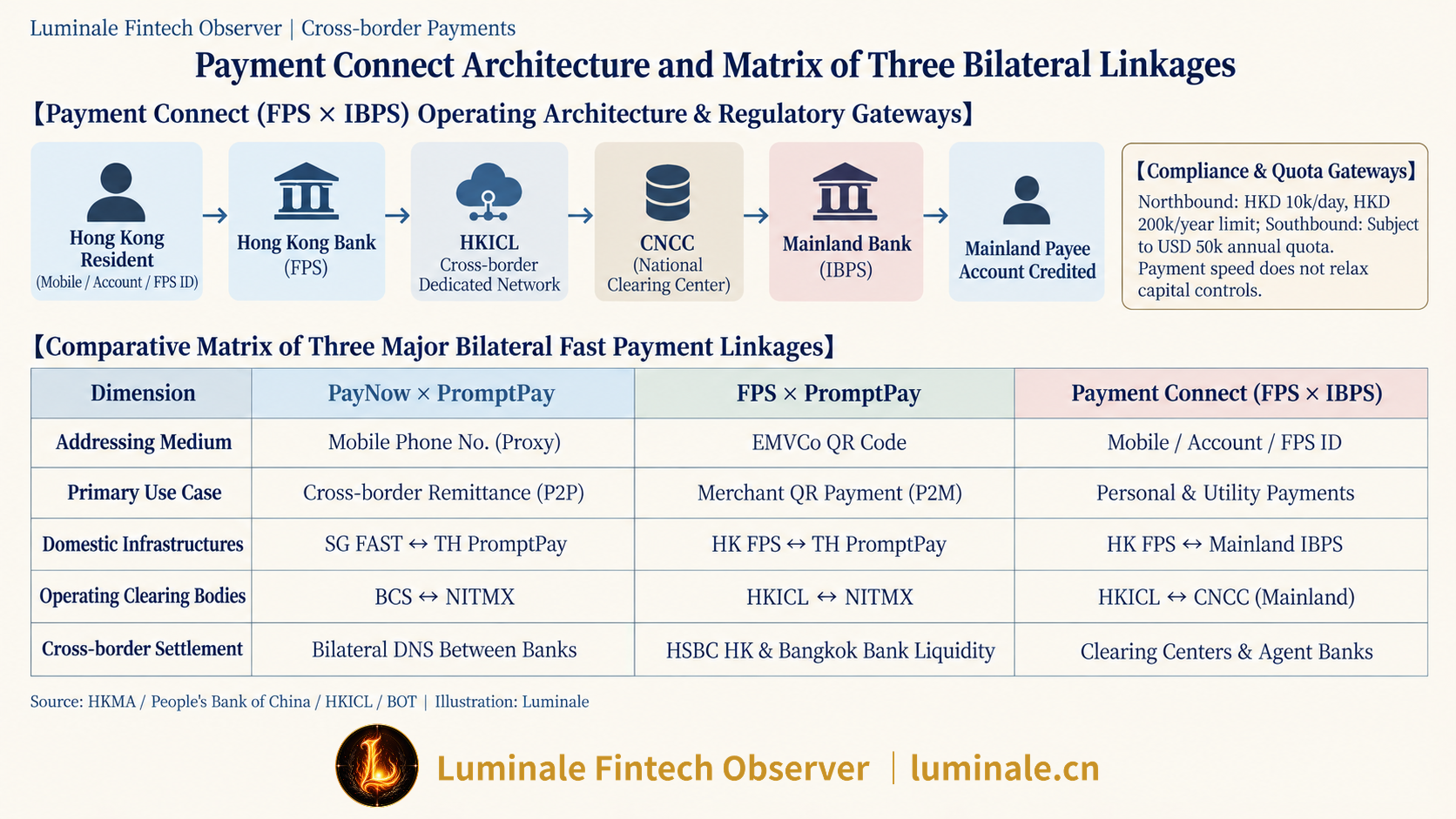
This project directly interconnects Mainland China's Internet Banking Payment System (IBPS) with Hong Kong's Faster Payment System (FPS), operated jointly by the China National Clearing Center (CNCC) and HKICL.
Unlike the Hong Kong–Thailand travel QR arrangement, Payment Connect returns to an account-to-account foundation, but encompasses a wider range of daily economic activities across the Greater Bay Area.
1. Two-Way Addressing and Public Utility Coverage
Payment Connect facilitates bidirectional small-value cross-border payments:
- Northbound Remittances (Hong Kong to Mainland): Hong Kong residents can initiate transfers using the Mainland recipient's mobile phone number or bank account number.
- Southbound Remittances (Mainland to Hong Kong): Mainland residents can transfer funds using the Hong Kong recipient's mobile phone number, email address, FPS ID, or bank account number[7].
In terms of use cases, Payment Connect supports everyday family remittances while explicitly accommodating current account public utility and personal remittances, including cross-border utility bills, medical payments, tuition fees, and payroll disbursements.
2. Balancing Payment Speed with Foreign Exchange Regulations
Payment Connect does not imply that funds circulate unconstrained between Mainland China and Hong Kong. Payment Connect represents an infrastructure modernization project, not a deregulation of capital account controls.
Regulatory authorities implemented strict compliance gates within the operating architecture:
- Transaction Quota Caps: Northbound personal transfers are capped at 10,000 HKD per day and 200,000 HKD per year per individual institution. Southbound transfers remain strictly governed within Mainland residents'annual personal facilitation quota of 50,000 USD equivalent.
- Transaction Authenticity Verification: Participating banks perform real-time front-end validation of underlying trade or life-service transactions, preventing the rail from being exploited for capital flight, illicit fund routing, or unauthorized investments.
- Currency Conversion Protocols: The system accommodates dual-currency clearing in Renminbi (RMB) and Hong Kong Dollars (HKD). When converting between currencies, sending institutions lock exchange rates before message transmission, embedding explicit conversion declarations within cross-border ISO 20022 payloads.
3. Cross-Comparison of Three Bilateral Linkages
Comparing these three operating models within a unified analytical matrix highlights their structural trade-offs:
| Dimension | PayNow × PromptPay | FPS × PromptPay | Payment Connect (FPS × IBPS) |
|---|---|---|---|
| Launch Date | April 2021 | December 2023 | June 2025 |
| Addressing Medium | Mobile Phone No. (Proxy) | EMVCo QR Code | Mobile / Account / FPS ID |
| Primary Use Case | Cross-border Remittance (P2P) | Merchant QR Payment (P2M) | Personal & Utility Payments |
| Domestic Infrastructures | SG FAST ↔ TH PromptPay | HK FPS ↔ TH PromptPay | HK FPS ↔ Mainland IBPS |
| Operating Clearing Bodies | BCS ↔ NITMX | HKICL ↔ NITMX | HKICL ↔ CNCC (Mainland) |
| Cross-border Settlement | Bilateral DNS Between Banks | HSBC HK & Bangkok Bank Liquidity | Clearing Centers & Agent Banks |
| Transaction Limits | Strictly Capped (1,000 SGD/day) | Aligned with Merchant Limits | Northbound: 10k HKD/day, 200k/yr; Southbound: 50k USD/yr quota |
These three initiatives demonstrate that fast payment linkages provide a neutral infrastructure conduit rather than a singular financial product. On top of the same underlying interbank capabilities, institutions can build peer-to-peer remittances, point-of-sale merchant acceptance, or cross-border public service disbursements.
5. From Bilateral Linkages to Multilateral Networks
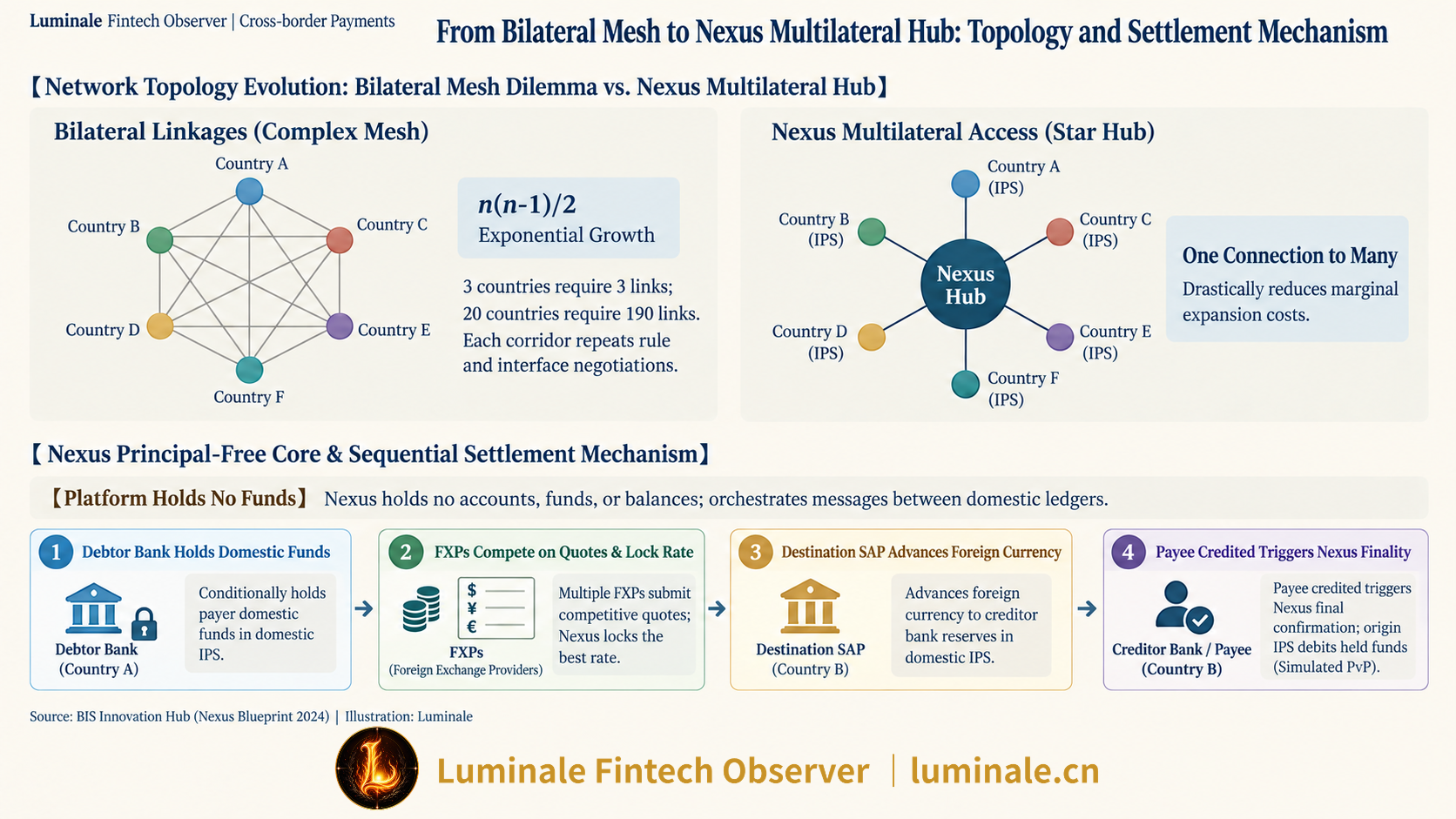
While bilateral linkages prove that connecting sovereign real-time payment systems is technically feasible, they expose geometric scaling bottlenecks.
The Bank for International Settlements (BIS) illustrated this scaling challenge mathematically: connecting 3 countries requires 3 bilateral corridors; connecting 5 countries requires 10 corridors; and connecting 20 countries would require:
For every separate bilateral corridor, central banks, commercial institutions, and clearing houses must negotiate dedicated API standards, messaging schemas, foreign exchange arrangements, settlement bank appointments, AML rules, data privacy compliance, and dispute resolution procedures. This pairwise patching approach cannot scale to support global real-time cross-border retail payments.
1. The Multilateral Hub Architecture of Project Nexus
To overcome bilateral fragmentation, the BIS Innovation Hub Singapore Centre published the comprehensive Nexus Blueprint in 2024[8]. In 2025, the central banks of India, Malaysia, the Philippines, Singapore, and Thailand jointly established an operational entity: Nexus Global Payments (NGP)[9].
The core architectural concept of Nexus is standardized multilateral access (One Connection to Many): each country's domestic instant payment system (IPS) connects once to the central Nexus hub using standardized specifications, gaining immediate operational access to every other connected network.
2. Core Operating Principle: The Platform Holds No Funds
A central feature of Nexus is that Nexus itself does not hold bank accounts, does not custody funds, and maintains no balance-sheet liabilities.
Nexus operates strictly as a message-sequencing and orchestration hub. Actual financial liabilities and liquidity commitments are borne by two specialized tiers of market participants:
- Foreign Exchange Providers (FXPs): Market participants that stream competitive, binding exchange rate quotes across currency pairs on the Nexus platform, committing to honor those quotes for validated transaction windows.
- Settlement Access Providers (SAPs): Commercial banks or clearing entities with direct access to domestic fast payment systems, responsible for debiting and crediting local fiat funds on behalf of FXPs within each jurisdiction.
To eliminate principal risk where funds are deducted in the source jurisdiction while delivery fails in the destination jurisdiction, Nexus utilizes Sequential Settlement with Conditional Reservation: the source bank places a conditional hold on the payer's domestic funds; Nexus locks the winning FXP rate; the destination SAP advances foreign currency into the creditor bank's central bank reserve account; the payee account is credited; and final confirmation triggers the source domestic rail to execute the final debit.
This architecture simulates the mechanics of Payment versus Payment (PvP), ensuring coordinated ledger adjustments across sovereign borders without requiring the central platform to hold legal title to fiat assets.
3. Persistent Challenges for Project Nexus
Transitioning from bilateral agreements to multilateral networks reduces marginal integration costs, but introduces distinct governance complexities:
- Liquidity Fragmentation and Pre-funding Requirements: FXPs and SAPs must maintain pre-funded liquidity across multiple currency accounts. For illiquid or emerging market currency corridors, private liquidity provision remains costly.
- Multilateral Legal and Supervisory Coordination: Bilateral treaties involve two sovereign counterparts. Multilateral frameworks must reconcile cross-border sanctions, AML escalations, and operational disruptions across dozens of legal jurisdictions simultaneously.
Conclusion
The evolution across PayNow–PromptPay, FPS–PromptPay, Payment Connect, and Project Nexus reflects a pragmatic trajectory for cross-border payment reform.
Rather than relying on speculative supranational digital tokens or overturning commercial banking ledgers, this model leverages domestic real-time clearing highways that economies have already spent decades perfecting, constructing standardized international transfer corridors between them.
This evolutionary path delivers concrete structural advances:
- Last-mile delivery Efficiency: Cross-border payments connect directly into domestic retail rails, compressing settlement times from days to seconds.
- Addressing and User Experience: Opaque account numbers are abstracted behind intuitive proxies such as mobile phone numbers and QR codes, backed by pre-validation name enquiries that sharply curtail execution errors.
- Transparent Pricing and Terms: Exchange rates and fee structures are locked before payment confirmation, eliminating intermediary correspondent deductions.
However, core financial frictions persist:
- Foreign Exchange and Settlement Risks Remain: While information flows instantaneously, interbank settlement obligations, foreign exchange risk management, and overnight liquidity commitments still depend on commercial banks.
- Regulatory Frameworks Are Inviolable: Real-time technology speeds up transaction validation, but capital account rules, balance of payments declarations, and AML surveillance remain non-negotiable legal mandates.
- Asymmetric Reversal Rails: The inability to automatically reverse instant credit transfers highlights ongoing institutional frictions in cross-border consumer protection and merchant acquiring rules.
From bilateral experiments to multilateral hubs, global cross-border payment infrastructure is undergoing a systematic architectural transformation. The objective remains constant: engineering a resilient equilibrium between sovereign monetary borders, regulatory imperatives, and modern technical efficiency.
References
[1]: Bank of Thailand. (2021). Launch of the world's first linkage of real-time retail payment systems between Thailand and Singapore. https://www.bot.or.th/en/news-and-media/news/news-20210429.html ↩
[2]: Association of Banks in Singapore (ABS). (2021). PayNow–PromptPay Linkage: Technical & Operating Framework. https://www.abs.org.sg/e-payments/pay-now ↩
[3]: DBS Bank Singapore. (2021). PayNow to PromptPay Transfer Terms and Transaction Limits. https://www.dbs.com.sg/personal/deposits/pay-with-ease/paynow/paynow-promptpay ↩
[4]: Bank of Thailand & Hong Kong Monetary Authority. (2023). Launch of the Hong Kong–Thailand Cross-border QR Payment Linkage. https://www.bot.or.th/en/news-and-media/news/news-20231204.html ↩
[5]: The Hongkong and Shanghai Banking Corporation Limited. (2023). HSBC acts as settlement bank for linkage between Hong Kong FPS and Thailand PromptPay. https://www.about.hsbc.com.hk/-/media/hong-kong/en/news-and-media/231130-hsbc-acts-as-settlement-bank-for-linkage-between-fps-and-promptpay-en.pdf ↩
[6]: Hong Kong Special Administrative Region Government Press Release. (2025). HKMA and PBOC launch Payment Connect. https://www.info.gov.hk/gia/general/202506/20/P2025062000305.htm ↩
[7]: Hong Kong Interbank Clearing Limited (HKICL). (2025). Payment Connect Consumer FAQ and Operating Rules. https://fps.hkicl.com.hk/schi/fps/consumers/payment_connect.php ↩
[8]: Bank for International Settlements (BIS). (2024). Nexus: Enabling instant cross-border payments (Report and Blueprint). https://www.bis.org/publications/nexus-enabling-instant-cross-border-payments ↩
[9]: Nexus Global Payments (NGP). (2025). Nexus Scheme Governance and Implementation Framework. https://nexusglobalpayments.org/ ↩
Originally published by Luminale Fintech Observer: https://luminale.cn/articles/from-paynow-promptpay-to-payment-connect-fast-payment-systems-cross-border-networks-en