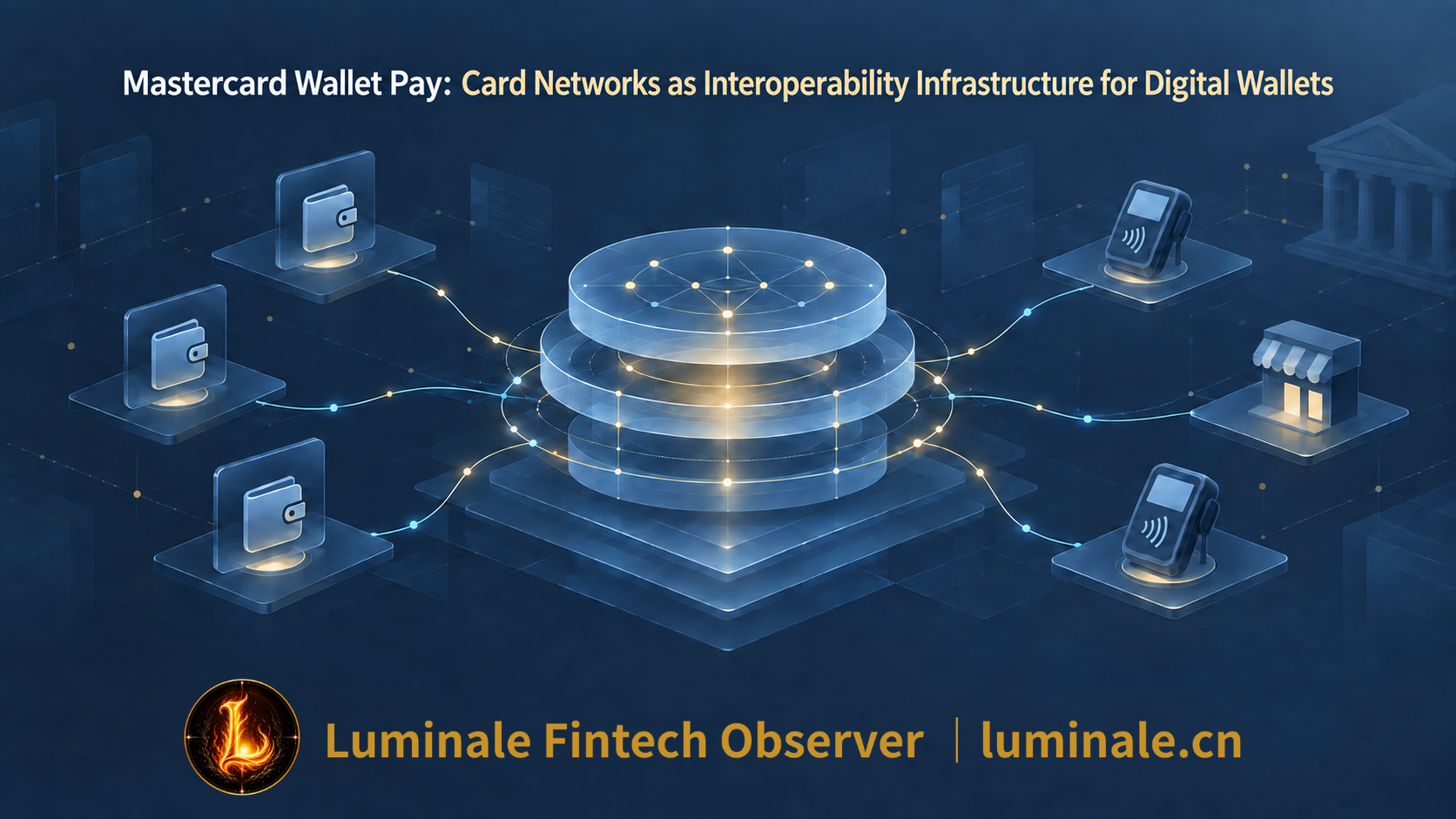
On September 10, 2026, Mastercard unveiled Mastercard Wallet Pay in Singapore, a global solution designed for digital wallets. The initial cohort of partners features key e-wallets within the Alipay+ ecosystem—the cross-border digital payment and digitalization solutions suite operated by Ant International—including AlipayHK (Hong Kong, China), GCash (the Philippines), Kakao Pay (South Korea), Touch 'n Go eWallet (Malaysia), and TrueMoney (Thailand), alongside regional leaders such as Mercado Pago from Latin America's e-commerce ecosystem and MTN Mobile Money from sub-Saharan African telecommunications operator MTN Group. According to Mastercard's roadmap, Wallet Pay aims to unify Near Field Communication (NFC), Quick Response (QR) codes, and online digital checkout, connecting regional digital wallets to Mastercard's global merchant acceptance footprint while facilitating fluid fund transfers across cards, wallets, and bank accounts.[1]
Over the past decade, global digital wallets successfully navigated their initial phase of localized expansion. From East Asia to Southeast Asia, and from Latin America to sub-Saharan Africa, e-wallets leveraged mobile internet penetration and aggressive merchant acquisition to build proprietary, closed-loop ecosystems serving tens to hundreds of millions of users. Third-party research cited by Mastercard indicates that global digital wallet users have surpassed 4.3 billion and are projected to exceed 6 billion by 2030.[1]
Yet, once wallets in diverse jurisdictions established high-frequency domestic networks, the industry's primary bottleneck pivoted: when a local digital wallet ventures beyond its proprietary ecosystem and sovereign borders, how can it execute seamless payments across foreign merchants, heterogeneous physical point-of-sale (POS) hardware, and fragmented acquiring networks?
The launch of Mastercard Wallet Pay signals that global card networks are abstracting decades of accumulated merchant acceptance, payment tokenisation, transaction routing, and risk management capabilities into plug-and-play modules for third-party digital wallets. However, assessing this offering requires delineating its true operational boundaries: at which functional layers does "wallet interoperability" genuinely occur, and which traditional clearing and settlement arrangements remain indispensable underneath?
1. The Acceptance Divide Facing Digital Wallets Beyond Local Ecosystems
During the initial ascent of digital wallets, the overriding mandate was substituting physical cash and legacy card-swiping routines for everyday domestic commerce. E-wallet operators anchored themselves in home markets by deploying static and dynamic QR codes, subsidising user acquisition, and integrating local bank accounts and municipal utility billing systems, constructing dense, self-contained acceptance loops.
While robust domestically, this operating model exhibits pronounced structural vulnerabilities in cross-border and cross-ecosystem scenarios:
- Fragmentation of Terminal Interaction Protocols: Numerous emerging Asian markets rely heavily on QR code infrastructure. In contrast, mature retail jurisdictions across Japan, Europe, and North America feature pervasive physical merchant terminals adhering to EMV specifications (chip-card and mobile payment standards governed by EMVCo) for contact and contactless transactions. A traveler accustomed to optical QR scanning encounters an immediate operational wall when facing an overseas merchant equipped exclusively with contactless tap-to-pay terminals, absent underlying protocol bridging.
- Economic Prohibitions of Bilateral Global Merchant Acquisition: For any regional e-wallet, attempting to independently establish bilateral commercial agreements and direct technical integrations with tens of millions of merchants and fragmented acquiring institutions across dozens of countries involves prohibitive lead times, regulatory compliance overhead, and infrastructure expenditures.
- Barriers in Security Credentials and Tokenisation Standards: To prevent Primary Account Numbers (PAN) and core account credentials from exposure across public data networks, major card schemes established mature tokenisation standards long ago.[3] If a regional wallet's proprietary identifier cannot be mapped into a globally recognized Device Token, it cannot be ingested by native operating system wallet containers or hardware-based secure elements.
In their nascent stage, digital wallets resembled municipal transit cards: frictionless within their home metropolitan transit authority, but inoperable across municipal or national borders due to incompatible card-reader standards and non-interoperable merchant terminals.
The industry has pursued two primary architectural paths to bridge this acceptance divide: one entails regional wallet interoperability networks such as Alipay+, which aggregate fragmented national QR standards and merchant acquirers to enable cross-border barcode roaming; the other, exemplified by Mastercard Wallet Pay, opens existing card scheme contactless rails and global merchant acceptance footprints directly to external e-wallets.
2. Deconstructing Digital Wallet Interoperability Across Three Layers
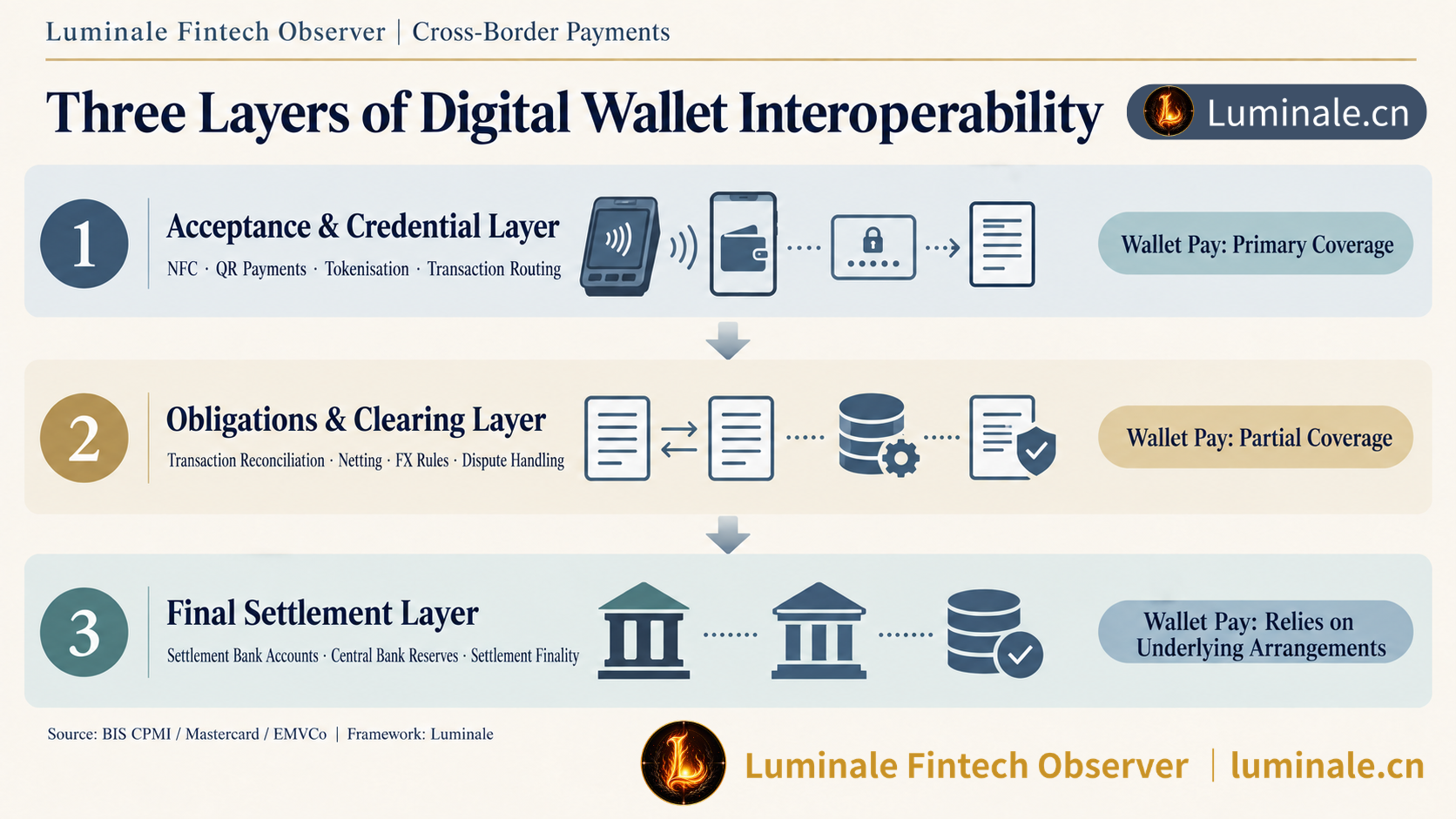
In discussions surrounding cross-border and cross-institutional payments, "interoperability" is frequently employed as an overarching buzzword. Under the payment infrastructure analytical framework developed by Luminale, interoperability within payment systems comprises three functionally distinct tiers:
| Interoperability Layer | Core Problem Addressed | Key Mechanisms & Technologies | Wallet Pay Scope |
|---|---|---|---|
| Acceptance & Credential Layer | Front-end interaction, credential recognition, and messaging routing: enabling wallets to initiate transactions across diverse terminals and merchants | EMV specifications, NFC, QR codes, payment tokenisation, messaging syntax conversion (e.g., ISO 8583 / ISO 20022) | Primary Coverage: Converts wallet credentials into scheme-compliant tokens or specifications, unlocking global POS terminals |
| Obligations & Clearing Layer | Inter-institutional transaction reconciliation, fee calculation, and netting: determining reciprocal obligations and fixing FX conversion rates | Multilateral netting, gross clearing, foreign exchange rules, dispute arbitration frameworks | Partial Coverage: Leverages card scheme clearing networks or partner rails to compute net obligations between issuers and acquirers |
| Final Settlement Layer | Extinction of interbank or inter-entity final obligations: specifying settlement assets and legal finality timing | Central bank statutory reserves, commercial bank correspondent accounts (Nostro/Vostro accounts), settlement finality legal frameworks | Relies on Underlying Rails: Final settlement executed through participating settlement banks via commercial bank balances or central bank reserves |
1. Acceptance and Credential Interoperability
This layer represents the most comprehensive breakthrough delivered by Mastercard Wallet Pay.
Historically, a Hong Kong dollar (HKD) balance stored within an AlipayHK account could only be spent at merchants supporting its proprietary barcode protocols or integrated partner aggregator gateways. Leveraging Wallet Pay's tokenisation and virtual issuance mechanisms, e-wallet operators can provision a virtual payment token adhering to international card scheme specifications against the user's balance, supported by Mastercard technology.
When a user taps their smartphone against an overseas merchant's NFC terminal, the terminal captures a standard EMV-compliant Device Token. The merchant acquirer processes the transaction as a standard Mastercard contactless payment, routing it across established card rails for authorisation. At this stratum, interoperability fundamentally denotes the standardisation of credential formats and terminal interaction protocols.
2. Money Movement and Clearing Interoperability
Once a transaction receives affirmative authorisation, an unsettled clearing obligation arises between the issuer (the licensed issuing entity or partner financial institution underpinning the wallet) and the acquirer (the merchant-facing institution). The Mastercard network aggregates transactions across scheduled daily clearing cycles, calculating bilateral or multilateral net positions among participating institutions.
Mastercard emphasizes that Wallet Pay facilitates multi-directional money movement across cards, wallets, and accounts, spanning over 200 countries and territories and 150 currencies.[1] This implies that cross-border fund flow instructions can leverage established money movement rails (such as Mastercard Move) for instruction dispatch and foreign exchange rate lock-in.
3. The Final Settlement Layer
Crucially, seamless acceptance across physical POS terminals does not imply that global digital wallet operators converge onto a shared, monolithic central ledger.
Following transaction clearing, the acquiring bank must disburse funds to the merchant, while the wallet operator (or its designated safeguarding custodian bank) must deliver equivalent settlement funds to Mastercard's settlement bank. This final discharge of interbank debt continues to depend on correspondent banking accounts (Nostro/Vostro accounts) maintained at commercial banks or final balance transfers executed in central bank reserve money across Real-Time Gross Settlement (RTGS) systems.
The ability of a mobile phone to achieve global cellular roaming relies on signaling gateways and bilateral roaming covenants among telecom carriers; it does not mean international telecom operators share identical cellular base stations or unified billing ledgers. Analogously, digital wallets accessing global merchant footprints via card rails connect to a standardized protocol conversion and routing gateway orchestrated by the card scheme, rather than a consolidation of disparate underlying account balances and sovereign settlement systems.
3. Dissecting the Transaction Flow: What Happens During an Overseas Purchase by a Hong Kong Resident
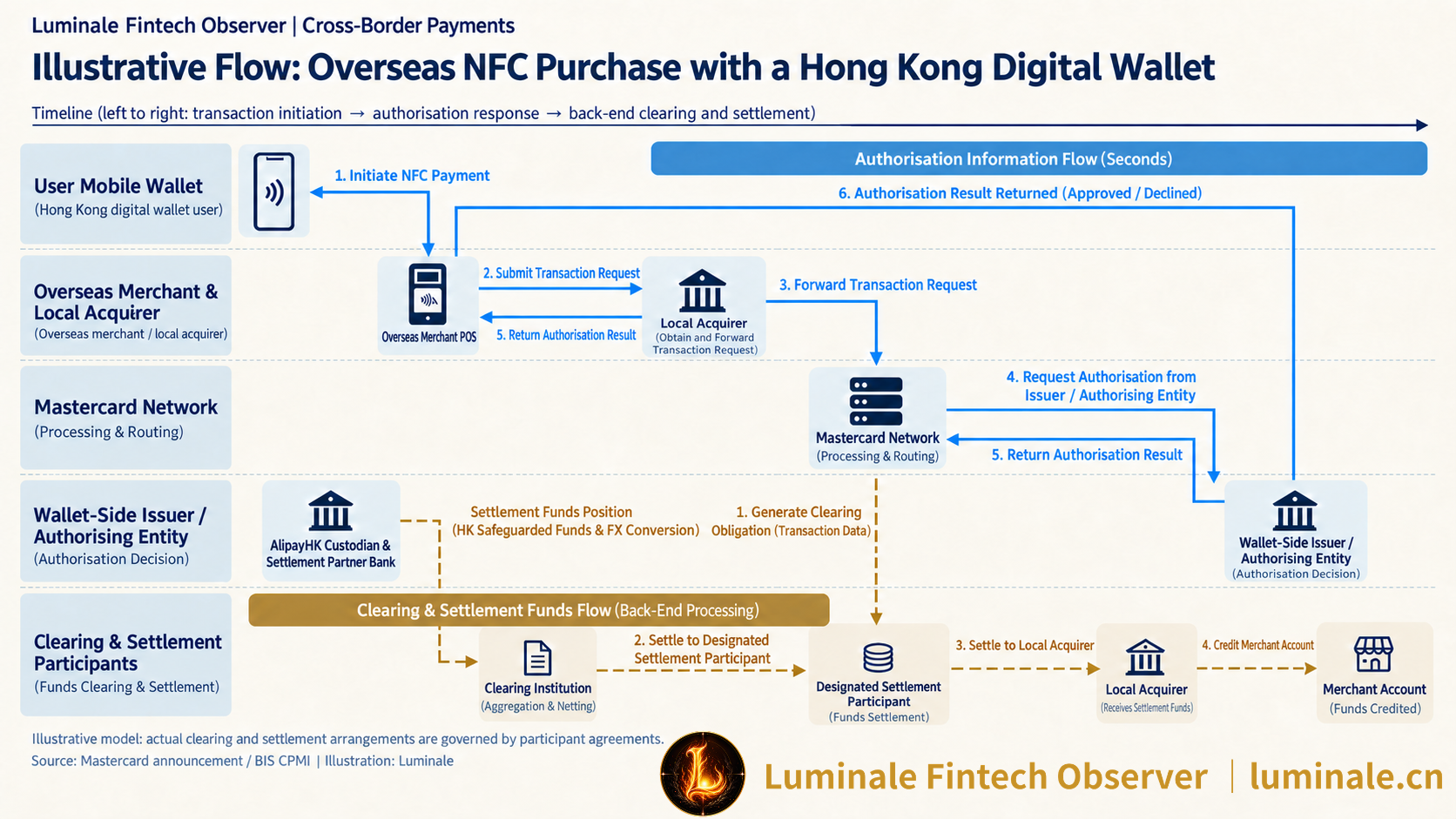
To analyze the operational mechanics of Wallet Pay in practice, we examine AlipayHK—an inaugural launch partner—tracing the end-to-end lifecycle of an overseas contactless transaction initiated by one of its users:
Business Scenario: A Hong Kong resident shops at a department store in Tokyo, making a purchase totaling 10,000 Japanese yen (JPY). The checkout counter exclusively accepts contact and contactless payment cards, offering no QR scanning capability. The user activates their virtual Mastercard contactless card linked to AlipayHK on their mobile device and completes the transaction via NFC tap-to-pay. The equivalent Hong Kong dollar (HKD) balance is deducted from AlipayHK, while the Tokyo merchant receives settled proceeds in JPY.
1. Balance Sheet Positions of Market Participants
In modern monetary systems, money circulates as a liability of its issuing institution. AlipayHK operates under a Stored Value Facility (SVF) license granted by the Hong Kong Monetary Authority (HKMA) pursuant to the Payment Systems and Stored Value Facilities Ordinance. The customer funds stored in its custodial bank accounts legally constitute statutory safeguarded liabilities owed by the licensed institution to its users.
In a simplified balance-sheet perspective, initial institutional positions are structured as follows:
| Market Participant | Assets | Liabilities |
|---|---|---|
| AlipayHK User | Claim on AlipayHK stored value facility (sufficient HKD balance) | Personal Net Worth |
| AlipayHK Operating Entity (SVF Licensee & Partner Issuer) | Statutory segregated customer deposits placed at local regulated custodian banks; clearing reserves placed at clearing banks | Stored value liabilities owed to users; clearing obligations payable to the Mastercard clearing network |
| Japanese Retail Merchant | Receivables due from Japanese merchant acquirer | Retail merchandise inventory |
| Japanese Merchant Acquirer | Settlement receivables due from Mastercard settlement account | Settlement liabilities payable to the Japanese retail merchant |
2. The Authorisation Phase
When the user taps their smartphone against the Tokyo merchant's POS terminal, system messages circulate instantaneously to validate the transaction, during which no actual cross-border funds move:
- Terminal Interaction and Credential Capture: The merchant POS terminal captures the simulated Mastercard-format Device Token stored in the user's device via NFC radio frequency.
- Message Routing and De-Tokenisation: The Japanese acquirer packages the request into a standard EMV authorization message, transmitting it across Mastercard's global processing network. Mastercard's Token Vault resolves the Device Token back to the underlying virtual card account mapping, identifying the transaction as originating from an AlipayHK-supported virtual payment instrument.
- FX Calculation and Balance Validation: Mastercard converts 10,000 JPY into the equivalent HKD amount based on prevailing wholesale cross-border settlement rates, dispatching a real-time authorization request via dedicated API to AlipayHK's core ledger.
- Wallet-Side Ledger Hold: AlipayHK's core accounting engine verifies sufficient available HKD balance, instantly posting the following internal entries:
- Liability side: Places an administrative hold on the user's HKD stored value balance.
- Response message: Transmits an affirmative authorization response code back to the network.
- Receipt Generation and Transaction Confirmation: The merchant POS terminal prints the transaction slip confirming authorization approval, enabling the customer to take possession of the goods.
This authorization cycle completes within 1 to 2 seconds, with participants exchanging legally binding payment commitments and data instructions.
3. The Clearing and Settlement Phase
Upon reaching the designated clearing window, the transaction transitions to back-end netting and final debt discharge:
- Multilateral Clearing and Netting: Mastercard's clearing system aggregates all transactions processed during the operational cycle, computing multi-currency net settlement obligations (in JPY, HKD, and other currencies) across Japanese acquirers and AlipayHK's partner issuing and clearing institutions.
- Cross-Border Debt Settlement and Merchant Disbursement:
- AlipayHK's custodian and settlement partner banks, upon receiving the clearing statement, draw upon local safeguarded balances in Hong Kong to execute foreign exchange conversion and remit the required settlement funds to Mastercard's designated global clearing concentration account.
- Mastercard's designated settlement bank transfers net JPY settlement funds to the Japanese acquirer through the Bank of Japan Financial Network System (BOJ-NET) or the Tokyo domestic interbank clearing framework.
- The Japanese acquirer deducts the agreed Merchant Discount Rate (MDR) and credits the net JPY proceeds into the merchant's commercial bank settlement account.
This operational sequence demonstrates that what connects disparate regional wallets with foreign merchants is not a series of bespoke point-to-point leased lines, but Mastercard abstracting its proven authorization routing rules, fraud risk scoring, multi-currency netting engines, and interbank settlement conventions into modular, embeddable primitives for local e-wallets.
4. Card Networks Export Network Capabilities, Not Physical Plastic
For decades, public perception of card networks remained closely bound to physical plastic cards and 16-digit embossed Primary Account Numbers (PAN).
Yet from the evolutionary vantage point of Financial Market Infrastructure (FMI), the plastic card was merely a cost-effective physical medium tailored to the data-recording and anti-counterfeiting constraints of a specific historical era. The foundational value of a card network resides in four abstracted institutional capabilities:
- Two-Sided Network Topology: By anchoring tens of thousands of issuers (commercial banks and emerging digital wallet operators) on one flank and millions of merchant acquirers and terminal devices on the other, card schemes resolve the exponential cost explosion (N × M complexity) inherent in point-to-point network architecture.
- Global Transaction Routing and Standardised Messaging Syntax: Whether transaction data originates from magnetic stripes, contact EMV chips, contactless NFC antennas, or e-commerce checkout clicks, card networks execute high-throughput, sub-second syntax normalization, translation, and deterministic routing.
- Risk Allocation and Multilateral Scheme Rules: Card networks maintain standardized legal rules governing fraud liability, dispute arbitration, chargeback resolution, and merchant bankruptcy collateral requirements across heterogeneous legal jurisdictions. Regional digital wallets, typically regulated under domestic non-bank payment regimes, cannot easily gain acceptance among foreign merchants without these institutional dispute resolution frameworks.
- Payment Tokenisation and Security Abstraction: Under cloud-based and tokenised architectures, the card scheme functions as a Token Service Provider (TSP), validating credentials and authorizing transactions without exposing underlying sensitive account numbers to intermediate checkout touchpoints.
In conventional issuance, card schemes packaged these primitives into physical debit and credit cards distributed through licensed banks. In the Mastercard Wallet Pay paradigm, the network decouples these identical capabilities, transitioning from a proprietary "card rail" into an interoperable "wallet connectivity foundation."
For digital wallet operators, constructing proprietary multilateral scheme rules, international merchant networks, and cross-border clearing licenses from scratch presents near-insurmountable capital and regulatory hurdles. Leveraging established card network infrastructure offers the most pragmatic engineering path to achieve enterprise-scale global acceptance within compressed timeframes.
5. The Multi-Rail Landscape of Cross-Border Retail Payments
A broader examination of global retail payment dynamics reveals that card scheme enablement of digital wallets represents only one facet of a broader technological realignment:
- Regional Wallet Super-Networks: Cross-border aggregation platforms such as Alipay+ unify diverse regional QR standards and merchant acquirers across popular tourism destinations, targeting high-density retail spend throughout the Asia-Pacific corridor.
- Bilateral Interconnection of National Fast Payment Systems (FPS): Real-time bilateral links—such as Singapore's PayNow and Hong Kong's Faster Payment System (FPS) interconnecting with Thailand's PromptPay, the international reach of India's Unified Payments Interface (UPI) across the UAE and Southeast Asia, and the "Payment Connect" initiative linking Mainland China's IBPS with Hong Kong's FPS[6]—enable retail P2P transfers anchored directly in central bank settlement accounts, delivering near-zero latency and minimal transaction fees.[2]
- Regulated Digital Currencies and Stablecoin Rails: Compliant USD-denominated stablecoins and emerging regulated tokenised commercial bank deposits facilitate 24/7 on-chain wholesale liquidity transfers, circumventing traditional multi-tiered correspondent banking chains and rigid operating-window constraints.[4]
The cross-border payments landscape is not converging toward a single, monolithic technology superseding legacy rails; rather, it is solidifying into an era of structural multi-rail coexistence and architectural overlap.[5]
Different payment infrastructures exhibit distinct functional trade-offs across physical and commercial environments:
| Payment Rail Type | Core Advantage Scenarios | Key Challenges & Bottlenecks |
|---|---|---|
| Traditional Card Networks & Wallet Pay | Ubiquitous global merchant acceptance, e-commerce checkout, standardized international chargeback and consumer dispute frameworks | Higher aggregate Merchant Discount Rates (MDR) and cross-border interchange costs relative to domestic account-to-account rails |
| Aggregated QR Code Networks (e.g., Alipay+) | High-frequency, low-ticket retail spend across Asia-Pacific corridors, rich mobile-native interactions, direct preservation of local wallet branding | Constrained penetration across jurisdictions dominated by contactless POS terminals (Europe/North America); heavy reliance on QR merchant signage rollout |
| National FPS Interconnection Links | P2P cross-border remittances, direct central bank reserve settlement, ultra-low fees, elimination of intermediate commercial hops | Extended bilateral diplomatic and regulatory coordination cycles, asymmetric capital controls, lack of native commercial chargeback and dispute arbitration protocols |
| Tokenised Deposits / Stablecoin Rails | 24/7 liquidity movement across time zones, automated institutional liquidity rebalancing, programmable conditional settlement | Stringent fiat on/off-ramp compliance requirements, fragmented on-chain liquidity pools, absence of ubiquitous consumer retail merchant acceptance |
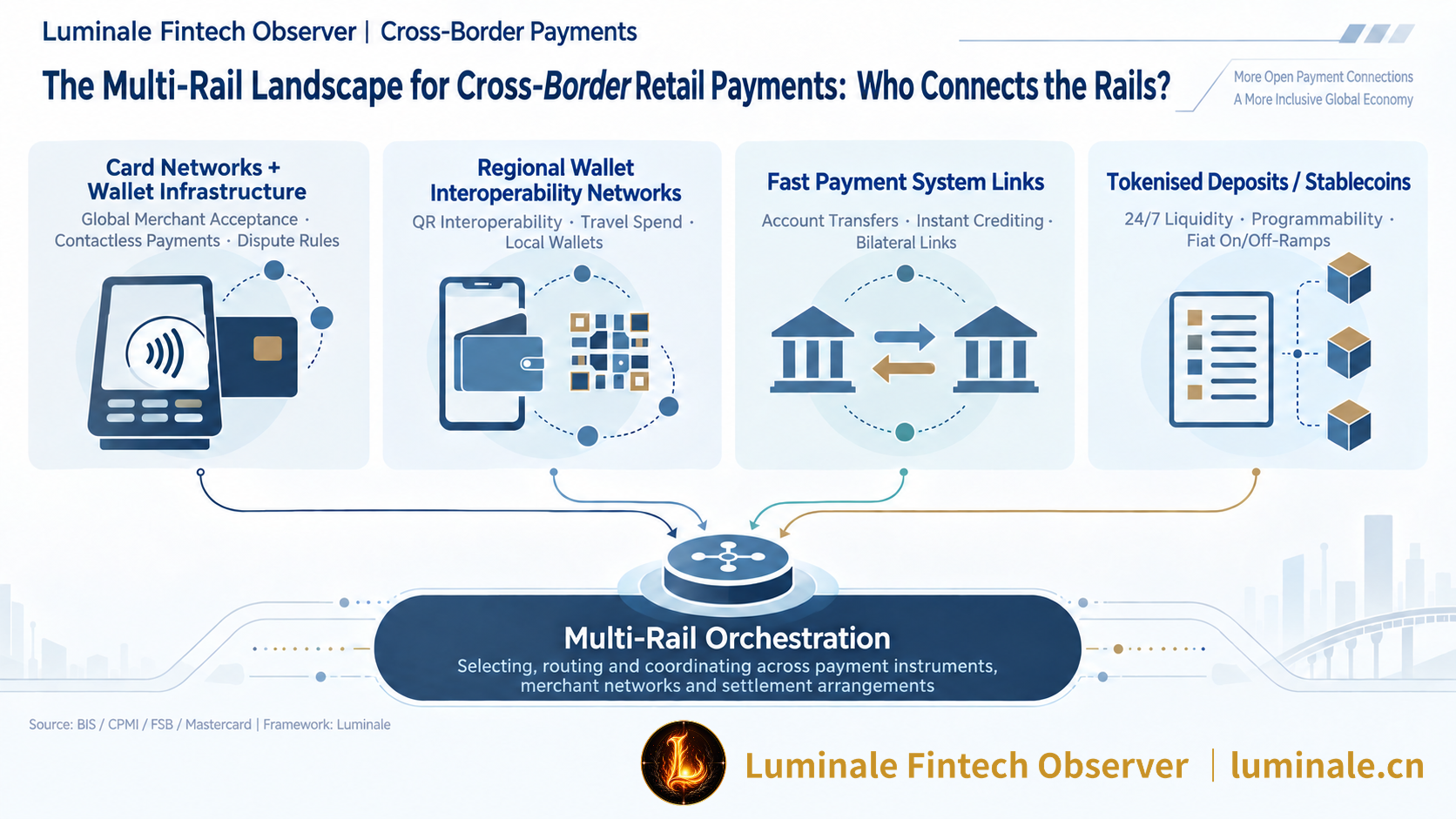
Within this multi-rail ecosystem, competitive differentiation has migrated from legacy "single-rail user lock-in" toward Multi-Rail Orchestration.
The partnership between Mastercard and the Alipay+ ecosystem around Wallet Pay illustrates this institutional dynamic: rather than locked in zero-sum substitution, market leaders are engaging in structural capability arbitrage.
Alipay+ commands hundreds of millions of highly active digital wallet users across Asia and an extensive merchant footprint in prime regional travel hubs; conversely, Mastercard contributes an established acceptance network of tens of millions of contactless POS terminals and online merchant checkouts across more than 200 countries and territories. By enabling local digital wallets to route across Mastercard rails while preserving native user experiences, wallet operators secure global acceptance at minimal marginal cost, while Mastercard channels transactional throughput from mobile-first demographics into its global clearing network.
Conclusion: Reshaping the Unit of Payment Competition and Underlying Trade-offs
The debut of Mastercard Wallet Pay illuminates a broader structural evolution across global financial architecture: competition within the payments industry is pivoting from rivalry among discrete payment instruments toward competition in cross-network, cross-media connectivity and translation capabilities.
The worldwide adoption of digital wallets has fragmented front-end payment form factors. Consumers may present domestic dynamic QR codes, tap NFC virtual credentials managed by mobile operating systems, pull balances directly from super-app accounts, or, in emerging paradigms, authorize autonomous AI agents to initiate transactions via programmatic credentials.
This relentless fragmentation at the point of interaction does not diminish the systemic value of standardized back-end networks; on the contrary, it intensifies market reliance on universal transaction gateways, multi-currency liquidity management, and robust clearing engines.
Nevertheless, this layered infrastructural integration introduces concrete trade-offs and structural complexities that warrant rigorous appraisal:
- Intermediation Layers and Cost Transmission: Funneling digital wallet traffic through international card rails injects card scheme brand fees, cross-border interchange fees, and tokenisation service levies into the value chain. Whether these incremental expenses are absorbed by merchants through higher pricing, passed to cardholders via wider foreign exchange spreads, or subsidized by wallet operators will directly determine the commercial durability of such programs.
- Architectural Dependencies on External Infrastructure: Regional e-wallets initially scaled via lightweight, autonomous domestic operations. Deeply integrating international card scheme specifications and security baselines subjects their product development roadmaps, data governance boundaries, and compliance architectures to the scheme rules of global payment networks.
- Legal Finality and Cross-Jurisdictional Regulatory Coordination: When a transaction is initiated by a Hong Kong-licensed stored value facility, routed across Mastercard's global network, and ultimately settled with a Japanese merchant acquirer, a temporal window separates the domestic hold placed on the user's balance from the final cross-border interbank settlement. In the event of an institutional insolvency or liquidity shortfall during this clearing interval, the legal enforceability of debt revocation, statutory safeguarding protections, and settlement finality will hinge on the harmonization of divergent cross-border legal frameworks.
In their first phase of development, digital wallets competed over who could capture the largest domestic user base. In the second phase, competition centered on deepening merchant closed-loops and local commercial ecosystems. Now, as the global wallet user base surpasses billions, the third phase of competition centers on who can construct the most efficient, secure, and legally resilient translation layer across fragmented wallet silos, account architectures, merchant terminals, and settlement rails.
Mastercard's rollout of Wallet Pay underscores a pragmatic recognition by incumbent card schemes: future consumers may no longer carry physical plastic cards, but so long as global commerce requires funds to traverse fragmented accounts and disparate terminals, the global economy will continue to depend on a resilient institutional foundation capable of bridging heterogeneous networks, managing systemic risk, and enforcing multilateral rules.
References
[1]: Mastercard. (2026, September 10). Mastercard launches Wallet Pay to scale digital wallets worldwide. Mastercard Newsroom. https://newsroom.mastercard.com/news/ap/en/newsroom/press-releases/en/2026/mastercard-launches-wallet-pay-to-scale-digital-wallets-worldwide/ ↩
[2]: Bank for International Settlements (BIS) Committee on Payments and Market Infrastructures (CPMI). (2016). Fast payments – Enhancing the speed and availability of retail payments. BIS CPMI Papers No 154. https://www.bis.org/cpmi/publ/d154.pdf ↩
[3]: EMVCo. (2024). EMV Payment Tokenisation Specification – Technical Framework v2.4. EMVCo Technical Documents. https://www.emvco.com/emv-technologies/payment-tokenisation/ ↩
[4]: Bank for International Settlements (BIS). (2023). Blueprint for the future monetary system: improving the old, enabling the new. BIS Annual Economic Report 2023, Chapter III. https://www.bis.org/publ/arpdf/ar2023e3.htm ↩
[5]: Financial Stability Board (FSB). (2020). Enhancing Cross-Border Payments: Stage 3 roadmap. https://www.fsb.org/wp-content/uploads/P131020-1.pdf ↩
[6]: HKMA. (2026). Payment Connect. https://www.hkma.gov.hk/eng/smart-consumers/payment-connect/ ↩
Originally published by Luminale Fintech Observer: https://luminale.cn/articles/mastercard-wallet-pay-interoperability-infrastructure-en