On 9 October 2026, Chia Der Jiun, Managing Director of the Monetary Authority of Singapore (MAS), delivered a keynote address entitled Building Trusted Foundations for Digital Finance at the INSEAD Digital Finance & Agentic AI Summit[1].
Over the past several years, numerous trials have demonstrated that blockchains can issue bonds, digital tokens can be transferred, and smart contracts can execute automatically. Following these experiments, three primary questions have emerged: Can tokenised assets generate sufficient market liquidity? Can on-chain transactions be settled using assets that carry legal finality and discharge debt? Can ledgers distributed across diverse institutions and disparate technological architectures interoperate seamlessly?
In this address, rather than spotlighting an isolated blockchain pilot, MAS articulated a cohesive institutional roadmap connecting asset tokenisation, digital settlement money, cross-network interoperability, and the governance of agentic transactions. Singapore's strategic focus has consequently shifted from fragmented proof-of-concept trials toward foundational infrastructure development, with the objective of enabling diverse assets, currencies, and networks to operate in concert.
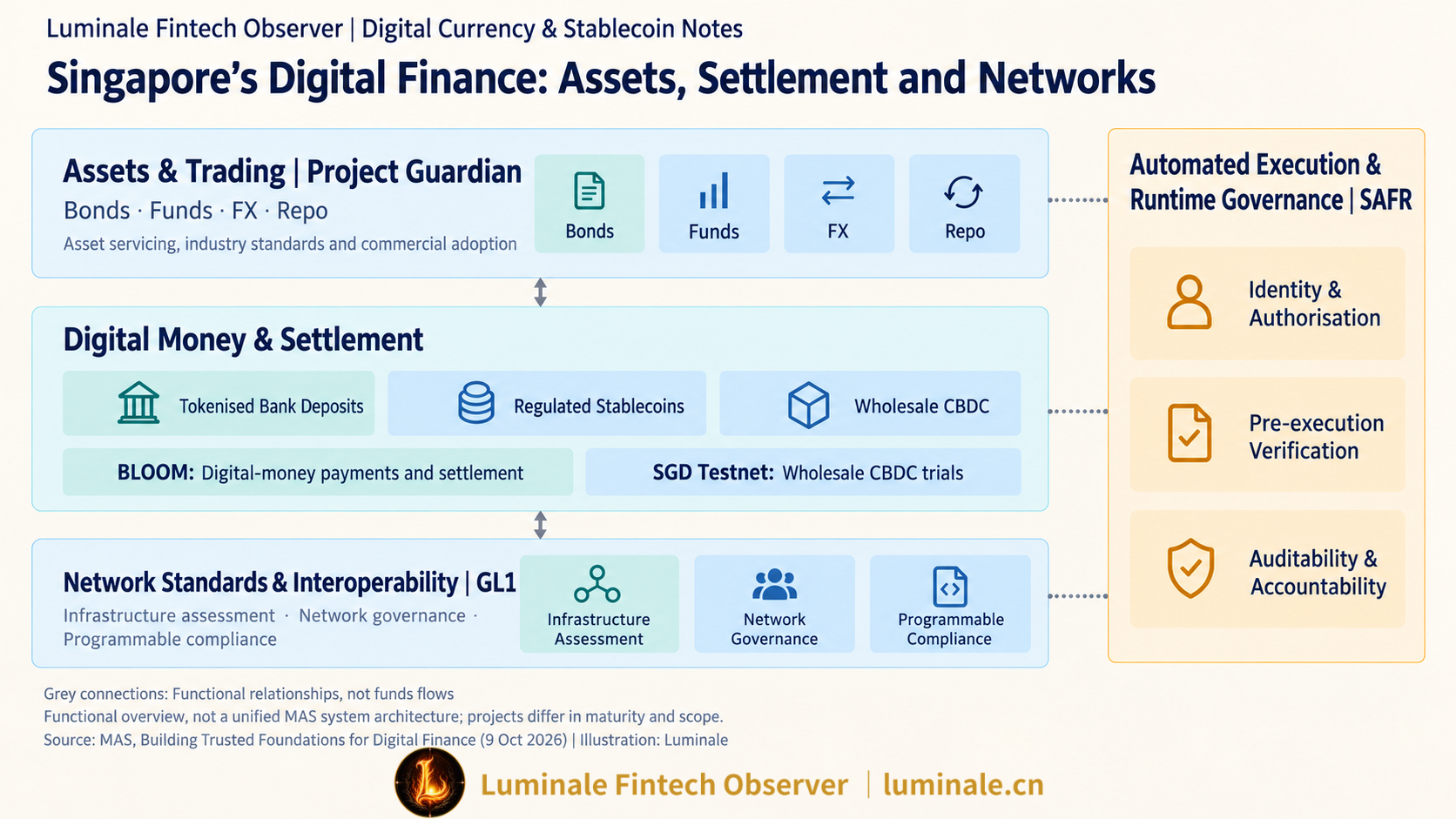
I. The Three-Tier Architecture of Singapore's Strategy
Singapore's digital finance architecture in recent years can be categorised into three interdependent layers: asset digitisation, programmable money, and ledger interoperability.
- The Asset Leg: Government bonds, investment funds, commercial paper, and repurchase agreements (repos) can all be tokenised using distributed ledger technology (DLT). Once assets are brought on-chain, robust custody arrangements, asset servicing, market-making counterparties, and investor protection frameworks remain indispensable. Tokenisation alone does not spontaneously create liquidity.
- The Cash Leg: Financial transactions fundamentally consist of two interdependent legs: asset delivery and cash payment. If securities reside on programmable ledgers while funds continue to traverse legacy batch-clearing rails, market participants must rely on ex-post reconciliation and absorb the cost of trapped intraday liquidity. Settlement assets must be capable of entering the same programmable environments under compliant arrangements.
- The Infrastructure Leg: Commercial banks, central securities depositories, and exchanges will not consolidate onto a single public blockchain. Each institution and jurisdiction will construct ledgers tailored to its own technology stack, compliance standards, and security requirements. Without unified protocols for interaction, these platforms will inevitably operate as isolated silos.
Singapore's objective is to ensure that established financial market functions—legal title transfer, liquidity management, settlement finality, and risk ring-fencing—remain fully effective within digital environments. A common institutional framework can accommodate diverse technological implementations without binding itself to any single blockchain or specific cryptocurrency.
Whether assets can technically be tokenised on-chain is no longer the principal bottleneck. The decisive challenge lies in whether this architecture can achieve commercial scale, maintain legal certainty, and preserve systemic stability under financial stress.
II. Project Guardian: From Asset Tokenisation Pilots to Commercial Scaling
Singapore's flagship initiative on the asset side is Project Guardian, launched in 2022[2]. Spearheaded by MAS in collaboration with multinational financial institutions, the project explores asset tokenisation across asset and wealth management, fixed income, and foreign exchange markets.
Over the past two years, Project Guardian has completed multiple pilots, including tokenised investment funds, FX liquidity pools, and structured note issuances. MAS has also released regulatory guidelines on tokenising capital markets products, clarifying how existing securities and futures legislation applies to tokenised instruments. In its latest address, MAS highlighted that the industry's focus has transitioned from isolated pilots to commercial scaling.
Why does tokenisation struggle to scale organically? Consider an interbank repurchase (repo) transaction. While conceptually simple—exchanging securities for cash with an agreement to repurchase at a future date—a repo trade in practice entails a complex sequence of coordinated operational steps:
- Initial Settlement: The cash borrower delivers securities as collateral, while the cash lender disburses funds;
- Ongoing Management: Collateral is marked to market daily. When the collateral valuation drops below a prescribed margin threshold, the lender issues a margin call to the borrower;
- Collateral Substitution: The borrower may need to substitute the pledged securities with an alternative pool of eligible high-quality assets;
- Settlement at Maturity: The borrower repays principal and interest, whereupon the lender unfreezes and returns the securities collateral.
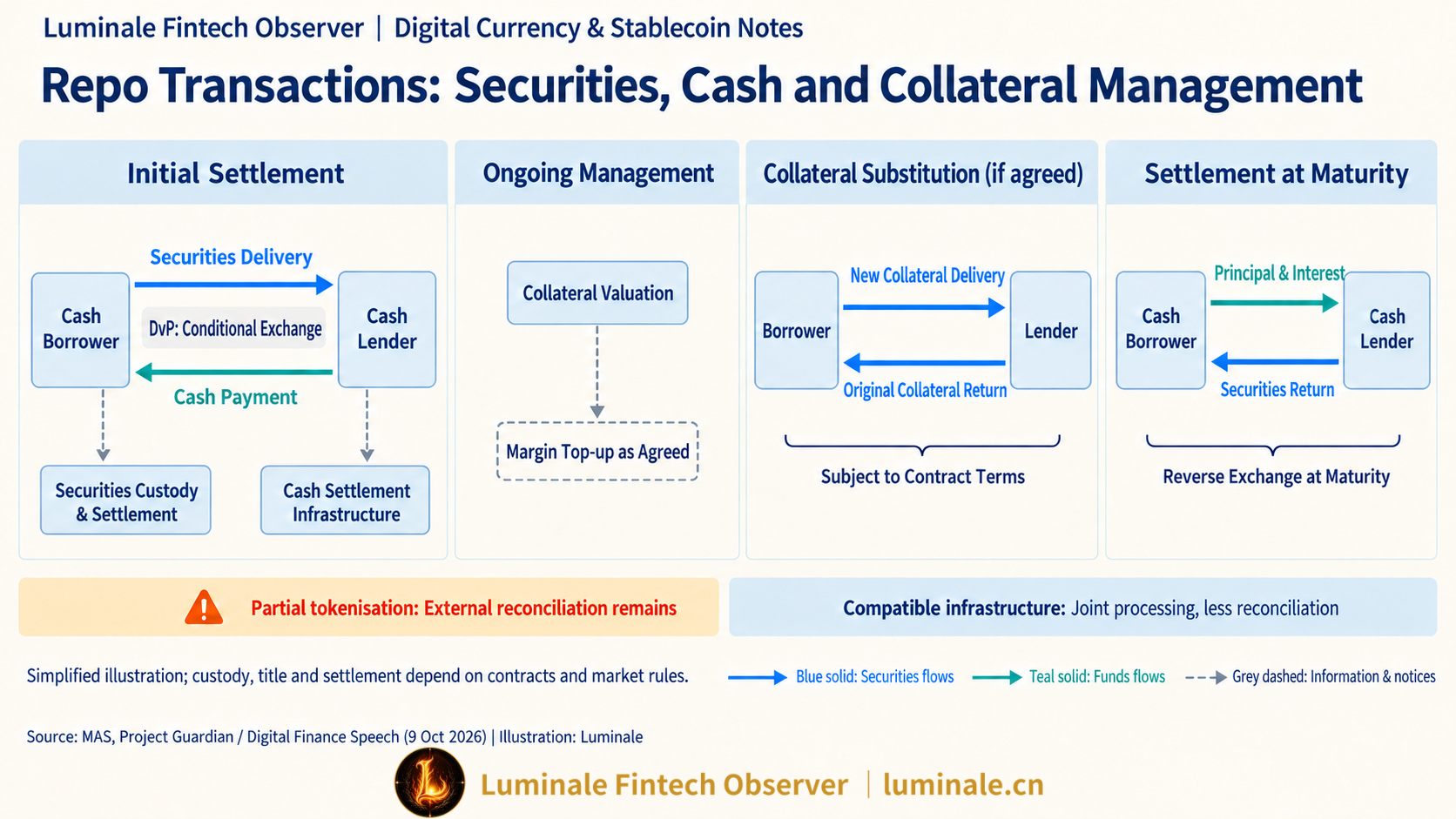
Under traditional operating models, these steps are dispersed across fragmented trading platforms, custodian accounts, clearing houses, and core banking systems, relying heavily on messaging confirmations and manual reconciliation. If a single institution launches a proprietary tokenised repo system while its counterparty, custodian, clearing depository, or settlement bank is not connected—or cannot recognize tokenised assets—the entire workflow reverts to external manual reconciliation.
Asset tokenisation faces three distinct constraints when scaling:
First, efficiency gains stem from automating end-to-end reconciliation rather than merely minting tokens. The true utility of tokenisation lies in embedding contract terms, asset entitlements, and lifecycle events (such as coupon payments, dividend distributions, and margin calls) into smart contracts, thereby compressing back-office operational overhead. If business processes cannot achieve end-to-end automation, partial tokenisation actually increases total maintenance overhead.
Second, isolated tokenisation platforms construct new liquidity silos. When institutions establish private consortium chains independently, tokenised government bonds issued on Chain A cannot seamlessly serve as eligible collateral for derivatives trades executed on Chain B. Rather than enhancing capital efficiency, technical fragmentation ties up scarce intraday liquidity.
Third, scaling requires synchronized ecosystem migration. Issuers, institutional investors, asset custodians, prime brokers, and financial market infrastructures (FMIs) must simultaneously adapt their operational workflows and compliance frameworks. Unilateral infrastructure upgrades by a single technology vendor cannot successfully drive asset tokenisation across the market.
This bottleneck is not unique to Singapore. The International Monetary Fund (IMF) observed in a recent assessment of tokenised finance that if transaction velocity accelerates without commensurate settlement infrastructure and liquidity buffers, stress can transmit across markets with greater rapidity. For an in-depth analysis of these mechanisms, see IMF GFSR Reading: Does Tokenisation Make Trading Faster, and Does Risk Arrive Faster Too?.
Because the asset leg cannot resolve the scaling challenge in isolation, MAS has directed its strategic focus toward the monetary settlement layer and interoperable infrastructure.
III. Money and Settlement: The Division of Labour Between Tokenised Deposits, Stablecoins, and Wholesale CBDC
Asset delivery represents only half of any financial transaction; the other half is cash settlement.
In the absence of reliable, programmable digital legal tender that provides unconditional settlement finality, tokenised assets lack an effective settlement medium on-chain. Counterparties must ultimately revert to traditional fiat payment rails to confirm the receipt of funds, rendering atomic settlement impossible.
Which form of digital currency, then, is best suited as a settlement asset? MAS's stance is that no single digital currency can fulfill every market requirement. Different monetary forms, grounded in distinct credit foundations and institutional arrangements, must assume specialized roles across different use cases.
1. The Division of Labour Among Three Digital Settlement Assets
In Singapore's framework, tokenised commercial bank deposits, regulated stablecoins, and wholesale central bank digital currency (wholesale CBDC) constitute three distinct settlement assets, each serving tailored functions:
| Monetary Form | Primary Legal and Credit Foundation | Core Institutional and Reserve Arrangements | Focal Use Cases in Singapore |
|---|---|---|---|
| Tokenised Bank Deposits | Commercial bank liabilities (commercial bank money) | Subject to bank capital adequacy rules, reserve requirements, and existing deposit insurance schemes | Domestic and cross-border interbank commercial payments, corporate treasury management, and trade settlement |
| Regulated Stablecoins | Issuer credit and balance sheet (private liabilities) | Must be backed 100% by low-risk, highly liquid reserve assets, with a statutory commitment to redeem at par | Web3 ecosystem and digital-asset trading settlement, fintech retail payments, and select cross-border merchant clearing |
| Wholesale CBDC | Direct central bank liabilities (central bank money) | Backed by sovereign credit, free of credit and liquidity risk; serves as the ultimate settlement asset | Inter-institutional high-value financial market transactions, final settlement for FMIs, and settlement of tokenised high-grade assets |
This taxonomy requires distinguishing between technological form and the underlying source of credit.
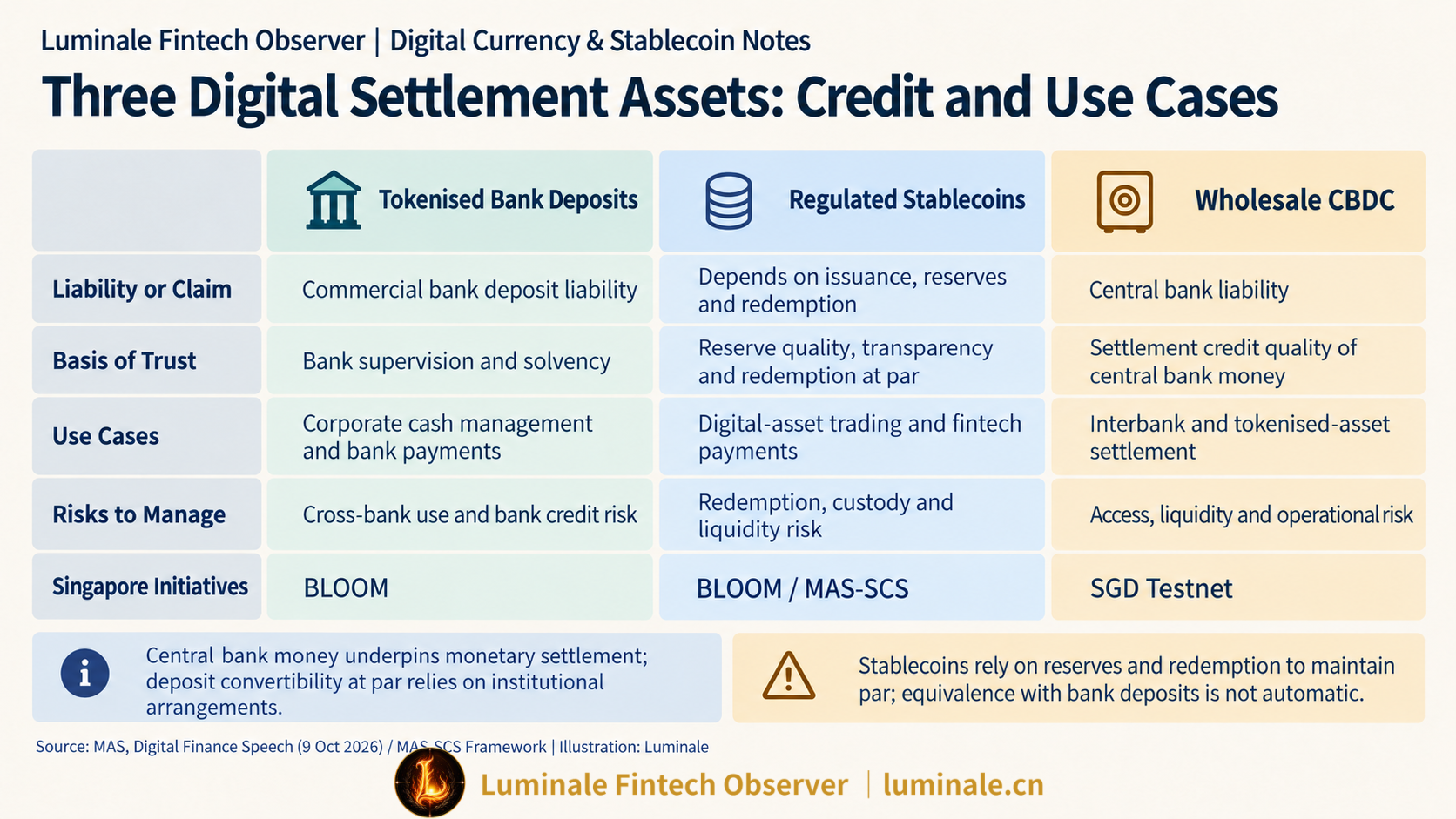
Technologically, all three instruments can be deployed as smart contracts conforming to common token standards and circulate across compatible networks. From an accounting and credit risk perspective, however, they diverge sharply: the solvency of tokenised deposits rests upon the issuing commercial bank's balance sheet; the stability of stablecoins hinges on reserve transparency and asset quality; and wholesale CBDC derives its credit directly from the central bank.
The Bank for International Settlements (BIS) has repeatedly stressed the principle of the "singleness of money." Commercial bank deposits maintain a 1:1 par exchange value precisely because central bank reserve accounts act as the ultimate settlement anchor. Divorced from this anchor, private digital tokens risk breaking parity and suffering credit fragmentation during liquidity shocks. For a detailed breakdown of the singleness of money, see Why Is One Yuan The Same Across Banks, While Stablecoins May Not Be? Understanding BIS's Singleness of Money.
2. BLOOM: Integrating Digital Settlement Assets into Real-World Payment Rails
Having delineated monetary categories, the operational priority becomes integrating these assets into routine economic activity.
In October 2025, MAS unveiled BLOOM (derived from Borderless, Liquid, Open, Online, Multi-currency)[3]. BLOOM establishes an overarching framework for the issuance, distribution, clearing, cross-network transfer, programmable compliance verification, and ultimate redemption of digital settlement assets.
If deposit tokens issued by Bank A can only circulate within Bank A's proprietary network, Bank B and its corporate clients cannot accept them. If every bank develops an isolated closed loop, commercial bank money on-chain degenerates into mutually incompatible stored-value facilities.
BLOOM directly tackles this inter-institutional clearing dilemma:
- When Corporate X pays Corporate Y at Bank B using Bank A's deposit tokens, how are Bank A's tokens locked or burned on-chain?
- How are interbank claims and liabilities between the two institutions netted and settled?
- Can the payee receive deposit tokens directly, or should the infrastructure automatically convert tokens into conventional commercial bank book money in real time?
Coordinated multi-institution account mapping is an essential prerequisite for commercial bank money to circulate on-chain. For an analysis of underlying tokenised deposit accounting, see Tokenised Deposits: How Commercial Bank Money Enters the On-Chain World.
3. Wholesale CBDC: Why High-Value Transactions Require Central Bank Money
While tokenised deposits are well suited for commercial payments, high-value financial market transactions demand central bank money.
Electronic central bank money in Singapore is not fundamentally novel. Real-Time Gross Settlement (RTGS, specifically MEPS+) has enabled commercial banks to transfer reserve balances electronically for decades. MAS's ongoing work on the SGD Testnet and wholesale CBDC addresses a distinct objective: introducing sovereign central bank money directly into programmable, tokenised market infrastructure.
In 2025, MAS executed a foundational trial via the SGD Testnet: three domestic banks—DBS, OCBC, and UOB—successfully settled overnight interbank lending transactions using wholesale CBDC on a shared test network.
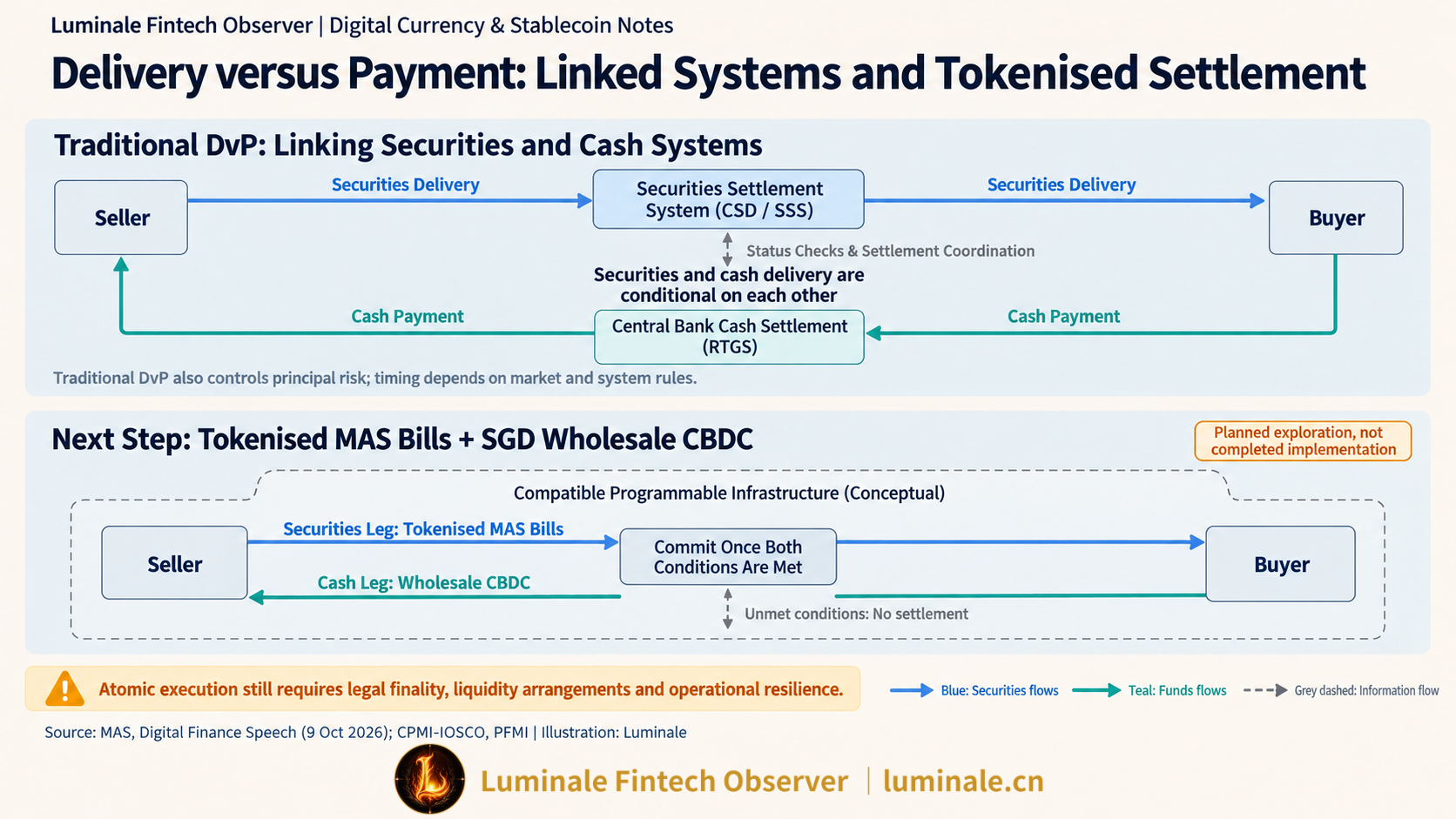
In its recent address, MAS outlined the next objective: exploring the settlement of tokenised MAS Bills using wholesale CBDC.
The strategic significance of this trial lies in securities settlement. Traditional financial markets typically execute settlement via Delivery versus Payment (DvP), linking central securities depositories (CSDs) with RTGS systems through messaging interfaces to ensure that securities title transfer and cash payment are strictly contingent upon one another. Messaging delays and batch processing windows across heterogeneous systems frequently extend settlement cycles to T+1 or T+2.
If tokenised MAS Bills and wholesale CBDC operate within compatible programmable infrastructure, atomic DvP settlement can execute within a unified smart contract: fund debits and securities transfers either succeed simultaneously or revert entirely. This eliminates principal risk arising from counterparty default and reduces the liquidity buffers institutions must maintain against settlement delays. On wholesale CBDC's role in market infrastructure, see What Is Central Bank Digital Currency (CBDC)? From Digital Cash to Financial Infrastructure.
4. Stablecoin Regulation: Imposing Prudential Reserve and Redemption Standards
Rather than excluding privately issued stablecoins from the financial architecture, MAS has subjected them to rigorous prudential standards.
In 2023, MAS finalized its Single-Currency Stablecoin (SCS) regulatory framework. On 1 September 2026, MAS published a public consultation paper on proposed legislative amendments to the Payment Services Act (PSA), with the consultation closing on 16 October 2026[4]. The objective of these amendments is to codify the framework into binding statutory law.
Key requirements under the MAS-SCS framework mandate that single-currency stablecoins recognized in Singapore hold reserve assets strictly in cash, cash equivalents, or sovereign debt securities with a residual maturity not exceeding three months. Reserves must be fully segregated from the issuer's proprietary assets and held in custody by licensed trust institutions. Upon a redemption request, issuers are legally obligated to redeem stablecoins at par value in fiat currency within five business days. Issuers must also satisfy minimum capital adequacy requirements and undergo frequent independent audits and public disclosures.
This underscores MAS's regulatory posture: stablecoins may function as viable payment and settlement instruments provided they meet bank-grade prudential criteria and do not facilitate unbacked shadow credit creation. Only when statutory reserve and redemption duties are firmly anchored can stablecoins serve as trustworthy payment media. For an analysis of how stablecoins sustain parity, see Understanding Stablecoins in One Article: How Do They Actually Stay "Stable"?.
IV. GL1: Interoperability Standards Across Heterogeneous Networks
A recurring assumption within certain crypto communities has been that all financial institutions would ultimately converge onto a single global public blockchain. Given sovereign disparities in legal systems, data protection mandates, and financial regulations, this assumption is inconsistent with operational reality.
Central banks will not surrender final settlement authority over sovereign currencies to public networks that operate beyond domestic jurisdiction and risk contentious protocol hard forks. Nor will global commercial banks conduct proprietary corporate flows across networks lacking granular permissions. Consequently, the future digital financial architecture will inevitably comprise heterogeneous, coexisting networks.
This operational reality forms the impetus behind the Global Layer One (GL1) initiative. Championed by MAS in partnership with international financial institutions, GL1 focuses on establishing interoperability standards and governance frameworks for institutional financial networks, rather than constructing a monolithic universal blockchain.
To date, the GL1 working group has delivered two primary operational tools:
- The Market Infrastructure Toolkit: Establishes onboarding and capability evaluation criteria for DLT platforms, assessing whether their operational uptime, settlement finality guarantees, disaster recovery mechanisms, and governance transparency satisfy FMI standards.
- The Programmable Compliance Toolkit: Focuses on packaging regulatory rules—including Anti-Money Laundering (AML), Countering the Financing of Terrorism (CFT), sanctions screening, and accredited investor verification—into reusable code modules. As transactions traverse different networks, these compliance checks execute automatically at the protocol layer.
Within Luminale's payment infrastructure analytical framework, when assets and settlement instruments reside across disparate ledgers, cross-network interoperability essentially entails re-establishing credit alignment and legal finality without a central clearing counterparty.
This hinges on three concrete mechanisms:
- Atomic Locking: When assets transfer from Chain A to Chain B, how does the system ensure that collateral on Chain A is irrevocably locked or burned before tokens are minted on Chain B, preventing double-spending?
- Failure Reversal and Compensation: If a cash payment is completed but asset transfer fails due to network latency, how does the protocol trigger legally enforceable unwinds or compensatory settlement?
- Cross-Jurisdictional Legal Settlement Finality: Technical inclusion of a transaction hash on-chain does not automatically confer judicial irrevocability. If a participating institution enters insolvency seconds after on-chain confirmation, is the transfer legally ring-fenced against clawback under domestic insolvency laws?
For an examination of when payment instructions achieve statutory finality and how insolvency clawback risks are mitigated, see Can a "Successful Payment" Be Reversed? What Risks Does Settlement Finality Solve?.
GL1 and BLOOM fulfill complementary mandates: BLOOM governs the practical transactional circulation and conversion of diverse digital currencies across interbank and cross-border payment flows; GL1 defines the overarching technical standards, compliance interfaces, and network governance protocols that underpin cross-ledger financial activity.
Europe has pursued a contrasting approach. The European Central Bank launched its Trials and Experiments initiative for new DLT transactions, using bridge mechanisms to link the Eurosystem's RTGS platform (TARGET2) with private tokenised asset venues—exemplified by Banca d'Italia's TIPS Hash-Link, Deutsche Bundesbank's Trigger Solution, and Banque de France's DLT test environment. Europe's strategy focuses on extending existing centralized central bank settlement outwards; GL1 concentrates on formulating multilateral interoperability standards across decentralized, institution-grade networks. For a detailed review of Europe's cash-leg integration, see From Pontes to Appia: How Europe Is Rebuilding the Cash Leg for Tokenised Securities.
V. Agentic Transactions: The Emerging Frontier in Singapore's Agenda
If tokenised assets, digital settlement money, and interoperable networks represent core foundational infrastructure, advances in artificial intelligence are transforming the entities initiating transactions.
In its 9 October address, MAS highlighted the next phase of digital finance: agentic finance and agentic payments.
In conventional electronic banking or corporate treasury systems, payment execution requires human entry, dual-control managerial authorization, hardware security tokens, and multi-factor authentication. In an agentic finance paradigm, autonomous AI agents managing corporate cash flows can monitor foreign exchange fluctuations or yield differentials, autonomously solicit quotes, make allocation decisions, and invoke APIs to execute multi-currency sweeps. On how smart contracts trigger automated execution, see Smart Contracts, Programmability, and On-Chain Settlement: Foundations of Financial Transaction Automation.
This transition raises critical institutional questions: when transaction initiation shifts from human operators to autonomous agents, how does the financial architecture authenticate authorization, verify transactional boundaries, and allocate liability for rogue executions?
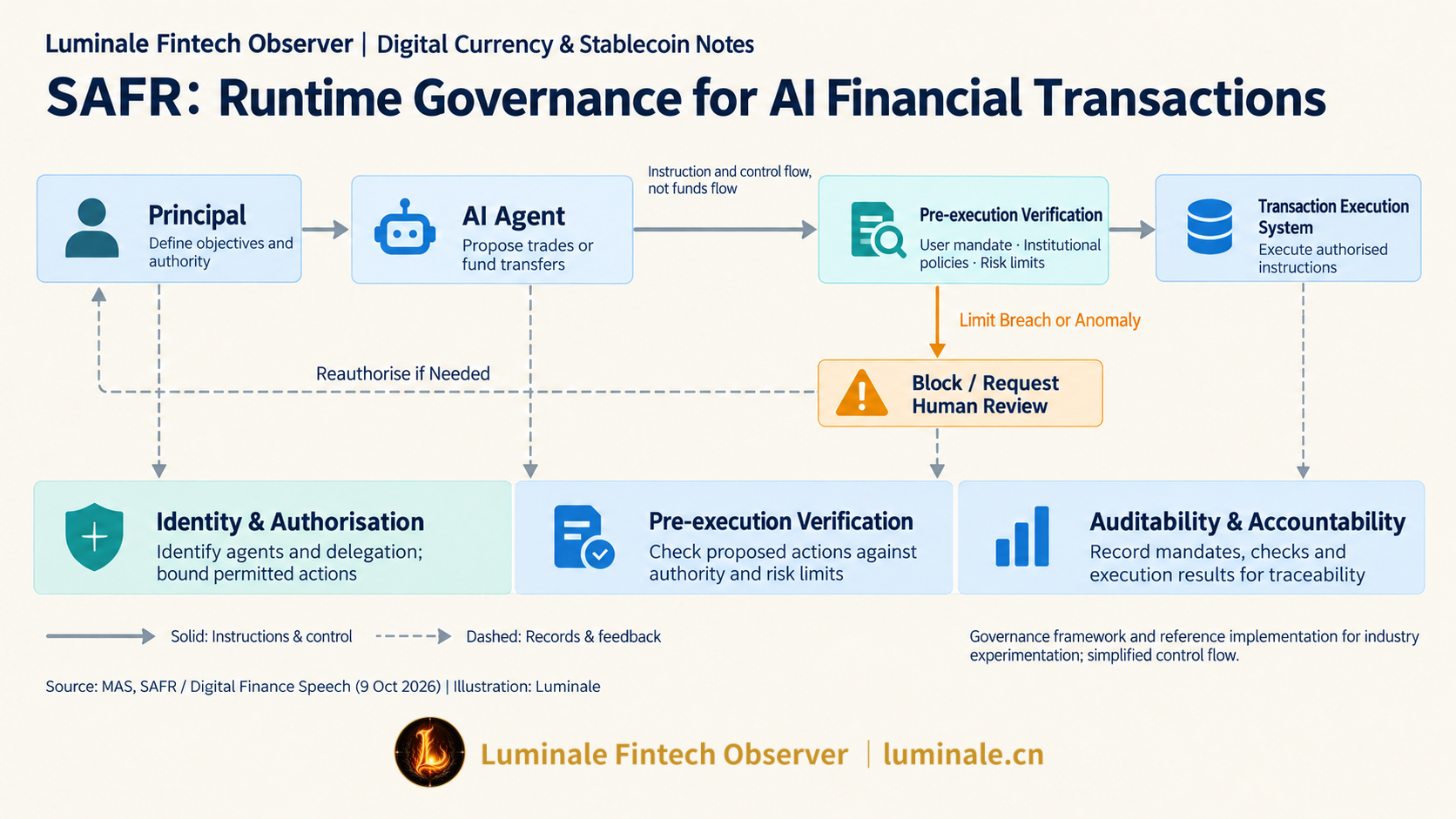
To address these challenges, MAS and industry partners introduced the Safeguards for Agentic Finance at Runtime (SAFR) framework, releasing the Version 1.1 Whitepaper alongside an open-source reference implementation at the summit[5].
SAFR replaces static, pre-transaction human reviews with dynamic runtime governance embedded directly within agent execution pathways. The framework incorporates three core controls:
- Cryptographic Identity and Mandate Boundaries: Every authorized AI agent is provisioned with a tamper-proof digital cryptographic identity. Principals (individuals or corporate treasuries) encode granular mandates on-chain, defining permissible currencies, whitelisted counterparties, single-transaction limits, and cumulative daily caps.
- Pre-Execution Verification: Before an agent-generated transaction instruction is broadcast to settlement rails, it must pass through an independent runtime verification gateway. The gateway validates proposed parameters against encoded mandate limits, intercepting anomalous patterns or out-of-bounds orders.
- Tamper-Evident Operational Auditability: An agent's reasoning steps, retrieved contextual data, decision trees, and signed instructions are recorded in tamper-evident logs. In the event of dispute or financial loss, investigators can determine whether failure stemmed from mandate misconfiguration, algorithmic hallucination, or malicious compromise, establishing clear legal accountability.
Beyond individual authorization, the systemic deployment of autonomous agents carries profound implications for intraday liquidity and macroprudential stability.
When hundreds of institutions deploy autonomous agents trained on correlated models and decision heuristics, a market pricing anomaly or credit shock could cause agents to execute identical buy or sell orders simultaneously. Such herd behavior could rapidly deplete intraday liquidity across specific clearing corridors, precipitating localized flash crashes and cascading defaults.
Consequently, every advance in automated transaction execution demands commensurate operational safeguards, governance frameworks, and liquidity buffers.
It should be noted that SAFR currently operates as an industry best-practice guide and technical reference implementation, rather than a mandatory statutory requirement for licensed institutions. It provides a foundational blueprint for governing the next generation of financial infrastructure.
VI. Conclusion: Four Dimensions of Singapore's Strategy
Tracing Singapore's trajectory across Project Guardian, BLOOM, the SGD Testnet, MAS-SCS, GL1, and SAFR reveals a coherent strategy addressing four distinct layers:
- The Asset Layer: Conducting empirical pilots to evaluate the commercial viability of tokenisation while establishing standardized asset data and operational protocols;
- The Monetary Layer: Differentiating the credit foundations of tokenised deposits, regulated stablecoins, and wholesale CBDC to preserve the sovereign anchor of the monetary system;
- The Network Layer: Embracing multi-network coexistence through GL1 by driving institutional interoperability, statutory settlement finality, and cross-border title recognition;
- The Frontier Layer: Anticipating the impact of agentic AI on transaction initiation and proactively deploying runtime mandates and liquidity governance.
Financial ledgers have evolved from paper certificates to centralized databases and distributed ledgers; money has transitioned from physical notes to electronic balances and programmable tokens; and transaction initiators have shifted from bank tellers to smartphone users and autonomous AI agents.
Yet the foundational questions of the financial system endure: Whose liability underpins each asset? Who provides emergency liquidity when markets seize? Under what legal conditions is a transaction irrevocably final? When risks materialize, who absorbs the loss?
These questions remain paramount in a programmable era. Singapore's ongoing initiatives represent a systematic effort to establish durable institutional arrangements capable of answering them.
References
[1]: Monetary Authority of Singapore (MAS). Building Trusted Foundations for Digital Finance. Speech by Chia Der Jiun, Managing Director, MAS, at the INSEAD Digital Finance & Agentic AI Summit 2026, 9 October 2026. https://www.mas.gov.sg/news/speeches/2026/building-trusted-foundations-for-digital-finance ↩
[2]: Monetary Authority of Singapore (MAS). Project Guardian: Collaborative Initiatives to Test Asset Tokenisation and DeFi. Official Initiative Overview and Industry Reports. https://www.mas.gov.sg/schemes-and-initiatives/project-guardian ↩
[3]: Monetary Authority of Singapore (MAS). Project BLOOM: Borderless, Liquid, Open, Online, Multi-currency Settlement Framework. Official Programme Documentation, October 2025. https://www.mas.gov.sg/schemes-and-initiatives/BLOOM ↩
[4]: Monetary Authority of Singapore (MAS). Consultation on Proposed Amendments to the Payment Services Act for Stablecoin Regulation. Public Consultation Paper, 1 September 2026 (Consultation closes on 16 October 2026). https://www.mas.gov.sg/publications/consultations/2026/consultation-on-proposed-amendments-to-the-payment-services-act-for-stablecoin-regulation ↩
[5]: Monetary Authority of Singapore (MAS). Safeguards for Agentic Finance at Runtime (SAFR). Version 1.1 Whitepaper and Open-Source Reference Implementation, October 2026. https://www.mas.gov.sg/publications/monographs-or-information-paper/2026/safeguards-for-agentic-finance-at-runtime ↩
Originally published by Luminale Fintech Observer: https://luminale.cn/articles/singapore-digital-finance-tokenisation-payment-clearing-infrastructure-en