Smart contracts are not a novel invention exclusive to blockchain technology. More than thirty years ago, cryptographer and computer scientist Nick Szabo systematically outlined the concept of embedding transaction rules into digital protocols. For a long time, however, this vision remained largely confined to theoretical models and isolated automation scripts.
It was not until the launch of Ethereum in 2015—which unified shared distributed ledgers, native digital assets, and general-purpose Turing-complete computing environments—that smart contracts acquired their first open, native operational infrastructure.
Today, as the Bank for International Settlements (BIS), central banks, and leading commercial financial institutions actively explore asset tokenization, tokenized deposits, and unified ledgers, the terms "smart contract" and "programmability" have once again taken center stage.
What truly warrants the attention of financial market professionals is not how "intelligent" these contracts supposedly are, but rather: when transaction rules directly govern ledger states and asset transfers, how the execution architecture of financial transactions is fundamentally reshaped.
I. Smart Contracts Are Over Thirty Years Old: Why Did They Fail to Catch On Back Then?
Before diving into on-chain settlement, it is essential to dispel a widespread misconception: smart contracts did not originate with Bitcoin or Ethereum.
In 1994, computer scientist and cryptographer Nick Szabo coined the term "smart contract." Subsequently, in his seminal 1996 and 1997 papers, Smart Contracts: Building Blocks for Digital Markets and The Idea of Smart Contracts, he systematically elaborated on how to embed contractual clauses into software, hardware, and computer network protocols [1].
Szabo's core objective was unequivocal: to reduce reliance on human discretion, paper-based procedures, and centralized intermediary enforcement throughout contractual execution, leveraging algorithmic determinism to slash counterparty default risk and transaction friction.
To illustrate this concept, Szabo offered a classic physical archetype: the vending machine.
The operational logic of a vending machine is straightforward:
- The machine has hardcoded, deterministic mechanical and electrical control rules.
- The buyer inserts coins matching specific dimensions and weight criteria (input condition).
- Internal physical or electronic mechanisms verify the value (condition evaluation).
- Once verified, the mechanical drive dispenses the chosen item and returns change (execution and physical delivery).
- If the inserted funds are insufficient or the transaction is canceled, the coins are returned intact.
Within this machine, rules are pre-embedded into physical hardware and circuitry. The contractual promise of "simultaneous exchange of payment and goods" no longer relies on the personal integrity or manual intervention of a store clerk; the machine enforces it automatically once conditions are met. This is the essence of a smart contract: if condition A is met, automatically trigger outcome B.
In traditional finance and corporate IT systems, condition-based automated logic has long been ubiquitous:
- Stop-loss and limit orders within broker-dealer trading platforms;
- Automated monthly utility bill debits through commercial bank accounts;
- End-of-day automated interest accrual and compounding routines in core banking engines;
- Liquidity queuing and grid-offsetting algorithms in Real-Time Gross Settlement (RTGS) systems.
However, traditional automation faces an unavoidable institutional and technical ceiling: these programs invariably run inside proprietary servers and centralized databases controlled by a single specific institution.
Under traditional IT architectures, the validity and execution of an automated routine depend entirely on the credibility, operational integrity, and administrative privileges of the central operator. A bank can execute automatic direct debits, but it unilaterally controls the ledger database; a brokerage can trigger stop-loss orders, but it maintains exclusive dominion over matching engines and order-book feeds. Across transacting counterparties, there has never been a neutral, mutually visible, shared execution environment immune to unilateral modification.
In the 1990s, the widespread adoption of smart contracts lacked four foundational building blocks:
- Shared distributed ledgers across institutions: The lack of an underlying network enabling mutually independent entities to simultaneously record and synchronize state transitions.
- Ledger-native digital assets: Traditional "assets" were merely account entries in proprietary databases; programs could not natively lock, hold, and atomically transfer legal ownership within a single unified computational sphere.
- Trustless multi-party consensus mechanisms: The absence of mathematical and cryptographic primitives allowing untrusted parties to reach immutable consensus on whether a program was executed correctly.
- Censorship-resistant and tamper-proof runtime environments: If a dispute arose, the party possessing root database access could unilaterally terminate the routine, alter parameters, or roll back ledger records.
Consequently, the smart contracts envisioned by Szabo remained largely confined to academic theory and localized internal scripts. While they improved automation efficiency at individual nodes, they could not bridge the trust gap across multiple disparate institutions.
II. Blockchain Did Not Invent Smart Contracts, but Why Did It Multiply Their Value?
At its core, a smart contract remains a computer program that executes according to predefined conditions; it can theoretically run on any conventional server. Blockchain did not magically invent a brand-new programming paradigm; its true contribution was transforming the host environment in which the code executes.
On July 30, 2015, the Ethereum public mainnet officially went live [2]. Unlike Bitcoin—which primarily supported a basic stack-based script language geared toward value transfer—Ethereum introduced a Turing-complete state machine known as the Ethereum Virtual Machine (EVM). This engineering leap enabled developers to write arbitrary, complex business logic as smart contracts and deploy them onto a shared, decentralized ledger.
From that moment, smart contracts broke free from single-institution servers, becoming deeply fused with shared ledgers and native digital assets.
| Dimension | Automated Programs within Traditional Institutions | Smart Contracts on a Shared Ledger |
|---|---|---|
| Execution Host | Local servers or private clouds controlled by a single firm | Distributed computing environment maintained across validator nodes |
| State Ownership | Stored in private corporate databases, opaque to outsiders | Recorded directly on a synchronized public/consortium ledger, verifiable by all |
| Asset-Execution Proximity | Logic is severed from funds; routines must dispatch external instructions | Assets exist natively on-chain; code directly exercises custody and transfer authority |
| Tamper Resistance & Determinism | System administrators hold root privileges to pause or overwrite states | Governed by deterministic consensus; no single party can unilaterally abort execution |
| Cross-Entity Composability | System integration requires complex point-to-point APIs and bilateral links | Smart contracts on the same ledger seamlessly call, nest, and trigger one another |
To clarify this structural evolution, consider the following fundamental equation:
Smart Contract ≠ Blockchain
However, when:
Predefined Execution Rules (Smart Contracts) + Distributed Shared Ledger + Native Digital Assets = A Next-Generation Financial Execution Infrastructure
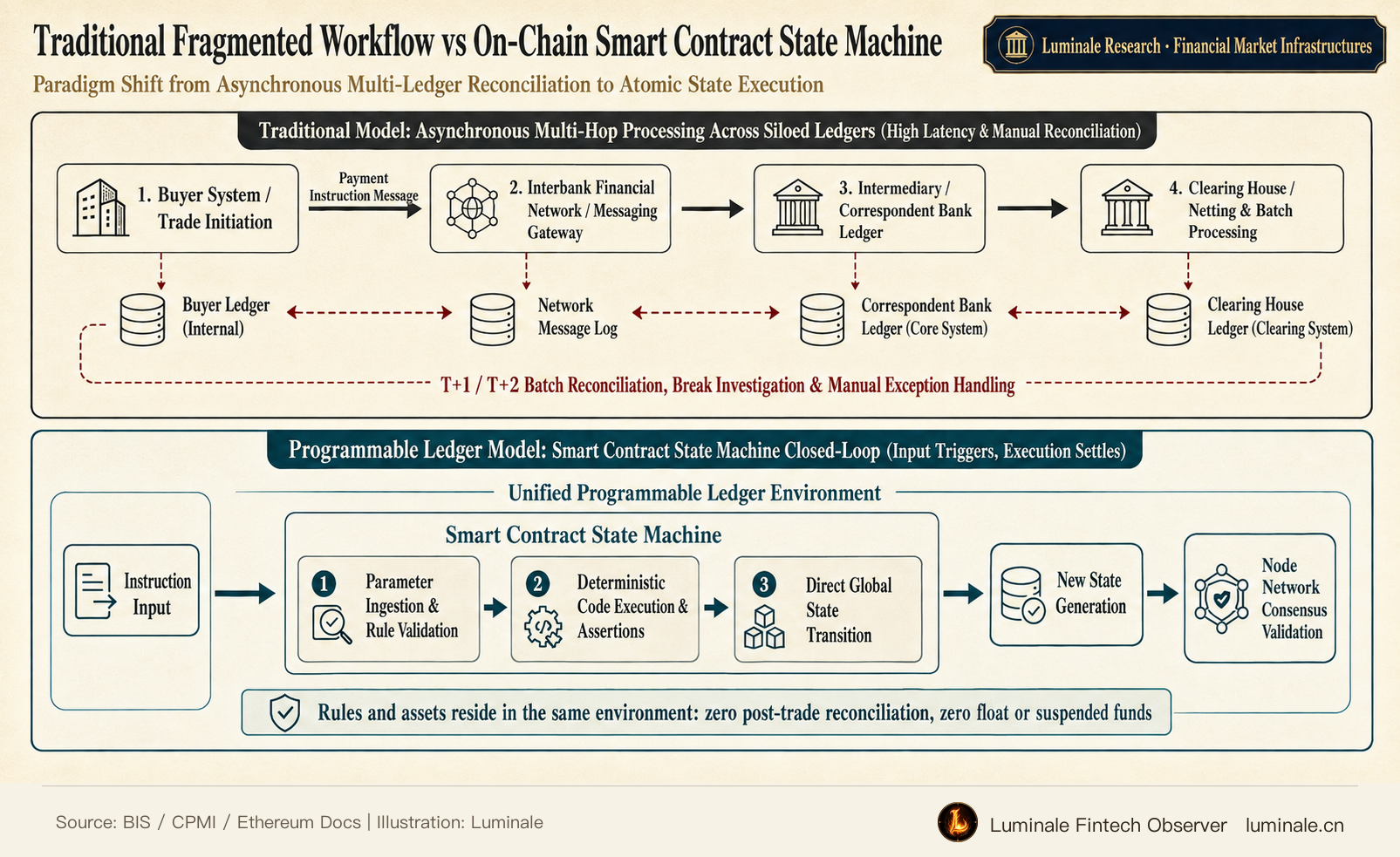
In legacy setups, transfer logic is typically detached from final settlement: "If customer balance is sufficient, deduct $100 and dispatch a SWIFT message." That message subsequently winds through clearing gateways, correspondent banks, and bilateral settlement accounts. The workflow is fragmented across multiple asynchronous databases, requiring constant status polling, and offers no absolute guarantee of end-to-end completion.
In contrast, within an on-chain smart contract environment, contractual rules and ledger states inhabit the exact same computational medium. When a transaction instruction triggers a contract, the code executes directly across validating nodes, instantly updating the global ledger state: the payer's token balance decreases by 100, and the payee's increases by 100. Every node deterministically validates the transition and records it in unison.
A critical distinction must be made here: the permissionless nature and absolute immutability seen on public blockchains are not mandatory prerequisites for financial transaction smart contracts.
In consortium networks or regulated permissioned ledgers spearheaded by traditional financial institutions, platforms enforce rigorous admission criteria regarding who can deploy contracts, initiate transactions, or validate state transitions. This directly reflects regulatory compliance requirements, as institutional authority derives from supervisory charters.
Yet, this does not diminish the value of smart contracts: as long as counterparties share the same governed ledger fabric, they obtain absolute certainty that no single participant can unilaterally manipulate locked transaction rules or doctor settlement results outside established consensus protocols.
III. What Problem Do Smart Contracts Actually Solve?
Stripped of technical buzzwords, the mechanical workflow of a smart contract can be distilled into five sequential phases:
Current State → External Input → Condition Evaluation → Execution Action → New Global State
What smart contracts excel at is collapsing fragmented, multi-step workflows—which traditionally rely on serial messaging, human intervention, and retrospective audits—into an automated, deterministic closed loop: "once conditions are satisfied, states update instantly."
Under Luminale's payment infrastructure analytical framework, the contrast between traditional multi-entity transaction flows and on-chain smart contract execution is illustrated below:
| Stage Comparison | Traditional Multi-Institution Execution Workflow | On-Chain Smart Contract Execution Workflow |
|---|---|---|
| Step 1: Condition Trigger | Firm A manually verifies trade terms to confirm payment conditions | Smart contract reads ledger states directly, validating rule parameters in code |
| Step 2: Message Relay | Firm A generates payment messages dispatched across proprietary networks (e.g., SWIFT) | User broadcasts a cryptographically signed transaction to the contract |
| Step 3: Cross-System Posting | Correspondent banks and clearing houses adjust internal ledgers asynchronously | Validating nodes execute contract logic concurrently, updating ledger states in unison |
| Step 4: Reconciliation & Exception Handling | T+1 or T+2 batch reconciliation to identify breaks, errors, and suspended balances | Execution constitutes settlement; the synchronized state is the single source of truth |
By binding "business logic" directly to "balance sheet accounting," smart contracts exhibit several definitive properties in financial operations:
- Autonomous Execution Without Secondary Sign-Off: Once predefined trigger conditions are met, the routine proceeds deterministically without requiring back-office staff to manually approve releases or transfers.
- Embedded Asset Custody: The code is not merely generating an advisory dispatch; it directly locks, escrows, transfers, or burns tokenized assets hosted on the shared ledger.
- Multi-Contract Composability: Distinct smart contracts can be plugged together like modular Lego bricks. A lending protocol can seamlessly interface with a liquidity pool contract to automate collateral liquidation without bilateral integration overhead.
Nevertheless, smart contracts operate under a fundamental limitation: they cannot natively perceive events occurring in the off-chain physical world.
A smart contract is an isolated, deterministic automaton. If identical inputs yielded diverging outputs across validator nodes, distributed consensus would instantly rupture. Hence, smart contracts cannot issue arbitrary HTTP calls to external web APIs to fetch real-time exchange rates or shipment statuses.
In official Ethereum developer literature, this constraint is known as the Oracle Problem [3]:
- What is the real-time spot foreign exchange benchmark in offshore markets?
- What was the official closing yield of a specific sovereign bond on a central exchange?
- Has a specific container tracked via Internet of Things (IoT) sensors cleared port customs?
Such off-chain facts must be packaged, cryptographically signed, and pushed on-chain by external entities or decentralized networks known as oracles. If an oracle feeds corrupted or compromised pricing data, the smart contract will execute flawlessly upon those erroneous inputs, yielding flawed settlement outcomes.
IV. From Smart Contracts to Programmability: On-Chain Atomic Settlement
With the foundational mechanics established, we can examine the core frontier of modern financial market infrastructures: programmability and atomic settlement.
When exploring central bank digital currencies (CBDCs) and tokenized assets, "programmability" represents an overarching paradigm beyond smart contracts alone. This architecture comprises three hierarchical layers:
- Programmable Platform: The foundational computing and ledger substrate that provides rule governance, consensus validation, and shared state maintenance.
- Smart Contracts: Specific application logic and operational routines deployed on the platform.
- Programmable Transactions: Sophisticated transaction arrangements and settlement flows orchestrated through these contractual routines.
In traditional securities clearing, buyers fear paying cash without receiving securities (principal risk), while sellers fear delivering securities without receiving payment. To mitigate this, Principle 8 of the CPSS-IOSCO Principles for Financial Market Infrastructures (PFMI) mandates the widespread adoption of Delivery versus Payment (DvP) [4]. In legacy environments, however, Central Securities Depositories (CSDs) maintain securities accounts, whereas central bank RTGS systems manage cash accounts. Connecting these distinct legacy platforms requires complex messaging bridges and state-coordination protocols to achieve near-real-time synchronization.
When cash and securities coexist natively on a regulated programmable ledger, DvP can evolve directly via smart contracts into atomic settlement:
Asset transfer and cash settlement are bound into a single, indivisible computational transaction. Either all conditions are satisfied and both legs settle simultaneously, or any leg fails and the entire state rolls back as if the transaction never occurred.
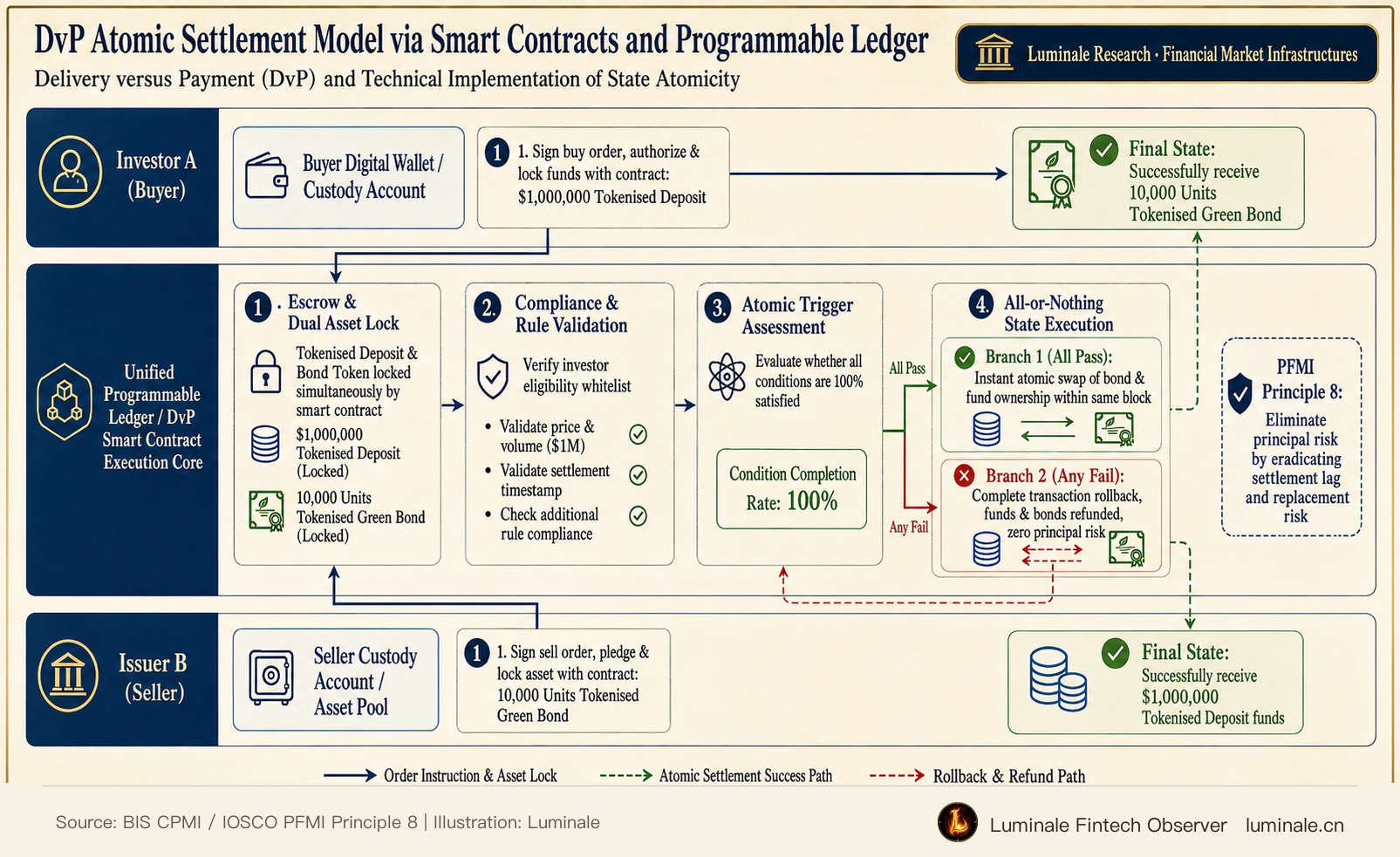
This deterministic logic extends naturally to cross-currency foreign exchange settlement via Payment versus Payment (PvP), and enables complex multi-leg workflows: spot FX swap → interbank tokenized deposit transfer → securities delivery → margin collateral rebalancing.
The BIS Blueprint for the future monetary system explicitly highlights that combining smart contract composability with a unified ledger allows traditionally sequential, multi-hop settlement chains to be re-engineered into single-trigger atomic executions, structurally eradicating principal risk and collateral drag [5].
Importantly, deploying a smart contract does not automatically equal definitive financial settlement. True legal settlement depends not merely on algorithmic execution, but on the legal nature of the settlement asset (whether it represents commercial bank debt, regulated stablecoins, or central bank reserves) and the statutory framework governing settlement finality.
V. Code Can Execute Automatically, but the Law Does Not Vanish
Alongside technical optimization, financial market infrastructures must confront an ultimate institutional reality: code demands uncompromising deterministic rigidity, whereas legal and economic systems must accommodate ambiguity, discretion, and restitution.
The early crypto slogan "Code is Law" has never been a viable doctrine within regulated institutional finance.
Computer code executes pre-programmed logic mechanically, whereas real-world financial commerce is fraught with human complexity:
- A trader inadvertently enters errant price parameters due to a clerical keystroke mistake;
- A seemingly compliant transfer involves covert fraud, extortion, or money laundering;
- Severe force majeure events render contractual performance physically impossible;
- A court issues a binding order to freeze or attach the assets of a sanctioned entity.
Under such circumstances, an infrastructure asserting that "the code has updated state and cannot be altered" exhibits a fatal governance defect rather than an innovative strength.
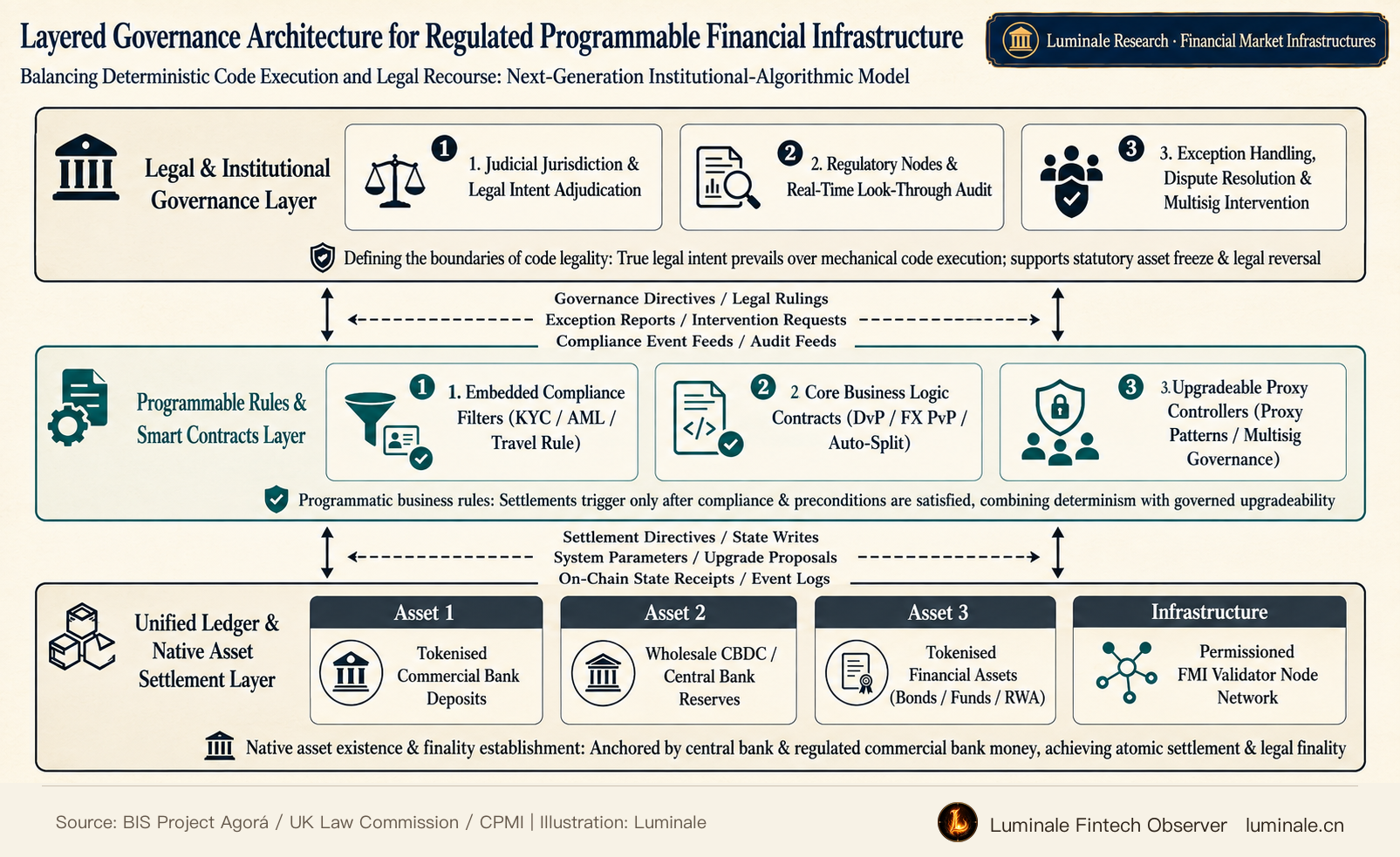
In its comprehensive law reform review, the Law Commission of England and Wales formally drew a boundary between bare computational code and "Smart Legal Contracts" [6]. The Commission concluded that while automated code can serve as an instrument to perform contractual obligations, it remains fully subordinate to established legal principles governing mutual intent, implied terms, vitiating factors, and judicial remedies. Where programmatic execution diverges from the documented objective intent of the contracting parties, the substantive law of contract prevails.
This reality introduces several critical governance prerequisites when designing on-chain financial architectures:
- Does Code Execution Equate to Legal Discharge? If a smart contract is exploited due to a software flaw, the law will not treat the drained funds as a valid contractual conveyance, but rather as illicit misappropriation.
- Mechanisms for State Reversal and Restitution: On an immutable ledger, when a court orders a transaction unwound, the system architecture must provide administrative override keys, reverse compensating transactions, or authorized governance protocols to effect lawful restitution.
- The Governance Dilemma of Upgradability: Code immutability fosters confidence that rules cannot be arbitrarily manipulated; yet, complete immutability prevents institutions from patching critical security vulnerabilities. Consequently, regulated institutional architectures rely on multi-signature governance frameworks or proxy patterns to govern upgrades responsibly [7].
Hence, global central banks and standard-setting bodies have firmly moved away from early decentralized experiments, focusing instead on embedding smart contracts and programmability within heavily supervised monetary and market infrastructures.
A prominent example is the Bank for International Settlements'Project Agorá, which convenes major central banks and dozens of global commercial banks to test wholesale cross-border payments using tokenized commercial bank deposits and tokenized central bank money on a shared programmable platform [8].
Within Project Agorá, smart contracts are utilized to encode automated regulatory compliance checks (KYC/AML), conditional payment triggers, and atomic FX settlement corridors. Rules are not dictated by autonomous unmonitored code, but rather are jointly anchored by sovereign regulatory mandates and central bank oversight.
Conclusion
The fundamental transformation that smart contracts bring to financial market infrastructures is not the mere translation of legal paperwork into code, nor the displacement of the legal order by automated algorithms.
Rather, it transforms the operational linkage between business conditions and balance sheet state transitions.
In conventional finance, a transaction typically stumbles through detached operational silos: "agreement negotiation → messaging exchange → authorization verification → settlement messaging → core ledger adjustments → post-trade reconciliation." Each phase resides in disparate institutions, runs on legacy stacks, and settles across disconnected ledgers.
Programmable architectures streamline this continuum into an integrated paradigm:
Validation of Preconditions → Deterministic Code Execution → Synchronous Ledger State Transition.
This foundation unlocks the full potential of on-chain DvP, PvP, and atomic multi-leg financial settlement.
Yet, this shift introduces deeper policy questions that market designers must resolve:
- If asset delivery and cash settlement occur simultaneously, will the liquidity-saving benefits of multilateral netting be diminished?
- Does instantaneous atomic settlement drastically elevate intraday liquidity requirements for commercial banks?
- Which asset should serve as the ultimate settlement anchor—commercial bank tokenized liabilities or central bank digital currency?
These structural inquiries represent the true frontier of next-generation programmable financial infrastructure.
References
[1]: Nick Szabo. Smart Contracts: Building Blocks for Digital Markets (1996); The Idea of Smart Contracts (1997). Nakamoto Institute: https://nakamotoinstitute.org/library/smart-contracts-building-blocks-for-digital-markets/ ↩
[2]: Ethereum Foundation. Ethereum Launches: Olympic Release. July 30, 2015: https://blog.ethereum.org/2015/07/30/ethereum-launches ↩
[3]: Ethereum.org. Smart contracts: The oracle problem & off-chain data sources. Official Documentation: https://ethereum.org/developers/docs/smart-contracts/ ↩
[4]: Committee on Payments and Market Infrastructures (CPMI), International Organization of Securities Commissions (IOSCO). Principles for Financial Market Infrastructures (PFMI). Principle 8: Settlement finality. 2012: https://www.bis.org/cpmi/publ/d101a.pdf ↩
[5]: Bank for International Settlements (BIS). Blueprint for the future monetary system: improving the old, enabling the new. Annual Economic Report, 2023: https://www.bis.org/publications/aer-2023/blueprint-future-monetary-system-improving-old-enabling-new ; Next-generation monetary and financial systems, 2025/2026: https://www.bis.org/publications/aer-2025/next-generation-monetary-financial-system ↩
[6]: Law Commission of England and Wales. Smart Legal Contracts: Advice to Government. Law Com No 401, November 2021: https://lawcom.gov.uk/project/smart-contracts/ ↩
[7]: Ethereum.org. Upgrading Smart Contracts: Proxy patterns and contract migration strategies. Official Documentation: https://ethereum.org/developers/docs/smart-contracts/upgrading/ ↩
[8]: Bank for International Settlements (BIS). Project Agorá: testing seamless cross-border wholesale payments with tokenised commercial bank deposits and central bank money. Innovation Hub: https://www.bis.org/project/agora ↩
Originally published by Luminale Fintech Observer: https://luminale.cn/articles/smart-contracts-programmability-and-onchain-settlement-en