
In December 2024, the People's Bank of China (PBOC) announced that starting from the statistical data of January 2025, it would formally revise the statistical definition of Narrow Money (M1) to include individual demand deposits and customer reserve funds held by non-bank payment institutions[1].
In everyday experience, funds held in bank cards and mobile wallets can be spent and settled at any moment, intuitively functioning no differently from physical cash. However, in the historical monetary statistical framework, individual demand deposits were long classified under Broad Money (M2) and excluded from M1.
In modern monetary statistics, M0, M1, and M2 are not three distinct, physical types of money. Instead, they represent a tiered aggregation of financial instruments classified by macroeconomic statistical authorities based on liquidity, payment convenience, issuing entity, and holder sector. Driven by advances in underlying payment technologies and shifts in bank account regulatory frameworks, the boundaries of monetary statistics remain in continuous recalibration.
1. Why Did Individual Demand Deposits Enter M1 Only in 2025?
China's prevailing money supply statistical system was established in 1994. In the early stages of this system, the PBOC defined M1 as the sum of Currency in Circulation (M0) and corporate demand deposits, while individual deposits were placed entirely into Broad Money (M2).
This classification was grounded in clear institutional and technological constraints of that era:
- Objective Constraints of Payment and Settlement Methods: In the early 1990s, household consumption settlement relied almost entirely on banknotes and coins, as bank cards were not yet widespread. Passbook savings accounts opened by individuals at bank branches were used primarily for safe asset storage and over-the-counter cash deposits and withdrawals. They could not be used to issue checks for shopping, nor could they initiate real-time transfers to third-party merchants. For everyday purchases, individuals generally had to line up at bank counters to withdraw cash. In contrast, enterprises held checking accounts and bank drafts; corporate demand deposits could directly settle procurement and commercial obligations. Under those institutional conditions, only corporate demand deposits possessed the attributes of a direct medium of exchange.
- The Proliferation of Mobile Payments and Account Networks: With the universal adoption of debit cards, the establishment of online banking and fast payment systems, and the pervasive spread of mobile QR code payments, individual demand deposits can now be transferred on mobile devices at any time or bound to payment apps for instant checkout. The real-time settlement capability of individual demand deposits no longer exhibits any practical difference from that of corporate demand deposits.
- Payment Instrument Attributes of Non-Bank Payment Reserve Funds: Customer reserve funds of non-bank payment institutions represent pre-funded or pending settlement balances accumulated when consumers and businesses use digital wallets such as Alipay and WeChat Pay. These funds are 100% centrally deposited with the PBOC, directly supporting massive volumes of small-value, high-frequency transactions and functioning de facto as a universal medium of exchange.
In a dedicated box in its China Monetary Policy Report (Q3 2024), the PBOC reviewed the historical adjustments to China's money supply metrics[3]. Historically, revisions primarily targeted Broad Money (M2)—such as incorporating securities investor margin deposits in 2001, housing provident fund deposits and non-depository financial institution deposits in 2011, and money market funds (MMFs) in 2018. In contrast, the boundary of M1 had remained unchanged for decades.
This revision reclassifies existing financial assets across different statistical tiers rather than creating new liquidity through central bank currency issuance or credit expansion.
2. Why Segment Money: From the Liquidity Spectrum to the IMF Statistical Framework
In modern financial architecture, assets do not divide into a binary distinction between 'what is money'and 'what is not.' Instead, they form a smoothly transitioning liquidity spectrum:
- Cash: Highest liquidity, endowed with legal tender status, unreservedly usable for immediate and final discharge of debt at full face value;
- Bank Demand Deposits: Convertible at face value on demand, directly usable for real-time payment to third parties;
- Bank Time Deposits: Yield interest, but early withdrawal entails interest forfeiture or transfer restrictions;
- Money Market Funds and Short-Term Treasury Bills: Highly liquid, yet converting them into final means of payment requires a redemption or transaction settlement step.
In the Monetary and Financial Statistics Manual and Compilation Guide 2016 (MFSM-CG 2016), the International Monetary Fund (IMF) explicitly notes that international standards do not mandate an identical formula for M1 or M2 across all countries[2]. Instead, the IMF provides an analytical architecture based on financial instrument characteristics, money issuers, and money holders.
In the monetary statistics and financial infrastructure framework structured by Luminale, determining whether a financial instrument belongs to a specific money supply aggregate depends primarily on three dimensions:
- Financial Instrument Characteristics: The IMF categorizes core transaction assets into Currency and Transferable Deposits. Transferable deposits must be exchangeable at face value on demand without penalty and directly usable by holders to make payments to third parties (via checks, debit cards, or electronic transfers). Deposits that cannot be transferred directly but can be converted at low cost are classified as Other Deposits.
- Money Issuers: Primarily the central bank and deposit-taking corporations (commercial banks). Liabilities issued by the central bank constitute sovereign fiat money, whereas liabilities issued by commercial banks constitute commercial bank credit money.
- Money Holders: The objective of money supply compilation is to measure the purchasing power available to domestic real economic sectors (households, non-financial corporations, local governments). Consequently, funds held by financial institutions themselves and commercial bank reserves deposited at the central bank serve internal financial clearing and are excluded from public money supply aggregates.
As financial instruments evolve, demarcation points along the liquidity spectrum shift continuously. The IMF launched a comprehensive revision of its monetary statistics manual in 2025, focusing on classification challenges posed by new digital assets and tokenised financial instruments.
3. The Balance Sheet Reality of China's M0, M1, and M2
Based on the PBOC's statistical definitions, China's money supply is structured into three tiers:
- M0 (Currency in Circulation): Banknotes and coins circulating outside the banking system.
- M1 (Narrow Money): M0 + Corporate demand deposits + Individual demand deposits + Customer reserve funds of non-bank payment institutions.
- M2 (Broad Money): M1 + Corporate time deposits + Individual time deposits + Other deposits (including securities margin deposits and deposits of non-depository financial institutions).
The PBOC often characterizes M1 as reflecting real-time purchasing power, and M2 as encompassing both real-time and potential purchasing power. Peering into the underlying balance sheets reveals distinct creditor-debtor relationships across these layers.
| Monetary Aggregate | Included Financial Instruments | Issuing Entity (Whose Liability) | Holding Sector | Economic Attributes & Payment Characteristics |
|---|---|---|---|---|
| M0 | Banknotes and coins | Central bank | Households, non-financial corporations | Sovereign fiat currency, zero commercial credit risk, ultimate settlement finality |
| M1 | M0 + Individual demand deposits + Corporate demand deposits + Payment institution customer reserves | Commercial banks (deposits) / Central bank (M0 & centralized reserves) | Households, non-financial corporations | Highly liquid transaction media, immediately usable for third-party settlement |
| M2 | M1 + Corporate time deposits + Individual time deposits + Securities margin deposits, etc. | Commercial banks and financial institutions | Households, non-financial corporations, non-depository financial institutions | Broad liquid assets, balancing payment convertibility and store of value |
Core Distinction: M0 Does Not Equal the Monetary Base
In macroeconomic monetary analysis, one of the most common misconceptions is equating M0 with the monetary base.
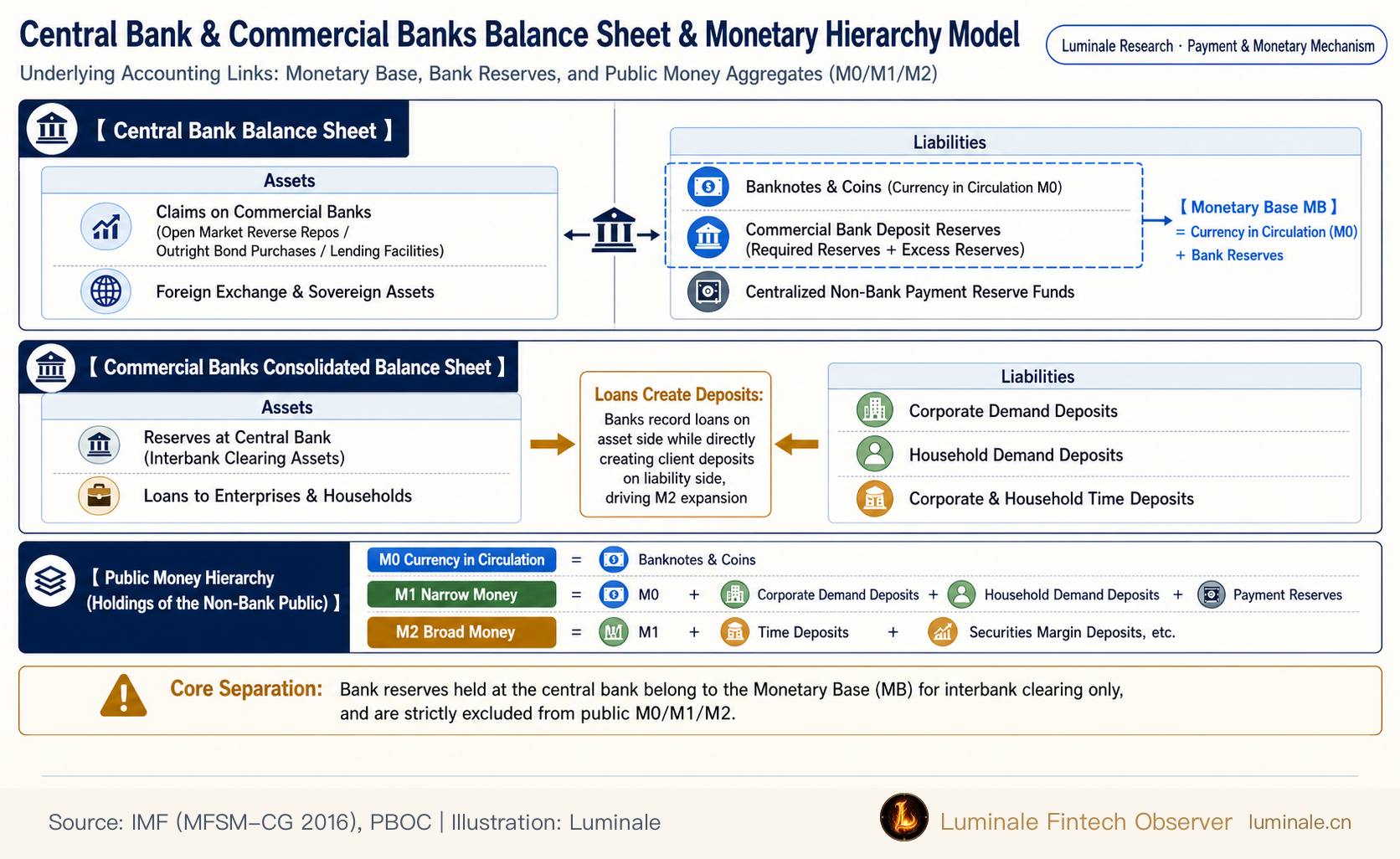
The Monetary Base (MB, also termed high-powered money) represents the primary liability on the central bank's balance sheet and comprises two components: Currency in Circulation (M0) and Commercial Bank Reserves.
Monetary Base (MB) = Currency in Circulation (M0) + Commercial Bank Reserves (Required Reserves + Excess Reserves)
Commercial bank reserves held at the PBOC are backed by sovereign credit and settle interbank transactions at full face value. Under IMF compilation principles, however, commercial banks are money issuers; reserves circulate only between the central bank and commercial banks or in interbank clearing, without entering the hands of the non-bank public.
Commercial bank reserves belong to the Monetary Base, but never to M0, M1, or M2. When the central bank conducts open market reverse repos or outright treasury bond operations, it primarily alters reserve account balances of commercial banks at the central bank, rather than directly crediting deposits or cash to the general public.
Modern Monetary System Expansion: Loans Create Deposits
When a commercial bank extends a loan, it does not physically transport vault cash to the borrower. Instead, it records a 'loan to customer'on its asset side while simultaneously crediting a 'demand deposit'directly to the borrower's account on its liability side.
Through this process, the banking system's balance sheet expands, and society's Broad Money (M2) increases accordingly. Commercial banks cannot create credit without limit; lending capacity is bound by reserve requirements, liquidity metrics, and capital adequacy ratios.
4. Why the US and Chinese M1 Differ Greatly: Evolution of Institutions, Accounts, and Payment Instruments
When comparing macroeconomic indicators, directly contrasting the nominal scale of M1 or M2 between the US and China often yields misleading conclusions. The retail banking account architectures and regulatory trajectories of the two nations differ substantially.
The US retail banking system features a granular classification of accounts, including Checking Accounts, Savings Accounts, Money Market Deposit Accounts (MMDAs), and Certificates of Deposit (CDs).
| Comparison Dimension | Chinese Banking Account System | US Banking Account System |
|---|---|---|
| Basic Product Segmentation | Demand Deposits, Time Deposits | Checking Accounts, Savings Accounts, MMDAs, CDs |
| Everyday Transaction Medium | Individual demand deposits (linked to mobile QR payments) | Checking accounts (direct spending via checks and debit cards) |
| Liquidity Regulatory Rules | No statutory transaction frequency cap on individual demand deposits | Historically subject to Fed Regulation D (monthly cap of 6 transfers) |
| M1 Inclusion Criteria | Includes individual demand deposits & payment reserves since 2025 | Included savings deposits into M1 in 2020 after lifting 6-transfer cap |
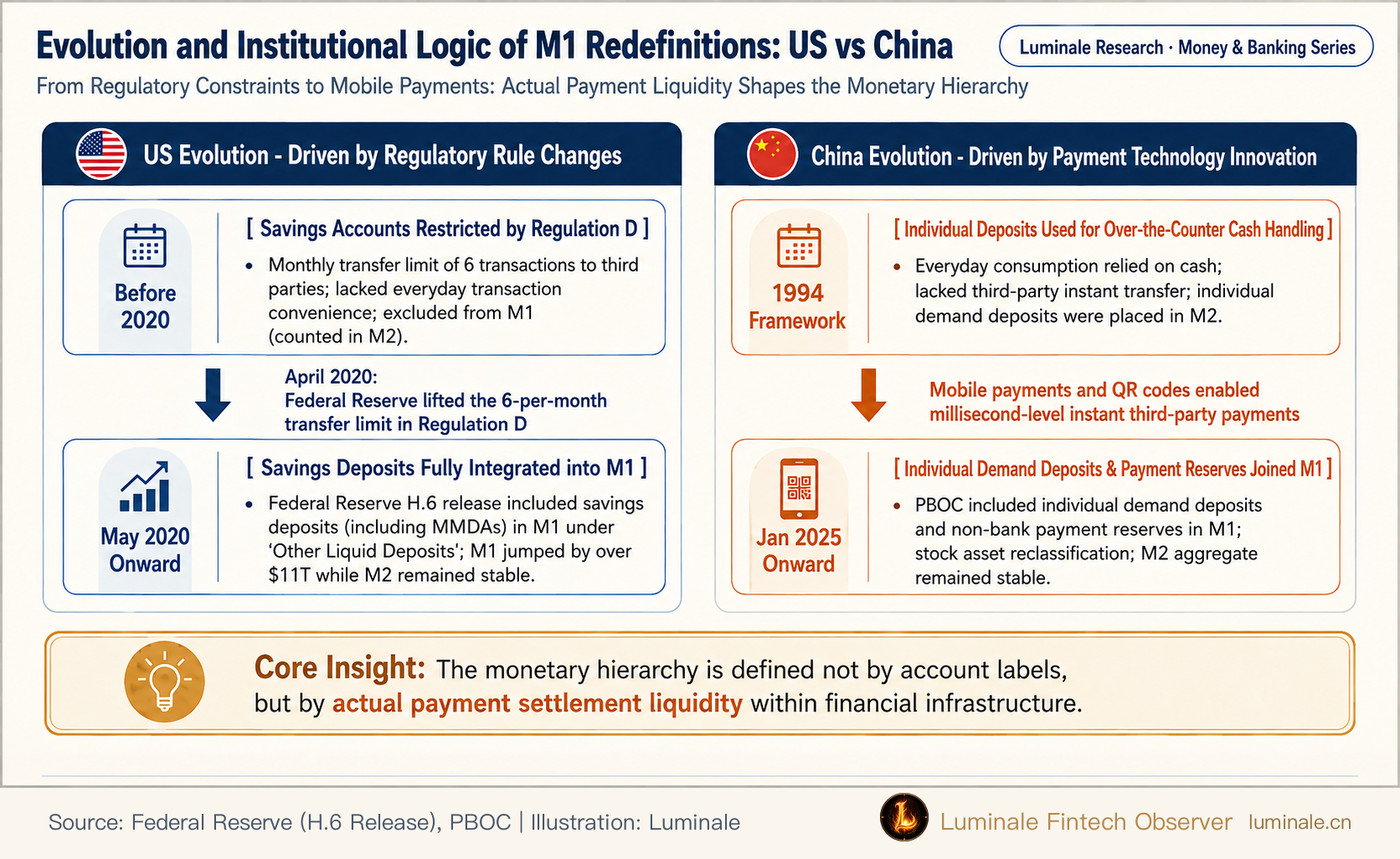
Prior to 2020, the Federal Reserve's Regulation D strictly mandated that savings deposit accounts could not execute more than six convenient transfers or withdrawals per month to third parties. Accounts exceeding this threshold had to be converted to transaction accounts or assessed penalties. Consequently, US savings deposits could not serve as high-frequency daily payment instruments, and the Federal Reserve's H.6 statistical release historically excluded savings deposits from M1, placing them in M2[4].
In April 2020, to accommodate electronic payment adoption and assist financial institutions in managing liquidity, the Federal Reserve revised Regulation D by deleting the six-transfer-per-month limit on savings deposits. Beginning with the statistical data of May 2020, the Fed reclassified savings deposits (including MMDAs) into M1 under 'Other Liquid Deposits.'
This technical adjustment caused US M1 to surge from approximately $4.8 trillion in April 2020 to over $16 trillion in May 2020—a single-month jump exceeding 230%. Yet US M2 did not experience an anomalous spike, as savings deposits were already included within M2.
The adjustments in China and the US form a clear comparative mirror:
- United States (2020): Regulatory amendment (elimination of Regulation D transfer limits) $
ightarrow$ Liquidity barriers on savings deposits removed $
ightarrow$ Incorporated into M1;
- China (2025): Technological adoption (mobile banking and QR code clearing) $
ightarrow$ Practical payment capability of individual demand deposits enhanced $
ightarrow$ Incorporated into M1.
Both evolutionary paths corroborate the same principle: whether a financial asset belongs to a specific monetary tier depends not on contractual account nomenclature, but on the actual payment liquidity it delivers under prevailing financial infrastructure and regulatory frameworks.
5. The Era of Tokenisation: Which Layer Do CBDCs, Tokenised Deposits, and Stablecoins Belong To?
With the integration of Distributed Ledger Technology (DLT) into financial market infrastructures, Central Bank Digital Currencies (CBDCs), Tokenised Deposits, and Fiat-Backed Stablecoins have emerged in succession.
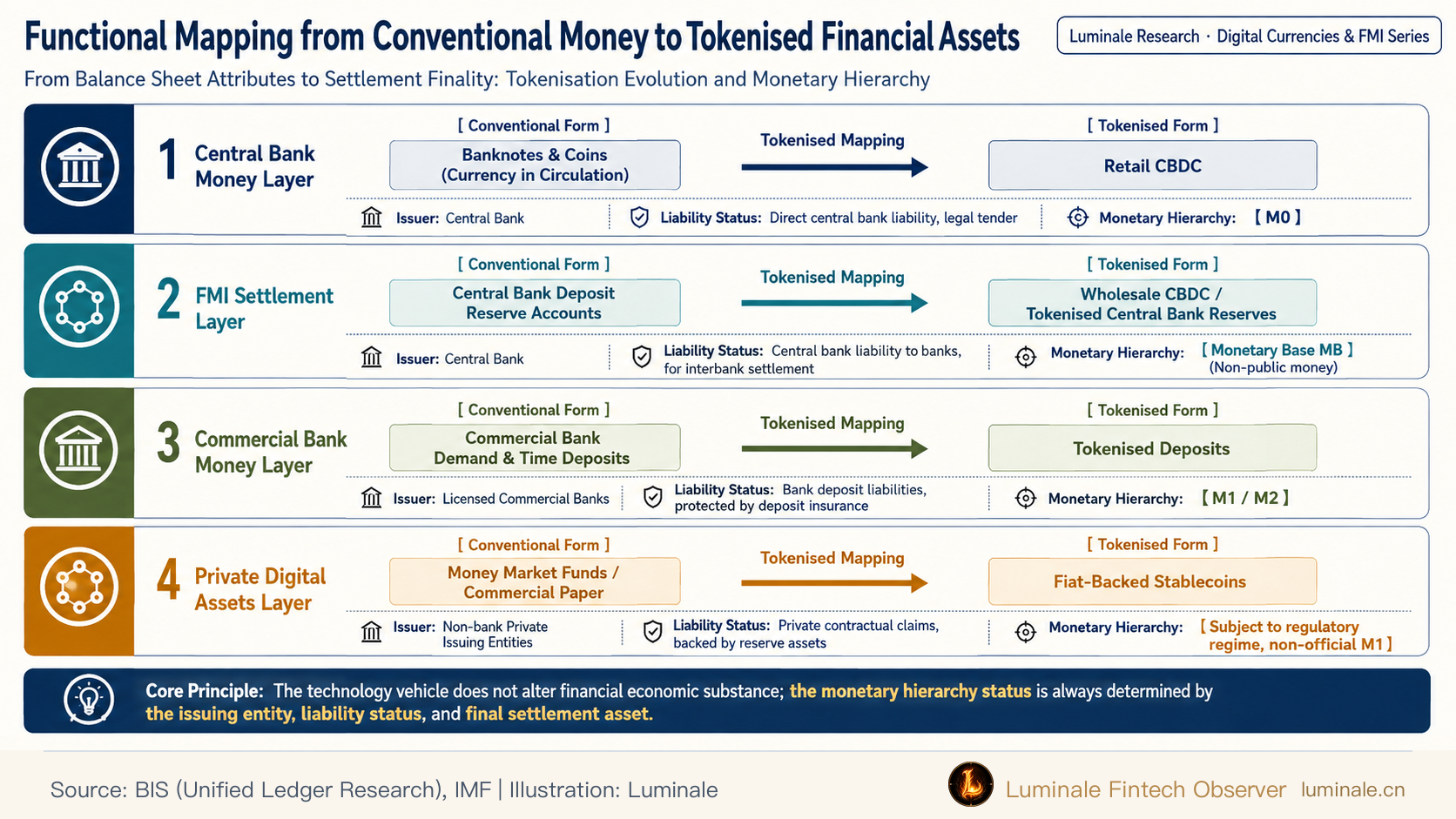
These innovative digital monetary instruments remain subject to fundamental monetary accounting principles. Identifying where a tokenised instrument sits within the monetary hierarchy requires examining its underlying balance sheet relationships and settlement mechanisms: Who issues it? Whose liability is it? What asset provides final settlement?
| Digital Asset Form | Corresponding Conventional Form | Issuing Entity | Liability Status & Credit Backing | Monetary Tier & Statistical Classification |
|---|---|---|---|---|
| Retail CBDC | Banknotes and coins | Central bank | Direct central bank liability, legal tender | M0 |
| Wholesale CBDC / Tokenised Reserves | Required & excess bank reserves | Central bank | Central bank liability to commercial banks | Monetary Base (MB), non-public money, excluded from M0/M1/M2 |
| Tokenised Demand Deposits | Commercial bank demand deposits | Commercial banks | Bank deposit liabilities, protected by deposit insurance & reserves | M1 (Bank credit money with instant transferability) |
| Tokenised Time Deposits | Commercial bank time deposits | Commercial banks | Bank term liabilities, yield-bearing with withdrawal limits | M2 (Quasi-money asset) |
| Fiat-Backed Stablecoins | Money market funds / Private commercial paper | Non-bank private issuers | Contractual liabilities of private entities, backed by reserve assets | Subject to regulatory regime; not recognized as official M1 without deposit safeguards |
1. Retail CBDCs and Balance Sheet Substitution in Commercial Banks
Retail CBDCs are designed as digital cash-like payment instruments, representing direct liabilities of the central bank to the public, and thus belong strictly to M0.
Examining balance sheet interactions demonstrates that public conversions into retail CBDCs affect the financial system in contrasting ways depending on the source asset:
- Public converts physical cash into retail CBDCs: A compositional shift occurs within central bank liabilities; physical currency liabilities decrease while digital currency liabilities increase by an equivalent amount. Commercial bank balance sheets remain unaffected.
- Public converts commercial bank demand deposits into retail CBDCs: Commercial bank liabilities ('client demand deposits') decline; to fund this transfer at the central bank, commercial bank assets ('reserves at central bank') decrease by an equal sum. On the central bank's balance sheet, commercial bank reserve liabilities decrease while retail CBDC liabilities to the public expand.
This mechanism explains why major central banks implementing retail CBDCs universally adopt holding caps and non-interest-bearing designs. If depositors could convert commercial bank deposits into central bank digital currency without limit, stress periods could accelerate systemic deposit outflows, altering the credit intermediation capacity of commercial banks.
2. Tokenised Deposits: Evolution in Accounting Forms of Bank Deposits
Tokenised deposits represent claims on commercial banks recorded as programmable tokens on a distributed ledger.
In its Unified Ledger research, the Bank for International Settlements (BIS) underscores that tokenised deposits retain the economic essence of commercial bank deposits[5]. Holders possess direct claims on the commercial bank, fully backed by reserve requirements, capital adequacy standards, and official deposit insurance.
A change in technological carrier does not alter the monetary tier: tokenised deposits issued against demand accounts maintain M1 attributes, whereas tokenised time deposits remain within M2.
3. The Boundary Between Stablecoins and Conventional Money
Although fiat-backed stablecoins (such as USDT and USDC) are widely used on-chain for pricing and instant settlement, their issuers are typically private entities operating under varying degrees of regulatory oversight, relying on bank deposits, short-term treasury bills, or reverse repurchase agreements as reserve backing.
Stablecoin holders hold contractual claims on private issuers rather than claims backed by sovereign central bank lender-of-last-resort facilities. Consequently, major central banks and global regulatory bodies do not categorize unbacked or private stablecoins as official M1. Instead, they treat them as financial assets akin to money market fund shares or stored-value electronic money instruments, focusing regulatory scrutiny on reserve custody and run-risk mitigation.
6. Conclusion
Money supply metrics—M0, M1, and M2—appear as statistical figures on the surface, but they chronicle the evolution of financial infrastructure beneath.
From physical cash to corporate checks, from the rise of mobile QR payments to the reclassification of individual demand deposits, and onward to tokenised financial assets, every recalibration of monetary statistics reflects tangible shifts in payment clearing efficiency, bank account frameworks, and regulatory regimes.
Given that the overwhelming majority of money used in daily economic life (M1 and M2) originates from commercial bank liabilities, how are these widely circulating bank deposits created systematically? In subsequent articles, we will examine the interacting balance sheets of commercial banks and the central bank to explore the mechanics of money creation in the modern banking system.
References
[1]: People's Bank of China. Questions and Answers on Monetary Aggregates and the Revision of M1 Statistical Definition[EB/OL]. (2024-12-02). https://www.pbc.gov.cn/rmyh/109339/2025080818580470423/index.html. ↩
[2]: International Monetary Fund. Monetary and Financial Statistics Manual and Compilation Guide (MFSM-CG 2016)[M/OL]. Washington, D.C.: IMF, 2016: 120-165. https://www.imf.org/-/media/files/data/guides/mfsmcg-final.pdf. ↩
[3]: Monetary Policy Analysis Group of the People's Bank of China. China Monetary Policy Report (Q3 2024)[R/OL]. Beijing: People's Bank of China, 2024: Box 1 "Evolution and Improvement of China's Money Supply Statistics". https://www.pbc.gov.cn/zhengcehuobisi/125207/125227/125957/5347949/afbfa5df25ee45889d916a2819b60a43/2024110815410752868.pdf. ↩
[4]: Board of Governors of the Federal Reserve System. Money Stock Measures - H.6 Release Technical Q&As: What changes did the Federal Reserve make to its H.6 statistical release in 2020?[EB/OL]. (2020-05). https://www.federalreserve.gov/Releases/H6/h6_technical_qa.htm. ↩
[5]: Bank for International Settlements. Blueprint for the future monetary system: improving the old, enabling the new[R/OL]. BIS Annual Economic Report 2023, Chapter III. Basel: BIS, 2023. https://www.bis.org/publ/arpdf/ar2023e3.htm. ↩
Originally published by Luminale Fintech Observer: https://luminale.cn/articles/m0-m1-m2-money-hierarchy-logic-en