
In our previous discussion on what a Central Bank Digital Currency (CBDC) is, we examined the foundational relationships between central bank liabilities, commercial bank deposits, and two-tier operational architectures. If we project these institutional concepts into an ongoing, real-world engineering initiative, what does a Retail Central Bank Digital Currency (rCBDC) actually look like?
The Digital Euro project, spearheaded by the European Central Bank (ECB), provides an exemplary archetype. Observing this initiative addresses a fundamental institutional question: in a society where day-to-day transactions are increasingly digitalized, how can the public continue to access and use central bank money directly without destabilizing the two-tier monetary system anchored in commercial bank deposits?
I. Why Pursue the Digital Euro When Europe Already Has Mature Digital Payments?
Europe certainly does not suffer from a scarcity of convenient payment instruments. Whether utilizing contactless payment cards issued by international card schemes such as Visa and Mastercard, or leveraging mobile banking and instant payments, everyday retail checkouts operate smoothly. However, the funds circulating behind these day-to-day payment rails represent commercial bank deposits in both legal and accounting terms, relying fundamentally on clearing networks operated by private commercial entities[1].
Physical banknotes and coins currently represent the only form of central bank money accessible to the general public in daily life. Cash possesses two indispensable legal and economic attributes: first, it is a direct liability of the central bank, carrying zero commercial credit default risk; second, it enjoys legal tender status, legally protected and backed by the public sector to guarantee settlement finality. Nevertheless, the physical nature of cash inherently prevents it from serving digital commerce, remote e-commerce checkouts, and online transfers. As the share of offline cash usage steadily declines, public money is effectively retreating from significant segments of the digital economy.
Beyond preserving public access to central bank money, European policymakers are driven by explicit regional strategic imperatives. While the euro area possesses a unified currency, its retail payment infrastructure remains fragmented along national borders. A majority of euro area member states lack domestic card schemes for point-of-sale card transactions, and for cross-border card acquiring and online cross-border transactions, Europe relies heavily on a handful of international card schemes and Big Tech payment networks originated in the United States[1].
The European Central Bank categorizes the strategic motivations for the digital euro across three distinct layers:
- Monetary Anchor Layer: Serving as a public monetary anchor in the digital era, ensuring that households can conveniently hold and spend publicly issued legal tender across e-commerce and digital transactions.
- Payment Infrastructure Layer: Establishing a unified public retail payment backbone spanning all euro area member states, overcoming the fragmentation of non-interoperable domestic instant payment systems.
- Strategic Autonomy Layer: Reducing the European economy's structural dependence on non-European cross-border payment conglomerates, thereby safeguarding retail payment resilience during external geopolitical tensions or global network disruptions.
II. What Exactly Is the Digital Euro?
The digital euro is neither a stablecoin nor a cryptoasset, nor is it a newly minted currency independent of the euro. One digital euro is permanently convertible at par: 1 digital euro equals 1 euro in cash or 1 euro in commercial bank deposits.
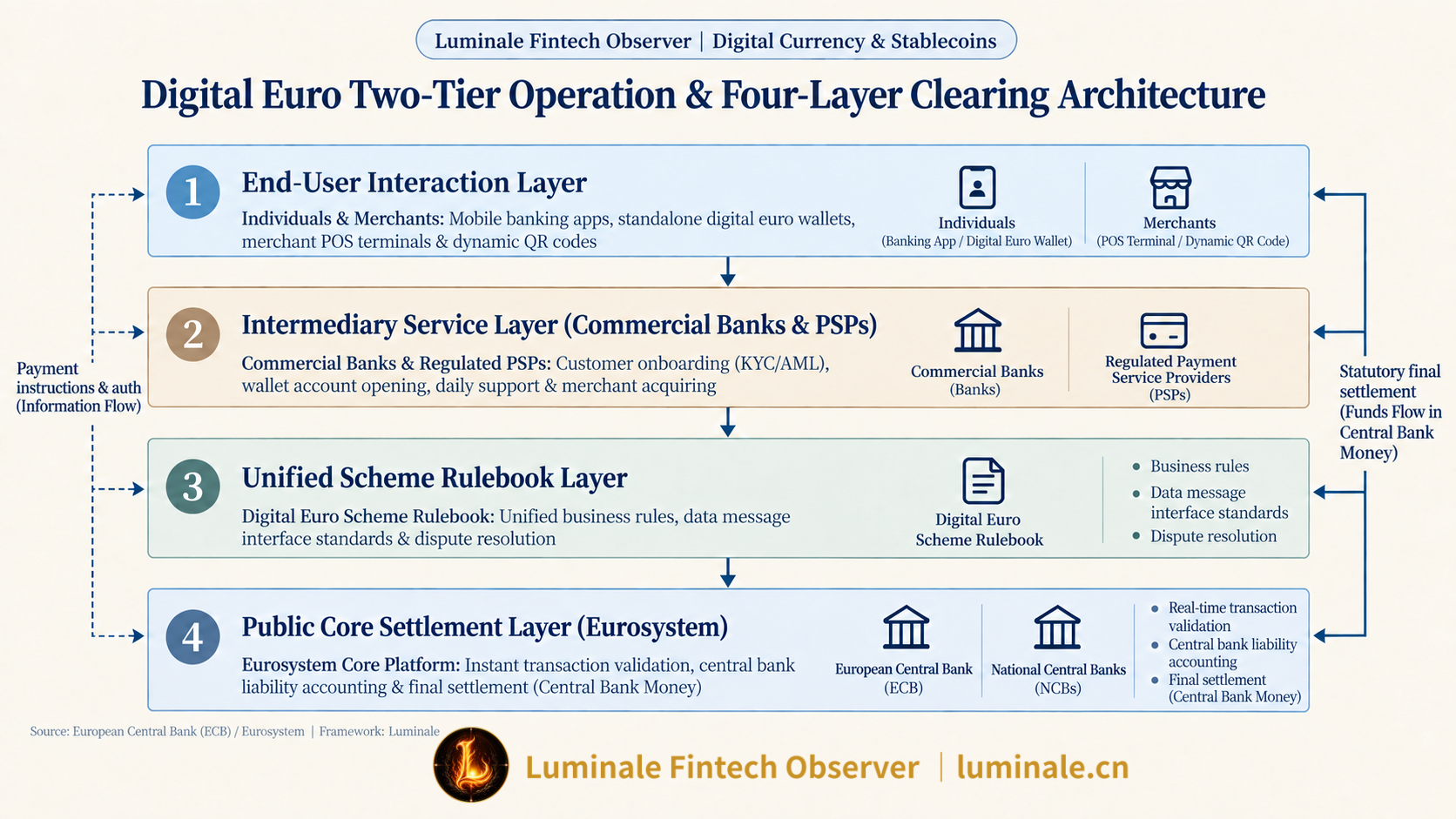
Institutionally, the digital euro constitutes a direct liability of the Eurosystem (comprising the ECB and national central banks of euro area member states). However, issuing a central bank liability does not imply that the ECB will directly onboard hundreds of millions of European citizens, process identity verifications, reset forgotten passwords, and manage retail customer support. Instead, the digital euro preserves the proven "two-tier operational architecture" of modern financial systems:
- Tier 1 (Public Core Layer): The Eurosystem is responsible for scheme governance, rulebook development, currency issuance, core settlement engines, and ledger management, ensuring systemic integrity and final settlement.
- Tier 2 (Intermediary Service Layer): Commercial banks, credit institutions, and regulated Payment Service Providers (PSPs) act as customer-facing intermediaries. They oversee Customer Due Diligence (CDD), Anti-Money Laundering (AML) compliance, wallet account onboarding, daily user interfaces, and merchant acquiring services[1].
Individuals / Merchants
    ↓ (Account Opening, Wallet Apps, Support, KYC/AML Compliance)
Commercial Banks / Regulated Payment Service Providers (PSPs)
    ↓ (Adherence to Standardized Technical and Business Rules)
Digital Euro Scheme Rulebook
    ↓ (Inter-Institutional Routing and Settlement Execution)
Eurosystem Core Settlement Platform
    ↓
Central Bank Legal Liability (Equivalent Status to Banknotes)
In terms of underlying architecture, technical specifications published by the ECB explicitly adopt a centralized settlement platform rather than Distributed Ledger Technology (DLT) or blockchain[1]. Retail retail payments impose stringent requirements on transaction throughput, ultra-low latency, and settlement certainty. Mature centralized clearing architectures offer decisive engineering advantages in handling massive volumes of instant, low-value retail payments.
Furthermore, the ECB strictly distinguishes between "programmable money" and "conditional payments" in its system design:
- Programmable Money: Implies that the central bank could program code-level constraints governing the usage, expiry dates, or merchant categories for which money can be spent (e.g., restricting expenditure to specific goods or imposing automated forfeiture dates). The ECB has categorically rejected programmable money, affirming that the legal tender status of the digital euro demands universal convertibility and unrestricted fungibility.
- Conditional Payments: Refers to automated functional instructions implemented at the payment services layer. Users can configure predefined payment triggers, such as "execute payment automatically upon delivery verification" or "automate monthly recurring utility billings." These features are deployed by intermediaries at the application layer, leaving the underlying currency completely neutral.
III. Payment Transaction Flows and Offline Operating Mechanisms
When retail consumers utilize the digital euro for daily transactions, how do funds circulate between accounts?
Under current architectural blueprints, users will establish dedicated digital euro accounts primarily via their existing commercial bank mobile banking apps, independent PSP applications, or a basic public digital euro app provided by the Eurosystem.
In the four-layer payment architecture structured by Luminale, transactions seamlessly traverse end-user access, intermediary validation, and the public foundation:
1. Three Primary Online Payment Scenarios
- Point-of-Sale (POS) Purchases: Consumers tap their smartphones via Near Field Communication (NFC) or scan dynamic QR codes presented by merchants. Instructions are routed via acquiring intermediaries into the Eurosystem settlement engine, achieving final settlement across merchant accounts within seconds.
- E-commerce Checkouts: Across domestic or cross-border e-commerce platforms, consumers select "Digital Euro" at checkout, authenticate via biometric verification within their linked banking app, and complete instant settlement.
- Person-to-Person (P2P) Transfers: Users select a recipient's phone number or account identifier from their contact list to execute instantaneous, cross-border peer-to-peer transfers, irrespective of the underlying PSP utilized by either party.
To guarantee seamless interoperability across thousands of commercial banks, PSPs, and merchant terminals throughout the euro area, the ECB established the Digital Euro Scheme Rulebook[1]. This rulebook formalizes harmonized data messaging protocols, user experience guidelines, merchant acceptance criteria, and dispute resolution mechanisms, serving an operational role analogous to international card scheme bylaws.
2. How Offline Payments Function
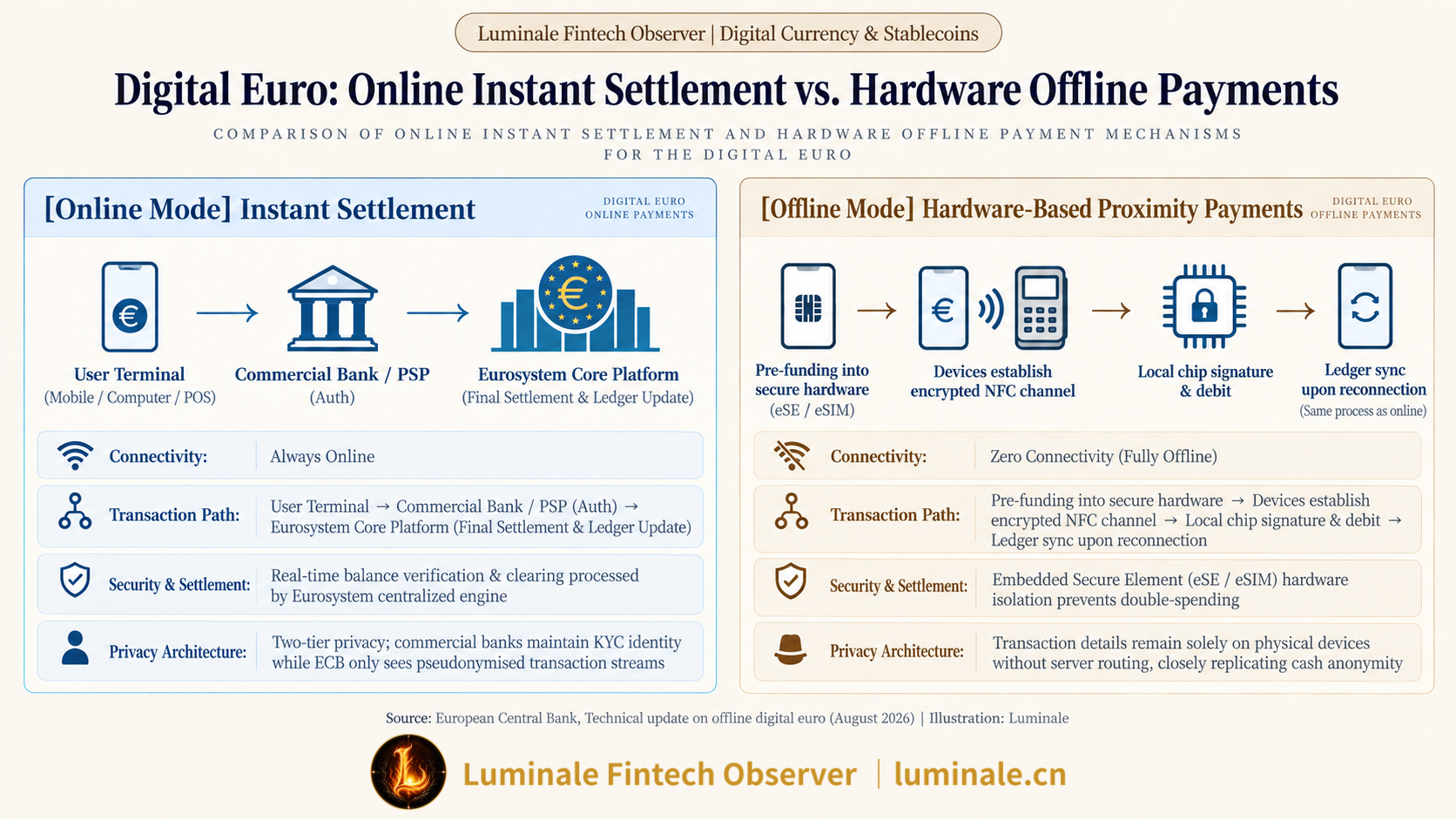
Offline payment capabilities distinguish the digital euro from the vast majority of existing commercial electronic payment rails. In environments devoid of cellular or network connectivity—such as underground parking structures, remote wilderness, or during network blackouts—users can successfully execute transactions simply by holding their physical devices in close proximity.
This functionality relies on tamper-resistant hardware security modules embedded in smartphones or smartcards, specifically an embedded Secure Element (eSE) or secure embedded SIM (eSIM)[2]. The operational sequence proceeds as follows:
- Pre-funding: While connected online, the user transfers a designated sum of digital euro credentials from their online account into the isolated hardware security enclave of their mobile device, decrementing their online balance and generating an equivalent offline balance.
- Peer-to-Peer Proximity Settlement: In a disconnected environment, two physical devices establish a local encrypted channel via NFC. The secure hardware enclave verifies cryptographic signatures and directly debits the payer's balance while crediting the payee's offline enclave, cryptographically preventing data tampering and double-spending.
- Reconnection Synchronization: Once the payee's device reconnects to the internet, aggregated offline transaction logs are synchronized back to the Eurosystem central ledger to validate ledger states and update aggregate holdings.
3. Tiered Privacy in Online and Offline Payments
For online digital euro transactions, the ECB implements a "privacy-by-design" architecture separating identity from transaction telemetry: intermediaries handle customer identification, while the central bank is segregated from personal details. Onboarding identity verification and AML compliance remain the exclusive duty of commercial banks and PSPs. The Eurosystem core platform only processes pseudonymized transaction instruction streams, preventing the ECB from directly correlating transaction activity with an individual's real-world identity[1].
In offline payment scenarios, privacy protection closely replicates physical cash. Because value transfers occur directly between the secure hardware modules of two physical devices without routing through central servers, transaction details and personal counterparty identifiers are never transmitted in real time to commercial intermediaries or the central bank, delivering the highest degree of transactional anonymity.
IV. Holding Limits and Liquidity Water Tanks: Protecting the Two-Tier Monetary System
Among all architectural design parameters of the digital euro, the imposition of an individual "holding limit" on wallet balances carries the most profound economic and financial stability implications.
1. Why Central Bank Money Cannot Be Opened Unlimitedly to Individuals
Modern banking systems operate under fractional-reserve principles. Sight deposits placed by retail households in commercial banks fund productive assets on the banking sector's balance sheet, including commercial loans, residential mortgages, and sovereign bonds. Banks hold only a fraction of their total deposits as central bank reserves to accommodate day-to-day liquidity withdrawals.
If a central bank were to offer the general public unlimited digital currency that combines zero credit default risk with ubiquitous digital payment convenience, households would gain access to a risk-free alternative to bank deposits. During tranquil macroeconomic conditions, continuous deposit migration toward the digital euro would erode low-cost retail funding for commercial banks, driving up borrowing costs across the real economy. During episodes of systemic distress, risk aversion could ignite frictionless "digital bank runs," triggering severe credit contraction across the banking sector.
We can illustrate account balance adjustments across all entities when a resident converts €1,000 of commercial bank sight deposits into digital euro using a simplified balance sheet framework:
| Institution / Entity | Asset Changes | Liability Changes |
|---|---|---|
| Individuals / Households | Commercial bank deposits −€1,000 Digital euro (central bank money) +€1,000 | (No change) |
| Commercial Banks | Central bank reserves −€1,000 | Customer sight deposits −€1,000 |
| Eurosystem (ECB) | (Total asset size unchanged) | Commercial bank reserves −€1,000 Digital euro in circulation +€1,000 |
Balance Sheet Analysis:
When residents convert bank deposits into digital euro, the total purchasing power in society does not expand, but the balance sheet of commercial banks contracts, accompanied by a direct drain on high-liquidity central bank reserves. If unlimited conversion were permitted, commercial bank balance sheets would face severe pressure on both liquidity and loan-to-deposit ratios.
To mitigate risks of financial disintermediation, the ECB has embedded two critical institutional guardrails into the scheme architecture:
- Zero-Interest Remuneration: The digital euro explicitly yields zero interest, firmly anchoring its economic role as a transactional medium of exchange rather than a wealth-accumulating savings asset.
- Statutory Holding Limits: Enforcing a strict ceiling on the total volume of digital euro balances an individual resident can maintain in their wallet.
2. The Waterfall and Reverse Waterfall Mechanisms
If individual digital wallets are constrained by holding limits, how can consumers complete larger retail purchases?
The ECB resolved this challenge by engineering automated "water tank" liquidity linking with commercial bank deposit accounts:
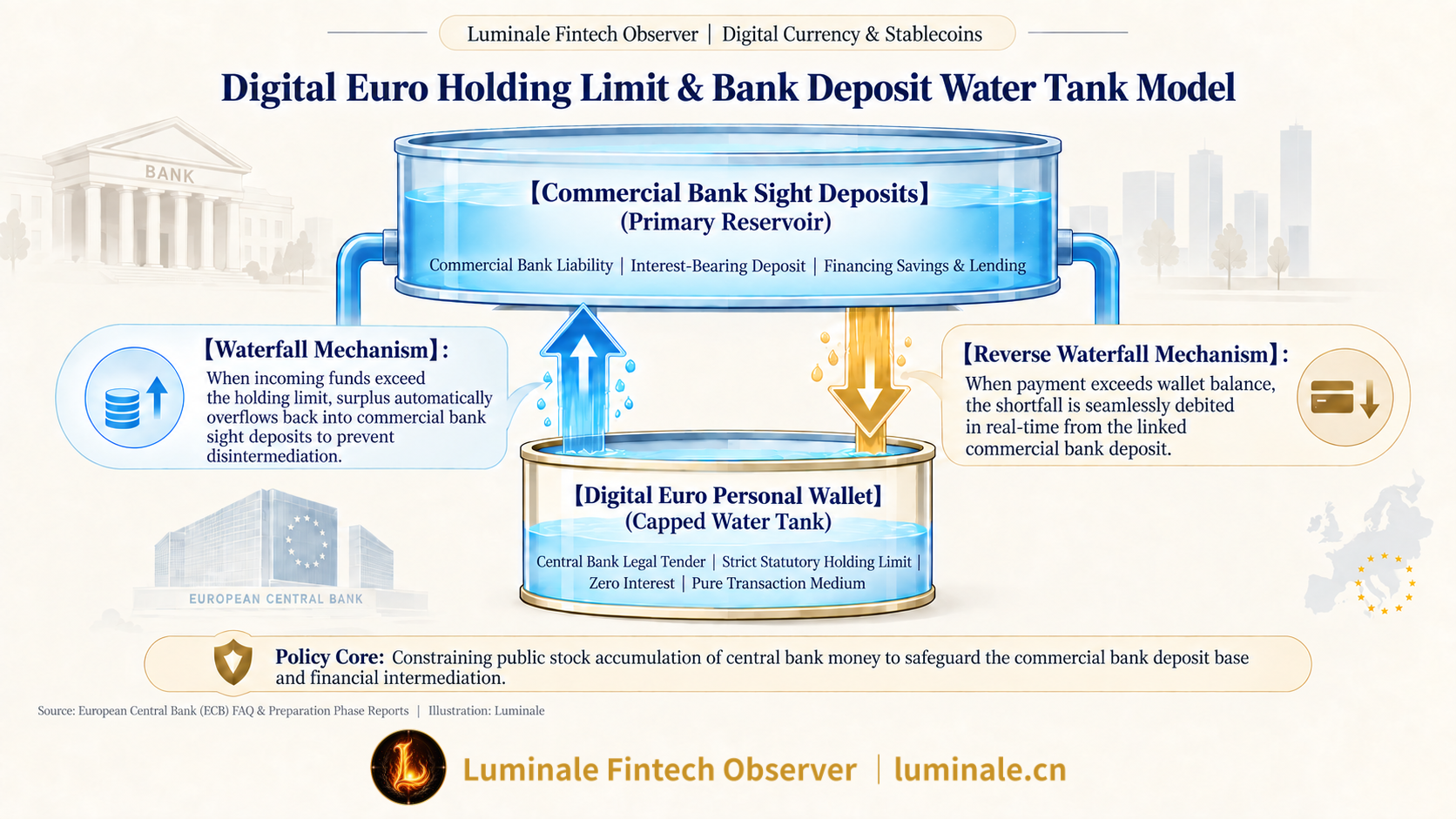
- Reverse Waterfall Mechanism: When a consumer makes a €2,000 retail purchase while holding only €500 in their digital euro wallet, the system—backed by pre-authorized user consent—automatically debits the remaining €1,500 shortfall from their linked commercial bank sight deposit in real time, converting it instantly to complete the transaction seamlessly.
- Waterfall Mechanism: When an incoming payment pushes a user's digital euro wallet balance beyond the statutory holding limit, excess funds above the threshold are automatically swept back and credited to their linked commercial bank deposit account.
This design anchors the digital euro strictly as a "flow-based transactional instrument," preventing it from becoming a "stock-based store of value" that drains deposit liquidity from the banking sector.
The exact statutory figure for the holding limit remains undecided. While the ECB utilized a hypothetical €3,000 cap per resident in preliminary academic stress tests and macroeconomic impact models[1], the final threshold range will be formally enacted by EU co-legislators during legislative deliberations to balance payment usability against financial sector stability.
V. Project Evolution Roadmap and Current Status
The digital euro is far from an abstract policy concept; it has progressed through years of disciplined technical exploration, advancing concurrently across legislative, engineering, and market prototyping tracks.
1. Key Timeline Milestones
- October 2021 – October 2023 (Investigation Phase): Focused on foundational market requirements, architectural design options, and conceptual functional blueprints.
- November 2023 – October 2025 (Preparation Phase – Stage 1): Executed technical prototyping for core platforms and offline components, initiated vendor procurement frameworks, drafted the Rulebook, and conducted user research. This stage concluded in October 2025[3].
- November 2025 Onward (Preparation Phase – Stage 2): The ECB established three strategic focus areas: engineering technical readiness, deepening market participant engagement, and actively supporting EU legislative deliberations[4].
- Second Half of 2026: The ECB selected 36 commercial banks and payment service providers across Europe to participate in testing environments and joint API interfacing[5].
- Second Half of 2027: Scheduled launch of a 12-month live pilot across controlled real-world transactional environments to stress-test interbank settlement, hardware enclaves, and merchant acquiring workflows[6].
- 2029: The target milestone established by the Eurosystem to achieve technical readiness for potential initial issuance.
2. What Is Settled vs. What Remains to Be Decided?
Evaluating the digital euro requires maintaining a clear distinction between technical proposals and finalized EU statutory law. While the ECB steers technical architecture and engineering preparation, sovereign institutional choices affecting civic rights and legal tender mandates rest exclusively with the Trilogue Negotiations between the Council of the EU and the European Parliament:
| Dimension / Mechanism | Current Established Status | Decision-Making Authority & Context |
|---|---|---|
| Legal Monetary Status | Formally established as a direct Eurosystem liability | Foundational premise; broad institutional consensus |
| Relationship to Cash | Established as a digital complement, not a cash replacement | EU legislative drafts concurrently reinforce physical cash acceptance mandates |
| Intermediation Model | Distributed exclusively through commercial banks and regulated PSPs | Central bank is barred from opening direct retail consumer accounts |
| Settlement Architecture | Centralized high-throughput platform, not built on DLT | Technical path formalized by the ECB |
| Offline Capabilities | Dual-mode architecture supporting both online and offline rails | Hardware security specifications undergoing industry coordination |
| Remuneration Policy | Fixed at 0% interest; non-interest-bearing | Consensus to preserve payment focus and avoid disintermediation |
| Holding Limits | Principle of capping individual wallet balances agreed | Consensus across institutions to safeguard bank liquidity |
| Specific Cap Figure | Not yet finalized | €3,000 served only as a modeling assumption; threshold to be determined by statute |
| Mandatory Acceptance | Proposed mandatory merchant acceptance with micro-business exemptions | Exact exemption scope subject to European Parliament and Council negotiations |
| 2027 Live Prototyping | 12-month live pilot scheduled for H2 2027 | 36 selected banks and PSPs preparing integration testing |
| Issuance Decision | No formal issuance decision adopted | Final decision to be made by the ECB Governing Council following legislative enactment |
VI. Conclusion
The digital euro represents far more than an engineering project to launch a cross-border European digital wallet; it embodies a profound institutional reconfiguration of the modern central banking settlement paradigm.
Defending public access to sovereign central bank money in a digitalized era does not necessitate dismantling established commercial banking structures. On the contrary, from holding limits and waterfall sweeps to two-tier distribution and privacy-differentiated offline enclaves, every functional and regulatory facet of the digital euro addresses a singular challenge: how to reinforce central bank money as the monetary anchor of the financial system while establishing a sustainable coexistence boundary between central bank liabilities, commercial bank deposits, and private payment networks.
The institutional insights gained from Europe's legislative negotiations, engineering trials, and public-private coordination will serve as a seminal reference point for the global evolution of central bank digital currencies.
References
[1]: European Central Bank, FAQs on the digital euro, updated August 2026. https://www.ecb.europa.eu/euro/digital_euro/faqs/html/ecb.faq_digital_euro.en.html ↩
[2]: European Central Bank, Technical update on the offline digital euro functionality and secure element integration, Market Information News, August 2026. https://www.ecb.europa.eu/press/intro/news/html/ecb.mipnews260818.en.html ↩
[3]: European Central Bank, Digital euro preparation phase: First progress report, October 2025. https://www.ecb.europa.eu/euro/digital_euro/progress/html/ecb.deprp202510.de.html ↩
[4]: European Central Bank, Eurosystem proceeds to next phase of digital euro project, Press Release, October 2025. https://www.ecb.europa.eu/press/pr/date/2025/html/ecb.pr251030~8c5b5beef0.en.html ↩
[5]: European Central Bank, Selection of 36 payment service providers for the digital euro prototyping and pilot environment, Press Release, July 2026. https://www.ecb.europa.eu/press/pr/date/2026/html/ecb.pr260714~8cd07d9d45.de.html ↩
[6]: European Central Bank, Digital euro pilot testing framework and timeline, July 2026. https://www.ecb.europa.eu/euro/digital_euro/pilot/html/index.en.html ↩
[7]: Council of the European Union, Single currency: Council agrees position on the digital euro and on strengthening the role of cash, Press Release, December 2025. https://www.consilium.europa.eu/en/press/press-releases/2025/12/19/single-currency-council-agrees-position-on-the-digital-euro-and-on-strengthening-the-role-of-cash/ ↩
Originally published by Luminale Fintech Observer: https://luminale.cn/articles/digital-euro-landscape-why-how-and-current-progress-en