What Exactly Is Blockchain? Starting with the Ledger Behind a Transaction
Many people first encounter blockchain through Bitcoin, cryptocurrencies, or NFTs, so it is often understood as a technology tied to "coin speculation." But if we shift our gaze away from prices and market narratives, blockchain first raises a fundamental question: when multiple parties need to jointly record assets and transactions but do not want to rely entirely on a single central institution, how can they reach a consistent understanding of "who owns what and what transactions have occurred"?
I. Why Did Blockchain Emerge: First Understand the Problem It Tries to Solve
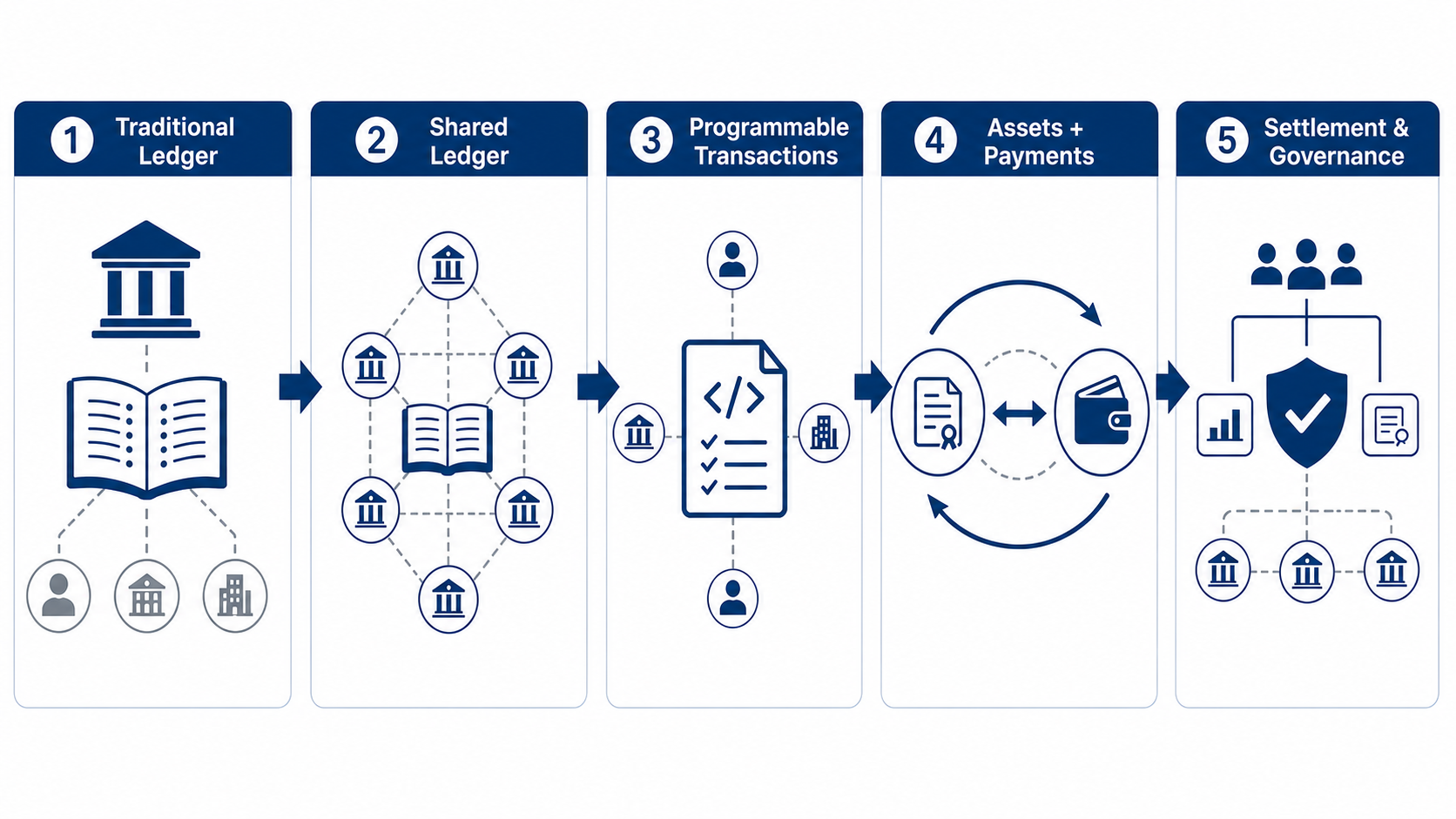
Financial activities are highly dependent on ledgers. Banks record customer deposit balances, securities registration and settlement systems record securities ownership, and payment systems record fund transfers between institutions. The account balance you see on your phone is not a digital picture of cash, but a liability or ownership record maintained by the relevant institution.
In the traditional financial system, this ledger is typically maintained by a clearly designated central institution. The internet solved the problem of information replication and transmission, but it did not naturally solve the "uniqueness" of digital assets: a unit of digital value cannot be paid to Party A and then paid to Party B as well.
Bitcoin and the blockchain approach behind it attempted to propose an alternative: if there is no single bank or central institution responsible for maintaining a unique ledger, can multiple nodes collaboratively maintain a ledger state that everyone recognizes, following common rules? This is the basic intuition behind distributed ledgers.
Blockchain did not invent cryptography, peer-to-peer networks, or distributed systems. Its importance comes more from the recombination of these technologies. The trust, verification, and coordination work originally undertaken by central institutions has not disappeared; it has simply been reassigned to cryptography, network nodes, consensus mechanisms, incentive mechanisms, and governance rules.
II. What Is Really Different About Blockchain: Advantages and Costs Come from the Same Place
The most worthwhile thing to understand about blockchain is not the "chain" data structure, but how multiple parties jointly confirm and update the same ledger state.
- Shared ledger: Multiple participants collaborate around the same set of transaction records and asset states, reducing the need for repeated reconciliation between different institutions'ledgers.
- Verifiability: Cryptography and consensus mechanisms are used to verify transactions and data states, but this does not mean the information is inherently truthful or the system is absolutely secure.
- Programmability: Smart contracts can write asset rules and transaction conditions into programs, providing a foundation for automated execution and atomic transactions.
- Native digitalization of assets: Tokens can be held, transferred, and combined according to on-chain rules, but this does not automatically mean that legal rights in the real world have been transferred.
These capabilities also come with costs: consensus requires resources, performance and scalability have constraints, privacy protection becomes more complex, erroneous transactions are difficult to reverse, and governance responsibilities can become more ambiguous.
Therefore, blockchain is not a "more advanced database," but rather a different trade-off among efficiency, trustworthiness, openness, privacy, and governance.
III. From Hype to Cooling Down, and Then to Renewed Attention
Bitcoin proved that mechanisms for recording and transferring digital value can be established without a traditional bank account system. Ethereum and smart contracts further expanded blockchain from a "transfer ledger" to a programmable ledger, giving rise to applications such as ICOs, DeFi, and NFTs.
Subsequently, a large number of projects exposed problems related to speculation, governance, security, liquidity, and regulation. Many enterprises also discovered that in scenarios where multiple parties do not need to jointly maintain a ledger, traditional databases are often more efficient. As a result, the financial industry cooled on "blockchain for blockchain's sake" projects at one point.
In recent years, blockchain has regained attention from financial institutions, but the focus has shifted. Discussions are increasingly less about "whether blockchain can replace banks" and more concentrated on stablecoins, tokenized deposits, tokenized assets, and on-chain payment and settlement infrastructure.
This does not mean that traditional finance is migrating entirely to blockchain; rather, the financial industry is reassessing whether distributed ledger technology can change the ways assets are recorded, transactions are executed, and settlements are completed.
IV. If Blockchain Is Placed in the Financial System, What Might It Change
1. Payments and Money
Stablecoins, central bank digital currencies (CBDCs), and tokenized deposits are all exploring how different forms of digital money can circulate on new types of ledgers. However, the liability subjects, issuance mechanisms, redemption arrangements, and final settlement attributes of the three are not the same. When evaluating a digital currency, one cannot only look at whether it runs on blockchain; one must also ask: whose liability is it, who issues it, and how is it ultimately redeemed?
2. Cross-Border Payments
On-chain transfers can provide near-24/7 value transfer capabilities, but foreign exchange conversion, fiat on/off ramps, identity verification, anti-money laundering screening, and liquidity management will not automatically disappear just because transactions are put on-chain.
3. Securities and Real-World Assets
Assets such as bonds and fund shares can be tokenized, but the key questions are what legal rights the Token represents, who is responsible for registration and title confirmation, how the Token corresponds to the underlying asset, and how holders can transfer or redeem.
4. Clearing and Settlement
An on-chain bond transaction can be split into two legs: the seller delivers the bond Token to the buyer, and the buyer delivers the payment asset to the seller. If the two legs can be completed simultaneously, DvP (Delivery versus Payment), known in Chinese as "券款对付", can be explored. But one must continue to ask: is the final delivery central bank money, commercial bank deposits, stablecoins, or other assets? Having assets on-chain does not mean financial settlement in the final sense has been completed.
5. Collaboration Among Financial Institutions
A shared ledger may reduce some reconciliation work, but permission management, data privacy, system governance, operational risk, and liability allocation will become even more important. Who has the authority to update the ledger, who is responsible for handling errors, and who bears losses caused by system failures all need to be clearly defined.
V. Will Blockchain Become the Next-Generation Financial Infrastructure?
It is still too early to jump to conclusions. Whether blockchain is suitable for financial infrastructure cannot be judged solely by TPS, gas fees, or "whether it is decentralized." Instead, one should return to the requirements of financial infrastructure itself: what are the assets, who maintains the ledger, who verifies transactions, what payment assets are used, where final settlement is completed, who bears the risk, and does the law recognize the results recorded on the ledger?
"Reducing intermediaries" does not necessarily equal "reducing functions." Identity authentication, credit assessment, liquidity provision, compliance review, dispute resolution, and risk bearing still need to be undertaken by someone.
In the past, when we talked about blockchain, the easiest question to ask was: "Can it replace a certain intermediary?" But from the perspective of financial infrastructure, the more worthwhile question is: has it changed the way assets are recorded, the way transactions are executed, and the way final settlement is completed?
If the original business processes are simply moved onto a chain, and the underlying account relationships, settlement assets, and risk bearing remain unchanged, then the technological change may be limited. Conversely, if assets can exist on a shared ledger, if money can also enter the same environment, if transaction rules can be executed through smart contracts, and if funds and assets can be delivered simultaneously, then blockchain brings not just a new database, but possibly a new way of organizing financial transaction infrastructure.
This is also the starting point for subsequently understanding stablecoins, CBDCs, tokenized deposits, RWA, and on-chain securities settlement.
Originally published by Luminale Fintech Observer: https://luminale.cn/articles/what-is-blockchain-en