
1. RMB Internationalization Depends on Whether Overseas Entities Can Actually Use It
Discussions surrounding renminbi (RMB) internationalization typically focus on global ranking metrics. According to the RMB Internationalization Report (2026) released by the People's Bank of China (PBOC), the RMB has become China's largest settlement currency for cross-border receipts and payments, the world's second-largest trade finance currency, the third-largest payment currency (by total scale), and the fifth-largest foreign exchange transaction currency. Furthermore, its weight in the International Monetary Fund's (IMF) Special Drawing Rights (SDR) basket ranks third globally[1]. In 2025, bank cross-border RMB receipts and payments on behalf of clients reached RMB 70.6 trillion, and grew by an additional 21.4% year-on-year in the first half of 2026 to RMB 42.4 trillion[1].
While these headline indicators illustrate a macro expansion curve, for an actual market participant, volume statistics do not automatically equate to practical usability. When an Indonesian manufacturing importer, a European multinational automaker, a commercial bank operating in Hong Kong, or a Middle Eastern sovereign wealth fund evaluates whether to integrate the RMB into daily treasury operations, it confronts highly specific operational questions:
- Outgoing Payments: When an importing firm purchases raw materials from Chinese suppliers, can it directly initiate wire transfers or real-time payments in RMB?
- Inward Receivables: When an overseas business receives RMB from exporting goods to China, in what form are these funds retained, and will they become trapped, illiquid balances?
- Corporate Financing: Can an overseas firm expand factories or acquire equipment locally by obtaining cost-effective RMB working capital loans from local banks, or by issuing RMB bonds directly in capital markets?
- Treasury Management: Can multinational corporate groups establish cross-border two-way cash pools across global subsidiaries to centralize and allocate idle RMB balances?
- Asset Allocation: Can temporarily idle RMB balances be invested in high-grade bonds, government bond futures, or equities with steady yields and ample liquidity?
- Risk Hedging: When exchange rates or interest rates fluctuate, can corporate treasurers and institutional investors manage exposures via forward contracts, currency swaps, or interest rate swaps?
- Liquidity Backstops: When offshore commercial banks face concentrated client withdrawals or intraday clearing overdrafts, can they borrow RMB in the interbank market or pledge collateral to local monetary authorities for emergency liquidity?
Whether the RMB can be sustained in cross-border use depends on whether these operational links fit together smoothly. If an overseas enterprise receives RMB but cannot access low-cost RMB credit, find eligible RMB assets for value preservation, or hedge currency volatility, it will naturally convert the RMB into US dollars or local currency immediately upon receipt.
Under such circumstances, the currency functions merely as a trade invoicing denomination and a transient transit token. To achieve widespread global adoption, a currency cannot rely solely on trade settlement; it must support payments, trade financing, asset allocation, liquidity management, and risk hedging as an integrated monetary ecosystem.
2. Sources of Offshore RMB Liquidity
Before overseas market entities decide to use the RMB, an essential prerequisite must be met: how does the offshore market secure abundant, predictable, and cost-effective RMB liquidity?
In cross-border finance, the willingness to pay does not automatically generate the capacity to settle. If the offshore market lacks liquidity supply conduits, preventing businesses from borrowing funds and banks from securing interbank financing, cross-border adoption will stall under friction. The offshore RMB liquidity framework outlined in the RMB Internationalization Report (2026) demonstrates three distinct tiers of liquidity provision:
1. Market-Driven Supply at the Enterprise and Commercial Bank Level
At the microeconomic commercial level, the primary offshore source of RMB stems from net outflows via the current account and direct investment. When Chinese enterprises purchase overseas goods and services, pay for offshore engineering projects, conduct Outward Foreign Direct Investment (OFDI), or when domestic parent companies extend cross-border RMB loans to overseas subsidiaries, domestic bank funds are channeled directly into the accounts of offshore entities.
The expansion of cross-border two-way RMB cash pooling and multinational corporate treasury management policies has further streamlined fund allocation between onshore and offshore entities. When an overseas subsidiary encounters a liquidity deficit, the domestic parent can transfer RMB offshore within the macroprudential framework for cross-border financing; conversely, surplus offshore funds can be swept onshore, shielding multinational enterprises from unnecessary foreign exchange conversion losses.
2. Bilateral Currency Swaps: Liquidity Support Between Central Banks
Relying exclusively on commercial trade and interbank borrowing leaves offshore RMB markets vulnerable to sharp interest rate spikes and liquidity squeezes during international financial market stress. Consequently, central bank bilateral currency swap agreements (Bilateral Local Currency Swap Agreements) establish a sovereign-level liquidity backstop.
A bilateral currency swap is an institutional arrangement between two central banks or monetary authorities: under agreed terms, either party can exchange a specified volume of domestic currency for an equivalent amount of the counterparty's currency to facilitate trade and investment settlement or provide short-term market liquidity, returning the original currencies with interest upon maturity.
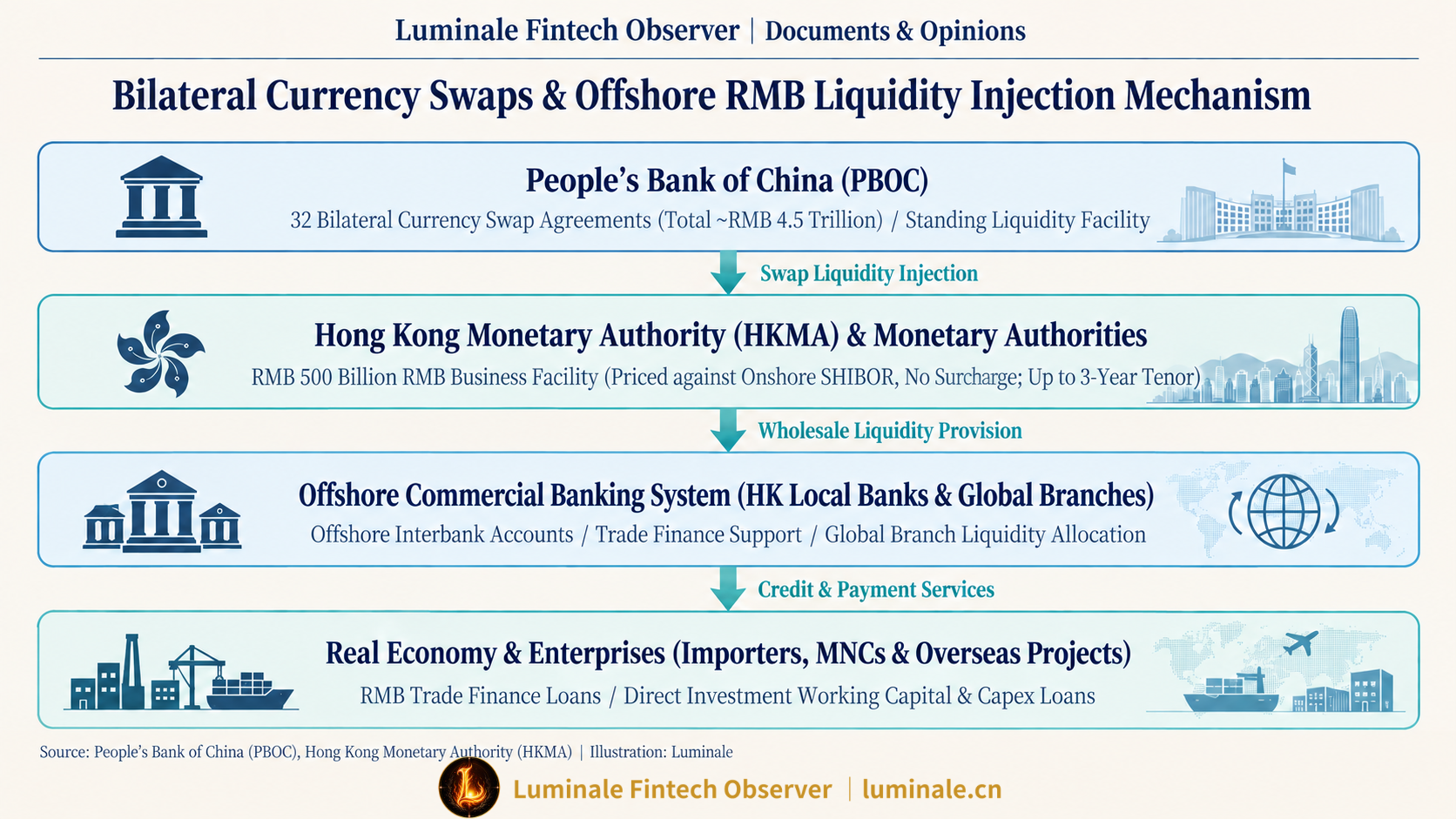
As of the end of June 2026, the PBOC maintained 32 active bilateral currency swap agreements with overseas central banks or monetary authorities, totaling approximately RMB 4.5 trillion; the outstanding balance of RMB drawn by foreign central banks stood at RMB 132.8 billion[1].
The RMB Business Facility established by the Hong Kong Monetary Authority (HKMA) represents a prominent institutionalized case study. In February 2025, supported by the PBOC, the HKMA utilized standing swap funds to launch the RMB Trade Financing Liquidity Facility, upgrading it in October of that year into the RMB Business Facility, with total capacity expanded to RMB 500 billion and tenors extending up to three years[2].
This arrangement features three defining characteristics:
- Low Funding Cost: The HKMA waived additional premium surcharges, aligning the borrowing rate for commercial banks directly with onshore Shanghai Interbank Offered Rate (SHIBOR) benchmarks of matching tenors, substantially lowering offshore banks'liability costs;
- Extended Tenor Coverage: Providing stable funding for up to three years enables commercial banks to comfortably issue medium-to-long-term project loans and capital expenditure credit without facing maturity mismatch risks;
- Broad Geographic Reach: Hong Kong local banks can deploy swap funds not only to their direct local clientele, but also to overseas branches within the same banking group, providing syndicated RMB credit for cross-border direct investments and trade projects globally. As of June 2026, cumulative utilization under this facility approached RMB 200 billion[1].
3. Local Currency Transaction (LCT) Framework: Bilateral Account Opening and Direct Market Making
Beyond providing liquidity through offshore financial hubs, sovereign states can also establish bilateral clearing and direct transaction frameworks. A prime example is the Local Currency Settlement (LCS) cooperation framework launched between China and Indonesia in September 2021, which was elevated in May 2025 into a comprehensive Local Currency Transaction (LCT) framework encompassing current accounts, direct investment, and capital and financial accounts[3].
Under the LCT framework, both central banks designate Appointed Cross Currency Dealers (ACCD banks). These ACCD banks open non-resident accounts in each other's domestic banking systems, establish direct quoting and market-making mechanisms, and conduct multilateral net settlement at the end of each business day. This arrangement allows importers and exporters in both nations to price and settle contracts directly in RMB and Indonesian Rupiah (IDR), eliminating the double conversion cost and exchange rate risk of routing through the US dollar. By the end of June 2026, cumulative cross-border RMB settlement under the Sino-Indonesian LCS/LCT framework reached RMB 120.4 billion, making the RMB/IDR pair the most actively traded regional currency pair in China's interbank foreign exchange market[1].
3. How Funds Move Across Borders: Accounts, Clearing Banks, CIPS, and Retail Networks
Once liquidity sources are established, how do RMB funds transfer securely and accurately from an onshore payer to an offshore payee's account? This process relies on an interconnected architecture composed of account frameworks, clearing institutions, and messaging networks.
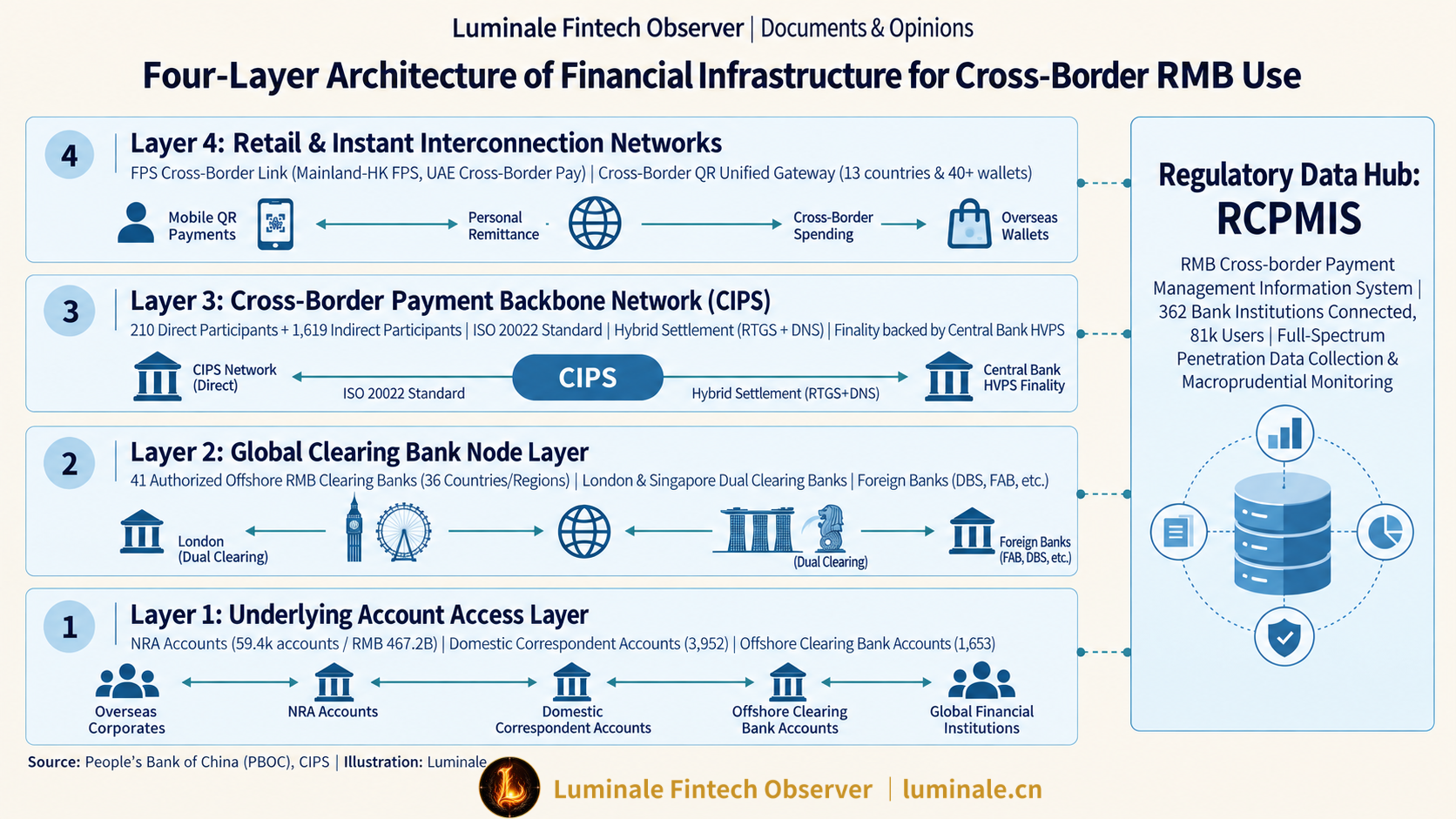
According to Luminale's cross-border financial infrastructure analytical framework, cross-border RMB usage spans four operational infrastructure layers, while regulatory data systems aggregate transaction information across all levels:
| Infrastructure Layer | Core Participating Entities & Systems | Operational Function & Accounting Route | Business Scope & Key Metrics |
|---|---|---|---|
| Layer 1: Underlying Account Access | Non-Resident Accounts (NRA), Domestic Correspondent Accounts, Offshore Clearing Bank Accounts | Establishes statutory balance sheet records for overseas entities | As of June 2026, over 59,000 NRA accounts (RMB 467.2B) and 3,952 domestic correspondent accounts (RMB 311.3B) |
| Layer 2: Global Clearing Bank Nodes | 41 Authorized Offshore RMB Clearing Banks (across 36 jurisdictions) | Acts as regional offshore hubs providing local conversion, clearing, liquidity, and onshore links | Expanded to major foreign banks (e.g., DBS, FAB, Standard Bank), introducing dual clearing banks in London and UAE |
| Layer 3: Cross-Border Backbone Network | Cross-border Interbank Payment System (CIPS) | Centralized message routing with hybrid settlement mechanisms (RTGS + DNS) | 210 Direct Participants, 1,619 Indirect Participants, reaching over 5,200 banking institutions in 192 jurisdictions |
| Layer 4: Retail & Instant Interconnection | Payment Connect (Fast Payment System links), Unified Cross-Border QR Gateway | Connects retail payment rails for real-time account-to-account remittances and mobile wallet interoperability | Mainland-HK FPS link, China-UAE Payment Connect; UnionPay gateway connecting 13 national QR networks and 40+ overseas wallets |
| External Regulatory Monitoring Layer | RMB Cross-border Payment Management Information System (RCPMIS) | Full-lifecycle data collection, authenticity verification, statistical reporting, and macroprudential monitoring | 362 corporate banking institutions connected with 81,000 users, monitoring full-spectrum cross-border RMB flows |
1. Layer 1: Three Foundational Account Models and Their Accounting Flows
To use the RMB, an overseas entity must first establish an account on the ledger of a regulated financial institution. According to the RMB Internationalization Report (2026), current cross-border account connections operate through three primary models:
- Non-Resident Account (NRA) Model: Overseas institutions open RMB settlement accounts directly with commercial banks incorporated within Mainland China. Foreign enterprises receive independent onshore account numbers and directly interface with domestic clearing systems;
- Domestic Correspondent Banking Model: Overseas participating banks open RMB correspondent accounts (Nostro/Vostro accounts) with qualified onshore commercial banks. Payment instructions from overseas clients are routed to onshore correspondent banks, which execute book entries and domestic settlements;
- Offshore Clearing Bank Model: Overseas participating banks open interbank accounts with designated offshore RMB clearing banks authorized by the PBOC, accessing onshore interbank clearing networks through these centralized hubs.
To illustrate the accounting reality of cross-border transfers, consider a transaction where an overseas participating bank pays RMB 10 million to an onshore corporate beneficiary via an onshore correspondent bank, with balance sheet adjustments across commercial banks and the central bank as follows:
| Balance Sheet Entity | Asset Adjustments | Liability Adjustments | Accounting & Financial Explanation |
|---|---|---|---|
| Overseas Participating Bank (Payer Bank) | Due from Onshore Correspondent Bank -RMB 10M | Demand Deposits of Overseas Payer -RMB 10M | Payer settles deposit liability; overseas bank debits its correspondent asset held at the onshore correspondent bank. |
| Onshore Correspondent Bank | Reserve Deposits at Central Bank -RMB 10M | Due to Overseas Participating Bank -RMB 10M (Total liabilities net out upon interbank central bank settlement) | Onshore correspondent bank reduces correspondent liability to the overseas bank and transfers central bank reserves to payee bank. |
| Onshore Beneficiary Bank (Payee Bank) | Reserve Deposits at Central Bank +RMB 10M | Demand Deposits of Onshore Beneficiary +RMB 10M | Beneficiary bank receives central bank reserve assets and credits the commercial demand deposit liability of the corporate payee. |
| Central Bank (PBOC Balance Sheet) | Total Assets Unchanged | Correspondent Bank Statutory Reserves -RMB 10M Beneficiary Bank Statutory Reserves +RMB 10M | Statutory Settlement Finality Achieved: PBOC adjusts bank reserve balances on its general ledger, eliminating interbank credit risk. |
2. Layer 2: Offshore RMB Clearing Banks as Regional Hubs
If every overseas bank opened bilateral correspondent accounts with onshore Chinese commercial banks, interbank network complexity would expand exponentially, creating excessive liquidity lock-up and reconciliation overhead. Offshore RMB clearing banks serve as centralized regional hubs designed to resolve this friction.
Offshore clearing banks are authorized by the PBOC from among established commercial banks possessing robust institutional creditworthiness and processing infrastructure. The PBOC provides them direct connectivity to the onshore High Value Payment System (HVPS) and facilitates access to onshore interbank liquidity.
By the end of June 2026, the PBOC had authorized 41 offshore RMB clearing banks across 36 countries and regions[1]. Recent clearing bank developments highlight two strategic shifts:
- Authorizing Dual Clearing Banks: In high-volume financial hubs such as Singapore, London, and the UAE, the PBOC authorized a second clearing bank, introducing competition, enhancing service resilience, and improving offshore liquidity pricing efficiency;
- Enlisting Global and Regional Foreign Banks: Foreign institutions including First Abu Dhabi Bank (FAB), DBS Bank, and Standard Bank were successively authorized as clearing banks, alongside the establishment of the first regional clearing bank serving Sub-Saharan Africa, expanding RMB clearing services to a wider network of local overseas banks[1].
3. Layer 3: Cross-Border Backbone Network CIPS and Clearing Mechanisms
A modern cross-border financial system requires a high-throughput, standardized clearing infrastructure to support interbank message exchange and funds settlement. The Cross-border Interbank Payment System (CIPS) handles cross-border interbank payment instruction exchange and funds settlement, operating as a national-level financial market infrastructure.
As of June 2026, CIPS included 210 Direct Participants and 1,619 Indirect Participants, covering 130 countries and regions and reaching over 5,200 banking entities across 192 jurisdictions. In 2025, CIPS processed RMB 180.2 trillion in transactions, with transaction volume exceeding RMB 100.9 trillion in the first half of 2026 alone[1].
CIPS architectural design and operating rules center on four key dimensions[4]:
- Tiered Participant Structure: Separated into Direct Participants (DP) and Indirect Participants (IP). Direct Participants maintain dedicated clearing accounts within CIPS and manage liquidity injection via reserve accounts in the central bank's HVPS, sending and receiving instructions directly. Indirect Participants do not hold CIPS accounts directly and must route cross-border clearing through Direct Participants; overseas DPs lacking onshore central bank reserve accounts designate onshore DPs as custodian banks to handle account funding and liquidity;
- Global Messaging Standards: CIPS natively adopts the ISO 20022 messaging standard, ensuring seamless structural interoperability with major international financial systems and accommodating rich structured data fields (such as unified enterprise identifiers, invoice details, and remitter notes) to reduce transaction errors;
- Hybrid Settlement Mechanisms: To balance clearing speed with liquidity conservation, CIPS operates a hybrid settlement model:
- For large-value financial market transactions, interbank funding, and urgent payments, it provides Real-Time Gross Settlement (RTGS) with immediate transaction-by-transaction finality;
- For regular commercial customer transfers, it provides Deferred Net Settlement (DNS) and multilateral intraday continuous matching, netting reciprocal obligations in predetermined batches to minimize intraday reserve lock-up;
- Settlement Finality Anchored to Central Bank Reserves: Settlement finality in CIPS is anchored directly to the PBOC's High Value Payment System (HVPS). During operational hours, Direct Participants fund their CIPS settlement balances from central bank reserve accounts; at end-of-day cutoff, CIPS posts net settlement positions back to the central bank's master ledger, conferring irrevocable sovereign legal finality upon all processed transactions.
4. Layer 4: Interconnection of Retail Payment Systems and Unified QR Code Gateway
CIPS and correspondent banking rails primarily manage large-value wholesale corporate flows. In recent years, cross-border RMB infrastructure has also begun covering retail payments for SMEs and individuals.
The RMB Internationalization Report (2026) highlighted two retail financial infrastructures:
- Fast Payment System (FPS) Interconnection ("Payment Connect"): Directly connects Mainland China's Internet Banking Payment System (IBPS) with overseas fast payment infrastructures through bilateral central bank interfaces, known as Payment Connect. In June 2025, Mainland China and Hong Kong established FPS interconnection, allowing residents to execute real-time cross-border retail remittances settled in RMB or local currencies; in April 2026, the China-UAE Payment Connect launched, enabling bilateral remittances, student grants, and worker subsidies[1].
- Unified Cross-Border QR Code Gateway: To resolve fragmented merchant terminals and proprietary QR protocols, China established a national unified cross-border QR code gateway. As of June 2026, clearing entities including UnionPay and NetsUnion linked QR networks across 13 countries; major Chinese mobile payment apps support QR payments across nearly 80 jurisdictions, while allowing over 40 overseas e-wallets to make inbound merchant payments debited directly from local accounts[1].
These infrastructures compress cross-border retail remittance processing times from multiple days to seconds, while sharply lowering intermediation fees compared to traditional correspondent wire rails.
4. Why Payment Networks Are Not Enough: Asset Allocation, Financing, and Risk Management
Suppose an overseas multinational enterprise receives an RMB 500 million receivable through these payment networks. If the local financial market cannot address the following operational needs:
- Where can idle funds be invested to yield competitive risk-free returns?
- Can the firm borrow in RMB to fund regional capital expenditures and balance asset-liability currency profiles?
- Can held RMB assets be pledged as collateral to unlock liquidity during cash squeezes?
- Can treasury managers access deep derivative markets to lock in exchange rate exposures against the dollar or local currency?
If these mechanisms are absent, the firm's rational choice is to immediately sell received RMB for dollars or local currency in the foreign exchange market. While the funds successfully traverse the payment pipes, they fail to take root in the balance sheet.
Consequently, smooth clearing connectivity is only one dimension. Whether foreign entities can allocate RMB assets, obtain RMB financing, utilize RMB securities as collateral, and hedge associated market risks fundamentally dictates cross-border currency viability.
1. Asset Allocation: Expanding Options for Overseas Investors via Bond Connect and Multiple Channels
To hold a currency over the long term, overseas institutions typically require the ability to invest in high-grade, liquid assets denominated in that currency. China's capital markets have systematically expanded foreign investor access through the Qualified Foreign Institutional Investor (QFII/RQFII) framework, China Interbank Bond Market Direct Access (CIBM Direct), and mutual market access channels such as Bond Connect and Stock Connect.
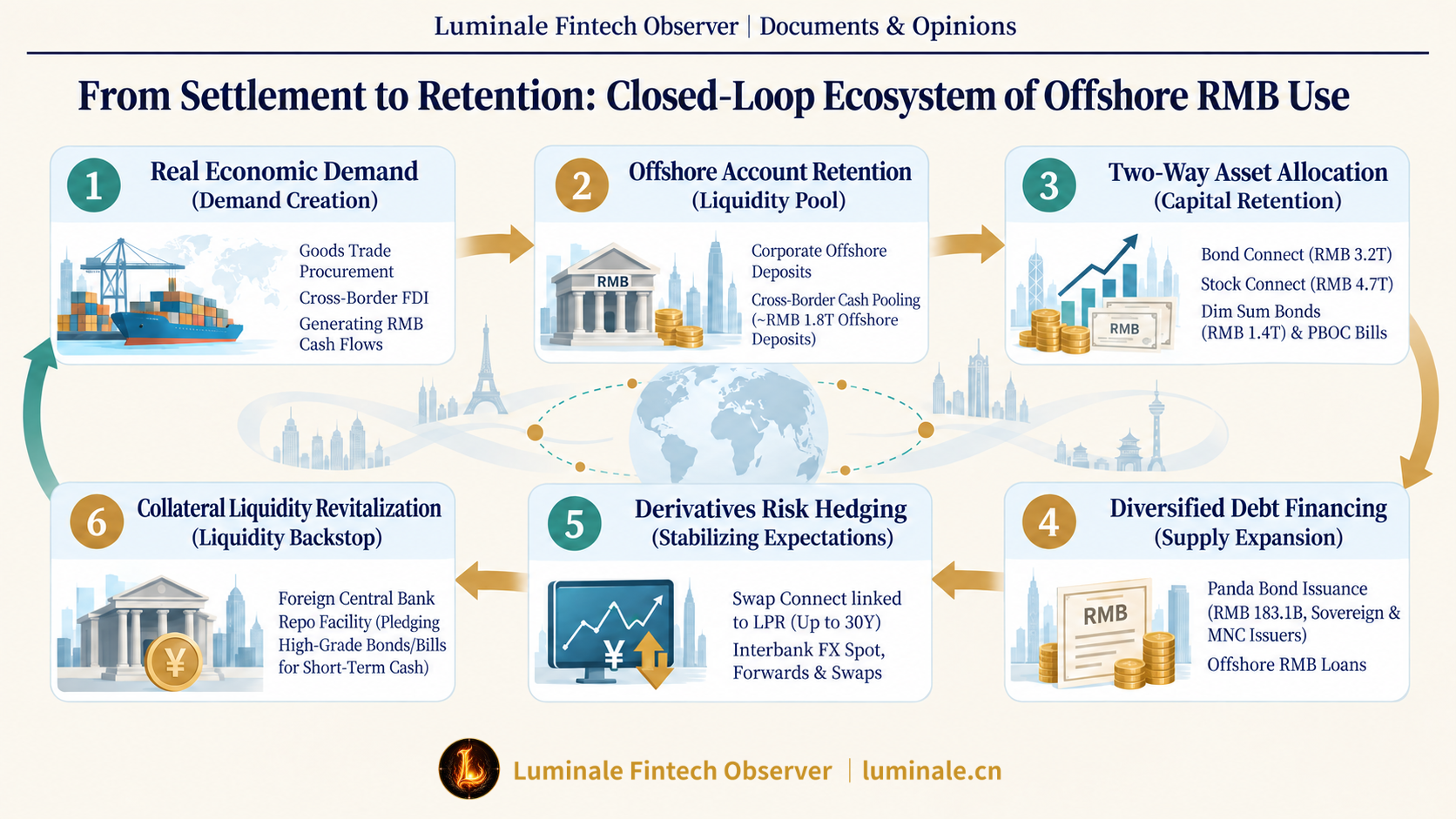
As of June 2026, total onshore financial assets held by overseas entities (equities, bonds, loans, and deposits) reached RMB 11.3 trillion, including RMB 4.7 trillion in equities, RMB 3.2 trillion in bonds, RMB 2.0 trillion in deposits, and RMB 1.4 trillion in loans[1].
In offshore markets, Dim Sum Bonds issued in Hong Kong absorb offshore RMB balances. In 2025, offshore RMB bond issuance reached approximately RMB 1.4 trillion, with first-half 2026 issuance surging by 94.4% year-on-year to RMB 896.1 billion[1]. Regular offshore sovereign bond and central bank bill issuances by the Ministry of Finance and the PBOC in Hong Kong supply high-grade benchmark assets and construct a continuous offshore RMB yield curve.
2. Liabilities and Financing: The Expansion of Panda Bonds
A critical benchmark of currency internationalization is whether foreign entities are willing to incur debt liabilities in that currency. Historically, lower dollar financing costs led global corporations to borrow predominantly in USD. However, with elevated interest rates across Western economies, the comparatively low and stable RMB interest rate environment has highlighted a distinct cost advantage, driving global issuers to tap RMB debt markets.
Panda Bonds (RMB-denominated bonds issued in Mainland China by overseas entities) continue to grow in issuance scale. In 2025, 123 Panda Bonds were issued across interbank and exchange markets totaling RMB 183.1 billion; in the first half of 2026, 89 bonds were issued totaling RMB 160.0 billion, a year-on-year increase of nearly 70%[1].
Crucially, the issuer composition has broadened considerably:
- Issuers have expanded beyond overseas subsidiaries of Chinese firms to include sovereign borrowers such as Hungary, Slovenia, and Indonesia, alongside multilateral development institutions like the Asian Development Bank and the New Development Bank;
- Global financial institutions (Deutsche Bank, Crédit Agricole, UOB) and multinational conglomerates (Mercedes-Benz, Bayer) utilize Panda Bonds for routine liability management;
- Raised RMB proceeds may be retained onshore for capital investments or repatriated offshore to support global operations, demonstrating that overseas institutions and enterprises are increasingly utilizing RMB for financing.
3. Collateral and Liquidity Management: Establishing the Repo Facility for Foreign Central Banks
Holding assets requires liquid monetization channels. Previously, when foreign central banks holding onshore Chinese government bonds faced foreign exchange squeezes, they had to liquidate bonds in secondary markets, incurring market impact costs.
To address this friction, the PBOC created the Repo Facility for Foreign Central Banks, permitting foreign central banks, international financial institutions, and sovereign wealth funds to pledge high-grade onshore treasury and policy bank bonds directly to the PBOC in repurchase agreements for short-term RMB cash liquidity[1].
This arrangement allows foreign official institutions to utilize RMB sovereign bonds as Eligible Collateral to obtain short-term liquidity from the central bank, enabling held debt securities to be actively deployed for liquidity management.
4. Risk Hedging: Deepening of Swap Connect and Interbank Derivatives Markets
As foreign asset holdings expand, demand for interest rate hedging naturally intensifies. In May 2025, regulatory authorities expanded Swap Connect: contract tenors were extended up to 30 years to serve institutional pension and insurance funds, interest rate swaps benchmarked to the Loan Prime Rate (LPR) were introduced, and dynamic quote evaluation mechanisms were implemented[1].
Through Swap Connect, offshore investors trade onshore interbank interest rate derivatives within familiar offshore operational workflows. Only when offshore institutions can manage interest rate and currency risks will they comfortably hold long-term RMB asset positions on their balance sheets.
5. The Evolution and Future Boundaries of Cross-Border RMB Financial Infrastructure
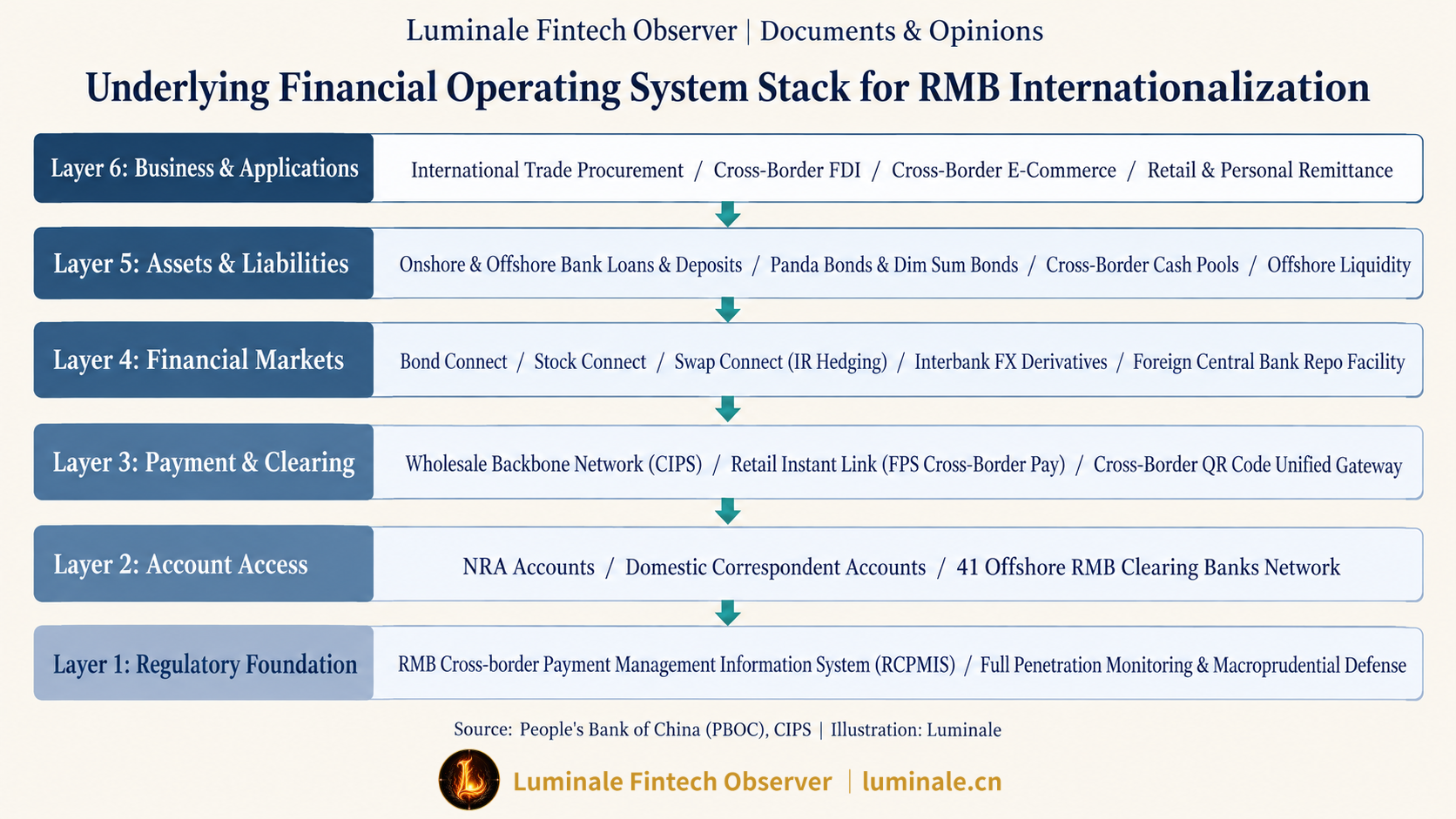
The RMB Internationalization Report (2026) illustrates multiple institutional and system arrangements supporting cross-border RMB use. These arrangements encompass liquidity provision, account access, payment clearing, retail links, and regulatory data:
1. Cross-Border Payment Infrastructure Will Maintain a Multi-Track Hybrid Form
Future cross-border payments will not converge on a single monolithic system, but will maintain specialized multi-track rails aligned with distinct transaction profiles:
- Large-Value Wholesale & Financial Settlement: CIPS remains the core backbone rail, expanding direct participant membership and deepening interoperability with global Real-Time Gross Settlement (RTGS) systems;
- Retail & SME Cross-Border Transfers: Account-to-account bilateral central bank connections via Payment Connect and unified QR code gateways support low-cost, instant retail settlement;
- Digital Currencies & Frontier Exploration: Exploration of Central Bank Digital Currencies (CBDC) continues to advance across global monetary authorities. As noted in the report's outlook, China is steadily advancing the use of the digital fiat currency (e-CNY) in cross-border payments.
2. Regulatory Infrastructure and Fund Flow Networks Evolve in Tandem
Cross-border infrastructure entails not only facilitating payment velocity, but ensuring regulatory visibility over capital flows.
The RMB Cross-border Payment Management Information System (RCPMIS) collects and manages cross-border RMB transaction data. As of June 2026, 362 corporate banking institutions and 81,000 users were connected to RCPMIS[1]. Commercial banks must report underlying transaction documentation and fund movement data in real time for cross-border transactions across current, capital, NRA, and CIPS accounts.
These transaction telemetry data enable regulatory authorities to monitor the direction, scale, and concentration risks of cross-border capital, providing empirical basis for evaluating the opening of capital accounts and offshore markets.
3. Financial Technology Can Lower Transaction Costs, but Cannot Dictate Monetary Credit
An objective assessment of currency internationalization recognizes that modern clearing rails, real-time message exchange, and unified QR gateways are ultimately technical tools that reduce transaction frictions and processing costs.
Financial technology can compress settlement windows and lower processing expenses, but technology alone cannot compel overseas institutions to hold a currency.
Widespread international acceptance ultimately depends on structural economic fundamentals and institutional credibility:
- The scale of real manufacturing output and commodity trade underpinning the currency;
- Long-term macroeconomic stability and legal predictability;
- The depth, liquidity, and accessibility of onshore financial markets;
- Institutional transparency, procedural convenience, and investor protections across capital account channels.
The RMB Internationalization Report (2026) demonstrates that foundational infrastructure and policy arrangements are steadily expanding. Whether cross-border RMB use continues to deepen will depend on underlying real trade and investment demand, alongside the broader financial market and institutional environment.
A currency's internationalization cannot be measured simply by whether it offers an alternative payment conduit. It depends on whether foreign corporations, financial institutions, and asset managers actively choose to incorporate that currency into their ongoing balance sheet management. Beyond executing receipts and disbursements, overseas entities must be able to hold, borrow, invest, hedge, and access reliable liquidity backstops within an integrated monetary network.
References
[1]: People's Bank of China (PBOC). (2026). RMB Internationalization Report (2026). http://www.pbc.gov.cn/ ↩
[2]: Hong Kong Monetary Authority (HKMA). (2025/2026). Operational Guidelines on the RMB Business Facility and Enhancement Measures. https://www.hkma.gov.hk/ ↩
[3]: People's Bank of China & Bank Indonesia. (2025). Joint Statement and Memorandum of Understanding on Establishing a Local Currency Transaction (LCT) Cooperation Framework. http://www.pbc.gov.cn/ ↩
[4]: Cross-border Interbank Payment System Co., Ltd. (CIPS Co.). (2025/2026). CIPS Business Rules and Participant Management Guidelines. https://www.cips.com.cn/ ↩
[5]: BIS Innovation Hub & Bank for International Settlements (BIS). (2024/2025). Project mBridge: Connecting economies through central bank digital currencies. https://www.bis.org/about/bisih/topics/cbdc/mcbdc_bridge.htm ↩
Originally published by Luminale Fintech Observer: https://luminale.cn/articles/rmb-internationalization-cross-border-financial-infrastructure-en