Electronic payments in Australia are widely adopted. According to the 2025 Consumer Payments Survey (CPS) published by the Reserve Bank of Australia (RBA), payment cards currently account for three-quarters of all consumer transactions; cash transactions have stabilized at around 15%; 43% of respondents used smartphones or wearable devices for contactless payments; and roughly half of respondents made payments using PayID over the past year[1].
From the perspective of consumer experience, this highly digitized market might appear to have completed the primary journey of payment modernization. However, the Payments System Board Annual Report 2026 released by the RBA demonstrates that regulatory and central bank priorities extend deeply into back-office infrastructure: how to safely decommission the legacy Bulk Electronic Clearing System (BECS), how real-time payment networks can support large-scale enterprise fund transfers, how core settlement engines can guard against systemic disruptions, why cross-border transactions face persistent friction despite domestic instant payments, and what forms of money should serve as final settlement assets amid financial asset tokenisation[2].
Once everyday consumer payments achieve basic digitization, the focal point of the payment and clearing system shifts to backend infrastructure: upgrading payment, clearing, and settlement rails, and managing structural migrations between legacy and modern systems.
1. Australia's Payment System Landscape
To understand the transformation of Australia's payment and clearing architecture, one can examine the end-to-end journey of funds from payer to payee. When money is deducted from a payer's account and credited to a payee as available funds, the transaction traverses multiple distinct stages: payment instrument submission, interbank message routing, clearing and netting, and final central bank account settlement.
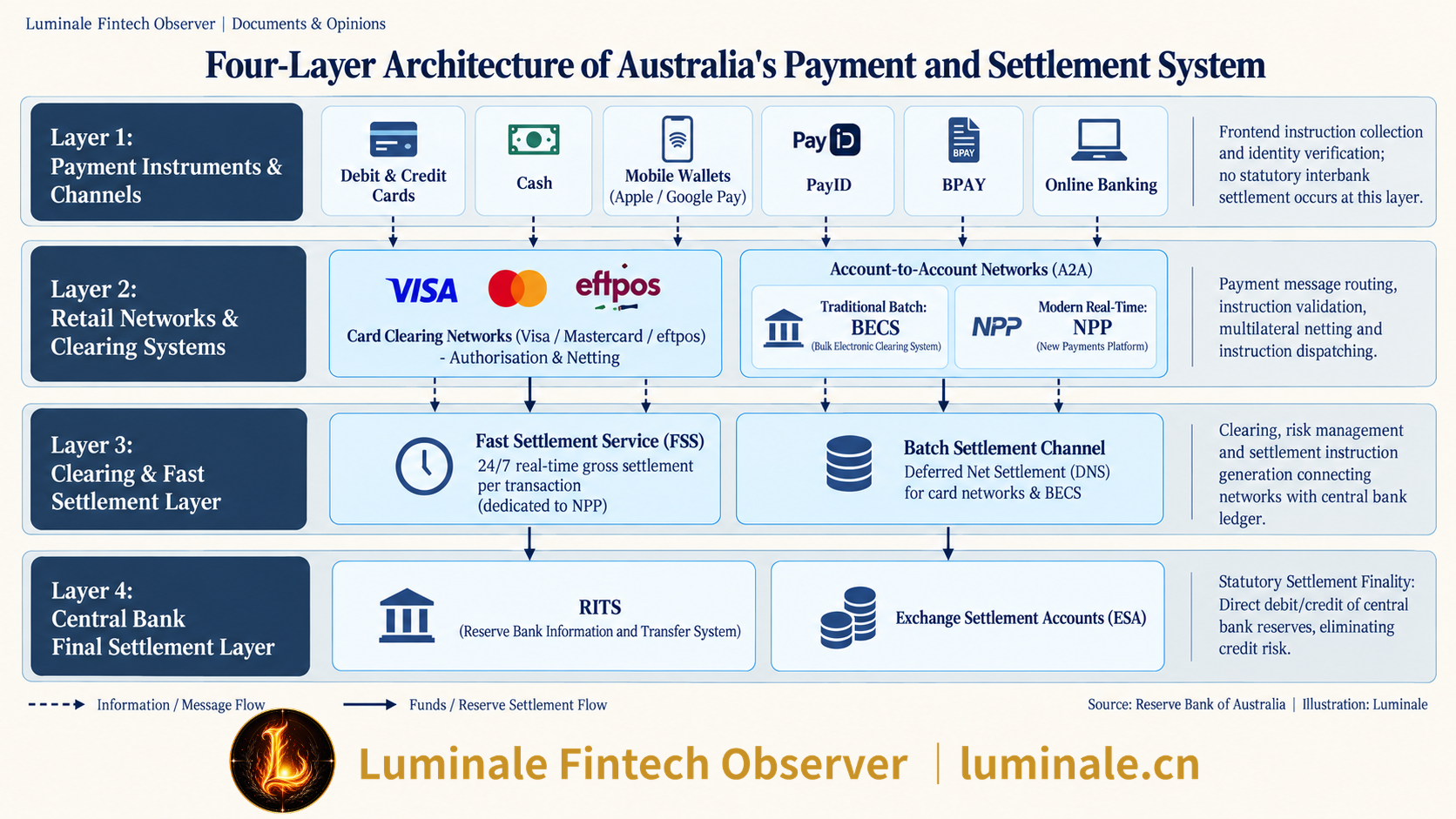
Under the Luminale payment infrastructure analytical framework, Australia's payment and settlement architecture can be organized into four core layers:
| System Layer | Core Components & Infrastructure | Business Scenarios & Functional Scope | Settlement Dependency & Mechanism |
|---|---|---|---|
| Layer 1: Payment Instruments & Channels | Debit cards, credit cards, cash, mobile wallets (Apple Pay / Google Pay), PayID, BPAY, online banking | Frontend touchpoints for consumers, businesses, and government entities to initiate payments; captures instructions and performs authentication | Relies on downstream clearing networks for message routing; does not execute statutory interbank settlement |
| Layer 2: Retail Payment Networks & Clearing Systems | Visa, Mastercard, eftpos (domestic debit network), Bulk Electronic Clearing System (BECS), New Payments Platform (NPP) | Inter-institutional message routing, instruction validation, fee calculation, and multilateral netting calculations | Card schemes and BECS generate net obligations; NPP dispatches instructions per transaction to the real-time settlement layer |
| Layer 3: Clearing & Fast Settlement Mechanisms | Fast Settlement Service (FSS) and batch settlement channels | FSS provides 24/7 real-time gross settlement per transaction dedicated to NPP; batch channels aggregate net obligations for card schemes and bulk files | FSS operates directly on RITS central bank reserve accounts; batch channels submit Deferred Net Settlement (DNS) requests to RITS |
| Layer 4: Central Bank Final Settlement Core | Reserve Bank Information and Transfer System (RITS), Exchange Settlement Accounts (ESA) | Australia's statutory Real-Time Gross Settlement (RTGS) system, administering the statutory reserves of all authorized institutions | Statutory Settlement Finality: Direct debiting and crediting of participant ESAs, providing central bank money settlement free of credit risk |
1. The Dual-Rail Operation of Retail Payment Instruments
The payment methods used daily by Australian consumers correspond fundamentally to two distinct clearing rails in the background:
The first is the card-based clearing network. This encompasses Visa, Mastercard, and Australia's domestic debit network, eftpos. When a consumer taps a card at a merchant terminal or uses Apple Pay linked to a payment card, transaction data is routed to the merchant acquirer and card scheme, followed by card issuer authorization. Final interbank fund settlement between the two commercial banks is deferred, netted, and cleared in aggregated batches.
The second is the Account-to-Account (A2A) direct transfer architecture. Historically, corporate payroll disbursements, recurring utility billings, and large-scale batch processing in Australia have relied primarily on BECS. Meanwhile, for peer-to-peer instant transfers and low-value retail transactions, the New Payments Platform (NPP) has progressively established itself as the core rail. Consumers initiate payments at frontend entry points using aliases such as mobile numbers or tax identifiers via PayID, while commercial bank backends resolve these proxies to underlying account numbers (BSB and account number) and execute fund transfers across associated standard deposit accounts.
2. Settlement Finality Manifested on the Central Bank Balance Sheet
Demand deposits recorded by commercial banks on customer ledgers represent accounting liabilities owed by the bank to its depositors. When Bank A's customer transfers 100 AUD to Bank B's customer, private bookkeeping between the two institutions cannot extinguish interbank credit risk. If Bank A promises to settle with Bank B at a later time, Bank B absorbs an interbank credit exposure against Bank A's potential insolvency. This principle was detailed in our previous article, After "Transfer Successful": Payment Instructions, Ledger Posting, and Funds Transfer Are Three Distinct Steps.
To eliminate this credit risk, interbank settlement must be conducted in default-free central bank money. All major commercial banks and regulated clearing houses operating in Australia maintain Exchange Settlement Accounts (ESAs) with the RBA.
When an interbank transfer takes place between two commercial banks, the underlying central bank reserves and commercial bank deposit liabilities adjust as follows:
| Balance Sheet Entity | Asset Side Adjustments | Liability Side Adjustments | Economic & Accounting Substance |
|---|---|---|---|
| Debtor Bank (Bank A) | ESA reserves held at the RBA −100 AUD | Payer's demand deposit account −100 AUD | The bank's external central bank claims decline; liabilities to the depositor contract equally, shrinking its balance sheet |
| RBA (Central Bank / RITS) | Total assets remain unchanged | Bank A's ESA reserves −100 AUD Bank B's ESA reserves +100 AUD | Central bank aggregate liabilities remain unchanged; statutory reserve ownership transfers between participant institutions |
| Creditor Bank (Bank B) | ESA reserves held at the RBA +100 AUD | Payee's demand deposit account +100 AUD | Available central bank reserves expand; deposit liabilities to the customer rise equally, expanding its balance sheet |
To enable 24/7 instantaneous settlement for low-value retail transactions while preserving the riskless nature of central bank accounting, the RBA deployed the Fast Settlement Service (FSS) directly within the RITS framework. Before regular operating hours close each day, commercial banks prefund dedicated FSS settlement sub-accounts by reallocating a portion of their daytime ESA reserves. During overnight hours or weekends when core RITS operations are closed, transactions initiated by retail customers over NPP using PayID trigger FSS to execute instantaneous, simultaneous debits and credits against the participating banks'central bank funds. Every individual NPP transfer achieves irrevocable statutory settlement finality in central bank money at the exact millisecond of delivery.
2. From BECS to NPP: The Migration of Payment Infrastructure
Australia already operates NPP and FSS to facilitate around-the-clock instant settlement. Why must the RBA and the industry continue to dedicate substantial resources to infrastructure modernization?
The challenge lies in the sheer complexity of migrating the backend ecosystem. Australia's A2A payment domain confronts a practical challenge: the legacy Bulk Electronic Clearing System (BECS) is slated for eventual decommissioning, yet migrating operational workflows established over decades to NPP incurs heavy software modernization and cross-industry coordination costs.
1. What Is BECS?
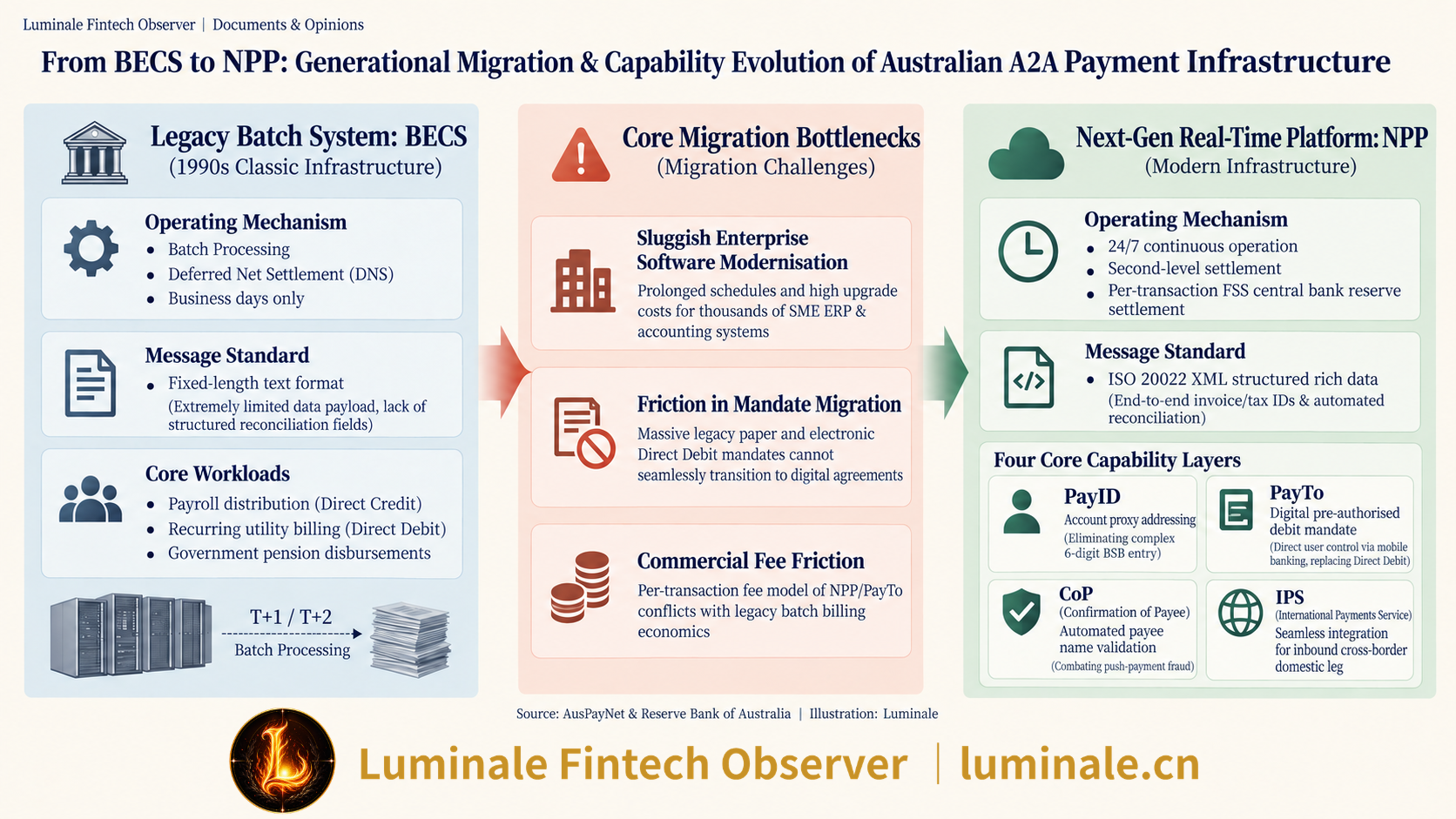
BECS was established in the early 1990s. Its architectural profile is characteristic of classic batch-processed Deferred Net Settlement (DNS). The system gathers packaged data files from participating financial institutions at designated cut-off times on business days, calculates multilateral net obligations, and submits net debit/credit requests to RITS during scheduled settlement windows.
Despite its legacy technical foundation, BECS continues to carry vital payment streams across Australia's commercial landscape:
- Corporate Payroll & Social Security: Millions of employees receive their weekly or fortnightly wages and superannuation contributions through corporate ERP systems generating Direct Credit files dispatched in batches to hundreds or thousands of recipients simultaneously;
- Utility & Periodic Bill Collections: Water, electricity, broadband, gym subscriptions, and mortgage repayments rely predominantly on Direct Debit protocols, where billing entities debit payer accounts on a scheduled basis under pre-authorized debit agreements;
- Government Welfare Disbursements: Massive social security and policy-driven payment transfers handled by agencies such as Services Australia.
These transactions do not demand sub-second latency, but depend heavily on batch throughput, low per-transaction processing costs, operational predictability, and automated accounting reconciliation. Software interfaces across thousands of small and medium-sized enterprises (SMEs), bank accounting cores, and commercial contractual payment authorizations have historically been engineered around BECS specifications.
2. What Upgrades Does NPP Bring?
Since launching in 2018, the NPP has introduced multiple foundational enhancements:
- PayID: Replaces cumbersome 6-digit Bank State Branch (BSB) codes and account numbers with intuitive aliases, reducing misdirected transfer rates;
- PayTo Agreements: Serving as the modern successor to traditional Direct Debit, PayTo enables businesses and consumers to establish digital pre-authorized debit agreements directly accessible within mobile banking apps. Consumers can view, pause, or amend payment mandates at any time, with funds settling instantly upon execution, structurally mitigating debit fraud and reconciliation disputes;
- Confirmation of Payee (CoP): Prior to confirming a transfer, the system automatically checks and displays the legal name associated with the destination account, preventing transfer errors and shielding users from Authorised Push Payment (APP) fraud;
- International Payments Service (IPS): Standardizes inbound foreign payment messages from correspondent networks, facilitating instant crediting for the last mile of international remittances entering Australia.
A critical divergence between NPP and BECS lies in messaging architecture. BECS utilizes legacy fixed-length character formats that carry minimal contextual data, occasionally requiring manual investigation by corporate recipients to match incoming funds with invoices. Conversely, NPP is natively engineered on the ISO 20022 Financial Messaging Standard.
Under ISO 20022 standards, payment instructions are encapsulated in structured XML hierarchies, accommodating comprehensive metadata including ultimate debtors, ultimate creditors, corporate tax identifiers, invoice details, and supply chain purchase order numbers. Enterprise accounting software can automatically process reconciliation and ledger matching without manual intervention.
3. Decommissioning BECS Takes Time
The Australian Payments Network (AusPayNet) and the banking industry originally targeted a complete retirement of BECS around 2030. However, the BECS Decommissioning Risk Assessment released by the RBA in 2025 and the 2026 Annual Report indicate that migration progress faces measurable headwinds[3].
Friction in migration stems primarily from multi-stakeholder coordination hurdles across the economy:
- Lagging SME ERP and Accounting Software Modernization: Enterprise management software utilized by hundreds of thousands of SMEs requires extensive interface redesigns to integrate with PayTo and NPP batch APIs, with third-party software vendors constrained by technical roadmaps and costs;
- Mandate Migration Complexities: Millions of active paper and electronic Direct Debit authorizations cannot be transitioned automatically to digital PayTo agreements without addressing legal, consent, and operational safeguards;
- Commercial Fee Structures: Certain smaller financial institutions and merchants report that per-transaction fee structures for NPP/PayTo exceed legacy flat-rate batch fees under BECS, dampening economic incentives to decommission legacy interfaces prematurely without regulatory mandates.
Building new infrastructure can be achieved in a matter of years; transitioning away from legacy infrastructure requires navigating entrenched legal relationships, commercial habits, and economy-wide software lifecycles.
3. Australia's Focus on Payment System Resilience, Cost, and Cash Accessibility
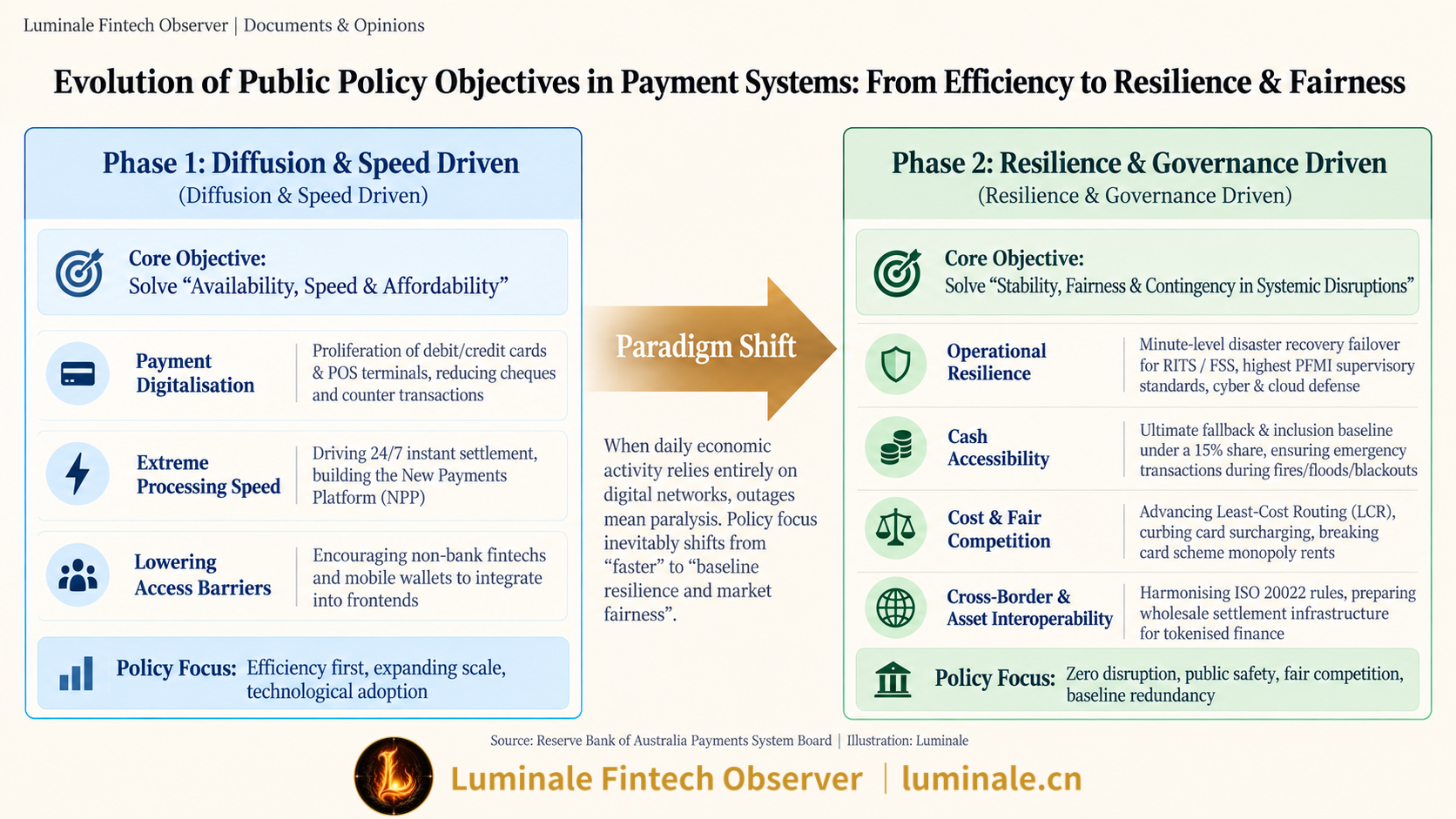
With Australia's payment landscape heavily digitized, the RBA's 2026 Annual Report examines critical imperatives beyond transaction speed, including operational resilience, card network costs and competition, and physical cash accessibility.
1. Operational Resilience of Core Clearing and Settlement Systems
In the era of paper cheques, a branch outage at a commercial bank rarely created broad systemic contagion. In today's interconnected digital environment, economic transaction velocity concentrates within a handful of systemic financial market infrastructures.
According to the Assessment of the Reserve Bank Information and Transfer System (RITS) 2026, core infrastructures such as RITS, FSS, and NPP are designated as Systemically Important Financial Market Infrastructures and are rigorously assessed against the Principles for Financial Market Infrastructures (PFMI) established by the Committee on Payments and Market Infrastructures (CPMI) and the International Organization of Securities Commissions (IOSCO)[4].
The Annual Report underscores that threats to operational continuity have evolved from isolated hardware failures into multifaceted operational challenges:
- Cloud and Third-Party Dependencies: As major commercial banks migrate core settlement components to cloud platforms, service interruptions across hyper-scale cloud vendors or major telecommunications carriers can quickly spill into payment execution layers;
- Cyber Risks: Distributed denial-of-service vectors, credential stuffing, and supply-chain compromises targeting real-time payment gateways are growing in sophistication;
- Operational Disruption During Upgrades: In environments where legacy platforms coexist with ongoing ISO 20022 message migrations, software defects during maintenance windows risk triggering system freezes.
Consequently, the RBA enforces stringent Business Continuity benchmarks for core infrastructure participants: primary and secondary operational data centers must maintain minute-level hot-standby failover capabilities, alongside structured fallback protocols during severe telecom outages. Preserving operational availability is treated as a foundational public policy objective on par with payment efficiency.
2. Maintaining Cash Accessibility Amid Declining Use
Findings from the 2025 Consumer Payments Survey reveal that cash transactions in Australia have dropped to roughly 15% of all consumer payments, with almost two-thirds of respondents identified as light or non-cash users.
Nevertheless, the RBA's Annual Report explicitly designates cash accessibility as a primary area for regulatory supervision.
Physical cash continues to fulfill two vital structural functions within modern economies:
- Financial Inclusion Baseline: Elderly citizens, regional and remote indigenous communities, and digital-disadvantaged groups rely heavily on physical notes for daily sustenance; withdrawing cash infrastructure prematurely risks economic exclusion;
- Disaster Resilience Fallback: Repeated natural disasters across Australia since 2020—including bushfires, severe floods, and widespread telecommunication outages that disable POS terminals and digital banking—demonstrate that offline physical banknotes remain the ultimate failsafe mechanism to sustain basic commerce and prevent social disruption.
The RBA is establishing regulatory standards directing major banks to maintain shared cash distribution arrangements, support retail ATM accessibility, and preserve local branch access, deploying targeted public intervention to safeguard regional cash networks where commercial models retreat.
3. Payment Card Costs and Market Competition
Although A2A payments continue to gain traction, payment cards represent the largest share of consumer spending in Australia. The cost of card transactions remains an active policy and market focus.
Australia has long maintained regulatory oversight of card payment surcharging, allowing merchants to pass on reasonable card acceptance costs to consumers to signal the cost differences across payment instruments. In practice, however, blanket surcharges imposed across major e-commerce platforms and merchants often mask the underlying payment rail used in digital wallets, dulling consumer awareness of instrument costs, dampening cash usage, and distorting competitive parity among payment service providers.
To address these distortions, the RBA expanded its Least-Cost Routing (LCR) reforms between 2025 and 2026. When a consumer uses a dual-network debit card (supporting both domestic eftpos and international Visa/Mastercard rails) physically or via mobile wallets, merchant acquiring systems can automatically route transactions through the lowest-cost clearing network. This regulatory measure checks the pricing power of international card schemes, underscoring that mature payment oversight prioritizes transaction friction, fair distribution of costs, and competitive balance.
4. Domestic Real-Time Capability vs. Cross-Border Payment Friction
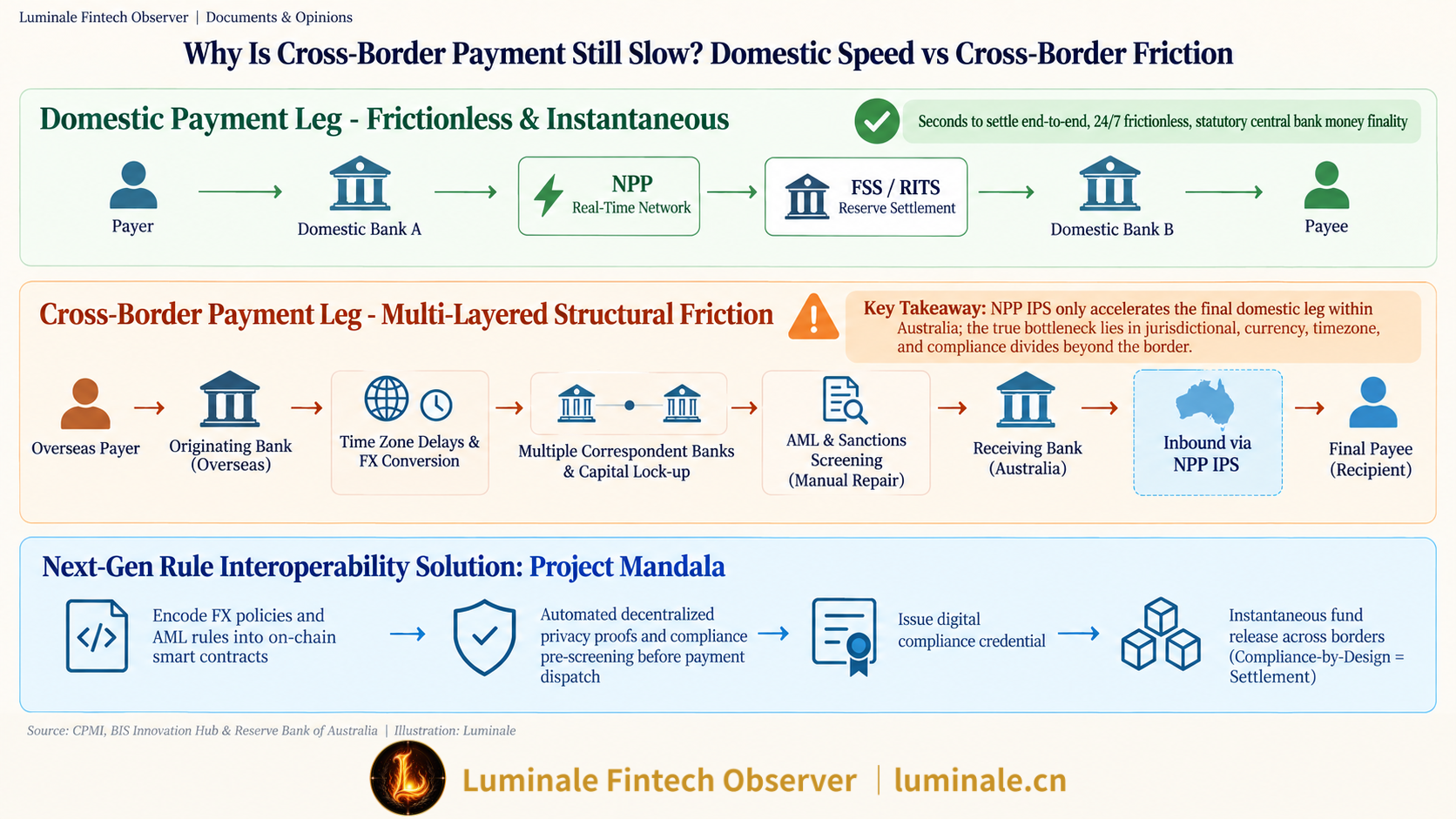
With the maturation of NPP and FSS, domestic fund transfers across Australian individuals and businesses settle within seconds, around the clock. Conversely, cross-border remittances can still require hours or days, carry opaque fees, and result in unexpected intermediary deductions upon receipt.
Why cannot domestic real-time processing capabilities translate directly into frictionless cross-border payments?
1. The Operational Scope of the NPP International Payments Service (IPS)
To interface with global cross-border payments, NPP introduced the International Payments Service (IPS). Structurally, however, IPS optimizes only the final domestic leg within Australian borders.
Under traditional correspondent banking, an incoming cross-border wire to Sydney that reaches an Australian correspondent bank outside normal business hours or over a weekend could stall until the next clearing day. NPP IPS allows authorized direct participants, upon receiving an incoming foreign Swift payment message and completing foreign exchange conversion, to inject funds directly into the NPP rail, utilizing FSS central bank reserves to credit the beneficiary within seconds, regardless of operating hours.
Yet, primary cross-border payment frictions arise before funds reach Australia.
Once funds cross national boundaries, they navigate fragmented sovereign environments:
- Operating Timezone and Liquidity Mismatches: Non-overlapping operational windows between originating foreign banks and Australian institutions prevent synchronized real-time RTGS settlement across respective central banks;
- Multi-Tier Correspondent Banking: Where counterparty institutions lack reciprocal accounts, payments must traverse multiple intermediary correspondent banks, with each participant deducting processing fees and tying up daylight liquidity;
- Fragmented AML and Sanctions Screening: Jurisdictional variations in Anti-Money Laundering (AML), Counter-Terrorism Financing (CFT), and sanctions compliance lists mandate independent reviews at each intermediary hop.
2. ISO 20022 Enhances Data Transmission
Global banking is accelerating the migration to ISO 20022 to address data deficiencies in cross-border messaging.
Legacy Swift MT messages enforce rigid character constraints (such as text truncation in MT103 fields), which often forces remitters to compress commercial descriptions, invoices, and entity identifiers into unstructured abbreviations. Intermediary compliance screening engines encountering truncated strings routinely trigger false-positive AML alarms, suspending transactions for labor-intensive manual repair.
With Australian payment systems fully adopting ISO 20022, messages standardize rich structured fields, including Legal Entity Identifiers (LEI), structured addresses, and uncompressed remittance data. Automated compliance engines can validate transactions in real time, drastically curbing false positives, exceptions, and rejections.
3. Project Mandala Explores Automated Cross-Border Compliance
Standardized messaging formats ensure clear data transmission, but do not harmonize regulatory discrepancies across borders. Different jurisdictions maintain distinct foreign exchange regulations, cross-border reporting thresholds, and capital control mandates.
To address these hurdles, the RBA collaborated with the BIS Innovation Hub Singapore Centre, the Monetary Authority of Singapore (MAS), the Bank of Korea (BOK), and Bank Negara Malaysia (BNM) on Project Mandala[5].
Project Mandala deploys a decentralized compliance engine embedded above distributed ledger infrastructure. It encodes complex, manual jurisdictional foreign exchange policies and AML screening rules into on-chain smart contract protocols. Before a financial institution dispatches cross-border funds, the Mandala architecture verifies compliance constraints across both jurisdictions using privacy-preserving zero-knowledge proofs and issues digital compliance credentials.
Project Mandala demonstrates a viable model for cross-border regulatory harmonization: engineering interoperability layers across currencies, legal frameworks, and financial market infrastructures that automatically interpret and enforce jurisdictional rules. Faster messaging rails alone cannot eliminate regulatory divergence.
5. From CBDC to Project Acacia: Digital Money and Wholesale Settlement
Australia's digital currency research has undergone an important pivot in recent years. Early discussions around Central Bank Digital Currencies (CBDCs) focused predominantly on retail digital cash wallets for consumers; the RBA has since turned its strategic attention to wholesale settlement infrastructure.
1. Why Australia Does Not Urgently Require a Retail CBDC
In the Payments System Board Annual Report 2026, the RBA reiterated its earlier findings conducted in partnership with the Digital Finance Cooperative Research Centre (DFCRC): introducing a general-purpose retail CBDC in Australia lacks a compelling public interest justification at this stage[6].
This assessment is grounded in the operational realities of the Australian retail market:
- Consumers enjoy access to a diverse, low-cost suite of digital payment instruments, with contactless card and mobile wallet penetration among the highest globally;
- The NPP provides around-the-clock, sub-second interbank retail fund transfers, settling per transaction in central bank money via the FSS;
- Commercial bank deposits are supported by the statutory Financial Claims Scheme (FCS), which guarantees deposits up to 250,000 AUD per depositor per institution, sustaining public confidence in commercial bank money.
Against an existing domestic framework characterized by efficiency and robust competition, launching a retail CBDC platform would entail substantial public expenditure while creating financial disintermediation risks—namely, during market turbulence, depositors could rapidly migrate commercial bank deposits into risk-free digital central bank liabilities, undermining the banking system's credit provision capacity.
Consequently, retail CBDC has been de-prioritized.
2. Project Acacia Focuses on Wholesale Markets
In wholesale financial markets, however, the structural requirements are markedly different.
Initiated in late 2025 and delivering key findings through 2026, Project Acacia represents the RBA's strategic focus on wholesale tokenised asset markets[7]. The initiative is executed in collaboration with the DFCRC, the Australian Treasury, Tier-1 commercial banks, and core financial market infrastructure operators.
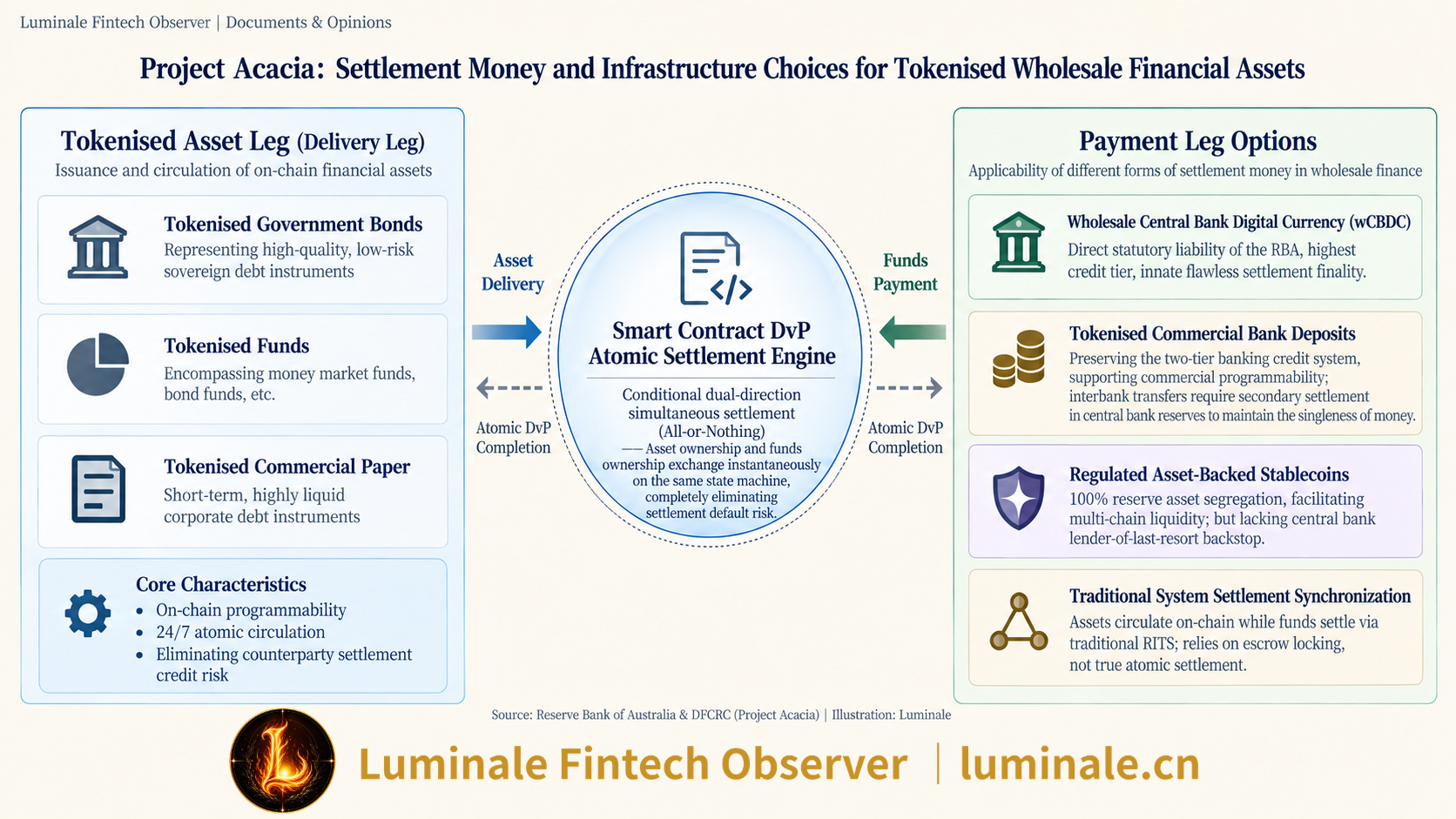
Project Acacia investigates a targeted foundational question: As capital market assets (sovereign bonds, corporate debt, investment funds, and commercial paper) progressively transition to distributed ledger technology (DLT) architectures for issuance, custody, and secondary trading, what forms of digital money should execute final wholesale settlement?
In legacy capital markets, securities clearing systems implement Delivery versus Payment (DvP) mechanisms to tightly bind securities transfer (the delivery leg) with central bank reserve postings (the payment leg), eliminating counterparty principal settlement risk. If the securities leg transitions to an on-chain, programmable token available for 24/7 continuous transfer, but the payment leg remains locked in traditional daytime batch clearing systems, market settlement structures become fragmented.
3. What Form of Money Should Settle Tokenised Financial Assets?
Project Acacia established simulation testbeds to evaluate and stress-test four distinct forms of digital settlement money:
| Settlement Asset Model | Issuing Authority & Legal Ownership | Legal Classification & Credit Tier | Value Proposition for Wholesale Tokenised Assets | Mechanism Constraints & Challenges |
|---|---|---|---|---|
| Wholesale Central Bank Digital Currency (wCBDC) | Direct digital liability token issued by the RBA | Highest statutory tier; equivalent to central bank reserves; zero credit risk | Enables programmable DvP atomic settlement natively on shared ledgers; uncompromised statutory finality | Central bank must operate or govern on-chain ledger protocols; risks crowding out traditional commercial bank interbank roles |
| Tokenised Commercial Bank Deposits | Tokenised deposit liabilities issued on permissioned ledgers by authorized banks | Commercial bank liabilities governed by prudential capital and liquidity standards | Preserves the two-tier banking architecture and credit intermediation; executes enterprise smart contracts natively | Interbank circulation faces the singleness of money challenge: Bank A tokens and Bank B tokens require secondary reserve settlement at the central bank level to maintain par value equivalence |
| Regulated Asset-Backed Stablecoins | Issued by prudentially regulated non-bank trusts or specialized entities | Backed 100% by segregated central bank reserves or high-quality liquid assets (HQLA) | Flexible multi-chain issuance; provides cross-platform liquidity pricing and settlement medium | Lacks direct access to central bank emergency liquidity facilities (Lender of Last Resort); vulnerability to run risk during stress |
| Settlement Synchronization with Legacy Systems | Tokenised asset circulates on-chain; cash leg settles via traditional RITS | Conventional central bank reserve debit/credit entries | Requires no new statutory tokens; introduces minimal disruption to current banking law and central bank balance sheets | Cannot achieve true on-chain atomic settlement; relies on centralized escrow locking arrangements, introducing latency |
The experimental findings of Project Acacia demonstrate that a single monetary form is unlikely to dominate every wholesale use case. A wholesale CBDC issued by the central bank serves as foundational systemic infrastructure, guaranteeing atomic finality across systemic capital market transactions. Meanwhile, tokenised commercial bank deposits offer high institutional adaptability for corporate treasury and ongoing commercial flows, allowing enterprises to benefit from programmable workflow automation while preserving existing banking relationships and credit expansion mechanisms.
This aligns closely with the international trajectory pursued by the Bank for International Settlements (BIS) under Project Agorá and the Hong Kong Monetary Authority (HKMA) under Project Ensemble. The analytical framing of digital currencies has matured: digital money is no longer treated as an external speculative crypto-asset designed to displace statutory currencies, but as an indispensable technological instrument integrated by central banks to underpin the next generation of wholesale tokenised financial infrastructure.
6. Four Observations
The RBA's 2026 Annual Report and accompanying policy initiatives highlight four structural observations relevant across modern payment jurisdictions.
Observation 1: Payment Modernization Hinges on Migrating Legacy Ecosystems Rather Than Building New Platforms
The deployment of the NPP proves that technical blueprints for modern real-time payment networks are mature. The true operational complexity lies in coordinating thousands of enterprises, third-party software developers, commercial banks, and entrenched institutional users to migrate away from legacy architectures operational for decades.
The BECS decommissioning process underscores that upgrading financial infrastructure is not merely an IT enhancement, but an extensive socio-economic coordination effort spanning legal authorizations, commercial economics, and software investment lifecycles.
Observation 2: Beyond Extreme Speed, Systemic Operational Resilience Becomes Paramount
When payment networks were manual, efficiency and speed were primary design metrics. In an era where economy-wide commerce relies continuously on a few integrated digital networks, transaction speed is no longer scarce; the continuous availability and disaster failover capacity of core rails form the primary line of defense for financial stability.
This explains why physical cash access must be protected even as its market share stabilizes around 15%. Transaction frequency reflects commercial preferences, whereas systemic availability during outages represents a foundational public interest. A robust payment system requires deliberate structural redundancy alongside transaction efficiency.
Observation 3: Cross-Border Modernization Demands Cross-Jurisdictional Regulatory Interoperability
In an era of fiber-optic networks, transmitting an electronic payment payload from Sydney to Singapore or London requires merely milliseconds. Real-world friction arises from regulatory divergence: foreign exchange controls, disjointed AML verification procedures, and fragmented correspondent bank clearing arrangements.
While ISO 20022 standardizes data syntax, initiatives such as Project Mandala demonstrate that the next breakthrough in cross-border efficiency lies in automating regulatory and compliance checks across legal boundaries. Sustainable cross-border payment efficiency depends on establishing programmable interoperability layers capable of parsing and executing sovereign compliance rules automatically.
Observation 4: Digital Currency Evolution Has Shifted Strategically to Wholesale Financial Settlement
The cooling of speculative enthusiasm around retail CBDC has not diminished the technological importance of digital currencies; rather, it has guided research back to its foundational domain: wholesale financial market settlement.
As explored in Project Acacia, as debt instruments, investment funds, and alternative assets transition to tokenised on-chain environments, the financial architecture demands a synchronized digital cash leg capable of atomic execution. The true transformation of digital money lies not in consumer retail apps, but in how wholesale central bank digital liabilities, tokenised deposits, and regulated stablecoins collaborate to extinguish settlement risk and establish absolute legal finality in modern capital markets.
References
[1]: Reserve Bank of Australia. (2026). Consumer Payment Behaviour in Australia: Findings from the 2025 Consumer Payments Survey. RBA Bulletin, May. https://www.rba.gov.au/publications/bulletin/2026/may/consumer-payment-behaviour-in-australia.html ↩
[2]: Reserve Bank of Australia. (2026). Payments System Board Annual Report 2026. https://www.rba.gov.au/publications/annual-reports/psb/2026/ ↩
[3]: Reserve Bank of Australia. (2025). BECS Decommissioning Risk Assessment and Migration Issues. Payments and Infrastructure Publications. https://www.rba.gov.au/payments-and-infrastructure/resources/publications/ ↩
[4]: Reserve Bank of Australia. (2026). Assessment of the Reserve Bank Information and Transfer System (RITS) 2026. Financial Stability and FMI Oversight. https://www.rba.gov.au/payments-and-infrastructure/rits/ ↩
[5]: Bank for International Settlements (BIS) Innovation Hub, Reserve Bank of Australia, Bank of Korea, Bank Negara Malaysia, & Monetary Authority of Singapore. (2024). Project Mandala: Automating compliance for cross-border payments. https://www.bis.org/publ/othp80.htm ↩
[6]: Reserve Bank of Australia & Digital Finance Cooperative Research Centre (DFCRC). (2023). Australian Central Bank Digital Currency: Project Report. https://www.rba.gov.au/payments-and-infrastructure/central-bank-digital-currency/ ↩
[7]: Reserve Bank of Australia & Digital Finance Cooperative Research Centre (DFCRC). (2025/2026). Project Acacia: Exploring digital money and settlement infrastructure for wholesale tokenised asset markets. https://www.rba.gov.au/payments-and-infrastructure/tokenised-money/project-acacia/ ↩
Originally published by Luminale Fintech Observer: https://luminale.cn/articles/reading-rba-payments-system-board-annual-report-2026-en