When observing fintech and payment systems, consumer-facing mobile payment apps, crypto assets, or tokenisation pilots often capture the spotlight. Yet from a central bank's perspective, the core pillar determining fund circulation efficiency and financial stability is always the underlying payment, clearing, and final settlement infrastructure.
In April 2026, the Bank of Korea (BOK) published the Korean edition of its Payment and Settlement Systems Report 2025, followed recently by the official English release[1]. The report compiles operating data for Korea's various payment and settlement systems throughout 2025, detailing the central bank's concrete measures in wholesale system maintenance, cross-border foreign exchange clearing reform, central bank digital currency (CBDC) pilots, and regulatory arrangements for Korean Won (KRW) stablecoins.
Across the report, the Bank of Korea's underlying logic builds firmly on the existing commercial banking system and central bank reserve settlement. On one hand, it extends operating hours for the wholesale settlement system and reaches cross-border channels for the Korean Won; on the other hand, it establishes technical interfaces and regulatory boundaries to integrate tokenised deposits, CBDCs, and compliant stablecoins with existing financial market infrastructure.
1. What Is This Annual Report Observing in Korea's Payment System?
When examining Korea's payment and settlement systems, one must first identify the Bank of Korea's statutory responsibilities in financial market infrastructure (FMI). Within the domestic payment ecosystem, the central bank fulfills three core roles:
- System Operator: Directly develops and operates the nation's real-time gross settlement (RTGS) system for large-value interbank funds transfers—BOK-Wire+;
- System Overseer: In accordance with statutory mandates, exercises macroprudential oversight and liquidity risk monitoring over systemically important payment systems (SIPS), retail clearing institutions, securities settlement systems, and participating financial institutions;
- Change Catalyst: Coordinates with commercial banks, non-bank financial institutions, and international organizations to advance ISO 20022 messaging standard migration, cross-border linkages, and regulatory frameworks for emerging digital assets.
In daily life, consumers rely on Kakao Pay, Naver Pay, Toss, mobile banking apps, or point-of-sale credit card terminals at the front end of the payment service chain. These client applications facilitate payment instruction initiation and authentication. When funds move between accounts at different institutions, intermediate retail clearing networks handle instruction routing and multilateral netting, culminating in irrevocable settlement across reserve accounts at the Bank of Korea.
Understanding the entire report requires tracing the settlement hierarchy: Payment Instruments & Front-End Instructions → Retail Payment & Clearing Systems → Securities & FX Settlement → Central Bank Large-Value RTGS (BOK-Wire+) & Reserve Accounts.
The report records comprehensive operational metrics and policy actions, detailing how Korea's financial infrastructure manages liquidity allocation and mitigates settlement risk amid capital market volatility, transaction surges, and cross-border payment demands.
2. Basic Architecture of Korea's Payment, Clearing, and Final Settlement System
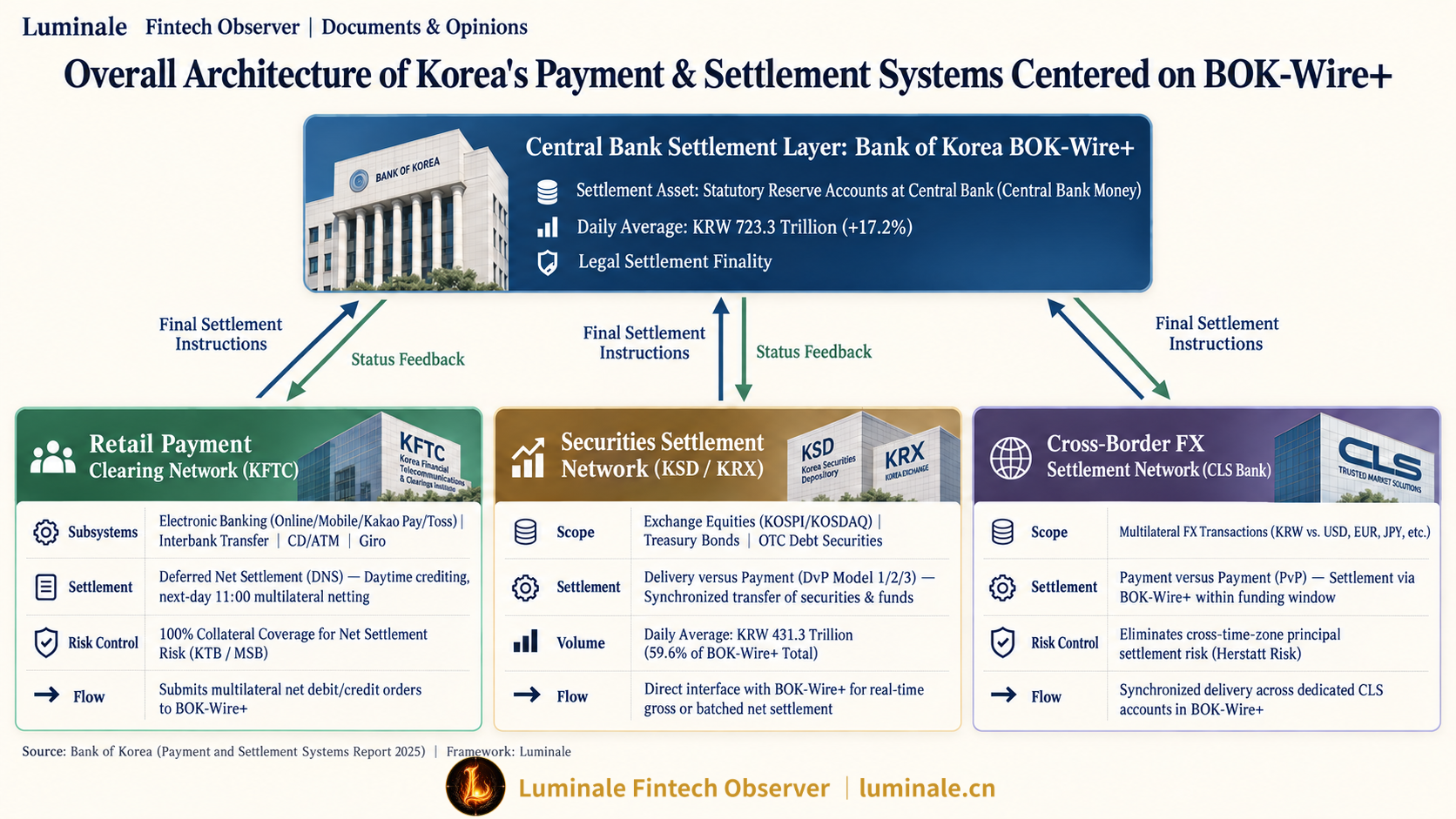
Korea's payment, clearing, and settlement architecture comprises four primary pillars: central bank large-value payments, retail payments, securities settlement, and foreign exchange settlement.
1. BOK-Wire+
The central hub for wholesale and final settlement is BOK-Wire+, operated directly by the Bank of Korea. Launched in 1994 as a pure RTGS system, it was upgraded in 2009 to a hybrid settlement system incorporating continuous bilateral offsetting and queuing optimization algorithms, achieving settlement finality while economizing daytime reserve holdings for commercial banks[2].
Official data reveals that in 2025, daily average transactions settled via BOK-Wire+ reached KRW 723.3 trillion, representing a year-over-year increase of 17.2%[3].
| Transaction Type | 2025 Daily Average (KRW Trillion) | YoY Change | Share of Total Settlement | Underlying Business & FMI Linkage |
|---|---|---|---|---|
| Securities Transactions | 431.3 | +20.7% | 59.6% | Inter-institutional equity and debt settlement linked to KSD via Delivery versus Payment (DvP) |
| Customer Transactions | 90.1 | +7.6% | 12.5% | Interbank client fund transfers settling multilateral net positions calculated by KFTC |
| Call Transactions | 33.1 | +15.1% | 4.6% | Short-term interbank money market funding adjustments and loan repayments |
| Foreign Exchange Transactions | 25.5 | +30.6% | 3.5% | Cross-border FX principal settlement linked to CLS Bank via Payment versus Payment (PvP) |
| Other Inter-system & Government Transfers | 143.3 | +11.8% | 19.8% | Treasury revenue/expenditures, open market operations, and central bank lending facilities |
| Total BOK-Wire+ | 723.3 | +17.2% | 100.0% | Total statutory highest-tier final settlement in Korea |
This breakdown reveals a structural reality often overlooked: securities settlement accounts for nearly 60% of all funds settled through BOK-Wire+ (KRW 431.3 trillion daily), whereas customer transfers and retail settlements account for 12.5% (KRW 90.1 trillion daily). Consequently, the operating window and liquidity mechanisms of BOK-Wire+ directly underpin financial stability in Korea's capital markets.
2. Division of Labor and Interlinkages Across Korea's Core Payment and Clearing Systems
Across Korea's financial ecosystem, distinct categories of transactions are collected, validated, and netted by dedicated financial market infrastructures before being channeled to BOK-Wire+ for final settlement.
The division of labor and operational interlinkages across Korea's core payment and clearing systems are structured as follows:
| Settlement Domain | Operator | Core Subsystems | Scope & Business Scenarios | Settlement Connection to BOK-Wire+ |
|---|---|---|---|---|
| Large-Value Payments | Bank of Korea (BOK) | BOK-Wire+ | Interbank call loans, government treasury receipts/disbursements, open market operations, cross-system final settlement | Operated in-house; debits and credits commercial banks'reserve accounts directly |
| Retail Payments | Korea Financial Telecommunications & Clearings Institute (KFTC) | Electronic Banking Network Interbank Funds Transfer CD/ATM Network Giro System | Retail/corporate online banking, mobile banking, non-bank fintech wallets (Kakao Pay, etc.), interbank ATM withdrawals, utility bill payments | Deferred Net Settlement (DNS): Intra-day crediting to clients; KFTC submits netted settlement obligations to BOK-Wire+ at 11:00 next business day |
| Securities Settlement | Korea Securities Depository (KSD) & Korea Exchange (KRX) | Securities Settlement System | Exchange-traded equities (KOSPI/KOSDAQ), government bonds, OTC debt securities | Delivery versus Payment (DvP): KSD manages securities ownership transfers and triggers simultaneous funds transfers via BOK-Wire+ dedicated interface |
| Multilateral FX Settlement | Continuous Linked Settlement (CLS Bank) & domestic banks | CLS Settlement Network Domestic FX Payment Network | Cross-border FX trading (KRW against USD and other major currencies), interbank foreign currency transfers | Payment versus Payment (PvP): Settlement members fund KRW positions in BOK-Wire+ within funding windows, ensuring simultaneous multi-currency settlement |
(1) Retail Payment System: Core Networks Operated by KFTC
Retail payment clearing in Korea is primarily handled by the Korea Financial Telecommunications & Clearings Institute (KFTC).
KFTC operates several specialized, independent retail clearing networks:
- Electronic Banking Network: The backbone of retail payments, supporting online banking, mobile banking, firm banking for corporates, and account-linked funding for non-bank payment providers (Kakao Pay, Naver Pay, Toss) with 24/7 instant crediting.
- Interbank Funds Transfer System: Primarily handles small-value interbank wire transfers initiated over commercial bank branch counters.
- CD/ATM Network: Enables cardholders to execute cash withdrawals, fund transfers, and balance inquiries across any domestic bank or convenience store ATM using debit cards.
- Giro System: Processes recurring public utility bills, municipal taxes, telecom charges, and insurance premiums via bulk direct debits and credit transfers.
- Card Clearing Network: KFTC manages interbank routing for debit card transactions, while dedicated card network processors handle credit card merchant authorization consolidation and settlement.
KFTC does not hold statutory reserve accounts at the central bank. Legally and operationally, it functions as a telecommunications routing and multilateral netting clearing agency. During each business day, KFTC tracks reciprocal receivables and payables among participating banks, submitting consolidated multilateral net positions to the Bank of Korea for final reserve account debiting and crediting at scheduled times.
(2) Securities Settlement System: KSD and Capital Market DvP Mechanisms
The Korea Exchange (KRX) conducts centralized order matching for equities and derivatives, while the custody, book-entry, and settlement of all equities and fixed-income securities are administered by the Korea Securities Depository (KSD).
Securities settlement comprises two complementary components: the transfer of securities ownership between investor accounts (the securities leg) and the corresponding transfer of funds between buyer and seller banks (the cash leg).
KSD maintains a dedicated, direct electronic interface with BOK-Wire+, supporting multiple Delivery versus Payment (DvP) mechanisms:
- Institutional OTC Bond Transactions (DvP Model 1): Operating on a gross-gross basis, BOK-Wire+ executes real-time gross debiting and crediting of reserve accounts simultaneously with KSD's gross book-entry securities transfer, eliminating principal risk.
- Exchange-Traded Equities and Government Bonds (DvP Model 2 / Model 3): Securities legs settle on either a gross or net basis, while net cash obligations calculated by KSD are settled via BOK-Wire+'s batch hybrid settlement facility at designated cut-off times.
In 2025, securities transactions represented nearly 60% of BOK-Wire+'s daily turnover, demonstrating the profound interdependence between capital market settlement and central bank liquidity facilities.
(3) Foreign Exchange Settlement System: CLS and Cross-Time-Zone PvP Settlement
Cross-border foreign exchange transactions inherently span different sovereign currencies and operating time zones, introducing settlement risk (Herstatt risk) if one counterparty pays out its currency leg but fails to receive the counter-currency due to bank failure or time-zone delays.
Korea connected the Korean Won to Continuous Linked Settlement (CLS Bank) in 2004. Under this multilateral settlement arrangement:
- Domestic CLS settlement member banks transfer required KRW liquidity to CLS's dedicated settlement account at the Bank of Korea via BOK-Wire+ during morning settlement windows in Seoul.
- Once CLS verifies that KRW funds and the corresponding USD, EUR, or JPY funds have arrived at respective central banks, it executes synchronized debits and credits on its internal ledger, achieving Payment versus Payment (PvP).
- If either currency fails to settle within the designated window, the transaction is withheld, protecting both counterparties from unilateral loss of principal.
Through BOK-Wire+, KFTC's net retail balances, KSD's securities settlements, and CLS's foreign exchange obligations converge onto the Bank of Korea's reserve ledger for final, irrevocable settlement.
3. Net Settlement Collateral Requirement Raised to 100%
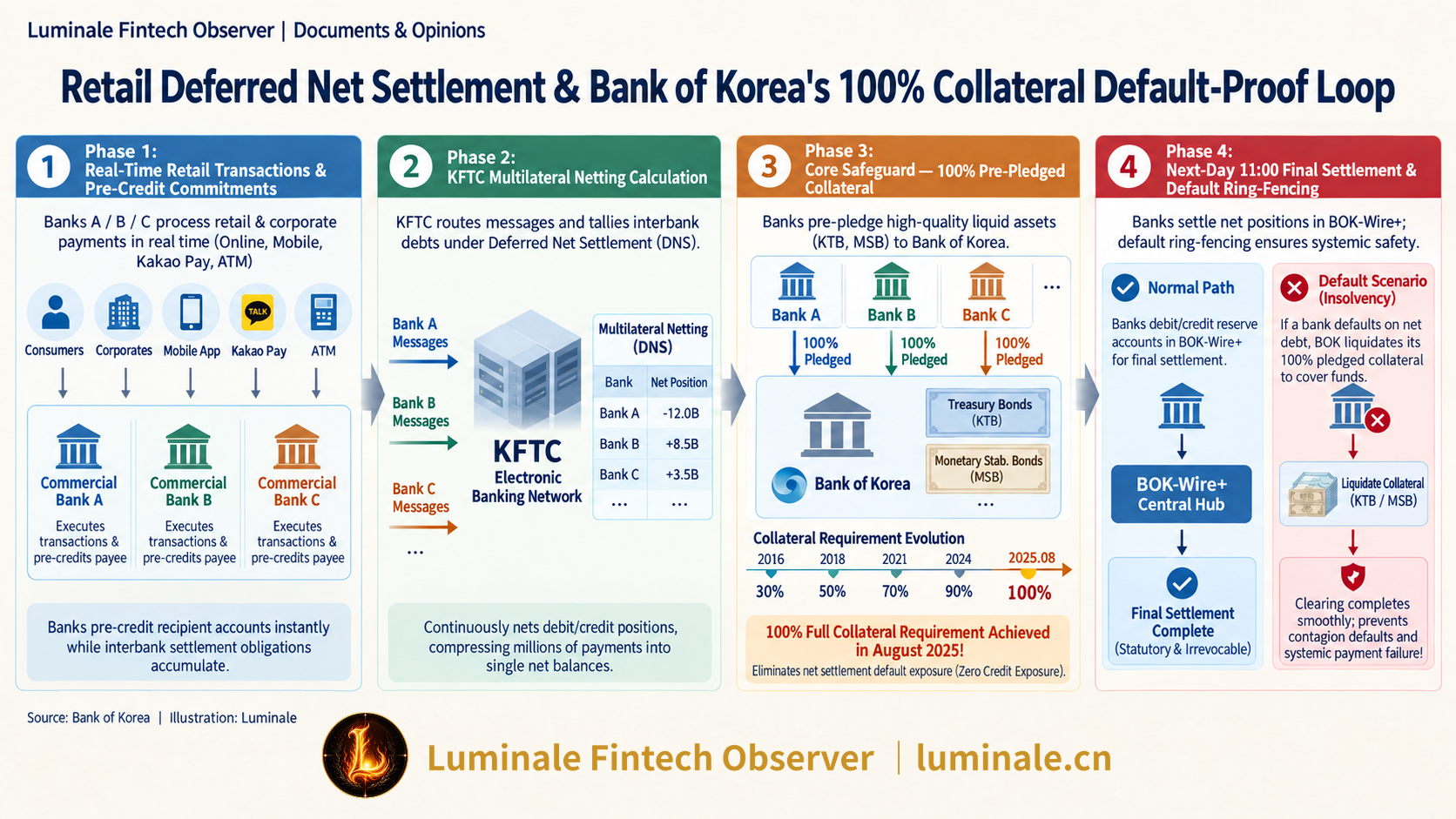
In KFTC-operated retail systems, transaction volumes reach tens of millions of payments each day. If every retail payment were settled individually on a gross basis through BOK-Wire+, commercial banks would face severe daytime liquidity constraints. Therefore, KFTC employs Deferred Net Settlement (DNS): banks credit beneficiary customer accounts intra-day in real time, and settle their net multilateral positions at the Bank of Korea at 11:00 on the following business day.
The fundamental structural hazard of deferred net settlement is credit settlement risk. If a participating bank credits incoming client transfers during the day but experiences an acute liquidity collapse overnight, rendering it unable to meet its net debit obligation at the central bank the next morning, the entire multilateral netting scheme fails to balance, threatening systemic gridlock.
To insulate the system against contagion, the Bank of Korea embarked on a phased policy in 2016 to progressively raise the Net Settlement Collateral Ratio, requiring participants to pledge high-quality liquid assets—specifically Korea Treasury Bonds (KTBs), Monetary Stabilization Bonds (MSBs), and policy bank bonds.
The Payment and Settlement Systems Report 2025 confirmed that in August 2025, the Bank of Korea officially raised the net settlement collateral requirement from 90% to 100%[4].
This reform guarantees that if a participant defaults at settlement, the central bank can immediately liquidate its pre-pledged collateral to cover the deficit, insulating the retail clearing system from credit loss and extinguishing counterparty default contagion.
3. Upgrades to Traditional Wholesale Payment Infrastructure
Beyond recurring statistics, the Payment and Settlement Systems Report 2025 devotes considerable attention to three major infrastructural overhauls: extending BOK-Wire+ operating hours, establishing an offshore KRW clearing framework, and migrating domestic systems to international messaging standards.
1. Extending BOK-Wire+ Operating Hours
In March 2026, the Bank of Korea implemented extended operating hours for BOK-Wire+, pushing the daily system closing from 17:30 to 20:00. This measure directly complements Korea's capital market initiative to lengthen domestic foreign exchange trading hours[5].
In cross-border finance, clearing window availability governs settlement efficiency:
- If a central bank's RTGS system closes in the late afternoon, overseas institutions operating in European and American time zones cannot access same-day final settlement in the domestic currency through correspondent banks.
- Foreign institutional investors trading Korean securities frequently had to park settlement funds in offshore clearing banks overnight, elevating cross-time-zone exposures and impeding the inclusion of Korean Treasury Bonds in global benchmarks such as the FTSE World Government Bond Index (WGBI).
Extending BOK-Wire+'s operating window bridges international trading hours, dramatically reducing settlement float and counterparty risk for cross-border transactions.
2. Developing the Offshore KRW Settlement System (BOK-Wire Int)
Historically, the Korean Won has been managed with cautious capital account controls, with offshore entities accessing KRW primarily via trade-related accounts or restricted non-resident facilities. As foreign investor participation in Korea's capital markets expands, international demand to hold and settle KRW directly has increased.
The report reveals that the Bank of Korea is actively developing a dedicated infrastructure tentatively designated BOK-Wire Int, scheduled to become operational in 2027[6].
BOK-Wire Int serves as an offshore interface layer integrated with BOK-Wire+:
- It permits eligible Registered Foreign Institutions (RFIs) to interface directly with the KRW settlement infrastructure via standardized messaging;
- Within a macroprudential framework, it provides a transparent, direct account-holding and settlement channel for offshore KRW transactions and interbank clearing.
This initiative systematically extends Korea's sovereign currency settlement architecture beyond domestic physical boundaries to global institutional participants.
3. Migration to the ISO 20022 Messaging Standard
Upgrading BOK-Wire+ and interconnecting BOK-Wire Int require a shared financial language—specifically the ISO 20022 messaging standard.
Traditional legacy formats, such as SWIFT MT text messages, have constrained field capacities. Essential metadata—including originator addresses, invoice numbers, ultimate beneficial owners, and regulatory screening codes—are frequently crammed into unstructured narrative fields. This creates high straight-through processing (STP) failure rates and escalates compliance costs for anti-money laundering (AML) verification and automated reconciliations.
The Bank of Korea confirmed it is executing a phased transition of domestic wholesale payment messaging to ISO 20022 (MX messages). Standardized, rich data dictionaries will reduce friction when domestic institutions interact with the global SWIFT network, while providing consistent data architecture for future interfaces between traditional clearing networks and tokenised asset platforms.
4. Next-Generation Payment Methods and Interface Pilots
Alongside traditional system upgrades, Chapter IV of the Payment and Settlement Systems Report 2025 reviews the central bank's initiatives across cross-border retail payments, multilateral CBDC bridges, tokenised deposits, and stablecoins.
These projects address a fundamental institutional question: As new digital asset representations and payment instruments emerge, how can the central bank design technical interfaces and regulatory boundaries to integrate them securely into the regulated financial system?
1. Cross-Border Retail Interlinkage: Korea–Indonesia Cross-Border QR Payments
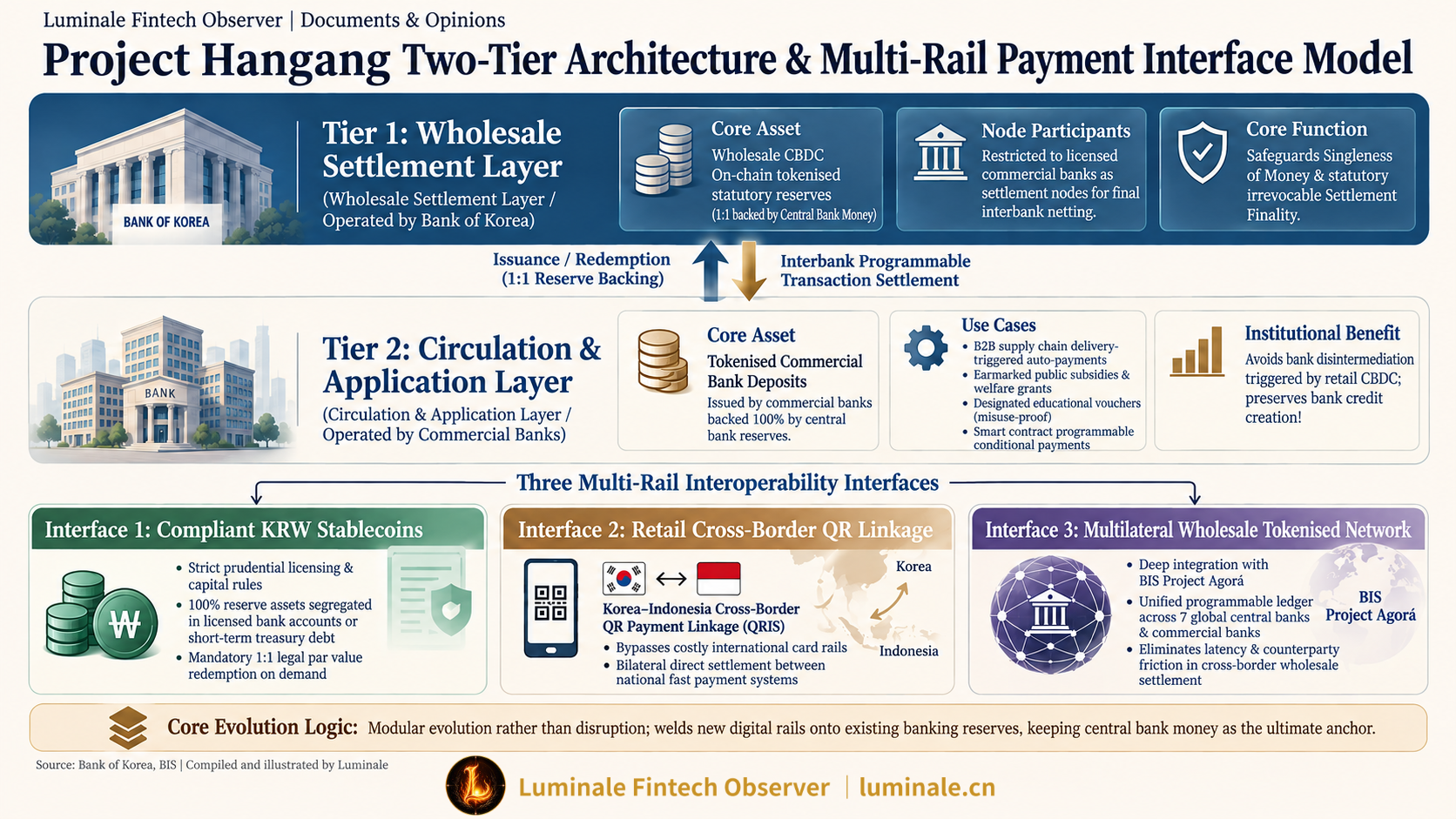
In retail cross-border payments, the Bank of Korea officially launched cross-border QR code payment interlinkage between South Korea and Indonesia in April 2026[7].
Korean travelers in Indonesia can scan standardized Indonesian Quick Response Code Indonesian Standard (QRIS) codes using their domestic Korean mobile banking or payment apps; conversely, Indonesian visitors in Korea can pay via their domestic digital wallets.
This service relies on direct bilateral agreements and clearing links between the two central banks and their respective retail payment switches, bypassing traditional international card payment network surcharges and processing intermediaries. It illustrates Korea's strategic adoption of bilateral fast payment system interlinkages for regional retail payments.
2. International Multilateral Collaboration: Project Agorá and Project Nexus
At the multilateral level, the Bank of Korea participates prominently in two flagship initiatives coordinated by the Bank for International Settlements (BIS):
- Project Agorá: Involving the Bank of Korea, the Bank of Japan, the Bank of England, the Bank of France, the Swiss National Bank, and two other central banks alongside leading commercial banks, Agorá explores using tokenisation to integrate commercial bank tokenised deposits and wholesale central bank tokenised reserves onto a unified programmable ledger. The project tests operational gains in multi-currency correspondent banking, AML verification, and FX execution.
- Project Nexus: Nexus addresses the multilateral interlinking of national fast payment systems (FPS). By evaluating Nexus's technical specifications and governance arrangements, the Bank of Korea is standardizing technical interfaces to connect KFTC's Electronic Banking Network with real-time retail payment switches across Southeast Asia and beyond.
3. Domestic Digital Currency Pilots: Project Hangang
In domestic digital currency exploration, the Bank of Korea concentrates its strategic resources on Project Hangang.
According to the report, Project Hangang implements a two-tier architecture combining wholesale CBDC with tokenised commercial bank deposits[8]:
- Tier 1 (Wholesale Settlement Layer): The Bank of Korea issues wholesale CBDC on a permissioned distributed ledger exclusively accessible to licensed commercial banks, serving as a digital manifestation of central bank reserve money;
- Tier 2 (Circulation & Application Layer): Regulated commercial banks issue tokenised deposits backed 100% by central bank reserves, circulating among businesses and retail users.
During 2025, Project Hangang developed an experimental digital infrastructure prototype and executed a Phase 1 Live Pilot across targeted consumer scenarios, such as digital government vouchers, earmarked welfare and education grants, and closed-loop merchant reward programs[9].
This design reflects two deliberate institutional choices:
- Preventing Bank Disintermediation: If a central bank directly distributes unconstrained, zero-risk retail CBDC to the general public, flight-to-safety incentives during banking stress could prompt rapid deposit migration from commercial banks to central bank liabilities, undermining commercial bank deposit bases and credit intermediation. Tokenised deposits preserve commercial bank balance sheet expansion and lending capacity.
- Enabling Programmability: Tokenised deposits operate on a smart contract layer, allowing corporate treasuries to execute conditional escrow payments upon verifiable supply delivery, or government agencies to restrict subsidies to designated merchant categories, eliminating fund diversion.
4. Regulatory and Licensing Framework for KRW-Denominated Stablecoins
In Chapter IV of the Payment and Settlement Systems Report 2025, the Bank of Korea examines the "Ideal Introduction Plan for KRW-denominated Stablecoins"[10].
As Korea's Virtual Asset User Protection Act advances through successive regulatory phases, private stablecoin issuance has become an inevitable policy topic. The central bank outlines three core regulatory prerequisites:
- Strict Prudential Licensing: Issuers must satisfy rigorous capital adequacy standards and maintain segregated custody of 100% of underlying reserve assets in commercial bank escrow accounts or short-term sovereign debt;
- Par Value Redemption Obligation: Issuers must bear a mandatory legal obligation to redeem stablecoins for KRW fiat currency at par (1:1) upon demand, prohibiting algorithmic stabilization mechanisms or non-liquid collateral assets;
- Central Bank Settlement Backstopping: When stablecoin holders execute large-scale redemptions, liquidity transfers across reserve asset accounts ultimately depend on commercial bank channels and the central bank RTGS network.
The central bank's regulatory objective is to establish robust prudential standards that integrate compliant stablecoins into existing payment oversight, safeguarding monetary sovereignty and systemic stability.
5. Perspectives on the Evolution of Korea's Payment Infrastructure
Synthesizing the initiatives detailed in the Payment and Settlement Systems Report 2025, four structural patterns define Korea's payment infrastructure roadmap:
1. Infrastructure Investments Focus on Backend Clearing and Settlement Systems
For the past decade, financial technology innovation focused heavily on consumer front-end interfaces, from mobile QR payments and biometric authentication to buy-now-pay-later tools.
However, once front-end message initiation reaches sub-second execution, underlying transaction frictions and liquidity costs are determined by backend infrastructure. If central bank RTGS windows close during overseas market hours, data standards remain unstructured, or net clearing arrangements harbor uncollateralized credit risk, systemic frictions persist.
From extending BOK-Wire+ hours and enforcing 100% net settlement collateralization to migrating to ISO 20022, the Bank of Korea's capital investments clearly prioritize backend throughput, data harmonization, and settlement resilience.
2. Cross-Border Capital Flows as a Primary Driver of Infrastructure Upgrades
Virtually every major project cited—extending BOK-Wire+ operations, building BOK-Wire Int, bilateral QR interlinking with Indonesia, and participating in Project Agorá and Project Nexus—is directly driven by cross-border capital flow demands.
Traditional RTGS systems were historically engineered for domestic institutions. With cross-border trade and institutional capital flows expanding, multi-tier correspondent banking chains exhibit persistent delays, high fees, and time-zone frictions. The Bank of Korea addresses this via a multi-track approach:
- For wholesale funding: Extending domestic RTGS windows and constructing BOK-Wire Int for eligible foreign participants;
- For retail flows: Implementing bilateral central bank agreements linking national fast payment switches and QR networks;
- For digital assets: Collaborating with the BIS on multilateral programmable ledgers for wholesale foreign exchange settlement.
3. New Forms of Money Still Rely on Central Bank Money for Final Settlement
In debates surrounding distributed ledgers, tokenised deposits, and stablecoins, technological narratives frequently suggest that atomic settlement on smart contracts will render central bank clearing obsolete.
This argument confuses technical execution synchronicity with legal and credit settlement finality. While distributed ledger state changes execute within seconds, so long as transacted assets represent claims on commercial banks or private issuers, counterparties retain credit and liquidity risk.
In Project Hangang, tokenised commercial bank deposits circulate interbank precisely because wholesale CBDC—backed directly by the central bank's balance sheet—provides ultimate finality. Similarly, stablecoin regulations require complete reserve segregation and redeemability into legal tender. Technology reshapes operational ledgers, but it reinforces central bank money as the foundational anchor of settlement finality.
4. Multi-Rail Coexistence of Traditional Systems and Emerging Networks
Financial market history demonstrates that new clearing architectures rarely displace legacy infrastructure outright. Rather, distinct settlement channels operate in parallel across specific use cases:
- Traditional BOK-Wire+ and retail deferred net clearing networks maintain unmatched economies of scale and low marginal costs for high-volume domestic wholesale and consumer payments;
- Cross-border fast payment linkages deliver real-time, low-fee settlement for bilateral tourism and retail corridors;
- Distributed ledger networks provide unique efficiency gains in multi-party contractual contexts, such as cross-ledger securities Delivery versus Payment and conditional corporate treasury management.
Evaluating any payment mechanism requires identifying where clearing efficiency originates, who absorbs liquidity costs, how settlement default risk is mitigated, and which reserve ledger provides ultimate statutory discharge under systemic stress.
Conclusion
The Payment and Settlement Systems Report 2025 illustrates a balanced, institutional approach to payment infrastructure modernization.
The Bank of Korea extends BOK-Wire+ operating hours, implements ISO 20022, and completes a ten-year transition to 100% net settlement collateral backing. Concurrently, it participates in Project Agorá, pilots tokenised deposits in Project Hangang, and establishes clear prudential expectations for KRW stablecoins.
Across these domains, Korea is not dismantling its established financial architecture. Instead, it is fortifying central bank reserve settlement, extending cross-border clearing connectivity, and deploying modular interfaces for the next generation of tokenised financial market infrastructure.
References
[1]: Bank of Korea. (2026-09-17). Payment and Settlement Systems Report 2025 (Official English Edition). Retrieved from: https://www.bok.or.kr/eng/bbs/E0000866/view.do?depth=400223&menuNo=400223&nttId=11064840 ↩
[2]: Bank of Korea. (2026). Payment and Settlement Systems in Korea: BOK-Wire+. Retrieved from: https://www.bok.or.kr/eng/main/contents.do?menuNo=400045 ↩
[3]: Bank of Korea. (2026-04-13). BOK-Wire+ Settlement Trends in 2025 (Press Release). Retrieved from: https://www.bok.or.kr/portal/bbs/B0000502/view.do?depth=201265&menuNo=201265&nttId=10097487 ↩
[4]: Bank of Korea. (2026-04-13). Payment and Settlement Systems Report 2025 (Full Korean Edition). Retrieved from: https://www.bok.or.kr/portal/bbs/P0000600/view.do?depth=200722&menuNo=200722&nttId=10097493 ↩
[5]: Bank of Korea. (2026-03). Extension of Operating Hours for BOK-Wire+ and Foreign Exchange Market Integration Plan. Retrieved from: https://www.bok.or.kr/eng/bbs/E0000634/view.do?menuNo=400423 ↩
[6]: Bank of Korea. (2025). Strategic Roadmap for BOK-Wire Int: Cross-Border Won Settlement Infrastructure. In Payment and Settlement Systems Report 2025. Retrieved from: https://www.bok.or.kr/portal/bbs/B0000502/view.do?depth=201265&menuNo=201265&nttId=10097487 ↩
[7]: Bank of Korea & Bank Indonesia. (2026-04-01). BI and BOK Continue Cooperation on Korea–Indonesia Cross-Border QR Payment Interlinkage (Joint Press Release). Retrieved from: https://www.bok.or.kr/eng/bbs/E0000634/view.do?menuNo=400423&nttId=10096355 ↩
[8]: Bank of Korea, Financial Services Commission, & Financial Supervisory Service. (2025-12-18). Project Hangang: Live Pilot of a Unified Ledger Integrating Wholesale CBDCs and Tokenized Deposits. Retrieved from: https://www.bok.or.kr/eng/bbs/E0000654/view.do?menuNo=400048&nttId=10095216 ↩
[9]: Bank of Korea. (2025-12-18). Project Hangang Usability Test Report and Phase 1 Real-Transaction Pilot Results. Retrieved from: https://file-cdn.bok.or.kr/eng/b6effecbf71f4ee69f60f471276c5712/1/03563849ae5f4fdf96da8cb2f92dfa93.pdf ↩
[10]: Bank of Korea. (2026). Special Analysis: Ideal Regulatory and Infrastructure Approaches for KRW-Denominated Stablecoins. In Payment and Settlement Systems Report 2025 (Chapter IV, pp. 78-95). Retrieved from: https://www.bok.or.kr/eng/bbs/E0000866/view.do?depth=400223&menuNo=400223&nttId=11064840 ↩
Originally published by Luminale Fintech Observer: https://luminale.cn/articles/reading-bok-payment-and-settlement-systems-report-2025-en